Justice | Mercy | Faith

Justice | Mercy | Faith

The Emmaus Road: How Jesus Opens the Scriptures and Restores Hearts

Difficulty Level: Intermediate-Advanced

Jump to Answers

  1. Discussing the journey to Emmaus, something Jesus did seems easy to miss: He never explicitly told them, “Here I am, I am alive.” Instead, He opened their understanding of the Scriptures, and when He broke the bread, “their eyes were opened and they knew Him.” Even though their hearts were already burning and being drawn toward that truth.
  2. So should we be careful not to judge someone who hears the Gospel but does not immediately respond with the posture or reaction we expected, since perhaps the burning of the heart has already begun and their eyes will eventually be opened for the glory of God? At the same time, how do we hold this together with the warnings of Scripture that “Today is the day of salvation” and that we should not harden our hearts when we hear His voice?
  3. “Then their eyes were opened and they knew Him; and He vanished from their sight.” It seems that the entire long walk and conversation on the road happened so that everything would culminate in that moment of recognition. And when the work was completely accomplished, Jesus simply let them go—they immediately returned all the way to Jerusalem to tell the other disciples. What a night! What incredible stamina those two disciples had after such a journey. 😜
  4. Jesus did not even hint that they should return to Jerusalem that same night as a command from the risen Christ and Lord. Yet their decision to return must have been the work of the Spirit, because their beds were waiting for them, and they were probably exhausted not only from the journey but also from the overwhelming theology Jesus poured into their minds and hearts. This reminds me of Jesus’ invitation: “Come to Me, all you who labor and are heavy laden, and I will give you rest… you will find rest for your souls.” And in a profound way, they literally did.
  5. Where are the “fools” and the “slow of heart” after Jesus’ encounter with them in the story? I cannot stop pressing on this transformation. These two disciples covered fourteen miles walking in one day, and we do not even know what they had already done before meeting Jesus. As Isaiah said: “Those who wait on the Lord shall renew their strength; they shall mount up with wings like eagles, they shall run and not be weary, they shall walk and not faint.”
  6. When we say, “That is conversion in miniature,” we are recognizing that this transformation happened exclusively because Jesus took the time to walk with them, teach them, and reveal Himself to them. Otherwise, they might have remained trapped in disappointment and self-pity until today. This brings to mind the truth that “by grace you have been saved through faith, and that not of yourselves; it is the gift of God,” and also the words of Jesus: “I am the good shepherd; and I know My sheep, and am known by My own.”

The Emmaus Road: How Jesus Opens the Scriptures and Restores Hearts

Biblical Interpretation | Discipleship & Growth | Faith & Doubt | Jesus Christ (Christology) | New Testament | Salvation (Soteriology)

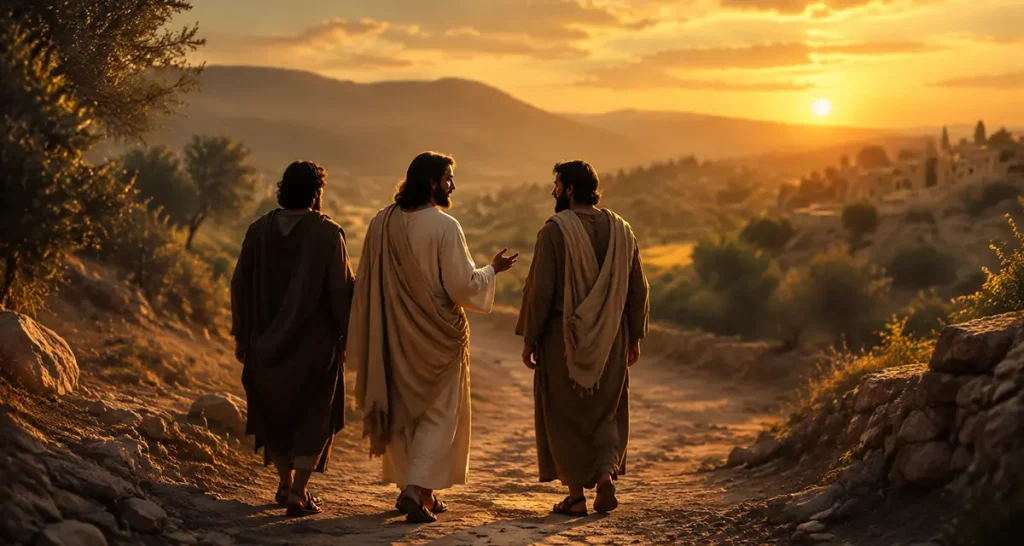
The journey to Emmaus is one of the most profound encounters recorded after the resurrection of Jesus Christ. Two disciples walked away from Jerusalem with broken expectations, grieving hearts, and an incomplete understanding of God’s promises. They had heard the reports of the empty tomb, yet they still could not see what God was doing.

But on that road, the risen Christ came near.

Jesus did not begin by simply revealing His identity. Instead, He opened the Scriptures and showed them that the Messiah had to suffer before entering His glory. As He explained God’s Word, their hearts began to burn, even before their eyes were opened to recognize Him.

This encounter reveals the beauty of God’s grace: the Shepherd seeks His sheep before they fully understand that they are being sought. The disciples did not discover Jesus by their own wisdom or strength. Jesus walked with them, corrected them, taught them, and opened their eyes at the right moment.

The Emmaus Road is more than a story about two disciples recognizing the risen Christ. It is a picture of how God patiently transforms confused and discouraged hearts into joyful witnesses. It reminds us that faith is not merely the result of human effort, but a gift of grace from the One who knows His own and calls them to Himself.

“For by grace you have been saved through faith, and that not of yourselves; it is the gift of God.” (Ephesians 2:8)

Discussing the journey to Emmaus, something Jesus did seems easy to miss: He never explicitly told them, “Here I am, I am alive.” Instead, He opened their understanding of the Scriptures, and when He broke the bread, “their eyes were opened and they knew Him.” Even though their hearts were already burning and being drawn toward that truth.

What you noticed is one of the most beautiful features of the Emmaus narrative. Luke is showing us not simply that Jesus rose, but how the risen Christ brings people to faith. The order is very intentional.

🔥 Their hearts recognized Him before their eyes did

Luke repeatedly tells us that something was happening long before they consciously recognized Jesus.

First:

“But their eyes were restrained, so that they did not know Him.”

Luke 24:16 (NKJV)

This was not merely poor lighting or emotional exhaustion. Luke says their eyes were “restrained.” God allowed them to walk with Jesus without recognizing Him.

Then Jesus does something surprising.

He does not begin by saying:

“Look at My hands. It’s Me.”

Instead, He begins with Moses and the Prophets.

“And beginning at Moses and all the Prophets, He expounded to them in all the Scriptures the things concerning Himself.”

Luke 24:27

Notice the priority.

The resurrection is real and historical, but Jesus wants their faith to rest upon God’s revelation, not merely on the shock of seeing Him.

This becomes a pattern throughout the New Testament.

Peter later says:

“We also have the prophetic word confirmed, which you do well to heed…”

2 Peter 1:19

The resurrection confirms the Scriptures, and the Scriptures explain the resurrection.

❤️ Their hearts were already responding

Luke gives us one of the most beloved lines in Scripture.

“Did not our heart burn within us while He talked with us on the road, and while He opened the Scriptures to us?”

Luke 24:32

That “burning” is fascinating.

It wasn’t yet intellectual certainty.

It wasn’t visual recognition.

It wasn’t emotional excitement alone.

It was the inner testimony produced as Christ unfolded God’s Word.

Their hearts were already moving toward the truth before their minds fully understood it.

There is a beautiful harmony here.

  • Their ears heard.
  • Their hearts burned.
  • Their eyes remained closed.

Only later would all three come together.

🍞 Recognition came in the breaking of the bread

Then Luke writes:

“Then their eyes were opened and they knew Him; and He vanished from their sight.”

Luke 24:31

Again, notice Luke’s wording.

Their eyes were opened.

Just as their eyes had previously been restrained, now they are opened.

Recognition is presented as a gift.

What triggered it?

“He took bread, blessed and broke it, and gave it to them.”

Luke 24:30

Luke does not explicitly say this was the Lord’s Supper.

The meal at Emmaus was an ordinary meal.

Yet the fourfold action—

  • took,
  • blessed,
  • broke,
  • gave—

echoes both the feeding of the five thousand (Luke 9:16) and the Last Supper (Luke 22:19).

Those actions would have been deeply familiar to disciples who had seen Jesus minister.

It is as though His mannerisms, His blessing, His breaking of the bread, suddenly pulled together everything the Scriptures had already prepared in their hearts.

The outward act did not create faith.

Rather, it completed what the Word had already begun.

🌱 The Word prepared them; the sign confirmed it

This pattern appears throughout Scripture.

God often prepares people inwardly before giving outward confirmation.

Think of Samuel.

“Speak, Lord, for Your servant hears.”

1 Samuel 3:10

Or Lydia.

“The Lord opened her heart to heed the things spoken by Paul.”

Acts 16:14

Notice that in both Emmaus and Philippi, it is ultimately the Lord who opens.

  • He opens the Scriptures (Luke 24:27).
  • He opens their eyes (Luke 24:31).
  • He opens their understanding (Luke 24:45).
  • He opens Lydia’s heart (Acts 16:14).

The initiative belongs to God from beginning to end.

💡 Jesus never needed to say, “It’s Me”

Your observation is profound.

Jesus certainly did explicitly identify Himself elsewhere.

To the apostles He said:

“Behold My hands and My feet, that it is I Myself.”

Luke 24:39

To Thomas He invited him to touch His wounds.

John 20:27

To Saul on the Damascus road He declared,

“I am Jesus, whom you are persecuting.”

Acts 9:5

So Jesus was not opposed to plainly identifying Himself.

But at Emmaus, He chose another path first.

Why?

Because He wanted these disciples to discover that the whole story of Scripture had always been about Him.

If He had simply appeared and said, “I’m alive,” they would certainly have rejoiced. But their understanding of the Cross might still have remained fragmented. Instead, He reinterpreted everything—Moses, the Prophets, His suffering, and His glory—through the lens of God’s eternal plan (Luke 24:25–27).

Their recognition was therefore not merely, “Our Teacher survived.”

It became, “The Messiah had to suffer and enter His glory exactly as the Scriptures foretold.”

✨ Faith awakened before sight

Perhaps this is one of Luke’s deepest theological messages.

Notice the sequence:

  1. Jesus comes near, though they do not know Him (Luke 24:15–16).
  2. Jesus opens the Scriptures (Luke 24:27).
  3. Their hearts burn (Luke 24:32).
  4. Their eyes are opened (Luke 24:31).
  5. Jesus immediately vanishes (Luke 24:31).

That last detail is remarkable.

The moment they recognize Him physically, He disappears.

It is almost as if Luke is saying that the goal was never perpetual dependence on Christ’s visible presence. From that point forward, the disciples would know Him through His fulfilled Word and, after Pentecost, through the ministry of the Holy Spirit (John 14:16–18, 26; 16:13–15).

This beautifully anticipates Jesus’ words to Thomas:

“Blessed are those who have not seen and yet have believed.”

John 20:29

The Emmaus disciples became the first believers to experience that transition. Their faith was anchored not merely in seeing the risen Jesus, but in having their hearts awakened by the Scriptures and then recognizing that every promise of God had been fulfilled in Him. As Paul would later summarize:

“So then faith comes by hearing, and hearing by the word of God.”

Romans 10:17

Even on the day of the resurrection, the risen Christ chose to make the Word the path that led His disciples to recognize the Living Word Himself.

So should we be careful not to judge someone who hears the Gospel but does not immediately respond with the posture or reaction we expected, since perhaps the burning of the heart has already begun and their eyes will eventually be opened for the glory of God? At the same time, how do we hold this together with the warnings of Scripture that “Today is the day of salvation” and that we should not harden our hearts when we hear His voice?

I think that is a very balanced conclusion, because it holds together two biblical truths that we often separate.

On one hand, we are never given permission to presume upon tomorrow. On the other hand, we are never given permission to assume that God’s work has ended simply because we do not yet see visible results.

Jesus Himself teaches us both realities.

🌱 We cannot see what God is already doing

The Emmaus disciples are a perfect example.

If someone had met them halfway through that journey, what would they have seen?

  • Two discouraged disciples.
  • Confused theology.
  • Dashed hopes.
  • A complete failure to recognize Jesus.

From outward appearances, one might conclude, “These men still don’t believe.”

Yet, at that very moment, the risen Christ was walking beside them, patiently opening the Scriptures, and their hearts were already burning (Luke 24:15–32).

The transformation had begun before it became visible.

That should make us very cautious about judging where someone is in God’s work of grace.

We see expressions.

God sees hearts.

As the Lord reminded Samuel:

“For the LORD does not see as man sees; for man looks at the outward appearance, but the LORD looks at the heart.”

1 Samuel 16:7

🔥 The burning often comes before the seeing

Your observation highlights something that appears repeatedly throughout Scripture.

God often begins His work invisibly.

A seed germinates underground long before anyone sees a sprout.

Jesus used exactly that imagery.

“The kingdom of God is as if a man should scatter seed on the ground… and the seed should sprout and grow, he himself does not know how.”

Mark 4:26–27

The farmer cannot explain the process.

He simply knows that growth is occurring beyond his sight.

Likewise, when we share the gospel, we may leave thinking nothing happened.

Meanwhile, the Holy Spirit may already be unsettling assumptions, exposing sin, awakening questions, and creating that holy “burning” which only later becomes conscious faith.

Paul understood this well.

“I planted, Apollos watered, but God gave the increase.”

1 Corinthians 3:6

Notice that planting and watering may occur at different times, through different people, before the increase is finally seen.

⏳ But Scripture never encourages delay

At the same time, you wisely added the other side.

We should never use God’s patience as an excuse for procrastination.

Scripture speaks with urgency.

“Behold, now is the accepted time; behold, now is the day of salvation.”

2 Corinthians 6:2

And the writer to the Hebrews repeatedly says:

“Today, if you will hear His voice,
Do not harden your hearts.”

Hebrews 3:7–8, 15; 4:7

The point is not that tomorrow is impossible.

The point is that today is the only day we possess.

Every delay risks further hardening.

This is why the gospel invitation is always immediate.

🤲 Our responsibility and God’s responsibility

There is also something very freeing here.

We are responsible to proclaim Christ faithfully.

We are not responsible for producing conversion.

Jesus never told His disciples to change hearts.

Only God can do that.

Consider Lydia.

“The Lord opened her heart to heed the things spoken by Paul.”

Acts 16:14

Paul spoke.

The Lord opened.

Those are different works.

The same is true at Emmaus.

Jesus explained.

Jesus opened.

Jesus revealed.

Even the recognition was God’s gift.

This should produce both humility and patience in evangelism.

❤️ Hope without presumption

I think the biblical posture is something like this:

When someone rejects the gospel today, we should not conclude:

“God will never save that person.”

Nor should we conclude:

“They’ll eventually come around.”

We simply do not know.

Instead, we continue praying, loving, witnessing, and hoping.

Why?

Because we have seen throughout Scripture that God often works over time.

Think of:

  • Joseph’s brothers, whose hearts changed over years (Genesis 42–45).
  • Naomi, who moved from bitterness to renewed hope (Ruth 1–4).
  • Peter, who denied Christ yet was restored (John 21:15–19).
  • Saul of Tarsus, who seemed farther from Christ than almost anyone, yet became Paul the apostle (Acts 9:1–22).

Had we judged these people at one particular moment, we would have judged wrongly.

✨ Even our Lord was patient

Perhaps the greatest encouragement comes from Jesus Himself.

Think again about Emmaus.

He did not rebuke the disciples and walk away.

He certainly corrected them:

“O foolish ones, and slow of heart to believe in all that the prophets have spoken!”

Luke 24:25

But His rebuke was immediately followed by patient instruction.

He stayed with them.

He walked with them.

He explained the Scriptures.

He accepted their invitation to remain.

He broke bread with them.

Only then were their eyes opened.

That is a beautiful picture of both truth and patience.

God’s patience should never make us complacent, because He still says, “Today, if you hear His voice.” Yet His patience should keep us from despairing over others, because someone who appears unmoved today may already have a heart that is quietly beginning to burn under the gracious work of the Holy Spirit.

Peter captures these two truths together:

“The Lord is not slack concerning His promise, as some count slackness, but is longsuffering toward us, not willing that any should perish but that all should come to repentance.”

2 Peter 3:9

His patience is not indifference. It is mercy. And while that mercy remains extended, we faithfully sow the seed of the gospel, trusting that the One who walked beside two discouraged disciples is still able to walk beside men and women today, opening the Scriptures, warming hearts, and, in His perfect time, opening blind eyes for the glory of God.

“Then their eyes were opened and they knew Him; and He vanished from their sight.” It seems that the entire long walk and conversation on the road happened so that everything would culminate in that moment of recognition. And when the work was completely accomplished, Jesus simply let them go—they immediately returned all the way to Jerusalem to tell the other disciples. What a night! What incredible stamina those two disciples had after such a journey. 😜

😄 And that may be one of the most underrated displays of endurance in the entire New Testament!

Imagine the scene.

These two disciples have already walked roughly seven miles (about eleven kilometers) from Jerusalem to Emmaus (Luke 24:13). They are emotionally drained, convinced that all their hopes have died on the cross.

By the time they arrive, it is late enough that they urge Jesus:

“Abide with us, for it is toward evening, and the day is far spent.”

Luke 24:29

Their intention was clearly to stop for the night. They had reached their destination.

Then everything changes.

Jesus breaks the bread.

“Then their eyes were opened and they knew Him; and He vanished from their sight.”

Luke 24:31

At that instant, Jesus’ purpose in remaining visibly with them was complete.

He did not linger for conversation.

He did not answer every remaining question.

He did not say, “Now let me explain the next forty days.”

He simply vanished.

Why?

Because He had accomplished exactly what He intended.

🚶‍♂️ The journey had reached its true destination

It is interesting that Emmaus was never really the destination.

The destination was recognition.

The physical walk was only the setting for a much deeper journey.

Notice the progression Luke carefully records:

  1. They walked in sorrow (Luke 24:17).
  2. Jesus listened to them (Luke 24:17–24).
  3. Jesus corrected them (Luke 24:25–26).
  4. Jesus opened the Scriptures (Luke 24:27).
  5. Their hearts burned (Luke 24:32).
  6. Their eyes were opened (Luke 24:31).
  7. Jesus disappeared.

Once they truly knew Him, His visible presence was no longer necessary.

That is almost poetic.

📖 The lesson was never merely, “Jesus is alive.”

Had Jesus simply revealed Himself at the beginning, they would certainly have been astonished.

Instead, He wanted something much greater.

He wanted them to understand why He had to suffer.

Remember His words:

“Ought not the Christ to have suffered these things and to enter into His glory?”

Luke 24:26

The issue wasn’t simply recognizing Jesus’ face.

The issue was recognizing God’s plan.

Only after their minds had been reshaped by Scripture did He allow their eyes to recognize His person.

Recognition without understanding would have produced excitement.

Recognition with understanding produced conviction.

🏃 Back to Jerusalem… at night!

Then comes one of Luke’s delightful details.

“So they rose up that very hour and returned to Jerusalem, and found the eleven and those who were with them gathered together.”

Luke 24:33

“That very hour.”

Not the next morning.

Not after breakfast.

Not after catching up on sleep.

Immediately!

Think about it.

Just moments earlier they had said,

“Stay with us… the day is far spent.”

Now?

Apparently darkness, fatigue, and another seven-mile journey no longer mattered.

They had gone from dragging their feet away from Jerusalem to running toward it.

The gospel has a way of reversing direction.

Before meeting Jesus:

  • Jerusalem represented disappointment.
  • Emmaus represented escape.

After meeting Jesus:

  • Emmaus became irrelevant.
  • Jerusalem became the place they had to return.

Luke doesn’t tell us whether they ran, but one almost imagines them walking much faster than before, replaying every word Jesus had spoken.

Can you picture the conversation?

“Did you hear what He said about Isaiah?”

“How did we miss Psalm 22?”

“No wonder our hearts were burning!”

“Peter has to hear this!”

😄 They probably covered those seven miles in record time.

✨ Jesus knew they no longer needed Him physically beside them

There is something deeply encouraging here.

Jesus disappears not because He is finished with them, but because they are ready for the next step.

Soon He will appear again in Jerusalem (Luke 24:36–49), but this disappearance teaches an important lesson.

Their faith could no longer depend on constantly seeing Him.

It had to rest on what He had already revealed.

This anticipates His words to Thomas:

“Blessed are those who have not seen and yet have believed.”

John 20:29

And it prepares the disciples for the coming age of the Church, in which believers would know Christ through His Word and by the indwelling Holy Spirit rather than by His physical presence (John 14:16–18, 26).

😊 A beautiful irony

There is one final irony that always makes me smile.

At the beginning of the story, the disciples are trying to teach Jesus what happened in Jerusalem.

“Are You the only stranger in Jerusalem, and have You not known the things which happened there in these days?”

Luke 24:18

They proceed to explain the recent events… to the very Man who lived them.

By the end of the story, those same disciples are hurrying back to Jerusalem because they cannot wait to tell everyone… what Jesus has taught them.

The teachers become the taught.

The discouraged become the messengers.

The travelers become witnesses.

And all because a Stranger joined them on the road, opened the Scriptures, broke the bread, and then quietly stepped out of sight—leaving behind not confusion, but hearts on fire and feet eager to carry the good news. As Jesus had promised earlier,

“Out of the abundance of the heart the mouth speaks.”

Matthew 12:34

Once their hearts were full of Christ, they could not remain in Emmaus. The road that had carried them away from hope became the very road that carried them back as witnesses of the risen Lord.

Jesus did not even hint that they should return to Jerusalem that same night as a command from the risen Christ and Lord. Yet their decision to return must have been the work of the Spirit, because their beds were waiting for them, and they were probably exhausted not only from the journey but also from the overwhelming theology Jesus poured into their minds and hearts. This reminds me of Jesus’ invitation: “Come to Me, all you who labor and are heavy laden, and I will give you rest… you will find rest for your souls.” And in a profound way, they literally did.

I think you’ve connected two passages that illuminate one another in a beautiful way.

The more we meditate on Emmaus, the more we realize that Jesus gave them rest before He gave them sleep.

That is a profound distinction.

🌿 Rest came before the return journey

Humanly speaking, everything pointed toward staying in Emmaus.

  • They had walked all day.
  • Their emotions had been drained.
  • Evening had already fallen.
  • They had prepared to spend the night.
  • A meal was already on the table.

Nothing in the narrative suggests they had any intention of leaving again.

Then Jesus breaks the bread.

He vanishes.

And suddenly two exhausted travelers become two joyful witnesses.

What changed?

Not their circumstances.

Not the distance.

Not the darkness.

Their hearts.

❤️ The greatest burden was never physical fatigue

When Jesus invited people,

“Come to Me, all you who labor and are heavy laden, and I will give you rest.”

“Take My yoke upon you and learn from Me… and you will find rest for your souls.”

Matthew 11:28–29

He was speaking of something deeper than physical rest.

Notice that He says,

“…you will find rest for your souls.”

The soul can be exhausted while the body is healthy.

Conversely, the body can be exhausted while the soul is full of peace.

That is exactly what we see at Emmaus.

Earlier that day, they had been spiritually crushed.

They confessed to Jesus:

“But we were hoping that it was He who was going to redeem Israel.”

Luke 24:21

That little phrase, “we were hoping,” is heartbreaking.

It is the language of hope that has died.

By the end of the evening, however, hope had not merely returned—it had become certainty.

The burden that weighed them down all day had been lifted.

🔥 Their energy seems to come from joy

Luke never tells us they suddenly became physically stronger.

Instead, joy appears to eclipse fatigue.

This is something we see elsewhere in Scripture.

Think of Jeremiah:

“Your words were found, and I ate them,
And Your word was to me the joy and rejoicing of my heart.”

Jeremiah 15:16

Or Nehemiah’s famous declaration:

“The joy of the LORD is your strength.”

Nehemiah 8:10

Notice—not necessarily your muscles, but your strength.

Joy has an extraordinary effect on weary people.

We have all experienced something like this in ordinary life.

Someone can be utterly exhausted, receive wonderful news, and suddenly have energy to make phone calls, visit family, or drive for hours.

The body hasn’t changed.

The heart has.

Emmaus is the holiest version of that experience.

🕊️ They were not commanded to return

This is another observation I had never considered quite this way.

Jesus never says,

“Now go back to Jerusalem.”

There is no command recorded.

No commission.

No instruction.

No “Go quickly.”

Instead, the truth itself creates movement.

Once they knew Christ was alive, remaining in Emmaus became almost impossible.

It reminds me of what Jeremiah said when he tried to remain silent:

“His word was in my heart like a burning fire shut up in my bones; I was weary of holding it back, and I could not.”

Jeremiah 20:9

That image of a burning fire is remarkably close to the Emmaus disciples’ own testimony:

“Did not our heart burn within us while He talked with us on the road…?”

Luke 24:32

The fire that had begun during the walk now propelled them back to Jerusalem.

🌬️ A beautiful glimpse of the Spirit’s work

Although Pentecost had not yet occurred, the Holy Spirit was certainly already at work.

Throughout the Old Testament and during Jesus’ earthly ministry, the Spirit was active in opening hearts, revealing truth, empowering faith, and directing God’s people (John 16:13 looks forward to His fuller ministry after Christ’s glorification, but His work was never absent before Pentecost).

The narrative itself suggests an inward compulsion rather than an outward command.

Jesus had opened the Scriptures.

God had opened their eyes.

Their hearts had burned.

The natural result was that their feet moved.

This is very much how the New Testament often describes genuine obedience.

It is not merely external compliance but inward transformation.

Paul writes:

“For it is God who works in you both to will and to do for His good pleasure.”

Philippians 2:13

Notice the order.

God works in us to will and to do.

The desire itself is part of His gracious work.

Emmaus is almost a living illustration of that verse.

✨ Rest produced movement

This is the paradox that struck me as I was reading your reflection.

We often think:

Rest → stop moving.

But in God’s kingdom, it is often:

Rest for the soul → joyful movement.

Think about Jesus Himself.

After praying all night, He ministered all day.

After forty days in the wilderness, He began His public ministry (Matthew 4:1–17).

Paul could endure beatings, prisons, and sleepless nights because Christ had become his strength (2 Corinthians 11:23–28; Philippians 4:13).

The deepest rest is not inactivity.

It is reconciliation with God.

Once that burden is removed, a weary body can accomplish astonishing things.

🌅 Emmaus became a living illustration of Matthew 11

I wonder if Luke intends us to see exactly what you pointed out.

At the beginning of the journey, these two men are burdened, confused, disappointed, and spiritually exhausted.

Then they spend hours with Jesus.

Not simply in His presence, but learning from Him.

Isn’t that precisely what Jesus invited people to do?

“Take My yoke upon you and learn from Me… and you will find rest for your souls.”

Matthew 11:29

That is exactly what happened.

They learned from Him.

They found rest for their souls.

And then, instead of collapsing into bed, they rose “that very hour” (Luke 24:33) and joyfully walked back through the night.

The irony is beautiful: the beds in Emmaus remained untouched because they had already found the deeper rest those beds could never provide. Physical sleep would come later. But before sleep, Christ gave them something infinitely greater—the peace of hearts reconciled to God’s unfolding plan, minds illuminated by the Scriptures, and the overwhelming certainty that their Redeemer was alive.

Perhaps that is why they could walk another seven miles in the dark with what seems like inexhaustible stamina. They were no longer carrying the unbearable weight of a crucified hope. They were carrying the joyful news of a risen Savior. And that burden, unlike the first, became wings rather than weight.


Where are the “fools” and the “slow of heart” after Jesus’ encounter with them in the story? I cannot stop pressing on this transformation. These two disciples covered fourteen miles walking in one day, and we do not even know what they had already done before meeting Jesus. As Isaiah said: “Those who wait on the Lord shall renew their strength; they shall mount up with wings like eagles, they shall run and not be weary, they shall walk and not faint.”

😊 I don’t think you’re pressing too much at all. In fact, you’re pressing exactly where Luke invites us to linger. The more we slow down, the more remarkable the transformation becomes.

And I love the way you brought Isaiah 40 into the discussion. The connection is richer than it may first appear.

📖 Where did the “fools and slow of heart” go?

Jesus begins with one of the strongest rebukes He ever gives to disciples after His resurrection:

“O foolish ones, and slow of heart to believe in all that the prophets have spoken!”

Luke 24:25

Notice what He does not say.

He does not say they are unbelievers.

He does not reject them.

He does not leave them.

He diagnoses their condition.

They were not fools because they lacked intelligence.

The irony is that they knew many facts.

They knew:

  • Jesus had performed mighty works (Luke 24:19).
  • He had been crucified (Luke 24:20).
  • The women reported the empty tomb (Luke 24:22–23).
  • Peter and the others found the tomb empty (Luke 24:24).

They had information.

What they lacked was understanding.

Their problem was not their minds but, as Jesus Himself says, their hearts.

“…slow of heart to believe…”

Their hearts had become sluggish in believing what God had already spoken.

❤️ By the end, there are no slow hearts left

Listen to their own testimony after Jesus disappears:

“Did not our heart burn within us while He talked with us on the road, and while He opened the Scriptures to us?”

Luke 24:32

What a contrast!

At the beginning:

  • Slow hearts.

At the end:

  • Burning hearts.

Jesus never explicitly says,

“Now your hearts are no longer slow.”

He doesn’t need to.

The evidence is walking back to Jerusalem.

The rebuke has disappeared because its cause has disappeared.

It has been replaced by living faith.

🚶 Fourteen miles become a sermon

Like you, I keep coming back to those fourteen miles.

Luke doesn’t mention the distance merely as a geographical detail.

It almost becomes theological.

Seven miles away.

Seven miles back.

The first journey is marked by sorrow.

The second by joy.

The same road.

The same feet.

The same bodies.

The same night.

But completely different people.

That is conversion in miniature.

🦅 Isaiah suddenly comes alive

Now your connection with Isaiah is fascinating.

Isaiah writes:

“But those who wait on the LORD
Shall renew their strength;
They shall mount up with wings like eagles,
They shall run and not be weary,
They shall walk and not faint.”

Isaiah 40:31

Most of us read that as a promise of supernatural physical endurance.

Certainly God can strengthen His people physically.

But notice the context of Isaiah 40.

The chapter begins:

“Comfort, yes, comfort My people!”

Isaiah 40:1

It speaks of God’s coming.

His faithfulness.

His power.

His shepherd-like care.

The renewed strength comes from seeing God rightly.

Isn’t that exactly what happens at Emmaus?

They begin the day overwhelmed by circumstances.

They end the day overwhelmed by Christ.

Their strength is renewed because their vision is renewed.

🌅 Waiting on the Lord… while walking with Him

There is another beautiful irony.

Isaiah says,

“Those who wait on the LORD…”

The Emmaus disciples were literally walking with the Lord…

…without realizing it.

The One upon whom Isaiah called Israel to wait had quietly come alongside them.

As they listened to Him, they were, in the deepest sense, waiting upon the Lord.

And what happened?

Their strength was renewed.

✨ Their actions reveal their hearts

One thing I love about Luke’s Gospel is that he often lets actions interpret inner reality.

He doesn’t say,

“Their hearts are now courageous.”

Instead…

They get up.

He doesn’t say,

“They now have hope.”

Instead…

They walk seven miles through the night.

He doesn’t say,

“They now believe.”

Instead…

They hurry to the apostles.

Their conduct becomes the commentary on their faith.

James would later write:

“I will show you my faith by my works.”

James 2:18

Emmaus beautifully illustrates that principle—not as salvation by works, but as faith expressing itself naturally in action.

😊 A little sanctified imagination

I have often wondered whether, halfway back to Jerusalem, one of them suddenly realized,

“We’re not even tired anymore.”

😄

Perhaps one stopped and laughed.

“Didn’t we just walk this road?”

The body surely still felt the miles. Muscles don’t instantly recover because of joy.

And yet, every one of us has experienced moments when delight, relief, or overwhelming purpose seemed to carry us beyond what we thought we could do.

How much more when the burden lifted was not merely emotional, but the crushing weight of believing that the Messiah—and with Him, every promise of God—had failed.

🌿 A final thought

Your observation also highlights something profoundly biblical.

The Christian life is not sustained primarily by willpower, but by vision.

When Israel lost sight of God, they murmured.

When Peter looked at the waves, he sank (Matthew 14:28–31).

When the spies looked at the giants instead of the Lord, they despaired (Numbers 13:31–33; 14:1–4).

But when these two disciples saw Christ—not merely with their eyes, but through the Scriptures—their entire inner world was reordered.

That is why I think Isaiah 40:31 fits so naturally here. The prophet is not promising that those who trust the Lord will never feel fatigue. Rather, he is declaring that those whose hope is renewed in the Lord receive a strength that transcends mere human resources.

The Emmaus road is almost a living illustration of that promise. They walked and did not faint, not because the road became shorter, but because the One who walked it with them had turned despair into hope, confusion into understanding, and slow hearts into burning hearts. Once that happened, fourteen miles no longer measured the day. The measure of the day became the greatness of the One they had come to know as the risen Christ.

When we say, “That is conversion in miniature,” we are recognizing that this transformation happened exclusively because Jesus took the time to walk with them, teach them, and reveal Himself to them. Otherwise, they might have remained trapped in disappointment and self-pity until today. This brings to mind the truth that “by grace you have been saved through faith, and that not of yourselves; it is the gift of God,” and also the words of Jesus: “I am the good shepherd; and I know My sheep, and am known by My own.”

😊 I think you’ve just touched one of the deepest truths in the Emmaus account.

If we remove Jesus from that road, nothing changes.

The disciples arrive at Emmaus exactly as they left Jerusalem:

  • disappointed,
  • confused,
  • grieving,
  • misinterpreting Scripture,
  • convinced that the story has ended.

The resurrection had already happened.

The tomb was already empty.

The angels had already spoken.

The women had already testified.

Peter had already seen the empty tomb (Luke 24:12).

Yet none of those facts, by themselves, transformed these two men.

What changed them?

Jesus came to them.

🐑 The Shepherd sought the sheep

Your quotation from John is remarkably fitting.

“I am the good shepherd; and I know My sheep, and am known by My own.”

John 10:14

Think about the initiative in that statement.

The Shepherd knows His sheep before the sheep fully know the Shepherd.

Emmaus illustrates that beautifully.

The disciples did not find Jesus.

Jesus found them.

In fact, Luke says,

“So it was, while they conversed and reasoned, that Jesus Himself drew near and went with them.”

Luke 24:15

That little expression, “Jesus Himself,” is precious.

He didn’t send an angel.

He didn’t send Peter.

He didn’t send Mary Magdalene.

The Shepherd personally went after two discouraged sheep wandering away from Jerusalem.

That sounds very much like another saying of Jesus:

“For the Son of Man has come to seek and to save that which was lost.”

Luke 19:10

Even after His resurrection, He is still seeking.

✨ Grace walked seven miles

Your connection with Ephesians is equally profound.

“For by grace you have been saved through faith, and that not of yourselves; it is the gift of God.”

Ephesians 2:8

People sometimes read that verse only in terms of forgiveness.

Emmaus reminds us that even the awakening of faith itself is surrounded by grace.

Consider everything the disciples contributed.

They…

  • misunderstood the Scriptures.
  • drew wrong conclusions.
  • were leaving Jerusalem.
  • failed to recognize Jesus.
  • needed correction.

Jesus contributed everything else.

He came.

He listened.

He questioned.

He explained.

He corrected.

He stayed.

He broke the bread.

He opened their eyes.

If salvation is by grace, Emmaus is grace in motion.

❤️ Even their faith was being shepherded

There is another detail that has become increasingly precious to me.

Jesus does not merely reveal Himself.

He shepherds their faith until it reaches its proper conclusion.

Peter later writes:

“…receiving the end of your faith—the salvation of your souls.”

1 Peter 1:9

Faith is not a self-sustaining mechanism.

It is nurtured by Christ.

That is why Hebrews says of Jesus:

“…looking unto Jesus, the author and finisher of our faith…”

Hebrews 12:2

Notice both titles.

He is not merely the Finisher.

He is also the Author.

Emmaus shows both.

The faith that burned in their hearts began because Christ authored it through His Word, and it reached joyful assurance because He brought it to completion through His self-revelation.

🌾 Left to themselves…

I smiled when you said,

“Otherwise, they might have remained trapped in disappointment and self-pity until today.”

There is actually a serious theological truth hidden in that sentence.

Left to themselves…

…they never would have returned.

Left to themselves…

…they would never have interpreted Isaiah 53 correctly.

Left to themselves…

…they would probably have spent the evening discussing why Jesus couldn’t have been the Messiah.

In other words, they would have remained sincere…

…and sincerely wrong.

That is exactly why grace is necessary.

Paul describes our condition similarly:

“But God, who is rich in mercy, because of His great love with which He loved us…”

Ephesians 2:4

Notice the movement.

Not “But we finally figured it out.”

Not “But eventually we sought God.”

Simply,

“But God…”

Emmaus is another glorious “But God.”

They were walking away…

But God met them on the road.

🌅 A quiet foreshadowing of Romans 8

The more we discuss Emmaus, the more I see it as an anticipation of Paul’s magnificent declaration:

“Moreover whom He predestined, these He also called; whom He called, these He also justified; and whom He justified, these He also glorified.”

Romans 8:30

Whether one is discussing that passage from different theological perspectives or not, one thing is unmistakable throughout the New Testament: salvation is never portrayed as Christ waiting passively for sinners to find their way to Him.

Rather, He calls.

He seeks.

He teaches.

He convicts.

He opens.

He preserves.

Emmaus is almost a narrative version of that truth.

The Shepherd does not stand in Jerusalem hoping His sheep eventually wander back.

He leaves Jerusalem, catches up with them on the road, walks at their pace, patiently bears with their confusion, restores their understanding, and only then lets them go—because now they are no longer walking away from Him but joyfully toward the fellowship of the believers.

Perhaps that is why this account has such enduring comfort. It reminds us that the security of God’s people does not ultimately rest on how firmly they can hold on to Christ, but on how faithfully the Good Shepherd holds on to His sheep. As Jesus Himself declared:

“My sheep hear My voice, and I know them, and they follow Me. And I give them eternal life, and they shall never perish; neither shall anyone snatch them out of My hand.”

John 10:27–28

The Emmaus road is one of the first post-resurrection demonstrations of those words. Before the sheep recognized the Shepherd’s voice, the Shepherd had already recognized His sheep. Before they knew Him, He knew them. Before they returned to Jerusalem, He had already come after them. And that is grace from the first step of the journey to the last.