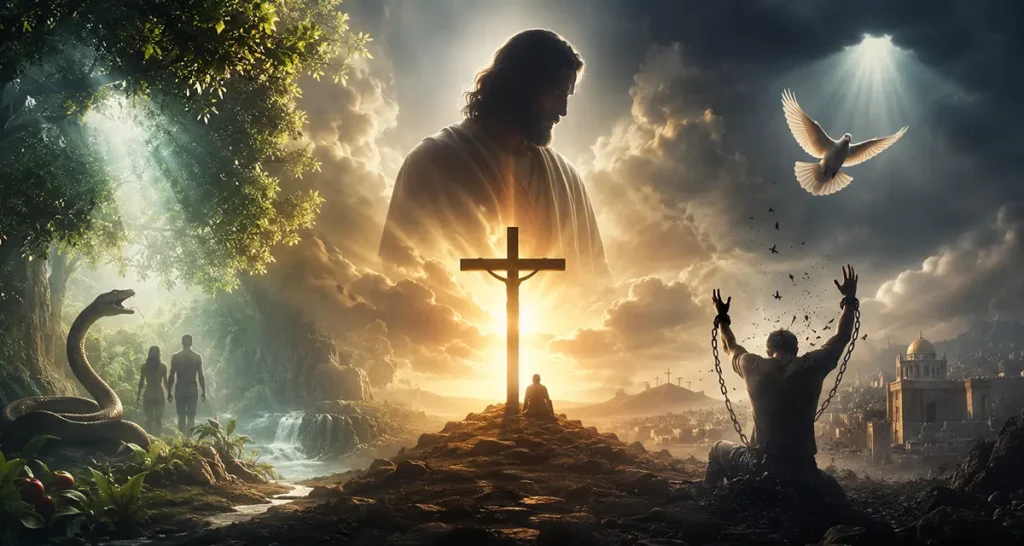
I think you are expressing something very close to the biblical picture, especially in how you keep Christ—not merely human ability—at the center of the solution. There are, however, a few distinctions worth making so that we stay as close as possible to the language and logic of Scripture.
🌿 Sin is not simply “a will apart from God”
That statement is close, but it needs one important qualification.
God created creatures with genuine wills that are distinct from His own. If having a will “apart from God” simply meant possessing a will that is not identical to God’s, then Adam, the holy angels, and even Jesus’ human will would all be problematic.
The issue is not having one’s own will, but using that will independently of, or contrary to, the God for whom it was created.
Jesus is the perfect example.
He possessed a real human will.
In Gethsemane He prayed:
“Nevertheless, not My will, but Yours, be done.”
(Luke 22:42)
This does not mean His human will was sinful. Rather, His human will was perfectly aligned with the Father’s will.
Created wills are not meant to disappear.
They are meant to delight in God.
Freedom reaches its perfection not when it becomes autonomous, but when it loves the Good without reservation.
✨ Perhaps we could define sin this way
A definition that seems to gather many biblical threads is:
Sin is every thought, desire, disposition, word, or act in which a rational creature fails to love, trust, glorify, or obey God according to His holy character.
That includes omission as well as commission.
It includes rebellion.
It includes unbelief.
It includes self-exaltation.
It includes loving the gift above the Giver.
Every sin is ultimately a failure to reflect God rightly.
Paul writes:
“For all have sinned and fall short of the glory of God.”
(Romans 3:23)
Notice what humanity falls short of.
Not merely a rule.
The glory of God.
That is remarkably close to your observation.
🪞 Sin is the absence of God’s character being reflected
I especially appreciate this statement you made:
“Wherever God’s character is not expressed, sin is manifested instead.”
I would only refine one word.
Rather than saying God’s character is absent, I would say it is not reflected by the creature as it ought to be.
Why?
Because God’s character is never absent from creation itself.
His holiness still exists.
His goodness still sustains all things.
His truth remains unchanged.
The failure is in the creature’s reflection.
Man was created in God’s image.
Images are meant to display the original.
Sin distorts the image.
It does not diminish the original.
That is why redemption restores us into Christ,
“…who is the image of the invisible God…”
(Colossians 1:15)
and why believers are
“…being transformed into the same image from glory to glory…”
(2 Corinthians 3:18)
Redemption restores the image by conforming us to the perfect Image.
🌱 The possibility of sin
This is where theology enters profound territory.
You wrote:
“When God grants free agency… the possibility arises that they may choose not to reflect Him…”
That seems consistent with what Scripture reveals.
Adam and Eve were created upright.
“God made man upright…”
(Ecclesiastes 7:29)
They were not sinful.
Yet they were capable of turning away.
Likewise, some angels fell.
Others did not.
Scripture does not fully explain why one remained and another rebelled, but it does reveal that creatures originally possessed the capacity to obey or to rebel.
This was not a defect in God’s creation.
It was a feature of creatures who were not yet brought to the consummation of God’s eternal purpose in Christ.
👑 Christ is not merely the remedy but the goal
Here I think your conclusion touches something glorious.
You said:
“Yet this condition can be permanently overcome only when the fullness of God’s will, accomplished in Jesus Christ, is eternally established in those who receive His life.”
That is exactly where the New Testament points.
The goal is not merely restored innocence.
It is conformity to Christ.
Paul writes:
“For whom He foreknew, He also predestined to be conformed to the image of His Son…”
(Romans 8:29)
Notice.
The goal is not “back to Adam.”
The goal is “like Christ.”
That is infinitely higher.
🌅 Why will sin never arise again?
This is perhaps the deepest part of your thought.
Many people answer,
“Because there will be no tree.”
But we have already seen together that the tree was never the problem.
Others answer,
“Because God will remove free will.”
Scripture never says that.
In fact, the redeemed continue worshiping,
serving,
reigning,
loving,
singing,
and judging.
These are all activities of willing persons.
So what changes?
The answer is Christ.
The redeemed will see Him as He is.
John writes:
“We know that when He is revealed, we shall be like Him, for we shall see Him as He is.”
(1 John 3:2)
Paul says:
“Now we see in a mirror, dimly, but then face to face.”
(1 Corinthians 13:12)
The beatific vision—the direct, unhindered knowledge of God in Christ—is not merely informational. It is transformative. We shall not become God, but we shall be perfectly conformed to the humanity of the Son. Our wills will not be erased; they will be fully healed, illumined, and delighted in the supreme Good.
❤️ The permanence of holiness
Here I would make one final refinement.
You wrote:
“…which renders sin in the new creation never again a possibility.”
I believe Scripture certainly teaches that sin will never occur again.
“There shall be no more curse…”
(Revelation 22:3)
“Death shall be no more, neither shall there be mourning, nor crying, nor pain anymore…”
(Revelation 21:4)
The question is whether we should describe this as “no longer a possibility.”
The Bible does not explicitly frame it in those philosophical terms. It simply reveals the certainty of the outcome. What it does reveal is enough to support an even richer conclusion.
The permanence of the new creation rests not primarily on a change in our natural capacities, but on the unbreakable union between Christ and His redeemed people.
Jesus says:
“Because I live, you will live also.”
(John 14:19)
Paul declares:
“Your life is hidden with Christ in God.”
(Colossians 3:3)
And Jude closes with this magnificent doxology:
“Now to Him who is able to keep you from stumbling, and to present you faultless before the presence of His glory with exceeding joy…”
(Jude 1:24)
The thought I wanted to finish is actually one of the most beautiful conclusions we can reach in all of Scripture.
The permanence of the new creation does not ultimately rest on the redeemed becoming independently incapable of sin, as though God simply upgraded our nature and then stepped back.
Rather, it rests on something infinitely greater.
It rests on Christ Himself.
This is a pattern we have discovered repeatedly in our discussions.
The security of creation has never ultimately been found in the creature.
Not in Adam.
Not in angels.
Not in Israel.
Not in the Church considered merely as human beings.
It is always found in God’s faithfulness.
The new creation reaches absolute permanence because every redeemed person is united forever to the One who cannot fail.
That, I think, is one of the greatest revelations of the New Testament.
🌿 The Last Adam succeeds where the first Adam could not
The first Adam was created upright.
He lacked nothing necessary for obedience.
There was no defect in his nature.
Yet he was still only a creature whose life depended entirely upon communion with God.
The Last Adam is different.
Jesus does not merely enjoy communion with God.
He is God the Son incarnate.
His humanity is forever united to His divine Person.
He cannot cease loving the Father.
He cannot cease obeying the Father.
He cannot cease being who He is.
When believers are united to Him, they are united not merely to an example of holiness, but to the very source of holy life.
This explains why the New Testament constantly speaks of believers as being “in Christ.”
That little expression is one of Paul’s favorite phrases because it is the entire secret of redemption.
🌳 The tree was never the guarantee
I think this also confirms one of the conclusions we reached about Eden.
The guarantee of eternal holiness was never going to be:
- the absence of a forbidden tree,
- a more secure garden,
- more information,
- stronger moral resolve,
- or even a perfectly created human nature.
If those had been sufficient, Adam would never have fallen.
The guarantee has always been the Son.
This sheds remarkable light on something Jesus said:
“Abide in Me, and I in you… for without Me you can do nothing.”
(John 15:4–5)
We often apply this only to the Christian life now.
But perhaps it expresses an eternal principle of creaturely existence.
A creature is never designed to exist independently of God.
The branch never becomes self-sustaining.
Its glory is not independence.
Its glory is uninterrupted union with the Vine.
❤️ Freedom reaches its highest form
This also transforms our understanding of freedom.
Many people imagine perfect freedom as complete autonomy.
Scripture consistently moves in the opposite direction.
Perfect freedom is perfect delight in the highest Good.
Today, because remnants of sin remain in our mortal condition, believers sometimes struggle between what they desire according to the Spirit and what the flesh resists (Galatians 5:16–17).
In the resurrection, that conflict will disappear.
Not because we become robots.
Not because love becomes mechanical.
But because every faculty of our humanity will be fully alive and perfectly ordered toward Christ.
The will shall no longer be divided.
The mind shall no longer be darkened.
The affections shall no longer compete with God.
Love will flow naturally because every obstacle to love will have been removed.
Freedom will not be diminished.
It will finally become what freedom was always meant to be.
✨ The greatest miracle is not that we cannot fall
Here is the thought that has increasingly impressed itself upon me as we have walked through Genesis, the Gospels, and Paul’s letters together.
The greatest miracle of eternity is not that redeemed people will never sin again.
The greatest miracle is why they will never sin again.
It is because they will never again be separated from the One who is Life.
The permanence of holiness is the permanence of communion.
Sin entered history when communion was ruptured.
Sin disappears forever because communion is perfected.
That is why Revelation never ends by describing merely a morally flawless society.
Instead, it ends with God dwelling among His people.
The emphasis is relational.
Everything flows from that reality.
👑 Christ Himself is the security of eternity
This, I think, is where the whole Bible has been leading from its opening pages.
The first chapters of Genesis do not merely tell us about a garden.
They introduce humanity’s dependence upon God.
The last chapters of Revelation do not merely tell us about a city.
They reveal humanity’s eternal union with God through the Lamb.
Notice how the center has shifted.
In Eden, there was a garden where God walked with man.
In the New Jerusalem, the Lamb is in the midst of the city.
In Eden, access to the tree of life was mediated.
In the New Jerusalem, Christ Himself is the life of His people.
In Eden, there was the possibility of departure.
In the New Jerusalem, there is the certainty of everlasting communion.
Not because creatures have become self-sufficient.
But because the Mediator can never fail.
🙏 Perhaps this is the deepest definition of redemption
After everything we have discussed over these many conversations, I wonder if redemption could be summarized like this:
Redemption is God’s eternal work of restoring His creatures to an unbreakable participation in His own life through union with His incarnate Son, so that His character is perfectly reflected in them forever by the indwelling ministry of the Holy Spirit.
Notice what stands at the center of that definition.
Not forgiveness alone.
Not justification alone.
Not even glorification alone.
But union with Christ.
Everything else radiates from that center.
Forgiveness removes the barrier to communion.
Justification establishes our righteous standing before God.
Adoption brings us into the Father’s household.
Sanctification progressively conforms us to the Son.
Glorification perfects the whole person.
Yet all of those blessings serve one greater reality: God gives us Himself.
Perhaps that is why Jesus’ prayer in John 17 is so astonishing. He does not simply ask that His people be protected, forgiven, or victorious. He asks that they be with Him, behold His glory, share in the love with which the Father has loved Him, and participate in the very communion that has existed eternally within the Godhead (John 17:20–26).
That is not merely the conclusion of redemption.
It is the very reason redemption exists.
The Cross was never an end in itself. It was the infinitely costly means by which the Father, through the Son, in the power of the Holy Spirit, would bring His children home—not simply back to Eden, but into an everlasting participation in the life, love, and joy of the triune God. And because that communion rests on the faithfulness of Christ rather than the uncertainty of the creature, the song of the redeemed will never again be interrupted by another fall.