Justice | Mercy | Faith

Justice | Mercy | Faith

Idolatry and the Human Heart: From Israel’s Unfaithfulness to Christ’s Faithfulness

Difficulty Level: Intermediate-Advanced

Jump to Answers

  1. A common theme throughout Judges and much of the Old Testament is the recurring statement, “Then the children of Israel again did evil in the sight of the Lord, and served the Baals.” Yet the primary accusation does not seem to be moral failure in itself, but covenant unfaithfulness. Their evil begins with forsaking the Lord and turning to other gods, while moral corruption follows as the inevitable fruit. Is not God’s chief complaint that they abandoned Him before they abandoned His ways?
  2. God once highlighted the remarkable fact that other nations did not exchange their gods for the gods of neighboring peoples. Though their gods were false, they remained loyal to them. Yet Israel abandoned the living God who had redeemed them. Is this not a profound and great point about the nature of the human heart?
  3. Why are we so often obsessed with the fruit while neglecting the root? Why do we focus on visible sins and outward conduct when the deeper issue lies in the heart’s trust, worship, and allegiance? How did the Fall distort not only our actions but even our ability to diagnose the true source of our brokenness and the nature of real repair?
  4. If we are already spiritually lost and incapable of producing the righteousness God desires, then our greatest need is the Lawgiver Himself to heal our hearts and restore us. How tragic, then, that we would forsake the very One who is both our only remedy and our only hope. πŸ€”
  5. The nations remained loyal to gods that were not even real, yet Israel abandoned the living God who had redeemed them. This brings us to a sobering and even terrifying realization: the closer we are brought to God, the greater the responsibility that accompanies such privilege. When greater revelation is met with unbelief rather than faithfulness, Scripture shows that the result is not neutrality but deeper accountability. What is the arithmetic behind this principle?Β 
  6. I want to make clear that we would all be found in the very same condition as Israel, sharing in the same blindness, folly, and ruin, were it not for the grace of God in Jesus Christ rescuing us from ourselves.Β 
  7. The observation that “it is possible to prune a dead tree endlessly and never address the fact that the tree is dying” is devastating. If the problem is not merely bad fruit but a lack of life itself, then what is our hope? Or rather, who is our hope?
  8. You pointed out that generation after generation concluded, “We need something else.” Their conclusion was more accurate than they realized. Israel’s history repeatedly demonstrated that the problem ran deeper than ignorance, discipline, or lack of effort. They did not need another thing; they needed Someone. They needed One who would heal their hearts and faithfully and vicariously hold them fast to God.

Idolatry and the Human Heart: From Israel’s Unfaithfulness to Christ’s Faithfulness

Throughout the Old Testament, especially in the book of Judges, one accusation rises above all others: God’s people repeatedly forsook the Lord and turned to other gods. While moral corruption certainly followed, Scripture consistently reveals that the deepest problem was not first bad behavior but misplaced worship. The root issue was idolatryβ€”a failure to trust, love, and remain faithful to the God who had redeemed them.

Yet this raises profound questions. Why does the human heart continually abandon the only source of life? Why are we often preoccupied with the fruit of sin while ignoring its root? Why did Israel, who knew the living God, repeatedly exchange Him for powerless idols? And if the problem lies deeper than ignorance or lack of effort, what hope is there for humanity?

This discussion follows the biblical storyline from Judges to the New Testament, exploring the nature of idolatry, the tragedy of covenant unfaithfulness, the blindness of the fallen heart, and the glorious answer found in Jesus Christ. Along the way, we discover that humanity’s greatest need was never merely a better law, stronger discipline, or more religious devotion. We needed a faithful Savior who would succeed where Adam failed, where Israel failed, and where every one of us would fail apart from grace. Ultimately, the story of Scripture is not about how sinners learn to cling to God, but about how God, in Christ, comes to rescue sinners and bring them back to Himself.

A common theme throughout Judges and much of the Old Testament is the recurring statement, “Then the children of Israel again did evil in the sight of the Lord, and served the Baals.” Yet the primary accusation does not seem to be moral failure in itself, but covenant unfaithfulness. Their evil begins with forsaking the Lord and turning to other gods, while moral corruption follows as the inevitable fruit. Is not God’s chief complaint that they abandoned Him before they abandoned His ways?

Yes, I think you are putting your finger on something that is fundamental to understanding not only Judges, but much of the Old Testament.

When we read statements like:

“The children of Israel again did evil in the sight of the LORD, and served the Baals.”

β€” Judges 2:11; 3:7; 10:6

our modern instinct is often to think immediately of moral sins: lying, stealing, violence, immorality, and so on. Those things certainly matter to God, but in Judges the first accusation is usually not moral corruption itselfβ€”it is covenant unfaithfulness.

God’s complaint is:

“They forsook the LORD God of their fathers… and they followed other gods.”

β€” Judges 2:12

Notice the order.

  1. They forsook the LORD.
  2. They followed other gods.
  3. Their lives became corrupted.

The root sin is abandonment of God; the moral collapse is the fruit.

🌿 Why Is Idolatry Treated as the Greatest Evil?

Because Israel was not merely a nation under laws. Israel was a covenant people bound to God Himself.

The first commandments are not:

“Do not murder.”

“Do not steal.”

Rather:

“You shall have no other gods before Me.”

β€” Exodus 20:3

and

“You shall not make for yourself a carved image.”

β€” Exodus 20:4

The relationship comes first.

In God’s eyes, the greatest offense is not merely breaking a rule but abandoning the One who redeemed them.

He continually reminds them:

“I am the LORD your God, who brought you out of the land of Egypt.”

β€” Exodus 20:2

The issue is personal before it is ethical.

πŸ’” The Language of Marriage

This is why the prophets often describe idolatry as adultery rather than merely disobedience.

God says through Jeremiah:

“You have played the harlot with many lovers.”

β€” Jeremiah 3:1

And through Hosea:

“The land has committed great harlotry by departing from the LORD.”

β€” Hosea 1:2

The imagery is striking.

God does not describe Israel as merely breaking regulations. He describes them as abandoning a husband for other lovers.

The deepest wound is relational.

πŸ”₯ Why Moral Corruption Always Follows

Your observation is exactly right: leaving God eventually produces moral deterioration.

The gods of Canaan demanded practices that reflected their character.

Baal worship was associated with ritual prostitution and fertility rites. Other pagan worship involved child sacrifice.

When Israel worshiped those gods, they gradually became like them.

Psalm 115 says concerning idols:

“Those who make them are like them; so is everyone who trusts in them.”

β€” Psalm 115:8

We become like what we worship.

If God is holy, worshiping Him produces holiness.

If an idol is empty, worshipers become spiritually empty.

Thus the moral decay was not separate from idolatryβ€”it flowed from it.

πŸ‘‘ The Heart of the Matter

What is fascinating is that God sometimes overlooks many weaknesses and failures when a heart remains loyal to Him.

Consider David.

David committed terrible sins, yet Scripture repeatedly emphasizes that his heart was fundamentally devoted to the LORD (1 Kings 14:8; Acts 13:22).

In contrast, many kings are condemned primarily because they led Israel into idolatry.

Why?

Because covenant loyalty is the central issue.

A person may stumble and still cling to God.

But idolatry is the act of turning away from God Himself.

✨ The Same Principle in the New Testament

The pattern continues.

When Jesus summarizes the Law, He begins not with moral conduct toward others but with love toward God:

“You shall love the Lord your God with all your heart, with all your soul, and with all your mind.”

β€” Matthew 22:37

Only then comes:

“You shall love your neighbor as yourself.”

β€” Matthew 22:39

The second command flows from the first.

Just as in Judges, the deepest problem is not first horizontal but vertical.

When the relationship with God is broken, everything else eventually follows.

πŸ™ A Final Observation

One of the saddest refrains in Judges is not that Israel became immoral, but that they repeatedly forgot the LORD who had rescued them.

“They forgot the LORD their God, and served the Baals and Asherahs.”

β€” Judges 3:7

That is why idolatry is treated so seriously throughout Scripture. It is not merely choosing the wrong religion; it is rejecting the true and living God for something less than Him.

The tragedy of Judges is not simply that Israel sinned. Humanity has always sinned. The tragedy is that the people who had seen God’s mighty works, heard His covenant, received His promises, and experienced His deliverance repeatedly exchanged Him for lesser gods.

As Paul later summarizes the universal human problem:

“They exchanged the truth of God for the lie, and worshiped and served the creature rather than the Creator.”

β€” Romans 1:25

That sentence could almost serve as a summary of the entire book of Judges. πŸ“–βœ¨

God once highlighted the remarkable fact that other nations did not exchange their gods for the gods of neighboring peoples. Though their gods were false, they remained loyal to them. Yet Israel abandoned the living God who had redeemed them. Is this not a profound and great point about the nature of the human heart?

Yes, and the fact that God brings that up shows how serious the matter is in His eyes.

The passage you are thinking of is likely:

“Has a nation changed its gods, which are not gods? But My people have changed their Glory for what does not profit.”

β€” Jeremiah 2:11

And just before that:

“Pass beyond the coasts of Cyprus and see, send to Kedar and consider diligently, and see if there has been such a thing.”

β€” Jeremiah 2:10

God is essentially saying:

“Go search the nations. Look everywhere. Have you ever seen a people abandon their own gods and adopt another?”

The implied answer is: No.

πŸ€” The Astonishing Irony

The nations remained loyal to gods that were not even real.

Meanwhile Israel abandoned the living God.

That is the shocking contrast.

The issue is not that the pagan nations were righteous. They were deeply sinful. But they were at least consistent in their devotion to what they believed.

Israel, on the other hand, had:

  • Seen the Red Sea opened (Exodus 14:21-22).
  • Eaten manna from heaven (Exodus 16:15).
  • Heard God’s voice at Sinai (Deuteronomy 4:33).
  • Received His covenant.
  • Entered the Promised Land by His power.

And yet they traded Him away.

God’s astonishment comes through in the next verse:

“Be astonished, O heavens, at this, and be horribly afraid; be very desolate, says the LORD.”

β€” Jeremiah 2:12

The heavens themselves are summoned as witnesses because the exchange is so irrational.

πŸ’Ž “They Changed Their Glory”

Notice God’s wording:

“My people have changed their Glory for what does not profit.”

β€” Jeremiah 2:11

Israel’s treasure was not merely a doctrine or a religion.

Their glory was God Himself.

Compare Psalm 106:

“Thus they changed their glory into the image of an ox that eats grass.”

β€” Psalm 106:20

What a tragic exchange!

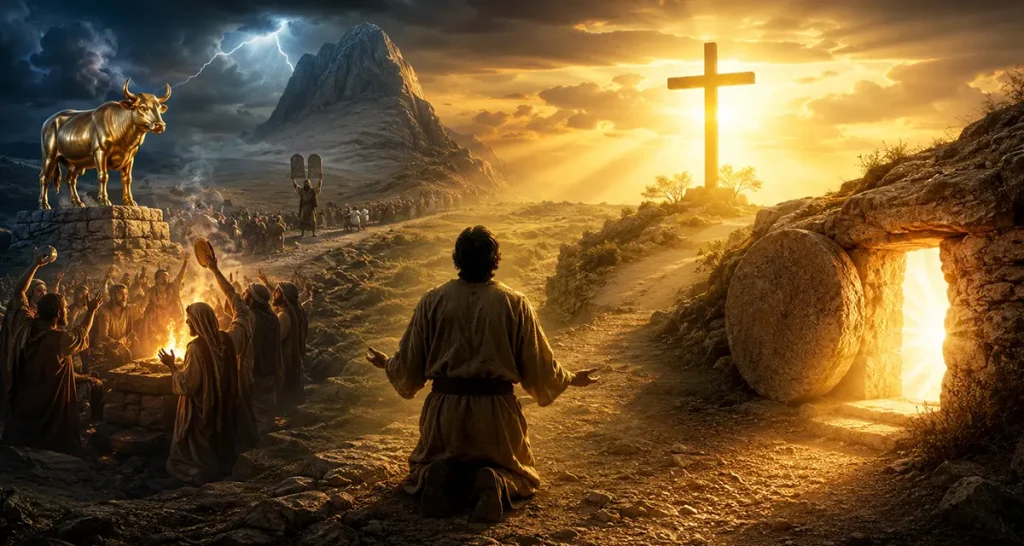
The Creator of heaven and earth exchanged for a golden calf.

Infinite majesty exchanged for metal shaped like a farm animal.

The issue is not merely that they chose another object of worship. It is that they exchanged something infinitely superior for something infinitely inferior.

🌊 The Two Evils

God immediately explains the heart of the problem:

“For My people have committed two evils:

They have forsaken Me, the fountain of living waters,

and hewn themselves cisternsβ€”broken cisterns that can hold no water.”

β€” Jeremiah 2:13

Notice again the order.

The first evil is not building idols.

The first evil is forsaking God.

The second evil is seeking satisfaction elsewhere.

This pattern appears throughout Scripture:

  1. Leave God.
  2. Seek substitutes.
  3. Experience ruin.

The idol is not the root problem. The idol is the substitute chosen after God is abandoned.

πŸ‘‘ Why This Matters So Much

You rightly call this “a great point.”

God is not merely saying:

“You worshiped the wrong deity.”

He is saying:

“Even the nations cling to what they believe is valuable. Yet you, who know Me, have abandoned Me.”

There is almost a tone of wounded amazement.

Not because God lacks anything, but because the irrationality of the exchange reveals the blindness of the human heart.

The same theme appears later in Romans:

“They exchanged the truth of God for the lie.”

β€” Romans 1:25

Humanity’s problem is fundamentally one of exchange.

We exchange:

  • Truth for falsehood.
  • Life for death.
  • The Creator for the creature.
  • Living water for broken cisterns.

✨ A Deeper Observation

There is another layer here that is easy to miss.

The nations kept their false gods because they had never known the true God.

Israel abandoned the true God after knowing Him.

That is what makes the sin so grievous.

As Amos says:

“You only have I known of all the families of the earth; therefore I will punish you for all your iniquities.”

β€” Amos 3:2

Greater privilege brought greater responsibility.

Israel’s sin was not merely idolatry. It was covenant betrayal.

It was the bride leaving her husband, the redeemed people abandoning their Redeemer, the nation whose glory was the LORD exchanging Him for gods that could neither speak, save, nor satisfy.

And yet, what is remarkable is that despite this repeated exchange, God repeatedly calls them back:

“Return to Me.”

β€” Jeremiah 3:12

The wonder of the Old Testament is not merely that Israel was unfaithful. The wonder is that God remained faithful and kept pursuing them. That prepares us for the ultimate revelation of that faithfulness in Christ, “who loved His own who were in the world, He loved them to the end” (John 13:1). πŸ™πŸ“–βœ¨

Why are we so often obsessed with the fruit while neglecting the root? Why do we focus on visible sins and outward conduct when the deeper issue lies in the heart’s trust, worship, and allegiance? How did the Fall distort not only our actions but even our ability to diagnose the true source of our brokenness and the nature of real repair?

That is a profound question, because it touches not merely on sin, but on how sin has distorted our entire way of seeing reality.

The pattern you noticed in Judges is not unique to Israel. It is a pattern that continues in every human heart.

We obsess over the fruit because the root is deeper, harder to see, and ultimately exposes us before God.

πŸ‚ The Fruit Is Visible; the Root Is Hidden

When Adam and Eve fell, the first thing they became aware of was not their distrust of God.

It was their nakedness.

“Then the eyes of both of them were opened, and they knew that they were naked.”

β€” Genesis 3:7

Notice what happened.

The root sin was believing the serpent’s lie about God (Genesis 3:1-6).

The fruit was shame, fear, hiding, blame-shifting, and eventual death.

Yet Adam immediately focused on the symptom:

“I was afraid because I was naked; and I hid myself.”

β€” Genesis 3:10

God, however, goes straight to the root:

“Have you eaten from the tree of which I commanded you that you should not eat?”

β€” Genesis 3:11

Man looks at the consequence.

God looks at the cause.

🌱 Why We Prefer Dealing With Fruit

The fruit allows us to remain in control.

It is easier to say:

  • “I need to stop lying.”
  • “I need to control my anger.”
  • “I need to stop lusting.”
  • “I need to be more disciplined.”

than to ask:

  • “Do I trust God?”
  • “What am I loving more than Him?”
  • “What am I seeking apart from Him?”
  • “What lie about God am I believing?”

The first set of questions concerns behavior.

The second concerns worship.

And worship is far more uncomfortable because it exposes the heart.

Jesus repeatedly did this.

People brought Him fruit; He addressed roots.

🌳 Jesus and the Root

The Pharisees focused on external conduct.

Jesus said:

“Out of the heart proceed evil thoughts, murders, adulteries, fornications, thefts, false witness, blasphemies.”

β€” Matthew 15:19

Notice the direction.

The heart produces the behavior.

The behavior does not produce the heart.

Likewise:

“A good tree cannot bear bad fruit, nor can a bad tree bear good fruit.”

β€” Matthew 7:18

Scripture consistently traces fruit back to a source.

🐍 The Distortion Introduced by the Fall

The serpent’s attack was not primarily against a commandment.

It was against God’s character.

“Has God indeed said…?”

β€” Genesis 3:1

“For God knows…”

β€” Genesis 3:5

The implication was:

“God cannot be fully trusted.”

That lie is the seed from which every other sin grows.

If God is not trusted, then I must secure my own happiness.

If God is not trusted, then I must become my own protector.

If God is not trusted, then I must define good and evil myself.

Every sin is, in some sense, an attempt to solve life apart from God.

The fruit changes.

The root remains the same.

πŸ” Why Even Our Repairs Become Distorted

The fall did not merely corrupt our behavior.

It corrupted our diagnosis.

This is why human religion often focuses on external reform.

Israel frequently did this.

God says:

“This people draw near with their mouths and honor Me with their lips, but have removed their hearts far from Me.”

β€” Isaiah 29:13

The behavior looked improved.

The root remained untouched.

It is possible to prune a dead tree endlessly and never address the fact that the tree is dying.

That is why legalism is so attractive.

It promises repair without surrender.

It allows us to focus on visible fruit while avoiding the deeper issue of our relationship with God.

❀️ Why God Always Goes After the Heart

This explains something remarkable throughout Scripture.

God often appears more concerned about trust than performance.

Consider Abraham.

Abraham lied.

Abraham doubted.

Abraham stumbled.

Yet God repeatedly highlights his faith (Genesis 15:6; Romans 4:3).

Why?

Because faith addresses the root.

Likewise, Israel’s greatest failure was not military weakness, political failure, or even moral corruption.

It was:

“They forgot the LORD their God.”

β€” Judges 3:7

The root problem was relational before it was behavioral.

✨ Actual Repair

The gospel addresses precisely what the fall damaged.

The serpent said:

“You cannot trust God’s heart.”

The Father sends the Son.

And what does Jesus reveal?

“He who has seen Me has seen the Father.”

β€” John 14:9

At the cross, God is not merely paying for sins.

He is unveiling His heart.

He is demonstrating that He is exactly the opposite of what the serpent implied.

Paul writes:

“God demonstrates His own love toward us, in that while we were still sinners, Christ died for us.”

β€” Romans 5:8

The deepest repair is not merely moral improvement.

It is restored trust.

The Christian life is not primarily learning to manage fruit. It is learning, by the Spirit, to know, trust, love, and treasure God again.

When the root is healed, fruit begins to change naturally.

This is why Jesus does not merely command better behavior. He says:

“Abide in Me.”

β€” John 15:4

Because the ultimate solution to bad fruit is not stronger branches.

It is union with the living Vine. 🌿✝️

And perhaps that is one of the great lessons of Judges: every cycle begins when Israel leaves the Lord and ends when they return to Him. The oppression, idolatry, and moral collapse are the visible fruit. The real battle is always over the heart’s allegiance and trust. That was the issue in Eden, in Judges, in the prophets, and ultimately at the cross. The root has always been: “Will we trust and love the Lord?” Everything else grows from that answer. πŸ™πŸ“–

If we are already spiritually lost and incapable of producing the righteousness God desires, then our greatest need is the Lawgiver Himself to heal our hearts and restore us. How tragic, then, that we would forsake the very One who is both our only remedy and our only hope. πŸ€”

Exactly. πŸ€”

And I think your observation gets to the tragic irrationality that God keeps exposing throughout Scripture.

The issue is not merely that Israel left a lawgiver.

They left the only One who could save them from themselves.

🌿 The Law Never Stood Alone

Notice how God introduces Himself at Sinai:

“I am the LORD your God, who brought you out of the land of Egypt, out of the house of bondage.”

β€” Exodus 20:2

He does not say:

“I am the LORD your God, who gave you commandments.”

He first presents Himself as Redeemer.

Deliverance precedes commandment.

Grace precedes law.

Relationship precedes obedience.

The law was never given as a ladder for sinners to climb to God. It was given to a people God had already rescued.

πŸ’” The Great Irony

Israel repeatedly demonstrated that they could not keep the covenant by their own strength.

Before Moses even came down from Sinai, they had already made the golden calf (Exodus 32:1-6).

The lesson should have been obvious:

“We need God.”

Instead, generation after generation often concluded:

“We need something else.”

That is the madness of sin.

Jeremiah describes it perfectly:

“They have forsaken Me, the fountain of living waters, and hewn themselves cisternsβ€”broken cisterns that can hold no water.”

β€” Jeremiah 2:13

The tragedy is not merely leaving water.

It is leaving water while dying of thirst.

πŸ‘ Like Sheep Leaving the Shepherd

The imagery throughout Scripture is often that of sheep.

Why?

Because sheep are not merely guilty; they are helpless.

“All we like sheep have gone astray; we have turned, every one, to his own way.”

β€” Isaiah 53:6

Notice that the problem is not simply that the sheep broke rules.

The sheep left the shepherd.

A sheep separated from the shepherd does not become independent.

It becomes lost.

Likewise, humanity separated from God does not become free.

It becomes enslaved.

Jesus says:

“Whoever commits sin is a slave of sin.”

β€” John 8:34

The promise of autonomy ends in bondage.

πŸ”₯ The Folly of Leaving Our Only Hope

What makes idolatry so serious is precisely what you pointed out.

If we are already fallen, corrupted, blind, and unable to restore ourselves, then abandoning God is not merely disobedience.

It is abandoning the only source of healing.

Imagine a terminally ill patient disconnecting himself from the only treatment that can save him.

The act is tragic not merely because it breaks a rule but because it rejects the cure.

This is why Jesus says:

“Apart from Me you can do nothing.”

β€” John 15:5

Not little.

Not less.

Nothing.

πŸ‘‘ The Deeper Layer

There is something even more astonishing.

The One Israel abandoned was not only their hope for moral restoration.

He was already their greatest good.

This is where the prophets often take the discussion.

God does not merely say:

“You left the One who helps you.”

He says:

“You left Me.”

The loss is not only the benefits.

The loss is the Person.

Consider God’s complaint:

“My people have forgotten Me days without number.”

β€” Jeremiah 2:32

The grief is relational.

The offense is not merely that Israel abandoned salvation.

They abandoned the Savior.

✨ The Gospel Reverses the Tragedy

The wonder of the gospel is that God does not wait for lost people to find their way back.

The Shepherd goes after the sheep.

Jesus says:

“The Son of Man has come to seek and to save that which was lost.”

β€” Luke 19:10

And:

“I am the good shepherd. The good shepherd gives His life for the sheep.”

β€” John 10:11

So yes, the absurdity is staggering.

We are spiritually bankrupt, unable to heal ourselves, unable to produce true righteousness, and dependent upon God for every breath (Acts 17:25-28). Yet the fallen heart’s instinct is to run from Him rather than toward Him.

That is why sin is so irrational.

It is not merely lawbreaking.

It is the patient fleeing the physician, the thirsty man abandoning the fountain, the sheep leaving the shepherd, the branch separating itself from the vine.

And that is why salvation is ultimately not just forgiveness of wrongdoing but reconciliation to God Himself:

“Christ also suffered once for sins, the just for the unjust, that He might bring us to God.”

β€” 1 Peter 3:18

The goal is not merely right conduct.

The goal is that the lost return to the One they were made for. πŸ™β€οΈπŸ“–

And perhaps that is why idolatry so grieves the heart of God. It is not only rebellion against the King. It is the refusal of the Physician by those who are sick, the rejection of the Shepherd by those who are lost, and the abandonment of the very One who is both the cure and the treasure.

The nations remained loyal to gods that were not even real, yet Israel abandoned the living God who had redeemed them. This brings us to a sobering and even terrifying realization: the closer we are brought to God, the greater the responsibility that accompanies such privilege. When greater revelation is met with unbelief rather than faithfulness, Scripture shows that the result is not neutrality but deeper accountability. What is the arithmetic behind this principle?

That is indeed a sobering thought, and Scripture repeatedly confirms it.

But I would phrase it carefully:

The closer one comes to God’s light, the more serious it becomes to turn away from that light.

Not because God becomes less merciful, but because rejection is measured against revelation.

πŸ“– The Principle of Greater Light, Greater Responsibility

Jesus Himself taught this principle:

“For everyone to whom much is given, from him much will be required.”

β€” Luke 12:48

And again:

“If I had not come and spoken to them, they would have no sin, but now they have no excuse for their sin.”

β€” John 15:22

Notice what Jesus means.

The sin existed already.

But the responsibility increased because the light increased.

The issue is not that knowledge creates evil.

The issue is that knowledge exposes the heart.

πŸ”₯ The Arithmetic of Revelation

A pagan worshiping Baal in distant lands had never seen Sinai.

Israel had.

A pagan had never crossed the Red Sea.

Israel had.

A pagan had never eaten manna.

Israel had.

A pagan had never heard the covenant read aloud by Moses.

Israel had.

Therefore when Israel turned away, they were not merely acting in ignorance.

They were rejecting known truth.

This is why Amos says:

“You only have I known of all the families of the earth; therefore I will punish you for all your iniquities.”

β€” Amos 3:2

That verse sounds almost backwards.

We might expect:

“You only have I known, therefore I will excuse you.”

Instead God says:

“Therefore I will discipline you.”

Why?

Because covenant privilege brings covenant responsibility.

🌞 Light Does Not Change the Heartβ€”It Reveals It

An interesting pattern appears throughout Scripture.

The same light that softens one heart hardens another.

Consider Pharaoh.

Each plague revealed more of God’s power.

Yet Pharaoh became increasingly hardened (Exodus 7–14).

Then consider Moses.

The same God who hardened Pharaoh’s resistance drew Moses into deeper worship.

The difference was not the light.

The difference was the response to the light.

This is why Jesus says:

“This is the condemnation, that the light has come into the world, and men loved darkness rather than light.”

β€” John 3:19

Light does not create darkness.

It exposes it.

βš–οΈ Why Israel Sometimes Appears Worse Than the Nations

This is one of the shocking themes of the prophets.

There are moments when God says Israel became worse than the pagans around them.

For example:

“You were more corrupt than they in all your ways.”

β€” Ezekiel 16:47

Why?

Not because Israel possessed a more evil nature than other nations.

But because Israel sinned against greater privilege.

Imagine two people rejecting a gift.

One has only heard rumors about the giver.

The other has lived in the giver’s house, eaten at his table, and experienced his kindness for years.

The outward action may look similar.

The relational meaning is very different.

πŸ’” The Tragedy of Familiarity

There is another danger.

What is familiar can become common.

Israel grew accustomed to things that should have produced awe.

The cloud.

The tabernacle.

The sacrifices.

The covenant.

The promises.

Eventually many treated holy things as ordinary things.

The sons of Eli are a frightening example.

They ministered around sacred things daily and yet:

“The sons of Eli were corrupt; they did not know the LORD.”

β€” 1 Samuel 2:12

Think about that.

They worked in the tabernacle.

They handled sacrifices.

They knew the rituals.

Yet Scripture says they did not know the Lord.

Physical proximity is not the same as spiritual attachment.

🌿 But There Is Another Arithmetic

Here is where we must be careful not to stop at the terrifying side.

There is another equation running throughout Scripture.

The closer one comes to God in faith, the more one is transformed into His likeness.

Paul writes:

“But we all, with unveiled face, beholding as in a mirror the glory of the Lord, are being transformed into the same image.”

β€” 2 Corinthians 3:18

The same proximity that increases responsibility also increases transformation when accompanied by faith.

The sun that hardens clay melts wax.

The issue is not the sun.

The issue is what is being exposed to it.

πŸ‘‘ The Ultimate Arithmetic

Perhaps the deepest formula is this:

Privilege + unbelief = greater accountability.

Privilege + faith = greater conformity to Christ.

This is why Judas and John are such striking contrasts.

Both walked with Jesus.

Both heard the same sermons.

Both saw the same miracles.

Both sat at the same table.

One became the beloved disciple who leaned on Christ’s breast (John 13:23).

The other betrayed Him for thirty pieces of silver (Matthew 26:14-16).

The difference was not proximity.

It was what each did with the One to whom he was brought near.

πŸ™ A Final Thought

The terrifying thing is not that closeness to God makes people worse.

Closeness to God never corrupts.

Rather, closeness to God exposes what is truly there.

When faith responds, the result is life, joy, holiness, and transformation.

When unbelief responds, the result is hardening, because the person is now resisting clearer and clearer revelation.

That is why Israel’s history is both a warning and an invitation.

A warning because one can live among holy things and yet drift from God.

An invitation because the very God whose light exposes the heart is also the God who heals the heart.

As James writes:

“Draw near to God and He will draw near to you.”

β€” James 4:8

The answer to greater light is not retreat from the light. It is surrender to it. For the same presence that judges hypocrisy is the presence that transforms those who cling to Him in faith. βœ¨πŸ“–πŸ™

I want to make clear that we would all be found in the very same condition as Israel, sharing in the same blindness, folly, and ruin, were it not for the grace of God in Jesus Christ rescuing us from ourselves.

Amen. And that is precisely the conclusion Scripture repeatedly presses upon us. πŸ™

One danger when reading Judges, Israel’s wilderness wanderings, the Pharisees, Judas, or even the crowds that cried “Crucify Him!” is to unconsciously place ourselves outside the story, as though we are spectators evaluating other people’s failures.

But Scripture does the opposite.

It continually turns the mirror toward us.

πŸͺž The Purpose of These Stories

Paul writes concerning Israel:

“Now these things became our examples, to the intent that we should not lust after evil things as they also lusted.”

β€” 1 Corinthians 10:6

And later:

“Now all these things happened to them as examples, and they were written for our admonition.”

β€” 1 Corinthians 10:11

The point is not:

“Look how foolish Israel was.”

The point is:

“Look what the human heart is capable of apart from God’s grace.”

🌿 Israel Is Humanity in Miniature

In many ways, Israel’s history is a concentrated picture of the human condition.

They saw miracles.

So would we.

They forgot.

So would we.

They complained.

So would we.

They feared.

So would we.

They exchanged God for idols.

So would we.

The reason their story is so uncomfortable is because we recognize ourselves in it.

When Israel stands before a golden calf, we are looking at humanity.

When the crowd chooses Barabbas over Jesus, we are looking at humanity.

When Peter denies Christ, we are looking at humanity.

πŸ’” Even the Disciples Teach This Lesson

One of the most humbling scenes in Scripture occurs at the Last Supper.

Jesus says:

“One of you will betray Me.”

β€” Matthew 26:21

Notice what the disciples do not say.

They do not ask:

“Is it Judas?”

Instead:

“Lord, is it I?”

β€” Matthew 26:22

Each disciple recognized something important:

“I am capable of more darkness than I understand.”

That is a healthy humility.

Peter’s fall shortly afterward proves the point (Luke 22:54-62).

πŸ‘‘ The Testimony of the Saints

The closer God’s people come to Him, the less impressed they become with themselves.

Paul, near the end of his life, writes:

“Christ Jesus came into the world to save sinners, of whom I am chief.”

β€” 1 Timothy 1:15

Not “of whom I was chief.”

“I am.”

Paul’s awareness of grace increased alongside his awareness of what he would be apart from grace.

Likewise David prays:

“Who can understand his errors? Cleanse me from secret faults.”

β€” Psalm 19:12

He knows there are depths in his heart he cannot even fully perceive.

✨ The Great Difference

The difference between the believer and the unbeliever is not that one possesses a naturally superior heart.

The difference is grace.

Paul could not be clearer:

“For who makes you differ from another? And what do you have that you did not receive?”

β€” 1 Corinthians 4:7

Everything is received.

Faith is not a trophy.

Repentance is not a trophy.

Perseverance is not a trophy.

Understanding is not a trophy.

Every good thing ultimately traces back to God’s mercy.

πŸŒ… The Right Response

This realization produces two beautiful fruits.

First, humility.

We stop looking down on Israel, Peter, David, or anyone else.

We recognize that apart from God’s preserving grace, we would follow the same paths.

Second, gratitude.

Because salvation becomes more than a theological concept.

It becomes a rescue.

Paul describes believers as those whom God:

“Has delivered us from the power of darkness and conveyed us into the kingdom of the Son of His love.”

β€” Colossians 1:13

Delivered.

Transferred.

Rescued.

Not merely advised.

Not merely educated.

Rescued.

πŸ™ A Final Reflection

The saints throughout history have often reached a point where they can read the failures of Scripture and say:

“That is me.”

The golden calf is me.

The wilderness complaints are me.

Peter sleeping in Gethsemane is me.

The disciples fleeing at the arrest of Jesus are me.

The crowd’s blindness is me.

And then, with equal conviction:

“Yet for the grace of God, there would I remain.”

Which is why heaven’s song is never:

“Worthy am I, for I finally understood.”

But:

“Worthy is the Lamb who was slain.”

β€” Revelation 5:12

Because from beginning to end, the story is not about the wisdom of those rescued, but about the mercy, patience, and faithfulness of the One who rescues them. πŸ‘‘β€οΈπŸ“–

As Jonah reluctantly confessed:

“Salvation is of the LORD.”

β€” Jonah 2:9

And the longer we look at Israel, the disciples, the church, and ourselves, the more astonishing that simple statement becomes.

The observation that “it is possible to prune a dead tree endlessly and never address the fact that the tree is dying” is devastating. If the problem is not merely bad fruit but a lack of life itself, then what is our hope? Or rather, who is our hope?

πŸƒ That statement is devastating because it exposes how much of human effort can be spent treating symptoms while the disease remains untouched.

A dead tree can be pruned.

Its branches can be rearranged.

Its trunk can be polished.

Artificial fruit can even be hung on it.

But none of those things give it life.

And Scripture’s diagnosis of humanity is not merely that we are sick, but that we are spiritually dead.

“And you He made alive, who were dead in trespasses and sins.”

β€” Ephesians 2:1

Notice that Paul does not say we needed better pruning techniques.

He says we needed life.

🌱 The Hope Is Not in the Tree

This is where many people instinctively look in the wrong place.

We ask:

  • How can I improve?
  • How can I become better?
  • How can I be more faithful?
  • How can I produce good fruit?

Those are not bad questions, but they can easily miss the deeper issue.

The first question should be:

“Where does life come from?”

A branch cannot generate its own life.

Jesus says:

“As the branch cannot bear fruit of itself, unless it abides in the vine, neither can you, unless you abide in Me.”

β€” John 15:4

The hope of the branch is not the branch.

The hope is the Vine.

πŸ‘‘ Christ Is Not Merely the Gardener

Sometimes we think of Jesus merely as the One who teaches us how to bear fruit.

Scripture presents something much greater.

He is not only the Gardener.

He is the Vine itself.

“I am the vine, you are the branches.”

β€” John 15:5

That changes everything.

Our hope is not that Christ gives us instructions from a distance.

Our hope is that His life becomes the source of our life.

This is why the New Testament constantly speaks of being “in Christ.”

🌿 More Than Forgiveness

Sometimes we reduce salvation to forgiveness.

Forgiveness is glorious and indispensable.

But God’s purpose is even larger.

Peter writes:

“Christ also suffered once for sins, the just for the unjust, that He might bring us to God.”

β€” 1 Peter 3:18

The goal is union and fellowship.

Life flowing from the Living One into those who were dead.

This is why Jesus says:

“I have come that they may have life, and that they may have it more abundantly.”

β€” John 10:10

Not merely pardon.

Life.

πŸ’” The Failure of Every Other Hope

This brings us back to Judges and the prophets.

Israel repeatedly sought life elsewhere.

Baal.

Military alliances.

Kings.

Wealth.

Religious ceremonies.

Yet God keeps saying:

“They have forsaken Me, the fountain of living waters.”

β€” Jeremiah 2:13

The problem was never merely that they chose the wrong source.

The problem was that they left the only source.

There are many things that can decorate a dead tree.

There is only One who can make it alive.

✨ The Miracle of the Gospel

The gospel is not God’s project of improving dead trees.

It is God’s miracle of giving life to the dead.

Jesus declares:

“I am the resurrection and the life.”

β€” John 11:25

Notice He does not merely say:

“I teach resurrection.”

Or:

“I explain life.”

He is life.

Life is not merely something He possesses.

Life is something He is.

That is why the ultimate Christian hope is not a doctrine, a system, a church, a spiritual discipline, or even an experience.

It is a Person.

πŸ™ Job’s Answer, David’s Answer, Paul’s Answer

As the saints mature, they increasingly move from asking, “What is my hope?” to “Who is my hope?”

Job says:

“I know that my Redeemer lives.”

β€” Job 19:25

David says:

“Whom have I in heaven but You? And there is none upon earth that I desire besides You.”

β€” Psalm 73:25

Paul says:

“For to me, to live is Christ.”

β€” Philippians 1:21

Not merely Christ gives hope.

Christ is the hope.

πŸŒ… The Final Answer

So when we realize that we are not merely poorly pruned trees but dead trees, the question becomes wonderfully simple.

Who can give life to the dead?

Who can open blind eyes?

Who can replace a heart of stone with a heart of flesh? (Ezekiel 36:26)

Who can keep us from abandoning the living God?

Who can complete the work He began? (Philippians 1:6)

The answer to all of those questions is the same Person:

“Christ in you, the hope of glory.”

β€” Colossians 1:27

Not Christ helping the dead tree improve itself.

Not Christ standing nearby offering advice.

Not Christ merely giving a second chance.

But Christ Himself becoming our life.

As Paul reaches the heart of the matter:

“It is no longer I who live, but Christ lives in me.”

β€” Galatians 2:20

That is why the Christian’s deepest hope is not ultimately in his faithfulness, his understanding, his perseverance, or even his fruit.

It is in the One who said:

“Because I live, you will live also.”

β€” John 14:19

And there is no stronger hope in heaven or earth than that. πŸ‘‘πŸŒΏβ€οΈ

You pointed out that generation after generation concluded, “We need something else.” Their conclusion was more accurate than they realized. Israel’s history repeatedly demonstrated that the problem ran deeper than ignorance, discipline, or lack of effort. They did not need another thing; they needed Someone. They needed One who would heal their hearts and faithfully and vicariously hold them fast to God.

Yes, and I think that is a beautiful observation. πŸ“–βœ¨

In one sense, Israel’s diagnosis was correct while their prescription was catastrophically wrong.

They truly did need something beyond themselves.

The Law had already demonstrated that.

The judges had demonstrated that.

The kings would demonstrate that.

The prophets would demonstrate that.

Generation after generation proved that the problem was deeper than lack of information, lack of rules, lack of miracles, lack of leadership, or lack of warnings.

The problem was the heart.

As Moses himself anticipated:

“The LORD your God will circumcise your heart and the heart of your descendants, to love the LORD your God with all your heart and with all your soul.”

β€” Deuteronomy 30:6

Notice how remarkable that promise is.

Moses does not say Israel will eventually learn enough.

He does not say they will eventually try harder.

He says God Himself must do something to the heart.

❀️ The Old Testament Already Knows the Problem

Sometimes people think the Old Testament teaches self-improvement while the New Testament teaches grace.

But the Old Testament itself repeatedly acknowledges that the deepest problem lies beyond human repair.

Jeremiah asks:

“Can the Ethiopian change his skin or the leopard its spots? Then may you also do good who are accustomed to do evil.”

β€” Jeremiah 13:23

And then God promises:

“I will put My law in their minds, and write it on their hearts.”

β€” Jeremiah 31:33

The Law written on stone exposed the problem.

The Law written on the heart would address it.

🌿 The Faithful Israelite Israel Could Never Be

Your wording is particularly interesting:

“One who would heal their hearts and faithfully and vicariously hold them fast to God.”

There is something profoundly biblical in that thought.

Israel’s story is marked by repeated unfaithfulness.

But Jesus appears as the faithful Son where Israel was unfaithful.

Consider the parallels:

  • Israel passes through the sea; Jesus passes through baptism.
  • Israel spends forty years in the wilderness; Jesus spends forty days in the wilderness.
  • Israel is tested and fails repeatedly.
  • Jesus is tested and remains faithful.

Matthew intentionally presents Christ as reliving Israel’s story and succeeding where they failed.

This is why He can say:

“I always do those things that please Him.”

β€” John 8:29

No Israelite could ever honestly say that.

No human being could.

But Christ could.

πŸ‘‘ The Faithfulness We Could Not Produce

This is one of the most comforting truths in Scripture.

Our salvation rests not merely on Christ dying for our sins.

It also rests upon Christ’s perfect obedience.

Paul writes:

“For as by one man’s disobedience many were made sinners, so also by one Man’s obedience many will be made righteous.”

β€” Romans 5:19

Notice the contrast.

Adam failed.

Israel failed.

David failed.

Peter failed.

We fail.

Christ did not fail.

He loved the Father perfectly.

He trusted the Father perfectly.

He obeyed the Father perfectly.

Even unto death.

“He humbled Himself and became obedient to the point of death, even the death of the cross.”

β€” Philippians 2:8

πŸ”₯ The New Covenant Answer

Ezekiel gives one of the clearest promises:

“I will give you a new heart and put a new spirit within you.”

β€” Ezekiel 36:26

Then God adds:

“I will put My Spirit within you and cause you to walk in My statutes.”

β€” Ezekiel 36:27

Notice the emphasis.

God does not merely command obedience.

He creates the conditions for obedience.

The New Covenant is not God lowering His standards.

It is God providing what the covenant people lacked.

πŸ™ Christ Clings to Us Before We Cling to Him

There is another beautiful layer here.

When we speak of our faithfulness, it is always imperfect.

Even Peter’s faith wavered.

Yet Jesus told him:

“I have prayed for you, that your faith should not fail.”

β€” Luke 22:32

Peter was preserved not because Peter held tightly enough to Christ, but because Christ held tightly enough to Peter.

That pattern runs throughout salvation.

We persevere because He preserves.

We remain because He remains.

We cling because He first clings.

As Jesus says:

“No one is able to snatch them out of My Father’s hand.”

β€” John 10:29

πŸŒ… The Astonishing Conclusion

So yes, Israel’s repeated failure was silently preaching a message.

The message was not:

“Try harder next time.”

The message was:

“You need a faithful Representative.”

You need a true Judge.

A true King.

A true Priest.

A true Israelite.

A true Son.

Someone who not only dies for sinners but also stands before God as the faithful Man they never were.

The entire Old Testament seems to groan toward that Person.

And when He arrives, He does not merely bring another law, another judge, or another reform movement.

He brings Himself.

“For all the promises of God in Him are Yes, and in Him Amen.”

β€” 2 Corinthians 1:20

The deepest cry of Judges is not ultimately, “We need a better judge.”

Nor is the deepest cry of Israel, “We need a better law.”

It is: “We need Someone.”

And the New Testament answers with one name:

“You shall call His name JESUS, for He will save His people from their sins.”

β€” Matthew 1:21

Not merely from the consequences of sin, but from the very unfaithfulness that had haunted the story from Eden onward. πŸ‘‘β€οΈπŸ“–