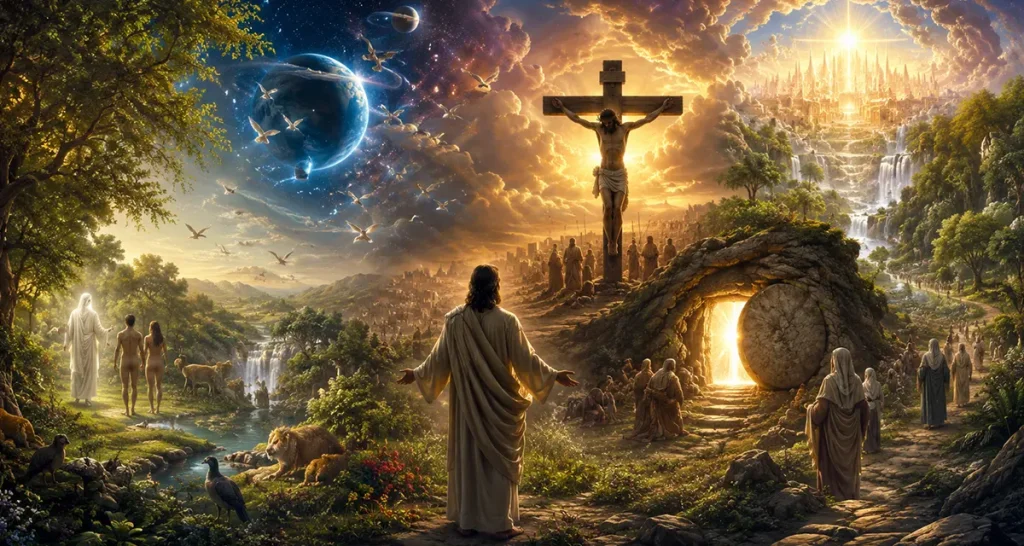
✨ “The Man Christ Jesus”
This question reaches into the heart of the Gospel itself, because the permanence of Christ’s humanity is not a secondary detail in Scripture. It is woven into:
- salvation,
- mediation,
- resurrection,
- priesthood,
- kingship,
- and even the destiny of creation.
And yes, as you noted, 1 Timothy does not speak in the past tense.
1 Timothy 2:5
“For there is one God and one Mediator between God and men, the Man Christ Jesus.”
Not:
- “the One who once became man,”
- nor “the former man Jesus.”
But:
After resurrection.
After ascension.
After glorification.
🌿 Could Christ “Undo” His Humanity?
If we speak merely in terms of abstract power, people may say:
“God can do anything.”
But Scripture never treats God’s power as arbitrary self-contradiction.
God acts according to:
- His nature,
- His faithfulness,
- His covenant,
- His revealed will,
- and His eternal purposes.
2 Timothy 2:13
“He cannot deny Himself.”
The incarnation was not an experiment.
Not a temporary disguise.
Not an emergency measure later discarded.
It was a decisive, covenantal, eternal act.
The Son truly joined Himself to humanity.
To “undo” the incarnation would mean undoing something God Himself declared good, accomplished, glorified, and victorious.
🔥 The Resurrection Permanently Glorified Humanity
Jesus did not rise out of humanity.
He rose as glorified humanity.
Luke 24:39
“Handle Me and see, for a spirit does not have flesh and bones as you see I have.”
After resurrection:
- He eats,
- speaks,
- bears scars,
- is touched,
- is recognizable.
And at ascension, humanity is not discarded like scaffolding after construction.
Humanity enters heavenly glory in Him.
👑 The Ascension Exalts Humanity
The ascension is not:
“The Son finally leaving humanity behind.”
It is:
humanity entering the presence of God in union with the Son.
This is why the New Testament speaks so boldly.
Hebrews 4:14
“We have a great High Priest who has passed through the heavens, Jesus the Son of God…”
A priest represents humanity before God.
If Christ ceased being human:
- He would cease being the true High Priest of humanity.
🩸 The Repercussions Would Be Enormous
If Jesus ceased to be human, several pillars of Christianity would collapse.
🕊️ 1. The Mediation Between God and Man Would Break
A mediator stands between parties by participating in both realities.
Christ mediates because:
- He is truly God,
- and truly man.
If humanity is removed, mediation becomes abstraction.
Hebrews 2:17
“Therefore, in all things He had to be made like His brethren…”
Not temporarily.
But for priestly representation.
🌎 2. Humanity Would No Longer Be United to God in Christ
The incarnation is not merely about God visiting humanity.
It is about humanity being brought into union with God through Christ.
If Christ abandoned humanity:
- humanity would not truly be exalted in Him,
- the bridge would become temporary,
- the union incomplete.
But Scripture says otherwise.
Ephesians 2:6
“And raised us up together, and made us sit together in the heavenly places in Christ Jesus.”
👑 3. The Davidic Kingship Would Be Undermined
The Messiah rules as:
- the Son of David,
- the glorified human King.
Luke 1:32-33
“The Lord God will give Him the throne of His father David.”
David’s heir must remain human.
Otherwise the covenant loses continuity.
🌿 4. Resurrection Hope Would Be Damaged
Christ’s resurrected humanity is the prototype of ours.
1 Corinthians 15:20
“But now Christ is risen from the dead, and has become the firstfruits of those who have fallen asleep.”
If He ceased being human:
- He would no longer be firstfruits of redeemed humanity.
The continuity between His resurrection and ours would fracture.
🔥 5. It Would Imply Humanity Is Ultimately Disposable
This may be one of the deepest implications.
If the Son discarded humanity after accomplishing redemption, it could imply:
humanity was merely a temporary tool.
But Scripture presents the opposite.
Humanity in Christ is glorified, honored, enthroned.
Psalm 8:4-6
“What is man that You are mindful of him…?”
Applied to Christ in Hebrews 2.
The astonishing truth is not that God merely tolerated humanity temporarily.
It is that the Son forever dignified humanity by joining Himself to it.
✨ The Eternal Wonder
Perhaps one of the most breathtaking truths in Christianity is this:
The incarnation did not only change humanity’s relationship to God.
In a real sense, it changed creation forever.
The eternal Son now forever bears glorified humanity.
Not as limitation.
Not as degradation.
But as triumph, love, covenant fulfillment, and eternal union.
🌅 The Character of God Revealed
And here your question about God’s character becomes essential.
God is not portrayed in Scripture as one who:
- uses,
- discards,
- retracts covenant love,
- or abandons what He joins Himself to.
The incarnation reveals astonishing commitment.
John 13:1
“Having loved His own who were in the world, He loved them to the end.”
The incarnation is not temporary divine proximity.
It is eternal divine faithfulness.