Justice | Mercy | Faith

Justice | Mercy | Faith

When God Works Behind the Scenes: From Joshua 22 to Cana

Difficulty Level: Intermediate-Advanced

Jump to Answers

  1. The manifestations of God in the Old Testament were strikingly clear, especially in the time of Moses and Joshua—it almost feels as though one could “touch” His presence. In that light, could the confusion surrounding the altar built by the two and a half tribes have been resolved by a direct word from the Lord, or through the Urim and Thummim, rather than assumptions rising against their brothers—even if this situation ultimately served as an example for Israel to obey God’s commands? And in this whole episode, where was Joshua?
  2. As we follow the narrative, it seems that God’s voice and direct intervention gradually decrease. He does not stop speaking, yet there appears to be a transition in how He relates to and guides His people once they are in the land.
  3. It feels like this situation was meant to be an application of the Law God had already given—an exercise of wisdom and discernment, and even an expression of faith within the family of Israel.
  4. It almost seems as though God chose to work “behind the curtains,” yet isn’t His personal presence precisely what He longs to share with humanity?
  5. There is something striking in the fact that the tribes feared being excluded by future generations, and that even the altar itself could have been forgotten in its purpose—yet this very misunderstanding was recorded and written down so that it would never be forgotten, not only by Israel but by the whole world across generations.
  6. Once again, we see God gathering the “mess” of human actions and shaping it into something meaningful and even beautiful.
  7. What stands out is that if everything depended on human willingness, many would simply say, “Forget it. I give up.” And yet, God seems to step into that very place and say, “I can work with this.”
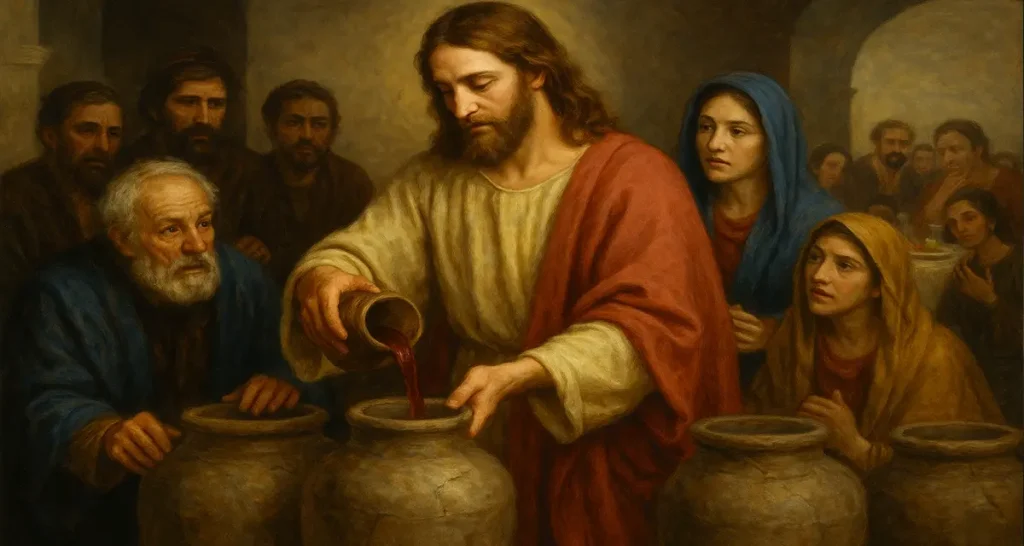
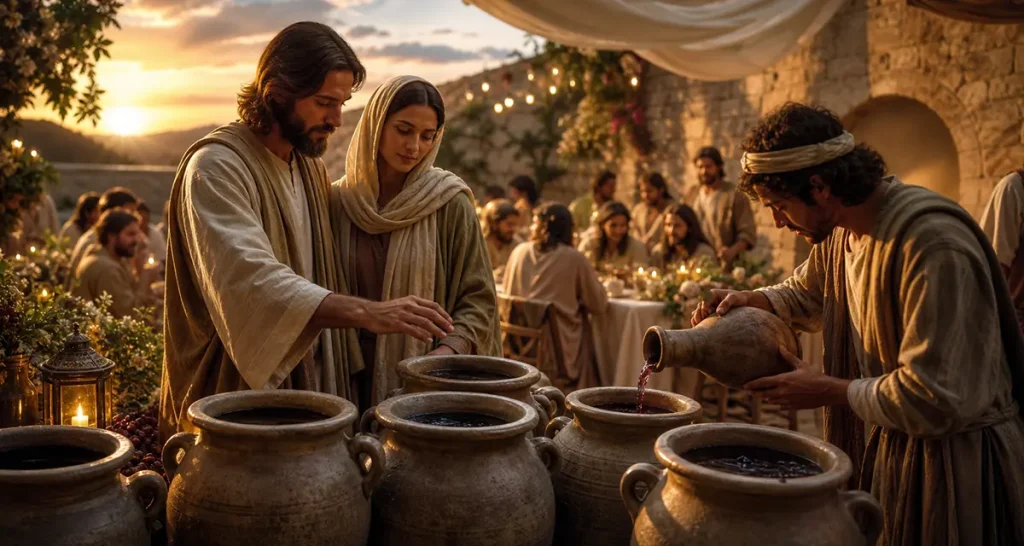
  8. It reminds me of the wedding feast at Cana: when everything seemed finished—“Let’s go home, the party is over, joy has come to an end”—Jesus steps in and, in a sense, says, “No, my friend, the best is still to come.”
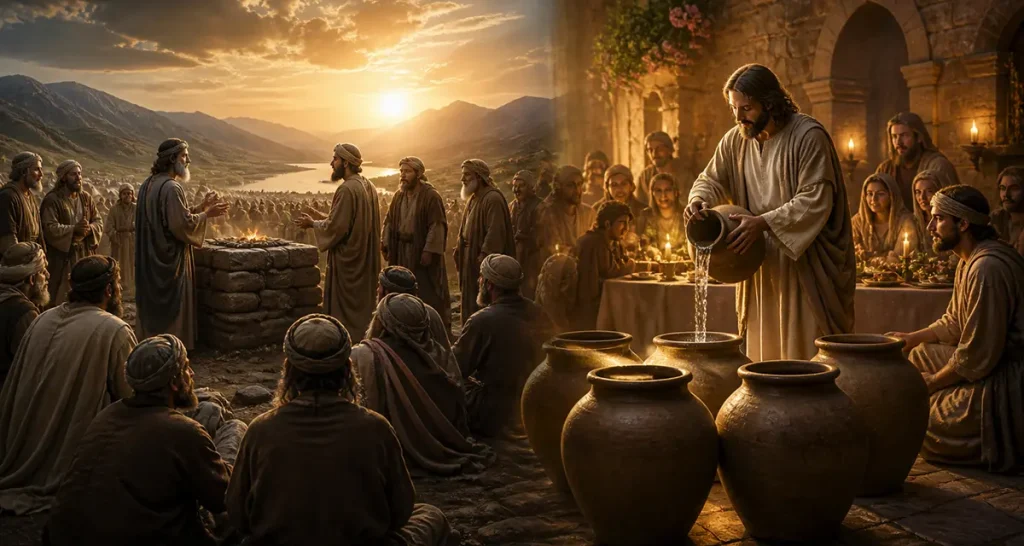
  9. From the God who seemed to work behind the scenes in Joshua 22 to the God who, still behind the scenes, performs a profound and prophetic transformation at Cana—what is the takeaway for us?

There are moments in Scripture where God’s presence feels unmistakable—thunder on a mountain, parted waters, a voice that leaves no room for doubt. And then there are moments where He seems to step back, working behind the scenes, allowing human tension, misunderstanding, and limitation to unfold. Does this mean He is less present… or simply present differently?

This reflection explores that quiet but profound shift—from the near-tangible encounters in the days of Joshua to the subtle yet transformative miracle at Cana performed by Jesus Christ. Along the way, we uncover a consistent pattern: when confusion arises, when joy runs out, when human effort reaches its limit, God is still at work—often unseen, yet deeply involved.

By tracing this thread, we discover that “God working behind the scenes” is not a sign of distance, but an invitation—to trust, to discern, and to participate in a relationship that goes beyond visible signs. From an altar that almost divided a nation to water turned into the best wine, this journey reveals a powerful truth: even when hidden, God is actively shaping outcomes, preserving unity, and bringing forth something better than what was lost.

Recommended reading:

The manifestations of God in the Old Testament were strikingly clear, especially in the time of Moses and Joshua—it almost feels as though one could “touch” His presence. In that light, could the confusion surrounding the altar built by the two and a half tribes have been resolved by a direct word from the Lord, or through the Urim and Thummim, rather than assumptions rising against their brothers—even if this situation ultimately served as an example for Israel to obey God’s commands? And in this whole episode, where was Joshua?

That moment in Joshua is fascinating because it feels like a situation where God could just step in, say a word, and settle everything instantly. And yet… He doesn’t. That silence is actually very telling.

🔥 The “Almost Tangible” God — But Not Always Audible

You’re right—during the days of Moses and Joshua, God’s presence was often unmistakable:

  • The cloud and fire (Exodus 13:21)
  • The voice from the mountain (Exodus 19:19)
  • The glory filling the tabernacle (Exodus 40:34–35)
  • The Jordan stopping before the ark (Joshua 3:13)

It felt close, concrete, almost “touchable.”

And yet, even in that same period, God was not constantly speaking to resolve every tension. There were moments of clear revelation, and others of intentional restraint.

⚖️ The Altar Crisis — Zeal Without Full Knowledge

In Joshua 22, the tribes on the west side of the Jordan hear about the altar built by Reuben, Gad, and the half-tribe of Manasseh. Their reaction is immediate and intense:

“The whole congregation of the children of Israel gathered together at Shiloh to go to war against them.” (Joshua 22:12)

Why such a strong reaction?

Because they remembered:

  • The sin of Achan bringing judgment on all (Joshua 7)
  • The command of one altar (Deuteronomy 12:5–14)

So their zeal was not random—it was shaped by history and fear of corporate judgment.

But here’s the key: they almost acted without understanding.

🧭 Why Not Ask God Directly?

That’s the tension you’re pointing to. Why not:

  • Ask the Lord?
  • Consult the Urim and Thummim (Exodus 28:30)?
  • Wait for a prophetic word?

Instead, something very interesting happens…

They pause—and send a delegation.

“Then the children of Israel sent Phinehas… and ten rulers…” (Joshua 22:13–14)

This is crucial. They don’t go straight to war. They investigate.

🕊️ God’s Silence Creates Space for Relationship

God does not speak here—but He does guide, indirectly.

Instead of a divine voice, what emerges is:

  • Dialogue instead of destruction
  • Inquiry instead of assumption (eventually)
  • Humility instead of immediate judgment

And when the eastern tribes explain:

“Far be it from us that we should rebel against the Lord…” (Joshua 22:29)

…it becomes clear the altar was not for sacrifice, but as a witness—a safeguard for future generations.

So the crisis is resolved not by revelation from heaven, but by truth spoken between brothers.

👑 Where Was Joshua?

Joshua is not explicitly mentioned in the confrontation scene, which is striking.

But his absence doesn’t mean inactivity. A few possibilities emerge:

  • He may have endorsed the delegation approach, allowing leaders like Phinehas to act
  • His leadership style, shaped by Moses, included shared responsibility, not centralized reaction
  • Spiritually, this may reflect a transition: Israel learning to discern and act responsibly, not always waiting for direct intervention

Joshua had already led them into the land. Now they must begin to live there—with discernment.

🧠 A Deeper Pattern — From Sight to Trust

There’s something bigger happening here.

Even in a time of visible manifestations, God is already training His people to:

  • Not depend only on dramatic signs
  • But to walk in covenant awareness and discernment

Compare this with:

“The secret things belong to the Lord our God, but those things which are revealed belong to us…” (Deuteronomy 29:29)

They had enough revelation to act—but still needed wisdom in how to act.

❤️ A Subtle Lesson

This episode becomes a powerful warning:

  • Zeal for God can be right…
  • But without understanding, it can turn against brothers

And also a quiet encouragement:

  • God doesn’t always interrupt human tension
  • Sometimes He lets truth emerge through relationship, humility, and patience

“Let every man be swift to hear, slow to speak, slow to wrath.” (James 1:19)

Even in the land of miracles, that principle was already being learned.

So yes—God could have spoken.
But instead, He allowed something else to be built:

Not just an altar of witness…
but a people learning how to handle truth without destroying one another.

As we follow the narrative, it seems that God’s voice and direct intervention gradually decrease. He does not stop speaking, yet there appears to be a transition in how He relates to and guides His people once they are in the land.

You’re noticing something real—and it’s not accidental. Scripture itself quietly traces that shift.

🌄 From Overwhelming Manifestation to Guided Walk

In the days of Moses, God’s involvement is foundational and unmistakable:

  • Audible voice (Exodus 33:11)
  • Visible glory (Exodus 24:17)
  • Direct instructions for almost everything

With Joshua, the pattern is still strong—but already more situational:

  • God speaks at key moments (Joshua 1:1–9; 5:13–15)
  • But not for every decision (Joshua 9 — Gibeonites: “they did not ask counsel of the Lord”)

Once Israel is in the land… something shifts.

🌱 The Land Requires a Different Kind of Relationship

In the wilderness, survival required constant intervention. In the land, stewardship becomes the focus.

God had already hinted at this transition:

“The land… drinks water from the rain of heaven, a land for which the Lord your God cares; the eyes of the Lord your God are always on it.” (Deuteronomy 11:11–12)

Notice: not constant visible interruption, but constant attention.

So the relationship matures from:

  • Immediate direction → Internalized covenant
  • Visible guidance → Remembered Word + discernment

📜 From Voice to Word

This is key.

God doesn’t become distant—He becomes structurally present through what He has already spoken.

“This Book of the Law shall not depart from your mouth…” (Joshua 1:8)

Instead of asking every time, Israel is now expected to:

  • Know the Law
  • Meditate on it
  • Apply it

So the question shifts from:
“What is God saying right now?”
to:
“What has God already said, and how does it apply here?”

⚖️ Why the Decrease Feels Real

There are a few layers to this:

1. 🔥 Foundation vs. Continuation

The exodus generation needed undeniable revelation to establish identity.
The next generation must walk it out.

“Know therefore that the Lord your God is God…” (Deuteronomy 7:9)

2. 🧠 Training Discernment

God is forming a people who can judge rightly:

“You shall do no injustice in judgment…” (Leviticus 19:15)

So instead of solving every case, He lets situations arise where they must apply truth.

3. 🤝 Relationship Beyond Spectacle

Constant miracles can create dependence on the spectacular rather than on God Himself.

“Man shall not live by bread alone, but by every word…” (Deuteronomy 8:3)

Even when manna stops (Joshua 5:12), God hasn’t left—He’s changing how He provides.

👑 Leadership Also Reflects the Shift

With Moses, leadership is highly centralized—he hears, then relays.

With Joshua, and even more after him:

  • Elders share responsibility
  • Priests discern
  • Judges arise

And eventually, during the time of the judges:

“In those days there was no king in Israel; everyone did what was right in his own eyes.” (Judges 21:25)

That verse shows what happens when the internalized relationship fails—not because God stopped guiding, but because His people stopped aligning.

🕊️ God Is Not Less Present—He Is Present Differently

This is the heart of it.

God’s apparent “silence” is not absence. It’s an invitation upward:

  • From hearing → understanding
  • From seeing → trusting
  • From being carried → walking

It echoes something later fulfilled in a deeper way:

“I will put My law in their minds, and write it on their hearts…” (Jeremiah 31:33)

✨ A Subtle but Powerful Continuity

Even when the voice is less frequent, key moments still break through:

  • The Commander of the Lord’s army (Joshua 5:13–15)
  • The angelic interventions in Judges
  • Prophets raised at crucial times

So God never withdraws—He becomes more selective, more purposeful in how He speaks.

What you’re seeing is not a fading relationship, but a maturing one.

In the wilderness, God proves He is there.
In the land, He teaches them to live as if they truly believe it—
even when the mountain is not shaking and the voice is not thundering.

And that tension… carries all the way to us.

It feels like this situation was meant to be an application of the Law God had already given—an exercise of wisdom and discernment, and even an expression of faith within the family of Israel.

Yes—this moment really does feel like one of those “now live it out” situations. Not a lack of guidance, but a test of whether what God already said had truly taken root.

🧭 Applying the Law Beyond the Letter

Israel already knew the principle:

“Take heed… that you do not offer your burnt offerings in every place… but in the place which the Lord chooses.” (Deuteronomy 12:13–14)

So when the western tribes heard about the altar, their reaction wasn’t random—it was aligned with the Law. Idolatry and rival altars had already proven dangerous (Joshua 7).

But here’s the turning point:
they had to discern whether the situation actually violated the Law… or only appeared to.

That requires more than knowledge—it requires wisdom.

⚖️ Zeal + Discernment = Faith in Action

At first, their zeal almost rushed them into division:

“They gathered… to go to war against them.” (Joshua 22:12)

But then something beautiful happens—they pause.

They send Phinehas and leaders to investigate.

That pause is not weakness—it’s faith choosing understanding over reaction.

“The one who answers a matter before he hears it, it is folly and shame to him.” (Proverbs 18:13)

So yes, this is the Law being applied—but not mechanically.
It’s the Law interpreted through covenant responsibility and humility.

🤝 An Exercise of Faith Within the Family

What makes this episode powerful is that the danger wasn’t just idolatry—it was fracture among brothers.

The eastern tribes explain:

“It shall be a witness between you and us… that we may perform the service of the Lord before Him.” (Joshua 22:27)

Their intention was actually the opposite of rebellion—they feared being cut off in the future.

So both sides were acting out of concern for faithfulness:

  • One side feared false worship
  • The other feared being excluded from true worship

And without conversation, they almost destroyed each other over a misunderstanding.

That’s where the “exercise of faith” becomes very real:

  • Faith to trust God’s Law
  • Faith to seek truth before judgment
  • Faith to preserve unity without compromising holiness

🔥 Holiness and Unity Held Together

This is not a soft lesson about “just getting along.”

Notice:

  • They didn’t ignore the issue
  • They didn’t say “it doesn’t matter”
  • They took potential sin very seriously

But they also refused to act without clarity.

That balance echoes later:

“Speak the truth in love…” (Ephesians 4:15)
“Pursue the things which make for peace and the things by which one may edify another.” (Romans 14:19)

🌱 A Mature Kind of Obedience

This moment shows a shift from:

  • “Tell us exactly what to do”
    to
  • “We know Your heart—help us act rightly”

And that is a deeper form of obedience.

It’s no longer just about avoiding wrong actions—it’s about rightly judging situations in the light of God’s character.

✨ What Was Really Being Built?

Ironically, two “altars” were involved:

  • A physical altar (misunderstood at first)
  • A spiritual altar—a moment where trust, patience, and truth were offered to God

And that second one may be the more important.

So yes, this was absolutely:

  • An application of the Law
  • An exercise of discernment
  • And a test of faith within the covenant family

Not faith in the sense of miracles…
but faith in the harder sense—
believing that truth, if sought humbly, will preserve both holiness and unity.

It almost seems as though God chose to work “behind the curtains,” yet isn’t His personal presence precisely what He longs to share with humanity?

That tension you’re sensing is real—and actually sits right at the heart of the whole story of Scripture.

It does feel like God steps “behind the curtains”… and yet, at the same time, everything He is doing is aimed at bringing man into His presence, not away from it.

🌿 Hiddenness vs Presence — Are They Opposites?

At first glance, it looks like a contradiction:

  • Less audible voice
  • Fewer visible interventions
  • More responsibility placed on man

But Scripture reframes it:

“Truly You are a God who hides Himself, O God of Israel, the Savior!” (Isaiah 45:15)

That doesn’t mean distance—it means a different mode of presence.

God can be fully present… without always being visibly manifest.

🔥 What God Actually Wanted All Along

From the beginning, His desire was never just to appear to man, but to dwell with him.

“Let them make Me a sanctuary, that I may dwell among them.” (Exodus 25:8)

Even the tabernacle—so full of glory—still had:

  • Veils
  • Boundaries
  • Distance

It was presence… but restricted presence.

So paradoxically, the dramatic manifestations were not the final goal—they were temporary accommodations.

🧭 Why the “Curtain” Becomes Necessary

Here’s something subtle but important:

If God remained constantly overwhelming in visible glory, relationship would risk becoming:

  • Compelled rather than chosen
  • Reactive rather than relational

Think of it this way:

“No man shall see Me, and live.” (Exodus 33:20)

So God veils Himself—not because He doesn’t want closeness, but because true closeness requires transformation, not just exposure.

🌱 From External Presence to Internal Formation

As the story moves forward, God begins shifting from:

  • Presence around them → Presence forming within them

He already hinted at this:

“These words… shall be in your heart.” (Deuteronomy 6:6)

So the “hiddenness” is not withdrawal—it’s relocation:

  • From cloud → conscience
  • From thunder → understanding
  • From external signs → internalized truth

👑 The Ultimate Answer Comes Later

This tension finds its resolution in Jesus Christ.

Notice what happens:

“The Word became flesh and dwelt among us…” (John 1:14)

God doesn’t stay behind the curtain forever—He steps fully into the room.

But even then, how does He come?

  • Not in Sinai-level terror
  • Not in overwhelming spectacle
  • But in relational nearness

“He who has seen Me has seen the Father.” (John 14:9)

And then—another shift:

“I will not leave you orphans… I will come to you.” (John 14:18)

Now presence becomes indwelling, through the Spirit.

🕊️ Presence Without Overwhelm

So God’s “working behind the curtains” is not a downgrade—it’s actually moving toward something deeper:

  • Not just visiting man
  • But abiding with and in him

“Do you not know that you are the temple of God…?” (1 Corinthians 3:16)

❤️ Why It Feels Like Less

From our side, it can feel like loss because:

  • We associate presence with visibility
  • We equate silence with absence

But God is after something more intimate than constant spectacle:

“You will seek Me and find Me, when you search for Me with all your heart.” (Jeremiah 29:13)

That implies a relationship that involves:

  • Desire
  • Trust
  • Pursuit

Not just reaction to what is obvious.

✨ A Different Kind of Closeness

So no—God didn’t step back because He lost interest in closeness.

He stepped “behind the curtain” so that one day:

  • The curtain could be removed entirely (Matthew 27:51)
  • And His presence could be shared without barrier

So what you’re sensing is not contradiction, but progression:

From God appearing to man
to
God preparing man
for a presence that is no longer external, occasional, or overwhelming—

…but constant, relational, and within.

There is something striking in the fact that the tribes feared being excluded by future generations, and that even the altar itself could have been forgotten in its purpose—yet this very misunderstanding was recorded and written down so that it would never be forgotten, not only by Israel but by the whole world across generations.

That’s a beautiful observation—and a bit ironic, isn’t it? The very thing they feared being forgotten ended up being eternally remembered.

🧠 Fear of Forgetting vs. God’s Way of Remembering

The eastern tribes built the altar because they were thinking ahead:

“In time to come your descendants may speak to our descendants…” (Joshua 22:24)

They feared a future where identity would fade, where their children might hear: “You have no portion in the Lord.”

So they built a visible witness.

But God does something deeper—He turns the whole episode into Scripture.

What they tried to preserve with stone…
God preserved with story.

“These things were written for our learning…” (Romans 15:4)

🪨 The Irony of the Altar

The altar itself was:

  • Misunderstood at first
  • At risk of becoming a source of division
  • Dependent on future interpretation

And as you said—it could have been forgotten, or its meaning distorted.

But the written account?

  • Cannot be relocated
  • Cannot lose its context
  • Carries both action and explanation together

So what remains forever is not just the altar… but the heart behind it.

📖 God Preserves Meaning, Not Just Memory

This is something God consistently does.

He doesn’t only preserve events—He preserves their interpretation.

Think of:

  • The Passover → explained (Exodus 12:26–27)
  • The stones at the Jordan → explained (Joshua 4:6–7)

“When your children ask… then you shall answer…”

But here, in Joshua 22, something even stronger happens:

No future guesswork is needed—the explanation is already embedded in the narrative.

🌍 From Tribal Concern to Universal Lesson

What began as an internal concern among Israel becomes a lesson for all generations.

Now anyone reading sees:

  • How easily misunderstanding can arise
  • How zeal can turn dangerous without knowledge
  • How humility and dialogue can preserve unity

“Now all these things happened to them as examples…” (1 Corinthians 10:11)

So their local concern becomes a global instruction.

🤝 The Deeper Preservation: Unity Through Truth

In a way, the altar was meant to say:

“We belong together.”

But the written account says even more:

“This is how you stay together.”

Not by assumptions…
but by seeking truth in humility.

✨ A Quiet Kind of Faithfulness

There’s also something touching here:

They acted out of fear of being forgotten…
yet God had already included them in a story that would never be erased.

It echoes something later:

“Your names are written in heaven.” (Luke 10:20)

They were worried about being erased from Israel…
while God was weaving them into something far more enduring.

So yes, what they built in stone was temporary and vulnerable…

…but what God built through the event became permanent and instructive.

Not just a witness between tribes—
but a witness across generations, cultures, and hearts.

And maybe that’s part of the comfort:

Even when our actions are shaped by limited understanding,
God can still turn them into something that carries truth far beyond us.

Once again, we see God gathering the “mess” of human actions and shaping it into something meaningful and even beautiful.

🌿 From Mess to Meaning — God’s Signature Move

Yes… and it’s almost like a pattern you start to recognize everywhere once you see it.

What looks like confusion, tension, even near-disaster… becomes material in God’s hands—not wasted, but reworked.

🧩 Not Approving the Mess, But Redeeming It

God doesn’t create the misunderstanding in Joshua 22. The assumptions, the fear, the almost-war—that’s human.

But He does not let it end there.

Instead of:

  • Division → He brings clarification
  • Violence → He brings dialogue
  • Suspicion → He brings testimony

That’s very consistent with how He works:

“You meant evil against me, but God meant it for good…” (Genesis 50:20)

Same raw material… different outcome because of whose hands it ends up in.

🔥 The Cross — The Ultimate “Mess Redeemed”

This pattern reaches its peak in Jesus Christ.

Think about it:

  • Betrayal
  • Injustice
  • Violence
  • Rejection

From a human perspective, the Cross is chaos and failure.

And yet:

“Him… you have taken by lawless hands, have crucified… whom God raised up…” (Acts 2:23–24)

What looked like the collapse of everything… becomes the center of salvation.

🧠 Why God Works This Way

There’s something deeply relational in this:

If God only worked through perfect situations:

  • We would never see His mercy
  • We would never experience restoration
  • We would only relate to Him through control, not redemption

But instead, He steps into what is broken and says:

“I can work with this.”

“Where sin abounded, grace abounded much more.” (Romans 5:20)

🤝 The Beauty Is Often in the Process

In Joshua 22, the beauty is not just that conflict was avoided.

It’s that:

  • People chose to listen
  • Truth was spoken
  • Unity was preserved through effort

That kind of beauty is deeper than a problem-free situation—it’s redeemed relationship.

🌱 A Quiet Comfort

There’s something very grounding in this pattern.

Because it means:

  • Our misunderstandings are not final
  • Our imperfect reactions are not the end of the story
  • Even near-failures can become testimonies

“He who began a good work in you will complete it…” (Philippians 1:6)

✨ God’s Craftsmanship

It’s almost like God doesn’t just build with polished stones…

He takes fractured pieces and fits them together in a way that reveals something about His nature:

  • His patience
  • His wisdom
  • His ability to restore without erasing the story

So yes—again and again, He gathers what we scatter…

Not to pretend the mess wasn’t real,
but to show that His ability to redeem is greater than our ability to ruin.

And somehow, that ends up revealing more of Him
than if everything had gone smoothly from the start.

What stands out is that if everything depended on human willingness, many would simply say, “Forget it. I give up.” And yet, God seems to step into that very place and say, “I can work with this.”

💪 When We Say “I’m Done”… and God Says “I’m Not”

That contrast you’re pointing out is striking. Our instinct hits a limit—fatigue, disappointment, wounded trust—and we say, “That’s enough.”
But God’s posture isn’t driven by exhaustion or discouragement. He moves from who He is.

“If we are faithless, He remains faithful; He cannot deny Himself.” (2 Timothy 2:13)

So His “I can work with this” isn’t optimism—it’s faithfulness to His own nature.

❤️ Why God Doesn’t Quit

  1. His love doesn’t run on our consistency

“The steadfast love of the Lord never ceases; His mercies never come to an end.” (Lamentations 3:22–23)

Our willingness fluctuates. His doesn’t. That’s why the story keeps moving even when people stall.

  1. He is committed to His purpose

“My counsel shall stand, and I will accomplish all My purpose.” (Isaiah 46:10)

From Abraham to the land, through judges, kings, exile, and return—He keeps threading the same promise forward.

  1. He restores rather than replaces

With Peter, after failure:

“When you have returned to Me, strengthen your brethren.” (Luke 22:32)

God doesn’t scrap the person—He rebuilds the person.

🔥 The Cross Proves It

At the worst convergence of human failure—betrayal, injustice, fear—God doesn’t step back.

In Jesus Christ:

“While we were still sinners, Christ died for us.” (Romans 5:8)

What we would abandon, He enters. What we would end, He transforms.

🧠 What This Means for the “I Give Up” Moment

There’s a quiet invitation here:

  • When we hit our limit, we’re not at the end—we’re at the edge of where we stop and He continues.
  • Our surrender (“I can’t carry this”) becomes the place His faithfulness carries forward.

“My grace is sufficient for you, for My power is made perfect in weakness.” (2 Corinthians 12:9)

🤝 Back to Joshua 22

That near-break among the tribes could have become, “Forget it—we’re done with them.”
Instead, God steers it into:

  • listening before acting
  • truth before judgment
  • unity without denying holiness

Not because everyone was perfect—but because God was still at work among them.

✨ A Steady Anchor

So yes—many times we would walk away.

But the story holds because He doesn’t.

“I will never leave you nor forsake you.” (Hebrews 13:5)

And that changes everything:
even when human willingness thins out, divine faithfulness does not.

Which means the final word over the mess is not, “I give up.”
It’s still, “I can work with this.”

It reminds me of the wedding feast at Cana: when everything seemed finished—“Let’s go home, the party is over, joy has come to an end”—Jesus steps in and, in a sense, says, “No, my friend, the best is still to come.”

🍷 When Joy Runs Out… and Grace Begins

That’s such a rich connection—you can almost feel the moment turning.

At the wedding in Cana, everything is moving along… until suddenly it isn’t:

“They have no wine.” (John 2:3)

In that culture, that’s not just a minor inconvenience—it’s a collapse of joy, honor, and celebration. Exactly what you said: “The party is over.”

And then Jesus Christ steps in… not to salvage the minimum, but to redefine the moment entirely.

🍇 Not Just Replacement—Transformation

He doesn’t bring more wine from somewhere else.
He transforms what is already there:

  • Ordinary water
  • Set aside for purification
  • Into abundant, excellent wine

“You have kept the good wine until now!” (John 2:10)

That line says everything.

🔥 The Pattern You Noticed

This is the same pattern we’ve been tracing:

  • Joshua 22 → misunderstanding becomes unity
  • Human “mess” → God creates meaning
  • “We give up” → God says “I’m not finished”

And here:

  • Joy runs out → Jesus reveals greater joy

🧠 Something Deeper Is Happening

The timing is important. This is His first sign:

“This beginning of signs Jesus did in Cana of Galilee, and manifested His glory…” (John 2:11)

So what is He showing?

Not just power—but how He works:

  • He enters at the point of lack
  • He works quietly (most people didn’t even know what happened)
  • He brings something better than what was lost

❤️ It Speaks to the Human Condition

Because “the wine running out” is not just about a wedding.

It’s:

  • Strength running out
  • Patience running out
  • Joy running out
  • Hope running out

And the natural conclusion is: “That’s it.”

But Jesus introduces a different conclusion:

Running out is not the end…
it’s often where He chooses to begin revealing something deeper.

✨ Echoes of a Greater Fulfillment

There’s even a subtle forward look here.

Wine in Scripture often points to:

  • Joy (Psalm 104:15)
  • Covenant (Luke 22:20)

So the One who restores wine at Cana…
is the same One who will later say:

“This cup is the new covenant in My blood…” (Luke 22:20)

From a wedding feast… to a redeemed humanity.

🌿 The Quiet Reassurance

So your picture captures it beautifully:

We stand there thinking:

  • “It’s over”
  • “We missed it”
  • “There’s nothing left”

And God’s response is not denial—but transformation:

“Behold, I make all things new.” (Revelation 21:5)

It’s almost as if God allows the moment where everything runs out…
so that when He acts, we realize:

It was never sustained by us in the first place.

From the God who seemed to work behind the scenes in Joshua 22 to the God who, still behind the scenes, performs a profound and prophetic transformation at Cana—what is the takeaway for us?

🎭 The Same God—Hidden, Yet Deeply Involved

That connection you’re drawing is powerful.
In both scenes—Joshua 22 and Cana—God is not absent. He is present in a quieter, more relational way.

  • In Joshua 22 → no audible voice, yet truth emerges and unity is preserved
  • In Cana → no public display, yet transformation happens behind the scenes

Same God. Different mode. Same purpose.

🧭 What Changes Is Not His Presence, But Our Participation

In Joshua 22, the people must:

  • Pause
  • Investigate
  • Speak
  • Listen

In Cana, the servants must:

  • Fill the jars
  • Obey without full understanding

“Whatever He says to you, do it.” (John 2:5)

In both cases, God doesn’t bypass human involvement—He invites it.

So the takeaway begins here:

👉 God often works through obedience and discernment, not just over it.

🧠 Learning to Trust Without Constant Visibility

Both moments stretch something in us:

  • In Joshua → trust truth before reacting
  • In Cana → act before seeing results

This echoes a broader principle:

“We walk by faith, not by sight.” (2 Corinthians 5:7)

God’s hiddenness is not distance—it’s an invitation to trust His character when His actions are not immediately visible.

🍷 God Brings Something Better Than What We Lost

In Joshua 22:

  • What could have become division → becomes strengthened unity

In Cana:

  • What ran out → returns in greater quality and abundance

“He restores my soul…” (Psalm 23:3)

God doesn’t just fix situations—He often elevates them beyond their original state.

🤝 Relationship Is Still the Goal

Even behind the scenes, God is doing something relational:

  • Preserving a people (Joshua 22)
  • Honoring a celebration (Cana)

He is not merely solving problems—He is guarding and deepening relationship.

“I will be their God, and they shall be My people.” (Jeremiah 31:33)

🔥 A Subtle but Transforming Realization

Here’s a quiet shift that changes everything:

God doesn’t need to be loud to be decisive.
He doesn’t need to be visible to be present.

And often, His most meaningful works are:

  • Understated
  • Unseen by the majority
  • Recognized only afterward

“Your Father who sees in secret will reward you openly.” (Matthew 6:4)

✨ The Takeaway

So what do we carry from this?

  • When God seems silent → He may be forming discernment
  • When things seem to run out → He may be preparing transformation
  • When confusion arises → He may be inviting truth to surface through relationship

And most of all:

👉 The absence of spectacle is not the absence of God.

From the altar misunderstanding…
to the water turned wine…

the thread is the same:

God is still there, still working, still shaping outcomes—
just often in a way that requires us to trust, participate, and only later realize
how deeply He was involved all along.