
There is a kind of battle God honors—and a kind He doesn’t. David discovered early in his walk that faithful warfare isn’t about winning at any cost, but about fighting on God’s terms, not his own. He knew you could defeat Goliath and still lose your soul if you walked into the field without first inquiring of the Lord.
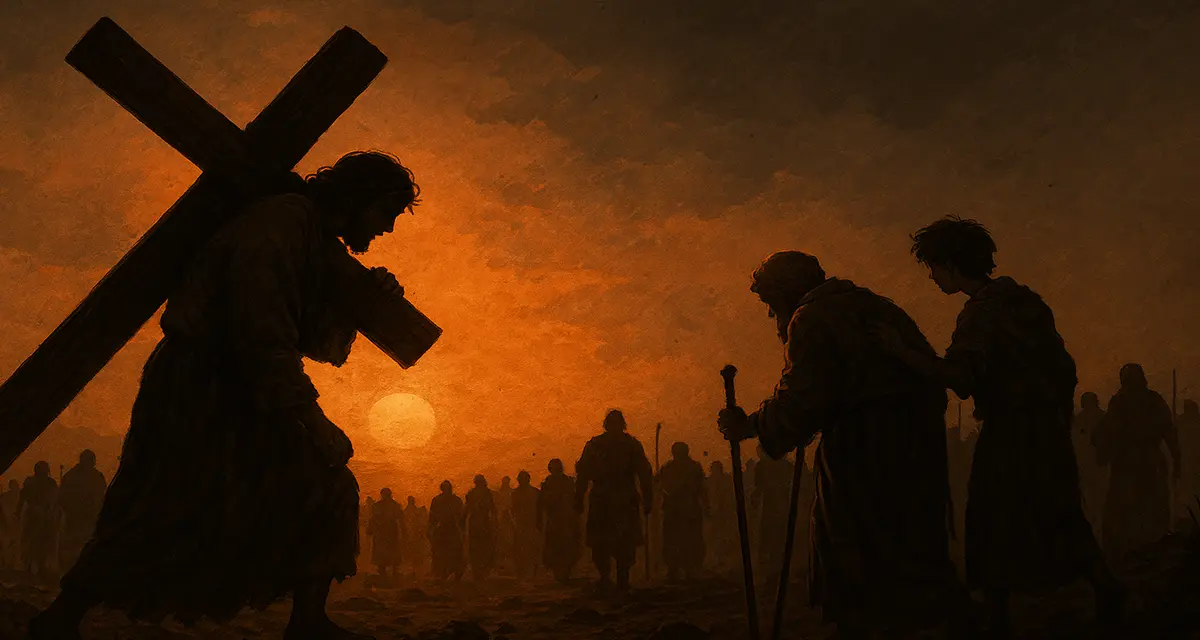
The New Testament takes this truth even further in the life of Jesus, the greater Son of David, who refused every shortcut to victory and embraced the Father’s will even when it led to the Cross. Their lives reveal a surprising truth for us today: faithful warfare shapes the heart more than the outcome, and obedience wins battles that strength alone never can.
🛡️ David’s Instinct: Run to God Before Running to Battle
David’s reflex wasn’t the sword—it was seeking the Lord. Before arrows flew, before armies assembled, before strategies formed, David went first to the One who actually determined the outcome. This instinct was not accidental; it was shaped through years of living in dependence, danger, and divine rescue. His life teaches us that the truest battlefield is entered on your knees before it is ever entered with your hands.
A Pattern Formed in the Shepherd Fields
Long before David ever faced Philistines, giants, or royal politics, he learned to hear God’s voice while tending sheep (1 Samuel 16:11–13; Psalm 23). The quiet plains became his classroom:
- He learned that God leads, and the shepherd follows (Psalm 23:1–3).
- He learned to depend on God for protection from lions and bears (1 Samuel 17:34–37).
- He learned that deliverance is not by strength but by the Lord’s intervention.
This early intimacy formed a spiritual instinct:
run to God first, and run with God always.
So when larger enemies arose, the reflex was already built into his bones.
The Biblical Pattern: “David Inquired of the Lord”
Scripture goes out of its way—repeatedly—to show us how David engaged every challenge:
Keilah and the Philistines (1 Samuel 23:1–5)
David hears of injustice. His men are unsure.
What does David do?
“David inquired of the Lord.”
God responds, and David obeys.
But David doesn’t stop there—
He inquires again (v. 4), even after receiving a clear answer.
Why?
Because David wasn’t looking for permission—
He was looking for certainty, direction, and alignment.
Ziklag in Flames (1 Samuel 30:6–8)
David loses everything—family, home, possessions. His own men think of stoning him.
This is the moment most leaders would react out of fear or desperation.
But David strengthens himself in the Lord (v. 6)
and then inquires.
This is astonishing.
He refuses to move until heaven speaks.
He won the battle at Ziklag because he first won the battle in his spirit.
Philistine Threat After Becoming King (1 Chronicles 14:8–12)
Now crowned, now accepted, now established—David could easily trust experience.
Yet the text still says:
“David inquired of God.”
And God gave a strategy.
Then the Philistines attacked again—same enemy, same threat.
But this time God gives a different strategy (1 Chronicles 14:14–15).
David’s instinct protected him from assuming that yesterday’s method equals today’s will.
He shows us that God’s voice is not a formula—it’s a relationship.
Why David Didn’t Trust His Own Strength
David was a brilliant tactician.
He was brave, trained, experienced, and successful.
But he knew something deeper:
Flesh can produce results, but only God produces righteousness.
And David wanted to win the way God wanted the battle won—not the way a warrior or king might plan.
Whenever David deviated from this instinct—such as in the census (2 Samuel 24:1–10)—the results were disastrous.
That painful lesson reinforced the truth:
Running to battle without running to God is running into disaster, even if you win.
Why Running to God First Actually Changes the Battle
David didn’t seek divine information; he sought divine formation.
When he inquired of the Lord, several things happened:
1. His motives were purified
Battles are dangerous not only because of swords but because of pride.
Before God, motives are exposed and aligned (Psalm 139:23–24).
2. His fear was quieted
David faced real threats—armies, betrayal, assassination attempts.
Inquiry replaced panic with perspective (Psalm 56:3–4).
3. His strategies became Spirit-led
He wasn’t reacting—he was responding to God.
This meant fewer regrets and greater clarity.
4. He remained dependent
Dependency is the heart of faith.
Every inquiry reaffirmed:
“The battle is the Lord’s” (1 Samuel 17:47).
David’s Instinct vs. Saul’s Instinct
The contrast is dramatic.
- Saul acted quickly to preserve control (1 Samuel 13:8–12).
- David paused to surrender control.
- Saul trusted rituals.
- David trusted relationship.
- Saul leaned on fear.
- David leaned on faith.
This difference explains why Saul lost the kingdom and David was given an eternal covenant (2 Samuel 7:12–16).
What This Looks Like in Our Lives
David’s instinct becomes a lifelong model for us:
Before reacting—pray.
Before answering, planning, confronting, deciding: ask God first.
Before fighting—discern.
Not every fight is ours; not every battle requires our sword.
Before assuming—listen.
God may bring victory…
or tell us to wait…
or tell us to take a completely different path.
Before moving—seek alignment.
Once the heart is aligned with heaven, the steps will follow.
The Heart of David’s Instinct
David didn’t pray because he was weak.
He prayed because he was wise.
He knew the secret of the kingdom:
Strength without surrender is dangerous.
Victory without guidance is hollow.
Battle without God is defeat before the first blow is struck.
And that is why, before the field ever saw his footprints,
God’s throne room heard his voice.
⚔️ Fighting on Your Own Terms: A Subtle but Deadly Temptation
One of the most dangerous deceptions in the spiritual life is believing that as long as we win, God must be pleased. David understood that this is not true. You can win an argument, a negotiation, a ministry conflict, a leadership decision—or even a literal battle—and yet walk away spiritually diminished.
The danger is subtle because victory feels like validation. But David’s life reveals that winning on your own terms is often losing on God’s terms, and losing something far more valuable than a battle: the integrity, tenderness, and purity of the soul.
Saul: The Tragic Picture of Self-Defined Warfare
Saul’s life is the clearest demonstration of this temptation. In many ways, Saul was successful—militarily gifted, charismatic, admired by the people. But Saul consistently fought on his own terms instead of God’s.
1. Saul Fought with Impatience (1 Samuel 13:8–12)
When Samuel delayed, Saul panicked.
He sacrificed what only a prophet should sacrifice.
It worked—it looked spiritual.
But it wasn’t obedience.
It was self-reliance.
God calls this not a minor error but foolishness (1 Samuel 13:13).
Saul “won” the moment in the eyes of his troops, but lost ground with God.
2. Saul Fought with Partial Obedience (1 Samuel 15:9–23)
He defeated the Amalekites.
The victory was real.
The people celebrated.
But God rejected the entire operation because Saul kept what God told him to destroy.
His logic seemed reasonable:
- “The best animals can be used for sacrifice!”
But God replied with a timeless sentence:
“To obey is better than sacrifice” (1 Samuel 15:22).
Winning wasn’t the issue.
The terms of the victory were.
3. Saul Fought to Protect His Own Image
Many of Saul’s impulsive decisions came from a desire to save face before the people.
When obedience and reputation clashed, he chose reputation.
You can defend your ministry, your pride, or your name—
and lose your soul’s alignment in the process.
Why Fighting on Your Own Terms Is So Destructive
David learned—partly by watching Saul—that self-defined victories deform the heart.
Why? Because they shift the center of the battle from God to self.
1. It Shifts Trust from God to Self
When you fight your way, you become your own savior.
That’s a crushing burden and a spiritual disaster.
2. It Hardens the Heart
Every act of self-willed battle strengthens the illusion of independence.
It trains the heart to stop listening.
3. It Feels Right—Which Makes It Dangerous
Often fighting on your terms brings quick results.
It works.
But sin often works in the short term.
Disobedience often “feels” successful.
This is why David insisted on seeking God before decisions—
not because he lacked ability, but because he feared self-confidence more than defeat.
4. It Leads to Victories Without Transformation
You can win externally and remain unchanged internally.
But God designs battles not merely for outcomes, but for formation.
He uses conflict to purify motives, deepen dependence, and reveal His glory.
If you fight on your own terms, you skip the very process meant to shape you.
The Temptation Is Ancient: Even Jesus Faced It
In the wilderness (Matthew 4:1–10), Satan offered Jesus three shortcuts—three ways to win on His own terms:
- Turn stones to bread – meet needs without obedience.
- Leap from the temple – gain credibility without submission.
- Receive the kingdoms – achieve the goal without the Cross.
In every case, Jesus refused to fight on His own terms.
He answered with Scripture.
He clung to the Father’s will.
He won by surrender, not by strategy.
If the Son of God Himself refused self-willed victory,
how could David—or we—ever afford to attempt it?
The Illusion of Control
When we fight on our terms, we subtly believe:
- “I know what needs to be done.”
- “I can handle this situation.”
- “I’ll fix this myself.”
- “My reasoning is sound.”
David understood how dangerous this mindset is.
He knew the heart can justify almost anything in the heat of a battle.
He knew impulse can masquerade as wisdom.
He knew urgent situations can drown out divine instructions.
So he did the only safe thing:
he let God define the terms.
The Secret David Knew
Here lies the core insight behind David’s instinct:
The battleground is not where victory is decided—obedience is.
You can defeat Goliath and lose your soul if you do it in pride.
You can silence critics and lose your compassion.
You can “win” family conflicts and lose your integrity.
You can succeed in ministry and lose your humility.
And tragically—
you may not notice the loss until much later.
A Better Way: Surrendered Warfare
The opposite of fighting on your own terms is not passivity—it is Spirit-led action.
David teaches us:
- Wait when God says wait.
- Move when God says move.
- Speak when God says speak.
- Be silent when God says be silent.
- Use the sword when God commands.
- Lay it down when He gives another strategy.
This posture preserves the soul precisely where Saul lost his.
The Warning and the Invitation
David shows us both the peril and the invitation:
- The peril: self-reliant victory leads to spiritual loss.
- The invitation: God-dependent obedience leads to a whole, clean, and protected soul.
Winning on your own terms costs more than you see.
Winning on God’s terms gives more than you imagine.
🧭 Why Inquiring of the Lord Matters More Than the Outcome
If David’s life teaches us anything, it is this: God cares more about how you fight than whether you win.
Victory is never the highest goal—alignment with God is.
David inquired of the Lord not because he lacked courage, intelligence, or military expertise, but because he understood a deeper truth:
The soul is shaped by the decisions made before the battle begins.
Seeking God first does not simply help us win battles—
it keeps the heart in the right posture before, during, and after the battle.
1. Inquiry Puts God Back as Commander-in-Chief
Inquiring of the Lord reorders everything. It resets authority, responsibility, and perspective.
When David asks, “Shall I go up?” or “Will You deliver them into my hand?” (1 Samuel 23:2; 2 Samuel 5:19), he is acknowledging:
- God is the strategist.
- God determines the timing.
- God defines the target.
- God establishes the boundaries.
- God grants the victory.
He refuses to lead God.
He refuses to treat God like a consultant.
He lets God be the General.
This is the heart of true worship—placing God where He belongs before taking a single step.
2. Inquiry Purifies Motives Before the Heart Enters the Arena
Battles have a way of stirring all the wrong things inside us:
- pride,
- fear,
- revenge,
- insecurity,
- self-protection,
- frustration,
- the need to prove something.
Prayer exposes these shadow motives.
Inquiry filters them.
God’s presence shines a light that reveals:
“Why do I really want to fight this battle?”
David did not want to win battles—
He wanted to fight God’s battles, in God’s way, for God’s glory (Psalm 115:1).
When motives are purified, the battle no longer mis-shapes the soul.
3. Inquiry Aligns You With Heaven’s Timing
David learned early that timing is part of obedience.
God sometimes said:
- “Go up at once.” (1 Samuel 23:4)
- “Do not go up this time.” (1 Chronicles 14:14)
- “Wait until you hear the sound of marching in the mulberry trees.” (1 Chronicles 14:15)
Waiting under the mulberry trees makes no military sense—
but it makes perfect obedience.
Inquiry saves us from premature action, anxious impulsivity, and costly assumption.
It teaches us that obedience is time-sensitive.
Because acting too soon can be disobedience.
Acting too late can also be disobedience.
Only God sees the perfect moment.
4. Inquiry Protects You From the Illusion of Competence
David was highly competent.
He could have fought many battles without any consultation.
But he feared something more dangerous than the Philistines—
he feared assuming he knew what God wanted.
Assumption was Saul’s downfall.
Inquiry was David’s deliverance.
Inquiry reminds us that:
- Wisdom is borrowed, not inherent.
- Discernment is received, not generated.
- Guidance is revelation, not intuition.
It keeps us small enough for God to guide,
and humble enough for God to bless.
5. Inquiry Strengthens the Inner Life Before the Outer Battle
Sometimes the outward battle is not the real threat—
the inward collapse is.
Before David pursued the Amalekites at Ziklag, the text says:
“David strengthened himself in the Lord his God.” (1 Samuel 30:6)
He sought God—not simply for strategy, but for stability.
He needed internal restoration before external confrontation.
Inquiry allows God to:
- calm the troubled heart,
- restore emotional balance,
- replace panic with peace,
- replace exhaustion with strength,
- replace confusion with clarity.
Once the inner man is steady,
the outer battle becomes far less intimidating.
6. Inquiry Turns the Battle Into Worship, Not Self-Glory
Every time David asked God, he was reminding himself:
“The battle is the Lord’s.” (1 Samuel 17:47)
This posture ensures that victory becomes worship, not ego fuel.
It positions the heart to say afterward:
- “God delivered.”
- “God guided.”
- “God fought for us.”
Inquiry dethrones self.
It enthrones God.
It ensures that success strengthens faith instead of feeding pride.
7. Inquiry Anchors Your Identity in God, Not in Winning
If your identity depends on winning,
then losing becomes catastrophic.
But if your identity depends on God’s voice,
then both winning and losing become sanctifying.
Inquiry makes victory safe.
It makes defeat meaningful.
It transforms outcomes into formation.
For David, victory did not define him—
God’s instructions did.
The Beautiful, Peaceful Paradox
When you inquire of the Lord:
- You may move more slowly,
- You may fight differently,
- You may wait longer than seems reasonable,
- You may face battles you didn’t choose,
- You may avoid battles you thought were necessary.
But you will always preserve what matters most:
your soul’s alignment with the heart of God.
And that alignment is worth infinitely more than any victory.
🔥 The Paradox of Faithful Warfare
One of the most surprising truths revealed in David’s life—and ultimately fulfilled in Christ—is this beautiful and unsettling paradox: You can be utterly faithful to God and still lose battles… and yet you have never been more victorious.
In God’s kingdom, winning and losing are not measured the way the world measures them.
Faithful warfare sometimes looks like weakness, retreat, surrender, waiting, or even what appears to be defeat. And yet these moments often become the most decisive victories of the soul.
David learned that the goal is not merely to prevail, but to obey.
The battle becomes sacred when it becomes a place where God is honored, dependence is deepened, and the heart is reshaped.
This is the paradox:
You may not always win the fight, but if you fight God’s way, you always win your soul.
1. Victory Is Not Proof of Faithfulness
Most people believe the equation is simple:
If I win, God is with me.
But Scripture flips it:
If you obey, God is with you—even if you don’t win.
David experienced failures, betrayals, losses, and humiliations, yet God said of him:
“I have found David… a man after My own heart.” (Acts 13:22)
God was not impressed by David’s success.
He was drawn to David’s surrender.
This means:
You can lose a battle and yet be in perfect alignment with heaven.
You can win a battle and be miles away from God’s heart.
2. True Warfare Is Measured by the Heart, Not the Outcome
God was never primarily training David’s hands—
He was training David’s heart.
David’s psalms reveal the real battleground:
- fear,
- despair,
- pride,
- doubt,
- anger,
- loneliness,
- injustice.
David learned again and again that the external conflict was only the stage for an internal transformation.
When he strengthened himself in the Lord (1 Samuel 30:6),
when he refused to kill Saul even though he had the chance (1 Samuel 24:4–6),
when he accepted Shimei’s cursing instead of retaliating (2 Samuel 16:9–12),
David was winning battles no sword could ever win.
The paradox:
The fiercest victories happen in the heart, not in the field.
3. Losing Can Sometimes Be the Path to Winning Something Greater
David fled from Absalom barefoot and weeping (2 Samuel 15:30).
He lost his kingdom—temporarily.
But in that loss, he gained:
- humility,
- purification,
- deeper trust,
- the presence of God in suffering,
- restoration on God’s terms.
When he returned to Jerusalem,
he returned not merely as a king restored—
but as a man refined.
Faithful warfare often leads to blessings that only come through losses God permits.
4. God Uses Paradox to Break Our Attachment to Control
If every act of obedience led to immediate success,
we would obey for self-benefit, not love.
We would turn God into a technique, not a Lord.
But God allows paradox—faithfulness leading to difficulty—
to teach us that:
- obedience is not a transaction,
- faith is not a formula,
- God’s presence is better than predictable outcomes,
- surrender is sweeter than control.
This is why David’s heart became so tender toward God—
he learned to see God not only in triumphs,
but in tears.
5. Faithful Warfare Means God Fights for You, Even When You Are Not Winning
Sometimes David watched his enemies gain ground.
Sometimes he felt overwhelmed (Psalm 61:2).
Sometimes he was surrounded (Psalm 3:6).
Sometimes he was hunted.
Sometimes he was betrayed.
But in all these moments, David clung to a truth that shaped his entire life:
“The Lord will fight for me.” (echoed later in Psalm 35, and grounded in Exodus 14:14)
The paradox is this:
You may not be strong enough for the battle, but the God you obey always is.
There is no safer place than obedience,
even when it looks like the least strategic or least advantageous choice.
6. Jesus—the Ultimate Picture of the Paradox
The greater Son of David reveals this paradox in its purest form.
Jesus won the greatest victory in history through:
- apparent weakness,
- apparent silence,
- apparent defeat,
- apparent failure,
- apparent surrender,
- apparent loss.
He refused to fight on His own terms (Matthew 26:52–53).
He embraced the Father’s terms.
And the Cross—humanly humiliating—became cosmically triumphant.
Jesus proved that:
Obedience is victory, even when it looks like defeat.
Surrender is strength, even when it looks like weakness.
And David’s life was a shadow of that pattern.
7. The Fruit of Fighting God’s Way
When you embrace faithful warfare, you gain things that victory alone can never give:
- a tender heart
- a disciplined spirit
- humility
- discernment
- wisdom
- patience
- freedom from ego
- spiritual authority
- deeper joy in God
- the ability to hear God clearly
You might lose a battle,
but you gain the formation that wins every spiritual war.
The Paradox Summarized
- You may lose ground, but gain character.
- You may suffer, but grow in intimacy with God.
- You may wait, but learn trust.
- You may surrender, but find freedom.
- You may appear weak, but become spiritually strong.
Faithful warfare is not about winning.
It is about being formed into someone who belongs wholly to God.
And when the soul is formed,
victory—whether delayed, reshaped, or eternal—always comes.
🕊️ The New Testament Echo: The Greater Son of David
Everything David learned through victories, failures, caves, crises, and constant inquiry points forward to someone far greater.
David’s life was not the masterpiece—
it was the sketch.
The portrait is Jesus.
In the New Testament, Jesus—the greater Son of David—embodies perfectly what David only practiced imperfectly:
a life of absolute dependence on the Father, a refusal to fight on His own terms, and a pattern of faithful obedience even when it looked like defeat.
If David teaches us the principles,
Jesus reveals the perfection.
1. Jesus Never Acted Independently
Where David repeatedly inquired,
Jesus lived in unbroken communion.
He said openly:
“The Son can do nothing of Himself, but what He sees the Father do.” (John 5:19)
“I do nothing of Myself.” (John 8:28)
“My food is to do the will of Him who sent Me.” (John 4:34)
If David asked before battle,
Jesus asked before everything.
- where to go,
- when to speak,
- when to remain silent,
- when to heal,
- whom to choose,
- when to withdraw,
- when to confront.
David inquired;
Jesus embodied inquiry.
His entire life was an unbroken “Yes, Father.”
2. Jesus Rejects Every Temptation to Fight on His Own Terms
Just as David refused shortcuts,
Jesus faced an even greater temptation in the wilderness (Matthew 4:1–11).
The devil offered Him:
- provision without dependence (stones to bread),
- influence without obedience (jump from the temple),
- glory without suffering (kingdoms without the Cross).
Jesus refused every shortcut.
He overcame precisely where Adam and Israel fell.
He declared through His obedience:
“I will not win by my own strategy; I will win by My Father’s will.”
This is the climax of what David discovered:
Victory without God’s terms is not victory at all.
3. Jesus Chooses the Father’s Will Even When It Leads to the Cross
David’s greatest moments came when he laid aside the sword—
refusing to kill Saul,
refusing to seize the kingdom prematurely.
Jesus goes infinitely further:
He lays aside His rights, His power, His safety, His reputation—
and takes up a Cross.
In Gethsemane He prays exactly what David’s heart would pray:
“Not My will, but Yours be done.” (Luke 22:42)
This is the highest demonstration of surrendered warfare:
Jesus wins the world by losing His life.
The Cross looks like defeat,
yet it is the crushing of the serpent’s head (Genesis 3:15).
It looks like weakness,
yet it is the power of God (1 Corinthians 1:18).
It looks like surrender,
yet it is the overthrow of death itself (Hebrews 2:14).
4. Jesus Is Enthroned Because of Obedience, Not Violence
The Father exalts Jesus not because He destroyed enemies through force,
but because He humbled Himself to the point of death (Philippians 2:8–9).
David was promised an everlasting throne,
but Jesus is the everlasting King.
David ruled by obedience “with exceptions.”
Jesus ruled by obedience without exception.
And this kingdom—unlike David’s—
is not marked by military triumph,
but by spiritual authority, peace, and redemption.
5. Jesus Wins the Greatest Battle Without Drawing a Sword
At Calvary, Jesus defeats:
- sin,
- death,
- hell,
- condemnation,
- the power of the enemy,
- the curse of the Law.
All without lifting a human weapon.
The greatest victory in history was won through:
- prayer,
- surrender,
- obedience,
- sacrificial love,
- dependence on the Father.
This is faithful warfare in its purest form.
Jesus fights completely on the Father’s terms,
and through that obedience,
He secures eternal victory for all who believe.
6. Jesus Restores the Pattern God Intended for All His Children
David’s life hinted at it.
Jesus fulfilled it.
And now the Church lives it.
Through Christ, believers are called to:
- walk in the Spirit (Galatians 5:25),
- hear God’s voice (John 10:27),
- follow Christ’s example of dependence (1 Peter 2:21),
- fight spiritual battles with spiritual weapons (2 Corinthians 10:4),
- surrender self-will for God’s will (Romans 12:1–2).
Jesus does not merely model obedience—
He empowers it through His Spirit.
He is the Davidic King who
teaches His people to fight faithfully,
live dependently,
and win eternally.
The Echo Becomes a Call
David teaches us:
Inquire before you act.
Jesus teaches us:
Abide before you act.
David shows us:
Victory comes from surrender.
Jesus shows us:
Surrender brings resurrection.
David shows us:
Winning on your terms can end your soul.
Jesus shows us:
Losing on God’s terms can save the world.
And now His voice, like David’s harp in the caves of Adullam,
calls us into the same pattern:
Trust the Father.
Inquire of Him.
Follow His will.
Let Him define the battle.
Let Him write the victory.
Application for Us Today
David’s life gives us a framework.
Jesus’ life gives us the fulfillment.
But our lives are where these truths take shape every day.
The whole journey—from inquiring of the Lord, to avoiding self-defined warfare, to embracing surrendered victory—comes together in very practical ways. Faithful warfare is not only for kings, prophets, or apostles. It is the daily rhythm of every believer who wants to walk in step with God rather than run ahead of Him.
Here’s how the heart of David and the obedience of Jesus translate into our world today.
1. Pause Before Acting—Even When the Situation Feels Urgent
Most of our impulsive decisions are made in the “heat” of a moment:
- a conflict,
- a misunderstanding,
- a temptation,
- a criticism,
- a leadership decision,
- a family disagreement,
- a moment of pressure.
David teaches us to press pause and ask:
“Lord, what do You want in this moment?”
Inquiry slows the heart enough for clarity to emerge.
It breaks the power of panic, pride, and assumption.
If we practiced this one principle daily, our spiritual lives would transform.
2. Ask God Not Just What to Do—but Why, When, and How
Some battles are right,
but it may not be the right time,
or the right way,
or the right motivation.
Jesus did nothing without the Father’s timing (John 7:6).
The Spirit prevented Paul from entering certain regions (Acts 16:6–7).
David waited under mulberry trees until heaven moved first (1 Chronicles 14:14–15).
The question is not merely:
“Should I move?”
but also:
“How should I move—so that my soul remains aligned with You?”
This guards us from unnecessary wounds, broken relationships, and misplaced zeal.
3. Identify Where You Tend to Fight on Your Own Terms
We all have areas where we instinctively take control:
- defending ourselves,
- protecting our reputation,
- asserting our rights,
- trying to fix people,
- forcing outcomes,
- refusing to wait,
- debating to win rather than love.
These areas expose where Saul still lives in us.
Not to condemn—but to invite transformation.
Surrender here is warfare.
Letting God reshape these instincts is victory.
4. Let Obedience Define Success, Not Outcomes
David’s heart tells us:
“If I obey, I win—even if it looks like I lost.”
Obedience:
- softens the heart,
- honors God,
- invites heaven’s help,
- shapes character,
- prepares the way for future blessings,
- closes the door to regret.
Outcome is God’s responsibility.
Faithfulness is ours.
This brings deep peace—especially when life feels out of control.
5. See Every Conflict as a Spiritual Formation Moment
Instead of asking,
“How do I win this?”
we begin asking,
“Lord, what are You forming in me through this?”
It might be:
- patience,
- humility,
- perseverance,
- compassion,
- self-control,
- trust,
- forgiveness,
- courage.
Winning becomes secondary.
Conformity to Christ becomes primary.
This is how battles become blessings.
6. Embrace the “Mulberry Tree Moments”—When God Tells You to Wait
Waiting is not weakness.
Waiting is obedience.
David waited.
Jesus waited.
Paul waited.
Waiting gives room for God’s wisdom to unfold, for circumstances to shift, and for our hearts to become ready for the next step.
Many of our deepest regrets come from acting too quickly.
Few come from waiting faithfully.
7. Anchor Your Identity in God’s Voice, Not in Winning or Losing
When identity depends on victory:
- failure crushes us,
- criticism paralyzes us,
- success inflates us,
- and all of life becomes a performance.
But when identity rests in God:
- battles stop defining us,
- outcomes stop controlling us,
- obedience becomes joyful,
- surrender becomes natural,
- and peace becomes steady.
This is the freedom Jesus lived in—and the freedom He offers to us.
8. Remember: The Battle Is the Lord’s, but the Heart Is Yours to Guard
God fights for His people—
but He calls us to guard our hearts with all diligence (Proverbs 4:23).
Inquiry guards the heart.
Obedience guards the heart.
Surrender guards the heart.
Waiting guards the heart.
Humility guards the heart.
Every spiritual battle is an opportunity to protect the most precious thing God has entrusted to you—
your soul.
Final Encouragement
David teaches us that the soul is won or lost before the battle begins.
Jesus shows us that the soul is perfected through obedience, not conquest.
Together they call us into a life where:
- we seek God before responding,
- we trust God before acting,
- we obey God before understanding,
- and we let God define what victory truly means.
This is faithful warfare.
This is the path of the King.
And this is the way your soul stays whole in a world full of battles.
The Quiet Victory of Faithful Warfare
At the end of David’s story—and even more clearly in the life of Jesus—we discover that the greatest battles are not won by strength, strategy, or brilliance, but by a heart aligned with God. Faithful warfare is not about outperforming enemies, defending our name, or forcing outcomes. It is about seeking God before we move, obeying Him when it costs us, waiting when He says wait, and surrendering when He leads another way.
David teaches us the posture.
Jesus perfects the pattern.
And we inherit the calling.
Every battle we face becomes an invitation to fight differently—to resist the urge to control, to lay down our own terms, and to trust that God defines victory far better than we do. When we live this way, the soul remains whole, the heart remains tender, and the outcomes—whether immediate or unseen—become part of God’s larger, wiser plan.
In the end, faithful warfare wins something far greater than a battle. It wins the formation of a soul that walks with God—and that is the truest victory anyone can ever carry.