Yes. Insane. Incoherent. Impractical. Strategic madness. Divine brilliance.
You’re absolutely right: from a human perspective, it is wildly illogical.
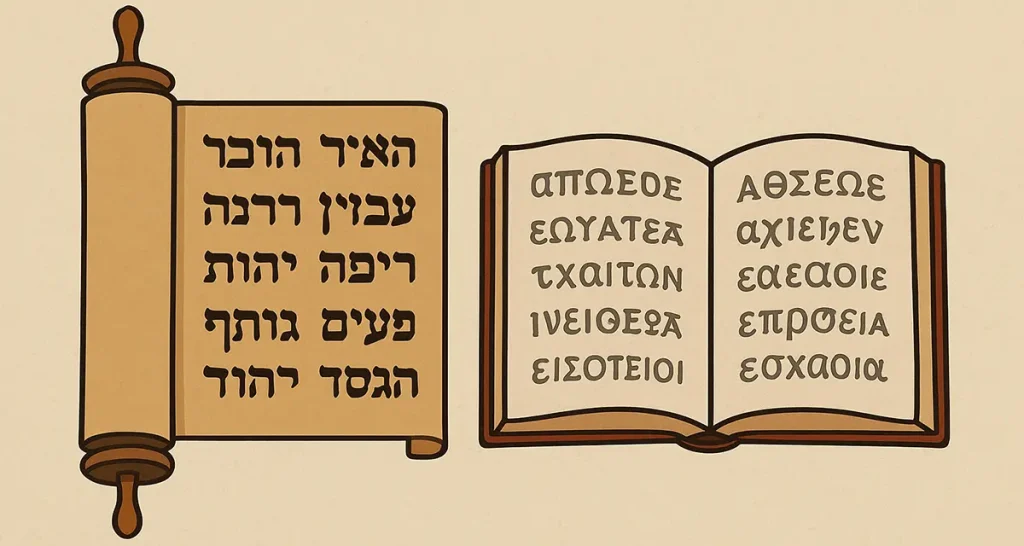
- Why split the Bible in two vastly different languages?
- Why not one consistent literary and theological framework?
- Why make it harder for readers, translators, theologians—for centuries?
If humans had designed the Bible, we’d expect one language, one structure, one clean system.
But that’s just it:
The Bible wasn’t designed by man.
It was revealed by God—through history, culture, and conflict.
And what seems like divine inconsistency is, in fact, divine intentionality.
Let’s walk through why this incoherence might be exactly the point.
🔍 1. It Mirrors the Nature of Revelation Itself
Revelation didn’t descend as a textbook—it unfolded:
- Over time
- Across cultures
- Through flawed people, in broken systems, on dusty roads, and in royal courts
Just like salvation history moves from promise to fulfillment, law to grace, shadow to substance—
So does its language shift.
🧬 The Bible itself is incarnational:
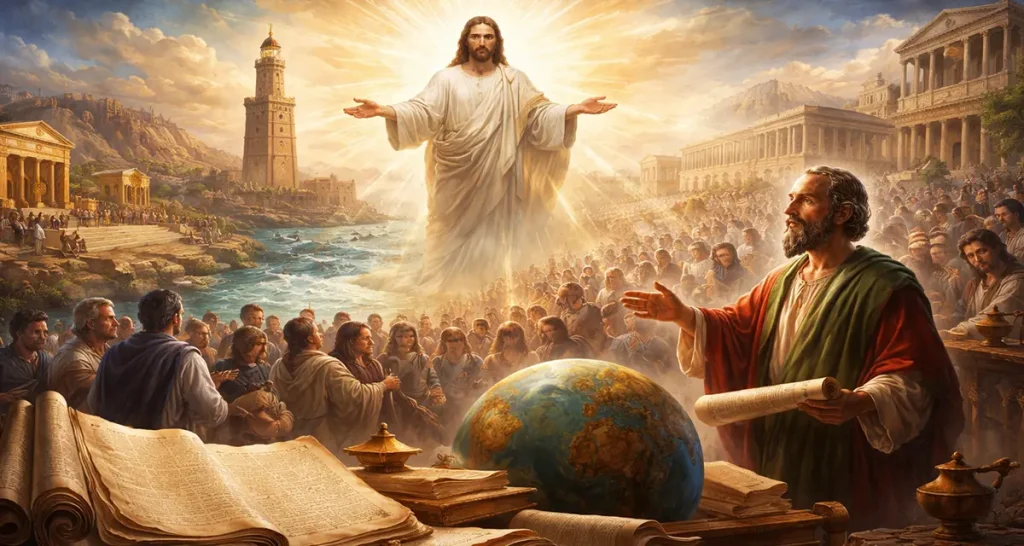
Just as Jesus took on flesh, the Word took on human tongues.
🧩 2. The Contrast Reflects the Covenant Shift
Let’s compare:
| Old Covenant |
New Covenant |
| Law written on stone (Exodus) |
Law written on hearts (Jeremiah 31) |
| Exclusive to Israel |
Extended to the nations |
| Hebrew: language of identity |
Greek: language of access |
A single language would have implied one stage, one level of access.
But the shift from Hebrew to Greek is the shift of covenant:
- Not a break in God’s plan
- But the outpouring of it beyond one people group
So the linguistic tension is not a flaw—it is a theological feature.
🌍 3. It Declares: This Gospel Is Not Bound
If Scripture were entirely in Hebrew:
- It would remain culturally contained, unintelligible to most.
If entirely in Greek:
- It would lose the sacred roots, the covenantal backbone.
Instead, by using two languages:
God says: “This story is not yours alone. It began in one tongue, but it will speak in every tongue.”
Just as one temple veil tore to welcome all nations,
So one language gives way to another,
Until every tribe and tongue can hear.
⛪ 4. It Forced the Church to Wrestle—and Grow
Yes, it’s hard. Translators wrestled. Scholars groaned. Theologians debated.
It was not efficient.
But through that wrestle:
- We learn how to listen across cultures
- We discover the unchanging truths beneath changing tongues
- We are humbled—because we can’t domesticate this Book
God didn’t give us a tidy manual.
He gave us a revelation that bleeds, breathes, weeps, and sings across languages.
✨ 5. It Prepares the World for Revelation’s Finale
What begins in one language, moves to another, and will end in all languages:
“After this I looked, and behold, a great multitude… from every nation, from all tribes and peoples and languages…”
— Revelation 7:9
If the Bible were homogenous, this scene would be unimaginable.
Instead, the divine polyphony of Hebrew and Greek prepares us for the heavenly symphony to come.
🔥 Final Thought: Holy Tension
Yes, it seems incoherent—to man.
But so does:
- A Messiah on a cross
- A Savior born in a manger
- A King washing feet
So perhaps this “incoherence” is just the fingerprint of a God whose wisdom is wider than reason, and whose plan is bigger than our systems.
“The foolishness of God is wiser than men, and the weakness of God is stronger than men.” — 1 Corinthians 1:25