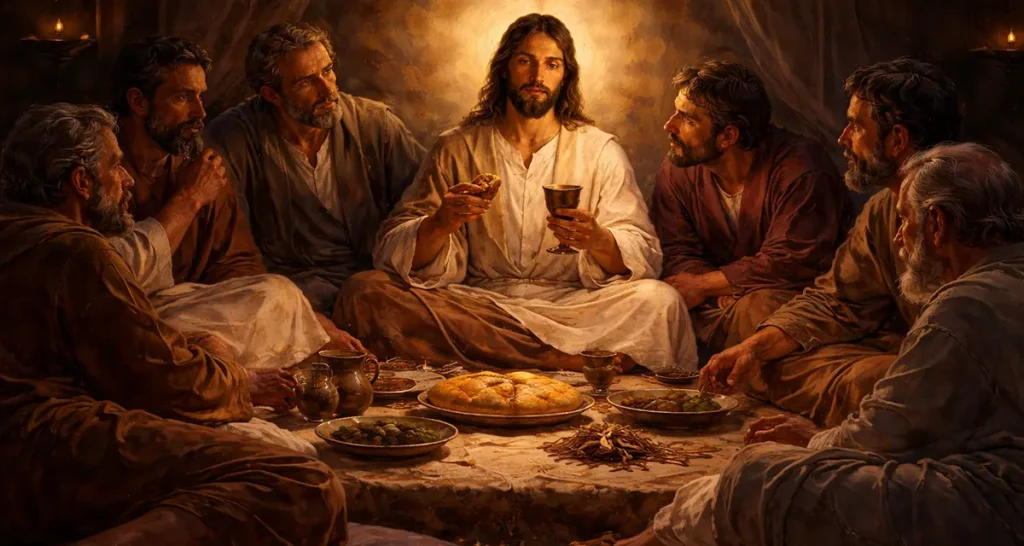
That single line — “having loved His own who were in the world, He loved them to the end” (John 13:1) — is John’s way of pulling back the veil so we can see the heart of Jesus in that tense room. It’s the apostle looking back, decades later, with eyes finally trained to understand what was really happening that night.
And it explains the entire emotional atmosphere of the Last Supper.
Love That Doesn’t Flinch ❤️
“To the end” in Greek (eis telos) carries two powerful meanings at once:
- To the final moment — all the way to the cross.
- To the fullest extent — to the absolute limit of love.
John is saying:
Every word Jesus spoke in that room was love.
Every warning, every comfort, every prayer, every tear — love.
Even the heaviness of the moment was love.
And this is striking because Jesus loved them knowing:
- Judas was already betraying Him (John 13:2).
- Peter would deny Him within hours (John 13:38).
- All would flee (Mark 14:27).
Yet none of that diminished His devotion. His love did not depend on their performance, strength, loyalty, or understanding.
He loved them to the end — not because they were faithful, but because He is faithful.
Love That Washes Feet 💧
John shows the “to the end” love in action when Jesus rises from the table, takes the towel, and washes their feet (John 13:4–5). Think about it:
- God washing dust off sinners.
- The Holy One cleansing the feet that will run away.
- The Creator kneeling before creatures.
That’s what “to the end” looks like in living form.
Love That Protects Weak Hearts 🌿
The heaviness of Jesus’ warnings (betrayal, denial, scattering) wasn’t condemnation — it was mercy.
He was preparing them so that:
- when Peter fell, he would remember Jesus’ words and return (Luke 22:32);
- when the disciples scattered, they would recall that Jesus already knew and still chose them (John 15:16);
- when the cross shattered their expectations, they would cling to His promises (John 14:1–3).
“To the end” means He refused to let their failures tell the final story.
Love That Enters Death for Them ✝️
The Passover heaviness reaches its deepest meaning here:
Jesus is hours away from the cross, and He loves them so fully that nothing — not even death — interrupts it.
John sees the connection clearly:
- The Lamb of God (John 1:29)
- In the Passover meal (John 13)
- Heading toward sacrifice (John 19:30)
- Crying “It is finished” — the telos, the completion of the love He promised.
The Last Supper is not merely tense.
It is the overflow of divine affection under the shadow of the cross.
John Finally Understood
When John wrote those words, he was no longer the young man at the table.
He was an old apostle, shaped by decades of remembering:
- the towel,
- the bread,
- the cup,
- the garden,
- the cross,
- the empty tomb,
- the ascension,
- and the Spirit who confirmed everything Jesus said.
Looking back, he sums it all up in one sentence that still softens the heart today:
He loved them to the end.