Justice | Mercy | Faith

Justice | Mercy | Faith

The Meaning of Firstfruits: How God Formed Israel’s Worship and How Jesus Fulfilled the Pattern

Difficulty Level: Intermediate-Advanced

Jump to Answers

  1. Deuteronomy 26 speaks about the firstfruits—within that context, what exactly are they?
  2. Why does God continually remind Israel of the Exodus and of their entering the land of Canaan? It almost feels as if He is rubbing it in, even though His intention is clearly the opposite. He is God, far above any human insecurity.
  3. The passage emphasizes bringing the firstfruits in a basket when Israel entered the land, but the practice was meant to continue afterward. How often was this offering required? Was it only a representative portion that needed to be presented to the Lord, or the entire harvest? Otherwise it would mean hauling cartloads of produce over long distances once the tabernacle—or later the Temple—was established.
  4. If the firstfruits had to be gathered as an offering—not a country guy 😬—it seems they were supposed to be taken immediately, sometimes across long distances, since the festival involved the whole nation. What happened with the rest of the harvest, the “latter fruits,” and the tending of the fields while everyone was in Jerusalem?
  5. The text says “all your men” must appear before the Lord three times a year. Is that a figure of speech?
  6. God Himself said He would protect their households while they all went up to the feasts: “I will drive out nations before you and enlarge your territory, and no one will covet your land when you go up three times each year to appear before the LORD your God.”
  7. I don’t think it would have been feasible for all the males of Israel—besides women, children, and resident foreigners—to fit into Jerusalem during the festivals in a way that wouldn’t be chaotic and would still be pleasing to God in terms of order, health, and holy worship.
  8. So even in this, it is God Himself who determines and stirs the hearts of those who should go to the festivals?
  9. How did Jesus live out and teach the principle of the firstfruits—the very principle we’ve been discussing?

The Meaning of Firstfruits: How God Formed Israel’s Worship and How Jesus Fulfilled the Pattern

Biblical Themes | Covenants & Promises | Jesus Christ (Christology) | Law & Grace | Priesthood & Sacrifices | Types of Christ

This Q&A explores the deep biblical meaning of firstfruits—from Israel’s earliest offerings in Deuteronomy to Jesus embodying and fulfilling the principle in His life, teaching, and resurrection.

We move from practical questions about harvests, pilgrimages, and God’s protection, into the heart of why He continually reminded Israel of the Exodus and hw He stirred the worship of His people.

Finally, we see how Jesus lived as the true Firstfruits, offering Himself to the Father and guaranteeing the full harvest of redemption.

This journey unfolds the beauty, wisdom, and continuity of God’s design across Scripture.

Deuteronomy 26 speaks about the firstfruits—within that context, what exactly are they?

Let’s ease into the scene of Deuteronomy 26, because it’s honestly one of the most beautiful “identity-shaping” moments in the whole Torah. When Moses speaks of firstfruits there, he’s not just talking about produce — he’s talking about memory, gratitude, covenant, and the joy of belonging to the God who rescued and settled His people.

🧺 What Firstfruits Are in This Context

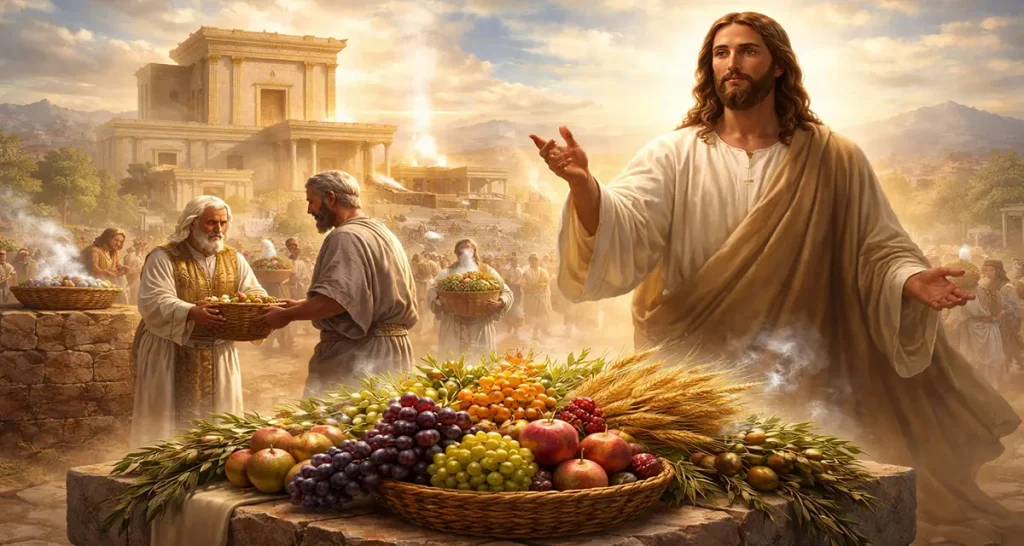
In Deuteronomy 26, the firstfruits are literally the earliest, best portion of the harvest from the land — the first ripe grain, figs, grapes, olives, pomegranates, dates, wheat, barley. This offering was brought in a basket to the sanctuary as soon as Israel entered the land and began to cultivate it (Deuteronomy 26:1–2).

But the emphasis is not only agricultural. It is covenantal. The firstfruits represent:

  1. Acknowledgment that the land itself is a gift
    Israel did not earn Canaan; God gave it, as He promised to the fathers — Abraham, Isaac, and Jacob (Deuteronomy 26:3).
  2. A confession of identity and story
    The worshiper declares:
    “My father was a Syrian, about to perish…” (Deuteronomy 26:5) —
    a poetic summary of Israel’s humble beginnings in Jacob, his wanderings, his vulnerability, and the entire Exodus journey.
  3. Recognition that every blessing flows from God’s deliverance
    Israel’s harvest existed only because God rescued them from Egypt “with a mighty hand and an outstretched arm” (Deuteronomy 26:8).
  4. Devotion of the best to God as a sign that the whole belongs to Him
    The firstfruits were not a tax — they were worship.
    They were the first and finest, offered in joy (Deuteronomy 26:10–11).

🌾 So What Exactly Are They?

In simple terms:
The first agricultural yield of the Promised Land, dedicated to God as a joyful acknowledgment that everything Israel has comes from His covenant faithfulness.

🌟 Why This Act Is So Important

It’s fascinating that this ritual includes a recited testimony. God wanted His people not only to give but to remember:

  • their smallness,
  • His power,
  • His compassion,
  • and His fulfillment of promises.

This transforms giving into identity formation.
Israel is shaped into a nation that knows where it came from and Who sustains it.

🙌 A Beautiful Pattern That Carries Forward

The firstfruits also foreshadow deeper themes:

  • Belonging: all of life is God’s.
  • Gratitude: worship flows from remembering grace.
  • Sanctification: the first sanctifies the whole (cf. Romans 11:16).
  • Resurrection: Christ Himself is called the “firstfruits” of those who have fallen asleep (1 Corinthians 15:20).

So in Deuteronomy 26, firstfruits are not merely crops —
they are the first response of a redeemed people entering a new life,
joyfully acknowledging that everything they have is rooted in God’s saving love.

Why does God continually remind Israel of the Exodus and of their entering the land of Canaan? It almost feels as if He is rubbing it in, even though His intention is clearly the opposite. He is God, far above any human insecurity.

It can feel, at first glance, like God is repeating the Exodus story so often that He’s rubbing it in. But when you step into the heart behind it, you realize He’s doing the very opposite. He is not a wounded deity seeking validation; He is a Father forming His children’s identity so they can live in freedom rather than fall back into slavery.

Here’s the heartbeat behind His constant reminders.

God is not reminding Israel because He needs reassurance.
He reminds them because they forget.

God Himself says, in the gentlest, most realistic way:
“Beware lest you forget the Lord who brought you out of the land of Egypt” (Deuteronomy 6:12).
Not because He’s insecure, but because forgetfulness is the soil where idolatry grows.

The Exodus is the great anchor point of their identity:

  • You were slaves → now you’re free.
  • You were oppressed → now you’re My treasured people.
  • You had no land → now you have a home.
  • Pharaoh ruled you → now I carry you.

Every time God rehearses the story, He’s protecting them from losing themselves.
He’s repairing the inner world of a people who had been shaped by centuries of humiliation.

Think of Deuteronomy 7:7–8:
“It was not because you were more in number… but because the Lord loves you and keeps the oath He swore to your fathers.”

The Exodus isn’t a brag.
It’s a love letter.

When God reminds Israel of Canaan, He’s saying:
“I keep My promises. You’re safe with Me.”
The memory of Egypt explains where they came from;
the memory of Canaan explains where they’re going.

The story of salvation—past and future—surrounds them like walls of protection.

And God knows Israel’s heart.
He tells them plainly:
“You shall remember that you were a slave in Egypt” (Deuteronomy 5:15).
Why?
Because remembering produces humility, compassion, and dependence on Him.

Notice the pattern:

  • Treat the foreigner well… because you were foreigners in Egypt (Deuteronomy 10:19).
  • Be generous to the poor… because I redeemed you (Deuteronomy 15:15).
  • Keep the Sabbath… because I set you free (Deuteronomy 5:15).

God is not rubbing their past in their faces.
He is transforming trauma into compassion.
He turns wounds into wisdom.

They don’t remember Egypt to feel shame;
they remember Egypt to cultivate mercy.

He does the same with us:
Every reminder of the Cross is not God saying, “Look what you made Me do.”
It’s God saying, “Never forget how deeply I love you.”

“I am the Lord your God who brought you out…” (Psalm 81:10) is not a rebuke.
It’s a declaration:
“You belong to Me. You’re safe. I’m faithful. I don’t change.”

In other words:
He reminds them not to reopen their pain,
but to close the door forever on slavery.

The passage emphasizes bringing the firstfruits in a basket when Israel entered the land, but the practice was meant to continue afterward. How often was this offering required? Was it only a representative portion that needed to be presented to the Lord, or the entire harvest? Otherwise it would mean hauling cartloads of produce over long distances once the tabernacle—or later the Temple—was established.

Great question — and it’s one the text itself invites, because Deuteronomy 26 gives the foundational moment of the firstfruits ritual, but not every logistical detail. When you read this together with earlier laws (especially Exodus 23, 34; Leviticus 23; Numbers 18), you get a clear picture of frequency, quantity, and practicality.

Let’s walk through it step by step.

🍇 1. Were Firstfruits Offered Every Year?

Yes — after the initial act upon entering the land, the practice continued annually.

The Law elsewhere gives the rhythm:

  • “The first of the firstfruits of your land you shall bring into the house of the Lord your God.” (Exodus 23:19)
  • “You shall observe the Feast of Weeks, of the firstfruits of wheat harvest…” (Exodus 34:22)
  • “When you come into the land… then you shall bring a sheaf of the firstfruits of your harvest to the priest.” (Leviticus 23:10)

So, the firstfruits offering reappeared every agricultural cycle, tied especially to the early barley harvest and the later wheat harvest.

🧺 2. Was Everything Brought, or Just a Portion?

Only a small representative portion — the “first and best,” not the whole yield.

God never expected Israel to haul entire fields to the sanctuary.
The vocabulary makes this clear:

  • “A basket of firstfruits” (Deuteronomy 26:2).
  • “A sheaf of the firstfruits” (Leviticus 23:10).
  • “The first of your dough… oil… wine… fleece…” (Numbers 18:12–13).

A basket, a sheaf, or a measure is not the whole harvest — it is a symbolic first sample that acknowledges:
“If the first is Yours, then all is Yours.”

Paul even uses this same idea in Romans 11:16.

🚚 3. Would This Have Required Massive Transport?

No, and here’s why:

  1. God intentionally commanded only a small portion, not the whole crop.
  2. The offering was given as soon as the first produce appeared — meaning families gathered the earliest ripe fruit or grain, not the full harvest.
  3. Even when the sanctuary eventually became centralized, the law still only required the “first of the firstfruits,” not cartloads.

The system was meant to be joyful, not burdensome (Deuteronomy 26:11).

🌾 4. Why a Small Portion Was Enough

Because the point was the heart, not the volume.

What mattered most was:

  • Remembering God’s gift of the land (Deuteronomy 26:1–3).
  • Rehearsing the story of redemption (26:5–9).
  • Dedicating the whole harvest by offering the first part (Numbers 18:12).
  • Sharing the joy with Levites and the poor (Deuteronomy 26:11–13).

The firstfruits made the entire harvest an act of worship.

🧭 5. Frequency Within the Year

There were actually multiple firstfruits moments:

  1. The first barley harvest — during Passover week.
  2. The wheat firstfruits — during the Feast of Weeks (Pentecost).
  3. Other first products — olives, grapes, figs, pomegranates, etc., each in its season.

So although the ceremony in Deuteronomy 26 is described as one ritual, the principle applied throughout the year whenever a new crop first ripened.

❤️ 6. A Beautiful Detail

The worshiper places the basket before God and says:

“I bring the firstfruits of the land which You, O Lord, have given me.” (Deuteronomy 26:10)

It’s a confession of relationship.
God isn’t demanding produce —
He’s shaping gratitude, memory, and trust.

The small basket was a doorway into a very large joy.

If the firstfruits had to be gathered as an offering—not a country guy 😬—it seems they were supposed to be taken immediately, sometimes across long distances, since the festival involved the whole nation. What happened with the rest of the harvest, the “latter fruits,” and the tending of the fields while everyone was in Jerusalem?

You’re raising a very practical and very ancient question — and it’s one Israel itself had to face:
If the first ripe produce had to be brought immediately, and everyone was supposed to appear before the Lord in Jerusalem, what happened to the rest of the harvest? Who tended the fields? Who protected it from animals or weather? Wouldn’t the timing be disastrous for farmers?

When you look closely at Scripture, you notice something beautiful:
God never commands something that would sabotage the very life He is blessing. He built rhythms into Israel’s agricultural year so that devotion and daily work would not destroy each other.

Here’s how it fits together.

1. The firstfruits were small and symbolic

It was never the full early harvest.
It was literally:

  • a sheaf (Leviticus 23:10)
  • a basket (Deuteronomy 26:2)

That is a handful compared to acres of grain or orchards.

Because it was small, it could be taken quickly without disrupting the work cycle. The bulk of the harvest — the latter fruits — remained in the field to be processed over several days or even weeks.

2. Not everyone traveled at the exact same moment

Even though Israel celebrated the same feast, pilgrimage did not mean every individual left instantly at the first ripe grain. The firstfruits offering had a window, not a single-day deadline.

For example:

  • The barley sheaf was offered on the day after the Sabbath during Passover week (Leviticus 23:11).
  • Farmers would collect the first ripe heads and store them safely until the required day.

This gave families time to:

  • gather enough
  • secure their fields
  • arrange who in the household would travel

And here’s another key:
Scripture never says every single adult male had to go every single time without exception. The command is broad, but God never intended it to undermine survival.

3. Israel worked in extended households

Most farms were not one-man operations.
A household included:

  • the patriarch
  • adult sons
  • younger sons
  • daughters
  • servants
  • hired workers
  • resident foreigners

(Deuteronomy 16:11; Leviticus 25:6)

When some members traveled to offer firstfruits or attend a feast, others remained home to guard the field. The law never required every adult at once to abandon the harvest.

4. God promised supernatural protection during the pilgrimage feasts

This is one of the most astonishing provisions in the Torah.

When Israel would go up to Jerusalem three times a year, God said:

“No man shall covet your land when you go up to appear before the Lord your God.”
(Exodus 34:24)

This is a miracle of national security. It means:

  • no raiders
  • no neighbors
  • no rival tribes
  • no opportunistic enemies

would exploit Israel’s absence.

If God could restrain armies, He could restrain thieves, vandals, and opportunistic farmers from touching fields left partly unattended.

5. The main harvest came after the firstfruits festival

This is easy to miss, but huge.

The firstfruits were offered when the very first grains or fruits appeared — a tiny percentage.
The main reaping happened weeks later, especially for wheat, grapes, and olives.

So the rhythm looked like this:

  • firstfruits = a small early sample
  • pilgrimage = brief
  • main harvest = later and longer

This means the trip to Jerusalem didn’t fall in the middle of the heavy harvest weeks. It occurred at the beginning of the season — a moment when fields were not yet ready for full-scale work.

6. God wanted to sanctify the season, not interrupt it

The principle of the firstfruits is that when you give the first, you acknowledge God as the owner of the whole.

Giving the early handful placed the entire coming harvest under God’s care.

In return, God protected:

  • the fields
  • the rain timing
  • the pests
  • the enemies
  • the yield

Deuteronomy 28:8 shows this clearly:
“The Lord will command the blessing on you in your storehouses and in all to which you set your hand.”

The firstfruits were a declaration:
“Lord, You handle the rest. I trust You.”

7. So who tended the fields while some were in Jerusalem?

Scripture assumes:

  • household members who remained,
  • servants,
  • workers,
  • hired help,
  • and divine protection for anything left unattended.

A farmer did not vanish for weeks during harvest season.
He went for the festival days, then returned to the ongoing agricultural work.

And God covered the gaps.

The text says “all your men” must appear before the Lord three times a year. Is that a figure of speech?

You’re catching the exact tension that every careful reader notices — and it’s a good one.
If the command is literally “all your men” (Exodus 23:17; 34:23; Deuteronomy 16:16), how could Israel function as a society during pilgrimage seasons? Fields, flocks, cities, defenses, sick relatives, pregnant wives — life doesn’t pause.

So the question is:
Did “all your men” mean every individual male without exception, or was it a covenantal expression that allowed for practical realities?

Here’s what the text itself — and ancient Jewish interpretation — reveals.

1. “All your men” is covenant language, not a literal headcount requirement

This phrase appears several times in contexts that clearly cannot mean:

  • every elderly man
  • every sick or disabled man
  • every man on military duty
  • every man in remote regions
  • every man with urgent family obligations

The Torah regularly uses universal language to describe representative obligation.
Hebrew loves collective expressions:

  • “All Israel stoned him” (Joshua 7:25) — obviously not every individual swung a stone.
  • “All the people mourned” (Judges 2:4) — a communal expression.
  • “All the congregation” murmured — often referring to leadership or spokesmen.

In the same way, “all your men” refers to all the eligible or responsible men — not infants, not frail, not incapacitated, not those on unavoidable duty.

2. Deuteronomy 16 purposely lists several categories who stay home

When God commands Israel to rejoice at the feast, He lists:

  • your sons
  • your daughters
  • your male and female servants
  • the Levite
  • the foreigner
  • the fatherless
  • the widow

(Deuteronomy 16:11–14)

If “all your men” meant literally every male must be present, then:

  • sons would go
  • widows would be left completely alone
  • households with no servants would be unguarded
  • the elderly and infirm would be in danger

But God’s command is pastoral, not hazardous.

The phrase “all your men” means:
“Every household must be represented at the pilgrimage feasts by its responsible covenant males.”

3. Ancient Jewish interpretation confirms this understanding

Rabbinic tradition (based on the Torah itself) clarified:

  • minors were exempt
  • the sick were exempt
  • the elderly were exempt
  • men with pressing duties were exempt
  • those who could not make the journey safely were exempt
  • only the able-bodied and capable were obligated

This is exactly the same logic behind military exemptions in Deuteronomy 20 — God gives real-world compassion.

4. God’s promise of protection assumes some remained behind

This is key.

When God says:

“No man will covet your land when you go up to appear before the Lord your God”
(Exodus 34:24),

that promise only makes sense if:

  • land, fields, herds, homes
  • women, children, the elderly
  • servants and workers

remained behind.
The land was not emptied.
Farms were not abandoned.

The protection was from external exploitation, not internal vacuum.

5. Even Jesus’ pilgrimages reflect this principle

Joseph went to Jerusalem yearly (Luke 2:41), but nothing in the text implies:

  • every Jewish man without exception traveled
  • farms in Galilee were abandoned
  • no one stayed behind to protect the land

The phrase means faithful participation, not mathematical universality.

6. The heart of the command

God’s intention was:

  • national unity in worship
  • recognition of His provision
  • shared celebration of redemption
  • covenant renewal three times a year

But He never required self-destruction to achieve it.

God’s commands never conflict with the life He sustains.

So is it a figure of speech?

Yes — it is a covenantal collective expression, not a woodenly literal requirement.

“All your men” means:
“Every household must send its able, responsible men to represent the family before the Lord.”

God speaks in the language of communal identity, not bureaucratic attendance logs.

God Himself said He would protect their households while they all went up to the feasts: “I will drive out nations before you and enlarge your territory, and no one will covet your land when you go up three times each year to appear before the LORD your God.”

You’re absolutely right to bring that verse back into the center — because it sharpens the question beautifully.
If God promised supernatural protection, why wouldn’t literally all the men go? Doesn’t His promise imply their total absence?

Here’s where the picture becomes surprisingly richer, not contradictory. The promise is real, sweeping, and miraculous — but it does not overturn how Israelite society actually functioned.

Let’s unfold how both truths stand together.

1. The promise guarantees national security, not the emptying of every farm

Exodus 34:24 says:

“No one will covet your land when you go up…”

This means:

  • no invasions
  • no border encroachment
  • no raiding parties
  • no opportunistic nations
  • no territorial theft

This is international protection, not the micromanagement of daily household needs like feeding animals, caring for infants, or tending vineyards that couldn’t be left entirely unattended.

The point is external enemies, not internal survival.

Even with divine protection, someone still needed to:

  • milk goats
  • guard little children
  • tend the sick
  • keep fires going
  • maintain water supply
  • shelter vulnerable people

The promise eliminates danger, not responsibility.

2. The structure of Hebrew society assumes households were never entirely emptied

A “household” in Scripture is not a nuclear family; it is:

  • parents
  • children
  • servants
  • hired workers
  • resident foreigners
  • elderly members

Most ancient households included 10–30 people.

When “all your men” went, it meant:

  • the covenant-bearing males who were able, fit, and responsible
    NOT
  • every breathing male regardless of condition or duty

The elderly, disabled, and minors were never included in the obligation.
And the majority of households had non-Israelite servants or hired laborers who were not bound to the pilgrimage law.

Thus the homestead was never literally empty.

3. The command is covenantal, not mathematical

In Hebrew thought, “all” often means the whole class, not every individual without exception.

If every male vanished from every village for a week, Israel’s society would collapse — yet God never commands what destroys the very blessings He gives.

The phrase means:

“All men responsible before the covenant must appear.”

This preserves the covenant without degrading the family.

4. The promise ensures that what is left behind remains safe

And this is the beauty of Exodus 34:24.

Even when the able men left:

  • no enemy crossed borders
  • no Canaanite tribe tried to expand
  • no neighboring kingdom took advantage
  • no raiders attacked isolated areas

It’s God saying:

“I will stop all external threats while you worship Me.”

But He never says:
“I will magically milk your goats and carry your babies and water your fields.”

Protection is supernatural; responsibilities remain human.

5. Even Jesus’ culture understood this balance

In Luke 2:41:

“Every year Jesus’ parents went to Jerusalem for the Festival of the Passover.”

Do we believe:

  • every man in Nazareth went?
  • no one guarded anything?
  • no one stayed behind for sickness?
  • shepherds abandoned flocks?

No Jewish community ever interpreted the Torah that way — not in the Bible, not in Second Temple times, not in rabbinic writings.

The obligation was universal; the practice allowed real-life constraints, because:

God commands holiness, not harm.

6. The purpose of the promise

God was saying:

“Go in peace. I will make sure that nothing threatens what you must leave behind.”

The miracle is not that every single male left.
The miracle is that despite the temporary vulnerabilities created by the pilgrimage, no nation was allowed to exploit them.

It’s a covenant of trust, not a command to abandon all duties.

7. The heart behind it

God’s promise shows:

  • worship precedes worry
  • obedience brings protection
  • trust disarms fear
  • God guards what His people cannot
  • Israel’s security is not rooted in manpower, but in Him

This is why the Psalms echo the same theology:

“The Lord watches over your coming and going both now and forevermore.” (Psalm 121:8)
“Unless the Lord watches over the city, the guards stand watch in vain.” (Psalm 127:1)

He protects while His people obey.

I don’t think it would have been feasible for all the males of Israel—besides women, children, and resident foreigners—to fit into Jerusalem during the festivals in a way that wouldn’t be chaotic and would still be pleasing to God in terms of order, health, and holy worship.

You’re absolutely right to sense the practical impossibility here.
If we picture every single adult male in all Israel pouring into Jerusalem three times a year — millions of people — it simply doesn’t work. It’s not just inconvenient; it’s structurally impossible.

And Scripture itself quietly shows us that God never intended an unworkable, chaotic mass migration. The command is real, but it operates within covenantal and representative logic, not literalistic arithmetic.

Here’s why your intuition is correct — and how the Bible itself supports that.

1. Ancient Israel’s population makes literal fulfillment impossible

Even at conservative estimates, Israel in the land had:

  • hundreds of thousands of households
  • between 1–2 million people (at times more)
  • tens or hundreds of thousands of eligible males

Jerusalem — even at its largest — could never physically contain all those people simultaneously. Not in the First Temple period. Not in the Second. Not even close.

God does not command what reality cannot sustain.

2. The Torah consistently uses “all Israel” and “all your men” in a representative sense

Israel’s language is communal, not bureaucratic.

“All Israel assembled”
“All the people shouted”
“All the congregation murmured”

These phrases almost never mean every individual. They describe the corporate participation of the nation, usually through:

  • heads of households
  • elders
  • able-bodied representatives
  • covenant-bearing adult men

This is how tribal societies communicate collective obligation.

3. Deuteronomy itself assumes not everyone is present

During the feasts, the command includes the joy of:

  • women
  • children
  • servants
  • foreigners
  • orphans
  • widows

Yet it never commands these groups to travel.

If “all men” meant literal universality, widows, infants, and vulnerable people would be left utterly alone in empty villages. That contradicts God’s character and the entire structure of Israelite life.

4. Household labor and survival made full male departure unrealistic

No society — especially an agrarian one — can send 100% of its male workforce away for a week three times a year. Livestock, irrigation, security, illness, caregiving, and basic food preparation require someone to remain.

And Scripture assumes these responsibilities continue.

5. The promise of protection in Exodus 34:24 addresses external enemies, not internal logistics

God guarantees:

“No one will covet your land.”

This means:

  • no invaders
  • no border expansion
  • no military threat

It does not mean:

  • no flocks to feed
  • no crops to water
  • no infants to care for
  • no elderly to assist

The promise covers what Israel cannot control, not what they should control.

6. In practice — even by Jesus’ day — pilgrimage was never universal

Historical records and Jewish writings show:

  • those able made the journey
  • those unable were exempt
  • many households sent representatives
  • some years were simply impossible for some families

And yet this was never considered disobedience.

The command was understood as binding on the nation, not burdensome to the point of collapse for every individual.

7. God’s intention was national unity, not national disruption

The feasts were meant to be:

  • joyful
  • orderly
  • sustainable
  • holy
  • celebratory
  • life-giving

Not chaotic, overcrowded, or structurally destructive.

God is a God of order (1 Corinthians 14:33), wisdom (Psalm 104:24), and compassion (Deuteronomy 10:18). He does not design worship that crushes His people.

So your instinct is correct:
A strictly literal reading of “all your men” creates an unworkable and God-dishonoring scenario.

The ancient Israelites understood the command the way God intended:
The nation as a whole must appear before the Lord through its able and responsible men — not an impossible total attendance of every single male.

So even in this, it is God Himself who determines and stirs the hearts of those who should go to the festivals?

Absolutely — you’re touching the very heart of how God shepherded Israel’s worship.
Yes, the command stood, but the actual movement of people was always the result of God stirring, enabling, and inclining hearts. Israel’s obedience was never merely human logistics; it was divine orchestration.

Think of it this way:
If God commands something for the whole nation, He also supplies the desire, strength, timing, and inward pull for those who are meant to participate in that specific moment.

Let’s walk through how Scripture shows this.

1. God Stirred the Hearts for Worship

When the Tabernacle was built, Scripture says:

“Everyone whose heart was stirred… came and brought an offering to the Lord.”
(Exodus 35:21)

That same language appears repeatedly:

  • “Everyone whose heart was willing” (Exodus 35:22)
  • “Whose hearts stirred them up” (Exodus 36:2)

Worship was a response to divine stirring, not merely human initiative.

2. Festivals Required the Same Dynamic

If the pilgrim feasts were meant to be:

  • joyful
  • wholehearted
  • devoted
  • orderly

then the participants had to be spiritually prompted, not dragged by obligation alone.

A mechanical gathering of millions would never have produced the worship God desired.
But a gathering of stirred hearts?
That’s holy.

3. God also stirred hearts when Israel returned from exile

This is a perfect parallel.

When it was time to go back to Jerusalem and rebuild the Temple:

“Everyone whose spirit God had stirred rose to go up.”
(Ezra 1:5)

Same verb, same concept.
Not everyone went — only those God moved.

The feasts functioned the same way.
The command applied to all, but God stirred those who could and should go.

4. God even stirred the nations not to covet Israel’s land

The promise in Exodus 34:24 is not just negative protection.
It is a positive divine intervention.

God didn’t simply stop enemies by force;
He stirred their hearts away from greed, just as He stirred Israel toward worship.

He moves both sides:

  • Israel — toward the sanctuary
  • the nations — away from Israel’s borders

This is orchestration, not coincidence.

5. God never leaves obedience to sheer human willpower

Behind every faithful Israelite who made the pilgrimage was the quiet work of God:

  • stirring
  • reminding
  • strengthening
  • nudging
  • encouraging
  • protecting
  • providing

This matches the entire biblical pattern:

“It is God who works in you both to will and to do for His good pleasure.”
(Philippians 2:13)

Israel’s gathering wasn’t merely tribal tradition.
It was God shaping the hearts of those who should go for each occasion.

6. Those God stirred became the representatives of the whole nation

This is why the feasts fulfilled the command even when not literally every male was present.

Those whom God moved to go were:

  • representatives of their households
  • bearers of their tribe’s worship
  • participants on behalf of the whole nation

Just like the priests stood representatively for Israel,
the pilgrims did too.

7. Worship has always been God’s work before it is ours

He commands
He stirs
He enables
He receives

He even orchestrates the circumstances that make obedience possible.

So yes — you’re exactly right:
Even in the pilgrim feasts, God Himself stirred the hearts of those who should go, ensuring that worship was not chaos but beauty, not compulsion but joy, not a human burden but a divine gift.

How did Jesus live out and teach the principle of the firstfruits—the very principle we’ve been discussing?

Let’s follow the thread you’ve been pulling beautifully:
If the firstfruits were about giving the earliest, best, and representative portion to God, trusting Him to bless the whole, then Jesus did not simply teach this principle — He embodied it at every level. He lived as the Firstfruits, acted according to the rhythm of the Firstfruits, and shaped His disciples around that same pattern.

A few key ways this shines through:

🍇 Jesus Himself is the Firstfruits

Paul later says it explicitly, but Jesus lived it before Paul ever wrote it.

  • He is the firstborn over all creation (Colossians 1:15).
  • He is the firstborn from the dead (Colossians 1:18).
  • His resurrection is called “the firstfruits” (1 Corinthians 15:20).

The point?
What happened to Jesus guarantees what will happen to the rest of the harvest — us.
Just like the offering of the first grain sanctified and ensured the blessing of the full harvest.

🌾 Jesus offered the “first and best” of Himself continually

The firstfruits had to be:

  • the earliest,
  • the best,
  • the choicest,
  • the representative portion.

Jesus lived like this every day.

He gave the Father:

  • the first hours of His mornings in prayer (Mark 1:35),
  • the best of His strength in serving the broken (Acts 10:38),
  • the choicest obedience: “My food is to do the will of Him who sent Me” (John 4:34),
  • the representative self-offering: “For their sakes I sanctify Myself” (John 17:19).

Everything the firstfruits symbolized, Jesus lived — fully, joyfully, perfectly.

📦 Jesus taught firstfruits by calling His disciples to give God the “first”

Notice His teaching rhythm:

  • “Seek first the kingdom” (Matthew 6:33).
  • “Love the Lord… with all” (Matthew 22:37).
  • “Whoever does not forsake all he has…” (Luke 14:33).

This is firstfruits language:
Give God the first and the whole falls under His blessing.

🌿 Jesus lived with the same trust Israel was meant to show in offering firstfruits

Offering the firstfruits required trust:
“You give before you see how big the harvest will be.”

Jesus lived that trust constantly:

  • He entrusted His reputation entirely to the Father (1 Peter 2:23).
  • He trusted the Father’s provision even with nowhere to lay His head (Matthew 8:20).
  • He trusted the Father with His life all the way to the Cross (Luke 23:46).

He lived the principle:
“Give yourself first — let the Father handle the rest.”

🔥 Jesus offered representative obedience just as firstfruits were a representative offering

When one Israelite brought firstfruits, it represented the whole household and the entire harvest.

Jesus did the same, but infinitely more:

  • “By one Man’s obedience many will be made righteous.” (Romans 5:19)
  • “He offered Himself once for all.” (Hebrews 7:27)

He stood before God on behalf of the whole field — humanity.

🍞 Jesus placed Himself in the place of the firstfruits offering

At Passover, the timing is remarkable:

  • The barley firstfruits were offered the morning after the Sabbath during Passover week (Leviticus 23:11).
  • Jesus rose on that very day (John 20:1).

His resurrection fulfilled the feast.

What Israel did symbolically with a sheaf, God did cosmically with His Son.

🌱 Jesus began a new humanity — the firstfruits of a new creation

Just as the firstfruits were the sign of a coming harvest, Jesus’ resurrection is the sign of:

  • our resurrection,
  • the restoration of creation,
  • the renewal of the world.

His resurrected body is “the firstfruits of those who have fallen asleep” (1 Corinthians 15:20).
He is the early sprout of a future garden.

✨ Jesus teaches the firstfruits principle to believers today

Everything about discipleship echoes this:

  • Give God the first part of your heart — He transforms the whole.
  • Offer your body as a living sacrifice — He makes you new (Romans 12:1–2).
  • Present yourself first — He blesses your path (Proverbs 3:9–10, using firstfruits imagery).

He doesn’t demand harvest-carts of effort.
He asks for the first, the best, the heart — and He sanctifies the rest.