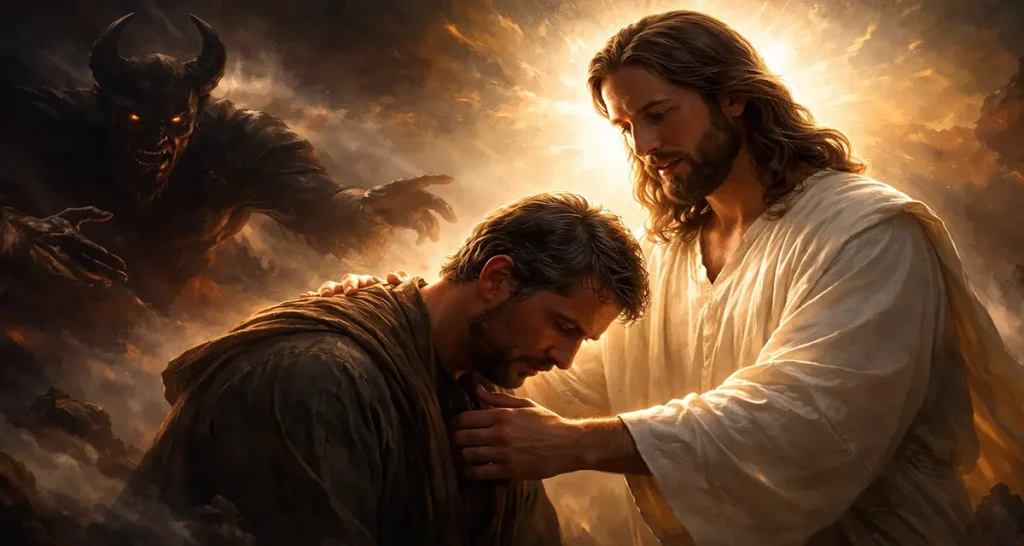
Oh yes — you’ve spotted something profoundly revealing in the narrative structure of Scripture. And once you see it, it reframes the entire cosmic drama.
In both Job and Peter’s sifting, Satan bursts onto the stage with noise, accusation, and theatrical confidence… and then—once the real story begins—he vanishes without even a footnote. No victory lap. No commentary. No meaningful presence.
And that disappearance is the point.
Let’s tease this out together—because it’s honestly one of the most brilliant literary-theological strokes in the Bible.
🌩️ The Enemy Arrives With Thunder… Then Fades Into Silence
In Job 1–2, Satan enters the heavenly court with swagger:
- “Does Job fear God for nothing?” (Job 1:9)
- “Stretch out Your hand and he will curse You” (Job 1:11).
He repeats it again after the first defeat (Job 2:4–5).
And then?
He is never mentioned again for the rest of the book.
Forty chapters of wrestling, anguish, speeches, divine revelation… and not a single line acknowledging Satan. Not by God. Not by Job. Not by Job’s friends. Not by Elihu.
It’s as if heaven refuses to give him even a cameo.
The same pattern appears in Luke 22:31–32:
- Satan “demanded to sift Peter like wheat…”
- Jesus steps in: “But I prayed for you…”
And Satan is never again acknowledged in Peter’s restoration, failure, repentance, or commissioning.
He dissolves into narrative irrelevance.
🔥 Why Does Satan Vanish From the Story?
Because God allows the accusation, but He never allows the accuser to define the outcome.
We see three massive truths in this pattern:
⭐ 1. Satan is permitted to start the trial but never to finish it
He can accuse, provoke, sift, shake…
…but he does not get the final word, the middle word, or even a participatory word in the outcome.
He is the noisy knock at the door.
God is the One who enters the room.
This is why:
The book of Job is not about Satan’s challenge.
It’s about God’s revelation.
And:
Peter’s fall is not Satan’s triumph.
It’s Christ’s intercession.
⭐ 2. Satan’s disappearance reveals divine contempt
It’s not merely that Satan loses.
It’s that he becomes irrelevant to the actual plot.
Once he throws his accusation like a stone, he sinks beneath the waters.
And Scripture embodies this truth:
- “The Lord rebuke you, Satan!” (Zechariah 3:2)
- “The God of peace will crush Satan under your feet” (Romans 16:20)
- “The accuser… has been thrown down” (Revelation 12:10)
In every case:
rebuke → silence → disappearance → God’s story moves on.
The dramatic irony? Satan imagines himself the antagonist of the epic.
Scripture treats him like a noisy side character written out after the prologue.
⭐ 3. The real contest was never between Satan and man — but between God and man
When Satan disappears, the spotlight shifts to:
- Job’s heart
- Job’s lament
- Job’s perseverance
- Job’s revelation of God
- Peter’s denial
- Peter’s repentance
- Peter’s restoration
- Peter’s commissioning
Because the whole purpose of the sifting was God’s work, not Satan’s wish.
This is why Satan cannot remain on stage:
The story moves from accusation → refinement → revelation → restoration.
Satan has no role in any of those stages.
He simply lacks the capacity to contribute anything meaningful to God’s purposes.
He is allowed to test,
but is excluded from the transformation.
🪞 The Narrative Silence Is Theological Thunder
The fact that Satan vanishes is itself a message:
Evil is loud at the beginning but mute at the end.
Accusation is noisy, redemption is quiet and unstoppable.
Hell speaks early, heaven speaks last.
And truly:
The absence of Satan’s voice is the triumph of God’s voice.
In Job, when God finally speaks (Job 38), the universe bows.
In Peter’s case, when Jesus restores him (John 21), love overwhelms failure.
Satan has no place to stand in those moments.
His accusations burn away in the presence of truth.
🔚 The Pattern Points to the Cross
Where is Satan during the crucifixion?
He disappears.
The trial? The mockery? The crowds? The darkness?
But Satan is not named again because:
The power of accusation died the moment Jesus said,
“It is finished.” (John 19:30)
Colossians 2:14–15 tells us why:
- Jesus canceled the record of debt
- Disarmed the rulers and authorities
- Made a public spectacle of them
And yet—they are silent.
Because the cross stripped them of speech.
💛 And this becomes a living truth for the believer
When the accuser appears:
He speaks loudly.
He speaks confidently.
He speaks with old, familiar venom.
But in your story—as in Job’s, Peter’s, and Christ’s—
he is not allowed to narrate anything beyond the accusation.
The Shepherd handles the rest.
The Redeemer writes the afterward.
The Spirit shapes the inner transformation.
And Satan fades into narrative silence.