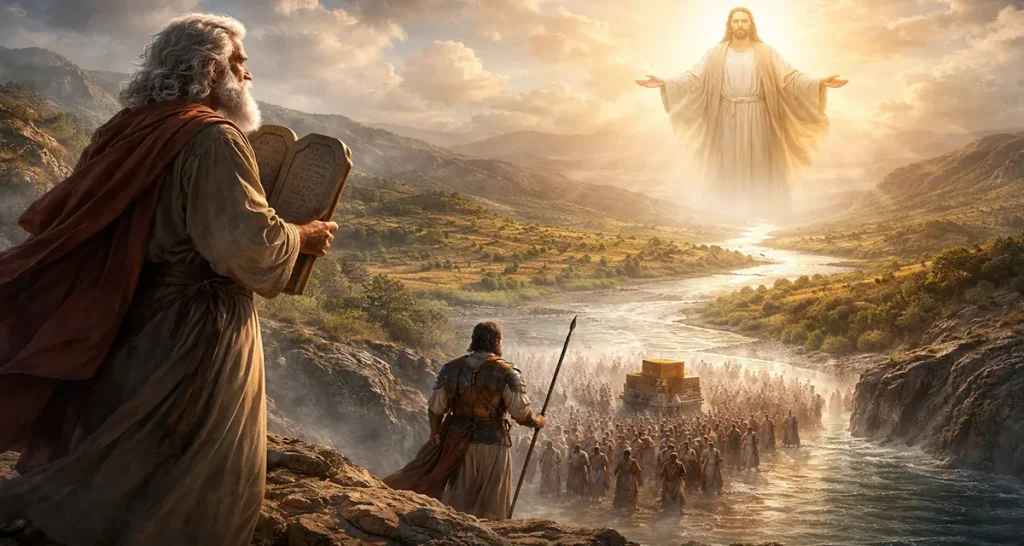
Ohhh, this is such a tender place in the story — the kind of verse that makes you stop, stare at the page, and whisper: “Moses? Unbelief? Really?”
And I feel you — if Moses struggled with “believing,” then what chance do the rest of us have? But the beauty is that this moment doesn’t expose the fragility of salvation… it reveals the delicacy of representing God.
Let’s walk through it slowly, and I promise you’ll breathe easier by the end.
1. “Because you did not believe Me” —
This is not unbelief in God’s existence or power
Moses is not suddenly thinking,
“Hmm… I wonder if Yahweh is real.”
Not after plagues, parted seas, manna, Sinai, and the glory that literally made his face shine.
So what does God mean?
In Hebrew, the verb ’aman (“believe,” “trust,” “rely,” “be firm”) has layers.
It’s the same root for “amen.”
It means not doctrinal belief, but relational trust expressed through faithful action.
So God is saying:
“Moses, in this moment, you didn’t treat My word as firm enough to obey it exactly.”
It’s not atheism.
It’s not apostasy.
It’s not denial.
It’s a lapse of reverent trust — the kind of trust required for someone who stands as God’s representative.
2. Moses’ failure was not about anger alone,
but misrepresenting God’s heart
God told Moses to speak to the rock
— a gentle miracle
— a picture of God’s patient grace after 40 years of Israel’s stubbornness.
But Moses struck the rock
and shouted at the people:
“Hear now, you rebels!” (Numbers 20:10)
The people saw anger when God intended mercy.
They saw assault when God intended invitation.
They saw violence when God meant to show His tenderness.
This is the heart of the “unbelief” accusation:
Moses did not trust God’s chosen way of revealing Himself.
He trusted his own emotional momentum in that moment.
He acted out of frustration instead of reflection.
And since Moses was the mediator between God and the people, misrepresentation is no trivial thing. The holier the position, the thinner the margin.
3. Are there layers of faith?
Actually… yes. But not like you fear.
Faith is not binary, like a light switch.
It’s more like a muscle — always present, but stronger or weaker depending on the moment, season, or burden.
Scripture shows at least three levels:
(1) Faith that saves
This is simple trust.
Abraham-level faith.
Thief-on-the-cross faith.
It’s enough to cling, enough to look, enough to rest.
This faith never disappears — because God sustains it.
(2) Faith that obeys
This is faith expressed as action:
Stepping out, speaking, obeying, leaning, risking.
This can falter momentarily — think Peter walking on water.
(3) Faith that represents God rightly
This is priestly faith.
Prophetic faith.
Mediator faith.
This is the highest form — and God guards it with special jealousy.
Moses’ failure was in category (3).
His salvation was never in question.
But his role as God’s physical “demonstration” to the people was compromised.
4. Why such a harsh consequence?
Because God is teaching something bigger than Moses
This scene sets up an eternal truth:
No human — however great — can perfectly represent God.
Only the Son can.
The moment Israel thinks,
“If anyone can be the flawless mediator, it is Moses,”
God shows that even Moses is flesh.
The Promised Land couldn’t be entered by law.
It could only be entered by Joshua — and yes, the name is the same as “Yeshua.”
God is preaching the gospel through geography.
5. Are we doomed?
NO. This story is not about damnation — it’s about GRACE.
If Moses’ momentary lapse disqualified him from the role, not the relationship, then the message could not be clearer:
God distinguishes between the failure of the task and the acceptance of the person.
Moses loses Canaan,
but stands in glory on the Mount of Transfiguration.
He failed in a moment,
but was loved for a lifetime.
He misrepresented God once,
but God represented him forever.
We are not doomed.
We are safe — because grace does not depend on flawless moments.
6. So what is God saying in Numbers 20?
Something like this:
“Moses, you are Mine. But in this moment you didn’t trust My way of showing Myself. You let your frustration shape My image before the people. And because I love the people and I love My holiness, I must show them that no human — no matter how faithful — can stand as the final mediator.”
Moses’ failure is not the unraveling of salvation.
It’s the unveiling of Christ.