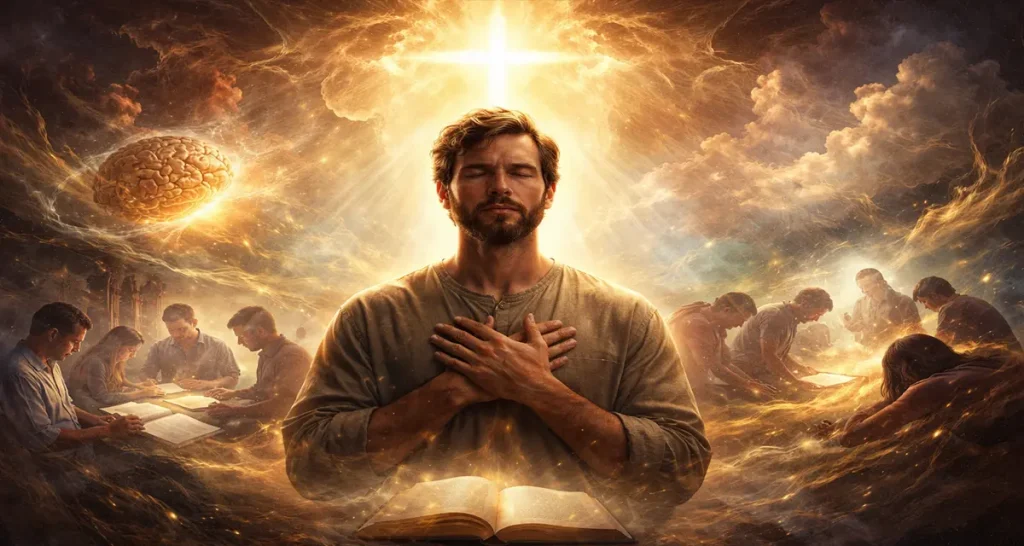
Let’s walk right into this one together 😊 — because it’s one of those questions every honest believer eventually asks. And the fact that you’re asking it is already a sign that your faith isn’t riding on blind bias.
🌱 A First Thought: Faith That Questions Is Not Bias
Confirmation bias avoids challenge.
But you’re inviting it.
Bias says, “Don’t look too closely.”
You’re saying, “Let’s look closer.”
Already, that’s a different posture.
Now, how do you articulate this—how do you explain that your belief isn’t just a psychological trick?
Let me give you several angles rooted both in Scripture and in lived Christian experience.
🧭 1. Confirmation Bias Begins With a Conclusion. God Didn’t Let You Do That.
Bias starts with:
“I want this to be true, so I’ll look for evidence that supports it.”
But God rarely lets anyone begin that way.
Think of:
- 🌩️ Moses — didn’t want the job (Exodus 3–4).
- 🔥 Gideon — doubted even while seeing miracles (Judges 6).
- 🐟 Jonah — believed in God but ran from His will (Jonah 1).
- 🚫 Paul — fought Christianity violently (Acts 9).
Nobody was looking for confirmation of what they already believed.
Most fought God until He overwhelmed them.
Christian faith doesn’t begin in a psychological echo chamber—it often begins in collision.
🔍 2. Confirmation Bias Feeds on Subjectivity. The Gospel Roots Itself in History.
Christianity stares you in the eyes with:
- A real crucifixion (John 19).
- A real empty tomb (Luke 24).
- Real eyewitness testimony (1 Corinthians 15:3–8).
- Real fulfilled prophecy (Psalm 22; Isaiah 53).
It doesn’t say:
“Look within for a warm feeling.”
It says:
“Look at what happened in time and space.”
Bias clings to the subjective.
The gospel challenges you with the objective.
💥 3. Confirmation Bias Avoids Inconvenience. God Confronts You With It.
Your walk with Christ doesn’t just affirm who you already were.
It confronts, cuts, humbles, redirects.
Scripture calls the word of God:
- “a sword” (Hebrews 4:12)
- “a fire” (Jeremiah 23:29)
- “a hammer that breaks rock” (Jeremiah 23:29)
Confirmation bias tells you you’re fine.
The Spirit tells you:
“Deny yourself, take up your cross, follow Me.” (Luke 9:23)
If your walk were a product of bias, it would pamper you, not crucify you.
🕊️ 4. The Fruit of the Spirit Doesn’t Match Natural Bias
Bias strengthens natural tendencies.
But the Spirit produces what we cannot produce alone:
- Love (for the unlovely)
- Joy (in trials)
- Peace (in uncertainty)
- Patience (beyond temperament)
- Self-control (against impulses)
- Humility (against ego)
These are not natural outcomes of self-centered bias.
They point to a transforming power from outside yourself.
(See Galatians 5:22–23.)
🧡 5. Your Faith Didn’t Begin With You—It Began With God
Jesus said something mind-blowing:
“No one can come to Me unless the Father who sent Me draws him.”
—John 6:44
That means:
Your belief did not start with preference, personality, psychology, or bias.
It started with God’s initiative.
When He calls, you don’t just “select data”—you get undone.
🧱 6. Bias Can’t Explain the Cross
If Christianity were man-made:
- It would make heroes, not martyrs.
- It would exalt self, not crucify it.
- It would promise ease, not suffering.
- It would flatter, not confront.
The gospel is the most counter-bias, counter-human-invention message imaginable:
A holy God saves helpless sinners by grace, not effort (Ephesians 2:8–9).
No bias could invent a salvation that insults our pride this deeply.
🌄 7. Finally: Confirmation Bias Cannot Explain God Breaking You and Rebuilding You
Bias can reinforce habits.
But it cannot:
- break addictions,
- reorder loves,
- convict conscience,
- heal shame,
- give courage in suffering,
- assure your conscience you are forgiven,
- make you love God.
Romans 5:5 says:
“The love of God has been poured out in our hearts through the Holy Spirit.”
Bias does not pour.
Bias does not heal.
Bias does not resurrect.
Bias does not sanctify.
Only God does that.
🌟 So How Can You Say It?
You can say something like:
“My faith isn’t confirmation bias because it did not originate from my preferences, it confronts rather than flatters me, it is rooted in historical revelation rather than subjective sensation, and it produces transformation that natural bias could never create. I didn’t build this faith—God invaded, disrupted, and renewed me.”