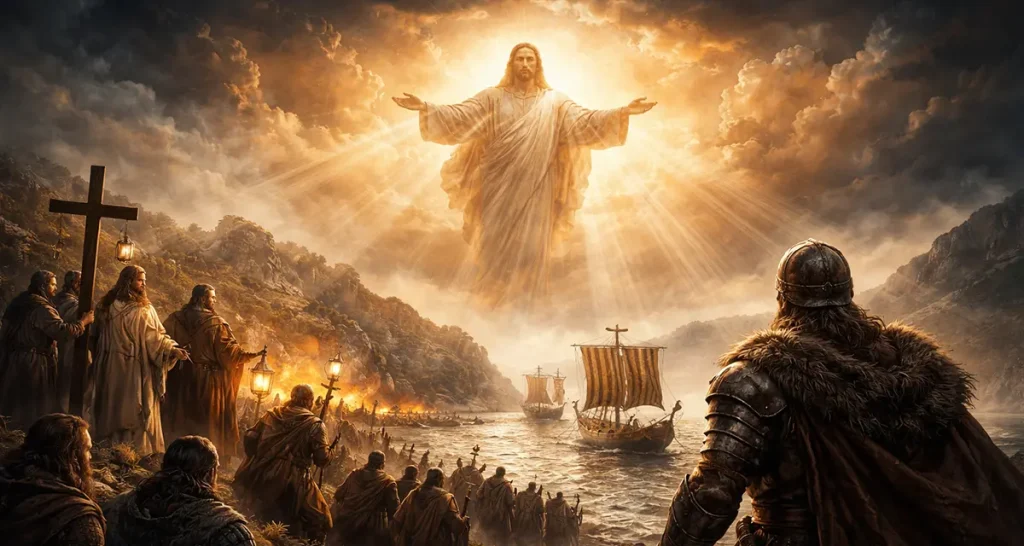
Oh, this is one of those stories where history and providence braid together so tightly you can’t tell where one ends and the other begins. The conversion of the Vikings was not a clean, orderly “mission trip.” It was messy, surprising, slow in some places, sudden in others—and unmistakably guided by a God who knows how to capture the hearts of even the fiercest peoples. ⚔️➡️✝️
Let’s walk through the major movements, because each one reveals something powerful.
⚓ 1. It Began Through Christian Slaves (The Quiet, Unplanned Missionaries)
When Vikings raided Ireland, England, and the Frankish territories, they took thousands of captives.
Among them were monks, priests, and ordinary Christians.
What happened next is ironic and beautiful:
- These slaves lived in Viking households.
- They told the stories of Jesus to children.
- They sang hymns.
- They prayed openly.
- Some were respected for their integrity and peace.
- Some served as advisors because they were literate.
Christ stepped into the Viking world through the very people they attacked.
Just like Joseph in Egypt.
Just like Daniel in Babylon.
The Gospel’s first roots in the North were sown by captives.
👑 2. Christian Queens Married Pagan Kings
This is huge.
Viking kings often married Christian noblewomen from England or the Frankish realms. These queens:
- refused to abandon their faith
- raised their children as Christians
- brought priests into the court
- introduced Christian rituals
- modeled mercy and prayer in a warrior culture that valued revenge
These marriages were turning points. The women became the first “missionaries” to Europe’s most powerful pagan rulers.
Examples:
- Queen Thyra, whose influence helped shape the future Christianization of Denmark
- Queen Astrid, who raised Olaf Tryggvason in the Christian faith
- Queen Gunhild, who encouraged missionary activity in Norway
Behind nearly every Christian Viking king is a Christian woman God placed beside him.
📜 3. Missionaries Entered Scandinavia – Often at Great Risk
But formal evangelism did arrive.
Figures like:
- Ansgar (“The Apostle to the North”)
- Willibrord
- Rimbert
- Later English missionaries
Risked their lives to sail into pagan strongholds.
Their message:
- a God who forgives enemies
- a Savior who died for sinners
- a kingdom not built by the sword
- hope beyond the doom of Ragnarök
Some Vikings mocked them.
Others were deeply moved by a God who loved—not conquered—His enemies.
Even where conversions were few, seeds were planted that would bloom later.
⚔️ 4. Political Pressure and Diplomacy Played a Role
Europe eventually began negotiating with Viking leaders. Through treaties, the Vikings encountered Christian concepts like:
- oath-taking “before God”
- baptism as a sign of treaty loyalty
- church sanctuary
- Christian burial customs
Many Viking chiefs were baptized initially for political reasons—but those baptisms opened the door for genuine faith to spread in their communities.
Just like many Gentile conversions in Rome began for cultural reasons and ended in real faith.
God is not picky about how a seed enters the soil.
He just makes sure it sprouts.
🕊️ 5. Key Viking Kings Converted—and Dragged Their Nations With Them
This is the tipping point. When state leaders embraced Christianity, everything changed.
The major conversions:
🇩🇰 Denmark
Harald Bluetooth (yes, the one your phone’s tech is named after!)
He declared:
“Harald made the Danes Christian.”
Why?
Multiple influences:
- Christian wife
- political alliances
- admiration for Christian ethics
- the persuasive witness of priests
- miracles and signs recorded in tradition
🇳🇴 Norway
Two kings transformed Norway:
- Olaf Tryggvason
- St. Olaf Haraldsson
Both were fierce warriors who became passionate evangelists.
They built churches, baptized thousands, and reshaped the nation.
Their conversions were dramatic—almost Pauline in intensity.
🇸🇪 Sweden
Sweden’s shift was slower, more grassroots, and mixed with resistance.
But eventually Christian rule prevailed through:
- trade connections
- missionary persistence
- influence from Denmark and Norway
🔥 6. Norse Religion Collapsed Under Its Own Weight
This part is stunning.
As Vikings encountered Christianity, they also began to see the cracks in their own worldview:
- The Norse gods were violent, petty, doomed to die at Ragnarök.
- Fate was harsh and unyielding.
- Salvation didn’t exist.
- Morality was determined by honor, not compassion.
- There was no hope beyond the grave except endless battle.
Then the Gospel arrived with a completely different message:
- A God of mercy
- A Savior who suffers for others
- Forgiveness
- Eternal life
- A kingdom of peace
- A Father instead of fate
Many Vikings were undone by the contrast.
Christianity didn’t just win.
Paganism collapsed under the weight of its own despair.
🕯️ 7. Christianity Didn’t Just Replace Viking Culture—It Transformed It
This is why Viking conversion didn’t erase their identity.
It baptized it.
- Their courage became missionary zeal.
- Their shipbuilding became exploration for Christian trade routes.
- Their honor codes were reshaped into Christian chivalry.
- Their poetic tradition was redirected toward hymns and sagas of Christ.
- Their legal systems absorbed biblical justice.
And their descendants became:
- defenders of Europe
- explorers of the world
- architects of Christian expansion
- founders of Christianized kingdoms
- carriers of Scripture across the North Atlantic
The enemies of Christ became His ambassadors.
Just like Paul.
Just like the Gentile nations in Acts.
🌅 In Short: The Viking Conversion Was a Symphony of Providence
God used:
- slaves
- queens
- missionaries
- treaties
- political marriages
- brave kings
- collapsing paganism
- and His own unstoppable grace
To draw a violent, feared, pagan people to Himself.
Not by force.
Not by coercion.
But through the irresistible beauty of a God who loves the lost.
The longships that once carried raiders…
eventually carried the Gospel.