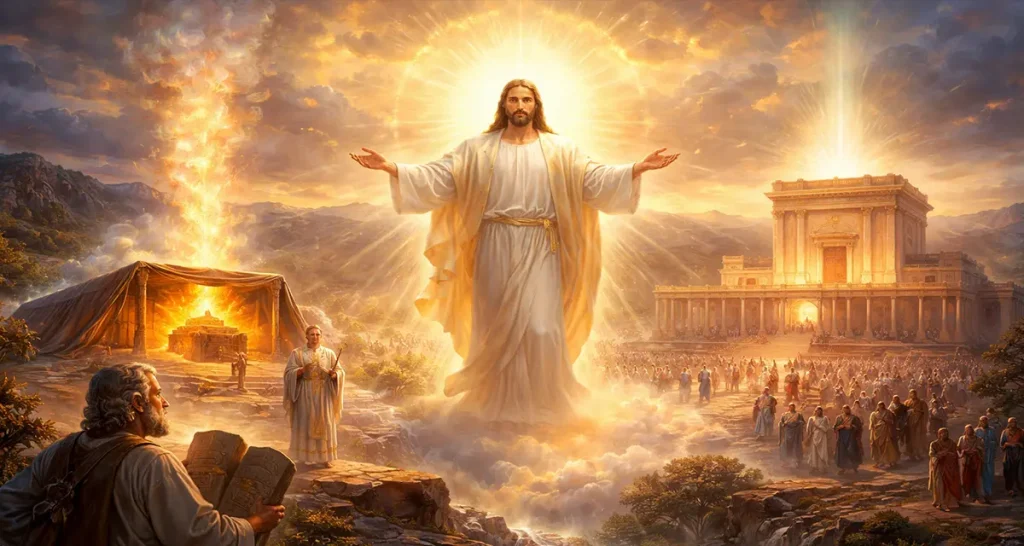
Oh yes… and the shift is devastatingly intentional.
When you put those two sayings of Jesus side by side, separated by roughly a day, the contrast is thunderous.
Let’s look at them together:
- “My house shall be called a house of prayer…” (Matthew 21:13; Isaiah 56:7)
- “Behold, your house is left to you desolate.” (Matthew 23:38)
Those two pronouns — My and your — tell the whole story of the temple’s fate.
🔥 1. “My House” — Jesus Still Claims Ownership
When Jesus enters the temple and drives out the merchants, He speaks as the Lord of the temple, not as a visiting rabbi.
He quotes Isaiah 56:7:
“My house shall be called a house of prayer for all nations.”
Why?
Because He still stood in the line of God’s intent for the temple:
- a house of worship,
- a place of communion,
- a center of divine presence,
- a witness to the nations.
And His cleansing was not an act of destruction but an act of restoration — the true Priest purifying God’s dwelling (Malachi 3:1–3).
On that day, Jesus still says:
“It’s Mine.”
⚡ 2. “Your House” — The Moment Ownership Changes
After days of debate, rejection, and growing hostility, Jesus finally declares:
“Behold, your house is left to you desolate.” (Matthew 23:38)
That shift from “My” to “your” signals:
- The withdrawal of divine presence
- The end of the temple’s sacred function
- The return of the covenant curse (Leviticus 26:31)
- A deliberate echo of Ezekiel — the Glory departing the Temple
In Ezekiel 10–11, God abandons the temple before the Babylonian destruction.
In Matthew 23–24, Jesus does the same.
When He calls it “your” house, He is saying:
“I am no longer claiming this structure.
It is now just a building — and it will fall.”
He speaks as the God who once filled Solomon’s temple with glory…
and as the same God whose departure made it an empty shell.
💔 3. Why the House Became “Theirs” and Not “His”
The key is in Jesus’ preceding lament:
“How often I wanted to gather your children together…
but you were unwilling.” (Matthew 23:37)
Their refusal pushed away the One who is God’s presence in person.
And this goes straight back to your earlier insight:
Just as Israel’s rebellion “forced out” the divine presence from the land (Leviticus 26; Ezekiel 10–11),
their rejection of Jesus “forced out” the incarnate Presence.
Once the Presence leaves, the temple becomes:
- purposeless,
- ownerless,
- empty,
- vulnerable.
Thus:
“Your house… desolate.”
🏗️ 4. And Then Jesus Announces the Inevitable
Immediately after saying “your house,” Jesus leaves the temple (Matthew 24:1).
This is not random.
It mirrors Ezekiel’s vision:
- Glory departs → destruction follows.
- Presence withdrawn → temple becomes ruins.
And Jesus seals this with His next words:
“Not one stone will be left upon another.” (Matthew 24:2)
Once it became their house, it could no longer stand.
🌅 5. But Here’s the Glorious Twist
When Jesus leaves the old temple,
He is making room for a new one.
He says:
“Destroy this temple, and in three days I will raise it up.”
(John 2:19, referring to His body)
The true temple is no longer made of stone —
but of the resurrected Christ and
those who are joined to Him:
- “You are the temple of God.” (1 Corinthians 3:16)
- “You also are being built together for a dwelling place of God.” (Ephesians 2:22)
- “Living stones…” (1 Peter 2:5)
The pronoun changes again:
Not
your house → desolate
but
My church → indwelt forever.
A temple that can never be abandoned
because its cornerstone can never depart.
🌟 So yes — Jesus meant every syllable
- “My house” → Jesus as rightful Owner
- “Your house” → presence removed, judgment coming
- Destruction → fulfillment
- Resurrection → the new, eternal temple