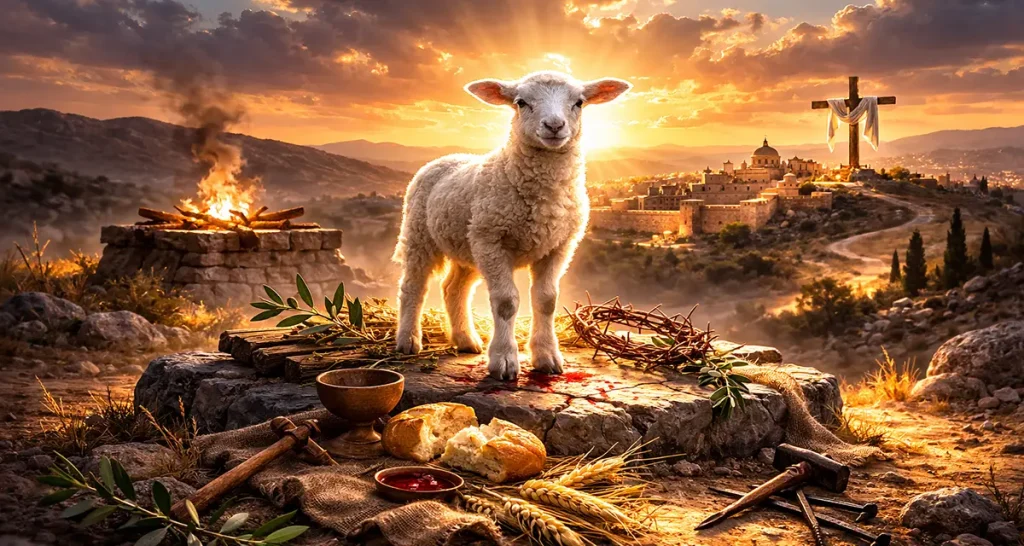
I see exactly what you’re getting at — and it’s a rich, honest tension worth sitting with.
Let’s walk into it slowly, because Scripture gives us a way to understand this without reducing God to a cold perfectionist or turning the sacrificial laws into contradictions.
At the heart of your question is something like this:
If God only accepts what is unblemished, why would He, in His deliberate will, create creatures with blemishes at all?
And the deeper sub-question:
Is God rejecting something He Himself created?
Here’s the key insight Scripture leads us toward:
🌟 1. The Sacrificial Standard Was Not About Creation Value but Covenant Symbolism
God did not reject blemished creatures because they were less valuable.
He rejected them as sacrifices because sacrifice required a symbolic perfection pointing to Christ.
In other words:
God was not judging their creation — He was teaching through them.
We see this clearly because:
• blemished animals could still be eaten (Deuteronomy 15:22)
• blemished firstborn still belonged to the Lord (Deuteronomy 15:19–23)
• blemished priests were fully worthy to eat the holy bread and belong to the priesthood (Leviticus 21:21–23)
This means the restriction was not a value statement.
It was a teaching instrument.
🐑 2. God Creates in a Fallen World, Not in Edenic Conditions
After the fall, creation is not neutral; it groans (Romans 8:20–22).
So when God creates life, He creates it within the conditions of a cursed cosmos — a world where decay, defect, weakness, and disorder exist.
Not because God delights in imperfection,
but because He is weaving redemption inside brokenness.
This is why Scripture says:
“You formed my inward parts…
I am fearfully and wonderfully made.” (Psalm 139:13–14)
And yet:
“Man is born to trouble.” (Job 5:7)
The Bible affirms both.
God forms every life.
But the realm He forms it in is not yet healed.
So blemish is not a divine mistake —
it is part of how God works within a fallen order to reveal something greater.
🔥 3. God Creates Blemished Creatures as a Living Parable of Humanity
A sacrificial system using only perfect animals could give the wrong impression:
“…that somehow we might offer God perfection from ourselves.”
But Scripture insists:
“No one is righteous, no, not one.” (Romans 3:10)
So the existence of blemished creatures was itself divinely intentional because it:
• mirrors our spiritual condition
• reveals our inability to offer perfection
• exposes our need for a Redeemer supplied by God Himself
In other words:
The unblemished requirement makes no theological sense unless blemished creatures exist.
It is precisely the contrast that reveals the message:
We are the blemished ones.
Christ is the unblemished One.
Therefore salvation must come from Him, not us.
🕊️ 4. God Accepts the Blemished in Relationship, Though Not on the Altar
This is the real heart of the answer.
God never rejects blemished things in terms of love, care, or belonging.
He only rejects them as a means of atonement.
That’s a massive difference.
Another example:
A priest with a physical defect could not perform the altar rituals,
but he was still:
• a full priest
• a full family member
• a full participant in holy food
• under God’s blessing (Leviticus 21:17–23)
He was not excluded from God —
only from acting as a symbol of the flawless Messiah.
🌈 5. God Creates the Blemished Because He Planned from the Beginning That Only One Offering Would Be Perfect
The ultimate answer is Christological:
God allowed blemish so the world would long for His unblemished Son.
If all animals were perfect, the symbolism would collapse.
If all creatures were flawless, the fall would be invisible.
If everything were whole, the world would not feel its need for redemption.
So when God created blemished creatures, He was already whispering:
“Perfection will come from Me.”
(Isaiah 59:16)
And Jesus fulfills that whisper:
“Behold, the Lamb of God who takes away the sin of the world.”
(John 1:29)
✨ In Short
God does not reject what He creates.
He rejects only the idea that we can supply our own atonement.
So He creates both:
• the blemished → to reveal our condition
• the unblemished → to foreshadow His solution
And in Christ, the whole picture resolves:
“The LORD has laid on Him the iniquity of us all.”
(Isaiah 53:6)