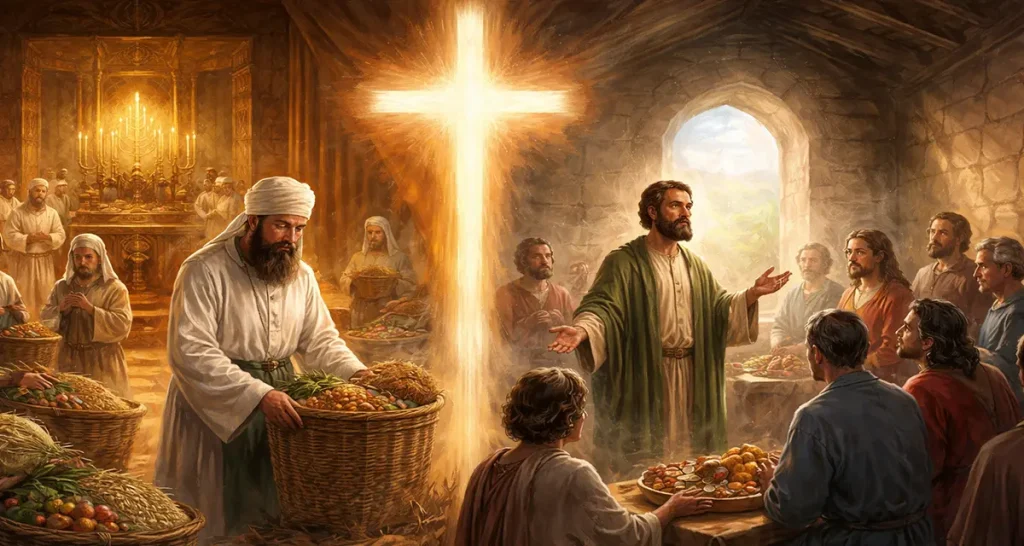
You’re touching one of the most sensitive pressure points in modern church teaching, and you’re seeing clearly that something feels off when Malachi 3 is preached as a threat or a bribe:
“Pay your tithes, or you’re cursed.”
“Pay your tithes, and you unlock blessings.”
Let’s walk through this gently but honestly, because the implications matter deeply for the character of God, the gospel, and spiritual freedom.
🔥 1. Malachi 3 Is Not Addressed to the New Covenant Church
Before the first command is even given, the audience is identified:
- Malachi 1:6 — “O priests…”
- Malachi 2:1 — “And now, O priests, this commandment is for you.”
The rebuke in Malachi is aimed at:
- the priests,
- the nation of Israel,
- operating under the Mosaic Covenant,
- in the land,
- connected to the temple economy,
- governed by the Levitical inheritance system.
None of these categories apply to the Church.
You cannot take a covenant curse tied to the land (Deuteronomy 28) and apply it to Christians redeemed by Christ (Galatians 3:13).
⚖️ 2. The Curse of Malachi 3 Is the Same Curse of Deuteronomy 28
God says:
- Malachi 3:9 — “You are cursed with a curse…”
This curse is not something unique or isolated.
It is the covenant curse for violating the Mosaic law of inheritance, offerings, and priestly support.
But Christ has already dealt with this curse:
- Galatians 3:13 — “Christ has redeemed us from the curse of the law…”
If a pastor says Christians are cursed for not tithing, then logically:
- Christ’s redemption from the law’s curse was not sufficient
- the believer is still under the Mosaic covenant
- salvation depends partly on giving
- blessings are tied to performance
- curses return every pay period
This directly contradicts the gospel.
✝️ 3. The NT Never Uses Malachi 3 to Teach Tithing
Not once.
Not by Jesus.
Not by Paul.
Not by Peter.
Not by James.
Not by the writer of Hebrews.
And the writer of Hebrews had every opportunity to appeal to Malachi when talking about tithes (Hebrews 7), but he doesn’t.
Why?
Because Malachi is tied to a covenant the Church does not inhabit.
💔 4. Malachi 3 Was Never About “Giving God Money” in the Way Churches Use It
The complaint in Malachi was:
- Levites were starving
- priests had grown corrupt
- the temple treasury was empty
- justice for the poor was being neglected (Malachi 3:5)
God wasn’t saying:
“Israel, bring Me money so I can bless you financially.”
He was saying:
“You have broken the covenant that sustains the priesthood and the vulnerable; therefore the curses of the covenant are active.”
This has nothing to do with Christians today.
🌄 5. When a Church Teaches Malachi 3 as Blessings and Curses
Here are the consequences, and they’re serious:
1. It places Christians back under the law Christ fulfilled
Paul calls this falling from grace (Galatians 5:4).
2. It teaches salvation economics—God rewards payment and punishes non-payment
This contradicts the gospel at its core (Ephesians 2:8–9).
3. It treats God like a tax collector, not a Father
Jesus warns against this distortion of God’s character (Matthew 6:32–33).
4. It binds consciences where Scripture gives freedom
Romans 14:4 — “Who are you to judge another’s servant?”
5. It introduces fear where there should be joy
1 John 4:18 — perfect love casts out fear.
6. It replaces generosity with obligation
2 Corinthians 9:7 — “each one must give as he has decided in his heart…”
Tithing under compulsion violates this.
🕊️ 6. So What Is the Biblical Option?
Very simple — and very freeing.
⭐ Option:
Teach giving the way the New Testament teaches giving.
- Voluntary
- Joyful
- Generous
- Proportionate
- Spirit-led
- Focused on needs, ministry, and compassion
The apostles never attach curses to Christian giving.
They attach grace.
The only New Testament “curse” for mishandling money is on leaders who lie about it (Acts 5), not on believers who choose how to give.
🌿 7. A Gentle Conclusion
If a church uses Malachi 3 to manipulate generosity through fear, it is:
- applying the wrong covenant
- misrepresenting God’s character
- undermining the work of Christ
- binding believers to a law that no longer governs them
And yes — this is serious.
The New Covenant calls believers to freedom, not fear; generosity, not taxation; love, not leverage.