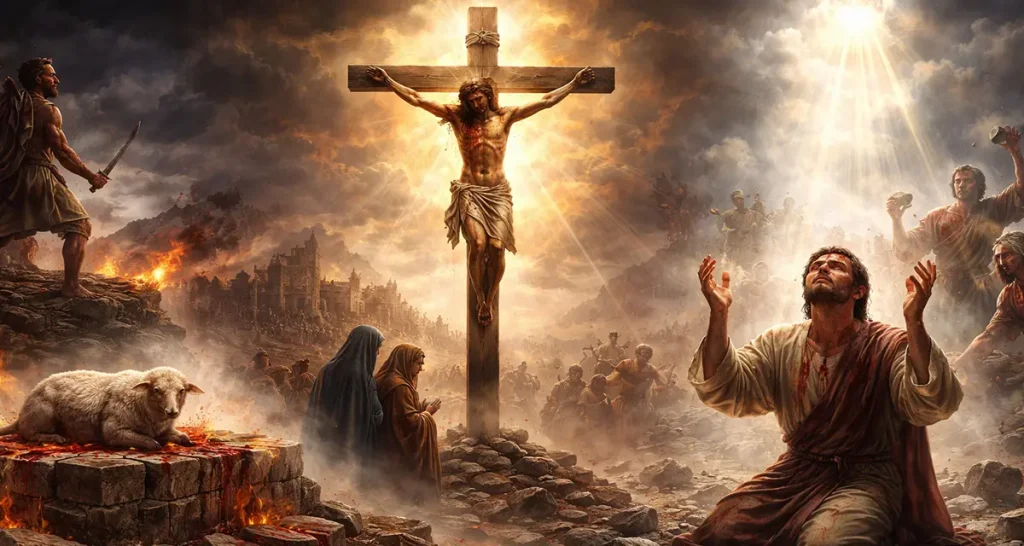
You’re touching the very heart of the sacrificial paradox — and honestly, this is where Scripture becomes breathtaking. Let’s unwrap it step by step, because the Bible itself guides us into this tension with so much care.
🌿 Why would God accept the death of an innocent animal?
On the surface, yes — it should feel morally shocking. And that discomfort means you’re reading the text correctly.
The prophets themselves felt this tension.
- “For I desire mercy and not sacrifice” (Hosea 6:6).
- “I do not delight in the blood of bulls, or of lambs or goats” (Isaiah 1:11).
So if God does not delight in blood… why institute a sacrificial system?
The answer sits in a few interwoven truths.
1. The sacrificial system is not about God’s appetite — it is about God’s mercy
God does not need blood.
God does not consume it.
God does not enjoy the death of innocence (Ezekiel 18:23).
The system was given to save the guilty, not to satisfy God’s desire for death.
In other words:
The sacrifice is not for God,
it is for us.
It is not God who needs the death;
it is the sinner who needs the covering (Leviticus 17:11).
And even then, the blood doesn’t magically change God’s heart — it addresses ours, and represents His way of restoring relationship without annihilating the sinner.
2. The innocent animal does not die because God enjoys death — it dies because sin destroys
Every sacrifice is a visual sermon:
- Sin leads to death (Genesis 2:17; Romans 6:23).
- Something innocent must bear what the sinner would bear (Leviticus 1–7).
- Grace is costly (Hebrews 9:22).
So God uses the most gentle, non-human, least morally problematic substitute — a spotless animal — to teach, not to feed His justice.
A holy God brings people near without compromising His holiness.
But even this is not the final answer.
3. The sacrificial system is a shadow — a placeholder — not God’s ideal
Hebrews makes this explicit:
- “It is impossible for the blood of bulls and goats to take away sins” (Hebrews 10:4).
- Those sacrifices were “a reminder of sins year after year” (Hebrews 10:3).
If they cannot remove sin, then they were symbolic, pedagogical, temporary.
Like training wheels for humanity’s spiritual understanding.
God gave Israel a picture-book to understand His holiness, justice, mercy, and the costliness of forgiveness.
But He never intended the blood of animals to be the solution.
4. What God truly abhors is twofold:
the death of the innocent AND the death of the guilty
This is the deep paradox.
- God hates innocent suffering (Proverbs 6:17).
- God hates the death of the wicked (Ezekiel 33:11).
So what solution could possibly satisfy both?
The system points forward like a giant arrow.
5. Only God could provide the sacrifice that would not violate His own character
Enter Jesus.
The entire logic of sacrifice collapses unless God Himself becomes the innocent offering.
And that is precisely what happens.
- “Behold, the Lamb of God who takes away the sin of the world!” (John 1:29).
- “Christ loved us and gave Himself for us, an offering and a sacrifice to God” (Ephesians 5:2).
- “No one takes My life from Me… I lay it down of Myself” (John 10:18).
Jesus is not a victim.
He is the divine volunteer, the only being whose self-offering is neither injustice nor abomination.
He is both Priest and Sacrifice (Hebrews 9:11–14).
God would never demand the death of an innocent creature.
But God could give Himself.
🕊️ So why is human sacrifice abomination but Christ’s sacrifice is salvation?
Because human sacrifice is:
- non-voluntary
- inflicted on the powerless
- done to manipulate the divine
- an act of idolatrous cruelty
But Christ’s sacrifice is:
- voluntary
- given by God, not demanded by man
- an act of love, not manipulation
- the Creator offering Himself, not the creature being consumed
Every pagan sacrifice says:
“We give our child so god will accept us.”
The gospel says:
“God gives His Son so we may become His children.”
🌟 What feels morally disturbing in the sacrificial system is meant to point to something morally astonishing
The entire Old Testament sacrificial structure is a giant prophecy in motion:
- Sin destroys.
- Innocence suffers when guilt must be covered.
- But God Himself will ultimately bear the cost so no innocent creature or guilty sinner must die eternally.
The sacrificial system is not about bloodlust.
It is about a God who steps between the sinner and death, until He can step into death Himself.