Opens in a new tab

Justice | Mercy | Faith

Justice | Mercy | Faith

Faithful Wounds and Deceitful Kisses: Jesus, Peter, Judas, and the True Meaning of Love

Difficulty Level: Intermediate-Advanced

Jump to Answers

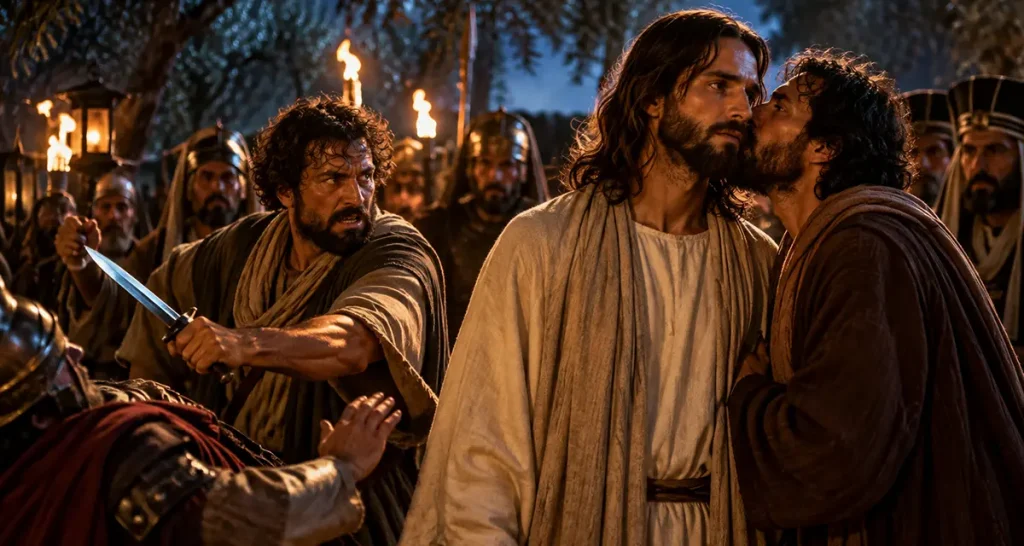
  1. “Faithful are the wounds of a friend, but the kisses of an enemy are deceitful”. Let us examine this proverb in light of three remarkable moments in the Gospels: Jesus’ severe rebuke of Peter, “Get behind Me, Satan! You are an offense to Me, for you are not mindful of the things of God, but the things of men”; His painful prediction, “I tell you, Peter, the rooster shall not crow this day before you will deny three times that you know Me”; and His penetrating question to Judas, “Judas, are you betraying the Son of Man with a kiss?” These encounters bring the proverb into striking focus, revealing the profound contrast between the wounds inflicted by a faithful Friend and the affectionate gesture used to conceal betrayal.
  2. So there are wounds that must be made in faithfulness to love, even when they cause pain, and kisses that must be avoided because they disguise deceit or betrayal! 🤔
  3. There is something mysterious, or perhaps profoundly human, in Peter’s actions that night. At first, he displays extraordinary courage, drawing his sword against an armed arresting party to defend Jesus, despite the danger to his own life. Yet only a short time later, that same courageous disciple crumbles before the questions of people gathered around a fire and denies knowing his Master. We should not hastily conclude that Peter was simply a coward. Throughout history, human beings have genuinely risked and sacrificed their lives for others, and Peter’s willingness to fight suggests that his courage was real. His subsequent failure therefore reveals something more complex about human nature, courage, fear, and the circumstances that can overwhelm even a devoted person.
  4. In Peter’s case, his restoration was accomplished only through the gracious will and intervention of Jesus. Without Christ’s intercession, forgiveness, and deliberate restoration, Peter would have remained wounded by his guilt, perhaps weeping over his denial without ever being able to repair what he had broken. 
  5. An important distinction we may overlook is that Judas deliberately planned his betrayal of Jesus, negotiating with the religious authorities and seeking an opportunity to deliver Him into their hands. Peter, by contrast, did not enter that night intending to deny his Master. His denial unfolded as events developed, under mounting pressure, fear, and confusion. This difference does not excuse Peter’s sin or diminish his responsibility, but it is nevertheless a significant fact. 
  6. Even in one of the most terrible acts committed by humanity against God, with Satan working through human betrayal, evil appropriated and violated one of the noblest expressions of human relationship: love. Yet the two are fundamentally incompatible: betrayal is completely ≠ love.
  7. What you have considered about Peter’s courage and subsequent collapse reveals how psychologically devastating a mistaken understanding of the Person and mission of Jesus can become when someone is suddenly confronted with the truth. Peter may have approached the confrontation with a conviction something like this: “The Messiah is with us to confront and conquer His enemies, including the powers oppressing Israel, and I am prepared to fight for Him even to death.” But when Jesus commanded him to put away his sword, Peter was confronted with the unmistakable reality that the Messiah would not fight the battle Peter expected. The reality now unfolding before him may have overwhelmed him psychologically, leaving him disoriented and uncertain how to respond. We sometimes overlook this profound human crisis and condemn Peter’s denial without considering the collapse of his expectations and understanding. None of this excuses his sin, or ours, but it helps us recognize the complexity of human weakness when deeply held beliefs about God are shattered by the revelation of who He truly is.
  8. It is interesting that many presentations and teachings suggest Judas may have betrayed Jesus in an attempt to force His hand, provoking the Messiah to confront and conquer His enemies through a dramatic demonstration of divine power. Although Scripture does not explicitly establish this as Judas’s motive, the interpretation raises an intriguing comparison with Peter. Peter himself appears to have expected a Messiah who would confront His enemies, and his decision to draw the sword in Gethsemane demonstrates his willingness to participate in such a confrontation. Yet when Jesus commanded him to stop fighting and willingly submitted to arrest, Peter’s understanding of the Messiah was shattered, perhaps contributing to the overwhelming confusion and collapse that followed. 
  9. Can we even imagine Jesus, considered from the perspective of His genuine humanity, having to navigate so many dangerous and conflicting circumstances at once? One disciple suddenly draws a sword and cuts off the ear of the high priest’s servant, potentially provoking a violent battle. Another disciple arrives with an armed arresting party to betray Him. The religious leaders are hostile, the disciples are frightened and confused, and the entire situation threatens to descend into chaos. All this follows Jesus’ own profound anguish in Gethsemane, where He had prayed in sorrow while His closest friends repeatedly fell asleep instead of watching with Him. Yet amid betrayal, violence, fear, misunderstanding, and the approaching suffering of the cross, Jesus alone remains steadfast, exercising extraordinary calm, sobriety, wisdom, compassion, and unwavering obedience to the Father. An ordinary person might have collapsed under such an overwhelming convergence of emotional and physical pressures. But Jesus, truly human and yet far more than a mere man, faithfully manages the confrontation. He is truly worthy of worship and praise! What a faithful Friend He is: the One who does not hesitate to wound us with necessary truth, yet also possesses the love, grace, and power to heal and restore us. 

Faithful Wounds and Deceitful Kisses: Jesus, Peter, Judas, and the True Meaning of Love

Discipleship & Growth | Jesus Christ (Christology) | New Testament | Sin & Human Nature

“Faithful are the wounds of a friend, but the kisses of an enemy are deceitful” (Proverbs 27:6). Few passages in Scripture portray the profound contrast of this proverb more dramatically than the final hours of Jesus before His crucifixion. In those hours, Peter receives painful rebukes from the Master he genuinely loves, while Judas approaches that same Master with a kiss intended to betray Him. One disciple is wounded by truth; the other uses an expression of affection to accomplish treachery. Yet beneath these contrasting actions lies a far more complex account of human courage, mistaken expectations, spiritual failure, and divine faithfulness.

Peter was no ordinary coward. When armed men came to arrest Jesus, he drew his sword and attempted to defend Him, despite the overwhelming danger. Yet that same night, he denied knowing Jesus three times. How could a man willing to fight and perhaps die for his Master crumble before questions around a courtyard fire? Was his failure merely fear, or had the Messiah’s refusal to fight shattered Peter’s understanding of who Jesus was and what He had come to accomplish?

Judas presents another troubling dimension. His betrayal was deliberately arranged, and the chosen signal was a kiss—an expression ordinarily associated with love, friendship, and trust. Some interpretations suggest that Judas may have intended to force Jesus into demonstrating His messianic power, although Scripture does not establish that motive. What remains unmistakable is that Judas planned his betrayal, while Peter’s denial unfolded under the pressure of an unexpected crisis. Both sinned against their Master, but their intentions, circumstances, and subsequent experiences were profoundly different.

And at the center of these events stands Jesus Christ. Having endured the anguish of Gethsemane and the disappointment of His sleeping disciples, He faces Judas’s betrayal, Peter’s impulsive violence, the hostility of the arresting party, and the approaching abandonment of His followers. Yet He remains faithful to the Father’s purpose. He restrains Peter’s sword, heals the wounded servant, protects His disciples, and willingly submits to arrest. The One being betrayed and delivered to suffering is also the One exercising perfect wisdom, compassion, and obedience amid the confusion surrounding Him.

Perhaps most remarkably, Jesus does not merely expose Peter’s weakness. He has already prayed for his restoration before the denial occurs. Peter can weep over his failure, but only the risen Christ can restore him to fellowship and entrust His sheep to his care. The faithful wounds of Jesus are therefore not expressions of rejection, but acts of truth within a relationship sustained by redeeming love.

This conversation explores the extraordinary relationship between faithful wounds and deceitful kisses, the difference between courage and spiritual understanding, the danger of imposing our expectations upon God, and the astonishing faithfulness of Jesus toward those who fail Him. Above all, it invites us to contemplate the Savior who, surrounded by betrayal, confusion, fear, and violence, never abandons His holy purpose or ceases to love.

For in Gethsemane, evil borrowed the gesture of love to accomplish betrayal, while Christ willingly proceeded toward the cross to accomplish redemption. The kiss concealed treachery, the rebuke revealed truth, and the wounds of the faithful Friend would ultimately become the means of our healing.

“Faithful are the wounds of a friend, but the kisses of an enemy are deceitful”. Let us examine this proverb in light of three remarkable moments in the Gospels: Jesus’ severe rebuke of Peter, “Get behind Me, Satan! You are an offense to Me, for you are not mindful of the things of God, but the things of men”; His painful prediction, “I tell you, Peter, the rooster shall not crow this day before you will deny three times that you know Me”; and His penetrating question to Judas, “Judas, are you betraying the Son of Man with a kiss?” These encounters bring the proverb into striking focus, revealing the profound contrast between the wounds inflicted by a faithful Friend and the affectionate gesture used to conceal betrayal.

🩹 The Wounds of Peter and the Kiss of Judas

Reading these passages together makes Proverbs 27:6 almost startlingly concrete:

“Faithful are the wounds of a friend,
But the kisses of an enemy are deceitful.” (Proverbs 27:6)

Because in the final journey of Jesus toward the cross, Peter receives wounds from Jesus, while Judas gives Jesus a kiss.

And the appearances are almost completely backwards.

Jesus speaks to Peter with words so severe that, isolated from everything else, they almost sound like rejection:

“Get behind Me, Satan! You are an offense to Me, for you are not mindful of the things of God, but the things of men.” (Matthew 16:23)

Later He tells Peter something equally painful:

“I tell you, Peter, the rooster shall not crow this day before you will deny three times that you know Me.” (Luke 22:34)

Those are wounds. Deep ones.

Judas, meanwhile, approaches Jesus with the outward sign of affection, familiarity, loyalty, and friendship:

“Judas, are you betraying the Son of Man with a kiss?” (Luke 22:48)

That is the kiss.

And suddenly the proverb is no longer merely telling us that sometimes friends say uncomfortable things and enemies flatter us. In these Gospel scenes, the wound is operating in the service of salvation, while the kiss is operating in the service of betrayal.

💔 Peter Is Wounded Because Jesus Refuses to Lie to Him

What strikes me first is that Jesus does not protect Peter from painful truth.

Peter loves Jesus. That matters enormously. Peter is not Judas in disguise. When Peter rebukes Jesus for speaking about His coming suffering and death, he apparently thinks he is defending Him. Matthew tells us that Peter took Jesus aside and said:

“Far be it from You, Lord; this shall not happen to You!” (Matthew 16:22)

That sounds affectionate.

In fact, on the surface, Peter’s words sound far more loving than Jesus’ response.

Peter says, essentially, Lord, may this terrible thing never happen to You.

Jesus answers:

“Get behind Me, Satan!” (Matthew 16:23)

😳

If we judged the exchange only by tone, Peter might appear compassionate and Jesus unnecessarily harsh. But Jesus sees something Peter cannot see. Peter’s affection has become temporarily aligned with a temptation Jesus must reject. Peter wants Christ without the cross. He wants the Messiah without the suffering foretold in God’s redemptive purpose. He loves Jesus, but at this moment his love is not yet thinking according to God.

That distinction is tremendously important.

A person can sincerely love someone and still say something profoundly wrong to them.

Peter’s intention does not make him Satan. Jesus is not identifying Peter’s person with Satan as though Peter had somehow become the devil. Rather, the temptation coming through Peter’s counsel is satanic in direction: avoid the cross. It echoes the wilderness temptation, where Jesus was offered glory without the appointed road of obedient suffering (Matthew 4:1–11).

So Jesus wounds Peter precisely where Peter needs to be wounded: in his confidence that human affection is automatically aligned with God’s wisdom.

That wound is faithful.

🐓 Then Jesus Wounds Peter Somewhere Even Deeper

The prediction of Peter’s denial cuts differently.

At Caesarea Philippi, Peter misunderstands God’s plan for Jesus. In the upper-room setting, Peter misunderstands Peter.

That may be the more painful misunderstanding.

Peter believes himself capable of a loyalty that, under pressure, he does not yet possess. Luke records him saying:

“Lord, I am ready to go with You, both to prison and to death.” (Luke 22:33)

And Jesus does not congratulate his courage.

He tells him the truth.

Before morning, Peter will deny Him three times.

There is something almost surgical about this. Jesus could have allowed Peter to keep his heroic self-image for a few more hours. It would certainly have been kinder in the shallow sense of making Peter feel good about himself.

But Jesus loves Peter too much to cooperate with Peter’s illusion about himself.

And here Proverbs 27:6 becomes very uncomfortable:

“Faithful are the wounds of a friend…”

Jesus’ friendship with Peter includes telling Peter something about himself that Peter desperately does not want to believe.

Yet notice something beautiful: the wound is given within a larger promise of restoration.

Just before predicting Peter’s failure, Jesus says:

“But I have prayed for you, that your faith should not fail; and when you have returned to Me, strengthen your brethren.” (Luke 22:32)

That changes the character of the wound completely.

Jesus is not saying, Peter, I know what a fraud you are, and tomorrow everybody else will know too.

He is saying, in effect, I know where you are going to break. I know it before you do. I have prayed for you. And I already see you on the other side of your failure, strengthening your brothers.

That is an astonishing kind of friendship.

Christ knows Peter’s coming sin without surrendering Peter’s future to that sin.

The wound tells Peter the truth about his weakness. The intercession tells Peter that his weakness will not have the final word.

💋 Judas Gives the Kiss That Peter Never Gives

Then comes the terrible reversal.

Peter, who truly loves Jesus, will publicly behave as though he does not know Him.

Judas, who has determined to betray Jesus, publicly behaves as though he loves Him.

That contrast is almost unbearable.

Peter’s outward action conceals his love; Judas’s outward action conceals his betrayal.

Peter says, in effect, I do not know Him when he does.

Judas says, through the cultural gesture of a kiss, I am His friend when he is handing Him over.

Both actions are false.

But they are false in opposite directions.

Peter’s mouth denies what remains painfully true in his heart. Judas’s kiss displays what is no longer true in his heart.

That does not excuse Peter’s denial. Jesus had explicitly warned him about it, and afterward Peter “went out and wept bitterly” (Luke 22:62). The Gospel does not soften Peter’s sin.

But it does help us understand why the stories of Peter and Judas, though both involving grievous failures toward Jesus, move in such radically different directions.

⚔️ “Friend” Becomes an Almost Unbearable Word

Matthew gives us another detail that makes Proverbs 27:6 resonate even more strongly.

When Judas approaches, Jesus says:

“Friend, why have you come?” (Matthew 26:50)

There is something devastating about that.

Judas comes with the gesture of a friend.

Jesus addresses him as “Friend.”

And the act occurring between them is betrayal.

Luke makes the contradiction explicit:

“Judas, are you betraying the Son of Man with a kiss?” (Luke 22:48)

Jesus exposes the horror not merely of betrayal, but of betrayal performed through affection.

Judas could have pointed.

He could have said, “That is Him.”

He could have arranged some other signal.

But the chosen sign was a kiss.

Something ordinarily communicating affection and fellowship becomes the mechanism by which the beloved is identified to His captors.

That is almost a living enactment of:

“…the kisses of an enemy are deceitful.”

The deceit is not simply that an enemy kisses. The deceit is that the kiss communicates a relationship that the action itself is violating.

🩹 But Look at the Strange Direction of the Wounds

There is another layer here that I find especially striking.

In Proverbs, we naturally imagine the friend giving the faithful wound.

In the Gospel story, Jesus is that faithful Friend to Peter.

He wounds Peter with truth:

Your thinking is wrong.

You are overestimating yourself.

You will deny Me.

But those wounds are intended to preserve Peter.

Judas gives Jesus the kiss, but the kiss is intended to deliver Jesus into death.

So the paradox becomes almost perfect:

The painful words are working toward life.

The affectionate gesture is working toward death.

That completely overturns our instinctive way of evaluating love.

We tend to measure love by immediate pleasantness. The person who reassures me feels loving; the person who confronts me feels hostile. The person who praises me seems safe; the person who exposes something ugly in me seems dangerous.

Proverbs says: Not necessarily.

The Passion narratives say: Look more carefully.

A wound can come from faithfulness.

A kiss can come from treachery.

The moral character of an action cannot always be determined by how pleasant it feels.

🔥 And Peter Himself Eventually Becomes a Friend Who Wounds

There is an extraordinary consequence to all this.

The Peter who had to hear, “Get behind Me, Satan,” eventually becomes capable of speaking painful truth to others.

On Pentecost, he stands before the crowd and says:

“Him, being delivered by the determined purpose and foreknowledge of God, you have taken by lawless hands, have crucified, and put to death.” (Acts 2:23)

That is not a flattering sermon. 😬

Later he tells them:

“Therefore let all the house of Israel know assuredly that God has made this Jesus, whom you crucified, both Lord and Christ.” (Acts 2:36)

And what happens?

“Now when they heard this, they were cut to the heart…” (Acts 2:37)

Cut to the heart.

Wounded.

But faithfully wounded.

And immediately Peter tells them what to do with that wound: repent, turn to Christ, receive forgiveness and the gift of the Holy Spirit (Acts 2:38).

The man whom Jesus wounded with truth has become a man capable of wounding others with truth for the purpose of bringing them to life.

That is a remarkable transformation.

🌱 A Faithful Wound Has a Destination

This also gives us an important safeguard, because Proverbs 27:6 can be horribly abused.

Not every hurtful thing someone says is a “faithful wound.” Cruel people can quote that proverb after saying something vicious and congratulate themselves for their honesty. 😒

But Jesus shows us what faithful wounding actually looks like.

He does not wound Peter to humiliate him, establish superiority over him, enjoy his embarrassment, or discard him.

Jesus wounds Peter toward repentance, truth, restoration, maturity, and usefulness.

“When you have returned to Me, strengthen your brethren.” (Luke 22:32)

There is the destination.

A faithful wound does not merely ask, Was what I said technically true?

It also forces the deeper question: What am I trying to accomplish in this person’s life by saying it?

Jesus knows exactly what He is accomplishing with Peter.

And that makes the comparison with Judas even sharper.

Jesus’ harsh-sounding words are directed toward Peter’s restoration.

Judas’s tender-looking kiss is directed toward Jesus’ arrest.

One looks hostile and serves love. The other looks loving and serves hostility.

🐓💋 Peter’s Denial and Judas’s Kiss Meet at the Cross

And perhaps this is where these passages become even deeper than the proverb itself.

Peter and Judas are not simply illustrations of “good friend” and “bad enemy.” The Gospel will not allow such an easy division.

Peter himself becomes, for one terrible night, someone whose actions are profoundly unfaithful to his Friend.

That matters.

Otherwise we could read Proverbs 27:6 and comfortably place ourselves among the faithful friends while identifying other people as deceitful enemies.

But Peter ruins that comfortable reading.

The friend can fail.

The disciple can deny.

The man who says, “You are the Christ, the Son of the living God” (Matthew 16:16) can later say that he does not know Him.

And yet Christ does not stop being Peter’s faithful Friend when Peter stops behaving like Christ’s faithful friend.

That may be the most beautiful reversal in the whole comparison.

Peter receives the faithful wounds of Christ before he understands how desperately he needs them.

Jesus warns him.

Jesus prays for him.

Jesus tells him he will fall.

Jesus anticipates his return.

And after the resurrection, Jesus does not flatter Peter or pretend the denial never happened. In John 21:15–19, He brings Peter directly back to the question of love and then recommissions him: “Feed My sheep.”

Another wound.

Another healing.

Another commission.

❤️ The Friend Who Wounds Is Also the Friend Who Was Wounded

And then there is one final reversal that Proverbs could only anticipate dimly.

The faithful Friend who wounds Peter with truth is Himself about to be wounded for Peter.

Jesus’ wounds are not merely metaphorical.

The hands that restore Peter will bear nails. The Friend who tells Peter the painful truth about his sin will carry that sin toward the cross. Isaiah’s language suddenly comes very near:

“But He was wounded for our transgressions,
He was bruised for our iniquities…” (Isaiah 53:5)

So Christianity gives Proverbs 27:6 a depth we might never have expected.

Peter is wounded by his Friend.

Jesus is wounded for His friend.

Judas kisses the One he betrays.

Peter denies the One he loves.

And Jesus, surrounded by false words, frightened disciples, swords, accusations, abandonment, denial, and a treacherous kiss, remains the one Person in the scene whose love never becomes false.

That is what makes His wounds faithful.

Jesus never uses truth against Peter. He uses truth to rescue Peter from what is false in Peter.

And perhaps that is the deepest difference between the wound and the kiss.

The faithful wound hurts because it refuses to disguise reality.

The deceitful kiss comforts appearances while concealing reality.

One says something painful because love will not cooperate with falsehood.

The other performs affection while love itself has already been betrayed.

Which makes Proverbs 27:6 far more searching than a proverb about choosing honest friends. In the light of Peter and Judas, it becomes a warning about how unreliable appearances can be when we try to recognize love.

Sometimes love sounds like, “You are wrong.”

Sometimes love says, “You will fall.”

Sometimes love exposes the thing we most desperately want to believe about ourselves.

And sometimes betrayal comes close enough to kiss us.

But in Christ we see the difference: true love wounds in order to heal; false love kisses while handing the beloved over.


So there are wounds that must be made in faithfulness to love, even when they cause pain, and kisses that must be avoided because they disguise deceit or betrayal! 🤔

🩹 Wounds That Must Be Made and Kisses That Must Be Avoided

Indeed! 🤔 And what a responsibility that places upon us! Because there are moments when refusing to wound someone may itself become a failure of love, while offering affection may become an act of dishonesty.

But there is something even more searching here: we must learn not only when to wound and when to withhold a kiss, but also when to receive a wound and when to refuse a kiss.

Peter needed to receive the rebuke of Jesus, even though everything within him might have resisted it. Judas needed to abandon the deception concealed beneath his affectionate gesture.

And notice that Jesus did not refuse Judas the opportunity to approach Him. He refused to allow the kiss to disguise what was happening. His question exposed the contradiction: “Judas, are you betraying the Son of Man with a kiss?” (Luke 22:48).

Jesus did not confuse love with the obligation to pretend that betrayal was friendship.

❤️ When Silence Becomes Unfaithfulness

There is a fascinating passage in Leviticus that brings another dimension to this discussion:

“You shall not hate your brother in your heart. You shall surely rebuke your neighbor, and not bear sin because of him.” (Leviticus 19:17)

Notice the connection between hatred and the refusal to address wrongdoing. In this context, rebuke is not presented as the opposite of love, but as something that may be required by it.

And the very next verse commands:

“You shall love your neighbor as yourself: I am the LORD.” (Leviticus 19:18)

What an extraordinary pairing! Rebuke your neighbor. Love your neighbor. Not two contradictory instructions, but two responsibilities that sometimes belong together.

Of course, this does not authorize us to wound whenever we feel offended. Jesus did not rebuke Peter because His pride was injured. He rebuked him because Peter’s thinking was obstructing his understanding of God’s redemptive purpose.

The wound was necessary because the danger was real.

And that gives us a demanding measure for our own conduct: Am I willing to cause someone temporary discomfort for their lasting good, without allowing my own anger, pride, or impatience to become the instrument?

💋 When a Kiss Becomes a Lie

Now consider the other side.

Not every kiss is a blessing, just as not every wound is faithful. Affection can become a means of manipulation, flattery, concealment, or betrayal.

Paul understood the importance of distinguishing genuine affection from its counterfeit:

“Let love be without hypocrisy. Abhor what is evil. Cling to what is good.” (Romans 12:9)

That is a remarkable combination. Love must be genuine, but genuine love cannot make peace with evil merely to preserve pleasant appearances.

Sometimes a kiss must be withheld because giving it would communicate approval, agreement, or intimacy that does not truthfully exist.

Yet we should distinguish refusing a deceptive gesture from refusing kindness altogether. Jesus continued to address Judas directly, even at the moment of betrayal. He did not need to become cruel in order to remain truthful.

✝️ The Hands That Wound Must Also Be Willing to Heal

And here is where the responsibility becomes particularly serious for the Church.

We cannot take Proverbs 27:6 as permission to become specialists in delivering wounds while leaving the healing to somebody else! 😅

Paul writes:

“Brethren, if a man is overtaken in any trespass, you who are spiritual restore such a one in a spirit of gentleness, considering yourself lest you also be tempted.” (Galatians 6:1)

The objective is restoration, not injury. Gentleness is not the absence of truth, and truthfulness is not the absence of gentleness.

Jesus’ dealings with Peter reveal both. The same Lord who rebuked Peter severely also prayed for him, looked upon him after his denial (Luke 22:61), and later entrusted His sheep to his care (John 21:15–17).

Jesus did not make wounds and then abandon the wounded.

That should humble anyone who believes they have been called to correct another person.

And perhaps we have discovered something even more demanding than the original proverb: we need the wisdom to wound without cruelty, the integrity to refuse affection without hatred, and the humility to recognize when we ourselves are the ones who need correction.

For Peter, the painful rebuke was a mercy. For Judas, the affectionate kiss was an indictment.

How astonishing that the same Jesus could discern both perfectly—and respond to each without ever ceasing to be faithful to the truth or to His own holy character.

There is something mysterious, or perhaps profoundly human, in Peter’s actions that night. At first, he displays extraordinary courage, drawing his sword against an armed arresting party to defend Jesus, despite the danger to his own life. Yet only a short time later, that same courageous disciple crumbles before the questions of people gathered around a fire and denies knowing his Master. We should not hastily conclude that Peter was simply a coward. Throughout history, human beings have genuinely risked and sacrificed their lives for others, and Peter’s willingness to fight suggests that his courage was real. His subsequent failure therefore reveals something more complex about human nature, courage, fear, and the circumstances that can overwhelm even a devoted person.

⚔️ Peter Was Brave Enough to Draw a Sword, but Not to Admit He Knew Jesus

And that is precisely what makes Peter’s failure so fascinating! We cannot simply explain his denial by saying that Peter was a coward. The Gospel accounts themselves make that explanation difficult to sustain.

Consider the scene in Gethsemane. Jesus has been approached by an armed group sent to arrest Him. Judas has betrayed Him, the disciples are surrounded by danger, and the situation is rapidly deteriorating.

Then Peter acts.

“Then Simon Peter, having a sword, drew it and struck the high priest’s servant, and cut off his right ear. The servant’s name was Malchus.” (John 18:10)

That is hardly the action of a man paralyzed by fear!

Peter is not facing a harmless opponent. The arresting party includes armed men, and John specifically mentions a detachment of troops and officers (John 18:3). The precise size of the force is uncertain, but the danger is unmistakable.

And Peter draws his sword.

We should not romanticize his violence, because Jesus immediately corrects him. Nevertheless, the action reveals something genuine about Peter: he was prepared to expose himself to serious danger in defense of Jesus.

There is even something astonishingly disproportionate about the gesture. One disciple with a sword confronting an armed arresting party! Whatever Peter lacked at that moment, it was not the willingness to fight.

Yet only a little later, that same man cannot acknowledge his relationship with Jesus before people gathered around a fire.

How do we account for that?

🔥 The Sword Gave Peter Something the Fire Did Not

Perhaps the first distinction we need to make is between courage in confrontation and faithfulness in helplessness.

In the garden, Peter could act. He could defend. He could resist. He could place himself between Jesus and those coming to arrest Him.

He understood that kind of loyalty.

But Jesus commanded him to put away his sword:

“Put your sword into the sheath. Shall I not drink the cup which My Father has given Me?” (John 18:11)

And suddenly Peter’s understanding of courage was confronted by something entirely different.

Jesus was not asking Peter to fight for Him. Jesus was submitting to arrest.

The Messiah whom Peter had confessed as the Son of the living God was allowing Himself to be bound and led away.

What was Peter supposed to do with that?

There is a profound difference between facing danger when you believe you can do something about it and facing danger when everything you believed you could accomplish has been taken out of your hands.

Peter could fight for Jesus, but he did not yet understand how to remain faithful to Jesus when Jesus refused to fight.

This is not an excuse for his denial. It is an attempt to understand the man whose courage and failure coexist in the same night.

🤔 Was Peter Prepared to Die for the Wrong Understanding of Victory?

Here we return to Jesus’ earlier rebuke:

“Get behind Me, Satan! You are an offense to Me, for you are not mindful of the things of God, but the things of men.” (Matthew 16:23)

Peter’s resistance to the suffering Messiah had not been a minor misunderstanding. It concerned the very nature of Jesus’ mission.

Peter was ready to defend a Messiah who would not be defeated. But Jesus had repeatedly explained that He must suffer, be killed, and rise again (Matthew 16:21; 17:22–23; 20:17–19).

What Peter was witnessing in Gethsemane was not the failure of Jesus’ mission. It was the fulfillment of that mission.

But Peter did not yet comprehend it.

In the garden, his courage had a recognizable purpose: protect the Master.

In the courtyard, that purpose seemed to have collapsed. Jesus was under arrest. The sword had been forbidden. The other disciples had scattered. The authorities appeared to control events.

And Peter was left standing in a situation for which his previous confidence had not prepared him.

We must be careful here. Scripture does not give us a complete psychological explanation of Peter’s denial. It does, however, show us the collision between his expectations and Jesus’ chosen path.

That collision may help explain why a man capable of remarkable bravery could suddenly become so vulnerable.

🐓 The Fire Was Not Necessarily Less Dangerous Than the Sword

There is another consideration worth making.

We tend to imagine the courtyard as a harmless setting because the questions initially come from servants and bystanders rather than armed soldiers.

But Peter was standing in the courtyard of the high priest while Jesus was being interrogated.

Being identified as one of Jesus’ disciples could have carried serious consequences. Peter was not simply being asked an embarrassing question at a social gathering. He was being associated with a prisoner whose fate was being determined by powerful authorities.

And John gives us a particularly revealing detail. One of those questioning Peter was related to Malchus, the man whose ear Peter had cut off:

“Did I not see you in the garden with Him?” (John 18:26)

Imagine the significance of that question!

Peter was not merely being recognized as a follower of Jesus. He was potentially being recognized as the man who had attacked someone during the arrest.

The sword he had drawn in courage could now become evidence against him.

Suddenly, the courtyard does not seem quite so harmless.

Yet the contrast remains: Peter had willingly entered danger in the garden, but now he denied the very relationship for which he had risked himself.

The danger had changed its form, and Peter’s courage did not remain consistent through that change.

💔 Human Courage Is Real, but It Is Not Always Steady

Your observation that people have actually given their lives for others is important because it prevents us from constructing a simplistic explanation in which Peter’s failure proves that human beings are incapable of genuine courage or sacrificial love.

Human history contains extraordinary acts of self-sacrifice. Scripture itself acknowledges the possibility:

“For scarcely for a righteous man will one die; yet perhaps for a good man someone would even dare to die.” (Romans 5:7)

Paul does not deny that people can willingly die for others. He acknowledges that such devotion is possible, even as he contrasts it with the astonishing character of Christ’s death for sinners.

So Peter’s willingness to die for Jesus need not have been entirely imaginary.

He may genuinely have been prepared to die in the garden.

And yet he denied Jesus in the courtyard.

There is no necessary contradiction here. Human courage is not a fixed quantity that operates identically under every circumstance.

A soldier may face gunfire with extraordinary bravery yet struggle to confess a moral failure. Someone may endure physical suffering courageously but collapse under public humiliation. Another person may be willing to sacrifice their life in a dramatic moment but find prolonged uncertainty almost unbearable.

Different situations expose different weaknesses.

Peter’s courage was real, but his knowledge of himself was incomplete.

And perhaps that is why Jesus’ prediction was so painful. Peter was not merely boasting about a quality he did not possess. He was trusting a quality he genuinely possessed beyond the limits of its reliability.

🙏 Jesus Knew Peter Better Than Peter Knew Himself

This brings us back to something extraordinary in Luke’s account.

Jesus says:

“Simon, Simon! Indeed, Satan has asked for you, that he may sift you as wheat.” (Luke 22:31)

Then Jesus assures him of His intercession and speaks of his eventual return.

Peter responds:

“Lord, I am ready to go with You, both to prison and to death.” (Luke 22:33)

What if Peter meant every word?

I think we should take that possibility seriously.

Peter may not have been deliberately exaggerating his loyalty. He may have been expressing his deepest and most sincere conviction.

And Jesus knew that Peter’s sincerity would not be enough.

There is something deeply humbling about that.

We can be sincere about what we intend to do and mistaken about what we will actually do.

Peter knew his love for Jesus. Jesus knew Peter’s love, his courage, his vulnerability, the coming temptation, and the failure that Peter could not yet imagine.

And Jesus did not respond by denying the existence of Peter’s love.

He prayed for him.

That distinction matters enormously. Jesus did not tell Peter, “You do not love Me.” He told him that he would deny Him.

His coming failure was real. But it did not exhaust the truth about who Peter was.

🌅 The Man Who Denied Jesus Would Eventually Follow Him to Death

Now consider what happens after the resurrection.

In John 21, Jesus restores Peter and commissions him to care for His sheep. Then He speaks about Peter’s future:

“Most assuredly, I say to you, when you were younger, you girded yourself and walked where you wished; but when you are old, you will stretch out your hands, and another will gird you and carry you where you do not wish.” (John 21:18)

John immediately explains:

“This He spoke, signifying by what death he would glorify God.” (John 21:19)

And Jesus concludes with the same command that had defined Peter’s discipleship from the beginning:

“Follow Me.” (John 21:19)

Here is the astonishing development.

Peter had once promised to follow Jesus to death and failed.

Now Jesus tells him that his life will indeed end in a death through which God will be glorified.

The Gospel does not describe the exact circumstances of Peter’s eventual death. Later Christian tradition associates his martyrdom with crucifixion, but John’s central concern is that Peter’s future death will glorify God.

And notice the language: Peter will be taken where he does not wish to go.

That is not the picture of someone who has become incapable of fear or naturally attracted to suffering.

It is the picture of someone who will follow Christ even when obedience leads where his human nature would rather not go.

The difference between the Peter of the courtyard and the Peter of his promised final witness is not that the latter ceases to be human.

It is that his discipleship will be carried through to an obedience that his earlier confidence could not sustain.

And we cannot overlook Pentecost and the gift of the Holy Spirit. The Peter who once denied knowing Jesus will openly proclaim Him before the very authorities who had opposed Him (Acts 4:8–12).

The courage remains recognizable. But its foundation and direction have changed.

🕊️ Perhaps Peter Did Not Need More Courage, but a Different Kind of Dependence

And this is where your observation becomes especially profound.

We often interpret Peter’s transformation as though he went from cowardice to courage.

But the evidence suggests something more complex.

He already possessed courage.

He already loved Jesus.

He already had the willingness to act at great personal risk.

What he lacked was not simply another measure of bravery. He lacked a sufficiently mature understanding of Christ’s mission and of his own dependence upon God.

His courage needed to be brought under obedience. His love needed to be purified of presumption. His confidence needed to rest somewhere deeper than his own determination.

And Jesus would accomplish this without destroying the man Peter was.

The impulsive disciple who drew a sword would become the bold apostle who proclaimed the resurrection. But instead of trying to prevent Jesus from drinking the Father’s cup, he would proclaim the saving significance of the very death he once tried to prevent.

What a transformation!

Peter’s courage was not discarded. It was redirected by a deeper understanding of Christ and sustained through dependence upon the Holy Spirit.

And perhaps the mystery of that night is that Peter discovered something he could never have learned merely by winning a battle in Gethsemane.

He discovered that a man may sincerely be willing to die for Christ and yet still need Christ to sustain him in the hour of testing.

Jesus knew this before Peter drew his sword, before he approached the fire, and before the rooster crowed.

And He loved Peter through all three moments.

In Peter’s case, his restoration was accomplished only through the gracious will and intervention of Jesus. Without Christ’s intercession, forgiveness, and deliberate restoration, Peter would have remained wounded by his guilt, perhaps weeping over his denial without ever being able to repair what he had broken.

❤️ Peter Could Weep, but Only Jesus Could Restore Him

And there you have touched something essential about the difference between repentance and restoration. Peter could recognize his sin, grieve over it, and weep bitterly. But none of those things, however sincere, could by themselves restore the fellowship he had broken or reinstate the commission he had compromised.

Peter could not simply declare himself forgiven and return to his apostolic responsibilities as though nothing had happened. He had denied his Lord three times, and that denial concerned the very relationship upon which his discipleship rested.

And here is the remarkable thing: the One whom Peter had denied was the only One who could restore him.

We must distinguish between Peter’s ability to repent and his authority to restore himself. His tears were genuine, but they were not sovereign. His sorrow was necessary, but it was not sufficient to repair everything his denial had damaged.

Only Jesus could receive Peter again, reassure him of their relationship, and entrust His sheep to him.

Without Christ’s gracious initiative, Peter’s tears would have had no power to secure his restoration. And that makes the events surrounding his failure even more extraordinary.

🐓 Jesus Had Already Prepared Peter’s Restoration Before His Fall

Consider the order of events in Luke 22.

Before Peter denies Jesus, before the rooster crows, before Peter goes out weeping, Jesus declares:

“But I have prayed for you, that your faith should not fail; and when you have returned to Me, strengthen your brethren.” (Luke 22:32)

Notice those words: “When you have returned to Me.”

Jesus does not say, “If you somehow manage to recover from this terrible failure, perhaps we can discuss your future.”

He speaks of Peter’s return before Peter has even departed!

That is astonishing.

Peter’s restoration is already within the purpose of Christ’s intercession while Peter remains completely unaware of the magnitude of his approaching failure.

Jesus knows the wound Peter is about to inflict upon their relationship. He knows the tears that will follow. He knows the shame that Peter will carry.

And yet He speaks of a future in which Peter will strengthen his brothers.

Peter’s failure does not take Jesus by surprise, nor does it force Jesus to improvise a plan for his recovery.

We should not interpret this as though Peter’s repentance were unnecessary or predetermined in a way that makes his response meaningless. Rather, the passage places Peter’s return within the loving foreknowledge and intercession of Christ.

Before Peter discovers the depth of his weakness, Jesus has already revealed the depth of His commitment to him.

💧 Tears Cannot Pronounce Absolution

Now consider Peter’s bitter weeping.

“So Peter went out and wept bitterly.” (Luke 22:62)

Those few words contain an enormous amount of suffering.

Peter had insisted that he was ready to go with Jesus to prison and death. Then, within hours, he heard himself denying that he even knew Him.

And Luke records something particularly painful:

“And the Lord turned and looked at Peter.” (Luke 22:61)

We are not told what expression was on Jesus’ face. Scripture does not describe that look as angry, disappointed, or tender. We should be careful not to invent what Luke leaves unspoken.

But the effect is recorded. Peter remembered the Lord’s words, went outside, and wept bitterly.

He could no longer hide from the truth about himself.

Yet tears, however sincere, cannot answer every question that guilt raises.

Does He still receive me?

Have I destroyed my place among His disciples?

Can I ever serve Him again?

Peter could regret his denial, but he could not answer those questions on Jesus’ behalf.

And this is where your observation becomes particularly important: the sinner cannot manufacture the forgiveness of the One against whom he has sinned.

We may confess, repent, and seek reconciliation. But reconciliation cannot be established merely by our desire for it. The offended party must also receive us.

In Peter’s case, that offended Person is the risen Lord, whose mercy is not something Peter can command.

🌅 The Resurrection Brings More Than Relief

There is a small but beautiful detail in Mark’s resurrection account.

When the women arrive at the empty tomb, the angel tells them:

“But go, tell His disciples—and Peter—that He is going before you into Galilee; there you will see Him, as He said to you.” (Mark 16:7)

“And Peter.”

Why single him out?

The text does not explicitly explain the reason. But in the narrative following Peter’s threefold denial, the personal mention is profoundly significant.

Peter has denied belonging to Jesus.

Yet the resurrection announcement names him among those who are to receive the news and anticipate seeing the risen Lord.

He is not forgotten.

He is not erased from the company of disciples.

He is specifically named.

And later, Paul preserves an early resurrection testimony that includes an appearance to Peter:

“…and that He was seen by Cephas, then by the twelve.” (1 Corinthians 15:5)

We are not given the conversation between Jesus and Peter on that occasion. How much we might wish to know what was said!

But the appearance itself matters. The risen Jesus personally encounters the disciple who denied Him.

And then John 21 gives us the remarkable public restoration beside another fire.

🔥 The Fire of Denial and the Fire of Restoration

John records that Peter stood warming himself beside a charcoal fire during the night of his denial (John 18:18).

Then, after the resurrection, Jesus prepares breakfast for His disciples beside another charcoal fire (John 21:9).

John uses the same distinctive Greek word, anthrakia, for both fires.

We cannot prove that John intended every symbolic association readers may find here. But the literary correspondence is striking.

At the first fire, Peter denied Jesus three times.

At the second, Jesus asked Peter three times whether he loved Him.

At the first, Peter tried to distance himself from his Master.

At the second, his Master drew him into a conversation about love and responsibility.

And notice who takes the initiative.

Jesus does.

Jesus prepares the meal. Jesus addresses Peter. Jesus asks the questions. Jesus gives the commission.

Peter does not arrive with a proposal for reinstatement.

He does not present a record of sufficient repentance or argue that his earlier courage should outweigh his denial.

He answers the questions Jesus places before him.

“Lord, You know all things; You know that I love You.” (John 21:17)

What a contrast with the Peter of the upper room!

Before his denial, Peter confidently announced what he would do for Jesus.

After his denial, Peter appeals to what Jesus knows about him.

His confidence has shifted from his own declaration of loyalty to the Lord’s perfect knowledge of his heart.

And Jesus responds:

“Feed My sheep.” (John 21:17)

There is the restoration of responsibility.

The sheep belong to Jesus. The commission belongs to Jesus. The authority to entrust them to Peter belongs to Jesus.

Peter receives what he cannot confer upon himself.

🕊️ The Wound Was Faithful Because the Healer Was Faithful

Now we can return to Proverbs 27:6 with an even deeper appreciation.

“Faithful are the wounds of a friend…”

We previously observed that Jesus wounded Peter with truth. But your point reveals something crucial about that wound.

Its faithfulness was not merely in the accuracy of the rebuke, but in the faithfulness of the Friend who would not abandon Peter to the consequences of his failure.

Jesus did not expose Peter’s weakness and then leave him to discover his own way back.

He interceded before the failure.

He foretold the return.

He rose from the dead.

He appeared to Peter.

He restored him to service.

And He called him once again to follow.

That is far more than correction. It is redeeming love at work.

There is also a sobering lesson for us when we correct someone. We can wound with truth, but we cannot necessarily heal what we have exposed. We are not Christ. We do not possess His perfect knowledge of another person’s heart, nor His sovereign authority to restore.

That should make us exceedingly careful about administering wounds in the name of faithfulness.

Jesus, however, knows both the disease and the remedy.

✝️ Peter’s Restoration Reveals Something About Salvation Itself

And here the account reaches beyond Peter.

The same principle appears in the broader testimony of Scripture:

“For by grace you have been saved through faith, and that not of yourselves; it is the gift of God.” (Ephesians 2:8)

We cannot save ourselves by the intensity of our remorse.

We cannot reverse our sins through the quantity of our tears.

We cannot establish our own righteousness by proving how sincerely we regret our unrighteousness.

Repentance is indispensable, but repentance does not become our redeemer.

Christ is our Redeemer.

And Peter’s experience provides a particularly moving illustration because we see both sides so clearly: the reality of human repentance and the necessity of divine grace.

Peter’s tears matter. His confession of love matters. His response to Jesus matters.

But none of these actions places Jesus under an obligation to restore him.

Restoration comes through the grace and authority of the One who was denied.

And consider how extraordinary that is: Jesus is not merely forgiving Peter’s past. He is entrusting Peter with a future.

The man who denied Him will shepherd His people.

The man who feared identification with Him will publicly proclaim His name.

The man who failed to follow Him into suffering will eventually glorify God through his own death (John 21:18–19).

All of this begins not with Peter recovering sufficient confidence in himself, but with Jesus refusing to abandon His disciple.

So yes, without the gracious will and intervention of Jesus, Peter could have remained imprisoned in his grief, unable to restore himself.

But there is an even more beautiful way to express the reality: Peter did not have to persuade Jesus to become willing to restore him. Jesus had already prayed for his return before Peter knew he needed restoring.

And that takes us back to the mystery of those faithful wounds.

The Friend who told Peter he would fall was already preparing to receive him when he returned.

Peter discovered the depth of his failure through bitter tears. But he discovered the greater depth of Christ’s faithfulness through the mercy of the risen Lord.

The tears belonged to Peter. The restoration belonged to Jesus.

An important distinction we may overlook is that Judas deliberately planned his betrayal of Jesus, negotiating with the religious authorities and seeking an opportunity to deliver Him into their hands. Peter, by contrast, did not enter that night intending to deny his Master. His denial unfolded as events developed, under mounting pressure, fear, and confusion. This difference does not excuse Peter’s sin or diminish his responsibility, but it is nevertheless a significant fact.

⚖️ Judas Planned His Betrayal; Peter Fell Into His Denial

And that distinction is enormously important, because it takes us beyond the outward actions and brings us into the question of intention, deliberation, temptation, and the condition of the human heart.

Both men sinned against Jesus. Both had walked with Him. Both had heard His teachings, witnessed His miracles, and received His personal attention. Both had been warned, though in different ways, about what was approaching.

But the paths leading to their sins were strikingly different.

Judas moved toward betrayal through deliberate arrangements. Peter moved toward denial through a succession of confrontations for which he was spiritually unprepared.

And as you carefully observed, recognizing that difference does not excuse Peter. It allows us to understand more accurately what Scripture actually reveals about each man.

💰 Judas Had Time to Reconsider

Matthew tells us that Judas went to the chief priests and asked:

“What are you willing to give me if I deliver Him to you?” (Matthew 26:15)

That question reveals something chilling.

Judas was not merely reacting to an unexpected threat. He was initiating a transaction.

He approached the authorities, negotiated the betrayal, and accepted the thirty pieces of silver.

Then Matthew adds:

“So from that time he sought opportunity to betray Him.” (Matthew 26:16)

“From that time.”

There was an interval between the agreement and its execution.

Judas had to wait for an opportunity. He had to continue moving among the disciples while carrying the knowledge of what he intended to do.

Luke tells us that the authorities were pleased with the arrangement and that Judas sought an opportunity to betray Jesus away from the multitude (Luke 22:5–6).

That detail is significant. The betrayal required not only a decision but also favorable circumstances.

And when the moment came, Judas arrived with those who would arrest Jesus, using a previously arranged signal to identify Him (Matthew 26:48–49).

The kiss was therefore not an impulsive gesture that unexpectedly became a betrayal.

It was part of the betrayal’s execution.

We must be cautious about claiming to know every movement of Judas’s heart. Scripture also describes Satan’s involvement (Luke 22:3; John 13:27), and the relationship between that influence and Judas’s responsibility deserves careful consideration.

Nevertheless, the Gospel accounts unmistakably portray Judas as an active participant in arranging the betrayal.

🔥 Peter’s Denial Developed Under Immediate Pressure

Peter’s experience unfolds differently.

Only hours earlier, he had declared his willingness to die with Jesus. In Gethsemane, he had drawn his sword against those who came to arrest Him.

Then Jesus was taken away.

Peter followed at a distance (Luke 22:54).

And that detail is important because Peter did not immediately abandon every connection with Jesus. He continued following, even after the arrest.

But then came the questions.

A servant girl recognized him.

Peter denied knowing Jesus.

Another person challenged him.

He denied again.

About an hour later, another accusation came, and Peter denied Him a third time (Luke 22:56–60).

There is no indication that Peter had arranged beforehand to deny Jesus three times. Quite the opposite: Jesus had predicted the denial, and Peter had vehemently rejected the possibility.

His denials arose as the night unfolded.

But there is an important qualification: although Peter did not plan the series of denials, each denial was still an act for which he bore responsibility.

He was not compelled to lie. Fear, confusion, and danger help explain his behavior without making it morally innocent.

Indeed, the repetition makes the account especially painful. After the first denial, there was another opportunity to speak truthfully. Then another.

Peter’s failure was not premeditated in the manner of Judas’s betrayal, but neither was it a single involuntary reaction.

It was a developing failure under pressure.

🧭 The Difference Between a Sin We Pursue and a Sin That Overtakes Us

There is a distinction here that Scripture itself invites us to consider.

Galatians 6:1 speaks of someone being “overtaken in any trespass” and instructs spiritually mature believers to restore that person gently.

That passage is not a direct explanation of Peter’s denial, but its language helps us recognize a genuine feature of human failure: sometimes a person enters a situation without intending to sin and nevertheless yields when temptation arrives.

Other sins involve preparation, cultivation, calculation, and the deliberate pursuit of an opportunity.

Neither category is innocent.

Yet the distinction matters because the circumstances in which a person chooses evil, the knowledge available to that person, and the intentions accompanying the choice are morally significant.

Jesus Himself recognizes differences in responsibility.

In Luke 12:47–48, He distinguishes between servants who know their master’s will and those who act wrongly without the same knowledge.

And when speaking to Pilate, Jesus says:

“Therefore the one who delivered Me to you has the greater sin.” (John 19:11)

Jesus does not treat every participant in His suffering as bearing identical responsibility.

That is a serious theological consideration.

God’s judgment is not superficial. He does not merely count outward acts while ignoring intention, knowledge, opportunity, and the circumstances surrounding them.

Of course, we cannot calculate the precise degree of guilt belonging to Peter and Judas. That belongs to God.

But we can recognize that their sins were not identical in their formation.

💔 Judas Regretted His Betrayal, and Peter Wept Over His Denial

There is another detail that prevents us from making the contrast too simple.

Judas was not entirely without remorse.

Matthew records that after Jesus was condemned, Judas regretted what he had done, returned the thirty pieces of silver, and confessed:

“I have sinned by betraying innocent blood.” (Matthew 27:4)

That confession is remarkable.

Judas acknowledges his sin and declares Jesus innocent.

Peter, meanwhile, weeps bitterly when he recognizes the fulfillment of Jesus’ prediction.

Both men experience profound distress after their actions.

But their subsequent paths diverge tragically.

Judas returns to the chief priests and elders, the very people with whom he had arranged the betrayal. They respond with indifference:

“What is that to us? You see to it!” (Matthew 27:4)

What a terrible answer to a man overwhelmed by guilt!

Judas then departs and takes his own life (Matthew 27:5).

Peter, however, lives to encounter the risen Christ and receive His restoring commission.

We should resist the temptation to claim that Judas’s remorse was necessarily insincere simply because his story ended tragically. Matthew does not say that Judas was pretending to regret his actions.

Nor should we assume that Peter possessed some superior natural capacity for repentance that earned him restoration.

As we have already considered, Peter’s restoration rests upon the initiative, intercession, and grace of Jesus.

The contrast is not adequately explained by saying that one man felt sorry and the other did not.

🕊️ Jesus Knew Both Men Before Either Acted

And here is where the mystery becomes even deeper.

Jesus knew Judas would betray Him.

Jesus knew Peter would deny Him.

Neither event surprised Him.

Yet His dealings with each man reveal something important.

To Peter, Jesus explicitly promises intercession and anticipates his return:

“But I have prayed for you, that your faith should not fail; and when you have returned to Me, strengthen your brethren.” (Luke 22:32)

To Judas, Jesus gives warnings and opportunities to confront the reality of what he is doing. At the final meal, He identifies the coming betrayal, and in Gethsemane He exposes the terrible contradiction of the kiss (Matthew 26:21–25; Luke 22:48).

But Scripture does not record a promise to Judas corresponding to the promise Jesus gave Peter.

That difference should make us thoughtful rather than presumptuous.

We cannot conclude that Judas was denied every opportunity to turn from his course. Nor can we explain the entirety of divine judgment and mercy from the limited information the Gospel narratives provide.

What we can say is that Jesus’ foreknowledge did not erase either man’s responsibility.

Judas deliberately pursued an opportunity to betray Him.

Peter repeatedly denied Him when confronted.

And Christ remained fully aware of both.

❤️ The Faithful Friend Knows the Difference Between Weakness and Treachery

Now return to the proverb that began our discussion:

“Faithful are the wounds of a friend,
But the kisses of an enemy are deceitful.” (Proverbs 27:6)

It is striking that Peter, despite his genuine affection, could become an instrument of temptation when he tried to prevent Jesus from going to the cross.

And Judas, despite his outward display of affection, could use a kiss as the instrument of betrayal.

But their intentions were different.

Peter wanted to prevent Jesus from suffering, though his understanding was profoundly mistaken.

Judas deliberately arranged to deliver Jesus into the hands of His enemies.

Later, Peter denied Jesus in fear; Judas carried out his previously arranged betrayal.

The same outward appearance of unfaithfulness does not necessarily arise from the same inward condition.

That is an important lesson for us, especially when judging the failures of others.

We may see what someone has done without knowing whether the action arose from fear, confusion, ignorance, deliberate hostility, or some complicated mixture of motives.

We should not excuse wrongdoing merely because it arose from weakness. But neither should we automatically interpret every failure as evidence of calculated betrayal.

And perhaps that is why Jesus’ treatment of Peter is so moving.

He does not pretend Peter’s denial was harmless. He does not minimize the failure. Yet He also does not reduce Peter’s entire identity to those three terrible denials.

He knows the man who drew the sword.

He knows the man who stood beside the fire.

He knows the man who wept.

And He knows the man who will one day feed His sheep and glorify God through his death.

Jesus judges Peter’s failure with perfect knowledge, but restores him with a mercy that Peter could never have demanded.

There is something deeply comforting and deeply sobering about that combination.

For we are often tempted to judge people by their worst visible moment, while excusing ourselves by appealing to our unseen intentions.

Christ knows both the visible act and the hidden heart.

And unlike us, He never needs to guess which is which.

Even in one of the most terrible acts committed by humanity against God, with Satan working through human betrayal, evil appropriated and violated one of the noblest expressions of human relationship: love. Yet the two are fundamentally incompatible: betrayal is completely ≠ love.

💋 When Betrayal Borrows the Language of Love

Yes. And what makes your observation particularly disturbing is that evil does not merely oppose love in this scene; it appropriates one of love’s most intimate expressions to accomplish its purpose.

Judas does not approach Jesus with an open declaration of hostility. He approaches Him with a kiss.

The gesture ordinarily communicates affection, recognition, closeness, and trust. Yet Judas employs that very gesture to identify Jesus to those who have come to arrest Him.

In other words, the betrayal is not simply accompanied by a kiss. The kiss becomes the instrument of betrayal.

And that is what makes the scene so morally horrifying.

Something meant to express communion is employed to facilitate separation. Something associated with tenderness becomes an instrument of violence. Something that should affirm a relationship is used to violate it.

It is difficult to imagine a more deliberate contradiction between the meaning of an action and the intention behind it.

🐍 Evil Does Not Create Love; It Corrupts Its Expression

There is a theological dimension here that reaches back to Eden.

In Genesis 3, the serpent does not create an entirely new world of desires. He takes things already present in God’s good creation and redirects them toward disobedience.

The fruit is desirable for food, pleasant to the eyes, and presented as desirable for wisdom (Genesis 3:6). The temptation operates through things that appear attractive, but it draws the human heart away from trusting God.

Similarly, Judas does not invent a new gesture for betrayal. He takes an existing expression of affection and assigns it a treacherous purpose.

This illustrates an important theological understanding of evil: evil frequently operates by corrupting what is good rather than by producing an independent goodness of its own.

Love is good. Trust is good. Friendship is good. Affection is good.

But each can be misrepresented, manipulated, or exploited by someone pursuing evil.

The kiss does not become evil because affection is evil. It becomes an instrument of evil because Judas uses its recognized meaning to conceal and accomplish something contrary to that meaning.

That distinction matters. Otherwise, we might mistakenly conclude that the betrayal somehow contaminated love itself.

It did not.

Judas corrupted the use of a loving gesture; he did not change the nature of love.

⚖️ Betrayal Is Not Merely the Absence of Love

Now consider your statement that betrayal is completely different from love.

There is an important truth here, and I would take it even further.

Betrayal is not simply the absence of affection. It is a violation of trust within a relationship in which fidelity is owed or reasonably expected.

A stranger may injure us. An enemy may attack us. But betrayal carries an additional moral dimension because it exploits a relationship of confidence.

That is why David’s lament in Psalm 55 is so painful:

“For it is not an enemy who reproaches me;
Then I could bear it.
Nor is it one who hates me who has exalted himself against me;
Then I could hide from him.
But it was you, a man my equal,
My companion and my acquaintance.” (Psalm 55:12–13)

David continues by remembering the fellowship they once shared, including their worship together (Psalm 55:14).

The suffering is intensified because the injury comes through a relationship that should have provided security.

That is what betrayal does. It takes the very trust that makes friendship possible and turns it into a vulnerability.

In Judas’s case, this contradiction reaches an extraordinary intensity because the One betrayed is Jesus Christ.

And yet we should make one careful distinction: betrayal is contrary to love, but a person who betrays may have complicated affections, fears, and motives. Peter’s denial shows us that someone can genuinely love another person and still act in violation of that love.

Therefore, betrayal is incompatible with love as an act of faithfulness, even though a human heart may contain genuine affection alongside conduct that grievously contradicts it.

That distinction protects us from confusing the moral character of an action with everything that may be true about the person committing it.

✝️ Satan’s Opposition Reaches the One Who Is Love

And now we arrive at the most serious dimension of your observation.

John writes:

“He who does not love does not know God, for God is love.” (1 John 4:8)

Think about that in relation to Gethsemane.

The Son of God, who perfectly reveals the Father, stands before Judas.

Judas approaches Him with a sign associated with love.

But his intention is betrayal.

The expression of love is being used against the One who reveals divine love perfectly.

That is a staggering contradiction.

Luke tells us that Satan entered Judas before he arranged the betrayal (Luke 22:3). John likewise records Satan entering him in connection with the final meal (John 13:27).

Scripture therefore presents a genuine satanic dimension to Judas’s actions, without removing Judas’s personal responsibility.

But notice something: Satan’s opposition to God is carried out through a human relationship and a familiar gesture of affection.

The adversary does not need to abolish the appearance of goodness to pursue evil. He can exploit that appearance.

And perhaps this helps explain why Scripture treats hypocrisy and deceit with such seriousness.

They do not merely conceal wrongdoing. They make goodness itself appear to testify on behalf of wrongdoing.

A kiss says one thing.

The heart intends another.

The action accomplishes something contrary to what the gesture ordinarily signifies.

That is why Jesus’ question is so penetrating:

“Judas, are you betraying the Son of Man with a kiss?” (Luke 22:48)

Jesus exposes the contradiction in the act itself.

He does not ask merely why Judas is betraying Him.

He asks whether Judas is doing so with a kiss.

The means of betrayal matters.

❤️ Yet Love Does Not Become Betrayal in Return

And here is perhaps the greatest wonder in the scene.

Judas uses a gesture of love to accomplish betrayal.

But Jesus does not respond by turning His own love into hatred.

He knows what Judas is doing. He does not mistake the kiss for genuine loyalty. He does not approve the betrayal or conceal its wickedness.

Yet He continues toward the cross in obedience to the Father.

And the cross itself will reveal a love that evil cannot redefine.

“But God demonstrates His own love toward us, in that while we were still sinners, Christ died for us.” (Romans 5:8)

There is a remarkable contrast.

Judas employs the appearance of love to deliver Jesus to death.

Jesus willingly goes toward death as the supreme demonstration of God’s love for sinners.

The same historical event in which human betrayal and satanic opposition are displayed becomes, through God’s purpose, the occasion for the revelation of redeeming love.

But we must be careful: this does not make Judas’s betrayal good, necessary as a moral virtue, or deserving of approval.

Peter later declares that Jesus was delivered according to God’s determined purpose and foreknowledge, while also holding those responsible for His crucifixion accountable for their lawless actions (Acts 2:23).

God’s redemptive purpose does not transform evil into goodness. Rather, it reveals that evil cannot ultimately overthrow His purpose.

Judas’s kiss remains treacherous.

The arrest remains unjust.

The condemnation remains wicked.

The crucifixion remains an act of terrible human violence.

Yet Christ’s self-giving love is not defeated by any of them.

🌿 Love Remains Love Even When Its Signs Are Abused

And this brings us to a distinction that I think is essential.

We sometimes speak as though love itself has been betrayed, corrupted, or destroyed when someone abuses its expressions.

But love, as revealed in God’s character, is not something evil can redefine.

Paul writes:

“Love does not rejoice in iniquity, but rejoices in the truth.” (1 Corinthians 13:6)

That sentence almost seems written to expose Judas’s kiss.

Love cannot rejoice in betrayal because betrayal violates truth and faithfulness.

A gesture may imitate love while serving iniquity, but imitation is not identity.

And here is the extraordinary reversal: Judas could make a kiss serve betrayal, but he could not make betrayal become love.

Evil can counterfeit the language of love, exploit its gestures, and violate the trust it creates. But it cannot make treachery an expression of genuine love merely by dressing it in affection.

That is why Proverbs 27:6 remains so penetrating.

The faithful wound may look hostile, but its purpose is the good of the beloved.

The deceitful kiss may look affectionate, but its purpose is the injury of the one receiving it.

And in Gethsemane, the contrast reaches its most terrible expression.

The betrayer kisses.

The faithful Friend submits to arrest.

The kiss delivers Him into the hands of sinners.

And the One betrayed continues toward the cross, where He will give His life for sinners.

Judas shows how deeply evil can misuse the appearance of love. Jesus shows how completely genuine love can remain faithful in the presence of evil.

And perhaps that is the most astonishing truth of all: at the very moment betrayal borrows love’s expression, divine love remains entirely itself.

What you have considered about Peter’s courage and subsequent collapse reveals how psychologically devastating a mistaken understanding of the Person and mission of Jesus can become when someone is suddenly confronted with the truth. Peter may have approached the confrontation with a conviction something like this: “The Messiah is with us to confront and conquer His enemies, including the powers oppressing Israel, and I am prepared to fight for Him even to death.” But when Jesus commanded him to put away his sword, Peter was confronted with the unmistakable reality that the Messiah would not fight the battle Peter expected. The reality now unfolding before him may have overwhelmed him psychologically, leaving him disoriented and uncertain how to respond. We sometimes overlook this profound human crisis and condemn Peter’s denial without considering the collapse of his expectations and understanding. None of this excuses his sin, or ours, but it helps us recognize the complexity of human weakness when deeply held beliefs about God are shattered by the revelation of who He truly is.

⚔️ When the True Messiah Shatters Our Understanding of Him

There is something profoundly human in what you are describing, and I think it opens a dimension of Peter’s denial that we can easily overlook when we concentrate exclusively on his fear.

What happens to a person’s courage when the very understanding that gave that courage its direction suddenly collapses?

Peter was not simply confronted by a greater danger than he expected. He was confronted by a Messiah who refused to behave according to Peter’s understanding of what the Messiah should do.

And that is a very different kind of crisis.

A man may be prepared to die defending a cause he understands. But what happens when the person he is defending tells him to abandon the very means by which he intended to defend that cause?

Peter draws his sword. Jesus tells him to put it away.

Peter attempts to prevent His arrest. Jesus willingly submits to it.

Peter believes he is protecting his Master. Jesus reveals that Peter’s intervention is contrary to the Father’s purpose.

Suddenly, Peter is not merely facing armed enemies. He is facing the collapse of his own interpretation of Jesus.

And unlike an ordinary military defeat, this collapse comes not because Jesus has been overpowered, but because Jesus Himself refuses the victory Peter is attempting to secure.

🧠 Peter’s Crisis Was More Than Fear of Death

We should distinguish carefully between what Scripture explicitly tells us and what we can reasonably infer about Peter’s psychological experience.

The Gospels do not provide a clinical account of Peter’s state of mind. They do not say that he experienced a psychological collapse in those terms.

But they do reveal the circumstances that could produce an overwhelming crisis of understanding.

Peter had confessed Jesus as the Christ, the Son of the living God (Matthew 16:16). Yet immediately afterward, when Jesus explained that He must suffer, be killed, and rise again, Peter resisted Him.

“Far be it from You, Lord; this shall not happen to You!” (Matthew 16:22)

That response is revealing.

Peter accepted Jesus’ identity as Messiah, but he resisted the suffering that Jesus declared essential to His mission.

In other words, Peter’s confession was true, while his understanding of the implications of that confession remained seriously incomplete.

He knew who Jesus was, but he did not yet understand fully what Jesus had come to accomplish.

That is an extraordinary distinction, because it means a person can hold a true belief about God and still attach profoundly mistaken expectations to that belief.

And those expectations may become so deeply embedded in the person’s identity, hopes, and decisions that their collapse produces something resembling the loss of an entire world.

👑 The Messiah Peter Expected and the Messiah Who Stood Before Him

Your imagined declaration, “The Messiah is with us to fight Rome and enemies; I shall fight to death,” captures a plausible element of the expectations surrounding Jesus.

We should qualify it slightly: Scripture does not record Peter explicitly declaring that Jesus would lead a military revolt against Rome. Nor does it establish that this was the precise political program Peter personally expected.

Nevertheless, the disciples repeatedly struggled with the nature of Jesus’ kingdom.

They disputed about greatness (Luke 22:24). James and John sought privileged positions in His glory (Mark 10:35–37). Even after the resurrection, the disciples asked:

“Lord, will You at this time restore the kingdom to Israel?” (Acts 1:6)

And Luke records that Jesus’ followers had hoped He would redeem Israel (Luke 24:21).

These passages reveal how difficult it was for the disciples to reconcile their expectations of messianic deliverance with Jesus’ suffering and death.

Now imagine Peter in Gethsemane.

He sees the arresting party approaching. He possesses a sword. His Master is threatened.

At last, here is a situation he understands!

There is an enemy. There is danger. There is someone to defend. There is a weapon in his hand.

And Peter acts.

But Jesus says:

“Put your sword into the sheath. Shall I not drink the cup which My Father has given Me?” (John 18:11)

That command changes everything.

Jesus is not merely telling Peter that his military strategy is inadequate.

He is telling Peter that the event Peter is attempting to prevent belongs to the Father’s purpose.

The cup must be received, not resisted.

The suffering must be endured, not avoided.

The Messiah must go forward, not because His enemies have become stronger than He is, but because He is obedient to His Father.

For Peter, that distinction may have been far more destabilizing than the presence of armed men.

🔥 When Courage Loses Its Framework

There is an important psychological observation here.

Courage is often sustained by meaning.

People endure extraordinary dangers when they believe they understand what they are doing, why they are doing it, and what their sacrifice will accomplish.

A soldier may endure suffering because he believes he is protecting his country. A parent may expose themselves to danger because they are rescuing a child. A person may willingly face persecution because they understand their suffering as fidelity to a cherished conviction.

But when the framework that gives suffering its meaning suddenly disintegrates, the person may experience profound disorientation.

Peter may have been prepared to die fighting for Jesus.

But now Jesus forbids him to fight.

And if Peter cannot fight, what is he supposed to do?

Follow Jesus into custody?

Submit to arrest?

Watch the Messiah suffer?

Allow the authorities to take the One he knows possesses divine authority?

These questions expose the depth of the crisis.

Peter’s courage had not necessarily disappeared. The understanding that directed his courage had been overturned.

That is why I think your observation deserves serious consideration.

It offers a way of understanding Peter’s behavior without reducing him to a coward or excusing his sin.

His denial may have emerged from the collision of fear, confusion, disappointed expectations, and the sudden realization that Jesus’ mission was radically different from what he had imagined.

We cannot know the exact mixture. But the narrative gives us good reason to consider more than fear alone.

📖 Jesus Had Explained Everything, but Peter Had Not Understood

And here is one of the most sobering aspects of your observation: Jesus had not concealed His mission from Peter.

He had repeatedly announced His suffering, death, and resurrection.

Mark records:

“But they did not understand this saying, and were afraid to ask Him.” (Mark 9:32)

Luke goes even further after another prediction:

“But they understood none of these things; this saying was hidden from them, and they did not know the things which were spoken.” (Luke 18:34)

That is remarkable.

Jesus speaks plainly about events that will transform human history, yet the disciples cannot integrate His words into their understanding of Him.

They hear the announcement, but its meaning does not become part of their expectations.

We should be careful not to treat this simply as stubborn refusal. Luke explicitly describes the meaning as hidden from them, suggesting that their lack of understanding was deeper than an ordinary failure to pay attention.

Nevertheless, Peter’s earlier rebuke of Jesus demonstrates that his own expectations also stood in opposition to what Jesus was teaching.

And then Gethsemane arrives.

The suffering that Jesus had repeatedly foretold is no longer a prediction.

It is happening.

The cup is before Him.

The arresting party is present.

The sword must be put away.

Peter is no longer being asked to understand a future event. He is being forced to confront its reality.

There is a profound difference between hearing a truth and having that truth dismantle the assumptions by which we have lived.

💔 The Collapse of an Expectation Is Not the Collapse of the Truth

Here we encounter a distinction that is spiritually important.

When Peter’s understanding of the Messiah collapsed, the truth about Jesus did not collapse with it.

Jesus remained the Christ.

He remained the Son of the living God.

He remained sovereign over the circumstances of His arrest.

He remained obedient to the Father.

He remained the Redeemer.

Nothing about His identity had changed.

What was collapsing was Peter’s interpretation of that identity.

And this is where the experience becomes relevant to us.

Sometimes what we call a crisis of faith is, at least in part, a crisis of expectations.

We believe God is good, but we have attached to His goodness a particular expectation about what He must prevent.

We believe God is powerful, but we assume His power must be displayed in the way we consider most appropriate.

We believe God is faithful, but we have unconsciously defined faithfulness as the fulfillment of our preferred outcome.

Then something happens that contradicts those expectations.

And suddenly we feel as though the truth about God has been overturned.

But perhaps what has been overturned is not the truth about God, but something we had mistakenly added to it.

Peter had confessed the true Messiah. Yet he needed to discover that the true Messiah would accomplish salvation through suffering rather than by avoiding it.

That discovery was not an adjustment to a minor theological detail.

It overturned the very understanding through which Peter had been interpreting Jesus’ actions.

⚖️ Understanding Peter’s Collapse Does Not Justify His Denial

And I appreciate the distinction you insist upon here, because it is essential to any responsible reading of Scripture.

To understand why someone sins is not to declare the sin innocent.

Jesus had warned Peter.

Peter had insisted upon his loyalty.

And when confronted, he denied knowing his Lord.

His disorientation, however profound, did not make the denial truthful or faithful.

Yet neither does the reality of his guilt require us to ignore the extraordinary circumstances in which his failure occurred.

God’s judgment is not less righteous because He understands human weakness more completely than we do.

Indeed, Hebrews says of Jesus:

“For we do not have a High Priest who cannot sympathize with our weaknesses, but was in all points tempted as we are, yet without sin.” (Hebrews 4:15)

Jesus understands weakness without confusing weakness with righteousness.

He sympathizes with the tempted without approving temptation’s surrender.

And in Peter’s case, He knew the coming failure before Peter knew the limits of his own strength.

That knowledge did not lead Jesus to discard Peter.

It led Him to intercede for him.

🌅 The Resurrection Did More Than Restore Peter’s Courage

Now consider the significance of Peter’s restoration in light of your observation.

Jesus did not merely restore Peter’s confidence.

He restored Peter to fellowship and service while giving him a transformed understanding of the very mission that had once scandalized him.

After Pentecost, Peter proclaims:

“Him, being delivered by the determined purpose and foreknowledge of God, you have taken by lawless hands, have crucified, and put to death.” (Acts 2:23)

Look at the transformation!

The man who once drew a sword to prevent Jesus’ arrest now proclaims that Jesus’ death occurred according to God’s determined purpose and foreknowledge.

The man who once resisted the suffering Messiah now explains that suffering as central to God’s redemptive work.

And later he writes:

“For Christ also suffered once for sins, the just for the unjust, that He might bring us to God…” (1 Peter 3:18)

What Peter had once found unacceptable became part of the very Gospel he proclaimed.

That is not merely the recovery of a frightened man’s courage.

It is the transformation of his understanding of Christ.

He no longer needs to defend Jesus from the cross because he understands that the cross was not Christ’s defeat.

He no longer interprets the Messiah’s suffering as the contradiction of His mission because he knows that through His suffering Christ accomplished redemption.

And his courage now serves that truth rather than resisting it.

🕊️ When Christ Restores Us, He May Also Have to Rebuild Our Understanding

There is something especially beautiful about Jesus’ patience in all this.

He had explained His mission to Peter repeatedly.

Peter had resisted.

He had misunderstood.

He had attempted to intervene with a sword.

He had denied Him.

Yet Jesus did not abandon him to the ruins of his mistaken expectations.

After the resurrection, He restored him, recommissioned him, and called him once more to follow.

And the Holy Spirit would empower Peter to proclaim the truth that he had previously been unable to comprehend.

Perhaps that is one of the most profound aspects of Christian restoration: God does not merely forgive us for acting wrongly; He also teaches us to see rightly.

For Peter, the restoration of his relationship with Jesus was inseparable from the transformation of his understanding of Jesus.

And that brings us back to the fire in the courtyard.

There stood a man who had courage, loyalty, affection, and genuine devotion, yet whose understanding of his Lord had been shaken to its foundations.

He had drawn a sword against armed men.

He had been forbidden to use it.

He had watched his Master submit to arrest.

And now, surrounded by strangers, he could not bring himself to say that he knew Him.

What a terrible contradiction within one human being.

But what a magnificent testimony to the patience of Christ that this was not the end of Peter’s story.

The Messiah did not become what Peter expected. Instead, through His death, resurrection, and grace, He transformed Peter into someone who could finally understand and follow the Messiah as He truly is.

And perhaps that is a wound we all need at some point: not merely the correction of something we have done, but the correction of something we have believed about God that was never true of Him.

It is interesting that many presentations and teachings suggest Judas may have betrayed Jesus in an attempt to force His hand, provoking the Messiah to confront and conquer His enemies through a dramatic demonstration of divine power. Although Scripture does not explicitly establish this as Judas’s motive, the interpretation raises an intriguing comparison with Peter. Peter himself appears to have expected a Messiah who would confront His enemies, and his decision to draw the sword in Gethsemane demonstrates his willingness to participate in such a confrontation. Yet when Jesus commanded him to stop fighting and willingly submitted to arrest, Peter’s understanding of the Messiah was shattered, perhaps contributing to the overwhelming confusion and collapse that followed.

⚔️ Judas and Peter: Did Both Expect a Messiah Who Would Conquer His Enemies?

Now that is a fascinating connection, because it raises a possibility that is often overlooked when Judas and Peter are placed side by side: could two disciples have shared a mistaken expectation about Jesus while responding to the collapse of that expectation in radically different ways?

And there is something almost tragic about the possibility. Judas may have tried to force Jesus into a confrontation, while Peter actually attempted to fight that confrontation when it arrived. Yet Jesus refused to fulfill the expectations of either man.

But before developing that comparison, we need to distinguish an attractive interpretation of Judas’s motives from what Scripture actually tells us.

💰 Did Judas Intend to Force Jesus to Reveal His Messianic Power?

The idea that Judas betrayed Jesus in order to force Him to confront His enemies has appeared in Christian interpretations and dramatic portrayals of the Passion.

According to this interpretation, Judas may have believed that Jesus possessed the power to overthrow His opponents but was refusing to exercise it. By arranging His arrest, Judas would create a crisis in which Jesus would finally be compelled to demonstrate His authority.

In that scenario, Judas would not necessarily have intended Jesus’ death. He might have expected a spectacular intervention, perhaps even the beginning of a messianic victory.

It is an intriguing psychological reconstruction.

But the Gospels never explicitly identify this as Judas’s motive.

Matthew records Judas negotiating payment with the chief priests (Matthew 26:14–16). Luke describes Satan entering Judas and Judas arranging the betrayal (Luke 22:3–6). John identifies Judas’s dishonesty concerning money and later describes Satan entering him (John 12:4–6; 13:27).

These accounts establish deliberate betrayal, financial involvement, and satanic influence. They do not establish that Judas intended to provoke a military or supernatural confrontation.

Even Judas’s later remorse, when he saw that Jesus had been condemned (Matthew 27:3–4), does not prove that he had expected Jesus to escape or conquer His enemies. It is compatible with that possibility, but it does not confirm it.

We should therefore keep the theory where the evidence places it: a possible interpretation, not a revealed fact.

Nevertheless, your comparison with Peter gives us a much firmer biblical foundation for exploring the underlying question.

🗡️ Peter Actually Tried to Produce the Confrontation

Whatever Judas may have intended, Peter’s actions are recorded plainly.

When the arresting party arrives, Peter draws his sword and strikes Malchus (John 18:10).

That action is extraordinary because Peter is doing precisely what we might expect from someone who believes that the Messiah must be defended against His enemies.

And Jesus responds:

“Put your sword into the sheath. Shall I not drink the cup which My Father has given Me?” (John 18:11)

Matthew preserves another statement:

“Or do you think that I cannot now pray to My Father, and He will provide Me with more than twelve legions of angels?” (Matthew 26:53)

Now consider the significance of those words.

Jesus does not tell Peter that He lacks the power to defeat His enemies.

He does not say that the arresting party is too powerful or that resistance would be impossible.

He declares that overwhelming heavenly assistance is available to Him.

The Messiah is not submitting because He cannot conquer. He is submitting because conquest through force is not what the Father has appointed for that hour.

That distinction must have been astonishing for Peter.

The very power he believed Jesus possessed was real. But Jesus refused to employ it in the way Peter expected.

And Matthew immediately records Jesus explaining why:

“How then could the Scriptures be fulfilled, that it must happen thus?” (Matthew 26:54)

Peter was trying to prevent something that Jesus understood as the fulfillment of Scripture.

What Peter regarded as a threat to the Messiah’s mission was actually part of that mission.

👑 They May Have Shared an Expectation Without Sharing an Intention

This is where your observation becomes especially valuable.

We do not need to establish that Judas and Peter had identical motives to recognize that both operated within a world of messianic expectations that Jesus repeatedly challenged.

Peter’s resistance to the suffering Messiah is explicit in Matthew 16:21–23.

For Judas, the precise relationship between his expectations and his betrayal remains uncertain.

But suppose, for the sake of examining the interpretation, that Judas did expect Jesus to respond to His arrest with a demonstration of irresistible power.

Then the contrast becomes remarkable.

Judas would have attempted to create the crisis that compelled Jesus to fight, while Peter attempted to fight when that crisis arrived.

Both would have been attempting, in different ways, to direct the Messiah toward a victory they understood.

Yet Jesus did not accept either intervention.

He did not escape the arrest Judas arranged.

He did not permit the resistance Peter initiated.

Instead, He submitted to the Father’s will.

And the consequences for the two disciples were dramatically different.

Judas completed his betrayal and later experienced devastating remorse.

Peter’s attempt at resistance was stopped by Jesus, and Peter subsequently denied Him under pressure.

One had deliberately arranged the betrayal. The other had attempted to prevent the arrest.

Those moral differences remain substantial, regardless of any similarities in their expectations.

💔 What If the Messiah’s Refusal Was More Shocking Than His Arrest?

Here is something I find particularly worth considering.

For Peter, the most destabilizing event may not have been the arrival of armed men.

It may have been Jesus’ refusal to resist them.

Peter had seen Jesus command the winds and the sea (Matthew 8:23–27). He had witnessed extraordinary demonstrations of divine authority.

And John records that, at the arrest, when Jesus identified Himself, the arresting party drew back and fell to the ground (John 18:4–6).

Peter was therefore not watching a Master whose authority had simply vanished.

He was watching a Master who possessed authority and yet willingly surrendered Himself.

That is a far more difficult reality to reconcile with a mistaken expectation of messianic victory.

If Jesus had fought and lost, Peter might have understood the situation as defeat.

But Jesus did not fight.

He commanded Peter to stop fighting.

He spoke of drinking the Father’s cup.

He spoke of fulfilling the Scriptures.

And He allowed Himself to be bound.

Peter was confronted not with the defeat of Jesus’ power, but with the deliberate restraint of that power.

That may have been the very thing his understanding could not yet accommodate.

🕊️ Jesus Was Not a Messiah Waiting to Be Provoked

There is also an important Christological issue in the theory about Judas.

If Judas intended to force Jesus into action, then his plan depended upon the assumption that Jesus could be maneuvered into abandoning His chosen course.

But the Gospels repeatedly reveal Jesus acting with deliberate knowledge of His mission.

In John 10, Jesus says:

“No one takes it from Me, but I lay it down of Myself. I have power to lay it down, and I have power to take it again. This command I have received from My Father.” (John 10:18)

This statement radically changes our understanding of the Passion.

Jesus is not a reluctant Messiah whom circumstances finally force into action.

He is the obedient Son who knowingly gives His life.

Judas could arrange the betrayal, but he could not determine the meaning of Jesus’ death.

Peter could draw his sword, but he could not alter the Father’s appointed purpose.

The religious authorities could arrest Jesus, but they could not make His submission evidence of powerlessness.

Everyone around Jesus was acting according to their understanding of the situation, but Jesus alone understood fully the redemptive purpose toward which the events were moving.

And that makes the Passion narratives extraordinary.

Human beings are attempting to control events while the Son of God is freely submitting to the will of His Father.

🔥 Peter’s Collapse May Reveal the Difference Between Expecting Power and Understanding Obedience

Now we can return to the psychological dimension you identified.

Peter’s courage in Gethsemane was genuine. But it was operating within an understanding of Jesus that still required correction.

He knew Jesus possessed power.

He knew Jesus was the Messiah.

He knew Jesus was worthy of his loyalty.

What he had not yet understood was that the Messiah’s obedience to the Father would lead Him willingly through suffering and death.

And when Jesus commanded him to put away his sword, Peter was confronted by that truth in a form he could no longer evade.

We cannot know whether Peter immediately grasped the full significance of Jesus’ words. His later conduct suggests that his understanding remained deeply unsettled.

But the event certainly destroyed the possibility of defending Jesus in the way Peter had attempted.

And perhaps that helps us understand why his courage in the garden did not translate into faithfulness in the courtyard.

Peter knew how to stand beside a Messiah who would confront His enemies. He did not yet know how to stand beside a Messiah who would willingly surrender to them.

That is not an excuse for denial.

It is an explanation of why the testing of his faith may have been much more profound than a simple confrontation with physical danger.

✝️ The Victory Both Men Failed to Understand

And now consider the irony.

If Judas expected Jesus to defeat His enemies through a dramatic confrontation, he misunderstood the form of the coming victory.

If Peter expected Jesus to defend Himself against His enemies, he too misunderstood the form of that victory.

But the Messiah would indeed conquer.

Not by avoiding the cross.

Not by summoning angels to destroy His captors.

Not by permitting Peter to wage a hopeless battle in Gethsemane.

He would conquer through His death and resurrection.

Hebrews says:

“…that through death He might destroy him who had the power of death, that is, the devil.” (Hebrews 2:14)

And Paul declares:

“Having disarmed principalities and powers, He made a public spectacle of them, triumphing over them in it.” (Colossians 2:15)

The victory was real.

The conquest was real.

But its means were utterly contrary to the expectations of those who believed victory must first appear as the defeat of visible enemies.

And here is the remarkable difference between Peter before and after the resurrection.

Before the cross, he attempted to prevent Jesus from suffering.

After the resurrection, he proclaimed that suffering as the fulfillment of God’s purpose.

Before the cross, he reached for a sword.

After Pentecost, he proclaimed the crucified and risen Christ before hostile authorities (Acts 4:8–12).

His courage had not simply returned. His understanding of victory had changed.

And perhaps this is the deepest implication of your comparison: we may sincerely believe in the power of God while profoundly misunderstanding the manner in which God intends to exercise that power.

Peter’s restoration required more than the healing of his shame. It required the transformation of his understanding of Jesus.

And the Lord who had once commanded him to put away his sword would eventually teach him to proclaim the cross as the very triumph he had once tried to prevent.

What Peter had considered the catastrophe to be avoided became the salvation he would spend his life announcing.

Can we even imagine Jesus, considered from the perspective of His genuine humanity, having to navigate so many dangerous and conflicting circumstances at once? One disciple suddenly draws a sword and cuts off the ear of the high priest’s servant, potentially provoking a violent battle. Another disciple arrives with an armed arresting party to betray Him. The religious leaders are hostile, the disciples are frightened and confused, and the entire situation threatens to descend into chaos. All this follows Jesus’ own profound anguish in Gethsemane, where He had prayed in sorrow while His closest friends repeatedly fell asleep instead of watching with Him. Yet amid betrayal, violence, fear, misunderstanding, and the approaching suffering of the cross, Jesus alone remains steadfast, exercising extraordinary calm, sobriety, wisdom, compassion, and unwavering obedience to the Father. An ordinary person might have collapsed under such an overwhelming convergence of emotional and physical pressures. But Jesus, truly human and yet far more than a mere man, faithfully manages the confrontation. He is truly worthy of worship and praise! What a faithful Friend He is: the One who does not hesitate to wound us with necessary truth, yet also possesses the love, grace, and power to heal and restore us.

🌿 Gethsemane: When Everyone Was Losing Control, Jesus Remained Faithful

And consider what makes your observation even more extraordinary: Jesus was not managing all those circumstances from a position of emotional detachment. He had just endured one of the most agonizing experiences recorded in the Gospels. His soul was exceedingly sorrowful, even to death (Matthew 26:38). He had prayed in agony, and Luke tells us that His sweat became like great drops of blood falling to the ground (Luke 22:44).

He was not entering the confrontation refreshed, surrounded by alert companions, and enjoying the reassurance of loyal friends.

His closest disciples had repeatedly fallen asleep when He had asked them to watch with Him. Judas, one of the Twelve, was approaching with those who would arrest Him. Peter, who had promised to die with Him, was about to act violently against His expressed purpose. The other disciples were about to scatter.

And in the middle of all this stood Jesus.

Not confused about His mission. Not surprised by Judas. Not overcome by Peter’s impulsiveness. Not intimidated into abandoning His obedience to the Father.

He was the One being betrayed, arrested, and delivered to suffering, yet He was also the One preserving order, restraining violence, protecting His disciples, and fulfilling the Father’s will.

There is something majestic about that.

⚔️ The Man Under Arrest Is the One Preventing Bloodshed

Imagine the scene from the perspective of an ordinary observer.

An armed group arrives at night to arrest a controversial religious teacher. His followers are frightened. One of them suddenly draws a sword and strikes a servant of the high priest.

That single act could have provoked a violent response.

The arresting party might have interpreted Peter’s attack as the beginning of organized resistance. Other disciples might have attempted to defend themselves. The situation could have escalated rapidly.

And who intervenes?

Not the commander of the arresting party.

Not the religious authorities.

Not the disciples who were supposed to be defending their Master.

Jesus Himself.

“Put your sword into the sheath. Shall I not drink the cup which My Father has given Me?” (John 18:11)

Luke records another remarkable action:

“But Jesus answered and said, ‘Permit even this.’ And He touched his ear and healed him.” (Luke 22:51)

Consider that for a moment.

The prisoner heals a member of the party that has come to arrest Him.

Malchus had been injured by someone attempting to defend Jesus. Yet Jesus does not treat the man’s injury as an acceptable consequence of the confrontation.

He heals him.

We cannot know everything Malchus thought at that moment. Scripture does not tell us whether he later became a believer or how he interpreted what happened.

But the action itself is extraordinary.

Jesus refuses to let Peter’s misguided loyalty determine how His enemies will be treated.

And this brings us directly back to Proverbs 27:6.

Jesus wounds Peter with a command that corrects his behavior, while healing the physical wound Peter has inflicted upon another man.

The faithful Friend rebukes His disciple and heals His captor’s servant in the same confrontation.

What a revelation of His character!

💔 The Sorrowful Christ Is Not an Emotionless Christ

There is an important theological distinction in your observation about imagining Jesus as a mere man.

Jesus was not merely a man. He is the eternal Son of God who truly became human (John 1:14).

But neither should we imagine that His divine nature made His human anguish unreal or that He moved through Gethsemane untouched by the emotional and physical burdens of the moment.

That would diminish the wonder of His obedience.

Matthew records His words:

“My soul is exceedingly sorrowful, even to death. Stay here and watch with Me.” (Matthew 26:38)

He wanted His disciples to remain with Him.

He asked them to watch.

And when He returned, He found them sleeping.

He addressed Peter:

“What! Could you not watch with Me one hour?” (Matthew 26:40)

There is genuine human sorrow in this account. There is the burden of approaching suffering, the loneliness of disciples who cannot remain awake, and the submission of a human will to the Father’s purpose.

Yet we should be careful about describing Jesus as frustrated in precisely the way we experience frustration. The Gospels reveal His sorrow, distress, and correction of the disciples, but they do not give us permission to reconstruct every private emotion.

What they do reveal is sufficient to astonish us.

His emotional suffering was real, but it did not overthrow His obedience or turn His love into resentment.

That is not the absence of humanity.

It is humanity lived in perfect obedience to God.

🕊️ He Was Protecting the Very Disciples Who Were About to Abandon Him

Now there is another detail in John’s account that deserves special attention.

When Jesus identifies Himself to those who have come to arrest Him, He says:

“Therefore, if you seek Me, let these go their way.” (John 18:8)

John immediately connects this action with the fulfillment of Jesus’ earlier words concerning those given to Him (John 18:9).

Look at the situation.

Jesus knows Peter will deny Him.

He knows the disciples will scatter.

He knows Judas has betrayed Him.

Yet He is concerned that His disciples be allowed to leave.

He is not demanding that they prove their loyalty by sharing His arrest.

He is not using their failure as grounds to expose them unnecessarily to danger.

He is protecting them.

At the very moment when His friends are failing Him, Jesus is acting for their preservation.

That is a profound expression of friendship.

And notice that His protection is not dependent upon their immediate worthiness.

Peter has just attempted to fight contrary to Jesus’ purpose.

The others are frightened.

None of them fully understands what is happening.

Yet Jesus does not abandon His responsibility toward them.

His faithfulness is not governed by the instability of theirs.

👑 The Calm of Jesus Was Not Merely Exceptional Self-Control

We might be tempted to admire Jesus as though He were simply the most composed human being who ever lived.

And certainly His composure is astonishing.

But the Gospel invites us to see something deeper than extraordinary emotional discipline.

Jesus knows who He is, why He has come, and what the Father has entrusted to Him.

John introduces the arrest with a remarkable statement:

“Jesus therefore, knowing all things that would come upon Him, went forward and said to them, ‘Whom are you seeking?’” (John 18:4)

Knowing all things that would come upon Him, He went forward.

That sentence deserves to be contemplated slowly.

Jesus is not moving forward because He has underestimated the danger.

He is not calm because He believes everything will be resolved without suffering.

He knows what is approaching.

And He goes forward.

His serenity is not ignorance of danger. His obedience is not the product of favorable circumstances. His purpose is not dependent upon the cooperation of His disciples.

Indeed, His knowledge makes the scene more astonishing, not less.

He knows Judas will betray Him, and He does not retaliate.

He knows Peter will deny Him, and He has already prayed for him.

He knows the disciples will scatter, and He acts to protect them.

He knows He will suffer, and He willingly receives the Father’s cup.

That is more than composure.

It is the perfect harmony of knowledge, love, holiness, and obedience.

❤️ The Friend Who Wounds Is Himself Entering the Place of Wounding

And now your final observation brings everything together: Jesus is the Friend who wounds and heals.

But there is a remarkable reversal in Gethsemane.

Jesus corrects Peter, heals Malchus, protects His disciples, and exposes Judas’s betrayal.

Yet He does not protect Himself from the suffering He has come to endure.

He refuses Peter’s sword.

He refuses the possibility of summoning overwhelming angelic assistance.

He allows Himself to be arrested.

And He proceeds toward the cross.

We should not understand this as though Jesus considered His own life worthless. Rather, His willing self-giving reveals the immeasurable worth of the redemptive purpose entrusted to Him by the Father.

He says:

“Greater love has no one than this, than to lay down one’s life for his friends.” (John 15:13)

And immediately afterward:

“You are My friends if you do whatever I command you.” (John 15:14)

Think about the setting of those words.

They were spoken shortly before the arrest.

Jesus was teaching His disciples about the greatest expression of love while knowing that their loyalty would soon be tested and found wanting.

He did not wait until they had demonstrated perfect friendship before declaring the nature of His own.

And this is what makes His faithfulness so different from ours.

We often love in response to love.

We remain loyal while loyalty is returned.

We are patient while patience is appreciated.

But Jesus’ love is not sustained by the moral performance of those around Him.

His love proceeds from who He is, not from how successfully others love Him.

🙌 Worthy of Worship, Not Merely Admiration

And I think your declaration that He is worthy of worship and praise is precisely where this contemplation naturally leads.

There is a difference between admiring Jesus for His extraordinary character and worshiping Him as the incarnate Son of God.

We can admire a courageous person.

We can respect a patient leader.

We can honor someone who remains composed during a crisis.

But Gethsemane reveals more than admirable human qualities.

It reveals the Son who willingly submits to the Father, the Shepherd who protects His sheep, the Holy One who refuses to answer evil with evil, and the Savior who proceeds toward the sacrifice by which sinners will be reconciled to God.

And perhaps one of the most astonishing features of the scene is that Jesus is the only One who fully understands what is happening, yet He is the One who willingly bears its greatest cost.

Judas does not understand the full significance of what he is setting in motion.

Peter does not understand why his sword must be put away.

The disciples do not understand why their Master must be taken.

The arresting party does not understand the full identity of the One they have come to seize.

But Jesus knows.

And He remains faithful.

There is no frantic attempt to preserve His reputation, no desperate effort to prove His power, no abandonment of His disciples in retaliation for their weakness.

He corrects what must be corrected.

He heals what has been wounded.

He protects those entrusted to Him.

And He gives Himself according to the Father’s will.

It is worth remembering that the same Jesus who told Peter to put away his sword would later tell him, “Feed My sheep” (John 21:17).

Between those two commands stand betrayal, denial, abandonment, suffering, crucifixion, and resurrection.

Yet the love of Jesus remains faithful through all of them.

Peter’s sword could not save Jesus. Judas’s betrayal could not overthrow His purpose. The disciples’ weakness could not exhaust His patience. And the violence of His enemies could not extinguish His love.

What a Friend indeed!

Not merely because He speaks the truth that wounds us, nor merely because He possesses the power to heal us, but because He willingly bears the wounds through which our deepest healing becomes possible.

And there is something almost overwhelming about the realization that, while everyone else in Gethsemane was struggling to understand, control, resist, or escape what was happening, Jesus was faithfully carrying forward the salvation of the very people who could not stand faithfully beside Him.

Worthy is the Lamb who was slain (Revelation 5:12).