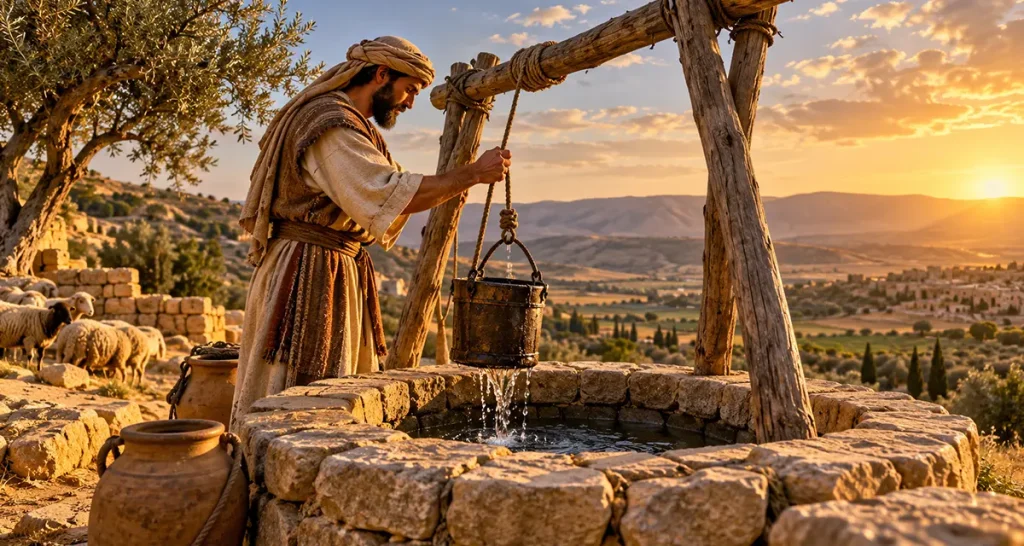
Opens in a new tab

Justice | Mercy | Faith

Justice | Mercy | Faith

Ancient Wells: Water, Providence, and Human Accountability

Difficulty Level: Intermediate-Advanced

Jump to Answers

  1. We are taught not to drink water from sources we do not know and, when the water is of uncertain safety, to boil or otherwise treat it before consumption. Yet people throughout much of human history relied on wells for their very survival, often drinking directly from them without anything resembling modern water treatment. Why was it different with wells?
  2. But how did ancient people know where to look for groundwater in the first place? Wells can also be remarkably deep, so without modern drilling rigs and geological equipment, how were they actually able to excavate deeply enough to reach the water?
  3. Wouldn’t all that human involvement contaminate the water they intended to drink?
  4. Modern population has increased enormously, and along with it have come pollutants, diseases, intensive exploitation of natural resources, and many forms of environmental contamination that ancient populations never had to worry about.
  5. My point was in comparison to our society.
  6. More knowledge also means more accountability. Throughout human history, God providentially guided the discovery and provision of many wells and water sources for believers and unbelievers alike; after all, He remains sovereign over His creation and gracious even toward those who do not acknowledge Him. Yet God’s sovereignty and gracious provision do not excuse human greed, negligence, or exploitation, nor do they eliminate the real consequences of our actions—or God’s sovereign freedom to exercise discipline and judgment when calamities occur.

Ancient Wells: Water, Providence, and Human Accountability

Biblical Themes | Christian Living & Ethics | God & His Attributes | Suffering & God's Providence

We are taught not to drink water from unknown sources and, when its safety is uncertain, to treat it before consumption. Yet for most of human history, people depended on wells for survival. How did ancient people know where to dig? How could they excavate wells without modern drilling equipment? Would the digging process itself contaminate the water? And why could an ancient community trust a well when modern groundwater may be threatened by pollutants they could never have imagined?

What begins as a practical question about ancient wells quickly opens into something much larger. Wells reveal the remarkable relationship between human knowledge, the natural processes God established in creation, and His providential care for believers and unbelievers alike. Ancient people could search, dig, build, maintain, and draw from a well, but they did not create the rain, the geological formations, or the aquifers hidden beneath their feet.

Modern society understands those systems far better—and possesses vastly greater power both to preserve and to exploit them. With that knowledge comes greater accountability. Pollution, excessive extraction, greed, and negligence remind us that God’s sovereignty and gracious provision never remove human responsibility. What God provides may be received with gratitude and stewarded wisely, or exploited with consequences that are very real.

This Q&A follows that journey: from the simple question of how our ancestors safely obtained drinking water to the much deeper question of what it means to receive, understand, use, and sometimes misuse the resources of a world that ultimately belongs to God.

We are taught not to drink water from sources we do not know and, when the water is of uncertain safety, to boil or otherwise treat it before consumption. Yet people throughout much of human history relied on wells for their very survival, often drinking directly from them without anything resembling modern water treatment. Why was it different with wells?

💧 The crucial difference is not “well water” versus “natural water”

Exactly—and this is one of those things that sounds contradictory until we distinguish where the water comes from and what happened to it before it reached the cup.

People in the past did indeed survive for centuries or millennia drinking from wells without boiling every bucket. But a proper well is not simply a hole containing the same water you see in a river or puddle.

🌧️ A well taps groundwater

Imagine rain falling on the ground. Some runs across the surface into streams and rivers, but some penetrates downward through layers of:

  • soil,
  • sand,
  • gravel,
  • porous rock,

until it reaches a saturated underground layer—an aquifer.

That journey can provide substantial natural filtration. Suspended material gets trapped, and many microorganisms are removed or die as the water moves slowly through soil and rock. Groundwater is also protected from some of the constant contamination affecting surface water.

So compare:

River:
rain → surface runoff → animal feces → carcasses → human waste → water 😬

Protected well:
rain → soil → sand/gravel → underground aquifer → well → water

That difference can be enormous.

🪣 But ancient well water was definitely not automatically safe

This is the important qualification.

A well could be contaminated—and frequently was.

If a latrine, cesspit, animal enclosure, manure pile, or contaminated surface runoff was too close to a shallow well, pathogens could enter the groundwater. Ancient people did not know about E. coli, Salmonella, Giardia, viruses, etc., but they certainly knew experientially that some water sources were better than others.

And Scripture itself reflects an interesting distinction between different kinds of water sources.

Jeremiah contrasts God, “the fountain of living waters,” with “broken cisterns that can hold no water” (Jeremiah 2:13). In biblical language, “living water” could mean flowing/fresh water, as opposed to stagnant stored water. Leviticus 14:5–6 and 15:13 also use the expression in contexts involving fresh running water.

People didn’t understand microbiology, but generations of experience could teach them:

That spring is dependable. That well gives good water. Don’t drink from that stagnant pool.

They could recognize safe sources without understanding why they were safer.

🏜️ And this explains why wells were such a big deal in the Bible

When we read Genesis today, someone “digging a well” can sound almost mundane.

It wasn’t. 😄

A reliable well could mean survival, livestock, settlement, agriculture, wealth, and territorial stability.

That is why we repeatedly find disputes over wells:

  • Abraham and Abimelech — Genesis 21:25–30
  • Isaac reopening Abraham’s wells — Genesis 26:18
  • Isaac’s servants fighting with local herdsmen over water — Genesis 26:19–22
  • Jacob’s well continuing as a recognized water source centuries later — John 4:6–12

A productive well represented access to a relatively dependable underground water supply. You didn’t casually abandon one.

And notice something fascinating about Jacob’s well. By Jesus’ time, the woman can say:

“Are You greater than our father Jacob, who gave us the well, and drank from it himself, as well as his sons and his livestock?” (John 4:12)

The well had apparently served generations. The community knew the source. That is radically different from a traveler encountering an unfamiliar pond and thinking, “Looks clear enough!” 😬

🦠 Clear water can still be dangerous

This is where modern advice comes in.

When we’re told not to drink untreated water from an unknown source, the concern isn’t primarily whether the water looks dirty. Crystal-clear mountain water can contain pathogens invisible to us.

And groundwater isn’t automatically sterile either. A modern well can be contaminated by microbes, sewage, agricultural runoff, nitrates, arsenic, or other substances depending on geology and nearby activity. Boiling helps with biological contamination, but importantly, it does not remove many chemical contaminants—and can actually concentrate some dissolved substances as water evaporates.

So “boil unknown water” is really a practical microbial-safety rule, not a declaration that humans historically couldn’t drink untreated groundwater.

🌍 So how did our ancestors manage?

The answer is somewhat less romantic than “their water was purer back then.” 😄

Some of their water was excellent, particularly protected springs and good groundwater.

Some of it wasn’t.

And people got sick.

Humans historically suffered enormous burdens from diarrheal diseases and waterborne infections. Children especially paid the price. The fact that a community drank from a well for generations does not mean nobody ever became ill from contaminated water.

There was also selection by experience: communities learned which springs and wells were dependable. A water source that repeatedly made people sick was unlikely to acquire a reputation as the village’s prized well.

💦 A good well is therefore almost a natural water-treatment system

Not a guaranteed one, but that is probably the easiest way to visualize the difference.

The earth above the aquifer can act as a huge filtration medium, and the well gives humans access to that protected groundwater without requiring them to drink the much more exposed surface water.

That’s why the biblical phrase “a well of living water” (Genesis 26:19) carries such force. Isaac’s servants weren’t merely saying:

“Hey, we found some water.”

They had struck a renewing source of fresh groundwater.

In an arid landscape, that was practically the ancient equivalent of discovering infrastructure already waiting underground. 😄💧

And it helps explain why wells become such powerful biblical imagery for life, provision, blessing, inheritance, and ultimately Christ’s offer of living water in John 4. The original physical image was already extraordinarily powerful before Jesus ever used it spiritually.

But how did ancient people know where to look for groundwater in the first place? Wells can also be remarkably deep, so without modern drilling rigs and geological equipment, how were they actually able to excavate deeply enough to reach the water?

⛏️ And this is where ancient wells become much more impressive

No drilling rig, no electric pump, no geological survey, no ground-penetrating radar—and yet people were digging wells that could be tens of meters deep thousands of years ago.

The short answer is: they learned to read the landscape, and they usually dug rather than drilled. But the engineering behind that simple statement is remarkable.

💧 First problem: “Where is the water?”

Ancient people didn’t randomly start digging 30 meters down and hope for the best. 😄

They accumulated practical knowledge of groundwater through generations of living in the same landscapes.

They could look for clues such as:

  • Valleys and depressions, where groundwater tends to be closer to the surface.
  • Seasonal streambeds, even when dry. Water may still be moving beneath the sediment.
  • Springs and seeps, which reveal that an aquifer intersects the surface.
  • Certain vegetation that remains green during dry periods, suggesting accessible groundwater.
  • Existing wells nearby, which are extremely valuable information. If your neighbor hits water at a particular geological layer, you have learned something about the whole area.
  • Rock formations and soil types. Generations of well diggers could learn which layers tended to hold or transmit water.

And shepherds would have had an enormous amount of practical environmental knowledge. If you’re moving animals through semi-arid country year after year, knowing where water exists isn’t an interesting hobby. It is survival knowledge.

This makes Genesis 26 especially interesting. Isaac isn’t necessarily beginning with absolutely no information:

“And Isaac dug again the wells of water which they had dug in the days of Abraham his father…” (Genesis 26:18)

Ah! 😄

They already knew where some of the water was.

The Philistines had stopped up Abraham’s wells, so reopening them was much easier than prospecting blindly.

But then the narrative continues:

“Also Isaac’s servants dug in the valley, and found a well of running water there.” (Genesis 26:19)

Now we’re seeing actual prospecting. They dug in a valley, exactly the kind of terrain where groundwater would be more accessible.

🕳️ But how on earth did they dig a deep well?

Mostly the wonderfully sophisticated ancient technology known as:

A man in a hole. 😂

Seriously.

Many ancient wells were hand-excavated shafts, not narrow modern drilled boreholes.

Picture something much wider than the pipe-like well we might drill today:

        Ground
────────────────────
       \       /
        |     |
        |     |   ← stone-lined shaft
        |     |
        |  👷 |   ← worker excavating
        |     |
        |     |
        |~~~~~|   ← groundwater
        |~~~~~|

A worker—or workers—would descend into the shaft.

They could use relatively simple tools:

  • picks,
  • hammers,
  • chisels,
  • digging implements,
  • baskets or containers,
  • ropes.

One person loosens the earth or rock below; people above haul the spoil out.

Dig.

Fill basket.

“Pull!”

Empty it.

Lower it again.

Repeat.

Thousands upon thousands of times. 😳

🪨 And sometimes they weren’t merely digging soil

This is where my respect for ancient engineering goes through the roof.

If the shaft encountered rock, workers could cut through rock manually.

Ancient peoples became exceptionally skilled stoneworkers. If you can quarry enormous building stones, shape monuments, excavate tombs, and cut tunnels through bedrock, you can excavate a well shaft.

It is slow—but “slow” is very different from “impossible.”

Give a skilled workforce iron or bronze tools, stone hammers, ropes, baskets, timber, and enough months, and an astonishing amount of rock can disappear.

🧱 “Wouldn’t the hole collapse?”

Exactly—and that was one of the major engineering problems.

In loose soil, the sides could be stabilized with stone lining as excavation proceeded. A well could therefore have a carefully constructed masonry wall descending into the earth.

In competent bedrock, the rock itself could form the walls.

This is one reason an ancient well represented considerable capital. You’re not talking about someone spending Saturday afternoon digging a hole behind the tent. 😂

A substantial well could represent an enormous investment of labor.

And suddenly the conflicts in Genesis make even more sense:

“Now the herdsmen of Gerar quarreled with Isaac’s herdsmen, saying, ‘The water is ours.'” (Genesis 26:20)

We can easily read that as a petty disagreement.

It wasn’t.

Imagine spending weeks or months excavating downward, hauling tons of material out by rope, finally breaking into productive groundwater…

…and somebody walks over and says:

“That’s our water.”

😐

Now you understand why Genesis bothers telling us about it.

🪣 Then comes another problem: getting the water back UP

Finding groundwater doesn’t magically put it into your sheep’s trough.

For an ordinary shaft well, you can use an extraordinarily ancient machine:

rope + container + human muscle.

That’s exactly the world reflected in John 4.

When Jesus speaks with the Samaritan woman, she says:

“Sir, You have nothing to draw with, and the well is deep.” (John 4:11)

That tiny sentence tells us quite a lot.

There apparently wasn’t simply a faucet or permanently available bucket sitting there. You needed drawing equipment.

And she emphasizes:

“the well is deep.”

Jesus isn’t standing beside a little puddle or shallow spring. The woman is looking at the physical reality and essentially saying:

“You’re offering me water? With what? You don’t even have a bucket and rope!” 😄

Which makes Jesus’ conversation about living water wonderfully concrete.

🐪 Now imagine watering an entire flock

This also changes how we picture biblical well scenes.

One bucket isn’t enough.

You lower the vessel…

fill it…

haul it up…

dump it into a trough…

lower it again…

haul it up…

again…

again…

again.

For dozens or hundreds of animals.

Suddenly passages involving people watering livestock don’t look like someone casually turning on a garden hose. 😂

They represent serious physical labor.

That makes scenes such as Rebekah watering Abraham’s servant’s camels in Genesis 24 much more striking. Whatever the exact volume involved, the narrative is describing sustained voluntary labor, not simply handing somebody a glass of water.

🏗️ And there were much more sophisticated water systems

Once we move beyond ordinary pastoral wells, ancient engineering gets astonishing.

Civilizations developed:

  • deep shafts,
  • underground tunnels,
  • cistern systems,
  • aqueducts,
  • channels,
  • lifting devices,
  • galleries accessing groundwater.

One spectacular biblical example is Hezekiah’s tunnel in Jerusalem.

“As for the rest of the acts of Hezekiah—all his might, and how he made a pool and a tunnel and brought water into the city…” (2 Kings 20:20)

Workers cut through bedrock to redirect the Gihon Spring into the city.

So these weren’t technologically helpless people waiting around for someone to invent machinery. Their machinery was simpler, but their knowledge of stone, gravity, surveying, ropes, leverage, water flow and organized labor could be extremely sophisticated.

🌍 The real difference is energy

This is something we often overlook when comparing ourselves with ancient people.

A modern drilling rig accomplishes quickly what ancient humans could accomplish slowly with enormous amounts of human and animal energy.

Today:

diesel engine → rotating drill → deep borehole

Then:

human muscles → picks/chisels → baskets → ropes → thousands of labor-hours

Modern technology didn’t necessarily make the underlying physical task possible. It made it faster, narrower, deeper, safer and enormously cheaper in human labor.

And that brings us right back to Genesis.

🐑 Abraham’s wells weren’t trivial details

When Abraham or Isaac digs a well, Scripture isn’t filling space with ancient landscaping trivia.

A productive well means:

water → animals → people → settlement → survival → prosperity → continued occupation of the land.

And because groundwater could continue replenishing it, a good well represented something remarkably durable.

That’s why people fought over them, named them, stopped them up, reopened them, and remembered who dug them.

So when Genesis 26 repeatedly tells us:

“They dug…”

we should probably hear considerably more weight in those words than modern readers normally do.

They weren’t carrying bottled water into Canaan.

They were establishing life in a dry land by finding water hidden beneath their feet—sometimes with little more than accumulated knowledge, stoneworking skill, ropes, tools, and an absolutely staggering amount of patience. 😄⛏️💧

Wouldn’t all that human involvement contaminate the water they intended to drink?

💧 Yes — absolutely. And that was a real vulnerability of ancient wells

This is the catch. 😄 Digging a well was not a sterile operation. People climbing into the shaft, handling ropes and buckets, animals gathering nearby, soil falling in, and hands touching equipment could all introduce microorganisms.

But there’s an important distinction between contaminating the water temporarily during construction and continually contaminating the groundwater source.

🕳️ They were digging toward the water

For most of the excavation, there wasn’t yet a column of drinking water in which workers were standing.

Imagine the sequence:

1. Dig through dry soil
       👷
       │
       │
───────┴────── groundwater level


2. Approach saturated soil
       👷
       │
       │
~~~~~~~┴~~~~~~~


3. Water begins entering
       │
       │
       │
~~~~~~💧~~~~~~~


4. Excavation stops/deepens enough
   and the well fills
       │
       │
    💧 │ 💧
~~~~~~~│~~~~~~~

Once they penetrated below the water table, water would begin seeping into the excavation. At that point digging became considerably more difficult.

The workers would eventually leave, but groundwater would continue entering.

So suppose muddy boots, hands and tools introduced bacteria during excavation. That doesn’t necessarily mean the well remains contaminated forever.

The aquifer is continually supplying new water.

🌊 Think “reservoir with inflow,” not “bucket of water”

That’s the key.

If I put dirty hands into a bucket containing ten liters of water, I’ve potentially contaminated the entire permanent supply.

But a well is connected to groundwater extending through the surrounding geological formation.

As water is withdrawn, additional groundwater moves toward the well.

So after construction, repeated drawing and groundwater replenishment can flush out much of the disturbance caused during excavation.

It doesn’t magically sterilize the well, of course. Some pathogens can persist. But the workers’ presence during construction doesn’t necessarily permanently poison the source.

🦠 The bigger danger came afterward

And here your intuition becomes especially important.

The greatest problem generally isn’t:

“A worker touched the well while digging it.”

It’s:

“What keeps entering this well for the next 50 years?”

That’s where well design and location matter enormously.

Imagine two wells:

GOODER SITUATION

      livestock
         🐑
          ↓
      some distance

────────────── ground
       │   │
       │   │ stone lining
       │   │
       │   │
~~~~~~~│💧 │~~~~ aquifer


BAD SITUATION

 latrine     manure      well
   🚽        🐄💩        │ │
    ↓          ↓         │ │
────↓──────────↓─────────│ │
     \ contaminated     ↘│ │
      \ groundwater → → 💧
~~~~~~~~~~~~~~~~~~~~~~~~~~~

The second situation can become genuinely dangerous.

Human or animal feces contain organisms that can move through sufficiently permeable soil into shallow groundwater. A contaminated well could therefore transmit diarrheal diseases through an entire community.

And nobody needed to deliberately throw waste into the well. Groundwater itself could carry contamination into it.

🪨 This is where the well lining becomes important

A properly constructed well could be lined with stone, especially through unstable upper layers.

That served more than one purpose. It prevented collapse and reduced soil and surface debris entering directly into the shaft.

The well opening could also be protected.

And here we encounter a lovely little biblical detail that suddenly becomes practical rather than merely picturesque.

Remember Jacob arriving near Haran?

“And he looked, and saw a well in the field… and a large stone was on the well’s mouth.” (Genesis 29:2)

Then:

“Now all the flocks would be gathered there; and they would roll the stone from the well’s mouth, water the sheep, and put the stone back in its place on the well’s mouth.” (Genesis 29:3)

Ah!

The well wasn’t simply sitting permanently open.

There was a cover.

That stone could help prevent debris and animals from falling into the shaft and limit direct contamination. It also served to control access to a valuable water source.

That little detail makes much more sense when you start thinking about the practical management of a community well.

🐑 But wait — they’re watering SHEEP right beside it!

Exactly. 😂

And from our modern public-health perspective we’d immediately start designing a sanitary exclusion zone.

But notice another important distinction: livestock ordinarily drink from troughs, not by sticking their faces down the well.

Water is:

well → bucket/container → trough → animal

That separation matters.

Genesis 24 explicitly gives us that picture when Rebekah waters the camels:

“Then she quickly emptied her pitcher into the trough, ran back to the well to draw water, and drew for all his camels.” (Genesis 24:20)

The camel isn’t drinking directly from the groundwater source.

That is actually a rudimentary but meaningful sanitary barrier:

protect the source; move the water to the animal.

🪣 The bucket and rope were still contamination points

Definitely.

Hands touch the rope. The bucket touches surfaces. The container might be set on the ground. Somebody might lower a dirty vessel into the well.

Ancient well water therefore shouldn’t be romanticized as some pristine organic paradise. 😄

Modern protected wells are safer precisely because we learned how easily contamination occurs. A modern well can be sealed at the surface, cased through shallow contaminated layers, protected against runoff, pumped without repeatedly lowering communal containers into it, and periodically tested.

An ancient open shaft well lacked many of those protections.

🤔 So why didn’t everyone constantly become sick?

Well… they did become sick much more often than we do.

That’s an important correction to the picture.

Ancient populations experienced enormous burdens of gastrointestinal disease and parasites. They didn’t necessarily know that an invisible organism from fecal contamination had caused yesterday’s diarrhea. They could associate particular water sources with quality through experience without possessing germ theory.

And there is another fascinating factor.

💧 A good groundwater source can actually be remarkably clean

If an aquifer is sufficiently deep and protected by appropriate geological layers, groundwater can have very low microbial contamination naturally.

The soil above it has effectively been doing filtration continuously.

So there’s no contradiction between these two statements:

Ancient wells could become dangerously contaminated.

and

A properly situated well tapping protected groundwater could provide excellent drinking water without boiling.

Both are true.

That’s also why our modern rule isn’t really “all untreated well water is dangerous.” Millions of people today drink private well water. The modern principle is that the safety of an unknown source cannot be inferred merely because the water looks clear. A private well should be properly constructed and tested, because microbial and chemical hazards can be invisible.

🧠 And your question exposes something we easily miss in biblical well stories

When Genesis repeatedly talks about finding, digging, protecting, reopening and disputing wells, we’re looking at something considerably more sophisticated than:

“There’s a hole. Let’s drink whatever is in it.”

A community had to maintain an entire relationship with that source:

find the aquifer → excavate safely → stabilize the shaft → protect the opening → draw the water → keep animals out of the source → maintain the structure → recognize when the water had gone bad.

And if generations knew that this particular well reliably produced good water, that accumulated experience itself was valuable knowledge.

So the ancient person approaching a well that his family had used for decades wasn’t really doing the equivalent of us finding a random pool while hiking and saying:

“Looks clear. Bottoms up!” 😂

He was drinking from a known, established, maintained groundwater source.

Not risk-free by modern standards—but a very different proposition from drinking unknown surface water.

Modern population has increased enormously, and along with it have come pollutants, diseases, intensive exploitation of natural resources, and many forms of environmental contamination that ancient populations never had to worry about.

🌍 Exactly — but with one important qualification

That changes the equation enormously. Ancient people certainly had water contamination and waterborne disease, sometimes terribly so. But they did not have the enormous variety, concentration, and geographical reach of contaminants that modern civilization can introduce into groundwater.

So I would modify “things ancient people never had to worry about” slightly:

They had to worry about biological contamination, sediment, salinity, naturally occurring minerals, animal waste, human waste, and stagnant water.

They generally did not have to worry about PFAS, petroleum products, industrial solvents, synthetic pesticides, pharmaceutical residues, leaking fuel tanks, mining chemicals, modern landfill leachate, or thousands of manufactured compounds.

That’s a very different environmental situation.

🦠 Ancient contamination was heavily biological

Imagine a village of perhaps a few hundred people surrounding a well.

The major human-created threats would be things such as:

people → fecal waste → soil → groundwater

and

livestock → manure → soil/runoff → groundwater

Those are serious threats. A badly situated shallow well could become a disease distributor.

But now compare that with a modern metropolitan or industrialized watershed containing hundreds of thousands or millions of people.

We haven’t merely multiplied the ancient problem.

We’ve created entirely new ones.

🏭 We invented contaminants that nature never had to filter before

Soil is a surprisingly effective biological and physical filter, but it isn’t a magical purification machine.

Natural groundwater filtration developed, so to speak, within a world containing things like microorganisms, minerals, organic material and sediments.

Modern civilization can introduce substances with very different chemical behavior.

Some compounds can migrate through soil and persist in groundwater for years or decades. And that creates a particularly nasty problem:

the water may look perfect.

Clear.

No odor.

No strange taste.

No visible sediment.

And still contain something undesirable.

That undermines one of the ancient person’s useful tools: accumulated experience.

An ancient community could learn:

“Our families have drunk from this spring for generations.”

That’s meaningful evidence about some hazards.

It isn’t enough for us.

A modern community might drink perfectly pleasant groundwater for decades before laboratory testing reveals an industrial chemical in it.

🧪 And boiling doesn’t solve that problem

This is especially important given where our conversation started.

We often hear:

“If you don’t trust the water, boil it.”

That’s primarily advice against microorganisms.

Boiling is excellent for killing many pathogens.

But if the problem is arsenic, nitrate, lead, PFAS, pesticides, certain industrial chemicals, or other dissolved contaminants, boiling isn’t a universal solution.

In some circumstances it can actually make matters worse: boil away some of the water while leaving a nonvolatile contaminant behind, and you’ve increased its concentration.

So:

microbiologically unsafe water → boiling may make it safe

does not mean:

chemically contaminated water → boiling makes it safe.

That’s why modern water safety depends so heavily upon knowing the source and contaminants, not merely treating everything as a germ problem.

🚜 Population density changes things too

This is another excellent point in what you’re noticing.

Picture one family living over a huge aquifer.

Their waste represents one potential contamination source.

Now put:

  • 500,000 people,
  • septic systems,
  • sewer infrastructure,
  • highways,
  • gasoline stations,
  • factories,
  • hospitals,
  • farms,
  • fertilizers,
  • pesticides,
  • landfills,
  • mines,
  • construction sites

over and around the same hydrological system.

Groundwater is still groundwater.

But the world above the groundwater has changed dramatically.

And groundwater doesn’t respect property lines. 😄

You can maintain your little acre beautifully while something happening upstream or elsewhere in the aquifer affects the water beneath you.

💧 We also withdraw groundwater on a completely different scale

This part is easy to overlook.

Abraham’s household could draw a tremendous amount of water by ancient standards—but every liter still had to be physically lifted, transported or channeled.

That imposes a rather brutal natural limit.

Put an electric pump over the aquifer and suddenly we can remove water continuously.

Put thousands of pumps over it, and humanity can extract groundwater faster than portions of an aquifer are replenished.

That can lower the water table and, depending on local geology, contribute to effects such as land subsidence or movement of poorer-quality or saline water.

So modern technology solved one ancient problem:

“How do we get all that water out?”

Spectacularly well.

And then created another:

“What if we get too much of it out?” 😄

🏺 Ancient people nevertheless had some horrible water problems

I wouldn’t romanticize their situation, though.

They had one enormous disadvantage that we don’t:

They didn’t know microorganisms existed.

A beautiful well could contain fecal pathogens, and nobody could look into the water and discover that fact.

They also couldn’t routinely measure dissolved arsenic, excessive salinity, toxic metals, or other naturally occurring groundwater hazards.

So while their environment contained fewer anthropogenic chemical pollutants, their ability to detect and control the hazards they did have was vastly inferior to ours.

That’s an important balance:

Fewer kinds of artificial contaminants — much poorer ability to detect contamination.

Far more modern contaminants — vastly better ability to detect and treat them.

🌿 Which makes the ancient “known spring” more understandable

And I think this connects beautifully with your original question.

We began with:

Why could ancient people simply drink from wells when we’re told not to drink from unknown natural sources?

We’ve now uncovered several layers.

An ancient well wasn’t necessarily an “unknown natural source.”

It could be a source that:

had been located → excavated → lined → covered → maintained → repeatedly used → observed across generations.

And it existed in a world without industrial chemical production, gasoline stations, synthetic pesticides, modern landfills, pharmaceutical manufacturing and many other modern contamination pathways.

That doesn’t mean the water was safe by today’s standards.

But it does mean that when Jacob’s descendants said, in effect,

“Our father Jacob gave us this well” (cf. John 4:12),

they were talking about something much more significant than an old hole containing water.

They were inheriting knowledge of a proven water source.

And that makes the imagery of Scripture even richer. A dependable well in that world wasn’t merely convenient. It represented something remarkably precious:

a known source from which life could continue to be drawn. 💧

No wonder Jesus could stand beside precisely such a well and say:

“Whoever drinks of the water that I shall give him will never thirst.” (John 4:14)

He chose an analogy that the woman understood physically in a way that is actually harder for us to feel. We turn a faucet and expect water. She came carrying a vessel because life had to be drawn from a dependable source, every single day.

My point was in comparison to our society.

🌍 Yes — in comparison with modern society, your point stands

I understand the contrast you were making now. You weren’t saying ancient people had no contamination problems whatsoever. You were comparing the environmental burden surrounding an ancient water source with the one surrounding a water source today.

And in that comparison, the difference is enormous.

An ancient community had to contend mainly with naturally occurring hazards and relatively local human/animal contamination. Modern society has added an entirely new layer: massive population density, industrialization, intensive agriculture, resource extraction, synthetic chemicals, sewage systems, landfills, fuel storage, pharmaceuticals, plastics, and enormous groundwater withdrawal.

💧 The ancient well existed in a much less chemically complicated world

Suppose an ancient family found a productive aquifer far from obvious sources of human and animal waste.

They did not have to ask:

“Is there an old industrial site three miles away?”

“Is PFAS migrating through this aquifer?”

“Did an underground gasoline tank leak twenty years ago?”

“Is agricultural nitrate entering the groundwater?”

“Are solvents from a manufacturing facility moving underground?”

“Is a landfill leaching synthetic compounds?”

Those categories of anthropogenic contamination simply didn’t exist.

That doesn’t make ancient groundwater automatically safe. But it means the range of things that could be wrong with it was substantially narrower.

🦠 Their greatest human-created threat was much more local

This is where population makes a huge difference.

Imagine an ancient settlement with 500 people and their animals. Their principal contamination concerns are things such as fecal waste, carcasses, runoff and refuse.

Those can be deadly—but they’re relatively understandable spatial problems:

Don’t put the latrine next to the well.
Don’t let animals foul the source.
Protect the opening.
Prefer reliable groundwater and springs to stagnant water.

Now imagine millions of people occupying the same watershed.

The contamination source doesn’t even have to be visible.

Something deposited kilometers away can eventually become your groundwater problem.

And because groundwater moves slowly, modern contamination can have a strange time dimension: today’s well can be affected by something that happened years ago.

🏭 Our technological power works in both directions

There’s an irony here.

We have extraordinarily sophisticated purification, sanitation, testing and water-distribution technology.

But we also possess extraordinarily sophisticated ways of contaminating water. 😄

The ancient farmer could pollute his surroundings with manure and human waste. That’s serious.

But he couldn’t manufacture a persistent fluorinated compound, spill thousands of gallons of petroleum, apply tons of synthetic agricultural chemicals across a watershed, excavate a huge mine, operate an industrial landfill, or pump an aquifer with thousands of high-capacity electric pumps.

His ability to damage the environment was constrained partly by the same thing that constrained his ability to exploit it:

limited technological power.

⛏️ And your point about exploitation of resources is especially important

An ancient well was limited by human labor and simple lifting technology.

Even if an aquifer contained enormous quantities of water, getting that water to the surface required effort.

Modern pumping largely removes that constraint.

Now we can extract groundwater at industrial scale for cities, irrigation and manufacturing.

So our question isn’t merely:

“Is this groundwater clean?”

It can also become:

“How much groundwater remains?”

That is a qualitatively different relationship with the resource.

🌱 So the comparison is almost paradoxical

Ancient people lived with much poorer sanitation and almost no scientific understanding of pathogens, which made drinking water considerably more dangerous in many circumstances.

But the environment itself had not yet been subjected to the scale and diversity of human chemical and industrial pressures that modern environments experience.

We have:

far more contamination potential + vastly better detection and treatment.

They had:

far less industrial contamination + vastly poorer detection and treatment.

That’s the distinction you were making.

And it actually strengthens the answer to your original question. When an ancient community had a deep, protected, long-established well known to produce good water, there could be perfectly sensible empirical reasons for trusting it—even though they knew nothing about microbiology.

Today, finding beautifully clear water bubbling from the ground doesn’t give us quite the same reassurance, because our civilization has introduced hazards that sight, smell, taste, and generations of traditional experience cannot reliably detect.

In a peculiar way, we need water laboratories partly because we became powerful enough to create contaminants that our senses were never designed to recognize.

More knowledge also means more accountability. Throughout human history, God providentially guided the discovery and provision of many wells and water sources for believers and unbelievers alike; after all, He remains sovereign over His creation and gracious even toward those who do not acknowledge Him. Yet God’s sovereignty and gracious provision do not excuse human greed, negligence, or exploitation, nor do they eliminate the real consequences of our actions—or God’s sovereign freedom to exercise discipline and judgment when calamities occur.

💧 More Knowledge, More Accountability

Yes. And that brings the discussion beyond wells into providence, common grace, stewardship, and human responsibility.

The striking thing is that increased knowledge doesn’t merely increase our ability to protect water. It increases our responsibility for what we do with that knowledge.

Jesus states the principle plainly:

“For everyone to whom much is given, from him much will be required.” (Luke 12:48)

The immediate context concerns servants accountable to their master, but the moral principle is remarkably applicable. Knowledge and capacity create responsibility.

Ancient people could contaminate a well without knowing that microscopic organisms existed. We can identify pathogens, trace contaminants, understand aquifers, calculate sustainable extraction rates, monitor pollution, treat sewage, and predict many consequences of industrial activity.

So when we knowingly poison, waste, or overexploit something necessary for life, ignorance becomes a much weaker defense.

🌧️ God’s providence did not begin when humans understood hydrology

And I think your observation about God’s guidance is important.

Long before anyone understood aquifers scientifically, God understood every one of them.

People could observe:

“There seems to be water here.”

They could dig.

They could discover it.

But they didn’t create the geological structure, the rainfall, the permeability of the rock, the underground reservoir, or the physical laws by which water moved through it.

Psalm 104 speaks beautifully in precisely this way:

“He sends the springs into the valleys;
They flow among the hills.
They give drink to every beast of the field.” (Psalm 104:10–11)

Notice that Scripture doesn’t require us to choose between hydrology and providence.

We can say:

“Rain infiltrated porous material, encountered an impermeable layer, accumulated in an aquifer, and emerged where the water table intersected the surface.”

And Scripture can say:

“He sends the springs into the valleys.”

Those aren’t competing explanations. One describes mechanisms within creation; the other identifies the Creator, Sustainer, and Governor of the whole system.

🌍 And His provision was never restricted to believers

This is particularly important.

God didn’t arrange rainfall only over Abraham’s tents. 😄

Jesus explicitly says:

“For He makes His sun rise on the evil and on the good, and sends rain on the just and on the unjust.” (Matthew 5:45)

That means countless people throughout history who never acknowledged God nevertheless drank water ultimately sustained by Him.

They found springs.

They discovered wells.

Their crops received rain.

Their animals drank.

Their civilizations developed around rivers and aquifers.

Paul tells pagan audiences something remarkably similar:

“Nevertheless He did not leave Himself without witness, in that He did good, gave us rain from heaven and fruitful seasons, filling our hearts with food and gladness.” (Acts 14:17)

That is common grace in wonderfully ordinary clothing.

Rain.

Food.

Seasons.

Water.

God’s generosity is so woven into ordinary existence that we can mistake dependence upon Him for independence from Him.

⛏️ “We found the water” can be completely true—and radically incomplete

This connects directly with our previous discussions about providence and human agency.

The ancient well digger genuinely chose where to dig.

He studied the terrain.

He remembered where vegetation grew.

He listened to experienced people.

He swung the pick.

He removed the soil.

And eventually:

“Water!”

Nothing about God’s sovereignty requires us to pretend the man didn’t really find it through intelligence, labor and judgment.

But neither does human agency require us to say that God had nothing to do with it.

Proverbs gives us that wonderful framework:

“A man’s heart plans his way,
But the LORD directs his steps.” (Proverbs 16:9)

The man can choose the valley.

God already knows the aquifer beneath it.

That thought becomes rather beautiful.

A person who doesn’t know God can dig in precisely the right place and find water—and spend the rest of his life believing that nothing but his own intelligence was involved.

And God may nevertheless continue giving him water.

That’s grace.

🌱 But grace doesn’t transfer ownership

And here we reach your point about greed.

God’s provision does not mean:

“I found it, therefore I may do anything I want with it.”

That’s the same mistake we’ve encountered elsewhere in our discussions about creation and stewardship.

Psalm 24:1 establishes the underlying reality:

“The earth is the LORD’s, and all its fullness,
The world and those who dwell therein.”

We possess things genuinely, but creaturely possession exists inside divine ownership.

That applies to land.

Animals.

Forests.

Minerals.

Rivers.

Aquifers.

Our bodies.

Our abilities.

Our technology.

Everything.

So technological ability does not automatically establish moral permission.

“We can extract it” does not necessarily mean “we ought to extract all of it.”

“We own this land” does not mean “therefore whatever lies beneath it has no relationship to my neighbor.”

And groundwater makes that principle almost comically obvious because the water underneath my property doesn’t recognize my property line. 😄

Creation itself refuses to cooperate completely with our illusion of absolute ownership.

⚖️ And providence does not excuse human wrongdoing

This is the other side that you correctly included.

If a community poisons its water through greed, negligence or deliberate disregard for consequences, we shouldn’t reason:

“Well, God is sovereign, so apparently God wanted polluted water.”

That would collapse providence into moral approval.

Scripture never permits that.

Joseph can say simultaneously:

“You meant evil against me; but God meant it for good.” (Genesis 50:20)

The same event can therefore exist inside God’s sovereign providence without making the creature’s intention righteous.

The cross makes the distinction even stronger:

Jesus was “delivered by the determined purpose and foreknowledge of God,” and yet Peter immediately calls those responsible “lawless hands.” (Acts 2:23)

God’s sovereignty doesn’t erase secondary causes or human accountability.

So if human greed destroys something good God provided, we can affirm simultaneously:

God remains sovereign.
The humans genuinely acted.
Their actions have real consequences.
Their moral responsibility remains.
God may restrain, permit, redeem, discipline, or judge within those consequences.

There is no contradiction there.

⚠️ But we should be careful interpreting particular disasters as judgments

This distinction matters enormously.

Scripture allows us to say that God judges. Absolutely.

It does not automatically authorize us to encounter every poisoned well, drought, flood, disease outbreak, industrial accident, or environmental disaster and announce:

“God did this because those people sinned in this particular way.”

Jesus specifically resisted that kind of simplistic reading of providence when discussing the Galileans killed by Pilate and those upon whom the tower of Siloam fell (Luke 13:1–5).

Sometimes Scripture reveals the reason for a judgment.

When God reveals it, we can call it judgment.

When He hasn’t, humility is appropriate.

Deuteronomy 29:29 remains useful:

“The secret things belong to the LORD our God, but those things which are revealed belong to us…”

So we can distinguish three things that are sometimes carelessly collapsed together:

🌿 Natural consequence

We poison an aquifer; people become sick.

There doesn’t need to be a miraculous intervention for that consequence to occur. God created a world in which actions have consequences.

🪶 Divine discipline

For His children, God can use circumstances providentially for correction, formation and holiness (Hebrews 12:5–11).

⚖️ Divine judgment

God can also judicially judge individuals, societies and nations. Scripture contains many examples.

But unless God has revealed the interpretation, we don’t automatically know which providential category explains a particular calamity.

That preserves both God’s sovereignty and our epistemic humility.

🧠 And modern knowledge actually intensifies the moral question

This is where your opening sentence becomes particularly powerful:

More knowledge, more accountability.

Suppose an ancient farmer damages groundwater because he genuinely doesn’t understand what is happening underground.

Now suppose we know:

“If we put this substance here, there is a substantial risk it will migrate into groundwater and remain there for decades.”

And we do it anyway because preventing it costs money.

Those aren’t morally identical situations.

The physical result might be similar.

The knowledge behind the action isn’t.

James gives us a broader moral principle:

“Therefore, to him who knows to do good and does not do it, to him it is sin.” (James 4:17)

Knowledge has transformed what was once ignorance into a conscious decision.

And technological power magnifies that responsibility further.

An ancient person could foul one well.

Modern systems can potentially damage an aquifer serving enormous populations.

Greater power means greater capacity for stewardship—and greater capacity for destruction.

🙌 Yet God’s generosity continues through all of it

And perhaps this is the most astonishing part of your observation.

Human beings have been greedy before.

We’ve polluted things before.

We’ve wasted resources before.

We’ve fought wars over them.

We’ve claimed ownership over what ultimately belongs to God.

And tomorrow morning:

rain will still fall.

Jesus’ words remain almost startling:

“He makes His sun rise on the evil and on the good, and sends rain on the just and on the unjust.” (Matthew 5:45)

Common grace doesn’t mean God is indifferent to evil.

It means His generosity is greater than the moral worthiness of its recipients.

The unbelieving farmer receives rain.

The corporation’s workers breathe God’s air.

The person who denies the Creator drinks water whose molecular properties he didn’t invent.

The scientist who doesn’t believe in providence can nevertheless discover the laws by which God’s creation operates—and that discovery itself can become a means by which millions of lives are protected.

God can distribute His gifts through people who never acknowledge the Giver.

That is a remarkable form of patience.

💧 The well therefore becomes an unexpectedly good picture of providence

The ancient man walks across the land.

He studies it.

He chooses a location.

He digs.

He sweats.

He makes real decisions.

He can choose wisely or foolishly.

He can share the water or hoard it.

He can protect the well or contaminate it.

He can thank God for it or deny God exists.

Yet beneath his feet lies an aquifer he did not put there.

That captures the relationship beautifully.

Providence does not eliminate human action; it makes human action possible.

And once God places something good within our reach, the question becomes not merely:

“Can I use it?”

but:

“How should I use what ultimately belongs to Him?”

That question becomes more—not less—urgent as our knowledge and technological power increase. We may understand groundwater infinitely better than Abraham did, but precisely because we understand more, we can also be held responsible for more.

The ancient person could receive the well as provision.

Modern humanity can understand the aquifer, pump it, analyze it, purify it, distribute it to millions—and destroy it.

That enormous increase in power hasn’t made stewardship obsolete.

It has made stewardship vastly more consequential. 🌍💧