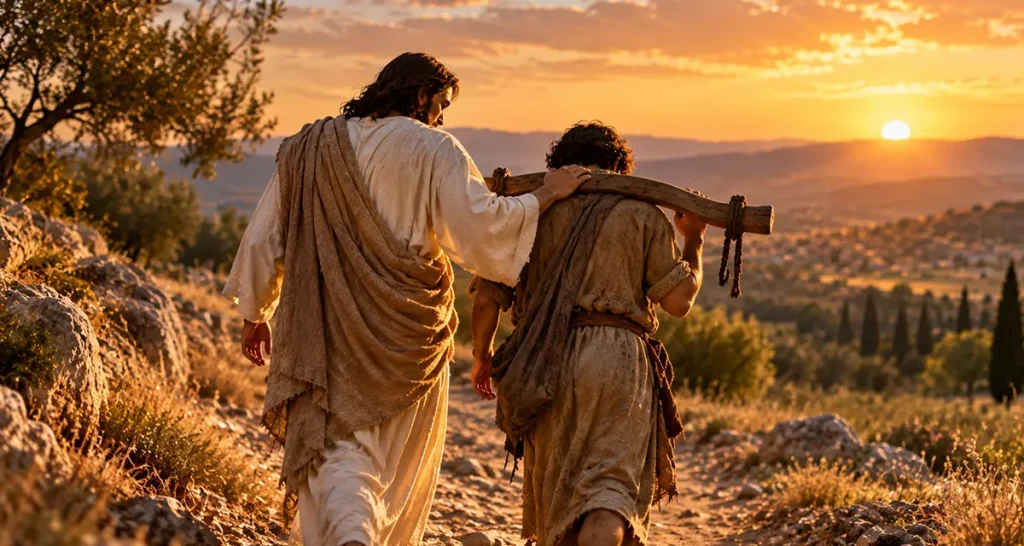
Opens in a new tab

Justice | Mercy | Faith

Justice | Mercy | Faith

Christ’s Yoke: Righteousness, Rest, and Our Dependence on God

Difficulty Level: Intermediate-Advanced

Jump to Answers

  1. “Come to Me, all you who labor and are heavy laden, and I will give you rest.” The Greek words κοπιῶντες (kopiōntes) and πεφορτισμένοι (pephortismenoi) seem especially revealing in the context in which Jesus spoke these words. 
  2. The image of the yoke that Jesus uses seems to require careful explanation. A yoke could join two animals pulling together, both placed under it by a master. So when Jesus says, “Take My yoke upon you and learn from Me”, is He presenting Himself as the Master whose yoke we receive, or as the One who comes under the yoke beside us and shares the burden? Scripture also forbids putting different kinds of animals under the same yoke (Deuteronomy 22:10), and the difference between Christ and us is infinitely greater: we could never keep pace with Him.
  3. Jesus is not yoked alongside us as though He needed our strength added to His, and yet He carries and sustains us far more than we realize—even during those moments when we imagine that we are standing and walking on our own.
  4. “He does not need my strength added to His.” Yet what are we to make of Simon of Cyrene, who was compelled to help Jesus carry the cross on the way to Calvary?
  5. “I was under one kind of burden → Jesus calls me under His lordship.” Yet Jesus’ exposition of the Law in Matthew 5 makes us tremble at our foundations. Rather than making righteousness easier than the Pharisees imagined, Jesus reveals that God’s Law reaches much further. The righteousness Jesus reveals is far more encompassing than even the Pharisees understood it to be.
  6. Jesus may not be yoked with us, but He nevertheless walks beside us at our painfully slow pace when compared with His perfection. We cannot possibly keep up with His stride, yet rather than abandoning us because of our weakness, He graciously slows His manner of leading to ours.
  7. It is striking that Jesus has no difficulty using an illustration that can wound our pride by comparing us, in a sense, to animals of burden under a yoke, if we misunderstand His words.
  8. “He who sustains human bodies possessed a body that could become exhausted.” Jesus truly became exhausted because He did not use His divine prerogative to exempt His humanity from the ordinary conditions God established for human life. Instead, He allowed His human body to be sustained within the creaturely order—as we ourselves must be sustained by God, except that we possess no divine prerogative from which we could ever choose otherwise.
  9. “The righteousness God requires cannot finally be detached from relationship with God Himself.” That seems to capture the gospel in remarkably few words, holding together both its demanding severity and its gracious accomplishment.
  10. “I do not possess in myself the life from which this righteousness naturally proceeds.” Yet this seems to require an even deeper qualification: even in a hypothetical perfectly sinless life, righteousness could never originate in me as its independent source.

Christ’s Yoke: Righteousness, Rest, and Our Dependence on God

Discipleship & Growth | Jesus Christ (Christology) | Law & Grace | Salvation (Soteriology) | Sin & Human Nature

Jesus’ invitation, “Come to Me, all you who labor and are heavy laden, and I will give you rest,” sounds immediately comforting. Yet His next words introduce an unexpected image: “Take My yoke upon you and learn from Me” (Matthew 11:28–29). Why would Jesus offer a yoke to people already exhausted beneath their burdens? Is Jesus pictured as sharing the other side of the yoke with us, or is He the Lord whose yoke we receive? And how can His burden be called “light” when His own exposition of righteousness in the Sermon on the Mount reaches beyond outward conduct into anger, desire, truthfulness, enemy-love, and ultimately the perfection of the Father Himself (Matthew 5:21–48)?

These questions lead far beyond the image of an agricultural yoke. Christ’s yoke confronts one of our deepest assumptions: that freedom means independence and that righteousness is something we might eventually possess or produce from ourselves. Yet Scripture presents human life differently. Even before sin entered the world, humanity was dependent upon God for life, goodness, knowledge, provision, and purpose (Genesis 1:26–31; 2:7–17). Sin did not create our dependence; it corrupted our relationship to it. And even a perfectly righteous, glorified creature will never become the independent source of its own goodness.

The wonder of the gospel, then, is not that Jesus lowers God’s righteousness until we can manage it. The righteousness God requires cannot finally be detached from relationship with God Himself. The same Christ who exposes the breathtaking depth of righteousness also says, “Come to Me.” He does not abolish the yoke; He calls us under His gracious lordship. He does not teach us how to become independent sources of spiritual life; He tells us to abide in Him because “without Me you can do nothing” (John 15:4–5).

And remarkably, the One who calls us into dependence entered dependent human existence Himself. The eternal Son became hungry, thirsty, weary, and physically weak (Matthew 4:2; John 4:6–7; 19:28). On the road to Calvary, Simon of Cyrene even carried His cross (Matthew 27:32). Yet the incarnate Son’s dependence was never sinful deficiency; it was the perfect human life lived before the Father. He showed us that dependence upon God is not an indignity from which mature humanity must eventually escape. It belongs to the beauty of creaturehood itself.

This Q&A explores Christ’s yoke from that starting point: the exhausted people Jesus calls to Himself, the demanding righteousness He refuses to diminish, the grace by which He accomplishes what we cannot originate, and the profound rest of discovering that we were never created to sustain ourselves. The branch will never become the Vine, and the creature will never become the Source (John 15:1–5). But in Christ, that is no longer bad news. It is the freedom of finally being what we were created to be: fully dependent upon God, fully alive in Him, and fully His.

“Come to Me, all you who labor and are heavy laden, and I will give you rest.” The Greek words κοπιῶντες (kopiōntes) and πεφορτισμένοι (pephortismenoi) seem especially revealing in the context in which Jesus spoke these words.

Yes! And the contrast between those two participles and Jesus’ promise is much richer than the English “labor and are heavy laden” can immediately communicate.

The Greek of Matthew 11:28 is:

Δεῦτε πρός με πάντες οἱ κοπιῶντες καὶ πεφορτισμένοι, κἀγὼ ἀναπαύσω ὑμᾶς.

“Come to Me, all you who labor and are heavy laden, and I will give you rest.”
— Matthew 11:28

The two words describe two somewhat different dimensions of exhaustion.

κοπιῶντες (kopiōntes) comes from κοπιάω, meaning to labor, toil, work to the point of weariness, become exhausted. The emphasis is strongly on the expenditure of effort. You have been working, struggling, striving—and you are tired because of it.

Paul uses the same verb for strenuous ministry:

“I labored more abundantly than they all…”
— 1 Corinthians 15:10

Then Jesus adds πεφορτισμένοι (pephortismenoi), from φορτίζω, “to load, burden, place a load upon.” And here the grammar becomes wonderfully suggestive.

It is a perfect passive participle.

So it isn’t merely:

“You are carrying something.”

It has the sense of:

“You have been loaded down, and you remain under that load.”

The passive voice matters. With κοπιῶντες, they are doing the labor. With πεφορτισμένοι, something has been done to them: a burden has been placed upon them.

That combination is powerful:

You have exhausted yourselves by your labor, and you are standing there still carrying burdens that have been laid upon you.

And then comes:

κἀγὼ ἀναπαύσω ὑμᾶς — “and I will give you rest.”

Notice that Jesus does not merely teach them a better technique for carrying the load. 😮‍💨

He says:

Come to Me.

That is especially striking because of what immediately precedes it:

“All things have been delivered to Me by My Father, and no one knows the Son except the Father. Nor does anyone know the Father except the Son, and the one to whom the Son wills to reveal Him.”
— Matthew 11:27

Then:

“Come to Me…”
— Matthew 11:28

So the invitation is profoundly personal. Jesus does not say merely, “Come to my teaching,” or “Come learn the correct interpretation of Torah.” The destination of the weary person is Jesus Himself.

And the immediate religious context makes πεφορτισμένοι even more interesting. Later Matthew describes the scribes and Pharisees this way:

“For they bind heavy burdens, hard to bear, and lay them on men’s shoulders…”
— Matthew 23:4

The noun there is φορτία (phortia), from the same word family as πεφορτισμένοι.

That does not mean Matthew 11:28 refers only to Pharisaic legal burdens. The invitation is broader than that. But Matthew certainly gives us a vocabulary that makes the connection difficult to miss: people can become exhausted attempting to bear religious burdens, moral burdens, the consequences of sin, human expectations, and the impossible project of establishing themselves before God.

And here comes the apparent paradox.

Jesus does not say:

“You have a yoke, so I will remove all yokes.”

He says:

“Take My yoke upon you and learn from Me…”
— Matthew 11:29

Wait. 😂

“Jesus, I came because I was overloaded, and You are giving me another yoke?”

But His yoke is categorically different:

“For My yoke is easy and My burden is light.”
— Matthew 11:30

The word translated “burden” there is φορτίον (phortion)—again, the same burden-word family.

So there is an intentional-looking progression:

πεφορτισμένοι — you have been burdened.

ἄρατε τὸν ζυγόν μου — take My yoke.

τὸ φορτίον μου ἐλαφρόν ἐστιν — My burden is light.

Jesus isn’t promising autonomy. He is offering a change of masters, a change of yokes, and therefore a change in the nature of the burden itself.

And there is another beautiful grammatical contrast.

κοπιῶντες is present: ongoing laboring.

πεφορτισμένοι is perfect: having been loaded and remaining burdened.

But Jesus answers both conditions with:

ἀναπαύσω — “I will give rest.”

The source of the rest is not their improved performance.

It is Him.

And that fits what Jesus has just said about knowing the Father. The exhausted person is not ultimately being invited into inactivity; he is being invited into relationship and discipleship under the Son:

“Learn from Me, for I am gentle and lowly in heart, and you will find rest for your souls.”
— Matthew 11:29

That last expression also echoes Jeremiah 6:16, where walking in God’s good way results in finding “rest for your souls.”

So the picture is not:

labor → stop doing anything.

It is much closer to:

laboring apart from Christ → come to Christ → receive rest → take His yoke → learn from Him → walk with Him.

That is an extraordinary anthropology of human exhaustion. We can exhaust ourselves not merely because we are doing too much, but because we are attempting to carry something from the wrong center of gravity.

And there is something particularly tender in Δεῦτε πρός με: “Come to Me.”

The One who has just claimed the unique authority to reveal the Father does not look at exhausted, burdened people and say, “Try harder.”

He makes Himself their destination.

The answer to their burden is ultimately not a lighter philosophy. It is a Person. ❤️

And that makes “I will give you rest” far more radical than a promise of relief. In the biblical story, God is the giver of rest (Exodus 33:14; Deuteronomy 12:10; Hebrews 4:1–11). Yet here Jesus calmly places Himself in that position: “Come to Me… and I will give you rest.”

That is quite a statement about who the weary people standing before Him were actually looking at.

The image of the yoke that Jesus uses seems to require careful explanation. A yoke could join two animals pulling together, both placed under it by a master. So when Jesus says, “Take My yoke upon you and learn from Me”, is He presenting Himself as the Master whose yoke we receive, or as the One who comes under the yoke beside us and shares the burden? Scripture also forbids putting different kinds of animals under the same yoke (Deuteronomy 22:10), and the difference between Christ and us is infinitely greater: we could never keep pace with Him.

Yes — this is exactly where the popular picture of Matthew 11:29 can become misleading.

We often hear the verse explained as though Jesus were saying, “Get into the double yoke beside Me. I’ll pull most of the weight, and you pull your part.” It is a warm image, but I don’t think that is what Jesus’ metaphor primarily means.

The question you raised exposes the problem immediately: if Jesus is the other animal under the yoke, what conceivable creature could be adequately yoked alongside Him? 😄

🪵 What does “yoke” mean here?

Jesus says:

“Take My yoke upon you and learn from Me, for I am gentle and lowly in heart, and you will find rest for your souls. For My yoke is easy and My burden is light.”
— Matthew 11:29–30

The Greek word is ζυγός (zygos), literally a yoke. But Scripture regularly develops the physical object into a metaphor for subjection, authority, obligation, or servitude.

For example:

“I broke the bars of your yoke and made you walk upright.”
— Leviticus 26:13

Jeremiah speaks of breaking God’s yoke as rebellion:

“You have broken the yoke and burst the bonds.”
— Jeremiah 2:20

And Paul uses the same Greek noun metaphorically:

“Do not be entangled again with a yoke of bondage.”
— Galatians 5:1

So when Jesus says “Take My yoke upon you,” the essential idea is not necessarily, “Climb into the other side of a two-animal harness with Me.”

It is:

“Place yourself under My rule. Become My disciple. Submit yourself to Me and learn from Me.”

That is reinforced by the next words:

“learn from Me”
— Matthew 11:29

The yoke therefore describes discipleship under Jesus.

👑 So is Jesus the Master in the metaphor?

Primarily, yes.

Notice the possessives:

My yoke.

Learn from Me.

My burden.

Jesus possesses and defines the yoke. The disciple receives it.

The movement is:

Jesus → gives His yoke

disciple → takes His yoke

That puts Jesus naturally in the position of Lord/Teacher, rather than another creature harnessed beside the disciple.

This also fits the immediate context extraordinarily well. Jesus has just said:

“All things have been delivered to Me by My Father…”
— Matthew 11:27

Then He says:

“Come to Me…”
— Matthew 11:28

Then:

“Take My yoke…”
— Matthew 11:29

The progression is majestic:

The Father has entrusted all things to the Son → the Son summons the weary to Himself → the Son places His own yoke upon those who come.

This is the language of authority, but astonishingly gentle authority.

🐂 But what about the familiar “Jesus is beside you in the yoke” interpretation?

We should distinguish a legitimate theological truth from the actual meaning of the metaphor.

Is Christ with us? Absolutely (Matthew 28:20).

Does His power sustain us? Absolutely (John 15:5; Philippians 4:13).

Does Christian obedience depend upon His working within us? Absolutely:

“For it is God who works in you both to will and to do for His good pleasure.”
— Philippians 2:13

But none of those truths requires us to turn Matthew 11’s yoke into a two-animal yoke with Jesus occupying the other position.

In fact, as you noticed, that interpretation creates a strange theological picture.

🐂🐎 “You shall not plow with an ox and a donkey together”

Deuteronomy says:

“You shall not plow with an ox and a donkey together.”
— Deuteronomy 22:10

Paul later draws upon the imagery of unequal yoking:

“Do not be unequally yoked together with unbelievers.”
— 2 Corinthians 6:14

Your observation is fascinating because it reveals the absurdity of making Christ simply our yoke-mate.

If unequal creatures should not be yoked together, what greater inequality could possibly exist than:

Creator + creature?

The eternal Son and me are not two approximately equivalent workers pulling the Father’s cart together.

I cannot “keep pace” with Jesus.

I cannot contribute complementary horsepower. 😂

And more fundamentally, He does not need my strength added to His.

“Nor is He worshiped with men’s hands, as though He needed anything, since He gives to all life, breath, and all things.”
— Acts 17:25

So I would be cautious about pressing Deuteronomy 22:10 as though Jesus were deliberately invoking that particular law in Matthew 11. There is no indication that He is. But your observation does demonstrate why the “Jesus and me pulling together under the same double yoke” picture should not control our interpretation.

🌿 Then why is His yoke “easy”?

Now something much more beautiful emerges.

The contrast isn’t:

I used to pull alone → now Jesus pulls beside me.

Rather:

I was under one kind of burden → Jesus calls me under His lordship.

And astonishingly, submission to Him produces rest.

That sounds contradictory.

A yoke signifies submission.

Rest signifies relief.

Jesus puts them together:

“Take My yoke… and you will find rest.”
— Matthew 11:29

Normally we imagine freedom as having no yoke.

Jesus defines freedom differently.

The creature finds rest under the right yoke.

That fits beautifully with what we have discussed before concerning creaturehood and dependence. Humanity’s problem is not fundamentally that we are dependent creatures and need to become independent. Our catastrophe begins when creatures attempt to live as though they were not creatures (Genesis 3:4–6).

Jesus does not liberate us from creaturehood.

He restores creaturehood to its proper relationship with God.

And therefore His yoke is not crushing because the One placing it upon us is:

“gentle and lowly in heart”
— Matthew 11:29

That phrase becomes crucial.

Jesus doesn’t merely say, “My requirements are easier.”

He tells us what the Master is like.

“I am gentle.”

“I am lowly in heart.”

The character of the One whose yoke we bear determines what life under that yoke is like.

❤️ And there may be an even deeper Christological beauty here

There is a sense in which Jesus Himself lived the perfectly dependent human life — but that is different from saying He occupies the other slot in our yoke.

As the incarnate Son, He says:

“I can of Myself do nothing.”
— John 5:30

And:

“I always do those things that please Him.”
— John 8:29

And ultimately:

“Not My will, but Yours, be done.”
— Luke 22:42

So the One who says “learn from Me” is not teaching creaturely dependence from a safe distance.

In His true humanity, Jesus displays the perfectly ordered human life: complete obedience, trust, dependence, and communion with the Father (Philippians 2:5–8; Hebrews 5:7–9).

That gives “learn from Me” enormous depth.

He is not saying:

“Keep up with Me.”

Impossible.

Nor:

“Contribute enough strength so that together we can pull this.”

He needs nothing from us.

Rather:

“Come under My gracious lordship. Become My disciple. Learn from Me what life before the Father actually is.”

And because even our life under His lordship depends upon His life and power, He later gives the disciples perhaps the clearest explanation of how this works:

“Abide in Me, and I in you… for without Me you can do nothing.”
— John 15:4–5

There it is.

We are not independent animals trying desperately to match Jesus’ stride.

We are branches receiving life from the Vine.

That image prevents exactly the misunderstanding you identified. The Christian life isn’t Christ’s strength + my independent strength.

It is participation through dependence.

And suddenly Matthew 11:28–30 becomes wonderfully coherent:

Come to Me → relationship.

I will give you rest → gift.

Take My yoke → submission.

Learn from Me → discipleship.

I am gentle and lowly → the Master’s character.

You will find rest → the result.

My burden is light → life under His lordship.

The astonishing promise is therefore not, “You will have no Master.”

It is something far better:

“You were made for a Master like Me.” ❤️

Jesus is not yoked alongside us as though He needed our strength added to His, and yet He carries and sustains us far more than we realize—even during those moments when we imagine that we are standing and walking on our own.

Exactly. And that distinction protects both truths beautifully: Jesus is our Lord, not our fellow draft-animal; yet the Lord who puts His yoke upon us is also the One sustaining the person beneath it.

There is something almost humorous about our tendency to think, “I’m doing pretty well carrying myself today,” while our very ability to think that thought is being upheld by God. 😄

Paul asks:

“And what do you have that you did not receive?”
— 1 Corinthians 4:7

Even our apparent independence is occurring inside God’s sustaining activity.

❤️ The One who gives the yoke also carries the yoked

This is where the biblical picture becomes much richer than the physical analogy itself. We shouldn’t force every theological truth into the mechanics of a wooden yoke. Scripture gives us other images precisely because no single metaphor can contain the relationship.

Isaiah gives us this extraordinary one:

“Listen to Me, O house of Jacob…
Who have been upheld by Me from birth,
Who have been carried from the womb:
Even to your old age, I am He,
And even to gray hairs I will carry you!
I have made, and I will bear;
Even I will carry, and will deliver you.”
— Isaiah 46:3–4

Look at the logic:

I made you → therefore I carry you.

That is almost the opposite of pagan religion in the surrounding context. People manufacture idols and then have to carry their gods (Isaiah 46:1–2, 6–7).

Yahweh says, essentially:

“You don’t carry Me. I carry you.”

And yet this God gives commands, calls for obedience, disciplines, sends, commissions, and expects His people to walk.

So being carried by God does not mean human inactivity.

It means our activity itself exists within a deeper divine sustaining.

🌿 We walk because we are being upheld

This is one of those biblical paradoxes that becomes clearer when we stop treating divine action and human action as competitors.

David says:

“The steps of a good man are ordered by the LORD… Though he fall, he shall not be utterly cast down; for the LORD upholds him with His hand.”
— Psalm 37:23–24

The man is genuinely walking.

They are genuinely his steps.

He can even genuinely fall.

Yet underneath the whole story is:

“the LORD upholds him.”

So from our perspective:

I walked.

From a deeper perspective:

God upheld me while I walked.

And when we forget the second statement, we begin interpreting the first as independence.

That’s the illusion.

🕊️ Even “standing on our own” is borrowed strength

Paul gives an astonishingly comprehensive statement:

“For in Him we live and move and have our being.”
— Acts 17:28

Not merely:

“In Him we were originally created.”

But:

live.

move.

are.

Every second of creaturely existence is dependent existence.

So the believer can have the subjective experience:

“I handled that myself.”

While the ontological reality remains:

“You existed, breathed, thought, moved, possessed strength, encountered circumstances governed by providence, and survived the moment because God continuously sustained your existence.”

We can forget dependence.

We cannot escape dependence.

That connects wonderfully with our previous discussions about creaturehood. Independence from God isn’t an alternative mode of existence available to the creature. We can behave as though independent; we cannot actually become independent.

Even rebellion must borrow its breath from God.

That is a staggering thought.

🤲 And grace makes this even more intimate

For the believer, Scripture goes beyond God’s universal preservation of creatures.

Paul describes his own ministry:

“I labored more abundantly than they all, yet not I, but the grace of God which was with me.”
— 1 Corinthians 15:10

And there is our word again: ἐκοπίασα, from κοπιάω — the same verb family behind κοπιῶντες, “those laboring,” in Matthew 11:28.

Paul really labored.

He doesn’t say:

“Grace worked, therefore I didn’t.”

He says:

“I labored…”

and immediately:

“…yet not I, but the grace of God which was with me.”

That is magnificent.

His participation was so real that he could say “I labored.”

His dependence was so complete that he could say “yet not I.”

Those aren’t contradictions.

They describe Christian participation.

And Philippians expresses the same thing:

“Work out your own salvation with fear and trembling; for it is God who works in you both to will and to do for His good pleasure.”
— Philippians 2:12–13

Our working occurs because God is working in us.

Not:

God does 70% + I supply 30%.

Rather:

God’s enabling action makes my genuine dependent action possible.

🐑 Perhaps the sheep image captures what the yoke cannot

Jesus gives us another image:

“My sheep hear My voice, and I know them, and they follow Me.”
— John 10:27

Here we are walking behind Him.

But then:

“Neither shall anyone snatch them out of My hand.”
— John 10:28

So which is it?

Are we following Him, or are we in His hand?

Both. ❤️

The sheep really walks.

The Shepherd really keeps the sheep.

That’s why we shouldn’t demand that the yoke metaphor explain every aspect of union with Christ. In Matthew 11, He is the Lord whose yoke we receive. Elsewhere He is the Vine whose life we receive (John 15:1–5), the Shepherd who keeps us (John 10:27–30), and the One without whom we can do nothing (John 15:5).

Taken together, the images give us something wonderful:

He commands us to walk.
He teaches us how to walk.
He gives us strength to walk.
He walks before us.
He holds us while we walk.
And when our feet fail, He is still the One carrying us.

Perhaps that is why old age does not frighten the Lord in Isaiah 46:4:

“Even to your old age, I am He… I will carry you.”

We eventually discover something that was true long before we discovered it:

We thought God started carrying us when we became too weak to walk.

He had been carrying us even when we thought we were strong. 🕊️

“He does not need my strength added to His.” Yet what are we to make of Simon of Cyrene, who was compelled to help Jesus carry the cross on the way to Calvary?

Ah, yes. And Simon of Cyrene makes this much more interesting, because at first glance he seems almost to contradict what we just said. The Almighty Son of God is physically unable, in that moment, to carry the crossbeam onward, and another man is compelled to carry it. (Matthew 27:32; Mark 15:21; Luke 23:26).

But I think the distinction is between need arising from deficiency in God and need genuinely assumed in the Incarnation.

✝️ Jesus really did receive Simon’s strength

We should not soften the humanity of the scene.

“Now as they came out, they found a man of Cyrene, Simon by name. Him they compelled to bear His cross.”
— Matthew 27:32

Luke makes the relationship especially vivid:

“And on him they laid the cross that he might bear it after Jesus.”
— Luke 23:26

Jesus had been scourged (Matthew 27:26), beaten and abused (Matthew 27:27–31), and was being led to crucifixion. Whatever precise reason the soldiers had for compelling Simon, the narrative presents Simon as actually carrying what Jesus had been carrying.

So at the level of Christ’s genuine human condition, we shouldn’t say, “Jesus didn’t really need Simon.”

Simon wasn’t theatrical scenery.

His muscles carried wood that Jesus was no longer carrying.

And that is breathtaking precisely because of who Jesus is.

🌿 “He does not need my strength” needs one qualification

Acts says:

“Nor is He worshiped with men’s hands, as though He needed anything, since He gives to all life, breath, and all things.”
— Acts 17:25

That remains completely true of God.

But the Son did something astonishing:

“And the Word became flesh and dwelt among us…”
— John 1:14

The One who needs nothing entered a human existence in which He could genuinely experience hunger, thirst, fatigue, pain, sleep, and physical weakness (Matthew 4:2; John 4:6–7; Mark 4:38; John 19:28).

He who gives food became hungry.

He who gives water became thirsty.

He who sustains human bodies possessed a body that could become exhausted.

And eventually:

The One who sustains Simon’s existence allowed Simon’s shoulders to carry His cross.

That is staggering. 😮

Simon could not have taken his next breath apart from God’s sustaining power (Acts 17:25, 28), yet the incarnate Son genuinely accepted the service of Simon’s body.

So there is no contradiction between:

“God needs nothing from creatures”

and

“Jesus needed Simon to carry the cross.”

The second occurs because the Son freely assumed a genuinely dependent human nature.

🤲 This is Philippians 2 made visible

Paul says of Christ:

“Who, being in the form of God, did not consider it robbery to be equal with God, but made Himself of no reputation, taking the form of a bondservant…”
— Philippians 2:6–7

The Incarnation isn’t God pretending to be weak while secretly making weakness irrelevant.

Hebrews says:

“Inasmuch then as the children have partaken of flesh and blood, He Himself likewise shared in the same…”
— Hebrews 2:14

He entered our creaturely condition without ceasing to be God.

And therefore something extraordinary becomes possible:

God can receive from man what God Himself first gave to man.

Simon gives Jesus strength.

Where did Simon’s strength ultimately come from?

God.

That does not make Simon’s contribution unreal. Quite the opposite. It explains how genuine human participation can exist without making God dependent upon creation in Himself.

This connects beautifully with our earlier theme:

“For of Him and through Him and to Him are all things…”
— Romans 11:36

God can dignify a creature by receiving from the creature precisely because the creature and everything it possesses already comes from Him.

🪵 And notice the astonishing reversal

There are really two burdens moving toward Golgotha.

Simon carries Jesus’ wooden cross.

Jesus carries something Simon cannot carry.

Peter says:

“Who Himself bore our sins in His own body on the tree…”
— 1 Peter 2:24

Simon can help carry the wood.

Simon cannot help bear the sin.

That distinction is crucial.

At Calvary, human participation reaches its boundary.

A man can carry Christ’s crossbeam.

A man can drive the nails.

Women can mourn.

A disciple can stand nearby.

Joseph of Arimathea can provide the tomb.

Nicodemus can bring spices (John 19:38–40).

But when it comes to accomplishing redemption:

“Who Himself bore our sins…”
— 1 Peter 2:24

And:

“I have trodden the winepress alone, and from the peoples no one was with Me.”
— Isaiah 63:3

Whatever the broader original context of Isaiah 63, that image captures an important theological distinction beautifully: there are works in which God permits and invites creaturely participation, and there is an accomplishment that belongs to Him alone.

Simon helped Jesus reach the place of crucifixion carrying the wood.

Simon did not help Jesus redeem the world.

❤️ And Simon himself becomes almost a living parable

There is a wonderful irony here.

Jesus had already told His disciples:

“If anyone desires to come after Me, let him deny himself, and take up his cross, and follow Me.”
— Matthew 16:24

Then, on the road to Golgotha, Simon is compelled to do something startlingly literal.

Luke’s wording is especially evocative:

“…that he might bear it after Jesus.”
— Luke 23:26

He bears the cross behind Jesus.

That looks remarkably like discipleship.

But even here we should preserve the distinction we’ve been developing. Simon is following, not matching Jesus. He participates in the journey, but he does not accomplish what Christ alone accomplishes at its destination.

And that gives us a much richer understanding of dependence and participation.

God’s self-sufficiency does not mean our participation is fake.

It means our participation is gift rather than supplementation.

God does not invite us because His strength has a missing percentage that ours must supply. Yet in the Incarnation, the Son went astonishingly further: He voluntarily entered a condition where He could genuinely receive human service.

The Creator allowed Himself to be served by His creature.

And perhaps nowhere is that more shocking than Simon:

The man carrying the cross was himself being sustained by the Man whose cross he carried.

And the Man whose cross Simon carried was going to Calvary to accomplish something Simon could never carry for Him.

Simon carried the wood.

Christ carried Simon. ❤️

“I was under one kind of burden → Jesus calls me under His lordship.” Yet Jesus’ exposition of the Law in Matthew 5 makes us tremble at our foundations. Rather than making righteousness easier than the Pharisees imagined, Jesus reveals that God’s Law reaches much further. The righteousness Jesus reveals is far more encompassing than even the Pharisees understood it to be.

Exactly. And this prevents us from making “My yoke is easy and My burden is light” mean “Jesus lowered God’s standards.” Matthew itself makes that interpretation almost impossible.

In fact, if we read Matthew 5 before Matthew 11, we might reasonably ask Jesus: “Easy? Light? After what You just said?” 😅

Jesus’ exposition penetrates far deeper than merely external observance.

“You have heard that it was said to those of old, ‘You shall not murder’… But I say to you that whoever is angry with his brother without a cause shall be in danger of the judgment.”
— Matthew 5:21–22

Then adultery reaches into lust (Matthew 5:27–28), truthfulness penetrates ordinary speech (Matthew 5:33–37), love extends all the way to enemies (Matthew 5:43–48), and the section culminates with:

“Therefore you shall be perfect, just as your Father in heaven is perfect.”
— Matthew 5:48

That is certainly not Jesus saying, “The Pharisees made God’s requirements too demanding, so I have relaxed them.”

If anything, Jesus reveals that they had not understood how deep righteousness actually goes.

🔥 Jesus doesn’t lighten the Law by shrinking righteousness

The Pharisaic temptation is actually manageable compared with what Jesus exposes.

If righteousness can finally be reduced to externally identifiable behaviors, I can establish boundaries:

“I haven’t murdered.”

Jesus goes after anger.

“I haven’t committed adultery.”

Jesus goes after desire.

“I haven’t broken my oath.”

Jesus asks why your ordinary “yes” cannot simply be trusted.

“I love my neighbor.”

Jesus points toward your enemy.

And finally, He doesn’t give us the Pharisees as our measuring stick:

“…just as your Father in heaven is perfect.”
— Matthew 5:48

There goes every comfortable measuring system. 😳

Jesus takes righteousness from something we might imagine ourselves capable of managing and reveals its true dimensions.

And this helps us understand why Matthew 11 cannot mean merely:

Pharisees = difficult rules
Jesus = easier rules.

That would actually make little sense after the Sermon on the Mount.

🪨 In one sense, Jesus’ teaching is more crushing

Jesus even says:

“Unless your righteousness exceeds the righteousness of the scribes and Pharisees, you will by no means enter the kingdom of heaven.”
— Matthew 5:20

Imagine hearing that as an ordinary Israelite.

The scribes and Pharisees were precisely the people popularly associated with meticulous religious observance. And Jesus says, essentially:

Not enough.

But then He proceeds to show why.

God isn’t merely interested in whether the hand committed murder. He sees the heart from which hatred arises.

He isn’t merely monitoring whether adultery physically occurred. He sees desire.

He isn’t merely checking whether technically valid oaths were honored. He desires truth.

He doesn’t merely demand toleration of enemies. He commands love.

So Jesus does not weaken God’s righteousness.

He removes our hiding places.

🌿 And now Matthew 11 becomes much deeper

This is where the sequence becomes beautiful.

The same Jesus who says:

“Therefore you shall be perfect, just as your Father in heaven is perfect.”
— Matthew 5:48

later says:

“Come to Me, all you who labor and are heavy laden, and I will give you rest.”
— Matthew 11:28

Those statements belong to the same Jesus.

Therefore the rest cannot consist in Jesus finally admitting:

“Well, God’s standard was unreasonable.”

No.

Jesus has already revealed that God’s righteousness reaches farther than we imagined.

The problem is not that God’s righteousness was too demanding.

The problem is that we cannot produce it from ourselves.

And suddenly “Come to Me” becomes enormous.

❤️ The answer is not a more achievable righteousness but Christ

This takes us back to what we have been discussing about dependence.

Suppose Jesus had said:

“The Pharisees gave you 613 requirements. I’m reducing them to 200.”

That would certainly be lighter quantitatively.

But we would still be operating under the same fundamental arrangement:

Here is the required righteousness → now produce it.

Instead, Jesus ultimately drives us toward something much more radical.

The righteousness God requires cannot finally be detached from relationship with God Himself.

That is why Jesus can simultaneously deepen the demand and offer rest.

Paul later expresses the gospel resolution magnificently:

“…that I may gain Christ and be found in Him, not having my own righteousness, which is from the law, but that which is through faith in Christ…”
— Philippians 3:8–9

Notice where Paul wants to be found:

“in Him.”

That sounds remarkably like the movement we have been tracing:

Come to Me.

Abide in Me.

Without Me you can do nothing.

(Matthew 11:28; John 15:4–5)

The solution isn’t lowering righteousness until fallen humanity can reach it.

It is bringing fallen humanity into Christ.

🕊️ And His yoke still contains commandments

This is important because grace can otherwise become another distortion.

Jesus says:

“If you love Me, keep My commandments.”
— John 14:15

And the Great Commission includes:

“…teaching them to observe all things that I have commanded you…”
— Matthew 28:20

So Christ’s yoke isn’t commandlessness.

The astonishing difference is that the disciple receives Christ’s commands inside a relationship of grace, life, dependence, forgiveness, and divine enablement.

That changes everything.

The Pharisaic burden can become:

Do → establish righteousness → prove yourself.

Christian discipleship is:

Come to Christ → receive → abide → learn → obey → bear fruit.

Jesus’ own vine metaphor makes the order unmistakable:

“He who abides in Me, and I in him, bears much fruit; for without Me you can do nothing.”
— John 15:5

Fruit is absolutely expected.

But nobody screams at a severed branch:

“TRY HARDER!” 😂

The problem isn’t insufficient motivation.

It needs life from the vine.

🌱 This may explain the strange combination of “yoke” and “rest”

Normally:

yoke = work

rest = absence of work

But Jesus says:

“Take My yoke… and you will find rest.”
— Matthew 11:29

So biblical rest cannot simply mean cessation of activity.

It is the end of a certain kind of labor.

The exhausting project of establishing ourselves before God, sustaining ourselves independently of God, producing righteousness from ourselves, justifying ourselves, and carrying the burden of our own existence reaches its end in Christ.

Then something surprising happens:

we begin working.

Paul is the spectacular example again:

“I labored more abundantly than they all, yet not I, but the grace of God which was with me.”
— 1 Corinthians 15:10

He has rest, yet he labors.

He has a yoke, yet he is free.

He works, yet says, “not I.”

He obeys, yet his confidence isn’t in his obedience.

That is very close to the paradox Jesus gives us in Matthew 11.

💡 And perhaps Matthew 5 actually prepares us for Matthew 11

Seen this way, the Sermon on the Mount does something necessary before “Come to Me” can be fully appreciated.

Jesus exposes just how deep God’s righteousness goes.

If Matthew 5 merely said:

“Try somewhat harder than the Pharisees,”

we might respond:

“All right. I’ll work harder.”

κοπιῶντες.

We labor.

Then eventually we discover that God’s demand reaches the heart, motives, loves, desires, relationships—even enemy-love and conformity to the Father’s character.

Now the illusion of autonomous righteousness begins collapsing.

And Christ says:

“Come to Me.”
— Matthew 11:28

That doesn’t make Matthew 5 disappear.

It changes where we stand in relation to it.

The Sermon on the Mount ceases to be a ladder by which we climb toward God and becomes, among other things, a revelation of the kind of life that belongs to His kingdom—the life into which Christ Himself brings us and which His Spirit produces in those who belong to Him (Romans 8:3–4; Galatians 5:22–25).

So I would sharpen our earlier statement:

I was under the unbearable burden of producing and establishing righteousness from myself → Jesus calls me under His lordship, where righteousness is not lowered, but where I receive from Him what I could never originate in myself.

That is why His yoke can be light without God’s holiness becoming lighter.

In fact, this may be one of the most astonishing things about the gospel:

Jesus raises our understanding of righteousness beyond what we thought bearable—and then says, “Come to Me.”

The standard did not become smaller.

The source of life changed. ❤️

Jesus may not be yoked with us, but He nevertheless walks beside us at our painfully slow pace when compared with His perfection. We cannot possibly keep up with His stride, yet rather than abandoning us because of our weakness, He graciously slows His manner of leading to ours.

Yes. ❤️ And I think that expresses the truth much better than putting Jesus into the other side of the yoke.

He is not yoked to us as though He and we were two laborers contributing strength to the same task. He is Lord. Yet this Lord astonishingly accommodates Himself to the weakness of the people He leads.

He doesn’t demand that sheep acquire the Shepherd’s stride.

🐑 The Shepherd knows the pace of the flock

There is a beautiful Old Testament picture of exactly this principle in Jacob’s words to Esau:

“My lord knows that the children are weak, and the flocks and herds which are nursing are with me… Please let my lord go on ahead before his servant. I will lead on slowly at a pace which the livestock that go before me, and the children, are able to endure…”
— Genesis 33:13–14

Jacob understands something any good shepherd understands:

The pace of the journey must take account of the weakness of those being led.

Isaiah then gives this magnificent picture of the Lord Himself:

“He will feed His flock like a shepherd;
He will gather the lambs with His arm,
And carry them in His bosom,
And gently lead those who are with young.”
— Isaiah 40:11

Notice the verbs.

Feed.
Gather.
Carry.
Gently lead.

God isn’t standing at the destination shouting:

“Come on! I’m already here!” 😄

The Shepherd adjusts His manner of leading to the condition of His sheep.

And remarkably, Isaiah has just described Him as the incomparable Creator:

“Who has measured the waters in the hollow of His hand…”
— Isaiah 40:12

The One whose power is incomprehensible in verse 12 is the One who gently leads in verse 11.

His infinite superiority doesn’t make Him impatient with creaturely weakness.

❤️ Jesus actually does this with His disciples

Look at how slowly the Twelve understand Him.

Jesus tells them plainly about His death and resurrection:

“The Son of Man is being betrayed into the hands of men, and they will kill Him. And after He is killed, He will rise the third day.”
— Mark 9:31

And immediately:

“But they did not understand this saying…”
— Mark 9:32

Then, almost unbelievably, they begin arguing about which of them is greatest (Mark 9:33–34).

Jesus is moving toward the Cross.

They’re discussing rankings. 😅

The distance between His understanding and theirs is enormous.

Yet what does He do?

“And He sat down, called the twelve, and said to them…”
— Mark 9:35

He teaches them again.

That’s the patience of Christ.

Not lowering truth to their misunderstanding, but remaining with them while their understanding slowly catches up.

🌿 He knows things they cannot yet bear

Jesus even explicitly acknowledges this:

“I still have many things to say to you, but you cannot bear them now.”
— John 16:12

That verse is extraordinary in this discussion.

He possesses the truth.

They are not ready for all of it.

And Jesus knows their capacity.

He doesn’t say:

“If you were proper disciples, you could handle everything I know right now.”

Instead:

“You cannot bear them now.”

There is no compromise of truth here. What they cannot presently bear remains true.

But revelation is given according to their capacity, and the Spirit will continue leading them:

“However, when He, the Spirit of truth, has come, He will guide you into all truth…”
— John 16:13

That’s divine condescension in the beautiful theological sense: God stoops without ceasing to be God.

🚶 Emmaus may be one of the loveliest examples

After the resurrection, two disciples are walking toward Emmaus, confused and disappointed (Luke 24:13–24).

And then:

“So it was, while they conversed and reasoned, that Jesus Himself drew near and went with them.”
— Luke 24:15

I love the simplicity of that.

He went with them.

The risen Lord already understands everything that has happened.

They understand almost nothing.

He knows He has risen.

They’re explaining His own crucifixion to Him. 😂

“Are You the only stranger in Jerusalem, and have You not known the things which happened there in these days?”
— Luke 24:18

Imagine telling the risen Jesus that He apparently hasn’t kept up with recent developments!

Yet Jesus walks with them.

He asks questions.

He listens.

He corrects them.

He opens the Scriptures.

And eventually He opens their understanding (Luke 24:25–32, 44–45).

Their ignorance does not determine His knowledge, but their weakness does influence the manner in which He accompanies and teaches them.

That’s an important distinction.

🕊️ He does not lower perfection; He lowers Himself

I think that’s the refinement your observation gives us.

Jesus doesn’t reduce holiness to our current pace.

He doesn’t say:

“Since you can’t reach this righteousness, we’ll redefine righteousness.”

Matthew 5 prevents that.

Rather, He comes down to where we are and leads us toward what He intends us to become.

Paul describes the astonishing movement:

“Christ Jesus… made Himself of no reputation, taking the form of a bondservant…”
— Philippians 2:5–7

The distance is not overcome by creatures somehow climbing up until we can keep pace with God.

God comes down.

And having come down, He doesn’t leave us where He found us.

That is discipleship.

👣 And our pace really can be embarrassingly slow

Peter is a wonderful example.

One moment:

“You are the Christ, the Son of the living God.”
— Matthew 16:16

A few verses later Jesus is effectively telling him:

“Get behind Me, Satan!”
— Matthew 16:23

Then Peter promises absolute loyalty (Matthew 26:33–35).

Then denies Jesus three times (Matthew 26:69–75).

Then Jesus restores him (John 21:15–19).

Then years later Paul still has to confront him publicly over his conduct at Antioch (Galatians 2:11–14).

That’s not exactly a straight-line sprint toward perfection. 😄

Yet Christ doesn’t discard Peter because Peter’s sanctification proceeds at Peter-speed.

He disciplines him.

Corrects him.

Restores him.

Teaches him.

Uses him.

And keeps him.

🌱 This gives “learn from Me” such tenderness

Now return to Matthew 11:

“Take My yoke upon you and learn from Me, for I am gentle and lowly in heart…”
— Matthew 11:29

A learner, by definition, doesn’t yet know what the teacher knows.

Jesus isn’t surprised that disciples need teaching.

That’s why they’re disciples.

And He specifically tells us what kind of Teacher receives these slow learners:

gentle and lowly in heart.

That matters enormously.

The perfection of the Teacher could terrify the imperfect student.

Instead, His perfection includes perfect patience.

So perhaps we could say:

Christ never slows the destination down to our imperfection.

But He graciously slows His manner of leading to our weakness.

He knows exactly how fast the sheep can presently walk.

Sometimes He leads.

Sometimes He waits.

Sometimes He corrects.

Sometimes He makes us stop.

Sometimes, as Isaiah says, He carries us (Isaiah 40:11; 46:3–4).

But He never confuses our current pace with our final destination:

“…whom He foreknew, He also predestined to be conformed to the image of His Son…”
— Romans 8:29

That destination is astonishingly high.

Conformed to Christ.

And the pace can feel astonishingly slow.

Yet the security lies neither in the sheep’s speed nor in its ability to match the Shepherd’s stride.

It lies in the Shepherd.

That makes Jesus’ words even sweeter:

“My sheep hear My voice, and I know them, and they follow Me.”
— John 10:27

He doesn’t say that His sheep keep up with Him perfectly.

He says they follow Him.

And perhaps that is enough to capture the whole picture:

We cannot keep pace with Christ.
So Christ does not abandon us on the road.
He walks at the pace at which He can bring us safely home.
❤️🕊️

It is striking that Jesus has no difficulty using an illustration that can wound our pride by comparing us, in a sense, to animals of burden under a yoke, if we misunderstand His words.

Yes! 😄 And I think there is something wonderfully characteristic of Jesus here. He has absolutely no obligation to preserve the flattering picture we have constructed of ourselves.

We hear, “Take My yoke upon you,” and because a yoke is placed upon working animals, there is an unavoidable humbling edge to the image (Matthew 11:29–30). Jesus does not seem worried that someone might protest, “Excuse me, Lord, couldn’t You have chosen a metaphor with a little more dignity?” 😂

But the wound is medicinal. He wounds the illusion of independence in order to reveal the dignity of dependence.

🐂 The yoke confronts our imagined autonomy

A yoked animal does not decide:

“I think I’ll redesign the route today.”

It is under another’s authority.

Its strength, direction, work, and destination are governed by its master.

And that is precisely where fallen human pride protests. We don’t merely want strength from God; we often want strength from God so that we can remain in charge of what we do with it.

Jesus’ invitation doesn’t accommodate that arrangement:

“Take My yoke upon you and learn from Me…”
— Matthew 11:29

There is ownership and authority embedded in those words.

My yoke.

And yet, astonishingly, Jesus presents taking that yoke as rest.

That overturns our instincts.

We tend to imagine:

No yoke = freedom.
Yoke = bondage.

Jesus says, in effect:

The question isn’t whether you will live as a dependent creature. The question is under whose lordship you will live.

That reaches directly into the creaturehood question we’ve been exploring.

🐑 Scripture is remarkably unconcerned about flattering us

The Bible repeatedly uses animal imagery for us, and sometimes it is downright embarrassing. 😄

“All we like sheep have gone astray; we have turned, every one, to his own way…”
— Isaiah 53:6

Sheep aren’t exactly Scripture’s symbol of strategic brilliance.

And Jesus happily continues the image:

“My sheep hear My voice, and I know them, and they follow Me.”
— John 10:27

Then Peter:

“For you were like sheep going astray, but have now returned to the Shepherd and Overseer of your souls.”
— 1 Peter 2:25

The point isn’t that human beings lack the unique dignity of God’s image (Genesis 1:26–27). They certainly possess it.

Rather, Scripture is willing to say simultaneously:

You bear God’s image.

and:

You are profoundly dependent.

We often assume dignity requires independence.

Scripture doesn’t.

That may be one of our deepest mistakes.

❤️ Dependence is not an insult when the Master is good

This changes everything.

If Jesus merely said, “You are a beast under a yoke,” the image could be terrifying.

But He immediately tells us about the One whose yoke it is:

“…for I am gentle and lowly in heart…”
— Matthew 11:29

That is remarkable.

The safety of the yoked creature ultimately depends upon the character of the master.

A cruel master makes the yoke dreadful.

A good master feeds, protects, guides, rests, and cares for what belongs to him.

And Jesus says:

Look at My heart.

That is why His authority and His gentleness cannot be separated.

The One saying “Take My yoke” is also saying “Come to Me.”

The Lord demanding submission is the Lord offering Himself as refuge.

🌿 And perhaps our pride misunderstands the metaphor because it misunderstands creaturehood

We tend to hear dependence as:

inferiority → humiliation → loss of dignity.

But biblically, creaturely dependence existed before the Fall.

Adam didn’t become dependent upon God because he sinned.

He was created dependent.

“And the LORD God formed man of the dust of the ground, and breathed into his nostrils the breath of life…”
— Genesis 2:7

Sin did not create dependence.

Sin created resistance to dependence.

That is a massive distinction.

The serpent’s temptation was precisely toward an imagined self-determination:

“…you will be like God…”
— Genesis 3:5

And therefore salvation doesn’t ultimately liberate us from dependence upon God.

It liberates us from the madness of pretending we can live without Him.

That’s why Jesus can use a yoke without embarrassment.

He isn’t degrading humanity. He’s restoring reality.

🕊️ And Jesus Himself destroys the idea that submission is inherently degrading

This is where Christianity makes the whole matter astonishing.

Jesus says:

“I have come down from heaven, not to do My own will, but the will of Him who sent Me.”
— John 6:38

And:

“I always do those things that please Him.”
— John 8:29

And finally:

“Not My will, but Yours, be done.”
— Luke 22:42

So obedience itself cannot be undignified.

The incarnate Son lived perfect human obedience to the Father (Philippians 2:5–8; Hebrews 5:8).

Our pride says:

“To be under authority diminishes me.”

Jesus’ humanity answers:

No. Rebellion deforms humanity. Loving obedience perfects it.

That’s enormous.

😄 And Jesus’ metaphors can be gloriously unsentimental

We are sheep.

Branches.

Clay.

Servants.

Children.

A field.

A building.

And, here, people invited to receive a yoke.

None of these images allows the creature to become the center of reality.

A branch boasting about its independence from the vine would be particularly ridiculous:

“Without Me you can do nothing.”
— John 15:5

“I beg your pardon, Lord. I prefer to think of myself as a self-sustaining botanical entrepreneur.” 😂

But detached from the vine, the branch doesn’t become liberated.

It dies.

And perhaps that is the key to why Jesus can afford to wound our pride.

He is not trying to humiliate us for pleasure. He is destroying a lie that is killing us.

Our pride says:

“I must carry myself in order to possess dignity.”

Jesus says:

“Come to Me.”

Our pride says:

“I need no master.”

Jesus says:

“Take My yoke.”

Our pride says:

“I can figure this out.”

Jesus says:

“Learn from Me.”

Our pride says:

“Dependence diminishes me.”

Jesus says:

“…you will find rest for your souls.”
— Matthew 11:29

And perhaps the deepest irony is this:

We are offended at being compared to a creature under a yoke while exhausting ourselves trying to carry a burden we were never capable of carrying independently in the first place.

Then Christ gently exposes the absurdity.

The yoke that initially wounds our pride turns out to be the place where our exhausted soul finally rests.

Because the humiliation isn’t really that we are creatures.

The humiliation is discovering how long we tried to pretend we weren’t.

And the liberation is being able finally to say, without embarrassment:

“Yes, Lord. I am Yours. Lead me.” ❤️🕊️

“He who sustains human bodies possessed a body that could become exhausted.” Jesus truly became exhausted because He did not use His divine prerogative to exempt His humanity from the ordinary conditions God established for human life. Instead, He allowed His human body to be sustained within the creaturely order—as we ourselves must be sustained by God, except that we possess no divine prerogative from which we could ever choose otherwise.

Yes — with one important refinement. I would distinguish between Jesus not using divine prerogative to exempt His humanity from ordinary creaturely conditions and the idea that He somehow stopped exercising divine power altogether. The first is right; the second would go too far.

The mystery is actually greater: the Son who continuously sustained creation as God allowed His own human body to live in genuine creaturely dependence.

🌿 He did not make His humanity self-sustaining

John tells us:

“And the Word became flesh and dwelt among us…”
— John 1:14

The incarnation did not turn Christ’s human nature into something halfway between Creator and creature. His humanity was real humanity.

Therefore His body ordinarily lived according to the creaturely order God established for human beings.

He needed food:

“And when He had fasted forty days and forty nights, afterward He was hungry.”
— Matthew 4:2

He needed water:

“Jesus said to her, ‘Give Me a drink.'”
— John 4:7

He became physically tired:

“Jesus therefore, being wearied from His journey, sat thus by the well.”
— John 4:6

He needed sleep:

“But He was in the stern, asleep on a pillow.”
— Mark 4:38

And eventually He could genuinely say:

“I thirst!”
— John 19:28

None of those things was theater.

His human body consumed energy. His muscles fatigued. Dehydration affected Him. Sleep restored Him. Food nourished Him.

He accepted the creaturely conditions of embodied human life.

🍞 And the temptation in the wilderness makes your point especially clear

This is why Satan’s first temptation is so revealing:

“If You are the Son of God, command that these stones become bread.”
— Matthew 4:3

Jesus could exercise supernatural power.

And yet He refuses to use His status as Son as a way of escaping the dependent human condition He had entered.

His answer is remarkable:

“Man shall not live by bread alone, but by every word that proceeds from the mouth of God.”
— Matthew 4:4; cf. Deuteronomy 8:3

Notice what He says.

Man shall live…

Jesus answers as the faithful Man.

He does not respond:

“Actually, I don’t need bread because I am God.”

Instead He accepts the fundamental human reality:

Human life is dependent life.

Bread sustains us instrumentally, but ultimately even bread isn’t the source of our existence. God is.

That fits exactly what you are saying.

🕊️ Jesus could do what we cannot — and refused to use it for autonomous self-preservation

This is where “prerogative” becomes important.

I cannot decide:

“I’m hungry, so I’ll create breakfast ex nihilo.” 😄

Jesus certainly demonstrated creative authority over food in the multiplication of the loaves and fishes (Matthew 14:13–21; 15:32–38).

Yet notice the fascinating difference:

He multiplies bread to feed others.

But when starving in the wilderness, He refuses to turn stones into bread at Satan’s suggestion.

That’s significant.

His divine power does not become a mechanism for making His humanity independent of the Father.

Indeed, Jesus repeatedly describes His earthly ministry in terms of dependence:

“The Son can do nothing of Himself, but what He sees the Father do…”
— John 5:19

And:

“I can of Myself do nothing.”
— John 5:30

Those statements do not deny His deity. Within John’s Gospel, that would be impossible (John 1:1–3; 5:18–23; 10:30; 20:28).

They reveal something extraordinary about the incarnate Son’s relationship with the Father.

❤️ He lived the human life Adam refused to live

And this takes us straight back to our discussions about Genesis 3.

The serpent effectively proposes:

Take → determine → possess → live as though God were unnecessary.

But Jesus in the wilderness is hungry and possesses the power Adam never possessed.

And still He refuses autonomous self-provision.

Adam was surrounded by food and grasped what God had forbidden.

Jesus was surrounded by stones and refused to grasp what the Father had not given Him to take in that way.

That’s an extraordinary contrast.

The first Adam effectively says:

“I will take.”

The Second Man says:

“It is written.”

The first reaches toward autonomy.

The Second embraces dependence.

That is why Jesus’ obedience is so much more than merely “following rules.” He lives the human relationship toward God as humanity was meant to live it.

🤯 But here comes the astonishing Christological paradox

This is where the thought almost overwhelms our categories.

John says of the Son:

“All things were made through Him, and without Him nothing was made that was made.”
— John 1:3

And Paul says:

“And He is before all things, and in Him all things consist.”
— Colossians 1:17

So think about Jesus sitting exhausted beside Jacob’s well in John 4.

His human muscles are fatigued.

His human body needs water.

His body is functioning within the created biological order.

And yet the Person sitting beside the well is the eternal Son through whom the created order itself continues to exist.

That’s staggering.

The water Jesus asks the Samaritan woman to give Him exists through Him.

The cells of His human body exist through Him.

The sun providing energy to the ecosystem exists through Him.

The woman from whom He requests water is herself being sustained by Him.

Yet:

“Give Me a drink.”
— John 4:7

God the Son genuinely receives creaturely provision according to His humanity.

This is precisely why we have to preserve both natures without collapsing one into the other.

✝️ And that brings us back to Simon of Cyrene

Now Simon becomes even more astonishing.

Simon carries the cross because Jesus’ human body has reached profound physical weakness (Matthew 27:32; Mark 15:21; Luke 23:26).

Simon has muscular strength that Jesus, in His devastated human condition, does not presently possess in sufficient measure for that task.

So Simon really helps Him.

Yet Simon’s heart is beating because God sustains him.

Simon’s lungs are breathing because God sustains him.

Simon’s muscles contract according to the created order established and upheld by God.

And the Son through whom all things consist is walking beside him in genuine human exhaustion (Colossians 1:16–17).

So we get this almost dizzying statement:

The Creator allows Himself, according to His humanity, to be sustained by a creature whom He Himself sustains according to His deity.

Not illusion.

Not contradiction.

Incarnation.

🌱 And therefore Jesus dignifies creaturely dependence from inside it

This may be the part I find most beautiful in what you are pointing out.

God did not save humanity merely by shouting instructions from outside creaturely existence.

The Son entered it.

“…in all things He had to be made like His brethren…”
— Hebrews 2:17

And:

“…was in all points tempted as we are, yet without sin.”
— Hebrews 4:15

Jesus knew what it was to wake hungry.

To become tired after walking.

To need sleep.

To receive food from others.

To drink water someone else drew.

To experience physical weakness.

And ultimately to have another man carry the crossbeam.

Therefore creaturely dependence cannot possibly be shameful.

Jesus sanctified dependent human existence by living it perfectly.

And this gives even greater depth to His words:

“Learn from Me…”
— Matthew 11:29

Earlier we said that Jesus doesn’t invite us to keep up with His divine stride.

Now we can go further.

He can teach us what dependent human life looks like because He actually lived it.

Not sinful dependence.

Not reluctant dependence.

Not dependence accompanied by our fantasy of autonomy.

Perfect, joyful, obedient dependence upon the Father.

And perhaps that is one of the deepest reversals of Genesis 3:

Adam, who had no divine prerogative, tried to grasp at being like God apart from God.

Christ, who truly possessed divine glory, entered our humanity and refused to use His divine status as an escape from faithful human obedience (Philippians 2:5–8).

Humanity tried to climb out of creaturehood.

The Son descended into it.

And in doing so, He showed us that dependence upon God was never our humiliation.

It was always where human life was meant to flourish. ❤️

“The righteousness God requires cannot finally be detached from relationship with God Himself.” That seems to capture the gospel in remarkably few words, holding together both its demanding severity and its gracious accomplishment.

Yes. ❤️ That sentence really does bring us very near the heart of the gospel, because it refuses to compromise either side of it.

God does not lower righteousness so that fallen humanity can reach it. But neither does He stand at the summit demanding that fallen humanity somehow manufacture what only life with Him can produce.

The gospel says something far more radical:

The righteousness God requires is inseparable from the God who requires it.

🔥 Its demanding severity

This is why Jesus’ teaching in Matthew 5 is so devastating to self-righteousness.

We naturally want righteousness to be something that can eventually be possessed independently:

“Tell me what righteousness requires. I’ll do it, and then I’ll have righteousness.”

But Jesus keeps pushing behind the action.

Murder → anger and contempt (Matthew 5:21–22).

Adultery → lust of the heart (Matthew 5:27–28).

Oaths → fundamental truthfulness (Matthew 5:33–37).

Neighbor-love → enemy-love (Matthew 5:43–44).

And finally:

“Therefore you shall be perfect, just as your Father in heaven is perfect.”
— Matthew 5:48

Notice where the standard terminates.

Not merely in a code.

In the Father Himself.

That makes righteousness terrifyingly comprehensive because God’s righteousness is not merely conformity to an external rulebook. The commandments express something about who God is.

“You shall be holy, for I the LORD your God am holy.”
— Leviticus 19:2

So eventually we encounter a problem far deeper than:

“I have broken some rules.”

We discover:

“I do not possess in myself the life from which this righteousness naturally proceeds.”

That’s much worse. 😳

You can repair a few infractions.

You cannot repair your own source of life.

🌿 And there comes its gracious accomplishment

If righteousness cannot finally be detached from relationship with God Himself, then salvation cannot finally consist merely in God handing us a cleaner record and sending us away.

We need Him.

That is why the New Testament’s language becomes so intensely relational:

“…that I may gain Christ and be found in Him, not having my own righteousness…”
— Philippians 3:8–9

And Jesus says:

“Abide in Me, and I in you.”
— John 15:4

And Paul:

“But of Him you are in Christ Jesus, who became for us wisdom from God—and righteousness and sanctification and redemption…”
— 1 Corinthians 1:30

That last passage is extraordinary.

Christ doesn’t merely teach us about righteousness.

He “became for us… righteousness.”

The gospel therefore does not say:

Here is the standard → reproduce it.

It says:

Here is Christ → receive Him.

And then, having received Christ:

Abide in Him → His life bears fruit in you.

❤️ This explains why justification and sanctification belong together without being confused

God does not wait until we have achieved Christlike righteousness before accepting us.

We are justified through faith apart from works as the ground of our acceptance (Romans 3:21–28; 5:1).

But neither does justification mean:

“God has declared you righteous; therefore actual righteousness no longer matters.”

Impossible.

The God who justifies us is also bringing us into communion with the Son whose image we are destined to bear:

“For whom He foreknew, He also predestined to be conformed to the image of His Son…”
— Romans 8:29

So grace doesn’t abolish the destination revealed in Matthew 5.

Grace accomplishes what autonomous human striving never could.

Paul says it magnificently:

“…that the righteous requirement of the law might be fulfilled in us who do not walk according to the flesh but according to the Spirit.”
— Romans 8:4

That is enormously important.

God does not finally say:

“Never mind the righteous requirement.”

He acts.

He sends His Son (Romans 8:3).

He condemns sin in the flesh.

He gives the Spirit.

And now something begins appearing in people who could never generate it independently.

🕊️ The gospel therefore humiliates and exalts us simultaneously

It humiliates us because it says:

You cannot produce the righteousness you need.

Even worse for our pride:

You cannot become independently capable of producing it.

Jesus’ words remain:

“…without Me you can do nothing.”
— John 15:5

But then comes astonishing grace:

You don’t have to become independent.

That was never God’s goal.

The branch’s salvation does not consist in eventually becoming such an impressive branch that it no longer needs the Vine. 🌿

Quite the opposite.

Its maturity consists in increasingly fruitful dependence.

And this connects beautifully with what we’ve been developing about creaturehood. The gospel does not repair fallen humanity by teaching us finally to stand on our own.

It reconciles us to the One in whom we were always meant to live.

✝️ And Christ Himself is both the severity and the accomplishment

The Cross prevents us from trivializing either side.

If righteousness didn’t matter very much, why the Cross?

If sin could simply be waved away, why the Cross?

If humanity could produce what God required through greater effort, why the Cross?

Yet if God were merely severe and unwilling to give what He requires, again:

why the Cross?

At Calvary, God does not lower His judgment upon sin.

Nor does He leave sinners to bear it themselves.

“For He made Him who knew no sin to be sin for us, that we might become the righteousness of God in Him.”
— 2 Corinthians 5:21

There are those two sides again.

Demanding severity: sin really must be dealt with.

Gracious accomplishment: God Himself provides what we cannot.

And notice Paul’s final words:

“in Him.”

Again and again we arrive there.

Not merely:

from Him.

But:

in Him.

🌅 So “Come to Me” may be even larger than we first thought

We’ve traveled quite a distance from Matthew 11:28, but strangely we’ve ended up even closer to it.

After exposing the frightening depth of righteousness in Matthew 5, Jesus does not eventually say:

“Now that you understand the standard, go away and achieve it.”

He says:

“Come to Me…”
— Matthew 11:28

That may be the gospel compressed almost to its smallest form.

The severity is hidden inside it:

You need to come because what you need is not in yourself.

And the grace is equally present:

You may come because everything you need is found in Him.

Then:

“Take My yoke upon you and learn from Me…”
— Matthew 11:29

Not merely learn information about righteousness.

Learn from the Righteous One.

And eventually the New Testament will unveil the astonishing fullness of what that invitation means:

“Christ in you, the hope of glory.”
— Colossians 1:27

So yes, I think your formulation captures something fundamental:

The severity of the gospel is that God will not reduce His righteousness to what we can produce apart from Him.

The grace of the gospel is that He never intended us to produce it apart from Him.

That last distinction changes everything.

The command that crushes autonomous humanity becomes, in union with Christ and by the Spirit, the life toward which grace is carrying us.

God’s answer to our inability was not to become less righteous.

It was to give us Christ. ❤️🕊️

“I do not possess in myself the life from which this righteousness naturally proceeds.” Yet this seems to require an even deeper qualification: even in a hypothetical perfectly sinless life, righteousness could never originate in me as its independent source.

Yes. That is an essential correction. ❤️ My wording still allowed righteousness to sound as though our fundamental problem were merely fallen nature: repair the nature, and perhaps the creature could then become an independent source of righteousness.

But even a hypothetical sinless creature cannot originate righteousness independently of God.

Sin makes the problem catastrophic; creaturehood makes dependence permanent.

🌿 Adam’s problem was not originally a defective nature

Before the Fall, Adam was not morally corrupt.

“Then God saw everything that He had made, and indeed it was very good.”
— Genesis 1:31

Yet even there Adam’s goodness was received goodness.

His existence was received.

His breath was received.

His garden was received.

His food was received.

His vocation was received.

His knowledge of good and evil was received through God’s revelation and command.

His relationship with Eve was received.

Even the command by which Adam knew what faithful obedience looked like came from God (Genesis 2:15–17).

So before there was any sin whatsoever, there was already dependence.

That means we have to distinguish two problems:

Sin: I am morally corrupted and therefore do not naturally love and obey God as I ought.

Creaturehood: Even if perfectly holy, I could never become the autonomous origin of my own goodness.

The first will someday disappear completely.

The second never will.

And wonderfully, the second isn’t actually a problem. It only appears problematic to fallen pride.

☀️ God alone is the Source

Jesus says something enormously important:

“No one is good but One, that is, God.”
— Mark 10:18

This does not mean creatures cannot truly be called good. Scripture itself calls people good and righteous in appropriate senses (Luke 1:6; Acts 11:24).

Rather, creaturely goodness and God’s goodness are not possessed in the same manner.

God is good in Himself.

I am good only because I am created, sustained, ordered, and brought into participation in what comes from Him.

James puts it beautifully:

“Every good gift and every perfect gift is from above, and comes down from the Father of lights…”
— James 1:17

Goodness has an ultimate address.

It comes from above.

And Paul gives perhaps the widest possible formulation:

“For of Him and through Him and to Him are all things…”
— Romans 11:36

Of Him — origin.

Through Him — sustaining agency.

To Him — goal.

There is simply no space left there for an autonomous creaturely source.

🌱 Even glorified humanity will remain dependent

This makes the point especially clear.

Suppose we jump beyond sin entirely.

Resurrection.

Glorification.

No corruption.

No sinful nature.

No temptation successfully drawing us away.

Perfect conformity to Christ.

Even then we will not say:

“At last I have matured sufficiently that righteousness now originates in me.”

Quite the opposite.

Revelation’s picture of perfected creation remains radically God-centered:

“And there shall be no more curse… His servants shall serve Him. They shall see His face…”
— Revelation 22:3–4

And the New Jerusalem doesn’t become self-luminous:

“The city had no need of the sun or of the moon to shine in it, for the glory of God illuminated it. The Lamb is its light.”
— Revelation 21:23

That’s almost a perfect image for what we’re discussing.

The perfected creature shines.

But it never becomes the Light.

We may become unimaginably radiant through participation in God’s glory, but the brighter we become, the more perfectly it will be manifested that the radiance is received.

As we said in another connection: the brighter I become by participation in God’s light, the clearer it becomes that I am not its Source.

❤️ This actually makes sin more intelligible

Now Genesis 3 becomes even more profound.

The serpent’s temptation wasn’t merely:

“Commit this prohibited act.”

It involved the impossible fantasy:

“…you will be like God…”
— Genesis 3:5

The creature reaches toward determination of good and evil apart from obedient reception from God.

That’s why autonomy isn’t merely one sin among many.

There is something fundamentally false about it at the level of creaturehood.

The creature is trying to live as though something originating only in God could somehow originate in itself.

But that cannot happen.

Even if Adam had remained sinless for ten million years, he would still awaken on day 10,000,001 dependent upon God.

He would never graduate from creaturehood. 😄

And he wouldn’t want to.

Perfect creaturehood would recognize dependence not as an embarrassment but as joy.

🕊️ This changes how we understand Jesus’ perfect humanity too

This connects directly with what we were saying about Jesus refusing to turn stones into bread.

As the eternal Son, He possesses divine life:

“For as the Father has life in Himself, so He has granted the Son to have life in Himself.”
— John 5:26

Yet in the incarnation He lives a genuinely human life characterized by perfect filial obedience:

“I can of Myself do nothing…”
— John 5:30

“I always do those things that please Him.”
— John 8:29

“Not My will, but Yours, be done.”
— Luke 22:42

Jesus’ sinless humanity doesn’t demonstrate successful human autonomy.

It demonstrates exactly the opposite:

perfect humanity is perfectly Godward humanity.

His humanity is not less perfect because it is obedient and dependent.

That obedience is part of its perfection.

🔥 So Matthew 5 becomes even more demanding than we were saying

When Jesus says:

“Therefore you shall be perfect, just as your Father in heaven is perfect.”
— Matthew 5:48

we mustn’t imagine the goal as:

God possesses righteousness → I eventually manufacture an equivalent righteousness → now both God and I possess independent stores of righteousness.

No.

The creature’s righteousness will always be creaturely righteousness: real, genuinely ours, genuinely enacted by us, genuinely pleasing to God—and yet wholly dependent upon Him.

Paul captures this astonishingly well:

“For it is God who works in you both to will and to do for His good pleasure.”
— Philippians 2:13

Notice how deep divine action goes.

Not merely:

God helps me after I decide what is good.

But:

“to will and to do.”

Even holy willing exists within God’s gracious operation.

Yet Paul does not conclude that therefore we do nothing. Immediately before it:

“…work out your own salvation…”
— Philippians 2:12

There is genuine human agency without autonomous human origination.

That distinction is crucial.

🌳 The branch never becomes a vine

And this makes Jesus’ metaphor almost unbeatable:

“As the branch cannot bear fruit of itself, unless it abides in the vine, neither can you, unless you abide in Me.”
— John 15:4

Notice that Jesus does not say:

“The branch cannot bear fruit by itself because it is currently diseased.”

That would imply that once healed, perhaps it could.

He says it cannot bear fruit of itself.

Why?

Because it is a branch.

Its dependence isn’t fundamentally a pathology.

It’s its ontology.

Even the healthiest branch imaginable cannot say:

“I have finally become healthy enough not to need the vine.”

The moment it achieves that supposed “independence,” it dies.

So salvation doesn’t merely cure the diseased branch.

It restores the branch to living communion with the Vine.

And eternal perfection does not mean eventually outgrowing that communion.

It means communion becoming complete.

💡 So I would revise my earlier sentence

Instead of:

“I do not possess in myself the life from which this righteousness naturally proceeds.”

I would make it more precise:

“I am not, and can never become, the source of the life from which righteousness proceeds. As a creature, even when perfected, my righteous life is received from God, sustained by God, lived before God, and returned to God in love and obedience.”

Now both Fall and creation fit.

Sin means the stream has become horribly disordered.

Redemption cleanses and restores us.

Glorification perfects us.

But God remains the Fountain forever.

And that makes the gospel even larger than rescue from sin.

The gospel doesn’t merely bring us from bad human beings to good human beings.

It restores the fundamental truth of existence:

“For of Him and through Him and to Him are all things, to whom be glory forever. Amen.”
— Romans 11:36

Perhaps the deepest difference between God and the glorified creature will never be that God is good and we are not. We really will be holy, righteous, and conformed to Christ (Romans 8:29; Revelation 22:3–5).

The eternal distinction is deeper:

He is the Source.
We are the recipients.

And rather than diminishing us, eternity will finally make us perfectly happy to be exactly that.

We will be fully His. ❤️