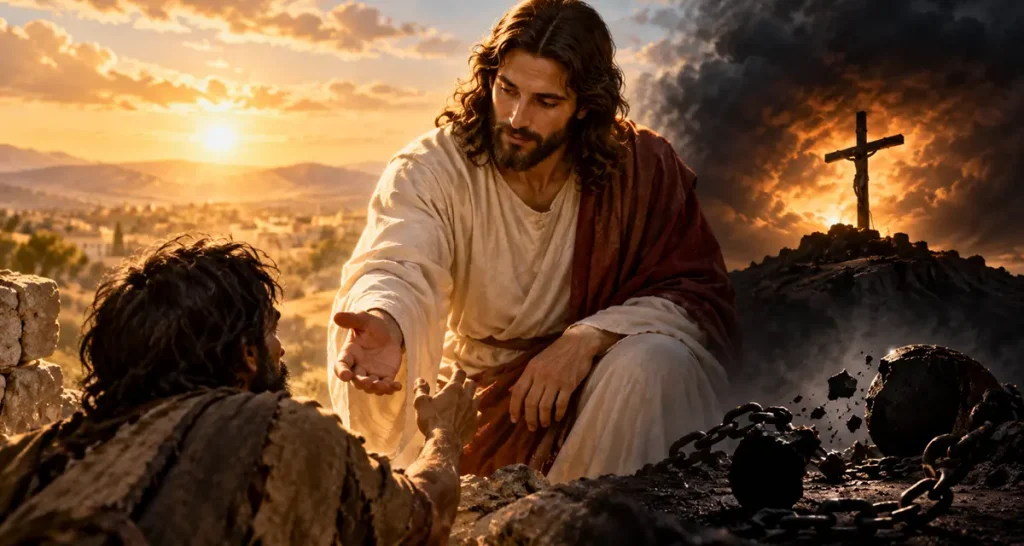
Absolutely. ❤️ Jesus is not merely the One who does something necessary for us; He is the One in whom we finally see correctly.
Without Christ, we could know real things about God through creation, conscience, Israel’s history, the Law, the prophets, and God’s acts. But in Christ, something decisive happens:
“No one has seen God at any time. The only begotten Son… He has declared Him.”
— John 1:18
Jesus doesn’t merely add more information about God. He interprets God to us.
👁️ Jesus is essential to knowing what God is like
This makes Jesus’ statement enormous:
“He who has seen Me has seen the Father.”
— John 14:9
Philip asks, essentially, “Show us God.”
Jesus’ answer is astonishing: You have been looking at Him revealed in Me.
Not because the Father and Son are the same Person, but because the Son perfectly reveals the Father (John 1:18; Hebrews 1:3).
Hebrews says:
“Who being the brightness of His glory and the express image of His person…”
— Hebrews 1:3
And Paul calls Christ:
“The image of the invisible God.”
— Colossians 1:15
There is something wonderfully paradoxical there:
How do finite creatures see the invisible God?
Look at Jesus.
❤️ Even “God is love” needs Jesus
Our present discussion is a perfect example.
Suppose we had only the proposition:
God is love.
Immediately we would have questions.
What is love?
Does love judge?
Can love become angry?
Does love confront?
Does love permit suffering?
Does love punish evil?
Does love forgive?
Does love require repentance?
We could begin constructing philosophical definitions.
Then Jesus walks onto the scene.
Suddenly we see love touching lepers (Mark 1:40–42), welcoming children (Mark 10:13–16), weeping with mourners (John 11:33–36), rebuking hypocrisy (Matthew 23), cleansing the temple (John 2:13–17), grieving over Jerusalem (Matthew 23:37), forgiving His enemies (Luke 23:34), and laying down His life for sinners (John 10:11; Romans 5:8).
And our definitions have to bow before Him.
We don’t say:
“My definition of love tells me what Jesus ought to be like.”
We say:
“Jesus tells me what divine love is actually like.”
That reversal protects us from creating God in our own image.
📖 Jesus also becomes crucial for understanding Scripture itself
This goes beyond understanding God’s attributes.
After His resurrection, Jesus tells His disciples:
“These are the words which I spoke to you… that all things must be fulfilled which were written in the Law of Moses and the Prophets and the Psalms concerning Me.”
— Luke 24:44
Then comes this remarkable sentence:
“And He opened their understanding, that they might comprehend the Scriptures.”
— Luke 24:45
They already possessed the Scriptures.
They could read the words.
They knew the stories.
They knew Moses, Abraham, David, sacrifices, Passover, priesthood, temple, covenant, kingdom.
Yet the risen Christ reorganizes their understanding of the whole thing around Himself.
That is why the road to Emmaus is so important:
“Beginning at Moses and all the Prophets, He expounded to them in all the Scriptures the things concerning Himself.”
— Luke 24:27
Jesus isn’t an appendix to the Bible.
He is the One toward whom its great movements were traveling.
✝️ And the Cross corrects our understanding of almost everything
What is power?
The world says domination.
Look at Jesus crucified (1 Corinthians 1:23–25).
What is greatness?
Look at Jesus washing feet (John 13:3–15).
What is obedience?
Look at Gethsemane (Luke 22:42).
What is love?
Look at Calvary (1 John 3:16).
What is holiness?
Look at the One who receives sinners without participating in their sin (Luke 15:1–2; Hebrews 4:15).
What is humanity supposed to be?
Look at Jesus.
And that last one is enormous.
🧍 Jesus doesn’t only reveal God; He reveals man
We have spent quite a bit of time discussing creaturehood and dependence. Here Christ becomes indispensable again.
Pilate unknowingly says something profound:
“Behold the Man!”
— John 19:5
Jesus is fully divine, but He is also truly human.
And what kind of human being do we find?
One completely dependent upon the Father.
“The Son can do nothing of Himself…”
— John 5:19
“I can of Myself do nothing.”
— John 5:30
“I always do those things that please Him.”
— John 8:29
And yet Jesus is not diminished by dependence.
He is the perfect Man.
That is devastating to the serpent’s original lie.
The serpent suggested that fulfillment lies in autonomy: “you will be like God” (Genesis 3:5).
Then the truly perfect human life appears, and what do we see?
Not autonomy.
Perfect communion.
Perfect obedience.
Perfect dependence.
Perfect love.
Jesus exposes our definition of freedom as badly confused.
Dependence upon God isn’t what prevents humanity from becoming fully human.
Dependence upon God is how humanity was always meant to live.
🌿 He doesn’t merely explain life; He is Life
And here Christianity makes an even greater claim.
If Jesus were merely our greatest teacher, He could correct our understanding and then leave us with accurate concepts.
But He says:
“I am the way, the truth, and the life.”
— John 14:6
Not merely:
“I teach the way.”
“I explain the truth.”
“I provide information about life.”
I am.
There is that language again.
And therefore salvation and understanding ultimately converge in Him.
We don’t merely need Jesus because we are guilty and require forgiveness.
We need Him because we are blind and require light (John 8:12).
We are dead and require life (John 11:25).
We are lost and require the Way (John 14:6).
We are susceptible to falsehood and require the Truth (John 14:6).
We are creatures separated from the Source of our life and require reconciliation with God (2 Corinthians 5:18–19).
🕊️ And this makes “abide in Me” even larger
“Abide in Me, and I in you… without Me you can do nothing.”
— John 15:4–5
We’ve discussed how offensive that can initially sound to our desire for autonomy.
But now notice: even our understanding depends upon participation in Him.
Jesus isn’t merely information stored in the mind.
Paul speaks of:
“bringing every thought into captivity to the obedience of Christ.”
— 2 Corinthians 10:5
Our thinking itself needs redemption.
We learn to see God through Christ.
We learn to see ourselves through Christ.
We learn to see other people through Christ.
We learn to understand love through Christ.
We learn to understand suffering through Christ.
We learn to understand power, service, death, resurrection, glory, obedience, freedom, and even creaturehood through Christ.
He doesn’t merely answer one theological question.
He changes the vantage point from which we ask all the others.
And perhaps that is why Paul’s language is so breathtaking:
“In whom are hidden all the treasures of wisdom and knowledge.”
— Colossians 2:3
Not some.
All the treasures.
So yes—the importance of Jesus cannot possibly be confined to, “He died so I can go to heaven.” Glorious and indispensable as His saving work is, the Gospel gives us something even larger:
In Christ, God reconciles us to Himself (2 Corinthians 5:19).
And in the same Christ, the invisible God makes Himself known (John 1:18).
We are saved by Him.
We know God through Him.
We discover true humanity in Him.
We learn how to live from Him.
And ultimately, our destination is not merely a wonderful place that Jesus makes accessible.
It is what Jesus said on the night before the Cross:
“I go to prepare a place for you… that where I am, there you may be also.”
— John 14:2–3
It keeps coming back to Him.
Not merely what He gives.
Not merely what He teaches.
Not merely what He rescues us from.
Him. ❤️