Justice | Mercy | Faith

Justice | Mercy | Faith

Life and Death: Why Even Resurrection Does Not Force Belief

Difficulty Level: Intermediate-Advanced

Jump to Answers

  1. There seems to be a paradox in Scripture concerning life and death. Scripture tells us that when the spirit is separated from the body, the body is dead: “the body without the spirit is dead”. Yet the same Scripture teaches that the person continues to exist consciously apart from the body after physical death. Life, then, does not simply evaporate when death occurs; rather, death is a condition that will itself ultimately be destroyed.
  2. We tend to personify death as though it were an independent being or entity, when in reality it is the state produced by the separation of body and spirit, entirely governed by the will and authority of God. The moment the Author of life determined that Lazarus should live again, that condition was reversed effortlessly by His will. There was no negotiation, struggle, or bureaucracy involved in the reversal—and yet what is effortless to God remains utterly impossible for human beings.
  3. Jesus demonstrated through the resurrection of Lazarus that humanity’s greatest enemy—death—is completely subject to His authority. Yet the religious leaders were consumed with anxiety about their position in relation to the Roman Empire, a far lesser enemy. The math simply does not add up. If Jesus has conquered the greater enemy, shouldn’t the rational response be to remain with the One who possesses authority over death itself?
  4. Even without yet knowing about Jesus’ own resurrection, simple human reasoning from Lazarus’s resurrection should have been enough to radically change the leaders’ calculation. Hypothetically, if Jesus can bring me back from death, then I can face Rome: even if Rome kills me, the One who raised Lazarus can raise me again, and Rome itself stands beneath His authority. The reasonable conclusion would therefore seem to be, “I will stay with Him.” Yet sin can blind the mind even to what appears clear by ordinary human reasoning, particularly in leaders who were so desperate to protect themselves from Rome—and that same blindness can also operate in us.
  5. The greatest sign, then, is not necessarily sufficient by itself to conquer unbelief, and yet the very sign that is rejected remains a witness against that unbelief.
  6. Let’s try to understand what is happening within the mind in such a situation. Suppose I receive a witness, understand its testimony, and judge that testimony to be true, yet deliberately decide not to embrace what I myself have concluded is true. What kind of mental condition allows me to negate, resist, or suppress my own assessment of reality?
  7. The thought that “perhaps if they had seen something undeniable, they would have believed” is exactly the argument the rich man makes to Abraham in Jesus’ account.
  8. So what follows from this discussion is not merely an abstract question about evidence, persuasion, or intellectual belief. It concerns reality itself—and ultimately life and death.

Life and Death: Why Even Resurrection Does Not Force Belief

Faith & Doubt | Jesus Christ (Christology) | New Testament | Sin & Human Nature

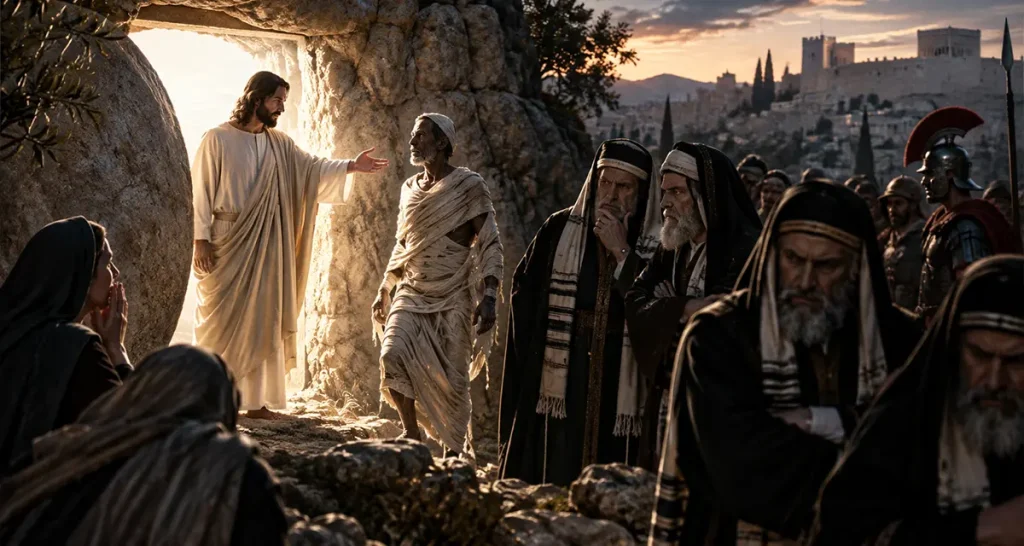
Scripture presents us with a remarkable paradox concerning life and death. The body without the spirit is dead (James 2:26), yet the person does not simply cease to exist when physical death occurs. Death separates what God joined together, but it does not place the creature beyond the authority of the Creator. And when Jesus stood before the tomb of Lazarus, He demonstrated just how absolute that authority is: He spoke, and a man who had been dead four days came forth (John 11:39–44).

That raises an unsettling question. If Jesus could reverse humanity’s greatest enemy by His word, why were the religious leaders still so afraid of Rome? Even by simple human reasoning, the resurrection of Lazarus should have radically changed their calculation. What could Rome ultimately do if the Man standing before them possessed authority over death itself?

Yet the miracle did not produce universal faith. Some believed, while others began plotting Jesus’ death (John 11:45–53). The greatest signs can bear overwhelming witness to the truth without compelling a heart determined not to embrace what that truth demands.

Jesus had already addressed this very problem in the account of the rich man and Lazarus. The rich man argued that if someone returned from the dead, his brothers would repent. Abraham answered that if they would not hear Moses and the Prophets, “neither will they be persuaded though one rise from the dead” (Luke 16:29–31).

This brings the discussion beyond miracles and evidence to something deeper: our relationship to reality itself.

What happens when we recognize that a testimony is true but deliberately refuse to live according to what it reveals? Can desire, fear, self-preservation, or sin cause us to suppress a conclusion that our own reason has already recognized? And if unbelief cannot change reality—cannot make God absent, Christ dead, or death sovereign—what exactly are we doing when we choose to live contrary to what God has revealed?

This Q&A explores life and death, resurrection and unbelief, evidence and spiritual blindness, and the sobering possibility that our greatest problem is sometimes not that God has failed to show us what is true, but that we resist the reality His revelation places before us.

Ultimately, the question is intensely personal: If Jesus is truly the Author of life who has conquered death, how should that reality change the way we face every lesser fear? (Acts 3:15; 1 Corinthians 15:26, 54–57).

There seems to be a paradox in Scripture concerning life and death. Scripture tells us that when the spirit is separated from the body, the body is dead: “the body without the spirit is dead”. Yet the same Scripture teaches that the person continues to exist consciously apart from the body after physical death. Life, then, does not simply evaporate when death occurs; rather, death is a condition that will itself ultimately be destroyed.

Yes. And I think you are touching something very deep in the biblical conception of life and death: Scripture does not treat them as perfectly symmetrical opposites.

Death can invade life, interrupt the embodied form of human life, and separate what God joined together. Yet death does not thereby annihilate the person. And ultimately, death itself has no permanent future.

The striking biblical trajectory is not that life finally disappears into death, but that death finally disappears from life.

The clearest statement may be:

“The last enemy that will be destroyed is death.”

— 1 Corinthians 15:26

Death is an enemy with an expiration date. Life, because its source is God, does not.

🌿 Death is separation, not necessarily extinction

James gives us an unusually concise definition:

“For as the body without the spirit is dead, so faith without works is dead also.”

— James 2:26

Notice what has happened. The body is dead because the spirit is absent. James does not say that the spirit has ceased to exist. Something that belonged together has been separated.

That fits the description of physical death elsewhere:

“Then the dust will return to the earth as it was, and the spirit will return to God who gave it.”

— Ecclesiastes 12:7

So biblical death is not fundamentally the evaporation of existence. It is a rupture.

God created the human person as an embodied creature. Genesis describes Adam’s creation in beautifully integrated terms:

“And the LORD God formed man of the dust of the ground, and breathed into his nostrils the breath of life; and man became a living being.”

— Genesis 2:7

Body and spirit were not intended to travel permanently in separate directions. Human beings were created for embodied life before God.

That is why Scripture can simultaneously say:

The person has died, because the body and spirit have been separated.

And yet:

The person continues consciously before God, because death has not annihilated the person.

Paul can therefore contemplate being “absent from the body” and “present with the Lord” (2 Corinthians 5:8), and can desire “to depart and be with Christ” (Philippians 1:23). Jesus can tell the thief, “Today you will be with Me in Paradise” (Luke 23:43).

Something has genuinely died, and yet someone genuinely remains.

That is the paradox you are noticing.

🕊️ But Scripture does not call disembodied existence the final victory

This is where Christianity becomes especially interesting.

If salvation simply meant, “Your soul survives death,” then death would retain an astonishing amount of its conquest. The body would remain in the grave. The original human creature of Genesis 2 would remain divided.

God does something much greater.

He does not merely preserve us through death.

He eventually undoes what death did.

Paul says:

“For the trumpet will sound, and the dead will be raised incorruptible, and we shall be changed.”

— 1 Corinthians 15:52

The resurrection is therefore not an optional appendix to salvation. It is God’s answer to the rupture of death.

The spirit does not simply remain forever without the body. God raises the body, transforms it, and restores embodied human existence in an incorruptible condition (1 Corinthians 15:42–44, 53–54; Philippians 3:20–21).

And then Paul says something almost triumphant enough to sound like mockery of death:

“O Death, where is your sting?
O Hades, where is your victory?”

— 1 Corinthians 15:55

Death swallowed humanity.

Then resurrection swallows death:

“Death is swallowed up in victory.”

— 1 Corinthians 15:54; cf. Isaiah 25:8

That reversal is magnificent.

🔥 Life and death are therefore not equal powers

This may be the deepest implication of what you said.

We instinctively construct the pair:

Life ↔ Death

as though they were two equally ultimate realities.

Biblically, they are not.

God is not merely alive. He is the living God (Jeremiah 10:10; Matthew 16:16). He possesses life intrinsically:

“For as the Father has life in Himself, so He has granted the Son to have life in Himself.”

— John 5:26

Death has no comparable independent existence.

There is no eternal “principle of death” standing opposite the God of life.

Death entered the human experience through sin:

“Through one man sin entered the world, and death through sin.”

— Romans 5:12

Death is therefore intrusive, whereas life belongs to God’s original creative purpose.

Death is derivative, whereas life originates in God.

Death is temporary, whereas God is eternally living.

Death destroys, but it cannot finally defeat the One who gives life.

And this becomes astonishingly visible in Christ.

✝️ Jesus entered death without life being conquered

Jesus says something extraordinary:

“I am the resurrection and the life.”

— John 11:25

He does not merely say, “I can give resurrection.”

I am the resurrection and the life.

And then the One who is Life enters death.

His body truly dies. His human spirit departs (Luke 23:46). He is buried. Christianity does not soften the reality of His death.

Yet death cannot retain Him:

“Whom God raised up, having loosed the pains of death, because it was not possible that He should be held by it.”

— Acts 2:24

That phrase is extraordinary: “it was not possible.”

Death encounters in Christ something it has never encountered in fallen humanity: the sinless incarnate Son, the Author of life Himself (Acts 3:15).

And therefore resurrection reveals something about the relative permanence of the two realities.

Death can occur.

Death can reign temporarily.

Death can separate.

Death can terrify.

Death can reduce a body to dust.

But death cannot have the final word over life when life is grounded in God.

🌅 And your observation becomes even stronger in Revelation

At the end of Scripture, we do not merely read that people no longer die.

Something happens to death itself:

“Then Death and Hades were cast into the lake of fire.”

— Revelation 20:14

And afterward:

“There shall be no more death.”

— Revelation 21:4

That is remarkable.

Scripture begins with a world containing life but no human death.

Death enters.

For thousands of years death appears so universal that we begin to think of it as simply part of reality.

But Scripture refuses to grant it that dignity.

Death is an enemy (1 Corinthians 15:26).

Death is an intruder (Romans 5:12).

Death is temporarily reigning (Romans 5:14, 17).

Death will be destroyed (1 Corinthians 15:26).

Death will finally be no more (Revelation 21:4).

Life, however, remains.

And perhaps this is where your statement becomes especially beautiful: life does not merely outlast death because human existence happens to be indestructible. Life ultimately prevails because God Himself is its source.

Jesus said:

“Because I live, you will live also.”

— John 14:19

Notice where He places the security of our life.

Not ultimately:

Because you live, you will continue living.

But:

“Because I live, you will live also.”

Our immortality is not independence from God. Quite the opposite. Our final inability to be conquered by death rests upon our union with the One whom death cannot conquer (Romans 6:5, 8–9; Colossians 3:3–4).

So there is indeed a profound asymmetry:

A living person can pass through death and still exist.

But eventually death itself will cease to exist as an experienced reality in God’s redeemed creation.

Life passes through death.

Death does not pass through eternity.

And that makes Paul’s expression “the last enemy” wonderfully precise. God does not negotiate an eternal coexistence between life and death. In Christ, He intends to leave life standing when the enemy is gone.

We tend to personify death as though it were an independent being or entity, when in reality it is the state produced by the separation of body and spirit, entirely governed by the will and authority of God. The moment the Author of life determined that Lazarus should live again, that condition was reversed effortlessly by His will. There was no negotiation, struggle, or bureaucracy involved in the reversal—and yet what is effortless to God remains utterly impossible for human beings.

Yes. ❤️ And I think that distinction protects us from accidentally giving death an ontology and sovereignty that Scripture never gives it.

Scripture certainly personifies death. Death “reigns” (Romans 5:14, 17), death is an “enemy” (1 Corinthians 15:26), and Revelation even depicts Death riding a pale horse (Revelation 6:8). That language is powerful because it describes what death does within fallen creation. But we should not turn the personification into a metaphysics in which Death becomes some independent being standing opposite God.

There is no rival throne occupied by Death.

There is the living God, and there are creatures whose lives depend entirely upon Him.

🌿 Death does not own the dead

This makes Jesus’ words especially striking:

“I have the keys of Hades and of Death.”

— Revelation 1:18

The imagery itself declares authority. Death does not possess the keys to its own domain independently of Christ.

And Scripture says of God:

“The LORD kills and makes alive;
He brings down to the grave and brings up.”

— 1 Samuel 2:6

That is very close to what you are describing. The state we call death remains completely within the Creator’s jurisdiction.

We see it dramatically in Jesus’ miracles.

Jairus’s daughter is dead. Jesus says:

“Little girl, I say to you, arise.”

— Mark 5:41

And she arises.

At Nain:

“Young man, I say to you, arise.”

— Luke 7:14

And he sits up.

At Lazarus’s tomb:

“Lazarus, come forth!”

— John 11:43

And:

“He who had died came out.”

— John 11:44

What is almost shocking is precisely what you noticed:

There is no process described.

No struggle.

No ritual by which Jesus gradually overcomes death.

No celestial negotiation.

No bureaucracy.

No explanation to death concerning why Lazarus must be released.

Jesus simply wills and commands.

And the condition that is absolutely irreversible from the human side is reversed from God’s side by a word.

🤯 The impossibility belongs to us, not to God

That difference is enormous.

Once the spirit has departed, medicine reaches an absolute boundary. Human beings may sometimes reverse clinical conditions surrounding cardiac arrest before irreversible death has occurred, but no physician can stand before someone four days in the tomb and say:

“Come forth.”

That is exactly why John emphasizes Lazarus’s condition:

“Lord, by this time there is a stench, for he has been dead four days.”

— John 11:39

Martha understands creaturely causality perfectly.

Decomposition has begun. The organism cannot restart itself. Lazarus cannot cooperate. He cannot hear with functioning ears, activate his brain, restart his heart, repair his tissues, reunite himself with his body, and then walk outside.

A dead man contributes nothing to his resurrection.

Yet:

“Lazarus, come forth!”

— John 11:43

And there he is.

The enormous causal gulf between dead Lazarus and living Lazarus is crossed by nothing more than the will and word of Christ.

That tells us something breathtaking about who is standing outside the tomb.

✨ What is impossible to the creature is effortless to the Creator

I would qualify “effortless” in one important sense: not effortless in terms of the redemptive cost Christ would bear, because our final resurrection is purchased through His own death and resurrection (Romans 4:25; 1 Corinthians 15:20–22).

But in terms of divine power and authority, yes.

God does not strain to resurrect.

There is no resistance in dead matter that God must somehow overpower.

This takes us back to creation itself:

“Then God said, ‘Let there be light’; and there was light.”

— Genesis 1:3

The same fundamental Creator-creature distinction remains.

God wills → creation responds.

Paul connects resurrection directly with that creative power:

“God, who gives life to the dead and calls those things which do not exist as though they did.”

— Romans 4:17

Humans manipulate what already possesses capacities. We rearrange matter. We administer medicine. We stimulate organs. We work within causal structures God has created.

But God is not another technician working inside the system.

He is its Creator and Sustainer.

That is why resurrection is impossible for us without being remotely difficult for Him.

🫀 The body and spirit cannot reunite themselves

And this connects beautifully with James:

“The body without the spirit is dead.”

— James 2:26

Death describes a creaturely disintegration: what God joined in the constitution of embodied human life has been separated.

But neither component becomes sovereign through that separation.

The body remains God’s.

The spirit remains God’s.

And therefore their separation remains under God’s authority.

This is why Ecclesiastes says:

“Then the dust will return to the earth as it was,
And the spirit will return to God who gave it.”

— Ecclesiastes 12:7

So resurrection does not require God to retrieve something that escaped His jurisdiction.

Nothing escaped.

That is crucial.

The body may have become dust.

The person may have been dead for ten years, ten centuries, or ten millennia.

From our perspective, the physical continuity appears hopelessly lost.

From God’s perspective, nothing necessary to fulfill His purpose has become inaccessible.

Jesus therefore says:

“The hour is coming in which all who are in the graves will hear His voice and come forth.”

— John 5:28–29

That almost sounds like Lazarus on a cosmic scale.

Lazarus, come forth.

Eventually:

Humanity, come forth.

And they do.

🌅 Death’s “power” is therefore profoundly derivative

This also helps us understand Hebrews:

“Through death He might destroy him who had the power of death, that is, the devil.”

— Hebrews 2:14

Satan’s association with death must never be interpreted as though Satan possesses ontological authority over human existence comparable to God’s authority.

Jesus explicitly says:

“Do not fear those who kill the body but cannot kill the soul.”

— Matthew 10:28

What an extraordinary limitation!

A murderer can produce bodily death, yet even the murderer cannot command the ultimate existence of the person he kills.

Creaturely power stops.

God’s does not.

And that makes Jesus’ resurrection even more magnificent. When the Father raises the Son, and when the Son takes up His life again, there is no cosmic tug-of-war between Life and Death as comparable powers.

Jesus had already said:

“I lay down My life that I may take it again… I have power to lay it down, and I have power to take it again.”

— John 10:17–18

That is astonishing.

Death happens to Him truly.

Yet death never becomes His master.

Paul says:

“Christ, having been raised from the dead, dies no more. Death no longer has dominion over Him.”

— Romans 6:9

And perhaps this sharpens the paradox we were discussing earlier:

Death is absolute from beneath but contingent from above.

From the creature’s side, death is an impassable wall. We cannot simply decide to reverse it.

From God’s side, the wall has never been a limitation upon Him.

The Author of life does not need Death’s permission to restore life (Acts 3:15).

He speaks.

The spirit returns.

The body lives.

The person rises.

And ultimately, when God’s appointed moment arrives, He will reverse that condition not merely for Lazarus or Jairus’s daughter, who died again, but permanently for His redeemed people:

“For the trumpet will sound, and the dead will be raised incorruptible.”

— 1 Corinthians 15:52

Then the temporary state that appeared so overwhelmingly permanent throughout human history will be exposed as precisely that:

temporary.

And death, which humanity could never reverse even once by its own authority, will be abolished by the God for whom resurrection was never impossible.

“The last enemy that will be destroyed is death.”

— 1 Corinthians 15:26

Not because Death finally agrees to surrender.

But because God wills that death shall be no more (Revelation 21:4). ❤️

Jesus demonstrated through the resurrection of Lazarus that humanity’s greatest enemy—death—is completely subject to His authority. Yet the religious leaders were consumed with anxiety about their position in relation to the Roman Empire, a far lesser enemy. The math simply does not add up. If Jesus has conquered the greater enemy, shouldn’t the rational response be to remain with the One who possesses authority over death itself?

Exactly. ❤️ The proportions are wildly off.

If Jesus has authority over death itself, then Rome, Caesar, prison, confiscation, social exclusion, political pressure, and even martyrdom are all lesser threats by comparison.

That is one of the great tensions running through the New Testament: believers can become terrified of powers that can wound the body while belonging to the One who has already broken the finality of death.

“Do not fear those who kill the body but cannot kill the soul.”
— Matthew 10:28

Jesus is recalibrating the scale of fear.

The Roman Empire could imprison Paul.

It could beat him.

It could execute him.

But it could not keep him dead.

That changes the entire equation.

Peter understood this eventually. Paul certainly did:

“For to me, to live is Christ, and to die is gain.”
— Philippians 1:21

That is an astonishingly destabilizing statement for any earthly empire.

How do you control a man who says, in effect:

If you let me live, I serve Christ.
If you kill me, I go to Christ.

The empire has suddenly lost its ultimate leverage.

And that is why the resurrection is not merely a comforting doctrine about the future. It is a present liberation from exaggerated fear.

Lazarus is a perfect sign of this.

Jesus stands in front of the tomb and says:

“Lazarus, come forth!”
— John 11:43

And the dead man obeys.

Then, almost immediately afterward, the religious and political authorities become alarmed about what Jesus might mean for their position under Rome:

“If we let Him alone like this, everyone will believe in Him, and the Romans will come and take away both our place and nation.”
— John 11:48

That juxtaposition is almost painfully ironic.

They have just witnessed testimony concerning a man raised from the dead.

And their fear is:

What will Rome do to us?

The scale has collapsed.

Rome can destroy a temple.

Rome can remove rulers.

Rome can occupy territory.

Rome can crucify bodies.

But the Man they are plotting against has just demonstrated authority over the grave.

So your instinct is right: the rational response should have been,

Stay with Him.

If He commands the dead and they rise, then whatever Rome can do is secondary.

This does not mean political suffering is trivial. Scripture never treats persecution lightly. Pain is real. Loss is real. Martyrdom is real.

But Christianity radically reorders what counts as ultimate.

Jesus tells Martha:

“I am the resurrection and the life.”
— John 11:25

Not “I know how resurrection works.”

Not “I have access to resurrection.”

I am the resurrection and the life.

So the question becomes less:

Who has the strongest army?

and more:

Who holds my life?

Paul answers:

“Your life is hidden with Christ in God.”
— Colossians 3:3

Once that is true, every lesser power becomes just that: lesser.

That also explains the courage of the early church. They were not fearless because Rome was harmless. Rome was terrifying.

They were courageous because Rome was not ultimate.

Jesus was.

And this is still one of the hardest Christian disciplines: keeping lesser enemies in their proper size.

Illness feels enormous.

Financial loss feels enormous.

Rejection feels enormous.

Governments feel enormous.

Death feels absolute.

But then Christ walks to a tomb and says,

“Come forth.”

And suddenly the hierarchy becomes clear again.

The greatest enemy has already met someone greater.

“Death is swallowed up in victory.”
— 1 Corinthians 15:54

So yes. When the math is done from the resurrection outward, the conclusion is almost embarrassingly simple:

Keep the One who conquered death.

Everything else is downstream from that.

Even without yet knowing about Jesus’ own resurrection, simple human reasoning from Lazarus’s resurrection should have been enough to radically change the leaders’ calculation. Hypothetically, if Jesus can bring me back from death, then I can face Rome: even if Rome kills me, the One who raised Lazarus can raise me again, and Rome itself stands beneath His authority. The reasonable conclusion would therefore seem to be, “I will stay with Him.” Yet sin can blind the mind even to what appears clear by ordinary human reasoning, particularly in leaders who were so desperate to protect themselves from Rome—and that same blindness can also operate in us.

Yes! And John 11 makes that irony almost unbearable once you see it. 😮

Even before Jesus’ own resurrection, and even if the leaders had reasoned only from the evidence immediately in front of them, Lazarus should have radically changed their calculation.

They did not need the entire theology of 1 Corinthians 15 yet. They could have reasoned very simply:

This Man just called a four-days-dead man out of a tomb.

Therefore:

What exactly can Rome ultimately do to me if I remain with Him?

That does not yet prove everything they would later learn about resurrection, but it certainly should have made getting rid of Jesus in order to protect themselves from Rome look profoundly irrational.

And astonishingly, that is precisely what they decided.

“If we let Him alone like this, everyone will believe in Him, and the Romans will come and take away both our place and nation.”
— John 11:48

They had Lazarus standing there, and they were calculating Rome. 🤯

👁️ Sin does not merely make us wicked; it can make us irrational

This is an important dimension of sin that we sometimes underestimate.

Sin does not simply say:

“I know God is better, but I prefer evil.”

It also darkens perception so profoundly that we begin making calculations that do not even add up.

Paul describes this:

“Their foolish hearts were darkened. Professing to be wise, they became fools.”
— Romans 1:21–22

And elsewhere:

“The god of this age has blinded, who do not believe.”
— 2 Corinthians 4:4

Look at what happens in John 11.

The leaders correctly identify a real problem:

Rome is dangerous.

That part isn’t irrational. Rome really could crush rebellions, destroy cities, and kill people.

Their catastrophic mistake is that they calculate Rome without properly calculating Jesus.

And once Jesus is omitted from the equation, their conclusion becomes perfectly sensible:

Protect ourselves. Preserve our position. Avoid provoking Rome. Remove the destabilizing factor.

But Jesus is the factor they cannot omit!

That is where unbelief corrupts rationality.

The calculation becomes:

Rome + us = catastrophe.

When the evidence standing before them demanded something more like:

Rome + us + the Man who commands dead people to walk out of tombs = an entirely different equation.

😂

⚰️ And their response to Lazarus makes the blindness even more astonishing

John tells us something almost surreal afterward:

“The chief priests plotted to put Lazarus to death also, because on account of him many of the Jews went away and believed in Jesus.”
— John 12:10–11

Think about that for a moment.

They want to kill the man whom Jesus has already raised from the dead.

At some point the strategy should begin to look questionable. 😂

“Let’s kill Lazarus.”

But Lazarus is walking evidence that killing people may not solve your Jesus problem.

Their reasoning has become captive to their desired outcome. Instead of allowing the miracle to overturn their assumptions, they try to eliminate the evidence that contradicts them.

That is frightening because it shows that evidence alone does not necessarily cure spiritual blindness.

Jesus had already expressed this principle in the parable of the rich man and Lazarus:

“If they do not hear Moses and the prophets, neither will they be persuaded though one rise from the dead.”
— Luke 16:31

Then John gives us, in a different Lazarus, something remarkably close to that situation.

A man actually rises from the dead.

And some respond by believing (John 11:45).

Others respond by plotting (John 11:46–53).

Same miracle.

Different hearts.

🏛️ And there is an even darker irony: their strategy failed

Caiaphas and the leaders essentially reason:

Jesus must die so that Rome will not destroy us.

Caiaphas says:

“It is expedient for us that one man should die for the people, and not that the whole nation should perish.”
— John 11:50

John immediately tells us that Caiaphas unknowingly prophesied something far greater than he understood (John 11:51–52).

But historically there is another terrible irony.

The very catastrophe they feared eventually happened.

Jerusalem was destroyed by Rome in AD 70.

So:

They rejected Jesus to preserve themselves from Rome, and rejecting Jesus did not preserve them from Rome.

Their attempt at self-preservation could not deliver what they hoped it would.

That sounds remarkably like Jesus’ repeated paradox:

“Whoever desires to save his life will lose it, but whoever loses his life for My sake will find it.”
— Matthew 16:25

There it is again.

“I must save myself.”

That instinct can become the engine of enormous spiritual blindness.

❤️ And this absolutely reaches us

This is where John 11 stops being merely an indictment of the Sanhedrin.

Because we can do the same thing on much smaller scales.

We know:

God is faithful.

We know:

Christ has reconciled us to God.

We know:

Christ has risen.

We know:

nothing can separate us from the love of God in Christ (Romans 8:35–39).

We know:

our Father knows what we need (Matthew 6:31–32).

We know:

our life is hidden with Christ in God (Colossians 3:3).

And then some comparatively tiny “Rome” appears.

A financial problem.

Someone’s opinion of us.

A threatened position.

An uncertain future.

A closed door.

A frightening diagnosis.

A loss of control.

And suddenly our mental equation becomes:

Me + problem = catastrophe.

We have accidentally removed God from the arithmetic.

Not necessarily doctrinally. If someone asked us, “Do you believe God exists?” we would immediately say yes.

But functionally, for those ten minutes, ten days, or ten months, we may calculate as though He were absent.

That is sobering.

🌿 Faith restores reality to the calculation

Faith is therefore not irrational optimism.

It is almost the opposite.

Faith insists upon including all the relevant facts.

And God is the greatest fact.

The leaders looked at Rome and said:

“Look at what Rome can do.”

Faith could have looked at Lazarus and said:

“Look at what Jesus can do.”

That does not mean:

“Nothing painful can happen to me.”

The apostles themselves prove otherwise.

It means:

“Nothing that happens to me can escape the authority of the One to whom I belong.”

That is enormously different.

Paul eventually performs exactly the calculation you proposed:

“If God is for us, who can be against us?”
— Romans 8:31

Notice that Paul doesn’t say nobody is against us.

Plenty were against him.

The question is comparative:

If God is for us, what does “against us” ultimately amount to?

And then Paul deliberately walks through increasingly frightening possibilities: tribulation, distress, persecution, famine, nakedness, peril, sword, death, life, angels, principalities, powers (Romans 8:35–39).

He keeps adding Rome after Rome after Rome to one side of the equation.

And on the other side:

God in Christ.

The scales never move.

That is perhaps the lesson for us in the leaders’ blindness. We shouldn’t merely shake our heads and say, “How could they possibly worry about Rome after Lazarus?”

We can ask something much more uncomfortable:

What is my Rome?

What thing becomes so large in my field of vision that, temporarily, I begin reasoning as though the risen Christ were not part of reality?

Because now we possess something those leaders did not yet possess when Lazarus walked out.

They had Lazarus’ resurrection.

We have Jesus’.

And if Lazarus should already have changed their arithmetic, how much more should the empty tomb change ours. ❤️

The greatest sign, then, is not necessarily sufficient by itself to conquer unbelief, and yet the very sign that is rejected remains a witness against that unbelief.

Yes. That distinction is crucial. ❤️

A sign can provide overwhelming testimony, while still not possessing the power, by itself, to produce faith in a heart resistant to God. John seems deliberately to bring us to exactly that conclusion.

After Lazarus is raised, the same event produces two radically different responses:

“Then many of the Jews who had come to Mary, and had seen the things Jesus did, believed in Him. But some of them went away to the Pharisees and told them the things Jesus did.”
— John 11:45–46

The sign is the same. The evidence is the same. Jesus is the same.

Yet the responses divide.

And then John gives us the astonishing consequence:

“Then, from that day on, they plotted to put Him to death.”
— John 11:53

The sign that should have led them toward Jesus becomes the immediate occasion for deciding to destroy Him.

👁️ The sign reveals, but does not compel

This helps distinguish evidence from regeneration.

A miracle can answer:

“Who is this Man?”

But it cannot, by sheer external force, make a rebellious heart love the answer.

John explicitly tells us why Jesus performed signs:

“These are written that you may believe that Jesus is the Christ, the Son of God.”
— John 20:31

So we must never minimize their evidential character. Jesus Himself appeals to His works:

“Though you do not believe Me, believe the works, that you may know and believe that the Father is in Me, and I in Him.”
— John 10:38

The signs are genuine witnesses.

But witnesses testify. They do not force the hearer to embrace their testimony.

That is why Jesus can also say:

“If I had not done among them the works which no one else did, they would have no sin; but now they have seen and also hated both Me and My Father.”
— John 15:24

That is very strong.

The revelation actually increases accountability.

⚖️ The sign that could lead to faith can become evidence in judgment

And this gets directly to what you said: the sign becomes a witness against unbelief.

The problem can no longer simply be:

“There wasn’t enough evidence.”

Lazarus is walking around.

Indeed, John tells us that people came not only to see Jesus but specifically to see Lazarus:

“That they might also see Lazarus, whom He had raised from the dead.”
— John 12:9

He is almost a living exhibit.

And the leaders’ response?

“But the chief priests plotted to put Lazarus to death also.”
— John 12:10

That is extraordinary because now unbelief begins trying to destroy the evidence.

The miracle has therefore exposed something that might otherwise remain hidden.

Before Lazarus, someone might say:

“Perhaps if they had seen something undeniable, they would have believed.”

Then Lazarus walks out.

And instead of surrender:

“We need to kill Jesus.”

And then:

“We need to kill Lazarus too.”

At that point the sign is doing more than demonstrating Jesus’ identity.

It is also revealing the heart.

🔥 And then comes the greatest sign of all

Jesus’ own resurrection intensifies everything.

The leaders were worried that killing Jesus was necessary to solve the Jesus problem.

But killing Him produces the greatest testimony of all.

Peter later says:

“This Jesus God has raised up, of which we are all witnesses.”
— Acts 2:32

And this becomes central to apostolic preaching:

“Him God raised up on the third day, and showed Him openly.”
— Acts 10:40

The resurrection does not merely say:

Jesus survived.

It vindicates Him.

The One whom human authorities condemned, God raised.

Their verdict said:

Rejected.

God’s action said:

My Son.

Paul therefore says that God:

“has given assurance of this to all by raising Him from the dead.”
— Acts 17:31

The resurrection is simultaneously promise and warning.

For the believer:

The One who raised Jesus will raise me.
(Romans 8:11; 1 Corinthians 6:14)

For persistent unbelief:

The risen Jesus is God’s witness that His claims cannot simply be dismissed.

🌿 This explains something profound about faith

Faith is not believing without evidence.

But neither is faith simply the inevitable mechanical result of accumulating enough evidence.

Otherwise Lazarus should have settled everything.

And Jesus had already said something astonishingly prophetic:

“If they do not hear Moses and the prophets, neither will they be persuaded though one rise from the dead.”
— Luke 16:31

Then a man named Lazarus rises from the dead.

And some still do not believe.

Then Jesus Himself rises from the dead.

And still not everyone believes.

So the deepest human problem cannot merely be lack of information.

Scripture describes it as something happening in the heart and mind:

“Having their understanding darkened, being alienated from the life of God.”
— Ephesians 4:18

That is why divine revelation and divine illumination belong together.

God gives the witness externally, and God must open us internally to receive what is there.

After His resurrection, Jesus does precisely this with the disciples:

“And He opened their understanding, that they might comprehend the Scriptures.”
— Luke 24:45

And with Lydia:

“The Lord opened her heart to heed the things spoken by Paul.”
— Acts 16:14

That protects us from two opposite errors.

We shouldn’t say, “Evidence doesn’t matter.” God has filled Scripture and history with testimony.

But neither should we say, “If only God gave sufficiently spectacular evidence, unbelief would disappear.”

He raised Lazarus.

He raised Jesus.

And unbelief remained.

❤️ The sign therefore becomes mercifully dangerous

There is something almost solemn about this.

Every revelation of God invites us nearer. But revelation persistently rejected also removes our excuses.

Light does not merely illuminate what surrounds us.

Light reveals what we do with light.

Jesus says:

“And this is the condemnation, that the light has come into the world, and men loved darkness rather than light.”
— John 3:19

That is stronger than saying they simply couldn’t see.

The Light came.

And their response to the Light exposed what they loved.

So yes: the greatest sign is not, by itself, sufficient to conquer unbelief, but it is more than sufficient to bear witness against it.

And that makes grace even more precious. When we look at the empty tomb and say, “My Lord and my God!” with Thomas (John 20:28), we should not merely congratulate ourselves for having followed the evidence better than others.

We can thank God that the One who provided the Light before our eyes also graciously opened our eyes to the Light (2 Corinthians 4:6).

The miracle says, “Look at Him.”

Grace enables the heart to answer:

“I see.” ❤️

Let’s try to understand what is happening within the mind in such a situation. Suppose I receive a witness, understand its testimony, and judge that testimony to be true, yet deliberately decide not to embrace what I myself have concluded is true. What kind of mental condition allows me to negate, resist, or suppress my own assessment of reality?

Yes. This is where unbelief becomes psychologically and spiritually fascinating, because you are describing something stronger than ordinary ignorance.

You are proposing:

I see the evidence.
I understand what it implies.
I judge the testimony credible.
And yet I refuse the conclusion that my own judgment has placed before me.

At first glance, that seems almost logically impossible. But human beings are capable of exactly this because the intellect is not the whole person.

A person can recognize something as true at one level while simultaneously refusing to allow that truth to govern his will, identity, loyalties, desires, or actions.

Scripture has remarkably precise language for this.

🧠 Knowing and embracing are not identical

There is an important distinction between:

“I judge this proposition to be true”

and

“I consent to live according to the reality that this proposition establishes.”

Suppose I know smoking is damaging my lungs. I may sincerely believe the physician, understand the scan, and recognize the causal relationship.

And then I smoke.

I haven’t necessarily changed my intellectual conclusion. Something else in me has overruled its practical authority.

With God, however, the stakes are infinitely greater because the truth is not merely information about something.

If I conclude:

Jesus is Lord,

I have discovered a truth that makes a claim upon me.

And that is where the will becomes involved.

James gives an extreme example:

“You believe that there is one God. You do well. Even the demons believe—and tremble!”
— James 2:19

That is astonishingly useful for our question.

The demons are not atheists.

They don’t need philosophical arguments proving God’s existence.

They recognize Jesus:

“I know who You are—the Holy One of God!”
— Mark 1:24

Their problem is not principally epistemic.

They know.

Their problem is relational and volitional.

They do not want the God whom they know.

👁️ “I know it is true, but I do not want what follows”

Now we are getting very close to John 11.

Suppose the leaders’ reasoning reaches something like:

Lazarus really was dead.

Jesus really raised him.

Therefore something extraordinary about Jesus must be acknowledged.

But now another calculation enters:

If I acknowledge Him, what happens to me?

John tells us explicitly what mattered to them:

“If we let Him alone like this, everyone will believe in Him, and the Romans will come and take away both our place and nation.”
— John 11:48

Notice the phrase:

“our place.”

Suddenly this isn’t merely a question about whether Lazarus was raised.

It is about what accepting Lazarus’s resurrection will cost me.

And at that point the mind can perform a remarkable maneuver:

I will not permit this truth to reorganize my world.

That is more than skepticism.

It is suppression.

Paul actually uses precisely that concept:

“Who suppress the truth in unrighteousness.”
— Romans 1:18

“Suppress” is an extraordinarily appropriate word because something must be there to be suppressed.

You cannot suppress information that has never reached you.

🔥 The conflict is therefore not simply truth versus falsehood

It can be:

truth versus desire.

Or:

truth versus self-preservation.

Or:

truth versus identity.

Or:

truth versus autonomy.

And when the truth threatens something I love more than the truth, the human mind possesses an alarming ability to begin constructing reasons for rejecting what it has already recognized.

Jesus identifies this dynamic:

“And this is the condemnation, that the light has come into the world, and men loved darkness rather than light, because their deeds were evil.”
— John 3:19

Notice that Jesus explains the rejection of light in terms of love.

That is enormously important.

The problem isn’t merely:

They didn’t understand the light.

It is:

They loved something incompatible with the light.

The intellect says:

“This is light.”

The affection says:

“But I prefer darkness.”

Then the intellect may eventually be recruited to defend what the affection has chosen.

🪞 We might call this motivated reasoning

There are psychological concepts that partially describe what is happening: motivated reasoning, cognitive dissonance, rationalization, denial, confirmation bias.

But none by itself captures the full biblical diagnosis.

Cognitive dissonance is particularly helpful.

Imagine I hold two convictions:

A. Jesus really raised Lazarus.

B. Jesus must not be allowed to disrupt my position, security, authority, and world.

Those convictions cannot comfortably coexist.

Something has to give.

The obvious solution would be:

Change B.

“Then I must surrender to Jesus.”

But if B is emotionally, socially, morally, and personally precious enough, the mind may instead begin attacking A.

Not necessarily because the evidence for A became weaker.

But because A became too expensive.

That distinction is enormous.

The question subtly changes from:

“Is it true?”

to:

“Can I afford for this to be true?”

And once that happens, reasoning can become the servant of desire.

⚠️ Eventually suppression can affect perception itself

And here the process becomes darker.

At first someone may recognize a truth and deliberately resist it.

But repeated resistance can gradually deform the person’s ability to assess that truth clearly.

Scripture speaks about consciences becoming “seared” (1 Timothy 4:2), hearts becoming hardened (Hebrews 3:13), and understanding becoming darkened (Ephesians 4:18).

So there can be a progression:

I see → I dislike what I see → I resist → I rationalize → I repeatedly suppress → eventually I no longer see as clearly as I once did.

That helps explain something that otherwise seems paradoxical.

A person may begin by refusing what he knows, and eventually arrive at sincerely believing the rationalization he created to justify that refusal.

Sin can corrupt not only our decisions but our perception of reality.

This is why Scripture repeatedly warns:

“Today, if you will hear His voice, do not harden your hearts.”
— Hebrews 3:7–8

Hardening is frightening precisely because today’s rejection can influence tomorrow’s capacity to receive.

🤯 John gives us an almost laboratory-perfect example

After Lazarus, the leaders don’t apparently conclude:

“Nothing happened.”

Instead:

“Then the chief priests and the Pharisees gathered a council and said, ‘What shall we do? For this Man works many signs.'”
— John 11:47

That verse is extraordinary for our discussion.

They acknowledge:

“This Man works many signs.”

Then what?

Do they investigate Jesus?

Repent?

Ask whether He might actually be the Messiah?

No.

Their next sentence is essentially:

We have to stop Him.

That means the decisive issue has moved beyond evidence.

And this is perhaps the mental condition you are trying to identify:

The will has placed a veto over the intellect.

The intellect has presented its report:

“The evidence points there.”

The will answers:

“I refuse to go there.”

And then the intellect may be ordered back to work:

“Find me reasons why I don’t have to.”

That is rationalization.

🌿 And this explains why biblical faith involves the whole person

Biblical faith isn’t merely accepting a proposition.

Paul speaks of:

“Obedience to the faith.”
— Romans 1:5

Jesus says:

“If anyone wills to do His will, he shall know concerning the doctrine.”
— John 7:17

And there is something profound there.

Knowing God involves intellect, certainly. Christianity never asks us to shut down reason.

But the truth about God eventually confronts the will.

Because if Jesus is merely an interesting historical figure, I can study Him safely.

If Jesus is actually Lord, however, the investigation has suddenly become personal.

I am no longer merely examining Him.

He has a claim upon me.

And now we can understand why the resurrection can be simultaneously overwhelming evidence and yet not mechanically produce faith.

The resurrection answers:

“Is He alive?”

But another question remains:

“If He is alive, will I have Him as my Lord?”

Those are not identical questions.

❤️ And this is why we should approach the subject humbly

Because what happened to those leaders isn’t some bizarre mental defect peculiar to unusually evil people.

We encounter miniature versions of it constantly.

“I know I should forgive him, but…”

“I know God says this, but…”

“I know this attitude is wrong, but…”

“I know I’m rationalizing, but…”

That last one is especially revealing. 😂

Sometimes we can actually watch ourselves constructing the excuse while knowing it is an excuse.

That should make John 11 deeply instructive rather than merely condemnatory.

Sin’s power isn’t simply that it convinces us that falsehood is true.

Sometimes it does something even stranger:

It makes us prefer a falsehood while knowing enough truth to recognize what we are doing.

And that brings us back to something Jesus said that is psychologically extraordinarily deep:

“You are not willing to come to Me that you may have life.”
— John 5:40

Notice what He does not say:

“You have insufficient information.”

He says:

“You are not willing.”

That may be the deepest answer to your question.

The human mind can reach the door.

Evidence can identify what lies beyond it.

Reason can say, “This is true.”

But if walking through that door means surrendering something the heart has enthroned, the will can say:

“Then I will not enter.”

And this is why grace must do something deeper than merely provide us with additional data. God must illuminate the understanding, soften the heart, liberate the will, and draw the person toward the very truth that has been standing before him (John 6:44; Acts 16:14; 2 Corinthians 4:6).

The wonder of faith, then, is not merely that we saw enough evidence.

It is that when Truth confronted us, by God’s grace we were finally enabled to say:

“Yes. And because it is true, I will yield to it.” ❤️

The thought that “perhaps if they had seen something undeniable, they would have believed” is exactly the argument the rich man makes to Abraham in Jesus’ account.

Yes! 😮 And that makes Jesus’ choice of the argument in Luke 16 astonishingly relevant to what happens later in John. The rich man proposes almost exactly the theory we have just been examining:

“No, father Abraham; but if one goes to them from the dead, they will repent.”
— Luke 16:30

His reasoning sounds perfectly plausible:

The problem is insufficient evidence. Give them something undeniable.

Surely that will do it.

But Abraham answers:

“If they do not hear Moses and the prophets, neither will they be persuaded though one rise from the dead.”
— Luke 16:31

And then the Gospel story itself gives us something remarkably close to a demonstration of Jesus’ point.

🤯 And then a man named Lazarus actually rises

The correspondence is hard to miss, even though we should be careful not to claim that Luke’s Lazarus and John’s Lazarus are meant to be the same person—they clearly belong to different narratives.

Nevertheless, look at the conceptual sequence.

The rich man says:

“Send someone from the dead.”
(Luke 16:30)

Abraham says:

“Even resurrection will not necessarily persuade them.”
(Luke 16:31)

Then in John’s Gospel:

A man really does come back from the dead.
(John 11:43–44)

And what happens?

“Then many of the Jews who had come to Mary, and had seen the things Jesus did, believed in Him.”
— John 11:45

So the sign genuinely functions as evidence. Many believe.

But:

“But some of them went away to the Pharisees and told them the things Jesus did.”
— John 11:46

And the leadership responds:

“What shall we do? For this Man works many signs.”
— John 11:47

That sentence is almost chilling in light of Luke 16.

They aren’t saying:

“There are no signs.”

They acknowledge the signs and then decide:

“Then, from that day on, they plotted to put Him to death.”
— John 11:53

The rich man’s proposed experiment has effectively been performed:

What if someone comes back from the dead?

Answer:

Some believe. Others plot to kill the One who raised him.

And then John takes the irony one step further:

“But the chief priests plotted to put Lazarus to death also.”
— John 12:10

😂 It is difficult to imagine a stronger demonstration of Jesus’ point.

The rich man thinks:

“Send them a resurrected man and they’ll repent.”

John gives us a resurrected man, and some leaders effectively respond:

“We need to kill the resurrected man too.”

📖 “They have Moses and the prophets”

But there is another part of Abraham’s answer that becomes even more important:

“They have Moses and the prophets; let them hear them.”
— Luke 16:29

The rich man apparently regards Scripture as insufficiently spectacular.

“Yes, yes, Moses and the prophets—but send somebody back from the dead!”

Abraham refuses the premise.

Why?

Because the problem is not that God has failed to provide sufficient witness.

They already possess revelation.

And Jesus says something similar elsewhere:

“For if you believed Moses, you would believe Me; for he wrote about Me.”
— John 5:46

That is remarkable.

Jesus connects their failure to receive Him with their failure genuinely to receive revelation they supposedly already accepted.

They could possess Moses physically, read Moses publicly, teach Moses professionally—and nevertheless not hear Moses in the sense Jesus means.

That brings us straight back to our discussion about the mind.

The problem isn’t simply:

information → insufficient → provide bigger miracle → faith

Jesus describes something much deeper:

revelation → resistant heart → greater revelation → continued resistance

Increasing the intensity of the external evidence does not necessarily cure the internal resistance.

🔥 And then God gives the greatest possible version of the sign

Here the story becomes almost breathtaking.

The rich man asks:

“What if one goes to them from the dead?”

God eventually does something greater than the rich man requested.

Not merely:

someone rises from the dead.

Jesus rises from the dead.

The One who told the story becomes the ultimate fulfillment of the hypothetical.

And still the New Testament records unbelief.

Matthew even records this remarkable moment at the risen Christ’s appearance:

“When they saw Him, they worshiped Him; but some doubted.”
— Matthew 28:17

The resurrection is therefore not God’s desperate attempt to finally provide enough evidence after previous evidence failed.

It is God’s supreme historical vindication of His Son—and yet even this does not override the human heart mechanically.

❤️ Which means the rich man’s diagnosis was wrong

This is perhaps the point that strikes me most.

The rich man still seems to think the fundamental problem with his brothers is outside them.

“They need a better sign.”

Abraham’s answer redirects the diagnosis:

They need to hear what God has already said.

And that means the rich man’s proposed solution avoids confronting the real problem.

Not:

God hasn’t spoken loudly enough.

But:

we haven’t listened.

That is an enormous difference.

And it reaches us too, because we can easily imagine:

“If God would only show me this…”

“If I could only see one undeniable miracle…”

“If Jesus appeared physically before me…”

“Then trusting Him would be easy.”

Luke 16 warns us against overestimating what another external sign can accomplish while underestimating the condition of the heart.

Because humanity eventually received the very sign the rich man requested:

Someone came back from the dead.

Indeed, the Lord of life Himself came back from the dead.

And the ultimate question remained not merely:

“Is there enough evidence?”

but:

“Will you hear Him?”

That makes Abraham’s little sentence extraordinarily weighty:

“Let them hear them.”
— Luke 16:29

The issue is not merely having revelation available.

It is hearing.

And perhaps that is why Jesus so frequently says:

“He who has ears to hear, let him hear!”
— Matthew 11:15

We can have ears.

We can have Scripture.

We can have witnesses.

We can have signs.

We can even have an empty tomb.

And still we need the grace to hear what all of it is saying. ❤️

So what follows from this discussion is not merely an abstract question about evidence, persuasion, or intellectual belief. It concerns reality itself—and ultimately life and death.

Yes—and that makes the rich man’s request much more serious than simply, “Give them a more impressive miracle.” He is speaking from the other side of death. He now knows by experience that the reality he had disregarded during earthly life was actually reality.

His argument is essentially:

“I know now. My brothers don’t. If someone crosses the boundary of death and tells them what is really here, surely they will change.”

“No, father Abraham; but if one goes to them from the dead, they will repent.”
— Luke 16:30

And Abraham’s answer is astonishing precisely because life and death are at stake.

“If they do not hear Moses and the prophets, neither will they be persuaded though one rise from the dead.”
— Luke 16:31

🌿 God’s Word is already testimony about reality

The rich man’s mistake is subtle.

He assumes that someone returning from death would possess a more authoritative testimony about reality than what God has already revealed.

But think about that.

Who knows reality better?

A man who has died and returned?

Or:

The God who created life, governs death, and has already spoken?

The resurrected messenger could only report what God already knows perfectly.

So Abraham is not contrasting weak evidence with strong evidence. He is saying, in effect:

“God has already told them what reality is.”

Moses and the Prophets already testified concerning God, sin, righteousness, judgment, mercy, and man’s accountability before his Creator.

The brothers’ problem is not that they lack information from beyond the grave.

The One who governs both sides of the grave has already spoken.

That changes the whole argument.

⚰️ Death does not make truth become true

This connects beautifully with what we were discussing earlier.

The rich man crosses through death and suddenly discovers that certain realities are unavoidable.

But those realities were equally true five minutes before he died.

Death didn’t create them.

Death merely removed his ability to ignore them.

That is profound.

God was God before he died.

He was accountable to God before he died.

His neighbor mattered before he died.

His choices mattered before he died.

Moses and the Prophets were true before he died.

The reality he encounters afterward had been surrounding his earthly life the entire time.

His death simply stripped away the illusion that he could live independently of it.

👁️ And this brings us directly back to unbelief

This is why unbelief is more than making an intellectual mistake about some abstract proposition.

If I reject the truth that 2 + 2 = 4, reality remains 4.

If I reject gravity, gravity remains gravity.

And if I reject what God says concerning life and death, life and death do not rearrange themselves around my unbelief.

Reality does not negotiate with my assessment of it.

That is what makes the rich man’s situation tragic.

During his earthly life, he could behave as though the visible world were the whole relevant world.

Then he dies.

And suddenly:

the reality he had been neglecting continues without asking his permission.

His unbelief did not alter reality by one millimeter.

🔥 That also explains the urgency of repentance

Notice what the rich man wants his brothers to do:

“They will repent.”
— Luke 16:30

That word is crucial.

He doesn’t say:

“Then they will acquire an interesting piece of theological information.”

He wants their lives redirected while they are still living.

Because repentance is fundamentally a response to reality.

It says:

“I have been living according to a false understanding of God, myself, and life. I must turn.”

And this connects directly with what we were saying about the leaders after Lazarus.

They aren’t merely getting a theological quiz wrong.

They are standing before the Author of life (Acts 3:15), watching Him reverse death, and nevertheless organizing their lives around preserving themselves from Rome.

That is why their calculation is so catastrophically distorted.

🤯 Lazarus makes the issue almost painfully concrete

Jesus says:

“Lazarus, come forth!”
— John 11:43

And Lazarus comes out.

At that moment, Jesus has demonstrated something about reality itself.

Death is not ultimate.

Rome is not ultimate.

Political power is not ultimate.

Human ability is not ultimate.

God is ultimate.

Now the leaders must decide how they are going to live in relation to that reality.

And they say:

“If we let Him alone like this, everyone will believe in Him, and the Romans will come and take away both our place and nation.”
— John 11:48

This makes their response even more tragic.

They are effectively choosing to organize their lives around the lesser reality.

Rome is real.

But Rome is not ultimate.

Death is more ultimate from the human perspective because Rome’s ultimate weapon is precisely death.

And Jesus has just demonstrated authority over that.

So even ordinary reasoning should begin climbing the hierarchy:

What can Rome do?

Kill me.

And then?

If this Man really has authority over death…

Ah.

Now everything changes.

✝️ And then Jesus Himself crosses that boundary

This is where Luke 16 ultimately becomes staggering.

The rich man says:

“If one goes to them from the dead…”
— Luke 16:30

And eventually Jesus does.

But unlike Lazarus, Jesus does not merely return to mortal life.

He passes through death and emerges beyond its dominion:

“Christ, having been raised from the dead, dies no more. Death no longer has dominion over Him.”
— Romans 6:9

Now the testimony is not merely:

“There is existence after death.”

It is something far greater:

“Death has been conquered.”

And Jesus does not merely report this reality.

He embodies it.

“I am He who lives, and was dead, and behold, I am alive forevermore.”
— Revelation 1:18

That is the final answer to the rich man’s request.

Someone has indeed come from the dead.

And He says:

“Because I live, you will live also.”
— John 14:19

❤️ So the issue really is reality

This connects beautifully with everything we have been discussing.

Christian faith is not God asking us to manufacture a comforting interpretation of existence.

It is God revealing what existence actually is.

Life comes from Him (Acts 17:25).

Our existence is sustained by Him (Acts 17:28).

Death remains under His authority (1 Samuel 2:6).

The dead remain accessible to His voice (John 5:28–29).

Christ has entered death and emerged victorious (Romans 6:9).

And death itself will ultimately be abolished (1 Corinthians 15:26; Revelation 21:4).

So unbelief cannot create an alternative reality.

It can only cause a person to live out of alignment with the reality that already exists.

And perhaps this brings us back to the serpent in Eden and our earlier discussion in a striking way.

The serpent could not actually make Adam and Eve independent of God.

That was ontologically impossible.

He could only persuade them to live as though they were.

Likewise, unbelief cannot make God absent.

It cannot make Christ dead.

It cannot make death sovereign.

It cannot make us self-existent.

It cannot make judgment unreal.

It cannot make eternal life unnecessary.

It can only persuade us to live as though those things were so.

And that is why unbelief is ultimately so destructive: it is an attempt to conduct one’s life according to a reality that does not exist.

Truth does not need our belief in order to remain true.

But we desperately need truth in order to live according to what is real.

And when the subject is the Author of life and the defeat of death, being aligned with reality is quite literally a matter of life and death (Deuteronomy 30:19–20; John 5:24). ❤️