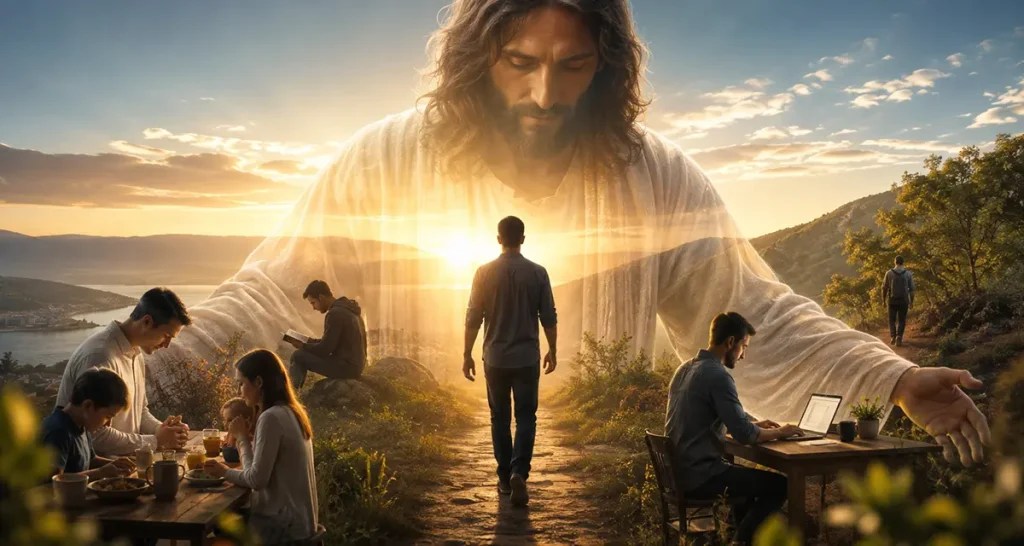
Yes. I think “our mode is Christ” gets much closer to Paul’s thought than dividing ourselves into “spiritual mode” and “natural mode.” And the qualification you added is crucial: this remains true even when our consciousness of it is weak.
Paul grounds Christian existence first in an objective reality accomplished by God, not in our moment-by-moment sensation of that reality.
“I have been crucified with Christ; it is no longer I who live, but Christ lives in me…”
— Galatians 2:20
That is an extraordinary statement. Paul does not say, “When I am sufficiently prayerful, Christ lives in me.” He describes what has become true of him because of union with Christ.
🌿 “Christ… is our life”
Colossians says it with astonishing simplicity:
“When Christ who is our life appears, then you also will appear with Him in glory.”
— Colossians 3:4
Not merely:
Christ gives us life.
That is true (John 10:28; Romans 6:23).
Not merely:
Christ improves our life.
Not even merely:
Christ is the most important part of our life.
Paul says:
Christ is our life.
And immediately before this he says:
“For you died, and your life is hidden with Christ in God.”
— Colossians 3:3
That word hidden is particularly helpful for what you said about not realizing or feeling it.
Something can be profoundly real while presently hidden.
Our life in Christ has not yet reached its visible manifestation. Paul actually says that when Christ appears, then what is already true will be openly displayed:
“…then you also will appear with Him in glory.”
— Colossians 3:4
So Christian experience presently contains an enormous disparity between what we are in Christ and what we perceive ourselves to be.
🕊️ Our awareness fluctuates; our union does not fluctuate with it
This is where feelings can easily confuse us.
I may wake up with an intense consciousness of God’s presence. I pray, read Scripture, and feel deeply aware that I belong to Christ.
Two hours later I am buying groceries and thinking about tomatoes. 🍅
I have not temporarily ceased being “in Christ.”
I may be asleep.
Still Christ’s.
I may be concentrating intensely on work without consciously thinking about God.
Still Christ’s.
I may be laughing with friends.
Still Christ’s.
I may even stumble into sin—and though that requires repentance, confession, and restoration of fellowship, my failure does not mean that I have temporarily reverted into Adam and must somehow climb back into Christ.
Paul’s category remains:
“There is therefore now no condemnation to those who are in Christ Jesus.”
— Romans 8:1
“In Christ” is an identity and sphere of existence, not an emotional state.
That is enormously comforting.
✝️ “None of us lives to himself”
The passage you brought from Romans 14 makes this even more comprehensive:
“For none of us lives to himself, and no one dies to himself. For if we live, we live to the Lord; and if we die, we die to the Lord. Therefore, whether we live or die, we are the Lord’s.”
— Romans 14:7–8
That last sentence almost summarizes everything:
“We are the Lord’s.”
Before anything I do for Christ comes the reality that I belong to Christ.
That belonging encompasses living and dying—and therefore everything between them.
Paul deliberately takes the two absolute boundaries of human existence:
life ← everything ← death
and places both under Christ’s lordship.
If my living belongs to Him and my dying belongs to Him, there really isn’t a neutral territory somewhere in between where I temporarily become my own again.
🌱 Then what does “walk in the Spirit” mean?
This also clarifies something important from our previous discussion.
If Christ is already our life, why does Paul still command:
“Walk in the Spirit…”
— Galatians 5:16
Because there is a difference between possessing the life and walking consistently according to that life.
Or, perhaps even better:
There is a difference between reality and realization.
Our sanctification increasingly brings our thoughts, desires, choices, habits, relationships, and actions into conformity with the reality God has already established in Christ.
That is why Paul can say:
“If we live in the Spirit, let us also walk in the Spirit.”
— Galatians 5:25
That order is beautiful.
He doesn’t say:
Walk in the Spirit so that eventually you may live in the Spirit.
Rather:
Since we live by the Spirit, let us walk by the Spirit.
Life precedes walk.
Grace precedes response.
Reality precedes experience.
🪞 We are learning to live as what God has made us
That gives sanctification a different character.
It isn’t primarily an attempt to manufacture a spiritual identity that doesn’t yet exist.
It is increasingly learning to live consistently with the identity God has already given us.
Paul repeatedly reasons this way:
“For you were once darkness, but now you are light in the Lord. Walk as children of light.”
— Ephesians 5:8
Notice again:
You are → therefore walk.
And similarly:
“If then you were raised with Christ, seek those things which are above…”
— Colossians 3:1
You were raised → therefore seek.
And Romans 6:
“Reckon yourselves to be dead indeed to sin, but alive to God in Christ Jesus our Lord.”
— Romans 6:11
Even the word “reckon” is revealing. Paul is asking us to take seriously as true what God has accomplished in Christ.
🤔 And this exposes our tendency to compartmentalize
We naturally create little rooms.
Here is God.
Here is work.
Here is entertainment.
Here is family.
Here is prayer.
Here is my private life.
Here is church.
And periodically we walk into the “God room.” 🙃
But Paul’s theology blows the walls out.
“Whatever you do in word or deed, do all in the name of the Lord Jesus…”
— Colossians 3:17
Why?
Because the person doing the “whatever” already belongs to Jesus.
This is why 1 Corinthians 10:31 is not simply a command to sprinkle religious thoughts over ordinary activities:
“Whether you eat or drink, or whatever you do, do all to the glory of God.”
Paul isn’t trying to make eating artificially religious.
He is recognizing that there is no portion of the redeemed person’s existence that falls outside God’s claim upon him.
❤️ And our failure to feel this doesn’t undo it
This may be one of the most comforting aspects of the whole truth.
Our consciousness is terribly inconsistent.
Some days Christ seems overwhelmingly near.
Other days everything feels painfully ordinary.
Sometimes prayer feels alive.
Sometimes we say the words and feel almost nothing.
Sometimes the truth that we are God’s children fills us with wonder.
Sometimes we get distracted five minutes later by something ridiculously trivial. 😅
Yet Scripture doesn’t say:
“You are God’s children whenever you manage to feel like God’s children.”
It says:
“For you are all sons of God through faith in Christ Jesus.”
— Galatians 3:26
And:
“The Spirit Himself bears witness with our spirit that we are children of God.”
— Romans 8:16
Our perception of the reality rises and falls.
The reality itself rests upon Christ.
And perhaps that changes how we understand the spiritual life altogether.
We aren’t continually trying to enter life with Christ.
We are learning to recognize, enjoy, and walk in the life with Christ into which grace has already brought us.
Prayer makes us more conscious of it.
Scripture illuminates it.
Worship celebrates it.
Obedience expresses it.
Fellowship shares it.
Suffering tests and deepens our apprehension of it.
But underneath all those changing experiences stands something wonderfully stable:
“Whether we live or die, we are the Lord’s.”
— Romans 14:8
So perhaps the deepest answer to “What mode am I in right now?” isn’t spiritual or natural.
For the child of God, the underlying answer is much simpler:
Christ.
“For to me, to live is Christ.”
— Philippians 1:21
And we may spend the whole Christian life discovering just how enormous that little sentence actually is.