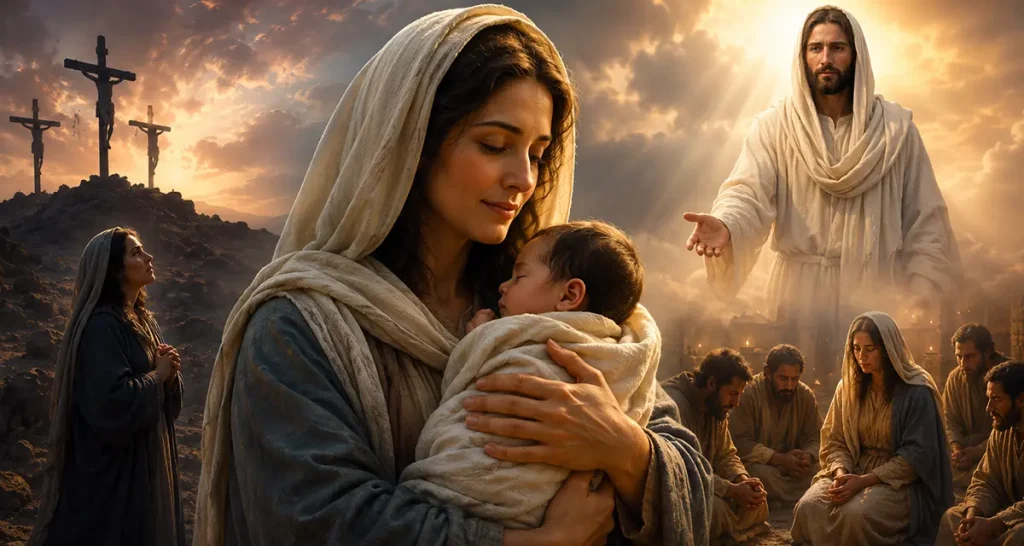
That is a profound question, because God could have spared Mary the sight. Nothing required her physical presence at Calvary for Christ’s atonement to be effective. Providence could have kept her away by something utterly ordinary—a sickness, a delay, even simply not knowing where Jesus had been taken.
Yet John deliberately tells us:
“Standing by the cross of Jesus were his mother…” (John 19:25)
So perhaps the question isn’t merely, “Why didn’t God spare Mary?” but “Why did God permit—and perhaps providentially appoint—Mary to be there?”
And I think Simeon’s prophecy gives us our strongest biblical doorway into the answer.
💔 “A sword will pierce through your own soul also”
When Jesus was only an infant, Simeon told Mary:
“Behold, this child is appointed for the fall and rising of many in Israel, and for a sign that is opposed—and a sword will pierce through your own soul also—so that thoughts from many hearts may be revealed.” (Luke 2:34–35)
Thirty-something years before Calvary, God told Mary that motherhood of this Child would involve a sword.
That is remarkable.
Gabriel had announced the glory:
“He will be great and will be called the Son of the Most High.” (Luke 1:32)
Simeon announces the pain.
In other words, Mary’s extraordinary privilege was never a divine promise of insulation from suffering.
Quite the opposite.
Her proximity to Christ would eventually become the very reason for extraordinary suffering.
The closer she was to Him in love, the deeper that sword could penetrate.
🌹 The grace given to Mary did not exempt her from the cost of following Christ
This changes something important in our discussion about Mary’s privilege.
We have been asking whether her unique relationship with Jesus gave her certain prerogatives.
Calvary shows us another side of that uniqueness:
privilege can create responsibility and suffering rather than exemption from them.
She was uniquely blessed to carry Him.
Therefore she uniquely experienced things nobody else could experience.
She heard His first cry.
And eventually she heard some of His final words.
She watched Him learn to walk.
And eventually watched Him carry—or attempt to carry—the instrument upon which He would be killed.
She cared for His body as an infant.
And then saw that body wounded and dying.
Nobody else at Calvary could look at the crucified Jesus and remember Him inside her womb.
That sword belonged particularly to Mary.
😢 And your phrase “beyond recognition” brings Isaiah to mind
We should be cautious about exactly how literally to reconstruct Jesus’ appearance, but Isaiah’s Servant is described:
“His appearance was so marred, beyond human semblance…” (Isaiah 52:14)
And:
“He was despised and rejected by men, a man of sorrows and acquainted with grief.” (Isaiah 53:3)
Imagine Mary reconciling that sight with Gabriel’s announcement:
“He will be great…” (Luke 1:32)
This is the great One?
Imagine reconciling Calvary with:
“The Lord God will give to him the throne of his father David.” (Luke 1:32)
A throne?
He’s hanging on a cross.
“He will reign over the house of Jacob forever.” (Luke 1:33)
Reign?
He’s dying.
“Of his kingdom there will be no end.” (Luke 1:33)
And now He is breathing His last.
Mary had to confront the same impossible-looking contradiction that confronts faith throughout Scripture:
God’s promise appears to have collided with circumstances that make fulfillment impossible.
🔥 Perhaps Mary had to walk Abraham’s road too
Your mention of Abraham made me think of something slightly different from what you intended.
Abraham receives a promise concerning Isaac:
“Through Isaac shall your offspring be named.” (Genesis 21:12)
Then God tells him:
“Take your son, your only son Isaac, whom you love…” (Genesis 22:2)
The promise and the command appear irreconcilable.
Hebrews tells us how Abraham endured it:
“He considered that God was able even to raise him from the dead.” (Hebrews 11:19)
Now look at Mary.
God promised her concerning Jesus:
He will reign forever. (Luke 1:32–33)
And then she watches Him die.
The promise appears impossible.
She cannot fix it.
She cannot rescue Him.
She cannot understand everything God is doing.
She can only entrust the apparent contradiction to God.
There is a profound similarity:
Abraham had to surrender the promised son.
Mary had to watch the promised Son die.
But with Mary there was no ram caught in the thicket to take Jesus’ place.
Because this time Jesus was the Lamb (John 1:29; cf. Genesis 22:13).
That is chillingly beautiful.
🐑 There could be no substitute for this Son
At Moriah:
Isaac is spared.
The ram dies.
At Calvary:
the Son is not spared.
Paul uses almost exactly that language:
“He who did not spare his own Son but gave him up for us all…” (Romans 8:32)
And that may bring us close to your question.
Why didn’t God spare Mary the sight?
Ultimately we don’t know every purpose of providence, and Scripture doesn’t give us a sentence saying, “Mary was present because…” So we shouldn’t pretend certainty.
But Scripture does tell us something greater:
The Father did not spare His own Son.
Mary’s suffering at Calvary is real and terrible, but the center of Calvary is not Mary’s suffering. It is Christ’s.
And perhaps Mary’s presence makes that truth more painfully visible.
✝️ Mary could not protect Jesus from His mission
There is something else happening at the cross that I think is important for our earlier conversation.
Natural motherhood reaches its absolute limit there.
Mary could once feed Jesus.
She could shelter Him.
She could hold Him.
She could flee with Joseph to protect Him from Herod (Matthew 2:13–14).
She could care for Him through childhood.
But at Calvary, she cannot save Him.
And even more profoundly:
she must not save Him.
Because He came for this.
Jesus had repeatedly said:
“The Son of Man came… to give his life as a ransom for many.” (Mark 10:45)
And:
“For this purpose I have come to this hour.” (John 12:27)
The mother’s natural impulse would be:
Save my Son.
God’s redemptive purpose required:
The Son must give Himself.
What a terrible surrender that must have been.
❤️ Yet Jesus is still Mary’s Son while dying
And John preserves one extraordinarily tender moment:
“When Jesus saw his mother and the disciple whom he loved standing nearby, he said to his mother, ‘Woman, behold, your son!’ Then he said to the disciple, ‘Behold, your mother!'” (John 19:26–27)
This moves me in the context of your question.
Jesus is being crucified.
His own suffering is beyond what we can adequately imagine.
Yet He sees her.
God did not spare Mary from Calvary.
But neither did Christ become indifferent to His mother at Calvary.
In the middle of accomplishing cosmic redemption, He attends to the practical earthly future of this woman who gave birth to Him.
He entrusts her to John.
That is astonishingly human.
🌱 And then Mary had to learn what every Christian must learn
Death did not have the final word.
Everything she saw on Friday was real.
The wounds were real.
The humiliation was real.
The corpse was real.
Her grief was real.
But none of it invalidated God’s promise.
“He will reign… forever.” (Luke 1:33)
How?
Resurrection.
And perhaps this is one reason it matters that Mary wasn’t artificially protected from the horror.
Christian hope isn’t:
God prevents His beloved from seeing terrible things.
Christian hope is much stronger:
God’s promises survive terrible things.
Mary had to pass through Friday before the Church could proclaim Sunday.
🌹 And this actually makes me appreciate Mary more
Not because she becomes a co-redeemer.
Not because her suffering contributes something lacking in Christ’s atonement.
Christ alone accomplishes redemption.
But Mary stands there as a disciple who cannot understand everything, cannot change what is happening, cannot protect the One she loves—and nevertheless remains there.
John’s wording is simple:
“Standing by the cross of Jesus…” (John 19:25)
Standing.
She did not get the merciful migraine.
She did not get the providential delay.
She did not sleep through it like Abraham while God acted elsewhere.
She was there.
And Simeon’s thirty-year-old prophecy finally becomes horrifyingly concrete:
“A sword will pierce through your own soul also.” (Luke 2:35)
Perhaps there is a lesson here that reaches far beyond Mary:
Being highly favored by God does not mean being highly sheltered by God.
Sometimes the person given extraordinary grace is also entrusted with extraordinary suffering.
And Mary had already answered the principle of that calling decades earlier, without possibly knowing everything her words would eventually cost:
“Behold, I am the servant of the Lord; let it be to me according to your word.” (Luke 1:38)
At Bethlehem, those words meant receiving the Child.
At Calvary, they ultimately meant surrendering Him to the Father’s purpose.
And Sunday would reveal that the Father had not lost her Son at all.