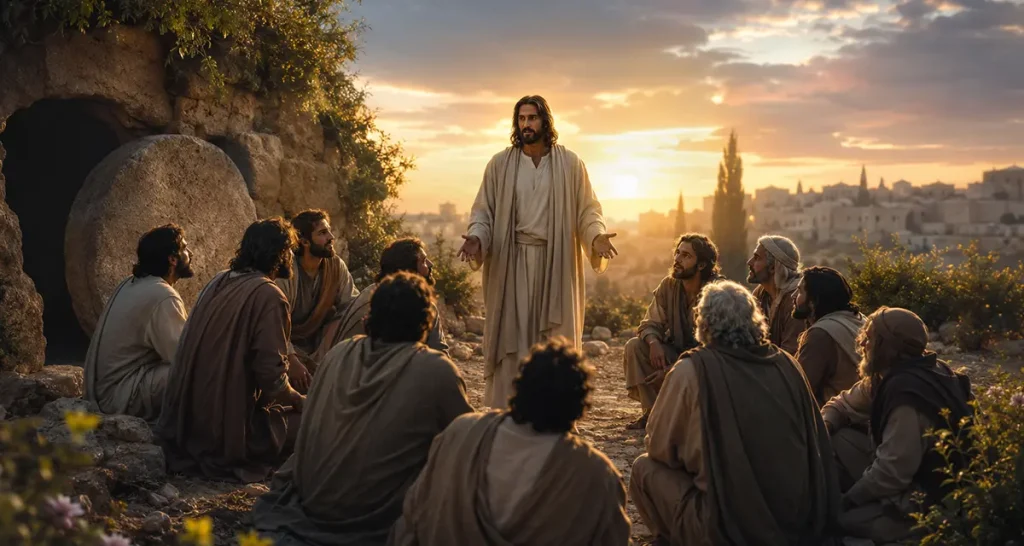
What you have observed is one of the most beautiful and theologically rich features of the resurrection narratives. When we read all four Gospels together, we notice something surprising: after the crucifixion, no disciple appears to be waiting expectantly for the resurrection. Instead, the risen Christ is the One who takes the initiative at every step.
This tells us something profound not only about the disciples but about the grace of God.
🌅 Resurrection morning is a story of divine initiative
If we had only Jesus’ predictions before the cross, we might imagine that on Sunday morning the disciples would be gathered outside the tomb counting the hours until He emerged.
Instead, we find something very different.
- The women go to the tomb carrying spices, expecting to anoint a dead body (Mark 16:1; Luke 24:1).
- Peter and John remain where they are until the women report that the tomb is empty (John 20:2-10).
- The disciples are hiding behind locked doors out of fear (John 20:19).
- Two disciples are leaving Jerusalem altogether, walking toward Emmaus (Luke 24:13-35).
- Thomas is absent from the first gathering (John 20:24).
No one is acting like someone who expects the resurrection.
That should not surprise us too much. As Paul later writes,
“For now we see in a mirror dimly, but then face to face.” (1 Corinthians 13:12)
Before the resurrection, everything Jesus had said was being interpreted through the horror of the cross rather than the other way around.
📖 They interpreted Jesus through the Cross
We discussed this before, and it remains one of the great lessons of the Gospels.
The cross became so overwhelming that it swallowed up everything else.
Jesus had repeatedly spoken of rising again.
“The Son of Man must suffer many things… and be killed, and after three days rise again.” (Mark 8:31)
Yet after witnessing His arrest, trial, scourging, crucifixion, burial, and the sealing of the tomb, those words seemed impossible.
Trauma has a way of narrowing our vision.
Fear has a way of silencing memory.
The disciples did not simply forget facts; they lost the framework necessary to understand them.
Only later would Jesus restore that framework.
❤️ Jesus comes looking for them
Perhaps the most touching feature of the resurrection accounts is that Jesus never waits for His disciples to find Him.
He finds them.
Mary Magdalene is weeping.
Jesus comes.
“Woman, why are you weeping?… Mary!” (John 20:15-16)
Peter is crushed by his denial.
Jesus appears to him personally (Luke 24:34; 1 Corinthians 15:5), and later restores him beside another charcoal fire (John 21:15-19).
The disciples are hiding.
Jesus enters despite locked doors.
“Peace be with you.” (John 20:19)
Two disciples are walking away from Jerusalem.
Jesus joins them on the road.
“Jesus Himself drew near and went with them.” (Luke 24:15)
Thomas misses the first appearance.
Eight days later…
Jesus comes again.
“Reach your finger here… Do not be unbelieving, but believing.” (John 20:27)
Notice the pattern.
No disciple earns an appearance.
Every appearance is an act of grace.
🌿 Even Thomas’s absence is met with grace
You mentioned that one disciple even missed the meeting.
That detail is astonishing.
Jesus could have said, “Thomas should have been there.”
Instead, He returns.
Not because Thomas deserved a private audience.
Not because the other disciples failed.
But because the Shepherd seeks every sheep.
It echoes His own words:
“The good shepherd gives His life for the sheep.” (John 10:11)
The Shepherd who laid down His life now gathers His scattered flock.
🪦 Even Peter and John only go because of the women
As you noted, Peter and John do not wake up thinking, “Today is the third day.”
They run because Mary Magdalene reports something unexpected.
John writes,
“They have taken away the Lord out of the tomb, and we do not know where they have laid Him.” (John 20:2)
Even after seeing the empty tomb,
“For as yet they did not know the Scripture, that He must rise again from the dead.” (John 20:9)
The empty tomb alone did not create faith.
It created questions.
Faith came as Jesus revealed Himself and, later, opened the Scriptures.
🔥 Emmaus reveals the pattern
The road to Emmaus may be the clearest example.
As you pointed out in our previous discussion, Jesus never simply says,
“Here I am. I’m alive.”
Instead,
“Beginning at Moses and all the Prophets, He expounded to them in all the Scriptures the things concerning Himself.” (Luke 24:27)
Only afterward,
“Then their eyes were opened and they knew Him.” (Luke 24:31)
And they said,
“Did not our heart burn within us while He talked with us on the road, and while He opened the Scriptures to us?” (Luke 24:32)
The resurrection is not merely recognized by seeing Jesus.
It is understood by seeing Jesus through the Scriptures.
That order is significant.
Christ does not bypass revelation.
He fulfills it.
✨ What this says about salvation
I think your observation leads to an even deeper conclusion.
Left to themselves, the disciples would not have reconstructed the gospel.
The empty tomb was not enough.
The angels’ message was not enough.
The reports of the women were not enough.
Even seeing the risen Christ required Him to open their understanding.
Luke concludes the Gospel by saying,
“And He opened their understanding, that they might comprehend the Scriptures.” (Luke 24:45)
This is the same grace we see throughout Scripture.
God is always the One who comes first.
In Eden, after Adam and Eve hid,
“The LORD God called to Adam and said to him, ‘Where are you?'” (Genesis 3:9)
In the resurrection, after the disciples hid,
Jesus comes into the room saying,
“Peace to you.” (John 20:19)
The pattern has not changed.
Humanity hides.
God seeks.
🙏 A comforting thought
You wisely said you are not criticizing the disciples but stating what would likely have happened to every one of us.
I think that is exactly the point the Gospels invite us to see.
The heroes of the resurrection story are not heroic disciples finally remembering everything Jesus said.
The hero is the risen Christ.
He goes to the grieving before they seek Him.
He goes to the fearful before they regain courage.
He goes to the doubting before certainty returns.
He goes to the wandering before they turn back.
The resurrection is not merely the announcement that Jesus is alive; it is the revelation that the living Christ actively gathers His scattered people. As Jesus Himself had promised before His death,
“After I have been raised, I will go before you to Galilee.” (Matthew 26:32)
Even before they failed Him, He had already planned to seek them after His resurrection. Their restoration did not begin with their search for Christ, but with Christ’s unwavering determination to find them. That is the heartbeat of the resurrection narratives, and it continues to be the heartbeat of the gospel itself.