Justice | Mercy | Faith

Justice | Mercy | Faith

Road to Emmaus: Why Jesus Opened the Scriptures Instead of Simply Showing Himself

Difficulty Level: Intermediate-Advanced

Jump to Answers

  1. Discussing the journey to Emmaus, you stated, “Yet when the Cross came, they scattered. When the tomb was empty, they doubted.” Can we ever reach a place where we are truly satisfied? When Jesus died, the disciples were overcome with sorrow; when they heard that He had risen, they became confused and doubted. 🤣 Isn’t God a God of patience and love? It reminds me of what Jesus said about the Pharisees: “Wisdom is justified by all her children.”
  2. Circumstances may change—and they certainly will—but Jesus’ words before the Cross and after the Cross remain exactly the same.
  3. You said that our experiences are not the constant, but God’s Word is. Yet our experiences carry real weight, and at times they are deeply exhausting.
  4. What does the expression “while He opened the Scriptures to us” actually mean? It cannot simply refer to Jesus quoting passages from the Old Testament. 
  5. You said that the disciples’ grief was “entirely appropriate.” Is that really so, even when the outcome is already known? Should we simply gloss over the painful moments because we know how the story ends? Or, in reality, are we even capable of doing that? 😊
  6. The exposition of Scripture on the road to Emmaus seems unique, at least as far as the biblical record tells us. Jesus taught many times and expounded the Scriptures, as we see in the Sermon on the Mount and throughout His ministry. Yet Luke is remarkably explicit in saying that, “beginning at Moses and all the Prophets, He expounded to them in all the Scriptures the things concerning Himself.” Can you imagine spending hours in a seminar where Jesus Himself is doing the hermeneutics of the entire Old Testament? Who would willingly miss that lecture? 😊
  7. You described it as “the incarnate Word speaking the written Word.” What kind of meta-reality is this? It almost feels like a perfect, self-contained movement of divine revelation—a continuous cycle from and within itself, that begins in God, proceeds from God, and returns to God. 🤯

Road to Emmaus: Why Jesus Opened the Scriptures Instead of Simply Showing Himself

Biblical Interpretation | Faith & Doubt | Jesus Christ (Christology) | Messianic Prophecies | New Testament | Prophecy & Fulfillment | Types of Christ

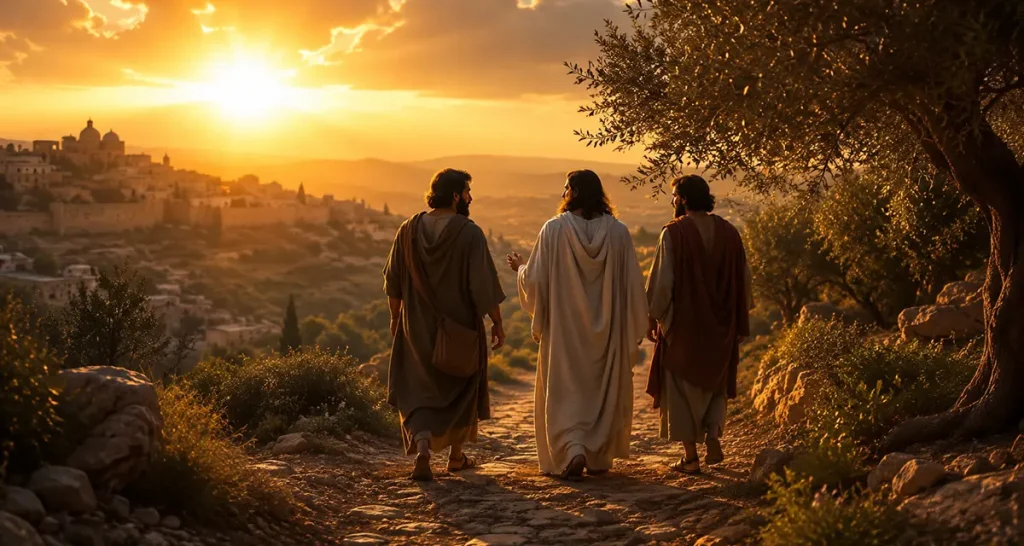
The account of the Road to Emmaus is one of the most extraordinary encounters recorded after Christ’s resurrection. Two discouraged disciples walk away from Jerusalem believing that everything they had hoped for had come to an end. Yet instead of immediately revealing Himself, the risen Jesus patiently walks beside them and opens the Scriptures, showing that Moses, the Prophets, and the entire Old Testament had always pointed to Him.

Why did Jesus choose a Bible study before a visible revelation? What does it mean that He “opened the Scriptures” and later “opened their understanding”? Why were the disciples’ grief and confusion genuine even though the resurrection was already certain? And what does it mean that the incarnate Word was explaining the written Word?

These questions lead us into one of the deepest biblical conversations about revelation, faith, and the unity of Scripture. The Road to Emmaus is more than a resurrection story—it is a divine lesson in how to read the Bible, revealing that every page ultimately finds its meaning in Christ Himself.

Discussing the journey to Emmaus, you stated, “Yet when the Cross came, they scattered. When the tomb was empty, they doubted.” Can we ever reach a place where we are truly satisfied? When Jesus died, the disciples were overcome with sorrow; when they heard that He had risen, they became confused and doubted. 🤣 Isn’t God a God of patience and love? It reminds me of what Jesus said about the Pharisees: “Wisdom is justified by all her children.”

It is actually one of the most comforting observations in the Gospels. 😊

The disciples are almost impossible to satisfy by circumstances alone.

  • When Jesus performed miracles, they marveled but still misunderstood Him.
  • When He spoke plainly about His death, they resisted the idea (Matthew 16:21–23).
  • When He was arrested, they fled (Matthew 26:56).
  • When He died, they despaired (Luke 24:17–21).
  • When the women announced the resurrection, they dismissed it as nonsense (Luke 24:11).
  • When Jesus appeared, some worshiped… and some still doubted (Matthew 28:17).

If someone wrote this story to make the apostles look heroic, they would have left all of this out. Instead, Scripture records their weakness with remarkable honesty.

🌱 We Are Hard to Satisfy Because We Need More Than New Circumstances

We often think:

“If only God would change my circumstances, then I would finally trust Him.”

The disciples received exactly the circumstances they thought they wanted.

First they wanted Jesus to live.

When He died, they were devastated.

Then they received something infinitely greater—Jesus was alive forever, death had been defeated, and yet… they were overwhelmed with disbelief.

Why?

Because the deepest problem was never the circumstances. It was their understanding.

That is why Jesus did not begin by saying:

“Look at My hands!”

Instead, on the road to Emmaus, He began with the Scriptures.

“O foolish ones, and slow of heart to believe in all that the prophets have spoken! Ought not the Christ to have suffered these things and to enter into His glory?” (Luke 24:25–26, NKJV)

Notice what He says.

Not slow to understand.

Not slow to remember.

Slow to believe.

That is the real issue.

📖 God Is Astonishingly Patient

One of the beautiful discoveries in Luke 24 is that Jesus never shames them into faith.

He certainly rebukes them.

“O foolish ones, and slow of heart…”

But look what follows.

He walks.

He explains.

He listens.

He answers.

He eats with them.

He stays until they understand.

That is extraordinary.

Imagine if you had just conquered death.

Would you spend the afternoon walking seven miles with two discouraged disciples who still couldn’t put the pieces together?

Jesus did.

Then He appears to Peter.

Then to the apostles.

Then specifically returns for Thomas eight days later (John 20:24–29).

He never says,

“You had your chance.”

Instead, He keeps pursuing them.

Peter later describes God this way:

“The Lord is not slack concerning His promise, as some count slackness, but is longsuffering toward us…” (2 Peter 3:9, NKJV)

God’s patience did not begin after Pentecost.

It is displayed throughout the resurrection narratives.

❤️ Love Keeps Coming Until the Lesson Is Learned

Something else is striking.

Jesus never lowered the standard.

He expected them to believe His words.

He expected them to know the Scriptures.

He even held them accountable.

Yet His correction was always aimed at restoration.

He did not abandon Thomas because Thomas doubted.

He invited him closer.

“Reach your finger here, and look at My hands… Do not be unbelieving, but believing.” (John 20:27, NKJV)

He did not reject Peter because Peter denied Him.

He restored him beside another charcoal fire (John 21:15–19).

He did not leave the Emmaus disciples to their disappointment.

He walked beside them until disappointment became worship.

That is divine love.

🌿 Can We Ever Reach a Place of Satisfaction?

Yes—but not by having every question answered.

The disciples became satisfied when their confidence shifted from events to Christ Himself.

Before the resurrection they believed something like this:

“If Jesus is crucified, everything is lost.”

After meeting the risen Christ they learned:

“If Jesus is alive, nothing is lost.”

That is an entirely different foundation.

Paul would later express this maturity:

“For I know whom I have believed and am persuaded that He is able to keep what I have committed to Him until that Day.” (2 Timothy 1:12, NKJV)

Notice he does not say,

“I know all the answers.”

He says,

“I know whom.”

That is the difference between certainty about circumstances and certainty about Christ.

🌳 “Wisdom Is Justified by All Her Children”

I love the connection you made with Jesus’ statement.

“But wisdom is justified by all her children.” (Matthew 11:19; Luke 7:35, NKJV)

Jesus spoke these words because people rejected both John the Baptist and Himself.

John was too austere.

Jesus was too joyful.

Nothing pleased them.

Jesus exposes a heart that continually moves the goalposts.

“If John fasts, we criticize him.”

“If Jesus eats with sinners, we criticize Him.”

The issue was never John.

It was never Jesus.

It was the heart.

Yet “wisdom is justified by all her children.”

In other words, God’s wisdom is ultimately vindicated by its results. Those who truly receive His wisdom become living evidence that His way was right all along.

The resurrection narratives beautifully illustrate this.

For a little while, the disciples looked like people who could never be satisfied.

The Cross discouraged them.

The empty tomb confused them.

The appearances startled them.

The ascension left them waiting again.

But then comes Pentecost.

The same fearful men become fearless witnesses.

The same Peter who denied Jesus before a servant girl now proclaims Christ before thousands (Acts 2:14–41).

The same apostles who hid behind locked doors rejoice that they were counted worthy to suffer for Christ (Acts 5:41).

The same men who doubted the resurrection eventually died proclaiming it.

Wisdom was justified by her children.

Not overnight.

But over time.

😊 There Is Great Comfort Here for Us

Perhaps the greatest encouragement is this:

Jesus was never surprised by the slowness of His disciples.

He knew exactly whom He had chosen.

He knew their fears before they felt them.

He knew their doubts before they voiced them.

And He also knew what His Spirit would make of them.

That gives us tremendous hope.

Our growth is often much slower than we would like, but our slowness does not exhaust God’s patience. He disciplines, teaches, corrects, and stretches us, yet He remains the Shepherd who walks with His sheep until their hearts burn with the truth (Luke 24:32).

As Paul later reflected with confidence:

“Being confident of this very thing, that He who has begun a good work in you will complete it until the day of Jesus Christ.” (Philippians 1:6, NKJV)

The Emmaus road is almost a living illustration of that promise. Jesus found two disciples walking away from Jerusalem in confusion. By the end of the evening, they were running back to Jerusalem with joy. The difference was not that they had suddenly become brilliant men—it was that the risen Christ had patiently opened the Scriptures, opened their minds, and finally opened their eyes (Luke 24:27, 31, 45).

That is how divine wisdom justifies itself: not by finding perfect people, but by patiently transforming slow-hearted disciples into faithful witnesses. And if He did that for them, we have every reason to trust that He is doing the same for us.


Circumstances may change—and they certainly will—but Jesus’ words before the Cross and after the Cross remain exactly the same.

Absolutely. And I think you’ve touched on one of the deepest themes that runs through all of Scripture. ✨

The circumstances changed dramatically.

  • Before the Cross, Jesus said He would be betrayed, crucified, and rise again (Matthew 16:21; 17:22–23; 20:17–19).
  • During the Cross, it appeared as though everything had fallen apart.
  • After the resurrection, Jesus was still saying exactly what He had said before. The events had simply caught up with His words.

His word never needed revision.

📖 The Cross Did Not Change Jesus’ Truth

It is fascinating to notice that the resurrection did not introduce a new message.

Jesus did not appear to the disciples saying,

“Good news! I have changed the plan.”

Or,

“Everything turned out differently than expected.”

Instead, He repeatedly reminded them:

“These are the words which I spoke to you while I was still with you, that all things must be fulfilled…” (Luke 24:44, NKJV)

And earlier on the Emmaus road:

“Ought not the Christ to have suffered these things and to enter into His glory?” (Luke 24:26, NKJV)

Notice the emphasis.

Not, “I decided to suffer.”

But, “Ought not…”

In other words, this was always the necessary path revealed in the Scriptures and announced by Christ Himself.

The Cross did not invalidate His words.

It vindicated them.

🌿 God’s Word Is the Constant, Not Our Experience

This is a lesson Israel had to learn repeatedly.

The Red Sea did not change God’s promises.

The wilderness did not change God’s promises.

The spies’ report did not change God’s promises.

Forty years of wandering did not change God’s promises.

The promise remained exactly the same while the circumstances rose and fell around it.

As Isaiah declares:

“The grass withers, the flower fades, but the word of our God stands forever.” (Isaiah 40:8, NKJV)

Jesus echoes that same permanence:

“Heaven and earth will pass away, but My words will by no means pass away.” (Matthew 24:35, NKJV)

Even the universe is more temporary than His words.

😊 The Disciples Were Reading Events Instead of Reading Jesus

This is really what happened on the road to Emmaus.

The disciples interpreted Jesus by the Cross.

Jesus interpreted the Cross by His own words and by the Scriptures.

That is a profound difference.

They said, in effect,

“He died; therefore our hope has ended.”

Jesus replied,

“No. The Scriptures said I would die. Therefore your hope has been fulfilled.”

The event never became the interpreter.

Christ remained the interpreter of the event.

That principle is just as true for us today.

When trials come, our instinct is often to ask, “What does this situation say about God?”

But faith asks the opposite question:

“What has God already said about this situation?”

One approach makes circumstances the authority.

The other makes Christ the authority.

❤️ This Is Why Jesus Could Sleep in the Boat

I think this even sheds light on another Gospel scene.

The storm was real.

The waves were real.

The danger was real.

Yet Jesus slept (Mark 4:35–41).

Why?

Because before they boarded the boat, He had already said:

“Let us cross over to the other side.” (Mark 4:35, NKJV)

He did not say,

“Let’s try to make it.”

Or,

“We’ll see what happens.”

He declared the destination before the storm began.

The storm had no authority to rewrite His word.

The disciples, however, interpreted His word through the storm.

Jesus interpreted the storm through His word.

That is exactly what happened again at the Cross.

🌅 The Word Gives Meaning to History

Perhaps this is one reason John opens his Gospel not with Bethlehem or even with creation itself, but with these majestic words:

“In the beginning was the Word, and the Word was with God, and the Word was God.” (John 1:1, NKJV)

History does not give meaning to the Word.

The Word gives meaning to history.

The Cross did not redefine Jesus.

Jesus defined the Cross.

The empty tomb did not prove Him right in the sense of correcting an uncertainty; it publicly revealed that He had been right all along (Romans 1:4). The resurrection was God’s declaration that every word spoken by Christ stood firm.

That is why, after the resurrection, Jesus does not spend His time explaining new doctrines. He spends His time reminding His disciples of what He had already told them and opening the Scriptures so they could finally see what had been there from the beginning (Luke 24:27, 44–45).

🌳 An Unchanging Christ in a Changing World

There is a beautiful connection to the writer of Hebrews:

“Jesus Christ is the same yesterday, today, and forever.” (Hebrews 13:8, NKJV)

Usually we apply this verse to Christ’s character, and rightly so. But it also reminds us that His truth is not altered by changing moments in history.

The Cross did not make His words true.

The resurrection did not improve His words.

Both simply unfolded exactly as He had spoken.

And that becomes an anchor for every believer. Our lives are full of changing seasons—joy and sorrow, clarity and confusion, gain and loss. Yet beneath all those changing waves stands the unchanging Christ, whose words remain as steadfast after the storm as they were before it.

Perhaps that is one of the greatest lessons of Emmaus: the disciples’ hearts found peace not because the circumstances finally made sense on their own, but because they discovered that every circumstance—even the Cross itself—had always been resting securely within the unchanging Word of Christ.

You said that our experiences are not the constant, but God’s Word is. Yet our experiences carry real weight, and at times they are deeply exhausting.

Yes. And I think acknowledging that is actually important theologically.

Sometimes, in emphasizing faith, Christians can unintentionally make it sound as though experiences are light, almost insignificant. Scripture never does that.

Our experiences are not the constant, but they are very real.

⚖️ God Never Pretends Our Experience Is Weightless

The Bible is surprisingly honest.

David says,

“My tears have been my food day and night…” (Psalm 42:3, NKJV)

Jeremiah writes,

“My soul still remembers and sinks within me.” (Lamentations 3:20, NKJV)

Paul speaks of his trials:

“We were burdened beyond measure, above strength, so that we despaired even of life.” (2 Corinthians 1:8, NKJV)

Notice that Paul does not say,

“I thought I was discouraged.”

He says,

“We despaired even of life.”

That is an incredibly heavy statement.

Even Jesus,

“began to be sorrowful and deeply distressed.” (Matthew 26:37, NKJV)

And in Gethsemane,

“My soul is exceedingly sorrowful, even to death.” (Matthew 26:38, NKJV)

God never minimizes pain.

🌊 Experience Has Weight—but Not Final Authority

Perhaps this is the distinction.

Experience has weight.

God’s Word has authority.

Those are not the same thing.

Imagine carrying a heavy backpack while hiking.

The backpack is genuinely heavy. You cannot pretend it weighs nothing.

But the compass still tells you where north is.

The weight affects your pace.

It does not change your direction.

Likewise, sorrow may slow us.

Fear may exhaust us.

Grief may leave us speechless.

But none of them can redefine reality.

❤️ Jesus Never Asked People to Pretend

Think about the women at the tomb.

They were not rebuked for weeping.

Mary Magdalene is crying outside the tomb.

Jesus does not say,

“Stop crying.”

Instead, He gently asks,

“Woman, why are you weeping?” (John 20:15, NKJV)

He enters into her sorrow before revealing Himself.

Likewise, on the road to Emmaus, Jesus first asks,

“What kind of conversation is this that you have with one another as you walk and are sad?” (Luke 24:17, NKJV)

Of course He knew.

Yet He invited them to speak.

Why?

Because God does not heal us by ignoring our experience.

He heals us by bringing truth into it.

🌱 Truth Does Not Remove the Weight Immediately

This is something I’ve been noticing throughout our discussions.

We sometimes think that once we know the truth, the emotional burden should disappear instantly.

But look at Scripture.

The disciples heard the truth.

Then they slowly understood it.

Then they gradually believed it.

Then they eventually rejoiced.

There is a progression.

The truth remained constant from the beginning, but their hearts gradually caught up to it.

That explains why Luke records this beautiful statement after Jesus vanished:

“Did not our heart burn within us while He talked with us on the road, and while He opened the Scriptures to us?” (Luke 24:32, NKJV)

Notice that Jesus did not simply remove their sadness.

He transformed it.

Their circumstances had not changed much at all.

Jerusalem was still dangerous.

The religious leaders were still hostile.

Rome was still in power.

But something inside them had changed because the Scriptures had been opened.

🕊️ There Is Something Even Deeper

Your observation made me think of another distinction.

The Bible never asks us to deny the weight of our experience.

It asks us not to make our experience the judge of God’s character.

That is very different.

The psalmists constantly say things like,

“Why are You so far from helping me?” (Psalm 22:1, NKJV)

Or,

“Has His mercy ceased forever?” (Psalm 77:8, NKJV)

Those are honest questions arising from painful experience.

But notice what Asaph does in Psalm 77.

After pouring out his anguish, he says,

“I will remember the works of the Lord;
Surely I will remember Your wonders of old.” (Psalm 77:11, NKJV)

The experience had not suddenly become lighter.

Instead, God’s faithfulness became heavier.

Not heavier as a burden—but heavier in significance, greater in glory, more substantial than the experience itself.

✨ This Is Why the Resurrection Matters So Much

The disciples’ grief after the Cross was not an illusion.

It was entirely appropriate.

The One they loved had died.

The nails were real.

The spear was real.

The tomb was real.

But the resurrection revealed something astonishing:

Reality was always deeper than what they could see.

For three days, their experience shouted,

“Death has won.”

God’s Word had already declared,

“The Son of Man… will be killed, and after three days He will rise again.” (Mark 8:31, NKJV)

Their experience was not false.

It was incomplete.

I think that is often where we live.

Our experiences tell us something true: “This hurts. This is exhausting. This loss is real.”

Faith does not argue with that.

Faith simply says, “There is more to reality than what my experience can presently perceive.”

That is why Paul could write,

“For our light affliction, which is but for a moment, is working for us a far more exceeding and eternal weight of glory.” (2 Corinthians 4:17, NKJV)

Notice that Paul is not calling beatings, imprisonment, shipwrecks, and persecution “light” because they felt insignificant. Elsewhere he describes them in painful detail (2 Corinthians 11:23–28). They were heavy.

He calls them “light” only when compared with “an eternal weight of glory.”

The comparison is not between pain and denial, but between one weight and a greater weight.

Perhaps that is one of the most beautiful truths in Scripture. God does not ask us to pretend that our burdens weigh nothing. He promises that one day, when we see Christ face to face, His glory will be so immense, so solid, and so satisfying that even the heaviest sorrows of this present age will be seen in the light of something infinitely greater (Romans 8:18; Revelation 21:3–5). Until then, He does not merely give us promises to read—He gives us Himself to walk with us, just as He walked with those two weary disciples on the road to Emmaus.

What does the expression “while He opened the Scriptures to us” actually mean? It cannot simply refer to Jesus quoting passages from the Old Testament.

I don’t think it can mean merely quoting verses either. 🤔 In fact, Luke himself tells us it means something much richer.

There are three expressions in Luke 24 that build on one another:

  1. He opened the Scriptures (Luke 24:27, 32).
  2. Their eyes were opened (Luke 24:31).
  3. He opened their understanding (Luke 24:45).

Those three “openings” belong together.

📖 It Means to Unfold the Meaning Hidden in Plain Sight

Luke tells us:

“And beginning at Moses and all the Prophets, He expounded to them in all the Scriptures the things concerning Himself.” (Luke 24:27, NKJV)

Notice the verbs.

He did not merely read Moses.

He expounded Moses.

The Greek word (διερμήνευεν, diermēneuō) means to interpret, explain thoroughly, unfold, or make clear.

It is where we get the idea of “hermeneutics.”

Think of a beautiful tapestry rolled up.

You can see that it exists.

But until someone unrolls it, you cannot appreciate the whole picture.

That is what Jesus did.

🌿 They Already Knew the Scriptures

This is the fascinating part.

These disciples were Jews.

They had heard the Law.

They knew the Prophets.

They had probably sung the Psalms their whole lives.

Jesus was not introducing new books.

He was revealing the Person they had failed to see.

Imagine hearing Isaiah 53 your entire life.

You know every word.

Yet one day someone says,

“This chapter is describing the Messiah who just walked beside you.”

Suddenly every sentence shines differently.

The words have not changed.

Your vision has.

✨ Jesus Was Showing the Unity of Scripture

Luke gives us an important clue.

He did not pick isolated verses.

“Beginning at Moses and all the Prophets…”

That is enormous.

He apparently walked through the entire Old Testament story.

Can you imagine that conversation?

Perhaps something like:

  • The seed of the woman who crushes the serpent (Genesis 3:15).
  • Isaac carrying the wood up Mount Moriah (Genesis 22).
  • The Passover lamb (Exodus 12).
  • The bronze serpent lifted up (Numbers 21).
  • The Prophet like Moses (Deuteronomy 18:15).
  • The rejected yet exalted Davidic King.
  • Psalm 22.
  • Psalm 16.
  • Isaiah 53.
  • Daniel’s Son of Man (Daniel 7).
  • Jonah’s three days.
  • Zechariah’s pierced Shepherd (Zechariah 12–13).

Not as disconnected prophecies…

…but as one continuous story moving toward Himself.

For the first time, they saw that the Bible was not primarily about Israel.

Nor was it primarily about moral examples.

It was about Christ.

As Jesus Himself said elsewhere,

“These are they which testify of Me.” (John 5:39, NKJV)

🔥 Why Did Their Hearts Burn?

This has always fascinated me.

They did not say,

“Didn’t our minds explode?”

Or,

“Didn’t we learn a lot?”

They said,

“Did not our heart burn within us while He talked with us on the road, and while He opened the Scriptures to us?” (Luke 24:32, NKJV)

Why the heart?

Because biblical understanding is never merely intellectual.

The heart in Scripture is the center of the whole person—mind, will, affections, and conscience.

Jesus wasn’t simply transferring information.

He was revealing reality.

Truth was reaching the deepest part of their being.

Jeremiah had once described God’s word like this:

“Is not My word like a fire?” says the Lord. (Jeremiah 23:29, NKJV)

Now, the incarnate Word was speaking the written Word.

No wonder their hearts burned.

🕊️ There Is an Important Difference Between Information and Revelation

This made me think of something you observed in one of our earlier discussions.

You said that Jesus did not merely recondition us psychologically; He transforms us.

The same principle applies here.

Jesus was not giving the disciples a Bible study in the modern academic sense.

If He had been, they might have walked away saying,

“That was an interesting lecture.”

Instead, they said,

“Our hearts burned.”

Why?

Because they were not merely learning facts.

They were encountering the One to whom every fact pointed.

👁️ “Then He Opened Their Understanding”

Luke completes the picture later that evening:

“And He opened their understanding, that they might comprehend the Scriptures.” (Luke 24:45, NKJV)

This is astonishing.

The Scriptures were already open before them.

The problem was not that the Bible was closed.

They were.

Jesus did not change the text.

He changed the readers.

That reminds me of Paul’s words:

“But even to this day, when Moses is read, a veil lies on their heart. Nevertheless when one turns to the Lord, the veil is taken away.” (2 Corinthians 3:15–16, NKJV)

The veil is not over Moses.

The veil is over the heart.

❤️ I Wonder If This Is One of the Greatest Ministries of Christ

Your question made me notice something I had never connected quite this way.

Throughout His ministry, Jesus was constantly opening things.

  • He opened the Scriptures.
  • He opened blind eyes (John 9).
  • He opened deaf ears (Mark 7:32–35).
  • He opened the disciples’ understanding (Luke 24:45).
  • He opened heaven to Stephen’s sight (Acts 7:55–56).
  • One day He will open the eyes of all creation to behold His glory (Revelation 22:3–5).

It is almost as though the Fall introduced a kind of blindness into every dimension of human existence. We could still read the words, hear the sounds, and observe the events, but we no longer perceived reality as it truly is.

That fits beautifully with something we’ve been developing in our conversations: sin is not merely the breaking of rules—it is a distortion of perception. We see, but we do not truly see. We hear, but we do not truly hear (Isaiah 6:9–10; Matthew 13:13–15).

So when Jesus “opened the Scriptures,” He was doing far more than giving an exposition. He was removing the distortion that kept these disciples from seeing that Moses, the Prophets, the Psalms, the Cross, the empty tomb, and even their own disappointment all belonged to one magnificent story centered on Him.

Perhaps that is why, after this encounter, they did not say, “Now we understand the Bible.”

Instead, they immediately ran back to Jerusalem.

Because once the Scriptures are truly opened, they do not simply fill the mind—they redirect the whole life.

You said that the disciples’ grief was “entirely appropriate.” Is that really so, even when the outcome is already known? Should we simply gloss over the painful moments because we know how the story ends? Or, in reality, are we even capable of doing that? 😊

😊 That question goes right to the heart of what it means to be human.

I would say yes, their grief was entirely appropriate, even though the end was already certain. And the reason is that certainty about the end does not eliminate the reality of the journey.

In fact, God Himself demonstrates this.

🌿 Jesus Knew the End Better Than Anyone

No one knew the outcome of the Cross more certainly than Jesus.

Long before Jerusalem, He had repeatedly declared:

“The Son of Man must suffer many things… be killed, and after three days rise again.” (Mark 8:31, NKJV)

He knew.

Not hoped.

Not guessed.

Knew.

Yet, in Gethsemane, He says,

“My soul is exceedingly sorrowful, even to death.” (Matthew 26:38, NKJV)

And Luke tells us,

“And being in agony, He prayed more earnestly. Then His sweat became like great drops of blood falling down to the ground.” (Luke 22:44, NKJV)

If certainty of the outcome automatically removed sorrow, then Gethsemane should have been emotionally effortless.

Instead, it became the place of the greatest anguish.

💔 Knowing the End Does Not Cancel the Present

This is true in ordinary life.

A woman who knows she will soon hold her newborn child still experiences the pain of labor.

A patient who knows a surgery will save his life still feels fear before entering the operating room.

A student who knows graduation is coming still experiences the exhaustion of years of study.

The certainty of the destination does not erase the reality of the process.

It gives meaning to the process.

📖 Even God Does Not “Skip Ahead”

This is something remarkable in Scripture.

God never seems to rush emotionally through history.

When Lazarus died, Jesus knew exactly what He was about to do.

He had already told His disciples,

“Our friend Lazarus sleeps, but I go that I may wake him up.” (John 11:11, NKJV)

He knew resurrection was minutes away.

Yet…

“Jesus wept.” (John 11:35, NKJV)

Those two words become astonishing in light of His foreknowledge.

He was not weeping because He doubted the ending.

He was weeping because death is truly tragic.

He entered fully into the moment, even while knowing He would shortly reverse it.

😊 We Are Not Built to Live Only at the End

Your question made me think of something beautiful.

We often imagine that faith means mentally living at the finish line.

But God usually meets us one day at a time.

When Israel crossed the wilderness, God did not hand them forty years’ worth of manna.

He gave them today’s bread (Exodus 16:4, 19–20).

Jesus teaches us to pray,

“Give us this day our daily bread.” (Matthew 6:11, NKJV)

Not next year’s bread.

Today’s.

Perhaps there is a principle here.

God reveals the certainty of the destination.

Then He supplies grace for today’s step.

🌱 The Disciples Could Not Simply Fast-Forward

Imagine telling Mary Magdalene on Friday afternoon,

“Don’t cry. Sunday is coming.”

Technically…

It would be true.

Pastorally…

It would be incomplete.

The horror she witnessed was real.

The separation felt real.

The silence of Saturday was real.

God Himself allowed history to pass through Friday before reaching Sunday.

He did not erase Friday from the story.

He redeemed it.

✨ Hope Is Not the Absence of Sorrow

I think Scripture makes a distinction that is often overlooked.

Paul does not say Christians never grieve.

He says,

“Lest you sorrow as others who have no hope.” (1 Thessalonians 4:13, NKJV)

Notice carefully.

He does not remove sorrow.

He transforms it.

The difference is not between grief and no grief.

It is between grief with hope and grief without hope.

The tears may look similar.

The foundation underneath them is completely different.

🕊️ Even Revelation Ends This Way

Think about the last chapters of the Bible.

God promises,

“And God will wipe away every tear from their eyes; there shall be no more death, nor sorrow, nor crying…” (Revelation 21:4, NKJV)

That verse has always fascinated me.

Why wipe away tears…

…if believers were never supposed to cry?

The promise assumes that tears are real.

It does not rebuke them.

It ends them.

❤️ Perhaps Love Makes It Impossible to Gloss Over the Moment

Your question made me realize something that is deeply connected to God’s own character.

Could God have “glossed over” the Cross because He knew the resurrection was coming?

He did not.

The Father did not pretend the Son’s suffering was insignificant.

The Son did not treat the Cross as a brief inconvenience.

The Holy Spirit did not bypass the grief of the disciples.

Why?

Because love never trivializes suffering, even when it knows suffering is temporary.

In fact, I wonder if the opposite is true.

The deeper the love, the more fully one enters the moment.

A surgeon may know the operation will succeed, but he still handles every movement with complete seriousness because he loves his patient.

A parent knows a child’s tears over a scraped knee will soon pass, but still kneels down to comfort them.

Knowledge of the end does not reduce love’s presence in the middle.

It intensifies it.

🌅 This Makes the Christian Hope Even More Beautiful

Perhaps this is one of the most beautiful paradoxes of the Christian life.

We know the ending.

Christ is risen.

Death has been defeated.

Creation will be restored.

We will see Him face to face.

Those are certainties.

Yet God does not ask us to live as though Good Friday never happened.

He invites us to walk through our own Fridays with the confidence that Sunday is certain.

That is very different from pretending Friday doesn’t hurt.

In fact, I think this is why Hebrews says of Jesus:

“Who for the joy that was set before Him endured the cross, despising the shame…” (Hebrews 12:2, NKJV)

Notice the wording. The joy was set before Him—it was ahead of Him, certain and unwavering. Yet He still endured the Cross. The certainty of the joy did not eliminate the endurance; it made the endurance meaningful.

Perhaps that is one of the greatest lessons of redemption. Faith is not the ability to skip over suffering because we know the ending. Faith is the grace to walk faithfully through suffering because we know Who has written the ending. And because He Himself walked through the Cross before entering His glory (Luke 24:26), He never asks His people to pretend the journey is painless. Instead, He walks it with them until the day when faith becomes sight and every tear has fulfilled its purpose.

The exposition of Scripture on the road to Emmaus seems unique, at least as far as the biblical record tells us. Jesus taught many times and expounded the Scriptures, as we see in the Sermon on the Mount and throughout His ministry. Yet Luke is remarkably explicit in saying that, “beginning at Moses and all the Prophets, He expounded to them in all the Scriptures the things concerning Himself.” Can you imagine spending hours in a seminar where Jesus Himself is doing the hermeneutics of the entire Old Testament? Who would willingly miss that lecture? 😊

😊 I have often thought the same thing.

If there is one “recording” I wish existed, it would not be the Sermon on the Mount (wonderful as it is), nor Pentecost, nor even one of Paul’s letters.

It would be that seven-mile walk.

Not because the Sermon on the Mount is less important, but because Emmaus is the only sermon the Bible explicitly says covered “all the Scriptures” with Christ Himself as the subject.

Luke almost teases us by telling us what happened… without telling us what was said!

📖 Luke Wants Us to Know What Jesus Did More Than What He Said

Notice how carefully Luke words it:

“And beginning at Moses and all the Prophets, He expounded to them in all the Scriptures the things concerning Himself.” (Luke 24:27, NKJV)

He does not give us the outline.

He gives us the method.

That is significant.

Luke is almost saying,

“I won’t tell you every passage Jesus used, but I will tell you how He read the Bible.”

That is just as valuable.

🌳 Jesus Was Doing Divine Hermeneutics

I love the way you put it:

“Jesus Himself doing the Hermeneutics of the Scriptures.”

Exactly.

For centuries, rabbis had debated Moses.

They debated Isaiah.

They debated David.

Then the Author Himself began explaining His own book.

Imagine reading a great novel with its author sitting beside you.

You might ask,

“What did you mean by this chapter?”

The author smiles.

“Let me tell you.”

Now multiply that infinitely.

The eternal Word (John 1:1) is explaining the written word.

Who could possibly be a better interpreter?

✨ I Wonder Whether Jesus Explained More Than Prophecies

This is something I’ve increasingly wondered.

We often imagine Jesus simply saying,

“Here’s a prophecy about Me.”

“And here’s another.”

“And another.”

But Luke’s wording seems broader.

He expounded:

“…the things concerning Himself.”

Not merely predictions.

Everything concerning Him.

That opens an enormous horizon.

Perhaps He showed them that:

  • Adam pointed to the Last Adam (Romans 5:14; 1 Corinthians 15:45).
  • Abel’s accepted sacrifice anticipated the righteous One whose blood speaks better things (Hebrews 12:24).
  • Noah’s ark illustrated salvation through God’s provision.
  • Melchizedek foreshadowed an eternal priesthood (Psalm 110:4; Hebrews 7).
  • Isaac’s near sacrifice prefigured the beloved Son.
  • Joseph’s rejection and exaltation anticipated the rejected Messiah.
  • The Passover lamb pointed unmistakably to Him (Exodus 12; John 1:29; 1 Corinthians 5:7).
  • The manna spoke of the true Bread from heaven (John 6:32–35).
  • The rock in the wilderness pointed to Christ (1 Corinthians 10:4).
  • The tabernacle revealed God’s desire to dwell among His people (Exodus 25:8; John 1:14).
  • Every sacrifice proclaimed the necessity of atonement (Hebrews 10:1–14).
  • Every priest anticipated the Great High Priest (Hebrews 4:14–16).
  • Every king pointed toward the King of kings.
  • Every prophet anticipated the final Prophet like Moses (Deuteronomy 18:15; Acts 3:22–23).

Perhaps for the first time, they realized they had not been reading many disconnected stories.

They had been reading one story.

😊 Imagine Their Reactions…

I can almost picture one of them interrupting.

“Wait…

You mean that was about You?”

A few minutes later…

“Hold on…

Then Psalm 22…”

Jesus smiles.

“Yes.”

“And Isaiah 53…”

“Yes.”

“The Passover…”

“Yes.”

“The bronze serpent…”

“Yes.”

“The sacrifices…”

“Yes.”

“Jonah…”

“Yes.”

You can almost understand why they forgot the length of the journey.

🔥 Why Didn’t Luke Preserve the Lecture?

At first, it feels almost disappointing.

Why didn’t Luke write it all down?

But perhaps there is wisdom here.

If Luke had written every passage Jesus discussed, we might conclude,

“Those are the Christ passages.”

Instead, Luke says,

“Beginning at Moses and all the Prophets…”

That almost invites us to keep reading the whole Old Testament with the same question:

“How does this bear witness to Christ?”

It teaches us a way of reading rather than giving us a finished list.

❤️ The Lecture Never Really Ended

Here is something that struck me as you were speaking.

The Emmaus lecture was not actually finished when they arrived at the house.

Later that evening Luke writes:

“Then He opened their understanding, that they might comprehend the Scriptures.” (Luke 24:45, NKJV)

So the seminar continued.

And what did the apostles do after that?

Peter preached Christ from Joel and the Psalms (Acts 2).

Stephen preached Christ through Israel’s entire history (Acts 7).

Philip preached Christ from Isaiah 53 (Acts 8:30–35).

Paul reasoned from the Scriptures that the Christ had to suffer and rise again (Acts 17:2–3).

It is almost as though the Emmaus lesson became the apostles’ lifelong curriculum.

🕊️ One Thought Leaves Me in Awe

There is one detail that humbles me more than anything else.

Jesus had just conquered death.

The greatest event in human history had taken place.

He could have spent that afternoon receiving the worship of angels, appearing before kings, confronting the Sanhedrin, or revealing Himself in power to the whole nation.

Instead…

He spent several hours walking with two discouraged disciples, patiently opening the Scriptures.

That tells us something profound about God’s priorities.

The risen Christ considered it worthwhile to invest an entire afternoon not in displaying His glory, but in forming the minds and hearts of two ordinary believers through His Word.

It is almost as if He were saying, “If you truly understand the Scriptures, you will understand My resurrection. But if you only witness My resurrection without understanding the Scriptures, you will still struggle to understand Me.”

Perhaps that is why, after all the miracles they had seen—including the empty tomb itself—Jesus’ first great act as the risen Lord was not another miracle. It was a Bible study. And not just any Bible study, but one in which the Word made flesh interpreted the written Word, revealing that from Genesis onward, every thread had always been woven toward Him. I cannot imagine a greater lecture ever given on earth. 😊

You described it as “the incarnate Word speaking the written Word.” What kind of meta-reality is this? It almost feels like a perfect, self-contained movement of divine revelation—a continuous cycle from and within itself, that begins in God, proceeds from God, and returns to God. 🤯

🤯 That observation is profound. I think you’ve put your finger on something that is almost impossible to express fully because it lies at the intersection of Christology, revelation, and the nature of God Himself.

When I wrote, “the incarnate Word speaking the written Word,” I wasn’t trying to be poetic. The more one thinks about it, the more astonishing it becomes.

It is almost… God interpreting God.

Not because there are two different “Words,” but because there are two different modes by which the one Word has made Himself known.

📖 Before Anything Was Written… There Was the Word

John begins his Gospel with these words:

“In the beginning was the Word, and the Word was with God, and the Word was God.” (John 1:1, NKJV)

Notice the order.

The Word did not begin in Bethlehem.

The Word did not begin with Moses.

The Word did not begin when Genesis was written.

The Word simply is.

Everything else comes afterward.

✍️ Scripture Is the Breath of the Word

Paul says,

“All Scripture is given by inspiration of God…” (2 Timothy 3:16, NKJV)

Literally, “God-breathed.”

So the written Scriptures are not independent of the eternal Word.

They come from Him.

Peter says something similar:

“Holy men of God spoke as they were moved by the Holy Spirit.” (2 Peter 1:21, NKJV)

So the prophets did not invent the message.

The eternal God breathed it out through human authors.

👶 Then the Word Became Flesh

John continues:

“And the Word became flesh and dwelt among us…” (John 1:14, NKJV)

Now think about Emmaus.

The One through whom Moses received revelation…

…is now explaining Moses.

The One who inspired Isaiah…

…is explaining Isaiah.

The One who gave David the Psalms…

…is explaining David.

That is extraordinary.

🔄 It Is Almost a Circle…

…but not a vicious circle.

A perfect one.

The Word reveals Himself.

The Word inspires Scripture.

The Word becomes flesh.

The incarnate Word explains the Scriptures that came from Him.

The apostles proclaim that explanation.

The Holy Spirit opens our hearts to receive it.

And through that Word, we come to know Christ, who is the Word.

It seems circular.

But perhaps it is better described as self-revelation.

🌳 This Fits Something You’ve Been Building

Actually, this reminds me of something you’ve said several times over the past weeks.

You observed that before anything else…

God.

Before justice…

God.

Before holiness…

God.

Before love…

God.

Not abstract principles that later became attached to Him.

Rather, those realities are who He is.

I think the same principle applies here.

Before theology…

God.

Before Scripture…

God.

Before revelation…

God.

Scripture does not create Christ.

Christ gives rise to Scripture.

The written Word is not the origin.

It is the faithful witness to the Origin.

✨ There Is a Beautiful Symmetry

Think about this progression:

God speaks…

The prophets write.

Centuries later…

The incarnate Word reads what the prophets wrote…

…and says,

“That’s about Me.”

Not because He is inserting Himself into the text.

Because He was always its Author.

It’s almost like an architect walking into a building centuries later and explaining why every beam, doorway, and window was designed the way it was.

No one else could explain it with greater authority because no one else conceived it.

🕊️ Jesus Never Quotes Scripture as an Outsider

Have you noticed how Jesus quotes the Old Testament?

The prophets usually say,

“Thus says the Lord…”

Jesus says,

“But I say to you…” (Matthew 5)

He is not replacing Scripture.

He is speaking with the authority of the One from whom Scripture came.

Even in the Sermon on the Mount, He does not diminish Moses. He brings Moses to its intended fullness because He is the One who originally gave the Law.

No prophet ever dared to speak quite like that.

❤️ Then My Mind Goes One Step Further…

Here’s the part that leaves me speechless.

When Jesus walked to Emmaus, He was not merely explaining words on a scroll.

He was explaining His own life.

Every sacrifice…

His sacrifice.

Every priest…

His priesthood.

Every lamb…

His death.

Every king…

His kingdom.

Every promise…

His fulfillment.

Every page…

His story.

So the One speaking and the One spoken about are the same Person.

That is unique.

🌅 The Cycle Ends Where It Began

Your phrase “continuous cycle from and in itself” is actually very close to what Scripture presents—not as an endless loop with no foundation, but as a revelation that begins and ends in God Himself.

The Father reveals the Son.

The Son reveals the Father.

The Spirit glorifies the Son and reminds the disciples of His words (John 14:26; 16:13–15).

The Scriptures bear witness to the Son (John 5:39).

The Son opens the Scriptures.

The Spirit opens our hearts to receive them (1 Corinthians 2:9–14).

And in knowing the Son, we know the Father (John 14:9).

Everything begins in God, proceeds from God, and returns to God.

🤯 One More Thought…

Your question made me realize why Jesus could say something that would be blasphemous for anyone else:

“If you believed Moses, you would believe Me; for he wrote about Me.” (John 5:46, NKJV)

Most people read that as, “Moses predicted Jesus.”

True.

But I think it is even deeper.

Jesus is saying that to understand Moses correctly is to arrive at Christ, because Moses’ writings originated in the very One who was now standing before them.

In other words, Moses was never the final destination. He was always a witness. The living Christ was both the source of Moses’ revelation and its goal.

That means the Emmaus road was not simply an inspired Teacher giving the best Bible study in history. It was something far more astonishing:

The eternal Author stepped into His own story, opened His own book, explained His own promises, fulfilled His own words, and revealed Himself as both the beginning and the end of the entire narrative.

Perhaps that is why, when John is given the final vision of Scripture, he no longer sees merely a book. He sees the Lamb (Revelation 5). The scroll matters because it belongs to Him. The words matter because they come from Him. And ultimately, the highest goal of revelation is not that we master the Book, but that through the Book we behold its Author face to face.