I think this may be one of the most practical distinctions we can make as Christians. Many believers either stop expecting anything from God because they fear presumption, or they become presumptuous and mistake it for faith. Scripture teaches neither extreme.
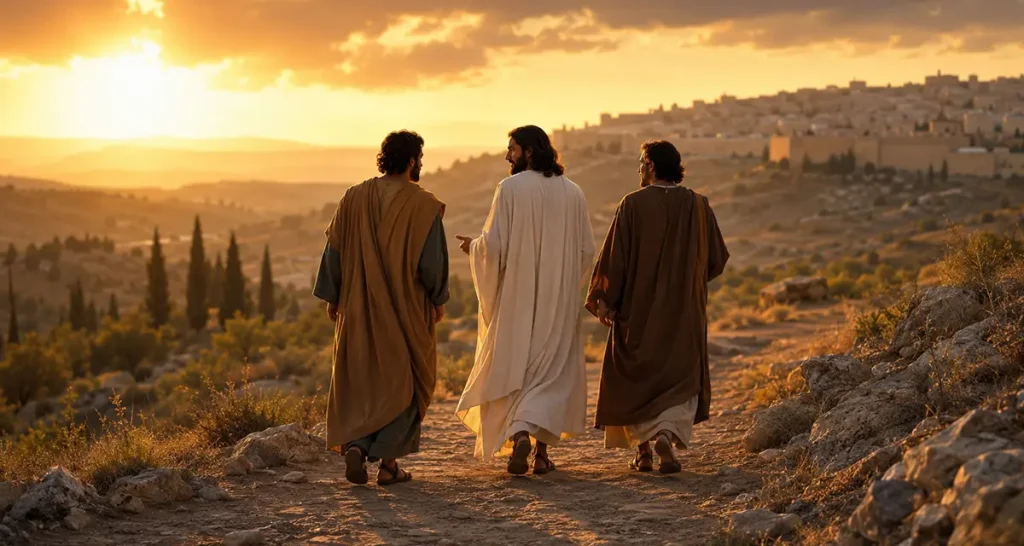
The Emmaus disciples actually help us see the difference.
🌱 Expectation Is Born from God’s Character
Expectation says,
“I know who God is.”
Presumption says,
“I know what God must do.”
Those may sound similar, but they are fundamentally different.
Expectation rests in God’s unchanging character.
Presumption rests in my interpretation of God’s intentions.
Expectation says,
“God is faithful.”
Presumption adds,
“Therefore He will certainly answer in this particular way.”
The first is faith.
The second quietly steps beyond what God has revealed.
📖 Expectation Clings to What God Has Promised
Faith is never asked to believe what God has not spoken.
Hebrews tells us:
“Now faith is the substance of things hoped for, the evidence of things not seen.” (Hebrews 11:1)
But notice something throughout Hebrews 11.
Every act of faith begins with God speaking.
- Noah built because God said a flood was coming (Hebrews 11:7; Genesis 6:13–22).
- Abraham left because God called him (Hebrews 11:8).
- Sarah conceived because she judged Him faithful who had promised (Hebrews 11:11).
Faith does not invent promises.
Faith believes promises.
Presumption often invents details God never gave.
🌊 Peter Walking on the Water
Peter gives us a beautiful picture.
He did not jump out of the boat simply because he believed Jesus could save him.
He first asked:
“Lord, if it is You, command me to come to You on the water.” (Matthew 14:28)
Jesus answered,
“Come.” (Matthew 14:29)
Only then did Peter step out.
That is expectation.
Had Peter jumped before Christ spoke, that would have been presumption.
The difference was one word from Christ.
🌿 Expectation Leaves Room for God’s Wisdom
Think about Jesus in Gethsemane.
He expected the Father to hear Him.
Indeed, Hebrews says:
“…He was heard because of His godly fear.” (Hebrews 5:7)
Yet His prayer was:
“…nevertheless, not My will, but Yours, be done.” (Luke 22:42)
That is remarkable.
Jesus expected the Father’s perfect response.
He did not presume the Father’s preferred method.
Even the sinless Son, in His humanity, entrusted the outcome to the Father’s wisdom.
🔥 Presumption Quietly Becomes Control
This may be the greatest danger.
Presumption often disguises itself as great faith.
But underneath it is an attempt to control God.
It sounds like:
“God promised to care for me…
therefore I will certainly get this job.”
“God loves me…
therefore this diagnosis cannot happen.”
“God called me…
therefore this ministry cannot fail.”
Notice what has happened.
God’s revealed truth has been joined to conclusions He never guaranteed.
When those conclusions collapse, people sometimes conclude that God has failed.
He hasn’t.
Their presumption has.
❤️ Expectation Is Humble
Expectation says,
“I know enough.”
Presumption says,
“I know more than God has revealed.”
Expectation can honestly pray:
“Father, I ask You to heal.”
Presumption declares:
“You will heal this way, at this time.”
Expectation says,
“I know You will keep Your promise.”
Presumption says,
“I know exactly what Your promise means in this circumstance.”
One is humble.
The other unknowingly takes God’s seat.
🌄 Abraham Is a Wonderful Example
God promised Abraham a son.
Abraham believed.
That was expectation.
Years passed.
Nothing happened.
Eventually Abraham and Sarah decided that Hagar must be God’s method.
That was presumption.
God had promised the destination.
They assumed the route.
Human history was changed because they confused those two things.
👀 Emmaus Revisited
Now return to Cleopas.
Expectation:
“The Messiah will redeem Israel.”
That was absolutely correct.
Presumption:
“Therefore the Messiah cannot die.”
That was nowhere promised.
In fact, Scripture had foretold the opposite.
Isaiah had written:
“He was wounded for our transgressions,
He was bruised for our iniquities…” (Isaiah 53:5)
Daniel had written:
“And after the sixty-two weeks
Messiah shall be cut off, but not for Himself…” (Daniel 9:26)
Their expectation came from God.
Their presumption came from human reasoning.
Jesus removed the latter while preserving the former.
He did not say,
“Stop expecting redemption.”
He said,
“Understand redemption according to the Scriptures.”
🕊️ The Holy Spirit Protects Us from Presumption
This brings us back to what we have been discussing over the last several days.
Why is the Spirit called:
“the Spirit of truth” (John 16:13)?
Because He continually draws us back from our interpretations to God’s revelation.
He teaches us to distinguish between:
- what God has promised;
- what we have inferred.
That distinction is the difference between peace and constant disappointment.
⚖️ A Simple Test
Perhaps we can ask ourselves four questions whenever we are praying or waiting on God.
- Has God actually promised this?
Not, “Do I desire it?”
Not, “Does it seem reasonable?”
But, “Has God spoken?”
- Am I trusting His promise or my preferred outcome?
Those are often different.
- If God fulfills His promise differently than I imagine, will I still call Him faithful?
Emmaus answers that question.
The disciples eventually did.
- Would I still worship if His answer surprised me?
That is where expectation becomes surrender instead of control.
🌳 The Garden: Where Expectation First Became Presumption
As we’ve been reflecting together on the storyline of Scripture—from Genesis to Emmaus—I cannot help but see that this distinction reaches all the way back to Eden.
God had clearly spoken:
“Of every tree of the garden you may freely eat; but of the tree of the knowledge of good and evil you shall not eat…” (Genesis 2:16–17)
The expectation that should have governed Adam and Eve was simple: God is good, therefore His word is trustworthy.
The serpent introduced presumption.
“Has God indeed said…?” (Genesis 3:1)
Then:
“You will not surely die.” (Genesis 3:4)
Notice what happened. Eve did not merely doubt God’s promise. She accepted an alternative interpretation of God’s motives. She began to presume that she knew better than God what would happen if she ate the fruit. She shifted from trusting God’s revealed word to trusting her own assessment of reality.
That same temptation has echoed through every generation. Presumption is, at its core, the attempt to complete God’s revelation with our own reasoning.
✨ Perhaps the Simplest Way to Remember It
After all of our discussions—from Abraham to the Cross, from Gethsemane to Emmaus—I think this distinction can be distilled into one sentence:
Expectation waits for God to be faithful. Presumption tells God what faithfulness must look like.
That is a world apart.
Expectation can wait twenty-five years like Abraham for Isaac because it is anchored in God’s character (Romans 4:20–21).
Expectation can walk into a fiery furnace like Shadrach, Meshach, and Abed-Nego and still say:
“Our God whom we serve is able to deliver us… But if not… we do not serve your gods.” (Daniel 3:17–18)
Those three young men expected God to act because they knew who He was. Yet they refused to presume how He would act. Their confidence rested not in a particular outcome, but in the unchanging God who held the outcome in His hands.
Perhaps that is the mature posture of faith. It kneels with open hands. It asks boldly because it knows the Father’s heart (Hebrews 4:16). It hopes confidently because His promises cannot fail (2 Corinthians 1:20). And yet it rests peacefully because it knows that infinite wisdom belongs to Him alone (Romans 11:33–36).
In that sense, expectation is one of the purest expressions of childlike trust. Presumption, however sincere it may appear, is often childlike confidence that has quietly outgrown its Father’s voice.