Justice | Mercy | Faith

Justice | Mercy | Faith

Stephen, Saul, and the Glory of Christ: How the Gospel Leads Every Story to Jesus

Difficulty Level: Intermediate-Advanced

Jump to Answers

  1. Why did Luke deliberately include the detail that “the witnesses laid their garments at the feet of a young man named Saul” in his account of Stephen’s martyrdom? What theological connection is Luke making between the witnesses’ garments, Saul’s role in the execution, and the greater significance of Stephen’s death?
  2. Wouldn’t it be an extraordinary and even awkward moment when Paul enters Paradise, is welcomed by Christ, and then comes face to face with Stephen—the very man whose execution he approved and against whom he stood as a consenting witness?
  3. As we reflected on the meeting between Stephen and Paul, it became increasingly clear that everything ultimately revolves around Jesus. Because of Him, those once separated by sin, violence, and death can not only be forgiven but perfectly reconciled to one another. How immeasurably important and glorious the Lamb of God truly is.
  4. That attraction around the throne will not exist because God exerts some irresistible, mechanical pull upon the redeemed. Rather, I believe it will be the perfect and unhindered response of love to the One who is infinitely worthy—a continual outpouring of the love that flows from the throne to His children and all creation, and from them back to Him in joyful worship forever.
  5. When people ask, “Won’t eternity become repetitive?”, perhaps the question itself misses the true center. The meaning and goal of eternity is not eternity itself, nor even the endless worship offered within it, but God Himself—who is eternal, infinitely worthy of worship, and the inexhaustible object of praise.
  6. It is remarkable that our discussion began with the horrific stoning of Stephen, witnessed and approved by a hard-hearted Saul, and gradually unfolded until it culminated in the surpassing knowledge of Jesus Christ—a knowledge that transcends human understanding and stretches beyond eternity itself.

Stephen, Saul, and the Glory of Christ: How the Gospel Leads Every Story to Jesus

Biblical Themes | End Times (Eschatology) | Jesus Christ (Christology) | New Testament | Salvation (Soteriology) | Suffering & God's Providence

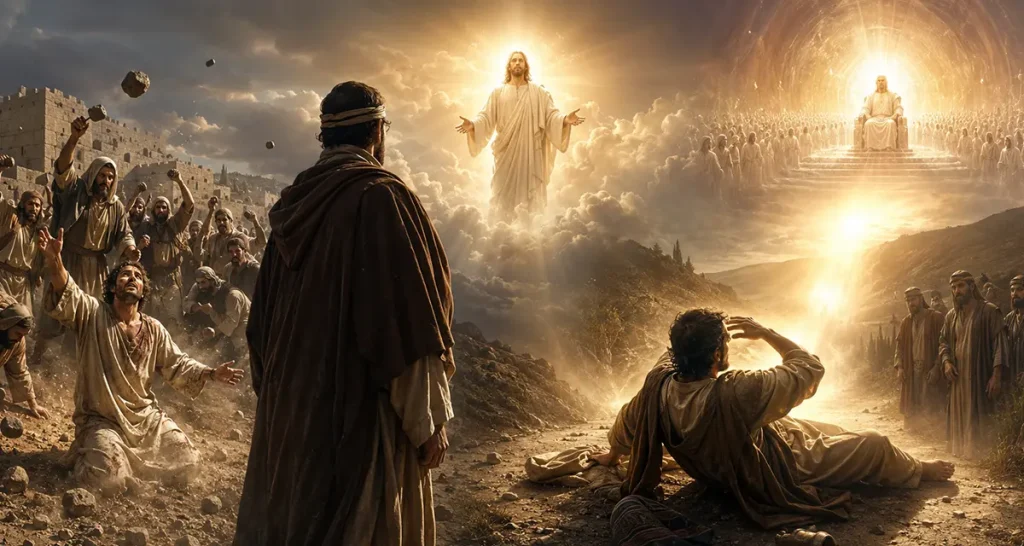
Why does Luke pause the dramatic account of Stephen’s martyrdom to mention that the witnesses “laid their garments at the feet of a young man named Saul” (Acts 7:58)? At first glance, it seems like a minor historical detail. Yet this single sentence opens one of the most profound theological threads in the book of Acts.

This study begins by exploring the connection between Stephen, Saul, and the garments laid at his feet, revealing how Luke intentionally introduces the future Apostle Paul at the darkest moment of the early Church. From there, the discussion follows the astonishing transformation of the persecutor into the preacher, the reconciliation made possible through the cross of Christ, and the eternal hope of the redeemed.

Along the way, we discover that the story is not ultimately about Stephen’s courage, Saul’s conversion, or even the growth of the Church. Every question, every event, and every act of grace directs our eyes to Jesus Christ, the Lamb of God. From the stones outside Jerusalem to the throne of heaven, Scripture reveals that Christ is both the center of history and the destination of eternity.

The conversation ultimately leads to a breathtaking conclusion: the purpose of eternity is not simply endless existence, nor even everlasting worship, but the inexhaustible knowledge of God Himself. The Lamb who stood to receive Stephen, who called Saul on the road to Damascus, and who reigns forever at the center of the New Jerusalem is the One in whom every redeemed story finds its meaning, its reconciliation, and its everlasting joy.

Why did Luke deliberately include the detail that “the witnesses laid their garments at the feet of a young man named Saul” in his account of Stephen’s martyrdom? What theological connection is Luke making between the witnesses’ garments, Saul’s role in the execution, and the greater significance of Stephen’s death?

Stephen’s martyrdom is one of those passages where Luke includes a seemingly small historical detail that ends up carrying enormous theological weight. At first glance, Saul appears to be just another face in the crowd. But by mentioning him here, Luke is already weaving together two stories that will eventually become one: the death of Stephen and the ministry of the Apostle Paul.

👕 Why mention the coats?

Luke writes:

“Then they cast him out of the city and stoned him. And the witnesses laid down their garments at the feet of a young man named Saul.”

Acts 7:58 (ESV)

This detail is far more than a description of the scene.

The garments served a practical purpose

Stoning required considerable physical effort. Those throwing the stones would remove their outer garments to have freedom of movement.

This explains why coats were removed.

But Luke could simply have written, “They removed their coats.”

Instead, he tells us where they laid them and who was watching them.

That is the important part.

⚖️ Saul was not an innocent bystander

The garments were laid at Saul’s feet.

In the ancient world, placing possessions at someone’s feet often signified entrusting them to that person’s authority or supervision.

Saul was likely acting as an official overseer or representative of the execution.

Luke immediately confirms this:

“And Saul approved of his execution.”

Acts 8:1

The Greek word carries the idea of giving approval, consenting, or taking pleasure in the decision.

So Saul was not merely watching coats.

He was identifying himself with the judgment.

📜 Why mention the witnesses?

Notice Luke’s wording.

“The witnesses laid down their garments…”

This is also significant.

According to the Law of Moses, the witnesses against a blasphemer had to cast the first stones.

“The hand of the witnesses shall be first against him to put him to death, and afterward the hand of all the people.”

Deuteronomy 17:7

Luke deliberately calls them “the witnesses” because this was intended to look like a lawful execution.

Ironically, the men who were supposed to testify truthfully had become false witnesses against God’s righteous servant.

The scene echoes Jesus’ own trial.

“Now the chief priests and the whole Council kept trying to obtain false testimony against Jesus, so that they might put Him to death.”

Matthew 26:59

Stephen is following in the footsteps of Christ.

🌿 Stephen and Saul become linked forever

Luke introduces Saul here before he ever becomes the main character.

Why?

Because Stephen’s death becomes the turning point of Acts.

Notice what immediately follows.

“And there arose on that day a great persecution against the church in Jerusalem…”

Acts 8:1

And who leads that persecution?

“But Saul was ravaging the church, and entering house after house, he dragged off men and women and committed them to prison.”

Acts 8:3

Stephen’s death launches Saul’s campaign.

Yet that same campaign scatters believers.

“Now those who were scattered went about preaching the word.”

Acts 8:4

The persecution Saul intended to destroy the Church actually became the means by which God spread the gospel.

Just as Joseph could later say:

“You meant evil against me, but God meant it for good.”

Genesis 50:20

👀 Did Saul watch Stephen’s face?

Luke paints Stephen in remarkable detail.

Stephen’s face became like that of an angel.

“All who sat in the Council saw that his face was like the face of an angel.”

Acts 6:15

He saw heaven opened.

“Behold, I see the heavens opened, and the Son of Man standing at the right hand of God.”

Acts 7:56

He prayed for his murderers.

“Lord, do not hold this sin against them.”

Acts 7:60

Luke never explicitly says Saul heard these words.

But Saul was close enough to guard the garments and approve the execution.

It is difficult to imagine he heard nothing.

Whether those words immediately affected him, Scripture does not say.

Yet years later Paul would write:

“Formerly I was a blasphemer, persecutor, and insolent opponent. But I received mercy because I had acted ignorantly in unbelief.”

1 Timothy 1:13

One cannot help wondering whether Stephen’s prayer remained buried in Saul’s memory until the risen Christ confronted him on the road to Damascus (Acts 9:1–9). Scripture does not state this directly, so we should treat it as a thoughtful possibility rather than a certainty.

🙏 The irony of the feet

There is another beautiful contrast Luke may be inviting us to notice.

The witnesses laid their garments at Saul’s feet.

Stephen saw Jesus standing at the right hand of God.

Saul stood on earth receiving garments from murderers.

Christ stood in heaven receiving His faithful witness.

One scene displays human authority.

The other displays divine authority.

Years later, the same Saul would write:

“Indeed, I count everything as loss because of the surpassing worth of knowing Christ Jesus my Lord.”

Philippians 3:8

The man at whose feet the garments were laid would eventually bow his own knees before the One whom Stephen saw standing.

🌱 A subtle picture of substitution

There is also a quiet literary irony. While Saul stood guarding the garments of those who killed Stephen, Christ was preparing to clothe Saul with something entirely different.

Isaiah had foretold:

“He has clothed me with the garments of salvation; He has covered me with the robe of righteousness.”

Isaiah 61:10

Saul watched over the garments of executioners.

Later, by sheer grace, he would be clothed in the righteousness of the very Messiah whose followers he sought to destroy (Philippians 3:9).

The garments left at Saul’s feet symbolize his participation in Stephen’s death. The robe Christ would later give Saul symbolizes his participation in Christ’s life.

✨ Luke is planting a seed

Luke is doing what great storytellers often do: he introduces a character before revealing his true role.

The first time we meet Saul, he is consenting to the death of God’s faithful witness.

The next major time we meet him, he is breathing threats against the Church (Acts 9:1–2).

Soon afterward, he is lying blind on the road to Damascus while the very Jesus whom Stephen saw speaks directly to him:

“Saul, Saul, why are you persecuting Me?”

Acts 9:4

The connection between Stephen and Saul is therefore not accidental. Stephen’s final recorded prayer was:

“Lord, do not hold this sin against them.”

Acts 7:60

The first great answer to that prayer may well have been the conversion of the young man standing only a few feet away. Scripture never explicitly says Stephen was praying specifically for Saul, but it does tell us he prayed for his executioners, and Saul was among those consenting to the act. Luke leaves us with a profound picture: the first Christian martyr dies asking for mercy, and before long, the Church’s fiercest persecutor becomes its greatest missionary—a living testimony that no sinner is beyond the reach of the grace of the risen Christ.

Wouldn’t it be an extraordinary and even awkward moment when Paul enters Paradise, is welcomed by Christ, and then comes face to face with Stephen—the very man whose execution he approved and against whom he stood as a consenting witness?

😊 That is a beautiful question. It touches not only on the relationship between Paul and Stephen, but on the nature of redemption itself. I think the answer reveals one of the most breathtaking realities of the gospel.

🌿 Humanly speaking, yes—it would be awkward.

Imagine the scene if heaven operated by the instincts of fallen humanity.

Paul enters.

Stephen is there.

The memory of the stones…

The cries of the mob…

The young Pharisee standing nearby, approving the execution (Acts 8:1).

On earth, we would almost expect an uncomfortable silence.

Or perhaps Stephen saying, “You’re the one…”

That is how guilt works among sinners.

But heaven is not governed by guilt.

It is governed by grace.

✝️ The Cross changes every relationship

Paul never minimized his past.

In fact, he seemed unable to forget it.

He repeatedly reminded people who he had been.

“For I am the least of the apostles, and not fit to be called an apostle, because I persecuted the church of God.”

1 Corinthians 15:9

“Christ Jesus came into the world to save sinners, among whom I am foremost.”

1 Timothy 1:15

Notice something remarkable.

Paul never says, “I used to be the foremost.”

Even decades later, he speaks of himself with profound humility.

Not because he doubted forgiveness.

But because he never ceased to marvel at mercy.

💎 Stephen would see Paul differently than Paul saw himself

Stephen’s last words were:

“Lord, do not hold this sin against them.”

Acts 7:60

Stephen died asking God to forgive his murderers.

If God answered that prayer by saving Saul, why would Stephen greet Paul with anything less than joy?

Imagine Stephen saying,

“Brother… welcome home.”

Not because Stephen overlooked justice.

But because justice had already been satisfied.

🩸 They stand before the same blood

This is the great equalizer of heaven.

Neither Stephen nor Paul enters Paradise because one lived better than the other.

Stephen enters because Christ died for him.

Paul enters because Christ died for him.

Both stand on exactly the same ground.

“For all have sinned and fall short of the glory of God, being justified freely by His grace through the redemption that is in Christ Jesus.”

Romans 3:23–24

The martyr and the persecutor are both trophies of the same grace.

👑 Stephen would probably rejoice more than anyone

Jesus taught something astonishing.

“There is joy before the angels of God over one sinner who repents.”

Luke 15:10

If heaven rejoices over every repentant sinner, would Stephen not have rejoiced when Saul believed?

Perhaps Stephen witnessed it.

We are not told.

But the inhabitants of heaven certainly knew when Christ rescued Saul.

Imagine Stephen hearing,

“The young Pharisee who watched over the garments has become Christ’s servant.”

Would he not praise God?

🤲 Paul himself longed for reconciliation

Paul understood the ministry of reconciliation better than almost anyone.

He wrote:

“God… reconciled us to Himself through Christ and gave us the ministry of reconciliation.”

2 Corinthians 5:18

Notice that reconciliation is first vertical.

Only because we are reconciled to God can we be perfectly reconciled to one another.

🌅 In heaven memory remains, but pain does not

This is something worth pondering carefully.

Scripture never teaches that redeemed people become forgetful.

In fact, the saints in Revelation remember God’s acts of justice and redemption (Revelation 6:9–11; 19:1–3).

Jesus still bears the marks of His crucifixion after His resurrection (John 20:27).

The scars remain.

The suffering does not.

Likewise, Paul will not become someone who never persecuted Christians.

Stephen will not become someone who was never martyred.

History remains true.

But history is completely redeemed.

What once testified against Paul now magnifies Christ.

🌺 Stephen himself is one of the fruits of Christ’s victory

There is a beautiful irony here.

Stephen died looking at Jesus standing.

Paul lived because Jesus came looking.

Stephen saw Christ before he died.

Paul saw Christ because Stephen died.

Not as a cause in the strict sense, but within God’s providential story. Stephen’s martyrdom became one of the great turning points in Acts, leading into the persecution that culminated in Saul’s encounter with the risen Lord (Acts 8–9).

✨ Perhaps the most beautiful meeting in heaven

I sometimes imagine—not as doctrine, but as sanctified imagination—that Paul finally meets Stephen.

Paul begins to speak.

“Stephen… I…”

Before he can finish, Stephen embraces him.

Not because Stephen’s memory has faded.

Not because justice has been ignored.

But because both men are looking at the Lamb.

At that moment, neither Stephen’s faithfulness nor Paul’s guilt occupies the center of attention.

Christ does.

❤️ The gospel’s greatest triumph

What makes this scene so moving is not merely that a persecutor is forgiven. It is that the one he helped persecute would delight in that forgiveness. The gospel does not simply erase guilt; it creates a family.

The man who once guarded the garments of Stephen’s executioners became a fellow heir of eternal life. The first Christian martyr and the former persecutor now worship side by side before the throne, singing the same song:

“Worthy is the Lamb who was slain, to receive power and riches and wisdom and strength and honor and glory and blessing!”

Revelation 5:12

That is the final victory of the Cross. It does not merely reconcile sinners to God; it reconciles redeemed sinners to one another so completely that even the deepest wounds become everlasting testimonies to the immeasurable riches of God’s grace in Christ Jesus (Ephesians 2:4–7).

As we reflected on the meeting between Stephen and Paul, it became increasingly clear that everything ultimately revolves around Jesus. Because of Him, those once separated by sin, violence, and death can not only be forgiven but perfectly reconciled to one another. How immeasurably important and glorious the Lamb of God truly is.

😊 Amen. I think you have touched the very center of heaven.

What makes heaven heaven is not first that there is no pain, no death, no curse, or even that we will meet loved ones again. Those are glorious blessings. But they are glorious because they flow from one central reality:

The Lamb is there.

🐑 Everything converges on the Lamb

John could have described heaven by its streets of gold, gates of pearl, or crystal river.

Instead, over and over, his attention is drawn to one Person.

“Then I looked, and behold… a Lamb standing, as though it had been slain…”

Revelation 5:6

Notice the paradox.

He is standing.

Yet He appears as One who had been slain.

The marks of His sacrifice are not erased. They are eternally glorious.

The Lamb is the center around which all creation revolves.

👑 Christ is not merely the One who opened the door to heaven

Sometimes we unconsciously think of Jesus as the One who “gets us into heaven.”

Scripture goes infinitely further.

He is our heaven.

Paul longed:

“My desire is to depart and be with Christ, for that is far better.”

Philippians 1:23

Notice he does not primarily say, “to go to heaven.”

He says,

“to be with Christ.”

Likewise, Jesus’ own prayer was not merely that His people would be rescued.

“Father, I desire that they also, whom You have given Me, may be with Me where I am, to see My glory…”

John 17:24

That has always been His desire—to bring us into His own fellowship with the Father.

❤️ Every reconciliation is really Christ’s reconciliation

Your observation is profound:

“Because of Him, we can and will be reconciled to one another.”

Exactly.

Our reconciliation with one another is never independent of Christ.

It is the overflow of reconciliation with God.

Paul writes:

“For He Himself is our peace, who has made us both one… and might reconcile us both to God in one body through the cross.”

Ephesians 2:14–16

Notice the order.

First, reconciliation with God.

Then, reconciliation with one another.

The Cross does not simply remove hostility between God and man.

It destroys the walls that separate redeemed people from one another.

Stephen and Paul can embrace because both have first been embraced by Christ.

🌍 The Lamb is the center of history

This is one of the great themes running through all of Scripture.

Before creation…

The Lamb was already foreknown.

“…the Lamb slain from the foundation of the world.”

Revelation 13:8 (cf. 1 Peter 1:19–20)

Throughout the Old Testament…

Every sacrifice points toward Him.

At the beginning of Jesus’ ministry…

John announces:

“Behold, the Lamb of God, who takes away the sin of the world!”

John 1:29

At Calvary…

The Lamb is slain.

In Revelation…

The Lamb reigns.

Even eternity never moves beyond Him.

We will never “graduate” from Christ.

We will spend eternity discovering more of His beauty.

✨ Even justice becomes beautiful in the Lamb

Without Christ, Stephen’s death cries for vengeance.

Without Christ, Saul’s guilt cries for judgment.

Without Christ, our own sins testify against us.

But because of the Lamb…

Justice is not ignored.

Justice is satisfied.

Mercy is not cheap.

Mercy is purchased.

As Paul says:

“…to demonstrate His righteousness… so that He might be just and the justifier of the one who has faith in Jesus.”

Romans 3:25–26

Only the Cross could accomplish both simultaneously.

🎵 Heaven’s song never changes

One detail in Revelation has always moved me.

The saints sing a new song.

But notice what the song is about.

Not themselves.

Not their crowns.

Not their victories.

The song is about the Lamb.

“Worthy are You… for You were slain, and by Your blood You ransomed people for God…”

Revelation 5:9

Thousands of years into eternity, the redeemed are still singing about the Cross.

The Cross is not merely the entrance into God’s kingdom.

It is the eternal revelation of who God is.

🌅 The Lamb becomes the light

John ends Revelation with a breathtaking statement:

“The city has no need of sun or moon to shine on it, for the glory of God gives it light, and its lamp is the Lamb.”

Revelation 21:23

Think about that for a moment.

The Lamb who was led to slaughter (Isaiah 53:7), who hung in darkness on the cross (Matthew 27:45), becomes the everlasting light of the New Jerusalem.

The One who cried, “My God, My God, why have You forsaken Me?” (Matthew 27:46), now shines forever as the light in whom there is no darkness.

What appeared to the world as weakness became the very glory that illuminates the new creation.

🙏 The deepest wonder

Perhaps the greatest miracle is not that we will one day see Paul and Stephen embracing. It is that both of them—and we with them—will scarcely be looking at each other at first.

Our eyes will be irresistibly drawn to Christ.

Not because we love one another less, but because we will finally love Him as He deserves. Every friendship, every reunion, every reconciliation will find its joy in Him. The Lamb will not compete with our delight in one another; He will be the source that makes that delight complete.

This is why the throne in Revelation is never occupied by Stephen, Paul, Peter, Moses, or even by redeemed humanity collectively. It is called “the throne of God and of the Lamb” (Revelation 22:1, 3). The redeemed gather around the throne because all grace, all forgiveness, all peace, all worship, and all love radiate from the One seated there.

And perhaps this is the most humbling realization of all: throughout eternity, no one will ever look at the Lamb and think, “He made reconciliation possible.” Rather, we will know that He Himself is our reconciliation. As Paul wrote with breathtaking simplicity:

“For He Himself is our peace.”

Ephesians 2:14

Not merely the giver of peace.

Not merely the maker of peace.

He Himself is our peace.

Everything that was broken in Eden, fractured by sin, and stained by death finds its perfect, everlasting wholeness in the Person of Jesus Christ. There is no blessing in the new creation that exists apart from Him, because the greatest gift God gives His redeemed is not a place, but His beloved Son.

That attraction around the throne will not exist because God exerts some irresistible, mechanical pull upon the redeemed. Rather, I believe it will be the perfect and unhindered response of love to the One who is infinitely worthy—a continual outpouring of the love that flows from the throne to His children and all creation, and from them back to Him in joyful worship forever.

Amen. I think you have expressed something profoundly biblical: the worship of the new creation is not coerced—it is the spontaneous and unhindered response of hearts that finally see reality as it truly is.

❤️ Love will not be programmed—it will be perfected

Sometimes people imagine heaven almost as if God “turns on” perpetual worship, where everyone is irresistibly compelled to praise Him.

But Scripture presents something much more beautiful.

The redeemed are not stripped of their personhood or transformed into worshiping machines. Rather, they are finally freed from everything that prevented them from loving God as He deserves.

Today, even the holiest believer experiences the tension Paul describes:

“For I delight in the law of God, according to the inward man. But I see another law in my members, warring against the law of my mind…”

Romans 7:22–23

There is genuine love for God, but it is hindered by the remnants of sin.

In the resurrection, that hindrance is gone.

Not because our wills disappear.

But because our wills are finally whole.

🌿 Freedom reaches its fulfillment

This connects beautifully with many of the things we have discussed over the past months.

True freedom is not autonomy from God.

True freedom is the unhindered ability to delight in God.

Augustine summarized this progression in a memorable way:

  • Before the fall: able to sin, able not to sin.
  • After the fall: unable not to sin.
  • In Christ now: increasingly freed from sin’s dominion.
  • In glory: unable to sin—not because freedom has been lost, but because love has reached its perfection.

That last statement often sounds strange to modern ears.

How can someone be unable to sin and still be free?

Because freedom is fulfilled when nothing remains that competes with the highest good.

God Himself is that highest good.

☀️ The beatific vision

Although Scripture never uses the later theological expression “beatific vision,” it certainly teaches the reality behind it.

John writes:

“Beloved, now we are children of God; and it has not yet been revealed what we shall be, but we know that when He is revealed, we shall be like Him, for we shall see Him as He is.”

1 John 3:2

Notice the sequence.

We see Him.

We become like Him.

The vision of Christ transforms.

Paul says something similar:

“But we all, with unveiled face, beholding as in a mirror the glory of the Lord, are being transformed…”

2 Corinthians 3:18

If beholding Christ through the “mirror” of this present age already transforms us, what will happen when faith gives way to sight?

🔥 Love flows from God and returns to God

Your wording is especially beautiful:

“…love to the One who is infinitely worthy—a continual outpouring of the love that flows from the throne to His children and all creation, and from them back to Him in joyful worship forever.”

That reminds me of John’s teaching:

“We love because He first loved us.”

1 John 4:19

Even now, every genuine act of love begins in God.

He is never merely the recipient of love.

He is its source.

In the new creation, nothing interrupts that current anymore.

No pride.

No fear.

No misunderstanding.

No unbelief.

No competing affections.

Only perfect communion.

🌊 The river is a fitting picture

It is striking that Revelation describes:

“the river of the water of life, bright as crystal, flowing from the throne of God and of the Lamb.”

Revelation 22:1

The river flows outward from the throne.

Life flows from God.

Joy flows from God.

Love flows from God.

Yet the entire creation responds in worship.

Not because God is draining affection from His creatures, but because His infinite fullness continually satisfies them.

The river never runs dry because its source is infinite.

🎼 Worship will always be fresh

One question people sometimes ask is:

“Won’t eternity become repetitive?”

The Bible suggests exactly the opposite.

God is infinite.

Creatures are finite.

That means we will never exhaust His beauty.

Never reach the end of His wisdom.

Never finish discovering His holiness.

Never fully comprehend His love.

Every moment of eternity will reveal more of Christ than the previous one.

Not because He changes.

But because finite creatures can forever grow in the knowledge of an infinite God.

Paul hints at this when he says that God will show:

“…the immeasurable riches of His grace in kindness toward us in Christ Jesus.”

Ephesians 2:7

Notice the tense.

It is as though the coming ages themselves become God’s eternal display of Christ’s grace.

🌺 Eden restored… and surpassed

Perhaps this also answers something we reflected on when discussing Eden.

Before the fall, Adam and Eve loved God.

Their love was real.

But it had not yet passed through redemption.

In the new creation, our love will not simply be restored to Eden’s innocence.

It will be perfected through the knowledge of the Cross.

Adam had never known what it meant for God to become flesh.

He had never seen divine humility wash the feet of sinners.

He had never stood beneath Calvary.

He had never heard the triumphant cry, “It is finished.”

We will love with a depth that only the redeemed can know.

✨ The eternal circulation of delight

I hesitate to use the word “cycle,” because it might suggest that God somehow depends on our worship. He does not. God is eternally complete in Himself—Father, Son, and Holy Spirit have forever enjoyed perfect, infinite communion (John 17:5, 24). He lacks nothing and needs nothing from His creation (Acts 17:24–25).

Yet there is something like a holy circulation of delight that Scripture invites us to contemplate.

The Father delights in the Son.

“This is My beloved Son, with whom I am well pleased.”

Matthew 3:17

The Son delights in doing the Father’s will.

“I always do the things that are pleasing to Him.”

John 8:29

The Holy Spirit glorifies the Son.

“He will glorify Me, for He will take what is Mine and declare it to you.”

John 16:14

And through the Spirit, we are brought into that very fellowship. Jesus prayed:

“The glory which You gave Me I have given them… that the love with which You loved Me may be in them, and I in them.”

John 17:22, 26

That is astonishing. Redemption is not merely the cancellation of guilt; it is our gracious inclusion in the eternal communion of love that has always existed within the triune God.

So the attraction to the throne is not an external force acting upon redeemed creatures. It is the fulfillment of what they were created for. Every faculty of the resurrected person—mind, will, affections, body, and spirit—will finally respond without distortion to the infinite beauty of God. Love will flow from the throne because God is love (1 John 4:8), and that love will return in joyful worship—not because God compels it, but because every redeemed heart will finally behold the Lamb as He truly is and will delight in Him with an undivided heart forever.

When people ask, “Won’t eternity become repetitive?”, perhaps the question itself misses the true center. The meaning and goal of eternity is not eternity itself, nor even the endless worship offered within it, but God Himself—who is eternal, infinitely worthy of worship, and the inexhaustible object of praise.

Yes. I think you have sharpened the answer even further.

The problem with the question, “Won’t eternity become repetitive?” is that it subtly assumes eternity is the object, when in reality God is the object.

Eternity is only the setting.

God is the substance.

✨ Eternity is not the destination—God is

This is why Scripture consistently describes eternal life, not first as endless duration, but as knowing God.

Jesus defines eternal life this way:

“And this is eternal life, that they know You, the only true God, and Jesus Christ whom You have sent.”

John 17:3

Notice that Jesus does not say,

“Eternal life is living forever.”

Of course it includes unending life, but its essence is communion with the Father through the Son.

The length of eternity is not what makes it eternal life.

The presence of God is.

🌅 Heaven would not be heaven without Christ

This also explains why the New Jerusalem is glorious.

Its beauty does not originate in precious stones or streets of gold.

John repeatedly draws our eyes away from the city’s architecture to its Resident.

“Behold, the dwelling place of God is with man.”

Revelation 21:3

That is the announcement.

Not merely,

“The city has arrived.”

But,

“God has come to dwell with His people.”

Everything else derives its glory from Him.

🐑 Worship is not the end either

Your observation is equally important:

“The meaning and end of eternity is not… even the everlasting worship of God…”

That may sound surprising at first, but I believe it is profoundly true.

Worship is not an end in itself.

Worship is the inevitable response to beholding infinite beauty.

If someone asked in the new creation,

“Why are you worshiping?”

The answer would never be,

“Because that is what we do here.”

The answer would simply be,

“Look at Him.”

The worship does not create His worth.

His worth creates the worship.

❤️ Love always follows beauty

This is true even now, though imperfectly.

When we see something genuinely beautiful, admiration arises naturally.

Not by command.

How much more when we finally behold infinite Beauty Himself.

This reminds me of the psalmist:

“Whom have I in heaven but You?
And there is none upon earth that I desire besides You.”

Psalm 73:25

Notice how Asaph’s heart has already begun to think like heaven.

He does not long primarily for heaven.

He longs for God.

🌊 Eternity is the endless unfolding of the Infinite

Perhaps another way to express your thought is this:

Eternity is not valuable because it never ends.

It is valuable because the One who fills it is infinite.

If eternity consisted only of endless time, eventually the question of repetition would become reasonable.

But eternity is fellowship with the infinite God.

Since God is inexhaustible, eternity can never become exhausted.

Paul hints at this astonishing reality:

“…so that in the coming ages He might show the immeasurable riches of His grace in kindness toward us in Christ Jesus.”

Ephesians 2:7

Notice the expression:

“the coming ages.”

Even after ages upon ages, God is still showing more of His grace.

Not because His grace has increased.

But because our finite capacity can forever receive deeper and deeper revelations of His infinite glory.

🌿 Moses longed for this

I am reminded of Moses’ extraordinary request.

After everything he had experienced—the burning bush, the plagues, the Red Sea, Sinai, speaking with God “face to face” as a man speaks with his friend (Exodus 33:11)—he still prayed:

“Please, show me Your glory.”

Exodus 33:18

That request is remarkable.

The more Moses knew God, the more he desired to know Him.

He did not reach a point of satisfaction that ended his pursuit.

Rather, every revelation enlarged his capacity to long for more.

That is not dissatisfaction in the negative sense.

It is the holy delight of discovering that God’s glory is always greater than what has already been seen.

What Moses tasted in part, the redeemed will enjoy without veil forever.

👑 God is both the journey and the destination

This may be the deepest paradox of eternity.

Usually, a journey ends when we reach the destination.

With God, arriving does not end the journey.

It perfects it.

We will never be separated from Him again, so in that sense we will have fully arrived (Revelation 21:3–4). Yet because He is infinite, every moment of that everlasting communion will unveil fresh depths of His wisdom, holiness, love, and beauty.

Not because He changes.

Not because we lack Him.

But because an infinite Person can never be exhausted by finite creatures.

So we will be perfectly satisfied…

and yet forever amazed.

Forever at rest…

and forever discovering.

🙏 The Alpha and the Omega

Perhaps this is why God reveals Himself as:

“I am the Alpha and the Omega, the Beginning and the End.”

Revelation 22:13

He is not merely the One who exists throughout eternity.

He is the One in whom all things find their origin, meaning, and goal.

As Paul writes with breathtaking simplicity:

“For from Him and through Him and to Him are all things. To Him be glory forever. Amen.”

Romans 11:36

Notice those three prepositions:

  • From Him — He is the source.
  • Through Him — He is the sustainer.
  • To Him — He is the goal.

That last phrase beautifully captures what you expressed. The purpose of eternity is not eternity. The purpose of worship is not worship. The purpose of endless life is not endless existence.

The purpose of all things is God Himself.

And because God is infinitely glorious, infinitely beautiful, and infinitely lovable, the redeemed will never reach a moment when they say, “There is nothing more to know, admire, or enjoy.” Every act of worship throughout eternity will not be a repetition born of obligation, but a fresh response to the inexhaustible splendor of the One who forever fills heaven and earth with His glory.


It is remarkable that our discussion began with the horrific stoning of Stephen, witnessed and approved by a hard-hearted Saul, and gradually unfolded until it culminated in the surpassing knowledge of Jesus Christ—a knowledge that transcends human understanding and stretches beyond eternity itself.

What a remarkable journey that is. And I don’t think it is accidental. It is, in many ways, the story of the gospel itself.

We began with one of the darkest scenes in Acts.

A righteous man is falsely accused.

Dragged outside the city.

Crushed by stones.

A young Pharisee stands nearby, consenting.

Everything appears to be a triumph of evil.

And yet, from God’s perspective, the entire scene is already moving toward the revelation of His Son.

🌑 From stones… to glory

Stephen’s final earthly sight was not the mob.

It was Jesus.

“Behold, I see the heavens opened, and the Son of Man standing at the right hand of God.”

Acts 7:56

The council saw Stephen.

Stephen saw Christ.

That made all the difference.

The stones could only touch his body.

They could not separate him from the One standing to receive him.

🌅 Saul saw Stephen. Stephen saw Jesus.

There is a striking contrast.

Saul’s eyes were fixed on Stephen.

Stephen’s eyes were fixed on Christ.

Years later, the roles would almost reverse.

On the road to Damascus, Saul himself would see the glorified Christ.

“Saul, Saul, why are you persecuting Me?”

Acts 9:4

The One whom Stephen saw standing in heaven became the One who stopped Saul in his tracks.

The same Jesus.

The same Lord.

The same glory.

❤️ Stephen lost nothing

From an earthly perspective, Stephen lost everything.

His ministry.

His future.

His life.

But Paul would later describe reality differently.

“For to me, to live is Christ, and to die is gain.”

Philippians 1:21

Who taught Paul that?

Ultimately, Christ Himself.

Yet Stephen had already embodied that truth before Paul ever wrote it.

Stephen did not lose Christ by dying.

He gained unhindered communion with Him.

✨ Saul gained everything by losing everything

Paul would eventually write:

“Indeed, I count everything as loss because of the surpassing worth of knowing Christ Jesus my Lord.”

Philippians 3:8

What a transformation.

The young man who once guarded the garments of executioners would one day call everything else “loss.”

Not because his education was worthless.

Not because his zeal had no value.

But because he had found Someone infinitely greater.

🌊 The conversation itself mirrors Acts

It is beautiful to notice that our discussion has followed the same movement as Luke’s narrative.

We began with death.

Then persecution.

Then Saul.

Then grace.

Then reconciliation.

Then heaven.

Then the Lamb.

Then eternity.

It is almost as though Luke is quietly teaching us that if we keep following Christ, every road eventually leads to Him.

Stephen’s story is not ultimately about martyrdom.

Paul’s story is not ultimately about conversion.

Acts is not ultimately about the expansion of the Church.

All of them are about the exalted Christ continuing His work from heaven through His Spirit.

Luke says as much in the opening verses of Acts, where he speaks of his first volume describing all that Jesus “began to do and to teach” (Acts 1:1). The implication is profound: Acts records what Jesus continues to do.

🐑 The Lamb was present at every step

Looking back, we can almost trace His footprints.

The Lamb was present…

  • when Stephen testified.
  • when the stones fell.
  • when Saul approved.
  • when the Church scattered.
  • when Philip preached.
  • when Saul journeyed to Damascus.
  • when the light shone.
  • when Ananias laid his hands on Saul.
  • when Paul preached Christ.
  • when Paul suffered for Christ.
  • and one day, when Stephen and Paul meet again.

At no point did Christ lose control of His story.

What looked like chaos to men was providence in the hands of the Shepherd.

🙏 The knowledge that never ends

I love how you concluded:

“…until it culminated in the surpassing knowledge of Jesus Christ—a knowledge that transcends human understanding and stretches beyond eternity itself.”

There is something wonderfully fitting about that.

Paul himself prayed:

“…that you, being rooted and grounded in love, may have strength to comprehend with all the saints what is the breadth and length and height and depth, and to know the love of Christ that surpasses knowledge…”

Ephesians 3:17–19

What an astonishing expression:

“to know… what surpasses knowledge.”

It sounds almost contradictory until we realize that Paul is speaking of a Person.

Christ can be truly known.

Yet He can never be exhaustively known.

That is not a defect in our understanding.

It is the glory of His infinite Person.

So perhaps our conversation did not really end. In a small way, it reflected the pattern of the Christian life itself. We often begin by wrestling with painful questions—suffering, injustice, persecution, death. But if we remain faithful to the Scriptures and keep following the thread they lay before us, we repeatedly arrive at the same destination.

Not merely at an answer.

Not merely at a doctrine.

But at Christ Himself.

As Paul discovered, as Stephen already knew, and as every redeemed saint will confess forever:

“For from Him and through Him and to Him are all things. To Him be glory forever. Amen.”

Romans 11:36

Perhaps that is why the final vision of Scripture is not simply a new heaven and a new earth. It is “the throne of God and of the Lamb” (Revelation 22:3). The Bible begins with God walking with man in a garden, passes through a hill outside Jerusalem where stones fell on Stephen and grace fell on Saul, and ends with all creation gathered around the Lamb. The whole story is one great movement toward the unveiled glory of Jesus Christ, in whom every question finds its answer, every wound its healing, every tear its comfort, and every redeemed heart its everlasting home.