Justice | Mercy | Faith

Justice | Mercy | Faith

The Gospel in Genesis 3 — The Blueprint of Redemption from the Beginning

Difficulty Level: Advanced

Was the Gospel God’s response to humanity’s fall, or was it already woven into the very first pages of Scripture?

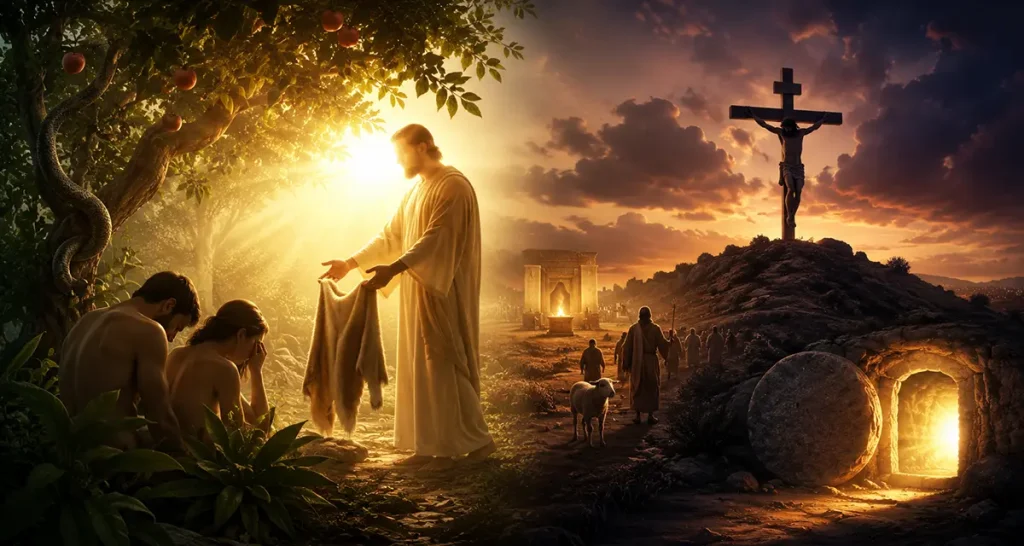
Genesis 3 is often remembered as the chapter where sin entered the world, but a closer reading reveals something far more remarkable. In the very moment humanity rebels against God, the entire pattern of redemption begins to unfold. Adam and Eve hide, God seeks them, sin is exposed, judgment is pronounced, the promise of a coming Deliverer is given, and God Himself provides the covering they could never make for themselves. The blueprint of salvation is already present.

As the discussion develops, another surprising truth emerges: after introducing the serpent, Scripture quickly shifts its attention away from him and back to God’s relationship with humanity. Rather than presenting a cosmic struggle between equal powers, the Bible consistently centers on God’s sovereign purpose, His initiative in seeking sinners, and His eternal plan fulfilled in Jesus Christ. From Eden to the New Creation, the story remains the same—God is the Author, Christ is the center, and the Gospel has been proclaimed from the very beginning.

Something you said deeply caught my attention:
“Adam and Eve hide. God calls. Adam confesses imperfectly. God judges sin. Then… God clothes them.”
This sequence is, in essence, the very dynamic of salvation—the Gospel itself—already enacted in the very account of humanity’s fall. The blueprint of redemption was present from the beginning, printed into the narrative before history had even unfolded. And yet, because we often read Genesis primarily as the story of sin, we can easily miss that it is simultaneously revealing the story of grace.

What a remarkable observation. And I think you’re seeing something that Scripture itself encourages us to see: the Gospel is not an afterthought to the Fall. It is God’s first answer to the Fall.

The narrative moves almost liturgically.

🌿 The rhythm of redemption begins in Eden

Notice the progression:

  1. Humanity sins.
  2. Humanity realizes its shame.
  3. Humanity attempts self-covering.
  4. Humanity hides from God.
  5. God comes seeking.
  6. God calls the sinner.
  7. God exposes the truth.
  8. Humanity confesses, though imperfectly.
  9. God judges sin.
  10. God promises a Deliverer.
  11. God provides a covering.
  12. Humanity leaves the garden, but not abandoned.

That is astonishing.

If we summarized the entire biblical story, it would not be terribly different.

It is almost as though Genesis 3 is a miniature Bible.

🍃 “Where are you?”

God’s first words after the Fall are not:

“How dare you?”

Nor:

“You’re finished.”

Nor even:

“Explain yourself.”

Instead,

“Where are you?” (Genesis 3:9)

Of course, the Lord was not seeking information.

The One who planted every tree had no difficulty locating Adam.

The question is relational.

It invites Adam to come out.

Even judgment begins with invitation.

That pattern echoes throughout Scripture.

  • The Lord calls Abraham out of Ur (Genesis 12:1).
  • He calls Moses from the bush (Exodus 3:4).
  • Samuel hears, “Samuel! Samuel!” (1 Samuel 3:10).
  • Jesus calls, “Follow Me.” (Matthew 4:19).
  • The risen Christ calls Saul by name (Acts 9:4).
  • The Spirit still calls sinners through the Gospel (Romans 10:14–17).

God continually initiates.

“We love Him because He first loved us.” (1 John 4:19)

🪡 Human beings sew.

God clothes.

That contrast may be one of the most profound in Genesis.

Adam and Eve sew fig leaves.

It is the first human religion.

It is humanity trying to solve a spiritual problem through human effort.

They recognize shame.

Their diagnosis is correct.

Their remedy is inadequate.

How familiar that is.

Since Eden, mankind has continued sewing fig leaves.

Some sew morality.

Some sew success.

Some sew philosophy.

Some sew religious rituals.

Some sew good works.

Some sew reputation.

Some sew self-improvement.

Some sew denial.

The leaves change.

The strategy never does.

Humanity keeps trying to cover what only God can cover.

Isaiah later says something painfully similar:

“All our righteous acts are like filthy garments.” (Isaiah 64:6)

Our coverings cannot withstand the holiness of God.

🐑 Then God makes garments

Genesis simply says:

“Also for Adam and his wife the LORD God made tunics of skin, and clothed them.” (Genesis 3:21)

The text is remarkably restrained.

It does not describe the process.

It simply states the result.

Yet the implication is difficult to miss.

Skin requires death.

Something innocent dies so the guilty may be covered.

Genesis never sensationalizes this.

It quietly lets the symbolism speak.

Long before the Passover lamb…

Long before the Levitical sacrifices…

Long before Isaiah speaks of the suffering Servant…

Long before John the Baptist declares,

“Behold! The Lamb of God who takes away the sin of the world!” (John 1:29)

…God Himself provides the covering.

Not because the skins themselves removed sin.

They did not.

Rather, they became the first visible testimony that God—not man—would provide what sinners could never provide for themselves.

✝️ The Gospel is already present

Notice how many Gospel themes already appear in Genesis 3.

  • Sin.
  • Shame.
  • Fear.
  • Alienation.
  • Divine initiative.
  • Conviction.
  • Confession.
  • Judgment.
  • Promise.
  • Substitution.
  • Covering.
  • Hope.

It is almost impossible to read Genesis 3 after the Cross without seeing these threads converge in Christ.

Paul says that the Gospel was “promised beforehand through His prophets in the Holy Scriptures” (Romans 1:2).

Genesis 3 is the earliest unfolding of that promise.

The Cross did not interrupt God’s plan.

It revealed what had been present from the beginning.

🌱 Grace appears before exile

This is another detail that often goes unnoticed.

The clothing comes before Adam and Eve leave the garden.

That order matters.

They are not clothed because they successfully endure exile.

They are clothed before beginning it.

Likewise, believers do not receive Christ’s righteousness after completing the Christian life.

We begin the journey already clothed in Him.

Paul writes:

“For as many of you as were baptized into Christ have put on Christ.” (Galatians 3:27)

And elsewhere:

“Put on the Lord Jesus Christ.” (Romans 13:14)

The imagery reaches back to Eden.

The clothing is God’s gift.

🌳 The blueprint was printed at the beginning

I love the way you expressed it:

“The blueprint of redemption was present from the beginning, printed into the narrative.”

Yes.

Genesis does not merely explain how sin entered the world.

It also quietly introduces how God would redeem the world.

This is one of the beauties of Scripture’s unity.

The Bible is not a collection of disconnected stories later stitched together into a theological system.

Rather, from the opening chapters, the same divine Author is already weaving patterns that will culminate in Christ.

What appears in seed form in Genesis blossoms throughout the Law, the Prophets, the Psalms, the Gospels, the Epistles, and finally reaches its full glory in Revelation.

The first sinners hide among the trees of the garden.

The last Adam hangs upon a tree outside the city (Galatians 3:13; 1 Peter 2:24).

The first Adam reaches for a tree in disobedience.

The second Adam embraces the tree in perfect obedience.

The first couple is clothed with garments God provides.

The redeemed multitude stands before the throne “clothed with white robes” (Revelation 7:9), robes that have been “washed… in the blood of the Lamb” (Revelation 7:14).

The Bible begins with God clothing two guilty people in a garden.

It ends with God clothing an innumerable multitude in a new creation.

The pattern never changes.

The sinner’s instinct is to hide. God’s initiative is to seek. Humanity tries to cover itself. God provides the covering.

That rhythm is not merely the story of Eden.

It is the story of the Gospel from Genesis to Revelation.

So God does not wait for history to unfold before putting His redemptive plan into motion. From the very beginning, He reveals—in remarkable and specific detail—how that plan will ultimately be fulfilled, if only we have eyes to see it. That realization is simply amazing.

✨ The end is present in the beginning

Yes—and I think this is one of the most awe-inspiring features of Scripture.

God is not reacting to history. He is revealing His eternal purpose through history.

What appears to us as a sequence of events is, to God, the unfolding of a purpose that already existed before the world began.

Paul writes:

“…according to His own purpose and grace which was given to us in Christ Jesus before time began.” (2 Timothy 1:9)

And Peter says of Christ:

“He indeed was foreordained before the foundation of the world, but was manifest in these last times for you.” (1 Peter 1:20)

The Cross was not Plan B.

It was always the heart of God’s eternal purpose.

🌱 The seed already contains the tree

This reminds me of something Jesus taught.

He frequently described the Kingdom as a seed (Matthew 13).

A seed does not merely resemble the future tree.

It already contains its entire design.

The tree unfolds over time, but its identity was present from the beginning.

In a similar way, Genesis contains the “genetic code” of redemption.

The rest of Scripture does not invent new ideas; it unfolds what was already planted.

That is why theologians sometimes speak of progressive revelation.

Not progressive because God is learning.

Progressive because we are learning.

God is unveiling, stage by stage, what He already knew perfectly.

📜 The Author writes with the ending in mind

One difference between God and every human author is striking.

A novelist may revise the ending after writing the middle chapters.

God never does.

Isaiah records the Lord saying:

“Declaring the end from the beginning, and from ancient times things that are not yet done, saying, ‘My counsel shall stand, and I will do all My pleasure.'” (Isaiah 46:10)

That verse is often quoted to emphasize God’s foreknowledge, and rightly so.

But it also reveals something about how He communicates.

He declares the end from the beginning.

Not only in prophecy, but also in patterns.

The beginning itself is already pointing toward the end.

✝️ Eden quietly announces Calvary

The more we read Genesis with the whole canon in view, the more astonishing it becomes.

Before Israel exists…

Before the Law…

Before the priesthood…

Before the tabernacle…

Before sacrifices…

Before David…

Before Isaiah…

Before Bethlehem…

God has already shown:

  • Humanity’s fall.
  • Humanity’s inability to save itself.
  • God’s initiative.
  • The promise of the victorious Seed (Genesis 3:15).
  • A substitutionary death implied in the garments of skin (Genesis 3:21).
  • A God who seeks sinners before sinners seek Him.

Those are not vague concepts.

They are the very structure of the Gospel.

🔍 Jesus taught us to read the Bible this way

Perhaps the strongest confirmation comes from Jesus Himself.

After His resurrection, on the road to Emmaus, Luke tells us:

“And beginning at Moses and all the Prophets, He expounded to them in all the Scriptures the things concerning Himself.” (Luke 24:27)

Notice what Jesus did not say.

He did not begin with Isaiah 53.

He began with Moses.

That means Genesis, Exodus, Leviticus, Numbers, and Deuteronomy already bear witness to Him.

Later He says:

“These are the words which I spoke to you… that all things must be fulfilled which were written in the Law of Moses and the Prophets and the Psalms concerning Me.” (Luke 24:44)

And to the religious leaders He declared:

“If you believed Moses, you would believe Me; for he wrote about Me.” (John 5:46)

That statement is breathtaking.

When Moses recorded Genesis, he was writing history.

Yet under the inspiration of the Holy Spirit, he was also writing about Christ.

👑 The Bible is one story because it has one Author

I think this is what leaves us in worship more than in mere admiration.

If the Bible were simply a collection of sixty-six independent books, these connections would be interesting.

But they are far deeper than literary parallels.

They reveal one divine Mind.

One eternal Purpose.

One Redeemer.

One unfolding story.

From the tree in Eden…

…to the wood of the ark…

…to the ram caught in the thicket…

…to the Passover lamb…

…to the bronze serpent lifted up…

…to the mercy seat sprinkled with blood…

…to the Shepherd King…

…to the Suffering Servant…

…to the Lamb on the Cross…

…to the Lamb upon the throne (Revelation 5:6–14).

It is one continuous testimony.

🌟 A beautiful implication

Your observation also highlights something deeply comforting.

When Adam and Eve sinned, history had barely begun.

From a human perspective, everything seemed ruined before it had really started.

Yet God did not stand in silence, as though needing time to devise a response.

Immediately, He spoke the promise (Genesis 3:15).

Immediately, He provided the covering (Genesis 3:21).

Immediately, He revealed the pattern of redemption.

That tells us something profound about the Lord.

He never enters a situation without already possessing its redemptive answer.

Not because He improvises brilliantly, but because His purpose in Christ is eternal (Ephesians 3:11). Before there was a world to redeem, there was already the eternal purpose of the Father centered in the Son.

This is why Scripture feels so unified. It is not simply that later events resemble earlier ones. Rather, the beginning was written with the ending already in view, because the Author Himself stands outside history while faithfully entering it.

As the Alpha and the Omega (Revelation 22:13), He is present at both the first page and the last. And because of that, every page in between is quietly leading us to Christ.

It is fascinating that Scripture introduces the devil in Genesis 3 and then, almost immediately, shifts its focus back to the central relationship between God and humanity, leaving the serpent largely absent for many chapters afterward.

🐍 One of the Bible’s most profound silences

I have often thought about this as well. The silence is almost as instructive as the words.

The serpent enters the narrative dramatically in Genesis 3…

…and then, almost disappears.

If we expected the Bible to be primarily about spiritual warfare, demons, and Satan’s schemes, this is exactly where we would expect the story to follow him.

Instead, Scripture does something surprising.

It follows God.

Then man.

Then the promise.

The devil is almost pushed into the background.

That is incredibly revealing.

🎯 The Bible refuses to make Satan the main character

Modern culture—even some Christian teaching—can become fascinated with the devil.

The Bible never is.

Notice the proportions.

Genesis has fifty chapters.

The serpent appears briefly in chapter 3.

Then the narrative moves to:

  • Cain and Abel.
  • Seth.
  • Noah.
  • Babel.
  • Abraham.
  • Isaac.
  • Jacob.
  • Joseph.

The serpent is not driving the story.

God is.

The Bible almost says,

“You know enough about the tempter. Now let us follow the Redeemer.”

That is a very different emphasis than many people assume.

🌱 The real conflict is never God versus Satan

This is another subtle lesson.

Genesis 3 never portrays Satan as God’s equal opponent.

There is no cosmic duel.

No battle of equals.

The serpent speaks only to the woman.

Afterward, God speaks.

Notice something remarkable.

God never even addresses the serpent in conversation.

There is no debate.

No argument.

No negotiation.

He simply pronounces judgment.

“Because you have done this…” (Genesis 3:14)

That is all.

The devil receives no opportunity to defend himself.

The Creator does not argue with a creature.

👤 The spotlight returns to humanity

After the serpent’s deception, the text becomes intensely interested in something else.

How does man respond to God?

Adam blames Eve.

Eve blames the serpent.

Cain murders Abel.

Lamech boasts.

The earth fills with violence.

Babel exalts itself.

Abraham believes.

Joseph forgives.

The biblical concern is consistently:

What is happening between God and mankind?

The serpent may tempt.

But the covenant story belongs to God and His image-bearers.

✝️ Even the first Gospel mentions the serpent only to move beyond him

Genesis 3:15 is often called the Protoevangelium—the first proclamation of the Gospel.

But notice how quickly the focus shifts.

The verse begins with the serpent.

Then immediately centers on:

  • the woman,
  • her Seed,
  • His victory.

The serpent is almost incidental.

He exists in the verse only because Christ is going to crush him.

The emphasis is not:

“Look how powerful the serpent is.”

The emphasis is:

“Look who is coming.”

That is profoundly Christ-centered.

📖 Satan rarely appears in Scripture as much as people imagine

When you read the Old Testament straight through, the devil appears surprisingly little.

He is present in:

  • Genesis 3.
  • 1 Chronicles 21.
  • Job 1–2.
  • Zechariah 3.

And that is essentially it in explicit form.

Hundreds of pages unfold without him taking center stage.

Instead, Scripture traces God’s covenant faithfulness.

That does not mean Satan is inactive.

Rather, it means he is not the point of the story.

👑 The Bible keeps returning to its true center

Your observation connects beautifully with what we discussed earlier.

The Bible has one central question:

How will a holy God dwell with sinful humanity?

Everything serves that question.

The serpent introduces the problem.

God announces the solution.

From that point onward, the narrative follows the solution.

Think of it almost like an orchestra.

The serpent strikes a dark chord.

Immediately, another melody begins—the melody of redemption.

From Genesis 3 onward, Scripture follows that melody all the way to Revelation.

🌟 Even Revelation ends this way

It is striking that the last book of the Bible follows the same pattern.

Satan is finally judged:

“The devil, who deceived them, was cast into the lake of fire…” (Revelation 20:10)

How much space does Scripture devote to describing his punishment?

Very little.

What comes next?

A new heaven.

A new earth.

The New Jerusalem.

God dwelling with His people.

The removal of death.

The river of life.

The tree of life.

The Lamb upon the throne.

The story does not end with Satan.

It ends with God dwelling with redeemed humanity (Revelation 21:3–4; 22:1–5).

That tells us what the Bible has been about all along.

The devil is real, active, and dangerous. Scripture never minimizes him (1 Peter 5:8). But it also never magnifies him beyond his proper place. He is neither the hero nor the antihero of the biblical drama.

In fact, there is a beautiful irony here. The serpent enters early, attempting to make himself central by drawing humanity’s gaze away from God. Yet the Bible itself refuses to grant him that prominence. It mentions him when necessary, exposes his work, announces his defeat, and then returns our eyes to the One who has always been the center.

As Paul writes so simply:

“For from Him and through Him and to Him are all things, to whom be glory forever. Amen.” (Romans 11:36)

Even the devil cannot change the fact that the Bible is ultimately God’s story, centered on God’s glory through God’s Son for the salvation of God’s people.

We are naturally drawn to mystery—to stories of an epic battle between good and evil, eagerly hoping that good will ultimately prevail. I even enjoy the goosebumps that suspense and fear can evoke. Yet Scripture invites us into something far greater. Rather than keeping us in suspense over the outcome, it reveals a more excellent way.

✨ A different kind of story

I think you’ve touched on something that reveals not only how Scripture is written, but also how our imaginations have been shaped by storytelling.

We naturally gravitate toward suspense.

Who is stronger?

Will evil win?

Will the hero survive?

Is the ending uncertain?

That is the structure of nearly every epic—from ancient myths to modern cinema.

But the Bible refuses to tell its story that way.

👑 There is no suspense in heaven

From the opening chapters, there is never any doubt about who reigns.

The serpent deceives.

God speaks.

Pharaoh hardens his heart.

God delivers Israel.

Goliath mocks.

God raises David.

Empires rise.

God removes them.

The beast terrifies the nations.

The Lamb opens the scroll.

Notice the pattern.

The tension is never,

“Can God win?”

The tension is,

“Will humanity trust Him?”

That is an entirely different story.

🐑 The Hero is never in danger

One reason Scripture feels so different from fiction is that God is never portrayed as vulnerable.

In our stories, the villain often seems stronger than the hero until the final act.

Not so in Scripture.

The devil is never a rival deity.

Death is never an equal force.

Sin is never beyond God’s authority.

Even the crucifixion—the darkest event in history—is not a moment when God loses control. Peter declares that Jesus was:

“…delivered by the determined purpose and foreknowledge of God…” (Acts 2:23)

What appeared to be Satan’s greatest triumph was, in reality, the very means by which Christ disarmed the powers.

As Paul writes:

“Having disarmed principalities and powers, He made a public spectacle of them, triumphing over them in it.” (Colossians 2:15)

The Cross looked like defeat only from earth’s perspective.

From heaven’s perspective, it was victory unfolding exactly as planned.

🌊 The deepest mystery is not evil—it is grace

We are often fascinated by darkness.

How did Satan fall?

What are demons doing?

How do spiritual forces operate?

Scripture answers only what we need to know.

Instead, it lavishes attention on something far more astonishing:

Why would the holy God love rebels?

That is the mystery Paul cannot stop talking about.

“…the mystery which has been hidden from ages and from generations, but now has been revealed to His saints… Christ in you, the hope of glory.” (Colossians 1:26–27)

The greatest mystery is not the origin of evil.

It is the immeasurable riches of God’s grace toward sinners (Ephesians 2:7).

❤️ Goosebumps give way to worship

I smiled when you wrote,

“I even enjoy the goosebumps that suspense and fear can evoke.”

There is something deeply human about that. We enjoy stories that make our hearts race because they place us on the edge of uncertainty.

But Scripture gradually retrains our hearts.

Instead of living on the edge of fear, it invites us into the depth of awe.

There is a difference.

Fear says,

“I wonder if evil is stronger.”

Awe says,

“How glorious is the One who was never threatened.”

The Bible still gives us moments that leave us breathless—not because God is nearly defeated, but because His wisdom, holiness, mercy, and sovereignty are so much greater than we imagined.

Isaiah doesn’t tremble because he sees a terrifying demon.

He trembles because he sees the Lord “high and lifted up,” while the seraphim cry,

“Holy, holy, holy is the LORD of hosts.” (Isaiah 6:1–3)

John doesn’t fall as though dead because he sees the dragon.

He falls because he sees the glorified Christ (Revelation 1:17).

The greatest “goosebumps” in Scripture come from encounters with God’s majesty.

🌟 The more excellent way

Your final sentence beautifully echoes Paul’s language:

“And yet I show you a more excellent way.” (1 Corinthians 12:31)

The Bible does not deny the reality of evil. It simply refuses to let evil become the lens through which we view reality.

Instead, it teaches us to see everything through the supremacy of God and the sufficiency of Christ.

By the time we reach Revelation, we discover something remarkable: the book is not chiefly about the dragon, the beasts, or the judgments. Those are real, but they are not the center.

Again and again, the vision returns to the throne.

John is first invited,

“Come up here…” (Revelation 4:1)

And what is the first thing he sees?

“A throne set in heaven, and One sat on the throne.” (Revelation 4:2)

Before John is shown beasts, bowls, trumpets, or Babylon, God ensures that he sees the throne.

That order is pastoral as much as it is theological. The Lord is saying, in effect:

“Before I show you the chaos of history, I want you to know who sits above history.”

Perhaps that is one of the Bible’s greatest gifts. It does not merely satisfy our curiosity about the conflict between good and evil. It reorients our hearts so that we stop asking, “Will God prevail?” and begin asking, “How could I ever have doubted the One who has been on the throne from the beginning?”

That is a deeper thrill than suspense. It is the quiet, enduring joy of worship.