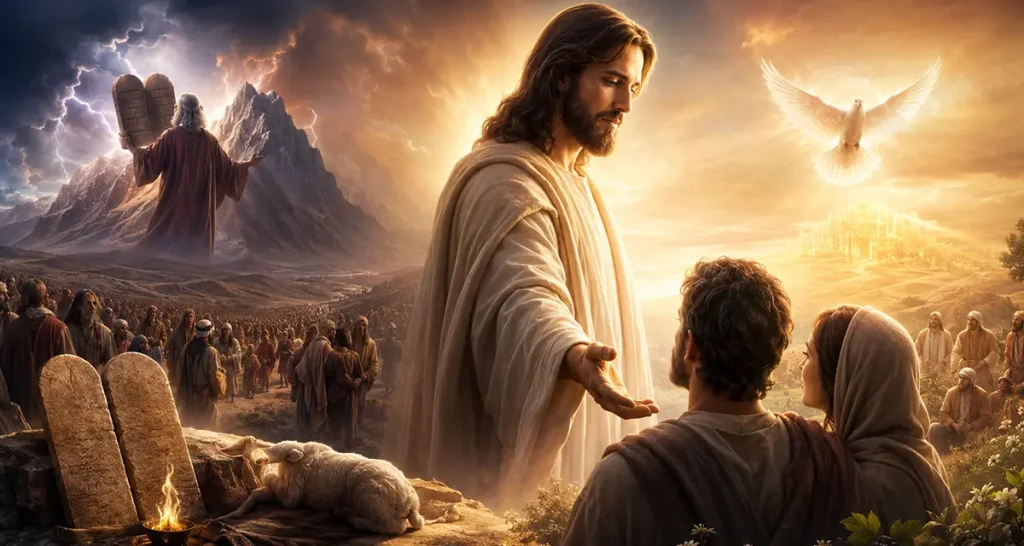
Justice | Mercy | Faith

Justice | Mercy | Faith

New Covenant: When God Gives Himself to His People

Difficulty Level: Intermediate-Advanced

Jump to Answers

  1. Hebrews describes Jesus as “the Mediator of a better covenant” (Hebrews 8:6) and “the Mediator of the new covenant” (Hebrews 9:15). If God already knew—as He later declared through Jeremiah—that the first covenant would be broken by His people (Jeremiah 31:31–32), why establish a covenant whose human side would ultimately fail, only to inaugurate the final and perfect covenant centuries later?
  2. How could Moses say, “For I know that after my death you will become utterly corrupt” (Deuteronomy 31:29)? On what basis could he know with such certainty that Israel would fall into corruption?
  3. When you pointed out that the location where the Law is written changes—from tablets of stone to the human heart—it opened an entirely new perspective on understanding the relationship between the covenants.
  4. God declared to Israel, “Then My anger shall be aroused against them in that day, and I will forsake them” (Deuteronomy 31:17), yet under the New Covenant He promises those who truly belong to Christ, “I will never leave you nor forsake you” (Hebrews 13:5). This contrast is striking. And yet, God never utterly forsook Israel as His covenant people; otherwise the Messiah would never have come, and the whole world would have perished.
  5. When Moses said, “For I know your rebellion and your stiff neck. If today, while I am yet alive with you, you have been rebellious against the LORD, then how much more after my death?” (Deuteronomy 31:27), what exactly did he mean? Doesn’t God hold the reins of His own people? Why would the presence or absence of a mere mortal make such a difference in restraining their behavior?
  6. This seems to lead us to the conclusion that the character of God, perfectly expressed in His Law, is not in itself sufficient to impart holy living as an inward reality. Because of our condition, God “has” to intervene personally by transforming the heart so that holiness is produced in us by His grace.
  7. When I said God “has” to intervene, the quotation marks were intentional. I meant that the necessity arises from our desperate need, not from any deficiency or obligation in God Himself.
  8. The promise, “I will put My Spirit within you and cause you to walk in My statutes, and you will keep My judgments and do them” (Ezekiel 36:27), carries tremendous authority, yet it could easily sound authoritarian: “I will put… I will cause… you will keep.” How should we understand this in light of the truth that God does not force His will upon us as though we were rebellious robots under His control?
  9. Throughout the Old Testament, God gave everything He could give—indeed, had it been necessary, He would have given all creation itself—yet none of these gifts was enough until He gave Himself. In the beginning, God created the heavens and the earth, then formed man from the dust and breathed into him life.
  10. When Jesus says, “No longer do I call you servants… but I have called you friends” (John 15:15), we often hear those words as though they came merely from the human Jesus. Yet if Jesus speaks only what the Father has given Him to speak, and if “he who has seen Me has seen the Father” (John 14:9–10), then this declaration ultimately comes from God Himself through the incarnate Son—not because Jesus is divided into two entities, but because in Him the Father is perfectly revealed. I hope you understand my point.
  11. My point is that such a declaration is astonishingly intimate for God Himself to make to a creature.
  12. My point goes even further: even if creation had remained perfectly holy and sin had never entered the world, it would still be astounding that God—who alone belongs to a category of being all His own, who has no needs, and for whom every creature is infinitely dependent and can add nothing to Him—would call finite creatures His friends, adopt them into His own family as sons and daughters, and make them fellow heirs with Christ. Such a “contract” could never be broken or annulled because it rests upon the character of God Himself, who neither lies nor goes back on His word.

Why did God establish the Old Covenant if He already knew His people would break it? Did the covenant fail, or did it accomplish a greater purpose in preparing the way for Christ? Why does Scripture move from commandments written on stone to God’s law written on the heart? And what does it mean that Jesus, the eternal Son, calls redeemed sinners His friends, His brothers and sisters, and heirs together with Him?

This discussion follows the unfolding story of redemption from Sinai to Calvary, exploring the relationship between the Old and New Covenants, the purpose of the Law, the necessity of a transformed heart, and the ministry of the Holy Spirit. Along the way, it considers profound questions about God’s self-sufficiency, the intimacy of adoption, and the astonishing truth that the greatest gift God has ever given is not merely forgiveness, blessings, or even heaven—but God Himself.

Ultimately, the New Covenant reveals not a different God or a different standard of holiness, but the fulfillment of God’s eternal purpose: to dwell with His people, transform them into the likeness of His Son, and bring them into a covenant fellowship that rests forever on His own faithful character.

Hebrews describes Jesus as “the Mediator of a better covenant” (Hebrews 8:6) and “the Mediator of the new covenant” (Hebrews 9:15). If God already knew—as He later declared through Jeremiah—that the first covenant would be broken by His people (Jeremiah 31:31–32), why establish a covenant whose human side would ultimately fail, only to inaugurate the final and perfect covenant centuries later?

Your question goes to the heart of the relationship between the Old and New Covenants. The author of Hebrews is not saying that God tried one plan, saw it fail, and then came up with a better one. Rather, Scripture presents one unified plan of redemption unfolding through history, with the first covenant serving a necessary purpose that reached its fulfillment in Christ.

📖 Was the Old Covenant a Failed Covenant?

It depends on what we mean by “failed.”

If we mean that God failed, then absolutely not.

If we mean that the covenant failed to produce a righteous people through human obedience, then yes—but that was never because of a defect in God’s law.

Paul is very careful here:

“Therefore the law is holy, and the commandment holy and just and good.”

Romans 7:12 (NKJV)

Again:

“For what the law could not do in that it was weak through the flesh, God did by sending His own Son…”

Romans 8:3 (NKJV)

Notice the wording.

The weakness was not in the Law.

The weakness was “through the flesh.”

The covenant exposed the inability of fallen humanity to produce righteousness.

🪞 The Covenant Revealed Man as He Really Is

The covenant at Sinai was never merely a list of rules.

It was God’s holy character expressed in commandments.

Israel enthusiastically responded:

“All that the LORD has spoken we will do.”

Exodus 19:8 (NKJV)

Again after hearing the Law:

“All the words which the LORD has said we will do.”

Exodus 24:3 (NKJV)

And once more:

“All that the LORD has said we will do, and be obedient.”

Exodus 24:7 (NKJV)

The confidence is striking.

Yet only days later they made the golden calf.

The problem was never ignorance.

The problem was the heart.

As Moses himself would later tell them:

“Yet the LORD has not given you a heart to perceive and eyes to see and ears to hear, to this very day.”

Deuteronomy 29:4 (NKJV)

Already the Old Testament hints that something deeper than commandments was needed.

🔥 Did God Already Know This?

Absolutely.

Nothing surprised Him.

Long before Sinai, God foretold Israel’s future apostasy.

Moses prophesied it plainly:

“For I know that after my death you will become utterly corrupt…”

Deuteronomy 31:29 (NKJV)

Likewise Joshua:

“…then He will turn and do you harm and consume you, after He has done you good.”

Joshua 24:19–20 (NKJV)

Even at Sinai itself, while Moses was on the mountain, God already said:

“I have seen this people, and indeed it is a stiff-necked people!”

Exodus 32:9 (NKJV)

None of this caught heaven by surprise.

🌱 Why Give the Covenant Then?

Several reasons emerge throughout Scripture.

1. To reveal God’s holiness

Without God’s Law, humanity invents its own morality.

The covenant established an objective revelation of God’s righteousness.

“You shall therefore keep My statutes and My judgments…”

Leviticus 18:4–5 (NKJV)

The Law became a visible expression of God’s holy character.

2. To expose sin

Paul writes:

“I would not have known sin except through the law.”

Romans 7:7 (NKJV)

Again:

“Moreover the law entered that the offense might abound.”

Romans 5:20 (NKJV)

Not that God wanted more sin, but that sin would be seen for what it truly is.

3. To restrain evil

Even though it could not regenerate hearts, the Law restrained outward wickedness within Israel.

Civil, ceremonial and moral laws preserved the nation through which the Messiah would come.

4. To prepare the world for Christ

Paul summarizes it beautifully:

“Therefore the law was our tutor to bring us to Christ…”

Galatians 3:24 (NKJV)

A tutor does not remain forever.

Its purpose is to lead the student to maturity.

✨ Jeremiah Saw Something Greater Coming

You mentioned Jeremiah, and I think this is exactly the passage you had in mind.

God says:

“Behold, the days are coming… when I will make a new covenant…”

Jeremiah 31:31 (NKJV)

Notice what follows.

“…not according to the covenant that I made with their fathers… My covenant which they broke, though I was a husband to them…”

Jeremiah 31:32 (NKJV)

There is the issue.

“They broke.”

Not,

“I failed.”

The covenant faithfully revealed both God’s holiness and man’s inability.

Then comes the astonishing promise:

“I will put My law in their minds, and write it on their hearts…”

Jeremiah 31:33 (NKJV)

The Law itself was not discarded.

Its location changed.

From tablets of stone…

to hearts of flesh.

❤️ The Difference Is Not Merely a New Document

This is one of Hebrews’ major themes.

The New Covenant is not simply better legislation.

It has a better Mediator.

“But now He has obtained a more excellent ministry, inasmuch as He is also Mediator of a better covenant, which was established on better promises.”

Hebrews 8:6 (NKJV)

Notice that Hebrews does not merely praise the covenant.

It points to Christ.

Everything is better because He is better.

The priesthood.

The sacrifice.

The sanctuary.

The promises.

The access.

The Mediator.

🤲 Where Does the Responsibility Shift?

I appreciated the way you phrased your question:

“…in what touches the responsibility of man…”

This is precisely where the New Covenant shines.

Under Sinai, the emphasis falls repeatedly on Israel’s pledge:

“All that the LORD has spoken we will do.”

Exodus 19:8; 24:3, 7 (NKJV)

Under the New Covenant, the emphasis falls on God’s promises:

“I will put My laws in their mind…”

Hebrews 8:10; Jeremiah 31:33 (NKJV)

“I will be their God…”

Hebrews 8:10 (NKJV)

“I will be merciful to their unrighteousness…”

Hebrews 8:12 (NKJV)

“Their sins and their lawless deeds I will remember no more.”

Hebrews 8:12 (NKJV)

The repeated phrase is not “they shall.”

It is “I will.”

That does not remove human responsibility—faith, repentance, perseverance, and obedience remain real and necessary responses (Acts 2:38; Hebrews 3:12–14; James 2:17). But the decisive foundation of the covenant no longer rests on human promises to God. It rests on God’s promises fulfilled in Christ and applied by the Holy Spirit.

🌅 One Unified Plan

Seen from the whole testimony of Scripture, the Old Covenant was not God’s unsuccessful first attempt. It was a true covenant given for a holy purpose within His unfolding plan. It revealed His righteousness, exposed humanity’s need, preserved the covenant people, foreshadowed the coming Messiah, and created a longing for the inward transformation that only God Himself could accomplish.

Perhaps this is why Hebrews can say of Jesus:

“Therefore He is also able to save to the uttermost those who come to God through Him, since He always lives to make intercession for them.”

Hebrews 7:25 (NKJV)

The contrast is profound. At Sinai, the people declared, “We will.” In the New Covenant, God declares, “I will.” The security of the covenant ultimately rests not on the constancy of man’s devotion, but on the faithfulness of the Mediator, who both inaugurates the covenant with His own blood and continually intercedes for His people (Hebrews 9:15; Hebrews 12:24). This is why Hebrews directs our confidence away from ourselves and toward Christ, “the Mediator of the new covenant.”

How could Moses say, “For I know that after my death you will become utterly corrupt” (Deuteronomy 31:29)? On what basis could he know with such certainty that Israel would fall into corruption?

This is an excellent question because it highlights something remarkable about Moses’ final speeches. Was Moses simply making a shrewd prediction based on human nature? Or was he speaking prophetically by revelation from God? Scripture points to both, but the emphasis is on the latter.

📖 Moses Was Not Guessing

When Moses says,

“For I know that after my death you will become utterly corrupt, and turn aside from the way which I have commanded you…”

Deuteronomy 31:29 (NKJV)

he is not speaking as a cynical old leader who has “seen enough people” to know how the story ends.

The immediate context is crucial.

Just a few verses earlier, God Himself tells Moses:

“Behold, you will rest with your fathers; and this people will rise and play the harlot with the gods of the foreigners of the land… and they will forsake Me and break My covenant which I have made with them.”

Deuteronomy 31:16 (NKJV)

Then God continues:

“Then My anger shall be aroused against them in that day, and I will forsake them…”

Deuteronomy 31:17 (NKJV)

Only after hearing this divine announcement does Moses speak to the people.

In other words, Moses knows because God has told him.

🔥 Moses Had Also Witnessed Their Hearts

That does not mean Moses had no human basis for understanding their condition.

For forty years he had shepherded Israel through the wilderness.

He had seen:

  • the complaints at the Red Sea (Exodus 14:11–12),
  • the grumbling over water (Exodus 15:24; 17:2–3),
  • the craving for Egypt’s food (Numbers 11:4–6),
  • the rebellion after the spies’ report (Numbers 14:1–4),
  • the rebellion of Korah (Numbers 16),
  • the repeated unbelief at Meribah (Numbers 20:2–5).

Again and again the pattern repeated.

Even after witnessing astonishing miracles, their hearts remained resistant.

Near the end of his life, Moses says:

“For I know your rebellion and your stiff neck. If today, while I am yet alive with you, you have been rebellious against the LORD, then how much more after my death?”

Deuteronomy 31:27 (NKJV)

Notice his reasoning.

“If this is how you behave while I’m still here…”

“…what will happen when I’m gone?”

Humanly speaking, Moses had every reason for concern.

❤️ Yet Moses Saw Something Even Deeper

What Moses recognized was not merely a behavioral problem.

He discerned a spiritual problem.

One of the most striking statements in Deuteronomy is this:

“Yet the LORD has not given you a heart to perceive and eyes to see and ears to hear, to this very day.”

Deuteronomy 29:4 (NKJV)

That is an extraordinary diagnosis.

Israel had:

  • seen the plagues,
  • crossed the Red Sea,
  • eaten manna,
  • heard God’s voice,
  • received His Law,

yet something was still missing.

Their hearts had not been transformed.

Moses understood that external commandments, by themselves, could not produce inward obedience.

🌱 This Explains His Hope

Interestingly, Moses did not end with despair.

He looked beyond Israel’s future rebellion to God’s future work.

Later in Deuteronomy he promises:

“And the LORD your God will circumcise your heart and the heart of your descendants, to love the LORD your God with all your heart and with all your soul…”

Deuteronomy 30:6 (NKJV)

This is astonishing.

Earlier, Moses had commanded the people:

“Therefore circumcise the foreskin of your heart, and be stiff-necked no longer.”

Deuteronomy 10:16 (NKJV)

That is their responsibility.

But in chapter 30, God says He Himself will circumcise their hearts.

This anticipates the New Covenant language of Jeremiah 31:31–34 and Ezekiel 36:25–27, where God promises to write His law on the heart and give His people a new spirit.

✨ Moses as Prophet, Not Merely Observer

This also reminds us of Moses’ unique role.

Scripture says:

“But since then there has not arisen in Israel a prophet like Moses, whom the LORD knew face to face.”

Deuteronomy 34:10 (NKJV)

Moses was not merely Israel’s lawgiver.

He was God’s prophet.

His words often looked beyond his own generation.

His prediction of Israel’s corruption belongs to that prophetic ministry.

🙏 A Beautiful Tension

I find there is a beautiful tension in Moses’ farewell.

On one hand, he has no illusions about the people. He has seen enough to know that they are incapable of covenant faithfulness in their own strength, and God has revealed that they will indeed break the covenant.

On the other hand, Moses does not conclude that God’s purposes have failed. Instead, he looks ahead to a day when God Himself will do what the Law could never accomplish: transform the human heart.

In that sense, Moses is already pointing toward Christ. He understands that Israel’s deepest need is not simply clearer commandments or stronger resolve, but a new heart. That is why the New Testament can speak of Jesus as “the Mediator of a better covenant” (Hebrews 8:6) and “the Mediator of the new covenant” (Hebrews 9:15). The One whom Moses foreshadowed would accomplish inwardly what the Law, holy and good as it was, could never produce by itself.

When you pointed out that the location where the Law is written changes—from tablets of stone to the human heart—it opened an entirely new perspective on understanding the relationship between the covenants.

I’m glad you noticed that, because I think it is one of the most profound ways Scripture itself explains the relationship between the covenants.

The “location” of the Law changes, and with it our perspective on the entire redemptive story.

🪨 The Law Written on Stone

When God established the covenant at Sinai, He personally wrote the Ten Commandments:

“And when He had made an end of speaking with him on Mount Sinai, He gave Moses two tablets of the Testimony, tablets of stone, written with the finger of God.”

Exodus 31:18 (NKJV)

The stone tablets were not an arbitrary choice.

Stone symbolizes permanence and objectivity.

God’s moral character does not change.

His commandments are not negotiable.

The Law stood outside the people, confronting them with God’s holiness.

It was visible.

Objective.

Authoritative.

But it remained external.

❤️ The Great Promise Is Not a New Law

Now notice Jeremiah carefully.

God does not say:

“I will abolish My law.”

Nor does He say:

“I will replace it with another law.”

Instead He says:

“I will put My law in their minds, and write it on their hearts…”

Jeremiah 31:33 (NKJV)

That sentence is astonishing.

The Law remains My law.

The content is continuous.

The location changes.

✍️ The Same Divine Writer

There is another beautiful observation.

Who wrote the Law on the tablets?

God Himself.

Who writes the Law on the heart?

Again, God Himself.

The divine Author never changes.

Only the writing surface does.

This is why Paul can say:

“…clearly you are an epistle of Christ… written not with ink but by the Spirit of the living God, not on tablets of stone but on tablets of flesh, that is, of the heart.”

2 Corinthians 3:3 (NKJV)

Paul intentionally echoes Sinai.

Stone.

Heart.

Same God.

Same Law.

Different ministry.

🌳 Why the Heart Changes Everything

Imagine placing the most perfect blueprint on the table before a master builder.

The blueprint is flawless.

But if the builder is blind, the blueprint cannot make him see.

Or imagine giving perfect sheet music to someone who cannot hear.

The music is not deficient.

The person lacks the ability.

That is essentially Paul’s argument.

The Law is perfect.

Man is not.

The external command reveals righteousness.

It cannot create righteousness.

🔥 Ezekiel Expands Jeremiah

Ezekiel explains how this change happens.

God promises:

“Then I will sprinkle clean water on you, and you shall be clean…”

Ezekiel 36:25 (NKJV)

Then comes the heart:

“I will give you a new heart and put a new spirit within you; I will take the heart of stone out of your flesh and give you a heart of flesh.”

Ezekiel 36:26 (NKJV)

Notice the irony.

The first covenant had commandments engraved on stone.

The people possessed hearts compared to stone.

The New Covenant reverses the picture.

The stone is no longer the heart.

The heart becomes living flesh.

Then comes the crucial verse:

“I will put My Spirit within you and cause you to walk in My statutes, and you will keep My judgments and do them.”

Ezekiel 36:27 (NKJV)

Notice the order.

It is not:

  • obey,
  • receive the Spirit.

It is:

  • receive the Spirit,
  • therefore walk in God’s statutes.

The obedience flows from God’s transforming work.

📜 Hebrews Sees This as the Center of the New Covenant

When Hebrews quotes Jeremiah almost word for word, it is making exactly this point.

“I will put My laws in their mind and write them on their hearts…”

Hebrews 8:10 (NKJV)

The author could have emphasized forgiveness first.

Or sacrifice.

Or priesthood.

Instead, he places the internal writing of the Law near the center of the covenant promise.

Why?

Because this answers the great failure revealed under Sinai.

💡 An Even Deeper Observation

There is something that has often filled me with awe.

At Sinai, Israel stood outside the mountain.

The Law came from above.

It confronted them.

It condemned disobedience.

Under the New Covenant, the Spirit dwells within believers.

The Law is no longer merely something confronting us from outside but something God forms within us as He conforms us to Christ.

This does not mean conscience replaces Scripture or that inward impressions become our authority. The objective Word of God remains the standard (2 Timothy 3:16–17). Rather, the Holy Spirit illumines that Word, inclines our hearts toward it, and empowers obedience (John 16:13; Romans 8:4).

✨ The Law Is No Longer Merely an Obligation

This is where I think the change of “location” becomes deeply personal.

Before, the Law said, in effect:

“This is the way; walk in it.”

And it was right.

But the human heart resisted.

Now, under the New Covenant, God not only says, “This is the way,” but also gives a new heart that begins to delight in that way.

That is exactly what we see anticipated in the Psalms:

“I delight to do Your will, O my God,
And Your law is within my heart.”

Psalm 40:8 (NKJV)

David could already speak this way by faith, but under the New Covenant this delight becomes the inheritance of all God’s people through the indwelling Spirit.

🌿 A Thought That Connects Everything

I wonder if there is an even richer layer to this.

The movement of the Law mirrors the movement of God’s presence throughout Scripture.

  • At Sinai, God descends upon a mountain while the people remain at a distance (Exodus 19:12–13, 18–24).
  • In the wilderness, His glory dwells in the tabernacle, in the midst of Israel yet separated by curtains (Exodus 40:34–38).
  • In Christ, “the Word became flesh and dwelt among us” (John 1:14).
  • At Pentecost, the Holy Spirit comes to dwell within believers (Acts 2:1–4; 1 Corinthians 6:19).
  • In the new creation, “the tabernacle of God is with men, and He will dwell with them” (Revelation 21:3).

The writing of the Law on the heart is part of this same movement. God is not merely changing the place where His commandments are inscribed; He is bringing His people into ever-deepening communion with Himself. The covenant reaches its fulfillment not simply because the Law is internalized, but because the Lawgiver Himself comes to dwell with and within His redeemed people through Christ and by the Holy Spirit. In the end, the greatest promise of the New Covenant is not merely transformed behavior—it is the restored fellowship expressed in these covenant words:

“I will be their God, and they shall be My people.”

Jeremiah 31:33; Hebrews 8:10 (NKJV)

Everything else—including the writing of the Law on the heart—flows from that restored relationship.

God declared to Israel, “Then My anger shall be aroused against them in that day, and I will forsake them” (Deuteronomy 31:17), yet under the New Covenant He promises those who truly belong to Christ, “I will never leave you nor forsake you” (Hebrews 13:5). This contrast is striking. And yet, God never utterly forsook Israel as His covenant people; otherwise the Messiah would never have come, and the whole world would have perished.

This is a wonderful observation, and I think you’re putting your finger on one of the great covenantal contrasts in Scripture. At first glance, the two statements seem almost opposite:

“Then My anger shall be aroused against them in that day, and I will forsake them…”

Deuteronomy 31:17 (NKJV)

and

“For He Himself has said, ‘I will never leave you nor forsake you.'”

Hebrews 13:5 (NKJV)

How can both be true? The answer lies in understanding both the nature of God’s covenant dealings and the faithfulness of His redemptive purpose.

📖 What Did “I Will Forsake Them” Mean?

The word “forsake” in Deuteronomy does not mean that God ceased to be the God of Israel in an absolute or irreversible sense.

The context explains what God means:

“I will forsake them, and I will hide My face from them, and they shall be devoured. And many evils and troubles shall befall them…”

Deuteronomy 31:17 (NKJV)

Notice the parallel expression:

“I will hide My face from them.”

Throughout the Old Testament, God’s “face” represents His favorable presence, blessing, protection, and fellowship.

To hide His face is to withdraw the covenant blessings His people were enjoying because of persistent rebellion.

It is judicial.

It is disciplinary.

It is not the annihilation of the covenant relationship.

🌿 The Covenant Already Anticipated Restoration

Even in Deuteronomy, judgment is never the final word.

After describing exile and scattering among the nations, Moses immediately speaks of restoration.

“When you return to the LORD your God and obey His voice… the LORD your God will bring you back from captivity, and have compassion on you…”

Deuteronomy 30:2–3 (NKJV)

God disciplines.

Then He restores.

The covenant contains both warnings and promises.

🔥 God’s Faithfulness Never Depended on Israel’s Faithfulness Alone

This is exactly what you pointed out.

Had God utterly abandoned Israel, there would have been:

  • no Davidic kingdom,
  • no preserved remnant,
  • no prophets,
  • no Bethlehem,
  • no incarnation,
  • no cross.

Paul says something astonishing:

“For the gifts and the calling of God are irrevocable.”

Romans 11:29 (NKJV)

And earlier:

“What if some did not believe? Will their unbelief make the faithfulness of God without effect? Certainly not!”

Romans 3:3–4 (NKJV)

Israel’s unfaithfulness never nullified God’s covenant purposes.

👑 The Difference Between the Nation and the Remnant

One of the consistent themes throughout the Old Testament is that while the nation often came under judgment, God always preserved a faithful remnant.

Isaiah says:

“Though the people of Israel be as the sand of the sea,
A remnant of them will return.”

Isaiah 10:22 (NKJV)

Paul applies this directly:

“Even so then, at this present time there is a remnant according to the election of grace.”

Romans 11:5 (NKJV)

God’s promises continued through the remnant until Christ came.

✝️ Something New Happens in Christ

Now we come to Hebrews.

When the writer says,

“I will never leave you nor forsake you.”

Hebrews 13:5 (NKJV)

he is not simply repeating an Old Testament encouragement.

He is showing what has become true because of Christ’s finished work.

Why can this promise now be spoken with such absolute certainty?

Because the Mediator cannot fail.

Under Sinai, the covenant relationship could experience covenant curses because the people broke the covenant.

Under the New Covenant, Christ has fulfilled the covenant perfectly on behalf of His people.

He is the obedient Israelite.

The faithful Son.

The perfect High Priest.

The covenant now rests upon His faithfulness.

🌑 The Most Astonishing Moment

Here, I think, is one of the deepest connections in all of Scripture.

There is one Person who truly experienced covenant abandonment in a unique and unfathomable way.

Jesus cried:

“My God, My God, why have You forsaken Me?”

Matthew 27:46; Mark 15:34 (NKJV)

This is extraordinary.

Israel deserved to be forsaken.

Christ did not.

Yet He willingly entered into the place of covenant curse.

Paul writes:

“Christ has redeemed us from the curse of the law, having become a curse for us…”

Galatians 3:13 (NKJV)

The One who perfectly kept the covenant bore the consequences reserved for covenant breakers.

❤️ Therefore, “Never Forsaken”

This gives profound depth to Hebrews’ promise.

Believers are not told, “God will never forsake you because you have become faithful enough.”

Nor because the New Covenant ignores sin.

Rather, God will never forsake those who belong to Christ because the covenant curse has already fallen upon the Mediator.

That is why Paul can say:

“There is therefore now no condemnation to those who are in Christ Jesus…”

Romans 8:1 (NKJV)

And later:

“Who shall separate us from the love of Christ?”

Romans 8:35 (NKJV)

His answer is magnificent:

“…neither death nor life… nor any other created thing, shall be able to separate us from the love of God which is in Christ Jesus our Lord.”

Romans 8:38–39 (NKJV)

🌱 Yet Even Israel Was Never Without Hope

I especially appreciated your careful wording:

“Not that God had ever actually forsaken Israel as a people…”

I think Scripture supports that nuance.

God did withdraw His favorable presence at times. He sent famine, exile, foreign oppression, and even allowed the temple to be destroyed. These were real acts of covenant judgment (2 Kings 17:7–23; 2 Chronicles 36:15–21). Yet He never abandoned His redemptive purpose for Israel.

In fact, even when announcing judgment through Jeremiah, He immediately adds:

“For I am with you… to save you;
Though I make a full end of all nations where I have scattered you,
Yet I will not make a complete end of you.”

Jeremiah 30:11 (NKJV)

Likewise, after announcing severe discipline:

“For a mere moment I have forsaken you,
But with great mercies I will gather you.

With a little wrath I hid My face from you for a moment;
But with everlasting kindness I will have mercy on you,”

Isaiah 54:7–8 (NKJV)

The “forsaking” was covenantal discipline within history, not the cancellation of God’s eternal promises.

✨ One More Beautiful Connection

There is one more thread that ties these passages together beautifully.

At Sinai, God says to Israel, in effect, “If you persist in breaking My covenant, I will hide My face from you” (Deuteronomy 31:17).

At Calvary, darkness covers the land (Matthew 27:45), and the faithful Son cries, “Why have You forsaken Me?” (Matthew 27:46).

Then, because He bears the curse and inaugurates the New Covenant with His own blood (Luke 22:20; Hebrews 9:15), those united to Him receive a promise that no Old Covenant believer ever heard expressed in quite this way:

“I will never leave you nor forsake you.”

Hebrews 13:5 (NKJV)

The One who alone did not deserve to be forsaken endured the curse of the covenant so that those who do deserve it might never experience God’s final abandonment. That does not eliminate the Father’s loving discipline of His children (Hebrews 12:5–11), nor does it make the warnings of Hebrews empty (Hebrews 3:12–14; 10:26–31). Rather, it means that discipline is no longer the discipline of a Judge condemning covenant breakers, but of a Father conforming His children to the image of His Son. In Christ, the covenant relationship rests on a foundation that cannot fail, because its Mediator cannot fail.

When Moses said, “For I know your rebellion and your stiff neck. If today, while I am yet alive with you, you have been rebellious against the LORD, then how much more after my death?” (Deuteronomy 31:27), what exactly did he mean? Doesn’t God hold the reins of His own people? Why would the presence or absence of a mere mortal make such a difference in restraining their behavior?

That is a perceptive question, because it forces us to think carefully about God’s sovereignty and His ordinary means of governing His people.

At first glance, Moses almost sounds as though he thinks he is the glue holding Israel together:

“For I know your rebellion and your stiff neck. If today, while I am yet alive with you, you have been rebellious against the LORD, then how much more after my death?”

Deuteronomy 31:27 (NKJV)

But that cannot mean Moses believed God needed him in order to control Israel. Moses knew better than anyone that Israel belonged to the Lord.

👑 Moses Knew Who the True Shepherd Was

Throughout his life, Moses repeatedly acknowledged that Israel was God’s people.

For example, after the golden calf he prays:

“Yet now, if You will forgive their sin—but if not, I pray, blot me out of Your book which You have written.”

Exodus 32:32 (NKJV)

Notice he does not speak like an owner protecting his own nation.

He is interceding before the true King.

Later, Moses himself asks God to appoint another leader:

“Let the LORD, the God of the spirits of all flesh, set a man over the congregation… that the congregation of the LORD may not be like sheep which have no shepherd.”

Numbers 27:16–17 (NKJV)

Moses knew perfectly well that God was the Shepherd.

Joshua would simply become God’s appointed servant.

🌿 God Usually Works Through Means

One of the beautiful patterns throughout Scripture is that God’s sovereignty does not eliminate secondary causes.

God could teach Israel directly from heaven every morning.

Instead He gave them Moses.

God could have defeated Amalek without Joshua lifting a sword.

Instead Joshua fought while Moses prayed (Exodus 17:8–13).

God could have preached the gospel directly from heaven.

Instead He sends apostles and pastors (Romans 10:14–15; Ephesians 4:11–16).

His sovereignty includes His choice to work through human instruments.

📖 Moses Was a Moral Restraint

While Moses was alive, his presence carried tremendous authority.

Think about what Israel had witnessed.

They had seen him:

  • confront Pharaoh (Exodus 5–12),
  • stretch out his rod over the Red Sea (Exodus 14),
  • ascend Sinai into the cloud (Exodus 24:15–18),
  • speak with God “face to face” (Exodus 33:11),
  • intercede repeatedly for the nation (Exodus 32; Numbers 14).

His authority was unique.

Even rebellious people often moderate their behavior when a respected authority is present.

This is simply part of God’s ordinary providence.

🔥 Yet Moses Also Knew Their Hearts

I think Moses is saying something like this:

“If your hearts have remained rebellious despite every privilege imaginable—even while I have been continually calling you back to the Lord—what confidence is there that my absence will improve matters?”

Notice the emphasis is not on Moses’ greatness.

The emphasis is on Israel’s persistent rebellion.

His reasoning is almost painfully realistic.

“If you resisted God when every possible outward restraint was present…”

“…what will happen when one of those restraints is removed?”

🌱 This Principle Appears Throughout Scripture

This is not unique to Moses.

Paul expresses a similar concern for the churches.

To the Ephesian elders he says:

“For I know this, that after my departure savage wolves will come in among you, not sparing the flock.”

Acts 20:29 (NKJV)

Paul does not mean Christ cannot protect His Church.

Rather, he recognizes that his apostolic ministry has been one means God has used to guard the flock.

Likewise Peter writes:

“Yes, I think it is right, as long as I am in this tent, to stir you up by reminding you… Moreover I will be careful to ensure that you always have a reminder of these things after my decease.”

2 Peter 1:13, 15 (NKJV)

Neither apostle imagines himself indispensable.

Yet both understand that God ordinarily shepherds His people through faithful leaders.

✨ Why Didn’t God Simply Prevent Israel’s Rebellion?

Now we come to the deeper theological issue behind your question.

You asked:

“Doesn’t God have the reins of His people?”

Yes, He does.

But Scripture consistently shows that God’s sovereign rule does not ordinarily operate by overriding human wills. Rather, He governs through His Word, His Spirit, His providence, and the leaders He appoints. When those leaders are removed, what is already present in the people’s hearts often becomes more openly visible.

This pattern appears repeatedly.

After Joshua died:

“…another generation arose after them who did not know the LORD nor the work which He had done for Israel.”

Judges 2:10 (NKJV)

Then immediately:

“Then the children of Israel did evil in the sight of the LORD…”

Judges 2:11 (NKJV)

Joshua’s death did not create apostasy.

It exposed it.

The same happened after the deaths of many godly kings. Under rulers like Hezekiah and Josiah, reforms took place, but after they died the people’s deeper inclinations resurfaced (2 Kings 21; 2 Kings 23:31–37).

❤️ A Lesson About the Human Heart

Perhaps the deepest lesson Moses is teaching is this:

No human leader—not even one who spoke with God face to face—can permanently keep God’s people faithful.

Moses was the greatest prophet of the Old Covenant (Deuteronomy 34:10).

Yet even his ministry could not change the nation’s heart.

That is why Deuteronomy ends with expectation rather than fulfillment.

Israel needed more than another Moses.

They needed the Prophet Moses foretold:

“The LORD your God will raise up for you a Prophet like me from your midst… Him you shall hear.”

Deuteronomy 18:15 (NKJV)

The New Testament identifies that Prophet as Christ (Acts 3:22–23).

✝️ The Greater Moses

This brings us back to the New Covenant. Moses’ ministry could restrain, teach, intercede, and mediate God’s Law, but it could not transform the heart. His very words in Deuteronomy 31 acknowledge that limitation. If Israel remained rebellious while such a leader stood among them, the ultimate need was not a more charismatic successor but a different kind of Mediator.

Jesus does not merely stand before His people and command obedience. He gives His Spirit to dwell within them (John 14:16–17), writes God’s law upon their hearts (Hebrews 8:10), and “always lives to make intercession for them” (Hebrews 7:25).

So Moses’ statement is not a confession that God needs a mere mortal to keep His people in line. It is, perhaps without Moses seeing its full significance, a testimony to the insufficiency of even the greatest human mediator. His impending death would reveal that the deepest problem was never the absence of Moses, but the absence of transformed hearts. Only the living Mediator, who would never die again (Romans 6:9), could shepherd God’s people in a way that no merely human leader ever could.

This seems to lead us to the conclusion that the character of God, perfectly expressed in His Law, is not in itself sufficient to impart holy living as an inward reality. Because of our condition, God “has” to intervene personally by transforming the heart so that holiness is produced in us by His grace.

I believe you’ve captured something profoundly biblical, and I would only make one careful refinement in the way it is expressed.

I would avoid saying that God “has” to intervene, as though there were an external necessity imposed upon Him. Rather, God has willed that holiness in redeemed sinners be produced by His own gracious, personal work. This is not because His Law is deficient, but because His purpose is not merely to inform creatures about holiness—it is to conform them to His Son.

That distinction, I think, preserves both God’s freedom and the biblical emphasis.

🌿 The Law Reveals Holiness, but Does Not Communicate Life

This is one of Paul’s central arguments.

He writes:

“For if there had been a law given which could have given life, truly righteousness would have been by the law.”

Galatians 3:21 (NKJV)

Notice what Paul does not say.

He does not say the Law was a bad law.

He says no law—even God’s perfect Law—was designed to give life.

Life belongs to God.

The Law can reveal life.

Describe life.

Direct toward life.

But it cannot impart life.

🔥 The Law Is a Revelation of God’s Character

The Law truly reflects God’s holiness.

Peter quotes Leviticus:

“Be holy, for I am holy.”

1 Peter 1:16, quoting Leviticus 11:44–45; 19:2 (NKJV)

The command is genuine.

The standard is God’s own character.

But hearing that command does not make someone holy.

In fact, Isaiah saw God’s holiness directly.

What happened?

He did not become instantly holy.

He cried:

“Woe is me, for I am undone!… For my eyes have seen the King, the LORD of hosts.”

Isaiah 6:5 (NKJV)

Only afterward does God act to cleanse him:

“Your iniquity is taken away,
And your sin purged.”

Isaiah 6:7 (NKJV)

Even there, God’s revelation is followed by God’s gracious action.

❤️ Holiness Is More Than Information

I think this is one of the most important truths in Scripture.

If information alone produced holiness, then Satan would be the holiest creature.

No created being possesses more theological knowledge than the fallen angels.

James reminds us:

“You believe that there is one God. You do well. Even the demons believe—and tremble!”

James 2:19 (NKJV)

Their problem is not lack of information.

Nor is ours.

Our deepest problem is that our hearts require renewal.

✍️ God Writes What He Commands

This brings us back to Jeremiah.

God does something extraordinary.

He does not merely repeat the commandments.

He writes them.

“I will put My law in their minds, and write it on their hearts…”

Jeremiah 31:33 (NKJV)

The command becomes accompanied by divine transformation.

🕊️ The Holy Spirit Is Not Merely an Assistant

Ezekiel makes the connection even clearer.

“I will put My Spirit within you and cause you to walk in My statutes…”

Ezekiel 36:27 (NKJV)

That little word “cause” is remarkable.

The Spirit does not merely encourage obedience from a distance.

He effectually works within God’s people so that they begin to delight in what God delights in.

This is why Paul says:

“For it is God who works in you both to will and to do for His good pleasure.”

Philippians 2:13 (NKJV)

Notice both dimensions.

God works:

  • to will (our desires),
  • to do (our actions).

Grace reaches deeper than behavior.

It reaches the affections.

🌱 This Is Not Mysticism but Union with Christ

I especially appreciated your use of the phrase “not enough to impart holy living as a mystical experience.”

I think the New Testament would actually redirect that language from “mystical experience” to union with Christ.

The change is certainly supernatural.

It is inward.

It is mysterious in the biblical sense.

But it is not an impersonal mystical force.

It is profoundly relational.

Jesus says:

“Abide in Me, and I in you. As the branch cannot bear fruit of itself… neither can you, unless you abide in Me.”

John 15:4 (NKJV)

Then He continues:

“He who abides in Me, and I in him, bears much fruit; for without Me you can do nothing.”

John 15:5 (NKJV)

Holiness grows from communion with the living Christ.

✨ God Gives More Than Commands—He Gives Himself

Perhaps this is the most beautiful way to say it.

Under the Old Covenant, Israel received God’s Law.

Under the New Covenant, believers receive:

  • the incarnate Son,
  • the indwelling Holy Spirit,
  • continual intercession by the risen High Priest,
  • and the Father’s adopting love.

In other words, God does not merely give a better set of covenant documents.

He gives Himself.

🌅 The Highest Gift Is the Presence of God

I think this also connects beautifully with a theme that has surfaced several times in our discussions: God Himself is both the goal and the means of salvation.

The Law reveals what holiness looks like because it reflects God’s own character. But holiness is not ultimately produced by contemplating an ideal from afar. It is produced as the living God draws near, unites us to Christ, and transforms us by His Spirit.

Paul describes this transformation in deeply relational terms:

“But we all, with unveiled face, beholding as in a mirror the glory of the Lord, are being transformed into the same image from glory to glory, just as by the Spirit of the Lord.”

2 Corinthians 3:18 (NKJV)

Notice the sequence.

We behold.

The Spirit transforms.

The more we behold Christ’s glory, the more we are conformed to His image. This is not mechanical, nor is it merely intellectual. It is the gracious work of God through communion with His Son.

Perhaps this explains why eternal life is defined not merely as endless existence, but as knowing God:

“And this is eternal life, that they may know You, the only true God, and Jesus Christ whom You have sent.”

John 17:3 (NKJV)

In the end, holiness is not simply the successful imitation of divine principles. It is the fruit of fellowship with the Holy One Himself. The Law can show us the beauty of God’s character, but only God can lovingly reproduce that beauty within those who belong to Him. That is why the New Covenant is so glorious: not because God’s standard has changed, but because the God whose holiness the Law reveals has come, through Christ and by His Spirit, to dwell with and within His people.

When I said God “has” to intervene, the quotation marks were intentional. I meant that the necessity arises from our desperate need, not from any deficiency or obligation in God Himself.

Ah, thank you for clarifying. That changes the nuance completely, and I think your quotation marks were doing exactly that work.

You were not speaking of an external necessity imposed upon God, but of a necessity arising from our condition. In that sense, I agree with your statement.

It reminds me of Jesus’ own words:

“Those who are well have no need of a physician, but those who are sick.”

Matthew 9:12 (NKJV)

The physician does not have to heal because of some constraint upon him. Rather, if the sick are to be healed, the physician must personally intervene. The necessity lies in the patient’s condition.

🌱 Our Need Exceeds Instruction

This is precisely what the history of Israel demonstrates.

God gave:

  • perfect commandments,
  • righteous statutes,
  • faithful prophets,
  • visible miracles,
  • sacrifices,
  • the priesthood,
  • the tabernacle,
  • His own presence among them.

Yet none of these, by themselves, could cure the disease of the heart.

They diagnosed it.

They restrained it.

They exposed it.

They pointed beyond themselves.

But they did not remove it.

As Jeremiah says:

“The heart is deceitful above all things,
And desperately wicked;
Who can know it?”

Jeremiah 17:9 (NKJV)

The implied answer comes a verse later:

“I, the LORD, search the heart…”

Jeremiah 17:10 (NKJV)

The One who diagnoses the heart is also the only One who can truly heal it.

❤️ Grace Is Wonderfully Personal

This is something I find breathtaking.

God does not merely send help.

He comes Himself.

The Father sends the Son.

The Son assumes our humanity.

The Spirit comes to dwell within us.

Every Person of the Trinity is personally involved in our sanctification.

Paul writes:

“Being confident of this very thing, that He who has begun a good work in you will complete it until the day of Jesus Christ.”

Philippians 1:6 (NKJV)

Notice the subject.

He began it.

He completes it.

✨ This Makes the New Covenant Astonishing

Perhaps we could summarize the movement of the covenants this way:

Under the Old Covenant, God says, in effect,

“Here is My holy character. Walk in it.”

Under the New Covenant, God says,

“Here is My holy character—and I Myself will dwell in you, transform you, and enable you to walk in it.”

That is exactly the progression from Deuteronomy 10:16:

“Therefore circumcise the foreskin of your heart…”

to Deuteronomy 30:6:

“And the LORD your God will circumcise your heart…”

The command remains.

But God graciously undertakes what our condition made impossible for us to accomplish apart from Him.

🙏 The Humility of God

What continues to amaze me is the condescension of God in all of this. He is under no obligation to rescue rebels. He could justly reveal His holiness, judge sin, and leave humanity to the consequences of its rebellion.

Instead, He does something infinitely greater. He does not merely tell us what holiness looks like—He comes to restore in us what sin has ruined. He gives His Son to atone for our guilt, His Spirit to renew our hearts, and His continual presence to sustain us until the work is complete.

As Paul says:

“For it is God who works in you both to will and to do for His good pleasure.”

Philippians 2:13 (NKJV)

The wonder of grace is not only that God forgives sinners, but that the Holy One willingly commits Himself to the lifelong work of making sinners holy. In that sense, because of our desperate need, God “has”—as you intentionally placed in quotation marks—to intervene personally. And in the New Covenant, He has done exactly that, not reluctantly, but according to “the good pleasure of His will” (Ephesians 1:5).

The promise, “I will put My Spirit within you and cause you to walk in My statutes, and you will keep My judgments and do them” (Ezekiel 36:27), carries tremendous authority, yet it could easily sound authoritarian: “I will put… I will cause… you will keep.” How should we understand this in light of the truth that God does not force His will upon us as though we were rebellious robots under His control?

That is a very important observation, and Christians have wrestled with that very tension for centuries. On one hand, Ezekiel 36:27 is one of the strongest statements in Scripture about God’s sovereign work in sanctification:

“I will put My Spirit within you and cause you to walk in My statutes, and you will keep My judgments and do them.”

Ezekiel 36:27 (NKJV)

At first reading, it almost sounds as though God overrides the human will.

Yet when we read the whole testimony of Scripture, it becomes clear that this is not what Ezekiel means.

🌿 The Context Is Restoration, Not Coercion

Notice the progression of God’s promises:

“I will sprinkle clean water on you…”

Ezekiel 36:25

“I will give you a new heart…”

Ezekiel 36:26

“I will put a new spirit within you…”

Ezekiel 36:26

“I will put My Spirit within you and cause you to walk in My statutes…”

Ezekiel 36:27

God does not begin with behavior.

He begins with cleansing.

Then a new heart.

Then His Spirit.

Only then comes obedience.

The order matters enormously.

God is not forcing unwilling people to obey Him.

He is making dead hearts alive so that they begin to love what they formerly hated.

❤️ God Changes the Heart, Not Merely the Actions

Think back to the promise of the New Covenant in Jeremiah:

“I will put My law in their minds, and write it on their hearts…”

Jeremiah 31:33 (NKJV)

God does not say,

“I will move their hands.”

He says,

“I will write on their hearts.”

The deepest transformation is not external compliance but inward affection.

This is why David prayed:

“Create in me a clean heart, O God,
And renew a steadfast spirit within me.”

Psalm 51:10 (NKJV)

He did not ask God merely to restrain his actions.

He asked for a renewed heart.

🌱 “Cause” Does Not Mean “Compel Against Their Will”

The Hebrew idea behind “cause” is that God brings about the result He promises. But how does He do so?

The rest of Scripture answers: by transforming the inner person.

Imagine two people standing before a piano.

One is dragged to the bench, his hands forced onto the keys. Music is produced, but there is no delight.

The other has been taught to love music. He sits down eagerly because his desires have been shaped.

Both play.

But only one plays freely.

The New Covenant describes the second picture.

God does not merely control the hands.

He renews the heart.

📖 Jesus Speaks the Same Way

Jesus says:

“If anyone loves Me, he will keep My word…”

John 14:23 (NKJV)

Notice the order.

Love.

Then obedience.

He does not say,

“If anyone is externally constrained…”

The obedience flows from a renewed relationship.

Likewise:

“If you keep My commandments, you will abide in My love…”

John 15:10 (NKJV)

The life of the branch comes from abiding in the vine (John 15:1–5).

The fruit grows organically because the branch shares the life of the vine.

🕊️ The Spirit Liberates Rather Than Enslaves

Paul says something remarkable:

“Now the Lord is the Spirit; and where the Spirit of the Lord is, there is liberty.”

2 Corinthians 3:17 (NKJV)

The Spirit’s ministry is characterized by liberty.

Not autonomy from God.

Freedom unto God.

This is a freedom that sin had stolen.

Paul also writes:

“For the law of the Spirit of life in Christ Jesus has made me free from the law of sin and death.”

Romans 8:2 (NKJV)

The Spirit does not replace one slavery with another.

He frees us from the tyranny of sin so that we may joyfully serve God.

🔥 Before the Fall, and After Redemption

This also connects with a theme we’ve discussed before.

Before sin, Adam was not a robot.

He delighted in God’s fellowship.

His obedience was the natural expression of a rightly ordered heart.

Sin disordered those affections.

Redemption does not destroy personhood.

It restores it.

Grace does not make us less human.

It makes us truly human again.

✨ Augustine’s Insight

One of the most helpful summaries comes from Augustine of Hippo. He prayed:

“Give what You command, and command what You will.”

That prayer is remarkably close to Ezekiel 36.

God commands holiness.

Then He gives what the command requires.

The command remains genuinely ours to obey.

The grace genuinely comes from Him.

🙏 Love Is the Key

I think the deepest safeguard against reading Ezekiel as authoritarian is this: God never treats people as impersonal objects. Throughout Scripture, His saving work is relational. He speaks, calls, persuades, reproves, promises, comforts, and invites. Even when He acts irresistibly in grace, He does not bypass the person He has made; He renews that person from within.

Notice how God describes His own desire:

“I will be their God, and they shall be My people.”

Ezekiel 36:28; Jeremiah 31:33 (NKJV)

That is covenant language, not mechanical language.

And when Jesus speaks of the New Covenant relationship, He says:

“No longer do I call you servants… but I have called you friends.”

John 15:15 (NKJV)

Friends are not robots.

Nor are sons and daughters.

🌅 The Freedom of a Renewed Will

Perhaps we can say it this way:

Before grace, our wills are not absent, but they are bent by sin. We choose, desire, and act, yet our loves are disordered (Romans 6:16–20; Ephesians 2:1–3). God’s work in the New Covenant is not to replace our will with His own, but to heal our will so that it can delight in Him.

That is why Ezekiel’s language is so strong. God is not promising to coerce obedience; He is promising to accomplish something that no human effort could ever achieve: a heart that freely loves Him. The obedience that follows is therefore both fully God’s gift and truly our obedience. We walk. We keep His judgments. We do them. Yet we do so because His Spirit has awakened, enlightened, and renewed us from the inside.

In that sense, divine grace is neither authoritarian nor permissive. It is restorative. It does not violate the person; it restores the person to the freedom for which humanity was originally created—to know God, to love Him, and therefore to delight in walking in His ways. This is why the psalmist can genuinely say:

“I delight to do Your will, O my God,
And Your law is within my heart.”

Psalm 40:8 (NKJV)

The law has not become lighter. The heart has become alive.

Throughout the Old Testament, God gave everything He could give—indeed, had it been necessary, He would have given all creation itself—yet none of these gifts was enough until He gave Himself. In the beginning, God created the heavens and the earth, then formed man from the dust and breathed into him life.

I think you’ve traced a beautiful thread that runs from Genesis to the New Covenant, and it reveals something profound about the heart of God.

What strikes me is that throughout Scripture, God is always giving. Yet each gift, wonderful as it is, points beyond itself until the Giver Himself becomes the Gift.

🌿 The Pattern of Divine Giving

Consider the progression.

In Genesis, God gives creation.

“Then God saw everything that He had made, and indeed it was very good.”

Genesis 1:31 (NKJV)

He gives light.

He gives the earth.

He gives the seas.

He gives plants.

He gives animals.

He gives dominion.

He gives food.

Everything is gift.

Then He gives man life itself.

“And the LORD God formed man of the dust of the ground, and breathed into his nostrils the breath of life; and man became a living being.”

Genesis 2:7 (NKJV)

Already, there is something intimate here.

Unlike the rest of creation, humanity is not merely spoken into existence. God stoops, forms, and breathes. The narrative slows down, emphasizing personal involvement.

❤️ Yet Even Eden’s Gifts Were Not the Goal

Adam was not created merely to enjoy a beautiful garden.

The greatest privilege of Eden was not the rivers, the trees, or even the Tree of Life.

It was that God walked with man.

After the fall, the greatest tragedy was not merely death entering the world.

It was this:

“So He drove out the man…”

Genesis 3:24 (NKJV)

The deepest loss was communion.

📖 God Continues Giving

Even after sin, God’s generosity does not cease.

He gives:

  • garments (Genesis 3:21),
  • promises (Genesis 3:15),
  • covenants (Genesis 9; 15; 17),
  • the Law (Exodus 20),
  • the tabernacle (Exodus 25:8),
  • sacrifices,
  • priests,
  • prophets,
  • kings,
  • wisdom,
  • the promised land.

Every one of these is an expression of grace.

Yet none of them is the final gift.

🔥 The Law Could Reveal God, But Not Replace Him

This connects with our earlier discussion.

The Law reflected God’s holy character.

The sacrifices pointed to His mercy.

The tabernacle displayed His desire to dwell among His people.

But none of these was God Himself in the fullest sense.

They were signs.

Shadows.

Preparations.

Hebrews says:

“For the law, having a shadow of the good things to come…”

Hebrews 10:1 (NKJV)

Shadows are precious because they point to a reality greater than themselves.

✨ Then God Gives Himself

Perhaps this is the great surprise of redemption.

God does not merely send another prophet.

Or another law.

Or another sacrifice.

John writes:

“And the Word became flesh and dwelt among us…”

John 1:14 (NKJV)

Paul says:

“God was manifested in the flesh…”

1 Timothy 3:16 (NKJV)

The Giver becomes the Gift.

This is beyond anything Israel could have imagined.

🕊️ Yet God Is Not Finished Giving

Even after Christ ascends, He does not leave His people with memories.

Jesus promises:

“I will pray the Father, and He will give you another Helper, that He may abide with you forever—the Spirit of truth…”

John 14:16–17 (NKJV)

Then He adds something astonishing:

“I will not leave you orphans; I will come to you.”

John 14:18 (NKJV)

The gift is still God Himself.

🌱 Your Connection to Genesis Is Beautiful

I especially appreciated your observation:

“In the beginning, God created the heavens and the earth, then formed man from the dust and breathed into him life.”

That breathing is more than the animation of dust.

It is an image of God’s intimate involvement with humanity.

Now compare that with Jesus after His resurrection.

“And when He had said this, He breathed on them, and said to them, ‘Receive the Holy Spirit.'”

John 20:22 (NKJV)

The parallel is striking.

In Genesis, God breathes natural life into Adam.

In John’s Gospel, the risen Christ breathes as the inaugurator of the new creation, signifying the life of the Spirit that He is giving to His disciples.

The imagery is unmistakable.

The Creator is breathing life again.

🌅 The Gift Has Always Been God Himself

This makes me think of something that may tie together many of the themes we’ve explored over the past weeks.

Sometimes we speak as though salvation is primarily the forgiveness of sins.

Or eternal life.

Or justification.

Or glorification.

All of those are gloriously true.

But they are not the ultimate end.

The ultimate gift has always been God Himself.

When God called Abraham, the greatest promise was not simply a land but, “I will be your God” (Genesis 17:7–8).

When He redeemed Israel from Egypt, He said:

“I will take you as My people, and I will be your God.”

Exodus 6:7 (NKJV)

The same promise appears in the New Covenant:

“I will be their God, and they shall be My people.”

Jeremiah 31:33; Hebrews 8:10 (NKJV)

And the Bible closes with the fulfillment of that promise:

“Behold, the tabernacle of God is with men, and He will dwell with them, and they shall be His people. God Himself will be with them and be their God.”

Revelation 21:3 (NKJV)

Notice the emphasis: “God Himself.”

Not merely His gifts.

Not merely His blessings.

Not merely a restored creation.

God Himself.

❤️ One Further Thought

Your observation also sheds light on why idolatry is such a grievous sin in Scripture. Humanity continually reaches for God’s gifts while turning away from God Himself. We desire life, peace, provision, wisdom, beauty, security, even heaven—but apart from the Giver. Sin is, in one sense, the attempt to enjoy creation detached from its Creator.

Redemption reverses that order. In Christ, God gives Himself first. And because He gives Himself, every other blessing finds its proper place. As Paul writes:

“He who did not spare His own Son, but delivered Him up for us all, how shall He not with Him also freely give us all things?”

Romans 8:32 (NKJV)

Notice the order: with Him. Every other gift is inseparable from the greatest Gift. Perhaps that is why Jesus could define eternal life so simply and so profoundly:

“And this is eternal life, that they may know You, the only true God, and Jesus Christ whom You have sent.”

John 17:3 (NKJV)

The story of Scripture begins with God breathing life into man and ends with God dwelling forever with His redeemed creation. From beginning to end, the greatest gift has never been merely what comes from God’s hand, but the God whose hand gives. Everything else prepares us to receive Him, delight in Him, and enjoy Him forever.

When Jesus says, “No longer do I call you servants… but I have called you friends” (John 15:15), we often hear those words as though they came merely from the human Jesus. Yet if Jesus speaks only what the Father has given Him to speak, and if “he who has seen Me has seen the Father” (John 14:9–10), then this declaration ultimately comes from God Himself through the incarnate Son—not because Jesus is divided into two entities, but because in Him the Father is perfectly revealed. I hope you understand my point.

Yes, I do understand your point, and I think it is an important Christological observation. You are not dividing Christ into two persons, nor are you saying that the divine Son merely used the human Jesus as an instrument. Rather, you are recognizing that when Jesus speaks, God is speaking personally to us through His incarnate Son.

That is precisely how the New Testament presents Him.

✨ The Voice of Jesus Is the Voice of God

Jesus says:

“He who has seen Me has seen the Father.”

John 14:9 (NKJV)

He also says:

“The words that I speak to you I do not speak on My own authority; but the Father who dwells in Me does the works.”

John 14:10 (NKJV)

And earlier:

“For I have not spoken on My own authority; but the Father who sent Me gave Me a command, what I should say and what I should speak.”

John 12:49 (NKJV)

These statements are remarkable.

Jesus is not saying, “I have my own independent message.”

He is saying that His words perfectly reveal the Father.

Therefore, when Jesus says,

“No longer do I call you servants… but I have called you friends…”

John 15:15 (NKJV)

this is not merely the kindness of a compassionate rabbi.

It is the very heart of God being revealed.

🌿 The Incarnation Does Not Filter God—It Reveals Him

Sometimes people unconsciously think like this:

“The Father is hidden somewhere behind Jesus.”

But John’s Gospel moves in exactly the opposite direction.

“No one has seen God at any time. The only begotten Son, who is in the bosom of the Father, He has declared Him.”

John 1:18 (NKJV)

The Greek verb translated “declared” (exēgeomai) carries the idea of making someone known, unfolding or revealing them.

Jesus is the Father’s self-revelation.

He is not softening the Father.

He is revealing the Father.

❤️ The Friendship Comes From Eternity

That makes your observation even richer.

When Jesus calls His disciples “friends,” that friendship is not a new idea born in Bethlehem.

It is the eternal love of God finding expression through the incarnate Son.

Consider what Jesus says just a few verses later:

“As the Father loved Me, I also have loved you; abide in My love.”

John 15:9 (NKJV)

The love flowing toward the disciples is the very love that has eternally existed between the Father and the Son.

The Incarnation opens that fellowship to redeemed humanity.

📖 Hebrews Begins With This Very Thought

The opening of Hebrews is almost a commentary on what you are saying.

“God, who at various times and in various ways spoke in time past to the fathers by the prophets, has in these last days spoken to us by His Son…”

Hebrews 1:1–2 (NKJV)

Notice the subject.

It is God who speaks.

The Son is not merely another messenger.

He is God’s final and fullest speech.

This is why the author immediately adds:

“Who being the brightness of His glory and the express image of His person…”

Hebrews 1:3 (NKJV)

The Son perfectly expresses the Father.

🔥 This Changes How We Read the Gospels

I think this is one of the greatest treasures of the Gospels.

When Jesus:

  • touches the leper (Mark 1:41),
  • welcomes children (Mark 10:13–16),
  • weeps at Lazarus’ tomb (John 11:35),
  • forgives the adulterous woman (John 8:10–11),
  • restores Peter (John 21:15–19),

we are not merely learning what Jesus of Nazareth is like.

We are seeing the heart of God.

As Paul writes:

“For it pleased the Father that in Him all the fullness should dwell.”

Colossians 1:19 (NKJV)

And again:

“For in Him dwells all the fullness of the Godhead bodily.”

Colossians 2:9 (NKJV)

🌅 Yet the Humanity Matters

Here is where I think your wording is especially careful and helpful.

You said,

“This declaration ultimately comes from God Himself through the incarnate Son.”

I would only make a slight theological refinement, not because your thought is wrong, but because the Incarnation is so unique.

The New Testament would probably say:

The eternal Son of God speaks these words according to His assumed human nature.

Why make that distinction?

Because Jesus does not alternate between being God and being man.

Nor does He speak sometimes as God and sometimes as man, as though there were two speakers.

Rather, the one Person—the eternal Son—speaks through the humanity He has assumed.

This is one of the profound implications of the opening of John’s Gospel:

“And the Word became flesh and dwelt among us…”

John 1:14 (NKJV)

Notice that John does not say the Word merely put on flesh as one might put on a garment. Nor does he say the Word inhabited a separate human person. The eternal Word became flesh—not by ceasing to be God, but by taking to Himself a true human nature.

Therefore, every word Jesus speaks is the word of the one divine Person, the Son. Sometimes He speaks from the reality of His humanity—”I thirst” (John 19:28), “My soul is exceedingly sorrowful” (Matthew 26:38). At other times He speaks with explicit divine authority—”Before Abraham was, I AM” (John 8:58), “All authority has been given to Me in heaven and on earth” (Matthew 28:18). Yet in every case, it is the same Person speaking.

❤️ This Makes John 15 Even More Beautiful

Perhaps this makes Jesus’ words even more astonishing:

“No longer do I call you servants… but I have called you friends.”

John 15:15 (NKJV)

These are not merely the warm sentiments of an approachable teacher. They are the words of the eternal Son, through whom all things were made (John 1:3), by whom all things consist (Colossians 1:17), and who is “the express image” of the Father’s person (Hebrews 1:3).

The One who spoke light into existence now speaks friendship over redeemed sinners.

That means friendship with Jesus is not something less than friendship with God—it is precisely how the living God has chosen to bring us into fellowship with Himself. As John later writes:

“Our fellowship is with the Father and with His Son Jesus Christ.”

1 John 1:3 (NKJV)

The two are inseparable. To hear the Son is to hear the Father. To know the Son is to know the Father. To be called a friend by Jesus is to discover the astonishing truth that this invitation has always arisen from the very heart of God Himself.

My point is that such a declaration is astonishingly intimate for God Himself to make to a creature.

I think you’ve touched on something that should make us pause in wonder.

If we stop and consider who is speaking and to whom, the statement almost feels too astonishing to be true.

“No longer do I call you servants… but I have called you friends…”

John 15:15 (NKJV)

The Creator of heaven and earth says this to creatures.

That is extraordinary.

Yet I would add an important distinction. The declaration is indeed too intimate for a holy God to speak to sinful creatures on the basis of their own merit. But it is not too intimate for God to speak to those whom He has redeemed and united to His Son.

That difference is everything.

🌿 Abraham Was Called God’s Friend

Long before Jesus spoke these words, Scripture had already hinted at such intimacy.

Abraham is called:

“…Abraham My friend.”

Isaiah 41:8 (NKJV)

James echoes this:

“And the Scripture was fulfilled which says, ‘Abraham believed God, and it was accounted to him for righteousness.’ And he was called the friend of God.”

James 2:23 (NKJV)

Even in the Old Testament, friendship with God was possible.

But notice that it was exceptional and covenantal.

It rested on God’s gracious initiative.

🔥 Moses Speaks with God as a Friend

Even more striking is Moses.

“So the LORD spoke to Moses face to face, as a man speaks to his friend.”

Exodus 33:11 (NKJV)

This does not mean Moses became God’s equal.

The verse describes the openness and immediacy of their communion.

Yet notice something beautiful.

Jesus does not say merely,

“I speak to you as a friend.”

He says,

“I have called you friends.”

He extends to all His disciples something that, under the Old Covenant, was experienced by only a few.

❤️ Yet Jesus Raises the Relationship Even Higher

And here is something fascinating.

John 15 is not actually the highest relationship Jesus offers.

Later, after His resurrection, He tells Mary Magdalene:

“Go to My brethren and say to them, ‘I am ascending to My Father and your Father, and to My God and your God.'”

John 20:17 (NKJV)

Notice the progression.

First servants.

Then friends.

Then brothers.

Paul goes even further.

“For you did not receive the spirit of bondage again to fear, but you received the Spirit of adoption by whom we cry out, ‘Abba, Father.'”

Romans 8:15 (NKJV)

And John writes:

“Behold what manner of love the Father has bestowed on us, that we should be called children of God!”

1 John 3:1 (NKJV)

If friendship seems astonishing, sonship is even more so.

✨ Why Is God Able to Speak This Way?

I think this is where your observation connects beautifully with the whole story of redemption.

By nature, Scripture describes us as:

  • enemies (Romans 5:10),
  • children of wrath (Ephesians 2:3),
  • alienated from God (Colossians 1:21).

God does not simply overlook those realities and begin calling rebels His friends.

Something had to happen first.

Jesus says, just a few verses after calling them friends:

“Greater love has no one than this, than to lay down one’s life for his friends.”

John 15:13 (NKJV)

Do you notice what He is doing?

He is about to make them His friends by dying for them.

His friendship is purchased.

Not presumed.

👑 The Son Brings Us Into His Own Relationship

I think this is perhaps the deepest point.

Jesus never says that the Father loves us instead of loving the Son.

Rather, He brings us into His own relationship with the Father.

He prays:

“That the love with which You loved Me may be in them, and I in them.”

John 17:26 (NKJV)

That is almost beyond comprehension.

The Father’s love for believers is not an inferior kind of love.

It is participation—by grace—in the love that eternally exists between the Father and the Son.

Not because we become divine.

Not because the distinction between Creator and creature disappears.

But because we are united to Christ.

🌅 The Intimacy Never Erases the Infinite Difference

I think this is where Scripture preserves both truths perfectly.

On one hand, the intimacy is breathtaking. We are called friends, children, heirs, brothers and sisters of Christ (Romans 8:16–17; Hebrews 2:11–12).

On the other hand, God never ceases to be the infinitely holy Creator.

Even in the new creation, where fellowship reaches its fullest expression, the redeemed still worship:

“His servants shall serve Him.”

Revelation 22:3 (NKJV)

Notice that. In eternity we remain servants, and yet we also enjoy unhindered communion:

“They shall see His face…”

Revelation 22:4 (NKJV)

The Bible never treats these as contradictions. We are servants because He is Lord. We are friends because He has graciously drawn us near. We are children because He has adopted us in His Son.

So I would gently rephrase your statement this way:

Such intimacy is indeed too great for a holy God to extend to guilty creatures on the basis of creation alone. But it is not too great for Him to extend through redemption, because in Christ He is not merely speaking to creatures; He is speaking to those whom He has reconciled, justified, adopted, and united to His beloved Son.

That is why the New Testament never presents this intimacy as something humanity naturally possesses. It is always a miracle of grace. The One who is infinitely above us does not lower His holiness to become our friend; rather, through the cross and the gift of His Spirit, He raises us into a restored fellowship without ever ceasing to be the holy God whom angels still adore, crying,

“Holy, holy, holy, Lord God Almighty…”

Revelation 4:8 (NKJV)

The wonder of the gospel is that the same God before whom seraphim veil their faces (Isaiah 6:2–3) is the God who, in Christ, says to redeemed sinners, “I have called you friends.” That does not diminish His majesty; it magnifies the immeasurable riches of His grace.

My point goes even further: even if creation had remained perfectly holy and sin had never entered the world, it would still be astounding that God—who alone belongs to a category of being all His own, who has no needs, and for whom every creature is infinitely dependent and can add nothing to Him—would call finite creatures His friends, adopt them into His own family as sons and daughters, and make them fellow heirs with Christ. Such a “contract” could never be broken or annulled because it rests upon the character of God Himself, who neither lies nor goes back on His word.

I think I understand your point now, and I find it deeply moving. You’re stepping back from the question of sin and asking something even more fundamental:

Why would the infinite, self-sufficient God ever elevate a creature into such intimate fellowship?

Even if Adam had never sinned…

Even if the Fall had never occurred…

The distance between Creator and creature would still have been infinite.

Not infinite in distance, but in being.

God alone is self-existent.

👑 God Alone Is in a Category of His Own

Scripture consistently places God in a category that no creature can enter.

“Before the mountains were brought forth,
Or ever You had formed the earth and the world,
Even from everlasting to everlasting,
You are God.”

Psalm 90:2 (NKJV)

He alone can say:

“I AM WHO I AM.”

Exodus 3:14 (NKJV)

Every creature exists because God continually wills its existence.

Paul tells the Athenians:

“Nor is He worshiped with men’s hands, as though He needed anything, since He gives to all life, breath, and all things.”

Acts 17:25 (NKJV)

That verse is astonishing.

God does not need worship.

He does not need angels.

He does not need humanity.

He does not need the universe.

Nothing can increase Him.

Nothing can complete Him.

As Job hears from the Lord:

“Who has preceded Me, that I should pay him?
Everything under heaven is Mine.”

Job 41:11 (NKJV)

Or as the psalmist records God’s own words:

“If I were hungry, I would not tell you;
For the world is Mine, and all its fullness.”

Psalm 50:12 (NKJV)

God is absolutely self-sufficient.

🌿 Therefore Grace Is Even More Astonishing

This is exactly where your observation becomes so profound.

If God needed us, then His love could be interpreted as necessity.

If He were lonely, creation might be explained as filling a lack.

If He depended upon creatures, then adoption would be mutually beneficial.

But none of those things is true.

The doctrine of God’s aseity—His self-existence and self-sufficiency—means that every movement from God toward creation is entirely free.

He creates because He wills to.

He loves because He wills to.

He redeems because He wills to.

Everything is grace.

❤️ Friendship Is Already Astonishing

You called it “scandalous.”

In one sense, I think that’s exactly the right word.

Not scandalous because it is improper.

Scandalous because it exceeds every expectation.

The infinite God says,

“I have called you friends.”

John 15:15 (NKJV)

Already that stretches our imagination.

But then the New Testament keeps climbing.

👨‍👧‍👦 Then Comes Adoption

Paul writes:

“Having predestined us to adoption as sons by Jesus Christ to Himself…”

Ephesians 1:5 (NKJV)

Notice those last words.

“To Himself.”

Not merely into a kingdom.

Not merely into safety.

To Himself.

Then Romans says:

“The Spirit Himself bears witness with our spirit that we are children of God, and if children, then heirs—heirs of God and joint heirs with Christ…”

Romans 8:16–17 (NKJV)

I sometimes stop at those words.

Heirs of God.

Not heirs of a kingdom merely.

Not heirs of blessings merely.

The inheritance culminates in God Himself (cf. Psalm 73:25–26; Lamentations 3:24).

✨ This Was Never Owed to Adam

I think your observation also guards us from another subtle mistake.

Sometimes we think adoption is merely God’s remedy for sin.

But even had Adam remained perfectly obedient, he would still have remained a creature.

Obedience could never place God under obligation.

Luke records Jesus saying:

“So likewise you, when you have done all those things which you are commanded, say, ‘We are unprofitable servants. We have done what was our duty to do.'”

Luke 17:10 (NKJV)

Perfect obedience earns no debt from God.

Why?

Because every breath is already gift.

So adoption is not wages.

It is grace.

Even more profoundly, it is grace that was purposed “before the foundation of the world” (Ephesians 1:4–5). The New Testament presents adoption not merely as an emergency response to the Fall, but as part of God’s eternal purpose in Christ.

🤲 And Here Is the Wonder

You then said something that I think deserves lingering over:

“Such a ‘contract’ could never be broken or annulled because it rests upon the character of God Himself…”

I might change one word—not because your thought is wrong, but because the biblical language is even richer.

It is more than a contract.

It is a covenant.

A contract is an agreement between parties exchanging obligations.

A covenant, especially God’s covenant, is His gracious commitment to bind Himself to His people.

That is why Hebrews says:

“By so much more Jesus has become a surety of a better covenant.”

Hebrews 7:22 (NKJV)

And:

“He is also Mediator of a better covenant…”

Hebrews 8:6 (NKJV)

The security of this covenant rests finally on God’s own faithfulness.

As Paul writes:

“If we are faithless, He remains faithful; He cannot deny Himself.”

2 Timothy 2:13 (NKJV)

And the author of Hebrews reminds us:

“…it is impossible for God to lie.”

Hebrews 6:18 (NKJV)

🌅 One Thought That Has Always Left Me in Awe

I wonder if this is one of the deepest reasons why the New Testament speaks so often of our union with Christ.

Left to ourselves, we remain creatures, and always will. Even glorified humanity will never cease to be finite, dependent, and upheld by the Creator.

Yet God does something that no creature could ever have imagined.

He does not erase the distinction between Creator and creature—that distinction remains forever. Rather, the eternal Son assumes our humanity (John 1:14; Hebrews 2:14–17), and by uniting us to Himself through the Spirit, He brings us into His own filial relationship with the Father.

That is why Jesus can say after the resurrection:

“I am ascending to My Father and your Father, and to My God and your God.”

John 20:17 (NKJV)

Notice His careful wording. He does not say, “Our Father,” as though His sonship and ours were identical. He remains the eternal Son by nature. We become sons and daughters by grace through adoption.

And yet—and here is the breathtaking part—the relationship is so real that the Father truly loves us in His Son.

Jesus prays:

“That the world may know that You have sent Me, and have loved them as You have loved Me.”

John 17:23 (NKJV)

That verse has often left theologians speechless. It does not mean the Father confuses us with the Son or that we share His eternal deity. Rather, because we are united to Christ, the Father delights in us with the very love that rests upon His beloved Son.

If that is true—and Jesus Himself prayed it—then perhaps the greatest scandal of grace is not merely that God forgives sinners. It is that the God who needs nothing freely wills to share Himself with creatures who can add nothing to Him. He was never enriched by creating us, yet He determined that we should be enriched by Him forever.

In the end, that is not a story about what God gains. It is a story about who God is. His self-sufficiency does not make Him distant; it makes His love utterly free. Because He has no needs, every act of grace springs from the fullness of His own goodness. And because His covenant rests upon His own faithful character, the adopted children He has brought into His household can rest in the confidence that “the gifts and the calling of God are irrevocable” (Romans 11:29, NKJV). The God who did not need a family nevertheless chose, in Christ, to have one—and because He is the covenant-keeping God, that family rests forever on His unchanging faithfulness rather than on its own worthiness.