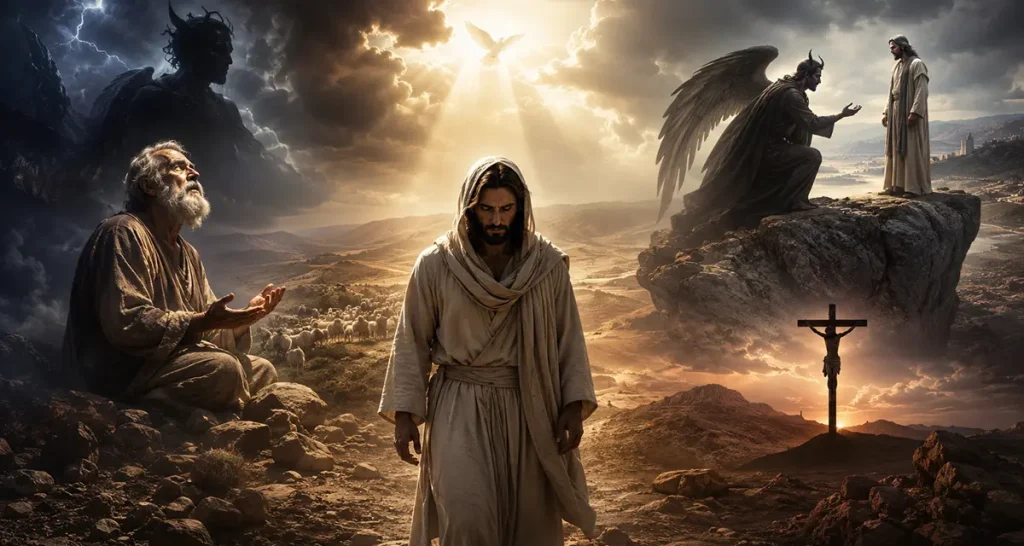
This question takes us very close to the mystery of evil itself.
At first glance, Satan’s actions seem irrational.
If he has already witnessed God’s glory, power, wisdom, and sovereignty more directly than any human ever has, why continue?
Why oppose God in heaven?
Why oppose Him on earth?
Why continue after repeated defeats?
⚔️ Courage or Madness?
I would not call it courage.
Courage faces overwhelming odds because something greater is worth pursuing.
A firefighter entering a burning building is courageous.
A martyr facing death for Christ is courageous.
Satan’s rebellion is not directed toward a noble good.
Scripture presents it more as a corruption of wisdom than courage.
Speaking of the king of Tyre in language many Christians see as extending beyond the earthly king to Satan’s fall, God says:
“Your heart was lifted up because of your beauty; you corrupted your wisdom for the sake of your splendor.” (Ezekiel 28:17)
Notice that.
Not lack of intelligence.
Corrupted wisdom.
He knows, yet refuses.
He sees, yet rejects.
He understands, yet rebels.
There is a kind of madness in sin.
🌿 Why Move the Battle to Earth?
Your observation is insightful:
If he lost in heaven, why would he think he could win on earth?
Perhaps because earth contained something heaven did not.
Man.
A creature made in God’s image.
“So God created man in His own image.” (Genesis 1:27)
Satan cannot wound God directly.
He cannot diminish God’s glory.
He cannot overthrow God’s throne.
But he can attack what God loves.
Imagine a king whose throne is untouchable.
An enemy unable to strike the king may strike the king’s children instead.
The king survives untouched, but the attack is still aimed at the king.
Earth becomes the theater where Satan directs his hostility toward God’s image-bearers.
🐍 The Serpent’s Strategy in Eden
Notice something remarkable.
The serpent does not challenge God directly.
He approaches Eve.
The attack is indirect.
“Has God indeed said…?” (Genesis 3:1)
He cannot dethrone God.
He seeks to corrupt God’s image in man.
And from a certain perspective, he succeeds.
Humanity falls.
Death enters.
Creation groans.
“Through one man sin entered the world, and death through sin.” (Romans 5:12)
For a moment, it appears as though Satan has achieved something significant.
👑 But Did Satan Think He Could Ultimately Win?
This is where we enter territory Scripture does not explain fully.
Several possibilities exist.
1. Satan’s rebellion may be fundamentally irrational
This is the simplest explanation.
Sin itself is irrational.
Jeremiah describes Israel abandoning:
“the fountain of living waters” (Jeremiah 2:13)
for broken cisterns.
That is not a rational trade.
Yet it happens.
Satan may simply be the fullest expression of this irrationality.
Hatred overriding reason.
Pride overriding reality.
2. Satan may not have understood God’s full plan
We often assume Satan knows far more than Scripture actually says he knows.
He is intelligent.
He is experienced.
But he is not omniscient.
Paul writes:
“Which none of the rulers of this age knew; for had they known, they would not have crucified the Lord of glory.” (1 Corinthians 2:8)
Again, whether this includes demonic rulers is debated, but the principle remains.
The mystery of redemption was not fully revealed.
The cross was not obvious.
The resurrection was not obvious.
The union of Jew and Gentile in Christ was not obvious (Ephesians 3:4-10).
Satan may have understood enough to oppose God but not enough to foresee how every move would ultimately serve God’s purposes.
🔥 The Strange Pattern of Scripture
One of the most fascinating patterns in Scripture is that Satan often accomplishes the opposite of what he intends.
He enters Judas.
“Then Satan entered Judas…” (Luke 22:3)
The result?
The atoning death of Christ.
He stirs opposition against the gospel.
The result?
The gospel spreads.
He afflicts Job.
The result?
Job knows God more deeply.
“I have heard of You by the hearing of the ear, but now my eye sees You.” (Job 42:5)
Again and again Satan acts, and God turns the attack into an instrument of His own purposes.
Joseph’s words become almost a summary of the entire biblical story:
“You meant evil against me; but God meant it for good.” (Genesis 50:20)
✨ The Most Sobering Possibility
There is another possibility that is both frightening and tragic.
Perhaps Satan never expected to win in the ultimate sense.
Perhaps he simply hates.
We see hints of this in Revelation.
After being cast down:
“Woe to the inhabitants of the earth and the sea! For the devil has come down to you, having great wrath, because he knows that he has a short time.” (Revelation 12:12)
Notice the wording.
Not because he thinks he will win.
Because he knows his time is short.
His actions increasingly resemble not a hopeful conqueror but a condemned rebel.
A man who knows judgment is coming and seeks to drag as many others into ruin as possible.
👑 The Ultimate Contrast
This brings us back to Christ.
Satan’s entire rebellion seems rooted in the declaration:
“My will.”
Christ’s entire earthly life is summed up by:
“Not My will, but Yours, be done.” (Luke 22:42)
One knows God and hates Him.
The other knows the Father perfectly and delights in Him.
One seeks his own exaltation.
The other humbles Himself.
“He humbled Himself and became obedient to the point of death, even the death of the cross.” (Philippians 2:8)
The astonishing thing is not merely that Satan continued to rebel after losing in heaven.
The astonishing thing is that the eternal Son entered the battlefield at all. He had nothing to gain for Himself, yet He came to seek and save those who had joined the losing side of the rebellion (Luke 19:10).
That contrast may be one of the deepest revelations of the heart of God and the heart of evil found anywhere in Scripture. 🙏👑✨