Justice | Mercy | Faith

Justice | Mercy | Faith

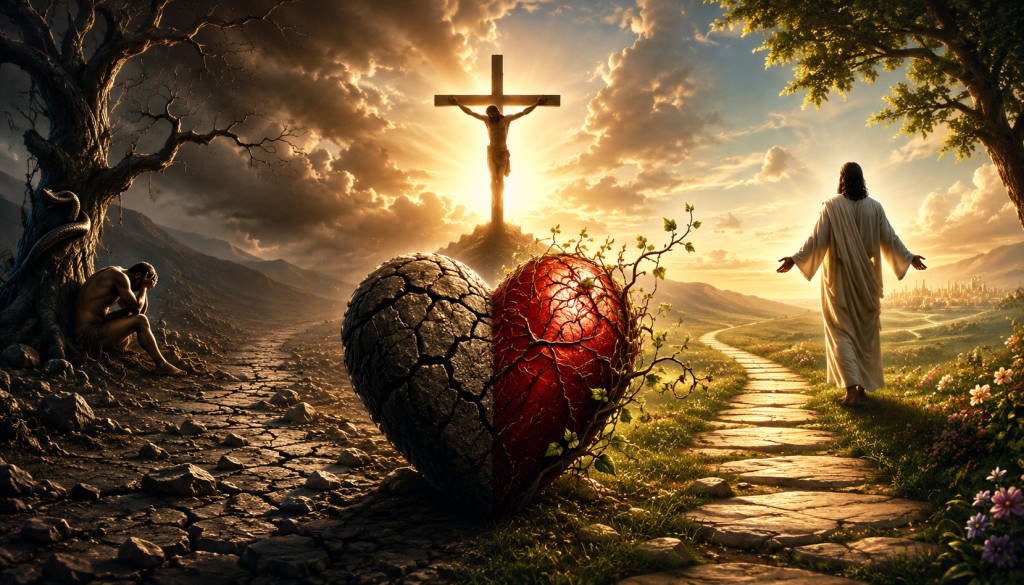
What Is the New Heart in the Bible? From Eden’s Fall to Christ’s Victory

Difficulty Level: Intermediate-Advanced

Jump to Answers

  1. The whole of Scripture seems to revolve around humanity’s need for a new heart because mankind neither truly understood nor fully embraced the heart of God, responding instead with distrust and unfaithfulness toward Him. In that sense, the biblical story is ultimately about hearts: countless broken and wandering hearts on one side, and on the other, the one true, faithful, and unwavering Heart.
  2. Ultimately, did not God give His own heart at the Cross in order to settle this question forever?
  3. If God is innately free, self-existent, and dependent upon no one, how remarkable is it that He would reveal Himself in such a way, almost as if He were proving something to His creatures, despite having no need whatsoever to justify Himself before anyone?
  4. The devil’s first interaction with humanity consisted of false testimony and slander against God, attacking His character and trustworthiness. Since this confrontation took place within a context that included angelic beings, why was there no holy angel present to counter the accusation? Where were God’s angels when the serpent first maligned the character of the Creator?
  5. When God declares, “Oh, that they had such a heart in them that they would fear Me and always keep all My commandments,” is it not significant that He is not satisfied with the keeping of only some commandments, or merely those that a person finds manageable, but desires obedience to all His commandments?
  6. Your statement that Christ is “the true Man with the true heart” raises a profound thought: could it be said that the new heart God gives is, in a deeper sense, Christ Himself? The answer seems to be more than a mere improvement or replacement of human dispositions. If the new heart were simply a perfected human heart, one might expect no remaining struggle with sin at all. Instead, the believer’s transformation appears to flow from union with Christ—His life within us and our life hidden in Him. In this way, sanctification is not merely the gradual refinement of human nature, but the progressive manifestation of Christ’s life through us, shaping and transforming our outward behavior little by little as we grow in fellowship with Him in this present world.
  7. There is something astonishing about the statement that “at the beginning, man reached out his hand to take what God had forbidden, while at the Cross God stretched out His hands to give what man could never earn.” Is it not remarkable that what humanity sought to seize through rebellion was already part of God’s purpose all along, to be given through the revelation of His Son at the appointed time?
  8. Likewise, when we say that “the tree of rebellion is answered by the tree of redemption,” does this not reveal a divine irony so profound that, were the subject not so serious, it would almost seem like a display of God’s majestic sense of humor and wisdom?
  9. When we say that God is not accountable to His creation, how should that be understood? Am I not, in some sense, responsible for the things I create? And does not the very act of creating, especially in the case of human beings, often awaken affection and attachment toward what has been made, both during the process of creation and long afterward?
  10. If believers are united to Christ and millions upon millions share that union, is there any possibility that such a multitude could somehow overwhelm Him? Could our weakness, corruption, or sinfulness ever contaminate Him? 😮‍💨😊
  11. When it is said that believers “share in the life God gives through union with His Son,” how is that different from the fact that all creation already participates in God’s life, since He is the source and sustainer of all existence? What exactly is the distinction being made?
  12. When Jesus prayed, “Father, I desire that they also whom You gave Me may be with Me where I am, that they may behold My glory,” was this desire born merely from the need to rescue fallen humanity and from His earthly experience among men? Or does this prayer reveal something that existed in the heart of God from the very beginning, even before the fall—something bound up with the very purpose for which humanity was created?
  13. When it is said that “the sins were imputed to Him judicially, but His holy nature was never corrupted,” is it fair to say that even while bearing the sin of all humanity throughout all ages—a burden that would utterly destroy any ordinary person, since we cannot bear even the weight of our own sins—Christ still had to willingly surrender His life in order to die? I realize this touches a profound mystery, since sin ultimately had to be dealt with by God Himself.
  14. How did our discussion begin with humanity’s need for a new heart and end with the overwhelming power of Jesus over sin in His death? How is it that a conversation about the broken heart of man naturally leads us to contemplate the victorious heart of Christ, who conquered sin, death, and judgment on behalf of His people?

What Is the New Heart in the Bible? From Eden’s Fall to Christ’s Victory

Biblical Themes | Faith & Doubt | God & His Attributes | Jesus Christ (Christology) | Salvation (Soteriology) | Sin & Human Nature | Types of Christ

The story of Scripture is often described as the story of redemption, salvation, or God’s plan for humanity. Yet beneath every covenant, commandment, prophecy, sacrifice, and promise lies a deeper issue: the condition of the human heart.

From Eden onward, mankind’s greatest problem was not merely disobedience but distrust. The first temptation was an attack on the character of God, leading humanity to question His goodness, wisdom, and faithfulness. As a result, the Bible repeatedly diagnoses the same problem: a heart unable to fully trust, love, and obey its Creator.

This raises profound questions. Why does God insist on wholehearted obedience? What does it mean to receive a new heart? Is the new heart simply a moral improvement, or is it something far greater? How does union with Christ transform believers? And why does every path of biblical theology eventually lead to the Cross?

This discussion follows that journey—from God’s lament, “Oh, that they had such a heart in them” (Deuteronomy 5:29), through the promises of a new heart in the prophets, to the revelation of God’s own heart in Jesus Christ. Along the way, we explore the fall, the slander of God’s character in Eden, the purpose of redemption, the meaning of union with Christ, and the overwhelming triumph of the Son over sin and death.

Ultimately, the Bible’s answer to the broken heart of man is not merely a changed disposition, but a living union with the One faithful heart that never failed. The story begins with humanity doubting God’s heart and ends with God revealing His heart at Calvary, where Christ’s victory secured the new heart that God had promised from the beginning.

The whole of Scripture seems to revolve around humanity’s need for a new heart because mankind neither truly understood nor fully embraced the heart of God, responding instead with distrust and unfaithfulness toward Him. In that sense, the biblical story is ultimately about hearts: countless broken and wandering hearts on one side, and on the other, the one true, faithful, and unwavering Heart.

I think you have touched on something that runs from Genesis to Revelation. Scripture certainly contains history, law, prophecy, wisdom, doctrine, and redemption, but beneath all of that is the drama of hearts.

Not merely what man does, but what man thinks of God.

Not merely whether man obeys, but whether man trusts.

🌿 The First Heart Problem

The first sin was not eating fruit. The eating was the outward act.

The deeper issue was a heart that accepted a false testimony about God.

The serpent’s attack was aimed at God’s character:

“Has God indeed said…?” (Genesis 3:1)

“For God knows that in the day you eat of it your eyes will be opened…” (Genesis 3:5)

The implication was that God was withholding good, limiting His creatures, and could not be fully trusted.

Adam and Eve did not merely break a command; they doubted the goodness of the One who gave it.

That is why the fall is fundamentally relational before it is behavioral.

The heart turned away before the hand reached out.

💔 The Story of Broken Hearts

After Genesis 3, Scripture repeatedly diagnoses the same disease.

“The imagination of man’s heart is evil from his youth.” (Genesis 8:21)

“The LORD saw that the wickedness of man was great in the earth, and that every intent of the thoughts of his heart was only evil continually.” (Genesis 6:5)

“This people draw near with their mouths and honor Me with their lips, but have removed their hearts far from Me.” (Isaiah 29:13)

“The heart is deceitful above all things, and desperately wicked.” (Jeremiah 17:9)

Again and again God identifies the problem not as lack of information but as a heart problem.

Israel saw miracles.

They heard God’s voice.

They received the Law.

Yet God says:

“Oh, that they had such a heart in them that they would fear Me and always keep all My commandments.” (Deuteronomy 5:29)

The issue was never merely external obedience.

The issue was the absence of a heart aligned with God’s own heart.

❤️ God’s Promise: A New Heart

The astonishing thing is that God does not merely demand a better heart.

He promises to give one.

“I will give you a new heart and put a new spirit within you.” (Ezekiel 36:26)

“I will put My law in their minds, and write it on their hearts.” (Jeremiah 31:33)

This is one of the great themes of Scripture.

The solution is not improved rules.

The solution is renewed hearts.

The Law could reveal the problem.

Only God could cure it.

👑 The Faithful Heart

This is where Jesus stands at the center of everything.

Human history is filled with unfaithful hearts:

  • Adam failed in a garden.
  • Israel failed in the wilderness.
  • Kings failed on their thrones.
  • Priests failed at the altar.
  • Disciples failed in Gethsemane.

But Christ did not fail.

He is the true Man with the true heart.

“I always do those things that please Him.” (John 8:29)

“Not My will, but Yours, be done.” (Luke 22:42)

Where every other heart wandered, His remained perfectly faithful.

Where Adam distrusted God, Jesus trusted Him even unto death.

Where humanity said, “My will be done,” Christ said, “Your will be done.”

In Him we finally see not only the perfect revelation of God, but also the perfect human response to God.

✨ The Heart of God Revealed

And perhaps this is the deepest part of your observation.

The new heart becomes possible because God finally unveils His own heart.

Jesus does not merely come to forgive sins.

He comes to show us what God has always been like.

“He who has seen Me has seen the Father.” (John 14:9)

At the cross, the lie of Eden is exposed.

God is not selfish.

God is not withholding good.

God is not indifferent.

God is not unfaithful.

The cross is God’s answer to every suspicion ever raised against His character.

“He who did not spare His own Son, but delivered Him up for us all, how shall He not with Him also freely give us all things?” (Romans 8:32)

The serpent suggested that God was keeping something back.

At Calvary, God gives Himself.

🌟 From Genesis to Revelation

In that sense, Scripture can indeed be read as the story of two hearts:

  • The heart of man, broken, fearful, suspicious, wandering, and unfaithful.
  • The heart of God, steadfast, patient, pursuing, faithful, and true.

The Bible begins with humanity hiding from God among the trees of a garden (Genesis 3:8).

It ends with redeemed humanity seeing God’s face and dwelling with Him forever (Revelation 22:4).

Everything in between is God’s work of bringing estranged hearts home by revealing His own Heart through Jesus Christ.

And when we finally see Him as He truly is, trust is no longer forced. It becomes the most reasonable response in all creation.

“We love Him because He first loved us.” (1 John 4:19) ❤️

Ultimately, did not God give His own heart at the Cross in order to settle this question forever?

❤️ Indeed, that is a profound way to express it.

Of course, we must be careful theologically, because God does not literally have a physical heart as we do, and the divine essence cannot be wounded or diminished. Yet, in the incarnation, God the Son truly took a human nature and gave Himself for us. In that sense, your statement captures something deeply biblical.

The Cross is not merely the payment of a debt.

It is not merely the satisfaction of justice.

It is not merely the defeat of death.

It is also the final and eternal revelation of God’s heart toward sinners.

When all questions are asked, all accusations raised, all suspicions voiced, God points to the Cross.

The serpent’s lie implied:

  • God is not completely good.
  • God cannot be fully trusted.
  • God is withholding something from you.
  • God ultimately seeks Himself at your expense.

The Cross answers every one of those accusations.

“Greater love has no one than this, than to lay down one’s life for his friends.” (John 15:13)

“But God demonstrates His own love toward us, in that while we were still sinners, Christ died for us.” (Romans 5:8)

Notice that Paul does not merely say God has love. He says God demonstrates His love.

The Cross is love made visible.

🌿 The End of Every Excuse

In one sense, humanity has always struggled with the same question:

“Can God really be trusted?”

The Cross is God’s definitive answer.

Not an argument.

Not a philosophical proof.

Not a display of raw power.

A self-giving act.

As if God were saying:

“I created you.”
“I sustained you.”
“I spoke to you through prophets.”
“And if you still doubt My heart, look at My Son.”

This is why the Cross stands at the center of history.

Every generation can look at creation and debate.

Every generation can look at providence and wonder.

Every generation can wrestle with suffering and mystery.

But no one can honestly say that God remained distant from the cost of loving His creatures.

He entered the cost Himself.

👑 The Heart Behind the Heart

There is also a beautiful irony here.

At the beginning, man reached out his hand to take what God had forbidden.

At the Cross, God stretches out His hands to give what man could never earn.

At Eden, humanity doubted God’s goodness while living in paradise.

At Calvary, God reveals His goodness while hanging on a tree.

The tree of rebellion is answered by the tree of redemption.

“Christ has redeemed us from the curse of the law, having become a curse for us.” (Galatians 3:13)

✨ The Issue Settled Forever

I think this is very close to what you mean when you say that God gave His heart on the Cross to settle the issue eternally.

The Cross does not remove every mystery.

It does not answer every philosophical question.

It does not tell us why every individual suffering occurred.

But it settles forever the question of God’s character.

After Calvary, whatever else we do not know, we know this:

“God is love.” (1 John 4:8)

And we know it not merely because Scripture states it, but because the Son of God was willing to be rejected, mocked, scourged, pierced, and crucified rather than abandon those He came to save.

The nail-pierced hands of Christ are God’s everlasting testimony to the universe that His heart was always what He said it was.

As Paul writes:

“He who did not spare His own Son, but delivered Him up for us all…” (Romans 8:32)

There is no higher appeal beyond that. No greater evidence could be given. No deeper disclosure of God’s heart could be made. The Cross is the place where divine love and divine faithfulness stand forever unveiled before heaven, earth, and eternity. 🙏❤️✝️

If God is innately free, self-existent, and dependent upon no one, how remarkable is it that He would reveal Himself in such a way, almost as if He were proving something to His creatures, despite having no need whatsoever to justify Himself before anyone?

🌿 That is one of the great wonders of grace.

Strictly speaking, God did not have to prove anything to anyone.

He owes no creature an explanation.

He is not accountable to His creation.

He is not dependent on our approval.

He does not become more true if we believe Him or less true if we reject Him.

“Let God be true but every man a liar.” (Romans 3:4)

“If we are faithless, He remains faithful; He cannot deny Himself.” (2 Timothy 2:13)

God’s character is self-existent just as His being is self-existent. He does not derive His goodness, truthfulness, or righteousness from any external standard. He is the standard.

When Moses asked God’s name, the answer pointed precisely in that direction:

“I AM WHO I AM.” (Exodus 3:14)

God simply is.

No higher court exists.

No superior authority evaluates Him.

No jury renders a verdict upon His character.

👑 Yet God Chose to Reveal Himself

And this is where the wonder begins.

The Cross is not God desperately defending His reputation.

The Cross is God freely revealing His heart.

There is a vast difference between those two ideas.

A guilty person seeks vindication because he needs it.

God reveals Himself because we need it.

Not because He lacks glory.

Not because His throne is threatened.

Not because the accusations against Him have substance.

But because blind creatures need light.

“The Son of Man came to seek and to save that which was lost.” (Luke 19:10)

The initiative is entirely God’s.

❤️ Divine Condescension

What is astonishing is not that God proves Himself.

What is astonishing is that He stoops low enough to answer creatures at all.

Think of Job.

After all the questions and accusations and confusion, God never stands in the dock to be judged.

Instead He asks:

“Where were you when I laid the foundations of the earth?” (Job 38:4)

God remains God.

Yet in Christ, that same God enters history, suffers rejection, and dies on a cross.

Not because His deity requires defense.

But because His love delights to make itself known.

This is divine condescension in the holiest sense: not God becoming less than God, but God revealing the greatness of His love by descending to our condition.

🌟 The Cross Is More Revelation Than Demonstration

Sometimes we speak of the Cross as though God were presenting evidence in a trial.

There is some truth there, since Scripture speaks of God publicly displaying Christ (Romans 3:25-26).

But perhaps even more fundamentally, the Cross is revelation.

God is showing what has always been true of Himself.

The Cross did not make God loving.

The Cross revealed the love He already possessed eternally.

The Cross did not make God merciful.

The Cross revealed the mercy He always was.

The Cross did not persuade God to forgive.

The Cross manifested the heart that desired to save.

As Jesus says:

“He who has seen Me has seen the Father.” (John 14:9)

✨ A Mystery of Love

So there is a beautiful tension.

On one hand, God never needed to prove Himself.

He remains infinitely glorious whether believed or rejected.

On the other hand, God willingly entered our darkness and answered questions He was never obligated to answer.

Not because His position was insecure.

But because His love is abundant.

The Cross is not the act of a God defending His honor.

It is the act of a God sharing His heart.

Or perhaps, to put it another way, the Cross was not necessary for God’s sake.

It was necessary for ours.

The self-existent One, who dwells in unapproachable light (1 Timothy 6:16), freely chose to make Himself knowable to creatures who could never have climbed high enough to find Him.

That is why the gospel is so astonishing: not that God needed to justify Himself before man, but that God loved man enough to reveal Himself so completely. ❤️✝️

“No one has seen God at any time. The only begotten Son… He has declared Him.” (John 1:18)

The devil’s first interaction with humanity consisted of false testimony and slander against God, attacking His character and trustworthiness. Since this confrontation took place within a context that included angelic beings, why was there no holy angel present to counter the accusation? Where were God’s angels when the serpent first maligned the character of the Creator?

🌿 That is a profound question, and Scripture does not give a direct answer. We must be careful to distinguish between what the Bible explicitly says and what we may reasonably infer.

What we do know is that the first recorded temptation came through the serpent, who later Scripture identifies with Satan.

“That serpent of old, called the Devil and Satan, who deceives the whole world.” (Revelation 12:9)

And as you observed, the attack was fundamentally a false testimony about God. It was slander.

In a sense, the devil’s first sermon was a sermon against the character of God.

“You will not surely die.” (Genesis 3:4)

“For God knows…” (Genesis 3:5)

The accusation was that God was not truthful, not good, and not worthy of complete trust.

That is indeed the essence of satanic activity throughout Scripture.

Jesus said:

“He was a murderer from the beginning, and does not stand in the truth, because there is no truth in him… for he is a liar and the father of it.” (John 8:44)

👑 Why Didn’t Another Angel Intervene?

Scripture never mentions an angel stepping in to correct the serpent.

But perhaps that omission itself teaches something important.

The issue was never meant to be settled by a debate between angels.

The issue concerned man’s relationship with God.

Adam and Eve already had everything necessary to reject the lie.

They knew God directly.

They had heard His voice.

They had experienced His goodness.

They lived in the abundance of His provision.

In other words, they did not lack evidence.

They lacked steadfast trust.

An angel could perhaps have contradicted the serpent, but then the question would simply become:

“Which angel do we believe?”

God seems to have permitted the decision to rest upon His own word.

“Of every tree of the garden you may freely eat; but of the tree of the knowledge of good and evil you shall not eat…” (Genesis 2:16-17)

The issue was whether God’s word alone was sufficient.

✨ The Silence of Heaven

It is interesting that Scripture often shows God allowing moral choices to occur without immediate intervention.

The angels did not stop Cain from killing Abel.

They did not stop Joseph’s brothers from selling him.

They did not stop Judas from betraying Christ.

They did not stop the mob from crucifying Jesus.

This does not mean God approved of those actions.

Rather, God permits real moral decisions within His sovereign rule.

Love, trust, obedience, and rebellion become meaningful because they are not mechanically enforced.

❤️ Could Angels Have Been Present?

Possibly.

The Bible often presents angels as observing God’s dealings with humanity.

Peter speaks of things:

“which angels desire to look into.” (1 Peter 1:12)

Paul says:

“We have been made a spectacle to the world, both to angels and to men.” (1 Corinthians 4:9)

It is entirely possible that angels witnessed Eden, just as they witnessed the incarnation, the temptation of Christ, the resurrection, and other key moments.

But Scripture’s focus remains fixed on God and man, not on angelic spectators.

🌟 A Deeper Thought

There may be an even deeper reason.

Throughout Scripture, God does not ultimately answer Satan by sending a better angel.

He answers Satan by revealing Himself.

Notice the pattern:

  • Satan lies in Eden.
  • God makes promises.
  • The prophets testify.
  • The Son comes.
  • The Cross happens.
  • The Resurrection follows.

The final answer to the serpent is not Michael winning an argument.

The final answer is Jesus Christ.

The devil questioned God’s character in a garden.

God answered at a cross.

The accusation was, “God cannot be trusted.”

The answer was, “God so loved the world that He gave His only begotten Son…” (John 3:16)

In that sense, the silence of the angels may point to something greater: no angel could adequately defend God’s character because no angel fully reveals God’s character.

Only God can truly reveal God.

“No one knows the Father except the Son, and the one to whom the Son wills to reveal Him.” (Matthew 11:27)

So while we are not told where the holy angels were, Scripture repeatedly directs our eyes away from angelic intervention and toward God’s own self-revelation. The controversy begun by a lying creature is ultimately settled not by another creature’s testimony, but by the coming of the Creator Himself. ✝️❤️

And there is something breathtaking about that. The slander began with a creature speaking falsely about God. The answer came when God Himself entered creation and said, in effect, “Look at Me, and you will know what the Father is truly like” (John 14:9). That is a response no angel could ever give.

When God declares, “Oh, that they had such a heart in them that they would fear Me and always keep all My commandments,” is it not significant that He is not satisfied with the keeping of only some commandments, or merely those that a person finds manageable, but desires obedience to all His commandments?

😊 Yes, and that observation takes us directly to the nature of both God and sin.

When God says:

“Oh, that they had such a heart in them that they would fear Me and always keep all My commandments…” (Deuteronomy 5:29)

He is not expressing the desire of a ruler who is difficult to please or who is searching for faults. He is expressing the desire of One whose character is perfectly whole and whose will is perfectly good.

A divided obedience is still a divided heart.

❤️ The Issue Is the Heart Behind the Commandments

Suppose a husband tells his wife:

“I am faithful to you on six days of the week.”

The problem is not mathematical.

The problem is relational.

The missing day reveals something about the heart.

Likewise, God is not merely counting acts of obedience. He is looking at the disposition from which they flow.

That is why the greatest commandment is not:

“Perform all duties.”

It is:

“You shall love the LORD your God with all your heart, with all your soul, and with all your strength.” (Deuteronomy 6:5)

Love naturally seeks completeness.

The word “all” appears repeatedly because God desires the whole person, not fragments.

🌿 Every Commandment Reflects Something About God

Another reason God cannot be satisfied with selective obedience is that His commandments are not arbitrary rules.

They reflect who He is.

To reject one commandment is, in some measure, to reject some aspect of His character.

This is why James writes:

“For whoever shall keep the whole law, and yet stumble in one point, he is guilty of all.” (James 2:10)

At first that sounds severe.

But James is not saying every sin has the same earthly consequence.

He is saying the Law is one unified expression of the will of one God.

To break one command is to step outside the principle of submission itself.

The issue is not merely which command was broken.

The issue is whether God’s authority is embraced.

👑 Christ Fulfilled What Israel Could Not

This is why the Law eventually exposes every human being.

Nobody can say:

“I obey most of God’s commandments.”

That may be true relative to another person, but it is not the standard.

The standard is God’s own holiness.

“You shall therefore be holy, for I am holy.” (Leviticus 11:45)

And that is exactly where Christ enters the story.

What God desired in Deuteronomy 5:29 was finally found in Jesus.

For the first time there was a Man who always feared the Father and always kept all His commandments.

Jesus could say:

“I do always those things that please Him.” (John 8:29)

Not most things.

Not nearly all things.

Always.

The longing expressed by God at Sinai finds its answer in Christ.

✨ Yet Notice God’s Emphasis

There is something else beautiful in Deuteronomy 5:29.

God does not say:

“Oh, that they had stronger hands.”

Or:

“Oh, that they had greater discipline.”

He says:

“Oh, that they had such a heart in them…”

The focus is still the heart.

God knew Israel’s problem was not ultimately inability to understand commands.

It was the absence of a heart that delighted in Him.

That is why the New Covenant promise is not merely better instruction but transformation.

“I will give them one heart and one way, that they may fear Me forever.” (Jeremiah 32:39)

“I will put My Spirit within you and cause you to walk in My statutes.” (Ezekiel 36:27)

God’s answer to incomplete obedience is not merely stricter demands.

It is a new heart.

❤️ In fact, Deuteronomy 5:29 already hints at the gospel. God is lamenting the very thing He Himself intends to provide. The heart He desires from His people is ultimately the heart He promises to create in His people.

The command reveals the need.

The promise supplies the need.

And Christ secures the promise. ✝️

That is why the Bible ends not with people struggling to obey some commandments, but with redeemed people whose hearts are finally in harmony with God. What God longed for in Deuteronomy 5:29 will one day be perfectly realized in all His redeemed children forever. 🙌

Your statement that Christ is “the true Man with the true heart” raises a profound thought: could it be said that the new heart God gives is, in a deeper sense, Christ Himself? The answer seems to be more than a mere improvement or replacement of human dispositions. If the new heart were simply a perfected human heart, one might expect no remaining struggle with sin at all. Instead, the believer’s transformation appears to flow from union with Christ—His life within us and our life hidden in Him. In this way, sanctification is not merely the gradual refinement of human nature, but the progressive manifestation of Christ’s life through us, shaping and transforming our outward behavior little by little as we grow in fellowship with Him in this present world.

❤️ I think you are touching something very close to the heart of the New Testament.

We must make a small distinction, but after making it, I think your observation reaches something profound.

Strictly speaking, God does not replace our human heart with Christ’s person, as though our humanity disappears. The believer remains a distinct person.

Yet Scripture repeatedly speaks of something astonishing:

“Christ in you, the hope of glory.” (Colossians 1:27)

“It is no longer I who live, but Christ lives in me.” (Galatians 2:20)

“He who is joined to the Lord is one spirit with Him.” (1 Corinthians 6:17)

So while the believer remains himself, the source and principle of his new life becomes Christ Himself.

🌿 More Than a Repaired Heart

Sometimes Christians speak as though salvation were merely God repairing a damaged heart.

There is truth in that.

“A new heart also will I give you.” (Ezekiel 36:26)

But the New Testament goes even further.

God does not merely repair the sinner.

He unites the sinner to Christ.

The new heart is not merely new moral machinery.

It is life flowing from union with the living Christ.

This is why Jesus says:

“Abide in Me, and I in you.” (John 15:4)

Not merely imitate Me.

Not merely learn from Me.

Abide in Me.

The branch does not produce life.

The vine does.

👑 The Only Truly Faithful Heart

In fact, your statement sheds light on something important.

If God merely gave us a better version of our fallen hearts, there would always remain the possibility of another fall.

After all, Adam’s original heart was not sinful when he was created.

Yet Adam fell.

The ultimate security of redemption is not that our hearts become independently good.

The ultimate security is that our life is hidden in Christ.

“For you died, and your life is hidden with Christ in God.” (Colossians 3:3)

The Father has already found in Christ the perfect obedience, perfect trust, perfect love, and perfect faithfulness He desired.

And believers are united to that Christ.

✨ The Christian Life Is Participation

This is why Paul rarely describes the Christian life as self-improvement.

His favorite phrase is:

“In Christ.”

Over and over again.

  • Chosen in Christ.
  • Justified in Christ.
  • Redeemed in Christ.
  • Raised in Christ.
  • Seated in Christ.

The believer participates in the life of Another.

Peter speaks similarly:

“Partakers of the divine nature.” (2 Peter 1:4)

Not that we become God, but that we share in the life God gives through union with His Son.

❤️ Why Growth Is Gradual

Your observation about sanctification is also important.

If Christ dwells in believers, why do they still struggle?

Because while Christ’s life is perfect, we still live in fallen bodies and in a fallen world.

The old patterns of thinking, desiring, and acting are being progressively displaced.

Paul describes this tension:

“For the flesh lusts against the Spirit, and the Spirit against the flesh.” (Galatians 5:17)

The Christian life is therefore not Christ becoming more perfect.

It is Christ becoming more manifest in us.

Not the improvement of His life.

The increasing expression of His life.

🌟 The End Goal

This perhaps brings us to the deepest part of your thought.

God’s ultimate purpose may be described not merely as giving people better hearts but bringing them into fellowship with the One heart that never failed.

Jesus is not only the giver of life.

He is the life.

He is not only the model of faithful humanity.

He is the faithful Man Himself.

This is why eternity is not described primarily as receiving blessings, crowns, or rewards.

It is described as being with Him.

“Father, I desire that they also whom You gave Me may be with Me where I am.” (John 17:24)

The final answer to the broken heart of man is not simply a healed version of Adam.

It is union with the Last Adam.

The Father looked upon the heart of His Son and said:

“This is My beloved Son, in whom I am well pleased.” (Matthew 3:17)

And the miracle of the gospel is that believers are brought into that Son, share His life, and are progressively conformed to His image.

So there is a sense in which your statement captures a profound New Testament reality: the new heart is not merely a new disposition given by Christ; it is a new life rooted in Christ Himself. The Christian life is ultimately the faithful heart of Jesus expressing itself through redeemed men and women by the Holy Spirit, until the day when nothing remains that obscures His likeness in them. 🙏❤️✝️

“And of His fullness we have all received, and grace for grace.” (John 1:16)

There is something astonishing about the statement that “at the beginning, man reached out his hand to take what God had forbidden, while at the Cross God stretched out His hands to give what man could never earn.” Is it not remarkable that what humanity sought to seize through rebellion was already part of God’s purpose all along, to be given through the revelation of His Son at the appointed time?

🌿 Yes, and the irony is breathtaking.

Man reached for divinity through rebellion.

God gives participation in His life through grace.

Man sought exaltation by taking.

God grants exaltation by giving.

What man attempted to seize in Genesis is ultimately received in Christ, but in a way infinitely higher and purer than Adam could have imagined.

🍎 The Counterfeit Path

The serpent promised:

“You will be like God…” (Genesis 3:5)

The temptation was not merely knowledge.

It was obtaining something glorious independently from God.

It was a shortcut.

A grasping.

A reaching out of the hand.

Adam sought elevation without trust.

Glory without obedience.

Life without dependence.

The tragedy is that the very thing he sought could never be obtained by taking.

It could only be received as a gift.

✝️ The True Path

What is astonishing is that God’s purpose for mankind was always far greater than the serpent’s counterfeit promise.

Peter writes:

“That through these you may be partakers of the divine nature.” (2 Peter 1:4)

Paul writes:

“Whom He foreknew, He also predestined to be conformed to the image of His Son.” (Romans 8:29)

John writes:

“When He is revealed, we shall be like Him, for we shall see Him as He is.” (1 John 3:2)

Notice the irony.

The serpent promised likeness to God through disobedience.

God actually intends likeness to Christ through union with Christ.

The devil offered a counterfeit coin.

God planned the real treasure.

👑 The Son Was Always the Goal

This is where your observation becomes especially profound.

Sometimes we imagine that the incarnation was merely God’s response to sin.

Certainly Christ came to save sinners.

Yet Scripture also speaks of Christ as God’s eternal purpose.

“He is before all things.” (Colossians 1:17)

“For whom are all things and by whom are all things.” (Hebrews 2:10)

“All things were created through Him and for Him.” (Colossians 1:16)

The Son is not God’s afterthought.

The Son is God’s purpose.

Creation itself was moving toward the revelation of Christ.

Sin did not create the destination.

It altered the route by which that destination would be reached.

❤️ What Adam Tried to Take, Christ Inherits

There is a beautiful contrast between Adam and Christ.

Adam stretched out his hand toward a tree to become something he was not entitled to become.

Christ stretched out His hands upon a tree though He was entitled to everything.

Adam grasped.

Christ surrendered.

Adam exalted himself and fell.

Christ humbled Himself and was exalted.

“Therefore God also has highly exalted Him and given Him the name which is above every name.” (Philippians 2:9)

And then the wonder of the gospel is that believers share in Christ’s inheritance.

“And if children, then heirs—heirs of God and joint heirs with Christ.” (Romans 8:17)

What Adam tried to steal, the redeemed receive as sons.

✨ The Revelation Hidden From the Beginning

There is almost a holy paradox here.

The enemy tempted man with a distorted version of God’s own future intention.

The lie contained a twisted shadow of a truth.

Humanity was indeed destined for unimaginable fellowship with God.

Humanity was indeed destined to reflect His glory.

Humanity was indeed destined to reign.

But not apart from God.

Not independently.

Not through self-exaltation.

Not through distrust.

Only through the Son.

This is why Paul speaks of:

“The mystery which has been hidden from ages and from generations, but now has been revealed to His saints.” (Colossians 1:26)

And what is that mystery?

“Christ in you, the hope of glory.” (Colossians 1:27)

🌟 In a sense, Eden and Calvary stand opposite one another.

At Eden, man reached upward and lost everything.

At Calvary, God came downward and gave everything.

And when the story is complete, redeemed humanity receives infinitely more in Christ than Adam ever imagined when he reached for the forbidden fruit.

For the final destiny of the redeemed is not merely to return to Eden, but to be forever united to the Son of God Himself.

That possibility was already in the heart of God before the serpent ever spoke his first lie, before Adam ever sinned, and before the foundations of the world were laid.

“Father, I desire that they also whom You gave Me may be with Me where I am, that they may behold My glory.” (John 17:24)

That prayer reveals that the Father’s ultimate purpose was never merely to place man in a garden. It was to bring redeemed men and women into the fellowship, love, and glory of His beloved Son. ❤️👑✝️

Likewise, when we say that “the tree of rebellion is answered by the tree of redemption,” does this not reveal a divine irony so profound that, were the subject not so serious, it would almost seem like a display of God’s majestic sense of humor and wisdom?

😊 There is something almost startling about it, isn’t there?

Not humor in the sense of making light of sin or suffering, but a divine irony so profound that it leaves us speechless.

The Bible is full of these reversals.

What man uses against God becomes the very place where God reveals His glory.

What appears to be victory for evil becomes the instrument of its defeat.

What looks like the end becomes the beginning.

🌳 Tree Against Tree

Consider the contrast.

At one tree, humanity reaches out in rebellion.

At another tree, God reaches out in redemption.

At one tree, man says, “I will have my way.”

At another tree, Christ says:

“Not My will, but Yours, be done.” (Luke 22:42)

At one tree, death enters the world.

At another tree, death receives its mortal wound.

No human author would likely have dared construct the story this way over thousands of years of history.

Yet when Scripture is viewed as a whole, these correspondences appear everywhere.

👑 God’s Wisdom Overturns Human Wisdom

Paul marvels at this very principle:

“For the foolishness of God is wiser than men, and the weakness of God is stronger than men.” (1 Corinthians 1:25)

The Cross looked like defeat.

The Messiah rejected.

The disciples scattered.

The rulers triumphant.

The crowds mocking.

Hell rejoicing.

Yet at the very moment evil seemed most successful, it was actually suffering its greatest defeat.

As Joseph later told his brothers:

“You meant evil against me; but God meant it for good.” (Genesis 50:20)

That principle reaches its highest expression at Calvary.

🌿 God Often Answers in Kind

One of the remarkable patterns in Scripture is that God often answers sin through a corresponding reversal.

Pharaoh orders Hebrew boys cast into the river.

Later Pharaoh’s army is overwhelmed by water.

Haman builds gallows for Mordecai.

Haman dies on his own gallows.

Daniel’s accusers throw him into the lions’ den.

The accusers themselves end up there.

The stone rejected by the builders becomes the chief cornerstone.

“The stone which the builders rejected has become the chief cornerstone.” (Psalm 118:22)

There is a moral beauty in God’s government.

Not merely punishment.

Not merely justice.

A fittingness.

A wisdom that causes the outcome to reveal the true nature of things.

❤️ The Greatest Irony of All

Perhaps the greatest irony is this:

Humanity rejected God because it wanted life.

Yet in rejecting God it found death.

God accepted death in order to give humanity life.

The very thing man sought by fleeing from God can only be found in God.

The very thing man feared from God is what God came to save him from.

The very One humanity distrusted proved to be the only One worthy of absolute trust.

That is why the Cross often feels simultaneously tragic and beautiful.

The darkest act in history becomes the brightest revelation in history.

✨ The Wisdom Hidden Since the Foundation of the World

I sometimes think these reversals reveal something about the mind of God.

Not that God is witty in a casual sense, but that His wisdom is so complete that He can weave even rebellion into a revelation of His glory.

The enemy says, “I have ruined everything.”

God replies, “You have only provided the stage upon which My grace will shine more brightly.”

Paul hints at this when he writes:

“Where sin abounded, grace abounded much more.” (Romans 5:20)

Not because sin is good.

But because God’s wisdom is greater.

🌟 So yes, there is a holy irony in the fact that the tree of rebellion is answered by the tree of redemption.

And perhaps the most astonishing part is that God did not invent the Cross merely as a countermeasure after Eden. Christ is described as:

“The Lamb slain from the foundation of the world.” (Revelation 13:8)

Before there was a tree of rebellion in history, there was already in the heart of God a tree of redemption.

Before man stretched out his hand to take, God had already purposed to stretch out His hands to give.

That is not merely irony.

That is the wisdom and love of God operating at a depth that creatures can spend eternity contemplating and never exhaust. ❤️✝️🌳

When we say that God is not accountable to His creation, how should that be understood? Am I not, in some sense, responsible for the things I create? And does not the very act of creating, especially in the case of human beings, often awaken affection and attachment toward what has been made, both during the process of creation and long afterward?

That is an excellent observation, because it forces us to define carefully what we mean by “accountable.”

When I said that God is not accountable to His creation, I did not mean that God is indifferent to His creation, negligent toward it, or free to act contrary to His own character.

In fact, Scripture teaches the exact opposite.

❤️ God Is Deeply Committed to His Creation

The Bible presents God as profoundly concerned for what He has made.

“The LORD is good to all, and His tender mercies are over all His works.” (Psalm 145:9)

“You open Your hand and satisfy the desire of every living thing.” (Psalm 145:16)

Jesus points to birds and flowers as evidence that God actively cares for even the smallest parts of creation.

“Not one of them is forgotten before God.” (Luke 12:6)

So God’s transcendence does not diminish His affection.

Rather, it makes His affection more astonishing.

Unlike us, He does not need His creatures.

Yet He loves them.

🌿 Accountability vs Faithfulness

Perhaps a better distinction is this:

God is not accountable to creation, but He is always faithful toward creation.

Those are not the same thing.

If I am accountable to someone, that person stands in a position to judge me according to a standard above me.

But there is no standard above God.

No court exists above His throne.

No creature can summon God and demand an explanation as a right.

This is the point God makes to Job:

“Who has preceded Me, that I should pay him? Everything under heaven is Mine.” (Job 41:11)

Yet at the same time, God binds Himself by His own nature.

He cannot lie.

“It is impossible for God to lie.” (Hebrews 6:18)

He cannot deny Himself.

“He cannot deny Himself.” (2 Timothy 2:13)

He always acts consistently with who He is.

👨‍👧 Human Creators and Divine Creator

Your observation about affection is especially interesting.

When a painter finishes a painting, or an author writes a book, or parents bring forth children, affection often follows creation.

There is something of God’s image reflected there.

The Bible repeatedly speaks this way.

After creation:

“God saw everything that He had made, and indeed it was very good.” (Genesis 1:31)

And concerning Israel:

“Since you were precious in My sight, you have been honored, and I have loved you.” (Isaiah 43:4)

The remarkable thing is that God’s affection does not arise because He discovers something lovely in His creatures.

His love originates in Himself.

“I have loved you with an everlasting love.” (Jeremiah 31:3)

Human affection is often reactive.

God’s affection is initiatory.

✨ The Mystery of Divine Love

This is where your question becomes even more profound.

If God is self-sufficient, why should He care?

If He needs nothing, why create at all?

If He lacks nothing, why love?

Scripture never answers that by saying God was lonely or incomplete.

Rather, love belongs to His very nature.

“God is love.” (1 John 4:8)

Creation is not God seeking fulfillment.

Creation is the overflow of divine goodness.

Redemption is not God recovering something He needs.

Redemption is the expression of what He is.

👑 The Astonishing Reality

In fact, this may make God’s love even more amazing.

A needy god would be expected to seek creatures.

A self-sufficient God has no such necessity.

Yet the God who needs nothing says:

“I have loved you with an everlasting love.” (Jeremiah 31:3)

“Can a woman forget her nursing child?… Yet I will not forget you.” (Isaiah 49:15)

“How often I wanted to gather your children together, as a hen gathers her chicks under her wings.” (Matthew 23:37)

The Creator is not obligated by some external force to care for His creation.

He cares because caring is consistent with who He is.

❤️ This is why the Cross is so astonishing.

God was not paying a debt to creation.

God was not answering to a higher authority.

God was not compelled by necessity.

Everything proceeds from His own heart.

The One who owes us nothing gives us everything.

The One who is accountable to no one chooses to bind Himself to His promises.

The One who needs nothing sets His love upon creatures who can add nothing to Him.

That is why grace is so breathtaking. God’s care for creation is not less meaningful because it is freely given. It is infinitely more meaningful because it is freely given.

And perhaps this is why the prophets are so moved by God’s love. The mystery is not that God made us. The mystery is that after making us, after our rebellion, after our distrust, after our unfaithfulness, He still says:

“I have loved you with an everlasting love.” (Jeremiah 31:3)

That is not the language of obligation. That is the language of the heart of God. ❤️✝️

If believers are united to Christ and millions upon millions share that union, is there any possibility that such a multitude could somehow overwhelm Him? Could our weakness, corruption, or sinfulness ever contaminate Him? 😮‍💨😊

😊 That question may sound simple at first, but it actually touches the very nature of Christ’s person and the security of salvation.

The short answer is: absolutely not.

Not because our sin is small, but because Christ is infinitely greater.

🌊 The Ocean Is Not Contaminated by a Drop

Imagine placing a drop of muddy water into the ocean.

The ocean is not contaminated by the drop.

The drop is overwhelmed by the ocean.

Of course, every illustration eventually breaks down, but the direction is correct.

Our union with Christ does not change Him.

His union with us changes us.

Throughout the Gospels, we see this principle repeatedly.

✨ Jesus Was Never Defiled by Contact

Under the Law, uncleanness normally spread from the unclean to the clean.

But when Jesus arrives, something astonishing happens.

A leper touches Him.

Instead of Jesus becoming unclean, the leper becomes clean.

“Immediately his leprosy was cleansed.” (Matthew 8:3)

A woman with an issue of blood touches Him.

Instead of Jesus becoming defiled, she is healed.

“Immediately the fountain of her blood was dried up.” (Mark 5:29)

Jesus touches a corpse.

Instead of death contaminating Him, life flows from Him.

“Young man, I say to you, arise.” (Luke 7:14)

Everywhere else impurity spreads.

With Christ, holiness spreads.

Everywhere else death conquers life.

With Christ, life conquers death.

👑 Christ Is Not a Reservoir

Part of the answer lies in who Christ is.

If Jesus were merely a holy man, perhaps millions of sinners united to Him would be a crushing burden.

But Jesus is not merely holy.

He is holiness itself.

He is not merely alive.

He is life itself.

He does not merely possess righteousness.

He is:

“The LORD Our Righteousness.” (Jeremiah 23:6)

He says:

“I am the resurrection and the life.” (John 11:25)

Notice He does not say, “I have resurrection.”

He says, “I am.”

Just as darkness cannot make the sun dark, sinners cannot make Christ sinful.

❤️ The Miracle of the Cross

In fact, something even more astonishing happened.

Christ willingly bore our sins.

“Who Himself bore our sins in His own body on the tree.” (1 Peter 2:24)

“He made Him who knew no sin to be sin for us.” (2 Corinthians 5:21)

Yet even there He was not morally contaminated.

He remained the spotless Lamb of God.

The sins were imputed to Him judicially, but His holy nature was never corrupted.

Otherwise He could not have been our perfect sacrifice.

The fire consumed the sacrifice, but the purity of the Lamb remained intact.

🌿 The Direction of the Union

Your question highlights something beautiful about salvation.

Many believers subconsciously think:

“What if my weakness overwhelms Christ?”

The New Testament teaches the exact opposite.

The question should be:

“What happens when infinite life joins itself to my weakness?”

The answer is transformation.

“Because I live, you will live also.” (John 14:19)

The life always flows from Him to us.

Never from us to Him.

The corruption never climbs upward to infect Christ.

The holiness descends and sanctifies us.

🌟 The New Creation

One day the process will be complete.

Right now, as you noted earlier, Christ’s life is progressively manifested in believers while we still struggle with remaining sin.

But the day is coming when nothing contrary to Him remains.

“We shall be like Him, for we shall see Him as He is.” (1 John 3:2)

Not because we finally managed to preserve Him from contamination.

But because He successfully preserved us from corruption.

❤️ In a sense, your question turns the gospel upside down in a wonderful way.

We often worry that millions upon millions of sinners united to Christ might somehow diminish Him.

But the gospel declares the opposite miracle:

Millions upon millions of sinners united to Christ cannot diminish Him at all, yet He is able to transform every one of them into His likeness.

The wonder is not that we might contaminate Him.

The wonder is that He can share Himself with countless redeemed people without ever being diminished, exhausted, weakened, or altered.

As the writer of Hebrews says:

“Jesus Christ is the same yesterday, today, and forever.” (Hebrews 13:8)

A million saints, a billion saints, all united to Him forever, add nothing to His perfection and take nothing away from it. Yet each one receives from His fullness.

“And of His fullness we have all received, and grace for grace.” (John 1:16) 😊❤️✝️

And perhaps that is one of the deepest reasons heaven will never become crowded for Christ. Every redeemed heart draws from an infinite fountain that can never run dry and can never be polluted. The fountain remains as pure after the last saint drinks as it was before the first sinner came. 🙌👑💧


When it is said that believers “share in the life God gives through union with His Son,” how is that different from the fact that all creation already participates in God’s life, since He is the source and sustainer of all existence? What exactly is the distinction being made?

😊 That is an excellent observation, because it forces us to distinguish between different senses in which creation “participates” in the life of God.

In one sense, you are absolutely right.

Every creature already participates in God’s life.

Otherwise it would not exist.

🌿 God Sustains All Things

Paul says:

“In Him we live and move and have our being.” (Acts 17:28)

And concerning Christ:

“In Him all things consist.” (Colossians 1:17)

The existence of every angel, every human, every animal, every atom is dependent upon God at every moment.

If God ceased sustaining creation, creation would not merely die—it would cease to exist.

So in that sense, all creation participates in God’s life as the recipient of His sustaining power.

A fallen man breathes because God gives him breath.

A believer breathes because God gives him breath.

A demon exists because God continues to uphold existence itself.

❤️ But Scripture Speaks of Something More

The New Testament, however, speaks of a participation that goes beyond mere existence.

A person may possess biological life and still be described as spiritually dead.

Jesus says:

“I have come that they may have life, and that they may have it more abundantly.” (John 10:10)

Notice He is speaking to people who are already physically alive.

There is a life they possess simply as creatures.

There is another life He came to give.

Paul says:

“And you He made alive, who were dead in trespasses and sins.” (Ephesians 2:1)

Obviously those people were physically alive.

Yet they were spiritually dead.

So there is a distinction between created life and redeemed life.

👑 Adam Had the First; Christ Gives the Second

This distinction appears clearly in Paul.

“The first man Adam became a living being. The last Adam became a life-giving spirit.” (1 Corinthians 15:45)

Adam received life.

Christ gives life.

Adam communicated natural life to his descendants.

Christ communicates resurrection life to His people.

The first is creaturely existence.

The second is participation in the life of the risen Son.

✨ The Difference Between Existing and Fellowshipping

Perhaps another way to say it is this:

All creatures participate in God’s sustaining power.

Only the redeemed participate in His covenant fellowship.

A prisoner and a son both receive food from the king.

But only one sits at the king’s table.

A servant may live in the palace.

A son belongs there.

This is why John speaks so often of eternal life not merely as endless existence but as relationship.

“This is eternal life, that they may know You, the only true God, and Jesus Christ whom You have sent.” (John 17:3)

The life of which Jesus speaks is relational, not merely biological.

🌟 The Highest Form of Participation

In fact, your observation may help us appreciate how extraordinary salvation really is.

Creation already shares in God’s generosity.

Redemption shares in God’s family.

Creation receives existence.

Redemption receives sonship.

Creation reflects God’s power.

Redemption is conformed to God’s Son.

Creation displays God’s wisdom.

Redemption enters God’s fellowship.

This is why John is amazed:

“Behold what manner of love the Father has bestowed on us, that we should be called children of God!” (1 John 3:1)

Not creatures merely.

Children.

❤️ An Even Deeper Thought

I think your question touches something very profound.

Sometimes Christians speak as though eternal life begins after death.

The New Testament does not speak that way.

The believer already possesses eternal life because he already possesses Christ.

“He who has the Son has life.” (1 John 5:12)

Not merely existence.

Not merely consciousness.

Not merely immortality.

Christ Himself.

So yes, all creation participates in God’s life in the sense that everything depends upon Him for existence.

But the New Testament’s astonishing claim is that believers participate in God’s life in a filial and relational way through union with Christ.

The difference is somewhat like the difference between standing in sunlight and being welcomed into the home of the sun’s owner. Both depend on the same source, but one enjoys a relationship that the other does not.

And perhaps this brings us back to your earlier observation: the goal of Scripture is not merely that man should continue existing because of God—as all creatures already do—but that man should know, trust, love, and share fellowship with the Heart of God revealed in His Son.

“Truly our fellowship is with the Father and with His Son Jesus Christ.” (1 John 1:3)

That is something more than existence. It is communion. ❤️✝️👑

When Jesus prayed, “Father, I desire that they also whom You gave Me may be with Me where I am, that they may behold My glory,” was this desire born merely from the need to rescue fallen humanity and from His earthly experience among men? Or does this prayer reveal something that existed in the heart of God from the very beginning, even before the fall—something bound up with the very purpose for which humanity was created?

❤️ I think you are touching something very deep in John 17.

If we read the verse carefully, Jesus does not say merely:

“Father, I desire that they be rescued from judgment.”

Nor does He say:

“Father, I desire that they avoid hell.”

Those things are certainly included in salvation, but they are not what He emphasizes here.

What He asks for is:

“Father, I desire that they also whom You gave Me may be with Me where I am, that they may behold My glory…” (John 17:24)

The goal is presence.

The goal is fellowship.

The goal is sharing.

The goal is Himself.

🌿 Salvation Is Not the Final Goal

Many Christians unconsciously think of salvation as the destination.

The New Testament presents it more as the means.

Saved for what?

Forgiven for what?

Redeemed for what?

The answer ultimately is:

For Christ.

To be with Him.

To know Him.

To see His glory.

To share His joy.

This is why Paul says:

“To depart and be with Christ, which is far better.” (Philippians 1:23)

Not merely to depart and be safe.

Not merely to depart and be happy.

But to be with Christ.

👑 Before Sin Entered the World

Your question becomes especially interesting here.

Was this desire born because man sinned?

Or was it already in God’s heart before the fall?

I believe Scripture points strongly toward the latter.

Consider:

“He chose us in Him before the foundation of the world.” (Ephesians 1:4)

“According to His own purpose and grace which was given to us in Christ Jesus before time began.” (2 Timothy 1:9)

“For whom He foreknew, He also predestined to be conformed to the image of His Son.” (Romans 8:29)

Notice that the goal is conformity to the Son.

Not merely recovery from sin.

Not merely restoration to innocence.

The Son stands at the center of the eternal purpose.

The plan is not “Adam first, Christ second.”

Christ is first.

Always.

✨ Eden Was Already Moving Somewhere

This is something that many believers overlook.

Adam was innocent.

But he was not yet glorified.

He was sinless.

But he had not yet entered the fullness of God’s purpose.

Even had Adam never sinned, God’s purposes for humanity would still have centered on deeper communion with Himself.

After all, God did not create mankind merely to inhabit a garden.

He created mankind in His image for fellowship.

The garden was the beginning, not the destination.

The New Jerusalem of Revelation is far greater than Eden.

The redeemed state is portrayed as something richer and fuller than the original state.

“Behold, the tabernacle of God is with men, and He will dwell with them.” (Revelation 21:3)

That sounds remarkably close to:

“That they may be with Me where I am.” (John 17:24)

❤️ The Language of Eternal Desire

Perhaps the most revealing part of the verse is the word “desire.”

Jesus is opening a window into the eternal heart of God.

The Son is expressing what He wants.

What He has always wanted.

And what does He want?

People.

Not merely servants.

Not merely worshippers.

Not merely subjects.

People with Him.

This echoes what He says earlier:

“I will come again and receive you to Myself; that where I am, there you may be also.” (John 14:3)

Notice the language.

Not merely “I will bring you to heaven.”

But:

“I will receive you to Myself.”

🌟 The Cross as the Way to the Desire

The fall changed many things.

It introduced sin, death, suffering, and the necessity of redemption.

But it did not create God’s desire for fellowship.

Rather, redemption became the path by which God’s eternal desire would be fulfilled despite human rebellion.

The Cross was not God inventing a new purpose.

The Cross was God overcoming every obstacle to His eternal purpose.

The purpose remained the same.

To bring many sons to glory.

“For it was fitting for Him… in bringing many sons to glory…” (Hebrews 2:10)

😊 In fact, one could almost say that John 17:24 is one of the clearest revelations of why man was created at all.

Not merely to serve God.

Not merely to obey God.

Not merely to avoid judgment.

But because the Father purposed from eternity that redeemed humanity would share in the joy, fellowship, love, and glory of His Son.

The prayer is not the voice of a Savior who became attached to people after thirty-three years on earth.

It is the voice of the eternal Son expressing a desire that reaches back before Bethlehem, before Eden, before creation itself.

“You loved Me before the foundation of the world.” (John 17:24)

And astonishingly, in the same breath in which Jesus speaks of that eternal love between Father and Son, He speaks of His desire to have His people with Him to behold that glory.

That suggests that the invitation into that fellowship was not an afterthought of redemption, but part of the very purpose for which humanity was created. ❤️👑✝️

Ultimately, heaven is not the bonus added to salvation. Salvation is the means by which God removes everything that prevents us from receiving what His heart desired from the beginning: “that they may be with Me where I am.”

When it is said that “the sins were imputed to Him judicially, but His holy nature was never corrupted,” is it fair to say that even while bearing the sin of all humanity throughout all ages—a burden that would utterly destroy any ordinary person, since we cannot bear even the weight of our own sins—Christ still had to willingly surrender His life in order to die? I realize this touches a profound mystery, since sin ultimately had to be dealt with by God Himself.

🌿 Yes, and you are touching one of the deepest mysteries of the Cross.

We must tread carefully because Scripture gives us boundaries, but within those boundaries there is much to contemplate.

The New Testament is clear on two truths that must be held together:

  1. Christ truly bore our sins.
  2. Christ Himself never became sinful in His nature.

“Who Himself bore our sins in His own body on the tree.” (1 Peter 2:24)

“He committed no sin, nor was deceit found in His mouth.” (1 Peter 2:22)

“He made Him who knew no sin to be sin for us.” (2 Corinthians 5:21)

The sin was truly laid upon Him, yet the Holy One remained holy.

👑 Death Could Not Simply Claim Him

One of the remarkable differences between Christ and every other human being is that death had no rightful claim upon Him.

We die because we are sinners.

“The wages of sin is death.” (Romans 6:23)

But Christ was sinless.

“The ruler of this world is coming, and he has nothing in Me.” (John 14:30)

There was nothing in Christ that belonged to death.

Nothing in Him deserved judgment.

Nothing in Him deserved corruption.

Nothing in Him deserved the grave.

This is why Jesus repeatedly speaks of His death as something He actively gives Himself into.

“I lay down My life.” (John 10:17)

“No one takes it from Me, but I lay it down of Myself.” (John 10:18)

That language is extraordinary.

No ordinary human can say that.

Death takes our lives.

Jesus gives His.

✝️ The Bearing of Sin and the Giving of Life

I think your observation points in the right direction.

Even while bearing the sins of the world, Christ is not a helpless victim being crushed by forces beyond His control.

He remains the Son.

He remains the Holy One.

He remains the Lord.

At every moment of the Passion, He could have stopped it.

“Do you think that I cannot now pray to My Father, and He will provide Me with more than twelve legions of angels?” (Matthew 26:53)

The Cross is therefore not merely something happening to Jesus.

It is something Jesus is willingly embracing.

❤️ The Mystery of the Holy One Bearing Sin

There is a profound paradox here.

The very One who is life itself bears the consequences of sin.

The very One who is righteousness itself bears the judgment due to unrighteousness.

The very One who deserves eternal fellowship with the Father experiences the abandonment signified in:

“My God, My God, why have You forsaken Me?” (Matthew 27:46)

Yet even there, His holiness is untouched.

The fire of judgment passes over Him, but it does not corrupt Him.

Just as gold passes through fire without becoming impure, Christ passes through judgment without becoming sinful.

🌟 Why Resurrection Was Inevitable

This is why the resurrection is not merely a miracle.

It is almost a necessity flowing from who Christ is.

Peter says:

“It was not possible that He should be held by it.” (Acts 2:24)

Not merely that God chose to raise Him.

But that death could not permanently hold Him.

Why?

Because death’s power is tied to sin.

“The sting of death is sin.” (1 Corinthians 15:56)

Christ bore sin’s judgment, but Christ Himself was never a sinner.

Once the work was completed, death had no further claim.

The grave could not retain the Author of Life.

🌿 Did Jesus Need to Surrender His Life?

In the deepest sense, yes.

The language of Scripture points repeatedly in that direction.

The soldiers did not ultimately take His life.

The crowds did not take His life.

Pilate did not take His life.

Even death itself did not seize His life against His will.

At the climactic moment we read:

“Father, into Your hands I commit My spirit.” (Luke 23:46)

And then:

“He bowed His head and gave up His spirit.” (John 19:30)

The order is striking.

He bows His head.

Then He gives up His spirit.

It is not the picture of death overpowering Him.

It is the picture of the Son consciously entrusting Himself to the Father.

😊 A Thought Worth Pondering

You mentioned that the weight of all human sin would be certain death for an ordinary person.

I think that is true.

Indeed, we cannot even bear the weight of our own guilt apart from God’s mercy.

Yet the wonder of the gospel is not merely that Christ carried an infinite burden.

It is that the One carrying it was infinitely greater than the burden.

The sins of the world are immeasurably terrible.

But they are not greater than the holiness of Christ.

The judgment is immeasurably severe.

But it is not greater than the worth of the Son.

That is why the Cross is not ultimately a story about the strength of sin.

It is a story about the greater strength of the Savior.

And perhaps this is why Jesus’ final cry is not one of defeat but of completion:

“It is finished.” (John 19:30)

The burden was real.

The suffering was real.

The judgment was real.

But in the end, sin did not overcome Him.

He overcame sin, and then voluntarily surrendered His life into the Father’s hands, only to take it up again in resurrection glory.

“I have power to lay it down, and I have power to take it again.” (John 10:18) 👑✝️❤️

That statement may be one of the most astonishing in all of Scripture. No mere man can say it. Only the One who is both the Lamb who dies and the Lord of Life who cannot ultimately be conquered by death.

How did our discussion begin with humanity’s need for a new heart and end with the overwhelming power of Jesus over sin in His death? How is it that a conversation about the broken heart of man naturally leads us to contemplate the victorious heart of Christ, who conquered sin, death, and judgment on behalf of His people?

😊 What a beautiful observation.

In a sense, we have traveled the entire storyline of Scripture without intending to.

We began with the problem of the human heart and ended with the triumph of Christ because those two themes are inseparable.

❤️ Why Does Man Need a New Heart?

We started with the question of the heart because that is where the problem began.

God says:

“Oh, that they had such a heart in them that they would fear Me and always keep all My commandments.” (Deuteronomy 5:29)

The prophets speak of a new heart.

“I will give you a new heart and put a new spirit within you.” (Ezekiel 36:26)

Jesus speaks of the heart as the source of evil.

“Out of the heart proceed evil thoughts…” (Matthew 15:19)

So the diagnosis is clear.

The problem is not merely actions.

The problem is the heart producing the actions.

🌿 But Why Can’t We Fix the Heart?

That question inevitably leads us to another.

If the heart is the problem, who can heal it?

Jeremiah asks:

“The heart is deceitful above all things, and desperately wicked; who can know it?” (Jeremiah 17:9)

The implied answer is that man cannot cure himself.

A sick heart cannot heal itself.

A blind eye cannot see itself into sight.

A dead person cannot resurrect himself.

The deeper we explore the heart, the more we discover the need for a Savior.

👑 Then Christ Appears

And what do we find in Christ?

For the first time in history, a Man with the heart God desired.

A heart that never distrusted.

A heart that never wandered.

A heart that never rebelled.

A heart that always loved the Father.

“I always do those things that please Him.” (John 8:29)

Suddenly the story is no longer merely about what is wrong with us.

It becomes about who He is.

✝️ Then the Great Question Emerges

But if Christ possesses the perfect heart, can that heart survive contact with our corruption?

Can He bear our sin?

Can He carry our guilt?

Can He endure our judgment?

Can the Holy One enter the deepest consequences of human rebellion and emerge victorious?

That question naturally leads us to the Cross.

And there we discover something astonishing.

The problem is greater than we imagined.

But Christ is greater still.

🌟 The New Heart and the Cross Are the Same Story

This is the key connection.

The new heart promised in Ezekiel is not handed out independently of the Cross.

The new heart exists because of the Cross.

Christ does not merely diagnose our condition.

He enters it.

He bears its consequences.

He conquers what enslaves it.

And then He shares His life with those who believe.

The reason we ended speaking about Christ’s victory over sin is because the new heart is the fruit of that victory.

No Cross.

No forgiveness.

No Spirit.

No new heart.

No union with Christ.

No restoration.

Everything hangs upon His triumph.

❤️ The Story Keeps Narrowing

Notice how Scripture keeps narrowing its focus.

At first the problem seems to be:

  • The world is broken.

Then:

  • Humanity is broken.

Then:

  • Israel is broken.

Then:

  • The heart is broken.

Then:

  • A new heart is needed.

Then:

  • Only God can give it.

Then:

  • God gives it through His Son.

Then:

  • The Son accomplishes it through His death and resurrection.

The whole Bible keeps leading us closer and closer to Christ.

👑 The Beginning and the End Meet

Perhaps the most beautiful part is this:

The need for a new heart reveals the greatness of Christ.

And the greatness of Christ reveals what the new heart truly is.

We began by saying that man failed because he did not trust the heart of God.

We ended by seeing the heart of God displayed at Calvary.

The solution perfectly matches the problem.

Man distrusted God’s heart.

God reveals His heart.

Man’s heart became corrupted.

God gives a new heart.

Man’s heart produced death.

Christ enters death and defeats it.

Man could not remain faithful.

Christ remained faithful unto death.

The beginning and the end fit together perfectly.

✨ In fact, if we had to summarize the entire journey in one sentence, it might be this:

Humanity’s deepest problem was a heart that could not trust God, and God’s ultimate answer was to reveal His own heart in Jesus Christ so completely that He could create in us a new heart through union with the One whose faithfulness conquered sin, death, and hell.

That is why a discussion that starts in Deuteronomy 5:29 can naturally end at the Cross. The cry, “Oh, that they had such a heart in them…” finds its answer in the Man who could say:

“It is finished.” (John 19:30)

The longing of God and the victory of Christ are not two separate stories. They are one story. ❤️✝️👑🙌