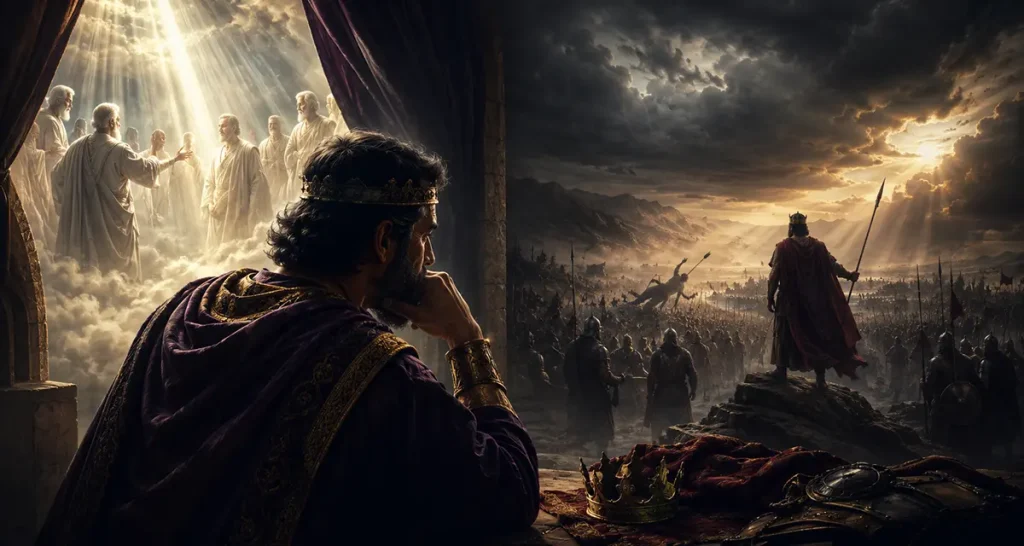
Yes. And that is what makes the account so unsettling. If Ahab were simply ignorant, the story would be easier to process. But he is not ignorant. He is resisting what he already knows.
What you described reveals something profound about the fallen human heart.
🪞 Ahab Did Not Reject the Facts
Ahab never disputes Micaiah’s authenticity.
In fact, his complaint almost assumes it.
“I hate him, because he does not prophesy good concerning me, but evil.” (1 Kings 22:8)
Notice how strange that statement is.
He does not say:
“Micaiah lies.”
He says:
“I hate him.”
The issue is emotional and moral before it is intellectual.
His problem is not with the truthfulness of the prophet.
His problem is with the implications of the truth.
🎭 The Disguise Is the Masterpiece of Self-Deception
I think the disguise is one of the most psychologically revealing moments in all Scripture.
Ahab does not stay home.
That would be an admission that Micaiah was right.
Neither does he openly reject the prophecy.
That would require him to deny what he knows.
Instead, he creates a third option:
“The prophecy is true, but perhaps I can maneuver around it.”
What an extraordinary thing for a human mind to do.
He believes enough to disguise himself.
Yet he does not believe enough to repent.
He acknowledges the danger.
Yet he refuses the remedy.
📖 This Is Not Merely Ahab’s Story
The prophet Jeremiah said:
“The heart is deceitful above all things, and desperately wicked; who can know it?” (Jeremiah 17:9)
We often read that verse and think of outright lies.
But Ahab demonstrates a subtler form of self-deception.
He is not deceiving himself about whether God exists.
He is not deceiving himself about whether Micaiah is a prophet.
He is deceiving himself about whether he can remain unchanged before the truth.
That is much closer to home.
🔥 The Leaders in Jesus’ Day Did Something Similar
As you observed earlier, there is a remarkable parallel.
The chief priests did not need more evidence.
After the raising of Lazarus, they did not say:
“Jesus cannot perform miracles.”
Instead they said:
“What shall we do? For this Man works many signs.” (John 11:47)
Notice that.
They acknowledge the signs.
The problem is not the evidence.
The problem is what the evidence demands.
Ahab and the religious leaders both arrive at a terrifying place where reality itself becomes inconvenient.
👑 The Insanity of Fighting Omniscience
There is also something almost absurd about Ahab’s strategy.
Who gave the prophecy?
The God who sees all things.
Who is Ahab trying to fool?
Not Micaiah.
Not the Syrians.
Ultimately, he is trying to evade the gaze of the One who already revealed the future.
The disguise is almost a symbolic act of rebellion.
It says:
“I will acknowledge God’s knowledge, but I will still attempt to outmaneuver it.”
Psalm 139 exposes the futility of that impulse:
“Where can I go from Your Spirit?
Or where can I flee from Your presence?” (Psalm 139:7)
The answer is nowhere.
🌿 The Frightening Part
The frightening part is not that Ahab is uniquely wicked.
The frightening part is that Scripture presents him as recognizably human.
How often do we do softer versions of the same thing?
We read a passage that exposes us.
We feel conviction.
We know exactly what God is saying.
Yet instead of obeying, we begin negotiating.
We adjust.
We rationalize.
We create exceptions.
We modify the application.
Anything except simple surrender.
The heart often prefers strategy over repentance.
Absolutely. The thought was moving toward something even deeper than Ahab’s self-deception.
✨ Yet There Is One More Layer
What amazes me most is not merely that God exposed Ahab’s heart.
It is that God exposed it before the judgment fell.
Think about the sequence.
God could have simply allowed Ahab to march into battle and die.
Instead:
- He gave him Micaiah.
- He gave him a warning.
- He gave him an explanation.
- He even pulled back the curtain on the heavenly council.
Ahab was shown what almost no human being in Scripture is shown.
For a brief moment, heaven interprets earth.
The king is told exactly what is happening.
And yet he refuses to repent.
👑 The Disguise Reveals More Than the Prophecy
At first glance, the climax of the story seems to be the prophecy coming true.
But there is something equally important happening.
The disguise exposes Ahab himself.
His response to the prophecy becomes a revelation of his heart.
Had he repented, the story would have looked very different.
Instead, he chooses concealment.
In a sense, the prophecy tests him.
Not because God needs information—God already knows his heart—but because the king’s heart must be brought into the open.
🌿 God Often Does This
This pattern appears throughout Scripture.
Adam
After the fall, God asks:
“Where are you?” (Genesis 3:9)
God was not seeking geographical information.
He was drawing Adam into self-revelation.
Cain
“Where is Abel your brother?” (Genesis 4:9)
Again, God knew.
The question exposed Cain.
Peter
After the resurrection:
“Simon, son of Jonah, do you love Me?” (John 21:15)
Jesus knew the answer.
Peter needed to see Peter.
🔥 The Word Reveals Us to Ourselves
One of the functions of God’s Word is not merely to tell us about God.
It tells us about ourselves.
Hebrews says:
“For the word of God is living and powerful, and sharper than any two-edged sword…” (Hebrews 4:12)
Then notice where the passage ends:
“And there is no creature hidden from His sight, but all things are naked and open to the eyes of Him to whom we must give account.” (Hebrews 4:13)
That shift is profound.
The writer moves seamlessly from the Word that searches us to the God who searches us because, ultimately, the Word is the expression of the One who speaks it.
The result is that when God’s Word comes to us, we are not merely reading a text. We are being encountered by the living God.
🔍 Ahab Was Not Just Hearing a Prophecy
This is what makes Ahab’s situation so serious.
He was not merely evaluating Micaiah’s opinion.
He was standing before the gaze of God.
The prophecy was not information about the future.
It was an invitation to come into agreement with reality.
When Micaiah spoke, God was effectively saying:
“Ahab, this is who you are.
This is where you are going.
This is what your heart has become.
Turn.”
And Ahab’s response was:
“I will change my clothes.”
That is one of the most tragic exchanges in Scripture.
God addresses the heart.
Ahab addresses the costume.
God exposes the man.
Ahab adjusts the appearance.
🎭 The Contrast Between Covering and Confession
This theme runs from Genesis to Revelation.
After the fall, Adam and Eve sewed fig leaves together (Genesis 3:7).
Their first instinct was covering.
God’s first movement was revelation.
Ever since then, fallen humanity has preferred management over confession.
We often want to improve the disguise rather than surrender the heart.
Ahab is doing exactly that.
He does not ask:
“What must I do?”
He asks:
“How can I avoid the consequences?”
The two questions seem similar, but they are worlds apart.
🌿 The Strange Mercy Hidden in Exposure
This is the layer that moves me the most.
When God exposes something in us, our first reaction is often discomfort.
Yet exposure is usually mercy in action.
A wound that remains hidden cannot be healed.
A disease that remains concealed cannot be treated.
Ahab viewed the prophet as his enemy.
But Micaiah was actually the last friend standing in the room.
The four hundred prophets told Ahab what he wanted.
Micaiah told Ahab what he needed.
One group comforted him toward destruction.
The other troubled him toward life.
👑 Ahab’s Last Opportunity
In a sense, Micaiah’s prophecy was Ahab’s final opportunity.
Not merely to avoid death—everyone dies eventually—but to humble himself before God.
Think about how many wicked kings received less light than Ahab.
He received:
- The ministry of Elijah.
- The ministry of Micaiah.
- Repeated warnings.
- Direct prophetic confrontation.
- Extraordinary demonstrations of God’s power.
And now he is given a glimpse behind the veil of history itself.
The tragedy is not that God withheld light.
The tragedy is that Ahab kept turning away from it.
✨ The Great Difference Between Ahab and the Saints
The saints are not those who never discover darkness within themselves.
The saints are those who stop defending it.
David, Peter, Isaiah, Job—all of them had moments when God’s light revealed uncomfortable truths.
Isaiah cried:
“Woe is me, for I am undone!” (Isaiah 6:5)
Peter cried:
“Depart from me, for I am a sinful man, O Lord!” (Luke 5:8)
Job said:
“I abhor myself, and repent in dust and ashes.” (Job 42:6)
None of these men looked good in the light.
But they remained in it.
Ahab spent his energy trying to avoid the light.
The saints, however painfully, surrendered to it.
❤️ The Gospel’s Answer to Ahab
Ultimately, the Gospel offers something Ahab never embraced.
The Gospel says:
Stop hiding.
Stop disguising.
Stop managing appearances.
Come into the light.
John writes:
“If we confess our sins, He is faithful and just to forgive us our sins and to cleanse us from all unrighteousness.” (1 John 1:9)
Notice the astonishing difference.
For fallen man, being fully known sounds terrifying.
For the believer, being fully known becomes the doorway to grace.
Ahab heard God’s truth and reached for a disguise.
The Gospel invites us to hear God’s truth and reach for Christ.
One covers himself.
The other is covered by Another.
And that may be the deepest layer in the entire story: Ahab is a picture of humanity’s ancient instinct going all the way back to Eden—when confronted by God, we reach for a covering of our own making. The Gospel announces that God has already provided the covering. The question is whether we will keep sewing fig leaves and disguises, or whether we will finally step into the light and let Him clothe us. ✨