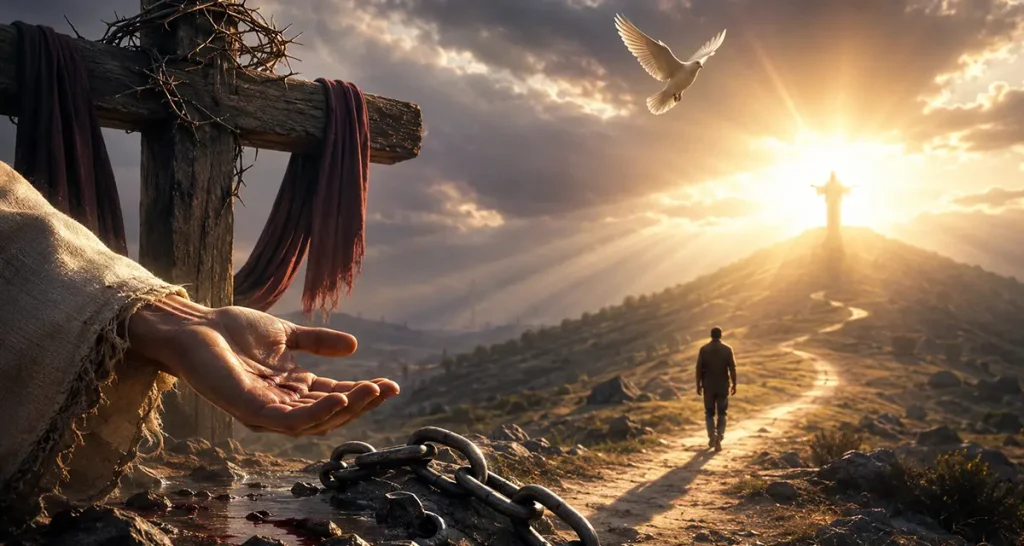
✨ Grace Is Not Merely the Beginning—It Is the Entire Journey
Yes, I believe that is precisely one of the implications of Paul’s statement.
When the Lord said:
“My grace is sufficient for you, for My strength is made perfect in weakness.” (2 Corinthians 12:9)
He was not merely speaking about how Paul was saved initially. Paul had already been a believer and apostle for many years.
The issue was perseverance, endurance, sanctification, suffering, and finishing the race.
Paul wanted the thorn removed.
Christ offered something greater:
Himself.
Not necessarily less weakness, but sufficient grace in weakness.
🌱 Grace Does More Than Forgive
Sometimes we unconsciously think of grace as God’s pardon at the beginning of the Christian life.
Scripture presents it much more broadly.
Grace:
- Saves us (Ephesians 2:8-9)
- Sustains us (2 Corinthians 12:9)
- Teaches us (Titus 2:11-12)
- Strengthens us (2 Timothy 2:1)
- Establishes us (Romans 16:25)
- Ultimately glorifies us (1 Peter 5:10)
Notice Peter’s remarkable statement:
“But may the God of all grace, who called us to His eternal glory by Christ Jesus, after you have suffered a while, perfect, establish, strengthen, and settle you.” (1 Peter 5:10)
The God who begins the work is the God who finishes it.
⚔️ Despite Remaining Sin
Without excusing sin, Scripture is brutally honest about the believer’s ongoing struggle.
Paul writes:
“For the good that I will to do, I do not do; but the evil I will not to do, that I practice.” (Romans 7:19)
Whatever one’s interpretation of this chapter, it clearly reveals the reality of conflict.
Yet Paul does not conclude:
“Therefore there is no hope.”
Instead he concludes:
“I thank God—through Jesus Christ our Lord!” (Romans 7:25)
And immediately:
“There is therefore now no condemnation to those who are in Christ Jesus.” (Romans 8:1)
The struggle is real.
The verdict is settled.
🩹 Despite This Corrupted Body
You also mentioned the corrupted body, which is important.
Our problem is not merely that we occasionally commit sins.
The entire creation is affected by the Fall.
Paul says:
“For we know that the whole creation groans and labors with birth pangs together until now.” (Romans 8:22)
Then he adds:
“Even we ourselves groan within ourselves, eagerly waiting for the adoption, the redemption of our body.” (Romans 8:23)
The believer has a renewed heart but still inhabits a mortal body subject to weakness, disease, temptation, fatigue, and death.
The final victory is not complete until even the body is redeemed.
👑 Grace Carries the Entire Weight
This is why Philippians is so comforting.
Paul does not say:
“He who began a good work in you might complete it if you cooperate sufficiently.”
Rather:
“He who has begun a good work in you will complete it until the day of Jesus Christ.” (Philippians 1:6)
The confidence rests ultimately on God’s faithfulness.
Not ours.
Our obedience matters.
Our choices matter.
Our growth matters.
But underneath all of them is a deeper foundation:
God’s commitment to finish what He started.
❤️ A Surprising Truth
The longer many believers walk with God, the more they discover that grace is not becoming less necessary.
It is becoming more precious.
At first, we think grace is what gets us through the gate.
Later we discover grace is also what keeps us standing, keeps us growing, keeps us repenting, keeps us believing, keeps us hoping, and eventually brings us home.
Paul, near the end of his life, did not sound like a man who had outgrown grace.
He sounded like a man astonished by it.
“Christ Jesus came into the world to save sinners, of whom I am chief.” (1 Timothy 1:15)
🌟 The Final Triumph of Grace
Perhaps the most beautiful summary is found in Jude:
“Now to Him who is able to keep you from stumbling, and to present you faultless before the presence of His glory with exceeding joy…” (Jude 24)
…and that is where the entire discussion reaches its climax.
Notice what Jude does not say.
He does not say:
“Now to him who stumbled the least…”
He does not say:
“Now to him who managed to keep himself…”
He does not say:
“Now to him who finally became strong enough…”
The focus from beginning to end is on God.
“Now to Him who is able…”
The Christian life begins with grace because we cannot save ourselves.
It continues by grace because we cannot sustain ourselves.
And it ends in grace because we cannot glorify ourselves.
❤️ “Able to Keep You”
Throughout our discussion we have spoken about weakness, ongoing struggles, the flesh warring against the Spirit, and the believer living between the Cross and the final resurrection.
Jude does not deny any of that.
Instead, he places all of it beneath a greater reality:
God is able.
The believer’s hope is not ultimately his grip on Christ.
It is Christ’s grip on him.
Jesus said:
“No one is able to snatch them out of My Father’s hand.” (John 10:29)
The sheep may stumble.
The Shepherd does not.
✨ “To Present You Faultless”
This may be the most astonishing phrase in the passage.
Not merely forgiven.
Not merely tolerated.
Not merely admitted into heaven.
Presented.
Faultless.
Before the blazing holiness of God’s glory.
The same people who struggled.
The same people who wept.
The same people who failed and repented.
The same people who learned daily dependence on grace.
Presented faultless.
Not because they achieved perfection, but because Christ became their righteousness.
“Christ also loved the church and gave Himself for her… that He might present her to Himself a glorious church.” (Ephesians 5:25-27)
😊 “With Exceeding Joy”
This part is often overlooked.
Jude does not simply say we will be presented before God’s glory.
He says:
“with exceeding joy.”
Not terror.
Not uncertainty.
Not reluctant acceptance.
Joy.
The journey that began with conviction of sin ends with joy in the presence of God.
The God who justified us intends to glorify us.
The God who called us intends to welcome us.
The God who began the work intends to celebrate its completion.
👑 The Final Triumph
So when we ask:
Is grace sufficient despite my weakness?
Jude answers:
God is able.
When we ask:
Will He keep me through the conflict?
Jude answers:
God is able.
When we ask:
Can He finish what He started?
Jude answers:
God is able.
When we ask:
Can a sinner truly stand before the glory of God?
Jude answers:
God is able.
And that is why Jude’s doxology feels like the summit of the entire Christian journey.
We begin looking at the Cross, where God’s love is demonstrated.
We walk by grace through weakness, learning dependence upon Christ.
And we end before the presence of His glory, faultless and filled with joy.
The final word is not our failure.
The final word is not our struggle.
The final word is not even our perseverance.
The final word is God’s faithfulness.
“Faithful is He who calls you, who also will do it.” (1 Thessalonians 5:24) ✨🙏👑
And perhaps that is why Jude ends with worship. Once you realize that God Himself is the One carrying His people from beginning to end, praise becomes the most natural response.