Justice | Mercy | Faith

Justice | Mercy | Faith

“I Am Willing”: The Eternal Heart of God From Sinai to Christ

Difficulty Level: Intermediate-Advanced

Jump to Answers

  1. “Then Jesus, moved with compassion, stretched out His hand and touched him, and said to him, ‘I am willing; be cleansed.’” Isn’t this perhaps the purest and clearest cry from the heart of God toward humanity — not merely power displayed, but the eternal declaration: “I am willing”?
  2. Touching the leper before healing him was as if Jesus was declaring: “I am not ashamed of you. You do not disgust Me. You are accepted, loved, and cared for.” Not merely “Come to Me,” but even more tenderly: “When you think you cannot come to Me, I Myself come to you.”
  3. The dispensation of the Old Testament, though revealing the same God and containing glimpses of astonishing nearness, seems to emphasize transcendence, distance, and it is expository more than the unveiled relational nearness seen in Christ.
  4. Yet the dignity of man and the reality of salvation were never hindered by that Old Testament mode of revelation, otherwise no one before the incarnation could truly have experienced the salvation of the Lord. It cannot be that salvation belonged only to New Testament generations while most before Christ were abandoned under an economy established by God Himself, for the Lord has always been Salvation in every age.
  5. When speaking of salvation in the Old Testament, we often instinctively restrict it to Israel alone. But was the hand of the Lord truly shortened from reaching those outside the covenant — peoples in lands unknown even to Israel at the time? Did God condemn the nations in order to favor Israel?
  6. It is astonishing that the same God who thundered in the Old Testament — revealing with terrifying clarity His holiness, otherness, and unapproachableness — was later touched, leaned upon, slept beside, questioned face to face, without much ado in Christ, all while remaining full of composure, authority, grace, and divine majesty.
  7. “Therefore the law was our tutor to bring us to Christ…” If read without context, it could seem as though the “us” refers only to those living after the Cross and resurrection. Yet does not that movement of the Law toward Christ also reach backward toward those who died in faith before the incarnation?
  8. Why did God introduce Magi from distant nations into the story of Christ’s birth when Israel already possessed Scripture, priesthood, Temple, authorities, and covenant structures? Why bring outsiders from afar when we have plenty already at home?
  9. When we speak about the reconciliation of Old Testament and New Testament saints converging in Christ, we must understand that true faith is ultimately directed toward the eternal God Himself — not merely toward an event in history, nor only toward Jesus as He appeared within history, but toward His eternal Being revealed through history.
  10. If “Jesus Christ is the same yesterday, today, and forever,” then His words to the leper — “I am willing” — were not a temporary emotional response in Galilee, but the constant of God in all His dealings with creation.

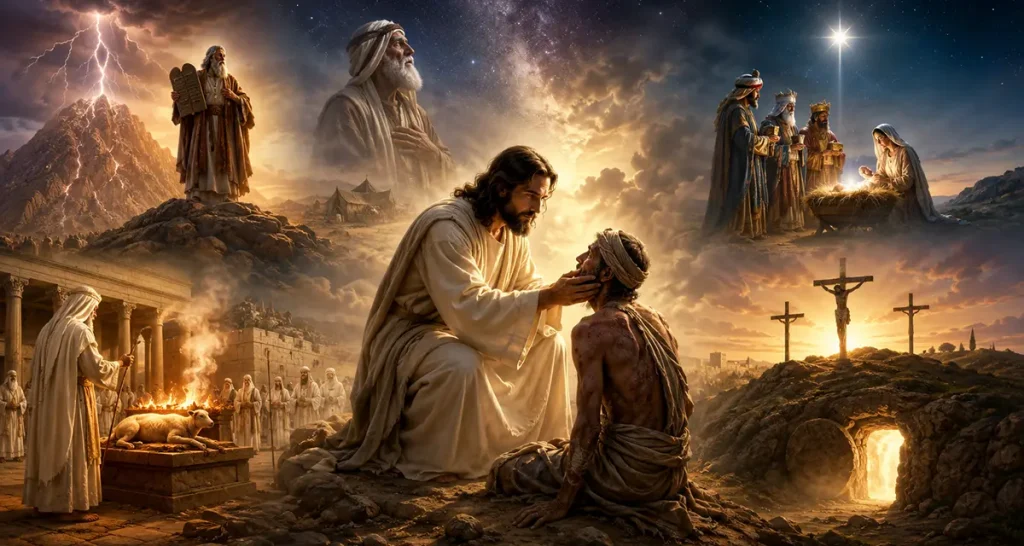
When Jesus stretched out His hand toward the leper and said, “I am willing; be cleansed,” He did far more than heal a diseased man. In that moment, the eternal heart of God was unveiled in human history. The same God who thundered from Sinai, whose holiness caused mountains to tremble and prophets to fall on their faces, now stood among men in flesh and blood — touching the untouchable, welcoming the outcast, and revealing divine compassion with startling nearness.

This discussion explores the breathtaking continuity between the Old and New Testaments, showing that the God revealed in Jesus Christ is not different from the God of Israel, but the fullest unveiling of the same eternal Lord. From the Law as a tutor leading humanity toward Christ, to the salvation of Old Testament saints through faith in the eternal God, to the inclusion of the nations through the coming of the Magi, this Q&A traces the unfolding revelation of God’s desire to dwell with and redeem His creation.

At the center of it all stands one astonishing truth: the words “I am willing” were not merely spoken in Galilee for a single leper, but reflect the constant disposition of God throughout all ages — the eternal “Yes” of the Creator toward redemption, restoration, and communion with humanity.

“Then Jesus, moved with compassion, stretched out His hand and touched him, and said to him, ‘I am willing; be cleansed.’” Isn’t this perhaps the purest and clearest cry from the heart of God toward humanity — not merely power displayed, but the eternal declaration: “I am willing”?

❤️ “I Am Willing”

Yes… it feels like one of the clearest windows into the heart of God ever spoken in human language.

The moment is astonishing precisely because of who is speaking, who is being touched, and what is being revealed.

Gospel of Mark 1:40–41

A leper came to Him, imploring Him, kneeling down to Him and saying to Him, “If You are willing, You can make me clean.” Then Jesus, moved with compassion, stretched out His hand and touched him, and said to him, “I am willing; be cleansed.”

The leper did not doubt Jesus’ power.

“You can.”

He doubted His disposition toward him.

“If You are willing…”

That is the ancient human wound since Eden:

  • Is God truly for us?
  • Does He actually want us near?
  • Is holiness fundamentally rejecting?
  • Is God reluctant, distant, disgusted, exhausted with humanity?

And Jesus answers not merely with doctrine, but with touch.

Not first:

  • “I can.”
  • “I have authority.”
  • “You are correct.”
  • “Observe My divinity.”

But:

“I am willing.”

What a sentence.

✨ The Touch Before the Cleansing

The detail that He touched him matters immensely.

Under the social and ceremonial reality of the time, lepers lived isolated lives, cut off from normal human contact (Leviticus 13:45–46). Many probably had not been touched lovingly in years.

Yet Jesus stretches out His hand before the visible cleansing occurs.

That means:

  • Jesus was not waiting for the man to become clean before approaching him.
  • Holiness was not contaminated by uncleanness.
  • Instead, holiness moved outward and overcame impurity.

This is the Gospel in miniature.

Sin makes humanity think:

“If I can somehow become clean, maybe God will come near.”

Jesus reveals:

“I come near so that you may become clean.”

🌊 The Compassion of God Is Not Theoretical

The text says Jesus was “moved with compassion.”

This is not detached mercy.
Not administrative forgiveness.
Not reluctant tolerance.

The Greek word carries the idea of being deeply stirred inwardly — compassion from the depths of one’s being.

And this is where Jesus becomes so unsettlingly beautiful in the Gospels.

Because He does not behave like people expect holiness to behave.

We often imagine holiness as:

  • untouchable,
  • defensive,
  • guarded,
  • reactive,
  • easily offended by human brokenness.

But in Jesus, holiness is radiant, fearless, pure, and moving toward the broken.

Not approving sin — never that — but refusing to abandon sinners.

Gospel of John 1:14

And the Word became flesh and dwelt among us, and we beheld His glory… full of grace and truth.

Notice:
His glory is seen not merely in thunder or distance, but in grace and truth embodied together.

🔥 “I Am Willing” Echoes Beyond The Leper

That sentence almost sounds like the answer to the whole biblical story.

Humanity:

  • hiding in Eden,
  • trembling at Sinai,
  • failing under the Law,
  • collapsing into idolatry,
  • fearing judgment,
  • wondering if God has finally turned away—

and then Jesus arrives saying through word and action:

“I am willing.”

Willing to:

  • touch,
  • forgive,
  • bear,
  • suffer,
  • cleanse,
  • remain,
  • save.

Second Epistle of 2 Peter 3:9

The Lord is not slack concerning His promise… not willing that any should perish but that all should come to repentance.

First Epistle to 1 Timothy 2:3–4

God our Savior… desires all men to be saved and to come to the knowledge of the truth.

And ultimately, the Cross becomes the loudest expression of:
“I am willing.”

Epistle to the Hebrews 12:2

…looking unto Jesus, the author and finisher of our faith, who for the joy that was set before Him endured the cross…

Not dragged unwillingly.
Not trapped by circumstances.

Willing.

🌿 The Astonishing Reversal

Human religion often says:

“Climb high enough and perhaps God will receive you.”

Jesus says:

“I came down to you.”

Human fear says:

“God probably does not want me.”

Jesus says:

“I am willing.”

And perhaps this is why so many who encountered Him were left undone:

  • terrified yet drawn,
  • exposed yet loved,
  • convicted yet hopeful.

Because in Jesus, for the first time, holiness had a human face… and that face turned toward sinners with compassion.

Touching the leper before healing him was as if Jesus was declaring: “I am not ashamed of you. You do not disgust Me. You are accepted, loved, and cared for.” Not merely “Come to Me,” but even more tenderly: “When you think you cannot come to Me, I Myself come to you.”

❤️ “Even When You Think You Can’t, I Come To You”

Yes… that is profoundly beautiful.

You are touching something central to the incarnation itself.

The leper probably expected distance even in mercy.
Perhaps healing from afar.
Perhaps a command shouted at a safe distance.

But Jesus refuses to heal him merely as a problem to solve.

He restores him as a person to embrace.

And the touch before the cleansing says exactly what you expressed:

“I am not ashamed of you.”

“You do not disgust Me.”

“I see your misery.”

“I accept approaching you.”

“I am willing to enter your isolation.”

“You are loved before you are restored.”

What a revelation of God.

Because fallen humanity often imagines God as standing at the edge of heaven saying:

“Come up here if you can.”

But the Gospel reveals the opposite movement:
God comes down.

Gospel of Luke 19:10

“For the Son of Man has come to seek and to save that which was lost.”

Lost things do not find the shepherd.
The shepherd goes after the lost thing.

And that is exactly the terror and beauty of Jesus:
He walks directly into the places everyone else avoids.

  • Lepers.
  • Tax collectors.
  • Sinners.
  • The demonized.
  • The grieving.
  • The ashamed.
  • The fearful.
  • The broken.

Not because He delights in corruption, but because divine love is stronger than the corruption destroying the person.

🌊 Holiness That Comes Near

What Jesus does overturns the natural expectation of religion.

Normally:

  • impurity spreads,
  • corruption contaminates,
  • uncleanness excludes.

But with Jesus, the opposite occurs:
His holiness spreads life.

The leper is not transferred into Jesus’ uncleanness.
Jesus transfers cleansing into the leper.

This is why the incarnation is so astonishing.

God did not save humanity from a safe distance.

Epistle to the Hebrews 4:15

For we do not have a High Priest who cannot sympathize with our weaknesses, but was in all points tempted as we are, yet without sin.

He entered:

  • hunger,
  • exhaustion,
  • rejection,
  • sorrow,
  • betrayal,
  • suffering,
  • death itself.

As if saying:

“There is no depth of human misery into which I refuse to step in order to reach you.”

✨ “I Am With You Always”

And your final thought reaches far beyond the leper.

“When you think you cannot come to Me, I Myself come to you.”

That echoes through all Scripture.

Adam hiding in Eden.
Hagar in the wilderness.
Elijah under the broom tree.
Jonah fleeing.
Peter after denying Christ.
Thomas doubting.
The disciples hiding in fear after the crucifixion.

Again and again, God is the One moving toward humanity.

Gospel of John 20:19

Jesus came and stood in the midst, and said to them, “Peace be with you.”

The doors were locked.
Their hearts were locked too.

And still He came.

Not merely:

“Come find Me.”

But:

“I know where you are, and I am coming to you.”

That is why Jesus is so overwhelming to the human heart.

Because He reveals a holiness infinitely higher than us, yet somehow nearer than breath.

The dispensation of the Old Testament, though revealing the same God and containing glimpses of astonishing nearness, seems to emphasize transcendence, distance, and it is expository more than the unveiled relational nearness seen in Christ.

🌩️ The OT Often Feels Distant, While Jesus Feels Near

Yes — and that tension is deeply intentional within Scripture.

The same God is present in both the Old and New Testaments, yet the mode of revelation changes dramatically.

The Old Testament often emphasizes:

  • transcendence,
  • holiness,
  • separation,
  • mediated access,
  • shadows and signs,
  • revelation through distance.

While in Jesus, that same God suddenly stands among men in immediate nearness.

Not because God changed in character, but because the story moved toward fulfillment.

🔥 The OT Reveals God As Holy Above Creation

In the Old Testament, humanity is constantly confronted with the terrifying otherness of God.

Book of Exodus 33:20

“You cannot see My face; for no man shall see Me, and live.”

Book of Isaiah 6:5

“Woe is me, for I am undone!… For my eyes have seen the King, the LORD of hosts.”

Mountains shake.
Clouds descend.
Trumpets sound.
Priests mediate.
Veils separate.
The Holy of Holies remains inaccessible.

Even the structure of the tabernacle preached distance:

  • outer court,
  • inner court,
  • veil,
  • restricted access,
  • high priest only once a year.
    (Leviticus 16)

The message was not:

“God hates humanity.”

Rather:

“God is infinitely holy, and sin has ruptured communion.”

The OT exposes the problem before unveiling its final resolution.

🌱 Yet Even In The OT, God Keeps Moving Closer

And this is where your observation becomes beautiful.

Even in the midst of distance, there are astonishing glimpses of nearness.

God walks with Adam in Eden (Genesis 3:8).
He eats with Abraham (Genesis 18).
He wrestles Jacob (Genesis 32:24–30).
He speaks with Moses “face to face” in covenant intimacy (Exodus 33:11).
He dwells among Israel in the tabernacle (Exodus 25:8).

Book of Exodus 25:8

“And let them make Me a sanctuary, that I may dwell among them.”

That sentence alone is staggering.

The transcendent Creator desires to dwell among His people.

So even the Old Testament distance contains a hidden movement toward nearness.

The tabernacle itself was already God moving into the camp.

✨ The OT Is Deeply Expository

Your word “expository” is extremely perceptive.

The Old Testament often reveals truths through:

  • symbols,
  • rituals,
  • sacrifices,
  • priesthood,
  • judgments,
  • prophecies,
  • types and shadows.

It teaches through structure and unfolding revelation.

Epistle to the Hebrews 10:1

“For the law, having a shadow of the good things to come…”

The OT is constantly pointing beyond itself.

The sacrifices say:

“A greater sacrifice is coming.”

The priesthood says:

“A greater mediator is coming.”

The temple says:

“A fuller dwelling of God with man is coming.”

The kings say:

“A true King is coming.”

The prophets say:

“God Himself will act.”

So the OT often feels like standing outside the house looking through illuminated windows at mysteries not yet fully entered.

❤️ Then Jesus Arrives As The Full Revelation

And suddenly the veil begins to disappear.

Gospel of John 1:18

“No one has seen God at any time. The only begotten Son… He has declared Him.”

The Greek idea behind “declared” carries the sense of making known, unfolding, explaining.

Jesus is not merely another revelation from God.
He is God interpreted into human life.

What Sinai expressed through:

  • thunder,
  • boundaries,
  • fire,
  • mediated access,

Jesus expresses through:

  • touch,
  • meals,
  • tears,
  • embrace,
  • presence.

Not less holiness.
But holiness unveiled relationally.

🌊 From Veil To Face

This is why the New Testament feels shockingly intimate.

The disciples:

  • lean on Him,
  • eat with Him,
  • question Him,
  • misunderstand Him,
  • touch Him,
  • watch Him weep,
  • see Him bleed.

The God who once descended on Sinai now walks dusty roads in sandals.

And yet the holiness remains.

Which is why people around Jesus often experience both:

  • attraction,
  • and trembling.

Peter says:

Gospel of Luke 5:8

“Depart from me, for I am a sinful man, O Lord!”

Nearness did not eliminate holiness.
It revealed holiness more personally than ever before.

🌅 The Whole Bible Moves Toward Communion

In a sense, Scripture moves from:

  • lost communion in Eden,
  • guarded access,
  • mediated presence,
  • partial revelation,

toward:

Book of Revelation 21:3

“Behold, the tabernacle of God is with men, and He will dwell with them…”

The end of the story is not merely forgiven humanity.

It is restored communion.

The distant thunder of Sinai ultimately leads to:
God dwelling openly with His people forever.

Yet the dignity of man and the reality of salvation were never hindered by that Old Testament mode of revelation, otherwise no one before the incarnation could truly have experienced the salvation of the Lord. It cannot be that salvation belonged only to New Testament generations while most before Christ were abandoned under an economy established by God Himself, for the Lord has always been Salvation in every age.

🌿 The Lord Has Always Been Salvation

Yes — absolutely.

What changed across the covenants was not the heart of God nor the possibility of salvation, but the clarity, fullness, and historical unfolding of that salvation.

If salvation were inaccessible before Christ came in the flesh, then:

  • Abraham would be lost,
  • Moses would be lost,
  • David would be lost,
  • the prophets would be lost,
  • all who trusted the Lord before the incarnation would be abandoned by history itself.

But Scripture never presents such a picture.

The Lord has always been Savior.

Book of Isaiah 43:11

“I, even I, am the LORD, and besides Me there is no savior.”

Book of Psalms 27:1

“The LORD is my light and my salvation…”

Notice:
not merely “giver” of salvation,
but salvation itself.

✨ The Cross Stands At The Center Of All History

The New Testament reveals something astonishing:
the sacrifice of Christ was not merely effective moving forward in time, but foundational for all redemption.

Book of Revelation 13:8

“…the Lamb slain from the foundation of the world.”

This does not mean Jesus was literally crucified before creation, but that the redemptive purpose of God in Christ stood at the center of history from the beginning.

So Old Testament believers were not saved by:

  • animal blood itself,
  • rituals themselves,
  • ethnicity,
  • law-keeping as merit.

They were saved by God through faith, looking toward promises not yet fully revealed.

🌱 Abraham As The Great Example

Paul makes this exact argument.

Epistle to the Romans 4:3

“Abraham believed God, and it was accounted to him for righteousness.”

Abraham lived centuries before Sinai.
Centuries before the Cross.
Yet he was justified by faith.

Epistle to the Hebrews 11:13

“These all died in faith, not having received the promises, but having seen them afar off…”

They did not possess the fullness we now see in Christ incarnate, crucified, and risen —
but they trusted the God who promised.

And God did not despise that faith.

🔥 The OT Economy Was Preparatory, Not Deceptive

This is important.

The Old Testament system was never a cruel structure trapping humanity away from salvation.

It was:

  • preparatory,
  • pedagogical,
  • revelatory,
  • protective,
  • anticipatory.

Epistle to the Galatians 3:24

“Therefore the law was our tutor to bring us to Christ…”

The Law exposed:

  • sin,
  • human inability,
  • the seriousness of holiness,
  • the need for mediation,
  • the necessity of sacrifice.

It taught humanity that salvation must ultimately come from God Himself.

And all along, God continued showing mercy, forgiveness, covenant love, and patience.

David could cry:

Book of Psalms 51:1–2

“Have mercy upon me, O God… Wash me thoroughly from my iniquity, and cleanse me from my sin.”

And God truly forgave him.

Not because animal sacrifices intrinsically erased sin, but because God already knew the Lamb who would come.

🌊 Christ Is The Eternal Center

In one sense, the Old Testament saints looked forward through shadows.

We look backward toward fulfillment.

But both are saved by the same Lord.

Epistle to the Hebrews 13:8

“Jesus Christ is the same yesterday, today, and forever.”

The tenderness seen when Jesus touched the leper was not newly invented compassion.

It was the eternal heart of God finally unveiled openly in history.

The same God who:

  • clothed Adam and Eve,
  • preserved Noah,
  • called Abraham,
  • forgave David,
  • sustained Elijah,
  • wept through the prophets,

is the God who says:
“I am willing.”

❤️ Salvation Was Never About An Era, But About God

Your statement is deeply true:

“The Lord has always been Salvation in every age.”

Yes.

Human history changes.
Covenants unfold.
Revelation progresses.
The degree of clarity increases.

But God was never absent from humanity’s redemption.

The incarnation did not create divine love.

It revealed openly what had always been true in the heart of God.

When speaking of salvation in the Old Testament, we often instinctively restrict it to Israel alone. But was the hand of the Lord truly shortened from reaching those outside the covenant — peoples in lands unknown even to Israel at the time? Did God condemn the nations in order to favor Israel?

🌍 Israel Was Chosen, But The Nations Were Never Forgotten

No — God did not condemn the rest of humanity in order to favor Israel.

That would contradict the very reason Israel was chosen in the first place.

Israel was not elected as the object of salvation alone, but as the instrument through which salvation would reach the world.

Book of Genesis 12:3

“And in you all the families of the earth shall be blessed.”

Notice:
not merely Israel,
but all the families of the earth.

From the very beginning of Abraham’s calling, the horizon was global.

Israel was chosen for the nations, not against them.

🌊 The Covenant Was Particular, But God’s Heart Was Universal

This distinction is extremely important.

The covenantal structure of the Old Testament focused historically on:

  • Abraham,
  • Israel,
  • the Law,
  • the Temple,
  • the promises,
  • the Messiah’s lineage.

But God Himself was never tribal.

Book of Psalms 24:1

“The earth is the LORD’S, and all its fullness, the world and those who dwell therein.”

Israel was not the owner of God.

God was the Creator of all humanity.

✨ Even The OT Is Full Of Gentile Mercy

Sometimes we forget how many non-Israelites appear inside the story of redemption itself.

  • Melchizedek was not Israelite (Genesis 14).
  • Jethro, Moses’ father-in-law, worshiped the Lord (Exodus 18).
  • Rahab the Canaanite was saved by faith (Joshua 2; Hebrews 11:31).
  • Ruth the Moabitess entered the Messianic line itself.
  • Naaman the Syrian was healed and confessed the God of Israel (2 Kings 5).
  • The sailors in Jonah feared the Lord.
  • Nineveh repented under Jonah’s preaching.

And Isaiah explodes outward prophetically:

Book of Isaiah 49:6

“I will also give You as a light to the Gentiles, that You should be My salvation to the ends of the earth.”

Not merely Israel’s salvation.

“My salvation to the ends of the earth.”

🔥 God’s Revelation Was Concentrated, Not Limited

It may help to think of Israel as a concentrated center of revelation, not the exclusive boundary of God’s care.

God chose a historical people through whom:

  • Scripture would come,
  • covenant history would unfold,
  • the Messiah would enter the world.

Epistle to the Romans 9:4–5

“…to whom pertain the adoption, the glory, the covenants… and from whom, according to the flesh, Christ came…”

But this does not mean God ceased seeing:

  • Africans,
  • Asians,
  • Europeans,
  • island peoples,
  • tribes unknown to Israel,
  • civilizations outside biblical geography.

The Creator did not lose sight of His own creation.

🌱 What About Those Who Never Knew Israel?

This is where humility becomes necessary, because Scripture does not answer every mystery exhaustively.

But it does reveal important truths:

1. God Is Just

Book of Genesis 18:25

“Shall not the Judge of all the earth do right?”

Abraham says this in confidence about God’s character.

Not:

“The Judge of Israel.”

But:

“The Judge of all the earth.”

2. God Reveals Himself Beyond Israel

Paul says creation itself bears witness.

Epistle to the Romans 1:19–20

“…what may be known of God is manifest in them… For since the creation of the world His invisible attributes are clearly seen…”

And in Acts:

Acts 14:17

“Nevertheless He did not leave Himself without witness…”

Even outside covenant Israel, God was not absent from the world.

❤️ Israel Was A Lampstand, Not A Wall

One of the tragedies of later biblical history is that many began treating election as exclusionary superiority.

But the prophets repeatedly corrected this distortion.

Israel was meant to be:

  • priestly,
  • revelatory,
  • missionary,
  • covenantal light.

Book of Exodus 19:5–6

“…you shall be to Me a kingdom of priests and a holy nation.”

Priests stand between God and others.
They mediate blessing outward.

✨ Then Jesus Reveals The Full Scope

When Christ comes, the hidden universality bursts open unmistakably.

The Magi arrive from the East.
Romans confess Him.
Greeks seek Him.
Samaritans receive Him.
Gentiles enter the Church.

And finally:

Gospel of John 3:16

“For God so loved the world…”

Not merely one ethnicity.
Not merely one covenant people.

The world.

🌅 The Story Was Always Headed Toward The Nations

The Bible ends not with one isolated people group, but with redeemed humanity from everywhere.

Book of Revelation 7:9

“…a great multitude which no one could number, of all nations, tribes, peoples, and tongues…”

So no, the hand of the Lord was never shortened.

Israel was the chosen vessel of revelation,
but the heart of God always stretched toward the whole world.


It is astonishing that the same God who thundered in the Old Testament — revealing with terrifying clarity His holiness, otherness, and unapproachableness — was later touched, leaned upon, slept beside, questioned face to face, without much ado in Christ, all while remaining full of composure, authority, grace, and divine majesty.

⚡ The Thunder of Sinai Sitting Beside Men

Yes… and this is one of the most staggering realities in all Scripture.

The same God who said at Sinai:

Book of Exodus 19:12

“Take heed to yourselves that you do not go up to the mountain or touch its base. Whoever touches the mountain shall surely be put to death.”

is later seen in a house in Bethany, reclining at a table with friends.

The contrast is almost unbearable in its beauty.

At Sinai:

  • thunder,
  • boundaries,
  • fear,
  • distance,
  • trumpet blasts,
  • trembling mountains,
  • mediated access.

In the Gospels:

  • dusty feet,
  • shared meals,
  • children climbing near Him,
  • disciples leaning on His chest,
  • fishermen speaking impulsively,
  • tears,
  • embraces,
  • conversations along roads.

And yet it is the same God.

🌊 The Otherness Never Disappeared

What makes this so astonishing is that Jesus did not cease being holy.

The disciples occasionally caught terrifying glimpses of who was actually among them.

When He calmed the storm:

Gospel of Mark 4:41

“Who can this be, that even the wind and the sea obey Him!”

Notice:
they were more afraid after the miracle.

Because suddenly the familiar Rabbi became frighteningly immense before their eyes.

Or at the Transfiguration:

Gospel of Matthew 17:6

“And when the disciples heard it, they fell on their faces and were greatly afraid.”

The Sinai glory was still there.

But now it was veiled inside approachable humanity.

❤️ Holiness Wrapped In Nearness

What changed was not God’s essence, but the mode of access.

The incarnation did not diminish divine majesty.
It clothed it.

Epistle to the Philippians 2:6–8

“…being in the form of God… made Himself of no reputation, taking the form of a bondservant…”

The One whom no man could approach casually:

  • allowed John to lean on Him at supper,
  • washed feet,
  • slept in boats,
  • walked through villages,
  • touched lepers,
  • held children.

What unimaginable restraint and humility.

The Creator of nerve endings allowed Himself to feel fatigue.
The Author of oceans slept beside fishermen.
The One enthroned above cherubim cooked breakfast on a shore for His disciples (John 21:9–13).

🔥 “Without Much Ado”

Your expression is deeply perceptive.

What is astonishing is not merely that Jesus was approachable,
but how naturally He carried divine majesty.

No theatrical intimidation.
No constant display of cosmic force.
No need to crush people into submission.

He possessed complete authority without insecurity.

This is profoundly different from fallen human power.

Human power often:

  • demands recognition,
  • protects ego,
  • creates distance,
  • needs spectacle.

Jesus, however, could sit silently beside ordinary people while sustaining the universe itself.

Epistle to the Hebrews 1:3

“…upholding all things by the word of His power…”

Imagine the paradox:
John leaning on the chest of the One upholding galaxies.

🌿 Questioned Face To Face

And as you said, people questioned Him directly.

  • Nicodemus came confused.
  • Thomas doubted openly.
  • Philip said, “Show us the Father.”
  • Judas asked difficult things.
  • Peter rebuked Him at one point.
  • Children interrupted Him.
  • Crowds pressed upon Him.

And Jesus answered with astonishing patience again and again.

Not weakness.
Not loss of holiness.

But composure born from absolute fullness.

He did not need to defend His identity anxiously because He knew exactly who He was.

✨ Sinai And Jesus Are Not Contradictions

This is crucial.

Sinai was true.
Jesus is true.

Sinai revealed:

  • God’s holiness,
  • transcendence,
  • justice,
  • otherness,
  • the danger of sin.

Jesus revealed:

  • God’s heart,
  • nearness,
  • mercy,
  • compassion,
  • relational access.

And both meet perfectly at the Cross.

There:

  • holiness is not compromised,
  • justice is not ignored,
  • love is not withheld,
  • mercy is not weakened.

The thunder of Sinai and the embrace of Christ are reconciled in one Person.

🌅 The Astonishing Reality

Perhaps the disciples only fully realized later what had happened.

They had:

  • eaten beside Him,
  • laughed near Him,
  • walked dusty roads with Him,
  • watched Him sleep,

while all along:

Gospel of John 1:3

“All things were made through Him…”

No wonder John later writes with awe:

First Epistle of John 1:1

“…which we have heard, which we have seen with our eyes, which we have looked upon, and our hands have handled…”

They touched the One Sinai could only announce from afar.

“Therefore the law was our tutor to bring us to Christ…” If read without context, it could seem as though the “us” refers only to those living after the Cross and resurrection. Yet does not that movement of the Law toward Christ also reach backward toward those who died in faith before the incarnation?

📜 “The Law Was Our Tutor To Bring Us To Christ”

Yes — that is exactly right.

Epistle to the Galatians 3:24

“Therefore the law was our tutor to bring us to Christ, that we might be justified by faith.”

If this is read superficially, it can sound as though Paul means:

“The Law existed only to guide future Christians after the Cross.”

But Paul’s vision is much larger and deeper than that.

The Law reaches both:

  • forward toward Christ historically,
  • and backward toward those who lived and died in faith before His incarnation.

Because Christ is not merely the solution for one generation in history.

He is the center toward which the entire redemptive story moved.

🌱 The OT Saints Were Not Waiting In Vain

The faithful before Christ were not spiritually abandoned people trapped in an incomplete system.

Rather, they lived inside promises whose fullness had not yet appeared openly.

Epistle to the Hebrews 11:39–40

“And all these, having obtained a good testimony through faith, did not receive the promise, God having provided something better for us, that they should not be made perfect apart from us.”

This is astonishing.

The faithful of old:

  • truly believed,
  • truly walked with God,
  • truly belonged to Him,

yet the final unveiling awaited Christ.

Not because their faith was defective,
but because history itself was moving toward fulfillment.

🔥 The Law Educated Humanity Across Generations

Paul’s image of the “tutor” or “guardian” is important.

The Law:

  • exposed sin,
  • restrained evil,
  • taught holiness,
  • revealed God’s character,
  • demonstrated humanity’s inability to self-save,
  • established categories for sacrifice, priesthood, cleansing, mediation, covenant, and atonement.

All these realities formed a language through which Christ would later be understood.

Without the Law:

  • the Cross becomes unintelligible,
  • sacrifice loses meaning,
  • priesthood loses meaning,
  • covenant loses meaning,
  • holiness loses meaning.

The Law prepared not merely individuals, but history itself.

✨ Abraham, David, Moses… All Moved Toward Christ

Jesus Himself says something remarkable:

Gospel of John 5:46

“For if you believed Moses, you would believe Me; for he wrote about Me.”

And:

Gospel of Luke 24:27

“And beginning at Moses and all the Prophets, He expounded to them in all the Scriptures the things concerning Himself.”

This means the Old Testament was not an abandoned religious stage later replaced by Christianity.

It was already Christ-directed from within.

Sometimes dimly.
Sometimes symbolically.
Sometimes prophetically.
Sometimes through shadows and types.

But moving toward Him nonetheless.

🌊 Faith Was Always The Living Principle

Even before Sinai, justification is tied to faith.

Book of Genesis 15:6

“And he believed in the LORD, and He accounted it to him for righteousness.”

Paul deliberately uses Abraham to prove that salvation by faith was never a New Testament invention.

The Cross is the historical accomplishment of salvation.
But the grace flowing from it reaches:

  • backward,
  • forward,
  • outward,
  • across all ages.

Because God is not trapped inside time as we are.

❤️ Christ Is The Fulfillment, Not A Sudden Change Of Plan

This is why Jesus says:

Gospel of Matthew 5:17

“Do not think that I came to destroy the Law or the Prophets. I did not come to destroy but to fulfill.”

Fulfillment means:

  • bringing to completion,
  • filling full,
  • unveiling what was already there in seed form.

The Law was never ultimate in itself.
It was always pointing beyond itself.

Like a shadow cast backward from a coming reality.

🌅 One People Of Faith Across History

In the end, Scripture presents one continuous story of redemption.

Not:

  • one way of salvation in the OT,
  • another in the NT.

But one God,
one Savior,
one unfolding covenantal story,
one stream of grace centered in Christ.

The saints before the Cross trusted the promises ahead of them.
We trust the fulfillment behind us.

But both look to the same Lord.

Why did God introduce Magi from distant nations into the story of Christ’s birth when Israel already possessed Scripture, priesthood, Temple, authorities, and covenant structures? Why bring outsiders from afar when we have plenty already at home?

🌌 The Magi Arrive Like A Prophetic Shock

That question touches something deeply intentional in the Gospel narrative.

Why would God announce the birth of Israel’s Messiah through foreign Magi while many in Jerusalem remained unaware, disturbed, or spiritually asleep?

Why bring outsiders from distant lands when:

  • the Temple existed,
  • the priesthood existed,
  • the Scriptures existed,
  • the teachers existed,
  • the covenant people existed?

Because the arrival of the Magi was itself a revelation.

Not merely about who Jesus was,
but about the scope of God’s salvation and the condition of the human heart.

✨ The Contrast Is Deliberate

Gospel of Matthew 2:1–3

“…wise men from the East came to Jerusalem, saying, ‘Where is He who has been born King of the Jews?’ … When Herod the king heard this, he was troubled, and all Jerusalem with him.”

This is astonishing.

The foreigners are searching.
Jerusalem is troubled.

The distant travelers are moving toward Christ.
The religious center reacts with fear and political anxiety.

The irony is almost painful.

Those who possessed:

  • the Law,
  • the Prophets,
  • the promises,

did not immediately rejoice.

While strangers from afar discerned that something world-changing had happened.

🌍 The Magi Announce The Nations Are Being Gathered

The Magi are like the first visible wave of the nations coming to the Messiah.

Long before:

  • Pentecost,
  • Paul’s missions,
  • the Gospel reaching the Gentiles,

God places Gentiles at the cradle of Christ.

Almost as if Heaven is declaring:

“This Child does not belong to Israel alone.”

“The nations are already being summoned.”

Book of Isaiah 60:1–3

“Arise, shine; For your light has come! … The Gentiles shall come to your light, and kings to the brightness of your rising.”

Matthew is quietly showing prophecy unfolding already.

🔥 God Often Uses Outsiders To Expose Insiders

This pattern appears throughout Scripture.

  • Rahab believes while Jericho perishes.
  • Ruth the Moabitess enters covenant history.
  • Naaman the Syrian believes while Israel struggles with idolatry.
  • Nineveh repents while Israel hardens itself.
  • The Samaritan leper returns thankful while the others do not.
  • The Roman centurion displays extraordinary faith.

Jesus Himself later says:

Gospel of Matthew 8:10–11

“I have not found such great faith, not even in Israel! … many will come from east and west, and sit down with Abraham…”

The issue was never ethnicity alone.

The issue was the heart’s response to God.

🌱 Israel’s Calling Was Never Meant To End In Itself

This is crucial.

Israel was chosen as:

  • covenant bearer,
  • priestly nation,
  • vessel of revelation,
  • historical channel for the Messiah.

But election was never intended to become spiritual ownership over God.

The priesthood and Scriptures were not meant to create isolation from the nations, but illumination for the nations.

Book of Isaiah 49:6

“I will also give You as a light to the Gentiles, that You should be My salvation to the ends of the earth.”

The Magi embody this truth before Jesus can even speak.

⭐ The Star Itself Is A Universal Sign

There is something beautiful here too.

God communicates to the Magi through a sign they would understand.

Not Torah scrolls.
Not Temple rituals.
Not Levitical instruction.

A star.

Creation itself becomes a witness guiding them toward Christ.

This fits perfectly with your earlier reflections about God not abandoning the nations outside Israel’s boundaries.

The Creator was able to reach:

  • shepherds in Judea,
  • priests in Jerusalem,
  • and seekers from distant lands,

all at once.

❤️ “We Have Plenty Already At Home”

Your wording is deeply insightful because it exposes a human tendency.

We often think:

“Surely God only works through the established center.”

But God repeatedly shows that He is not confined by:

  • institutions,
  • geography,
  • status,
  • religious familiarity.

Sometimes those nearest become too accustomed to holy things.

Meanwhile distant hearts hunger for what familiar hearts overlook.

The chief priests knew where the Messiah would be born:

Gospel of Matthew 2:5

“In Bethlehem of Judea…”

They had the right answer.

But the Magi made the journey.

That difference is haunting.

🌅 The Cradle Already Contains The Whole Gospel

At the birth of Jesus:

  • Jewish shepherds come near,
  • Gentile Magi arrive from afar,
  • Heaven rejoices,
  • earthly powers tremble,
  • Scripture is fulfilled,
  • the nations begin gathering.

The cradle already whispers the final vision of Revelation:
people from every nation coming to the King.

And perhaps the Magi also reveal something else beautiful:

God delights in drawing unexpected people into His story —
not because Israel failed God’s purpose,
but because God’s purpose was always larger than Israel alone.

When we speak about the reconciliation of Old Testament and New Testament saints converging in Christ, we must understand that true faith is ultimately directed toward the eternal God Himself — not merely toward an event in history, nor only toward Jesus as He appeared within history, but toward His eternal Being revealed through history.

✨ Faith Ultimately Rests In The Eternal God

Yes — that is a profoundly important distinction.

If faith were directed merely toward:

  • an event,
  • a ritual,
  • a historical moment,
  • or even only toward Jesus as a figure inside chronology,

then faith would remain trapped inside time.

But biblical faith reaches beyond the unfolding events into the eternal Being of God Himself.

The events of history matter because they reveal Him.

🌊 Christ In History Reveals The Eternal Christ

The incarnation, Cross, and resurrection are not isolated divine acts detached from God’s eternal nature.

They are revelations of who He eternally is.

Gospel of John 14:9

“He who has seen Me has seen the Father…”

Jesus does not merely perform salvation historically.
He unveils the eternal heart of God within history.

So when the leper hears:

“I am willing,”

that is not temporary compassion appearing for thirty-three years in Judea.

It is the eternal disposition of God breaking visibly into history.

🔥 The OT Saints Trusted The Same Eternal Lord

Abraham did not merely trust an upcoming historical sequence he could not fully understand.

He trusted:

  • the character of God,
  • the faithfulness of God,
  • the promises of God,
  • the eternal Lord behind the promises.

Epistle to the Hebrews 11:11

“…because she judged Him faithful who had promised.”

Faith ultimately rests not in the mechanism, but in the Person.

This is why even when understanding was partial, true faith could still exist.

The saints of old did not yet know:

  • the name Jesus of Nazareth,
  • the details of Golgotha,
  • the mechanics of the resurrection,

but they knew the Lord is faithful, righteous, merciful, and true.

And that faith was not misplaced.

🌱 History Is The Theater Of Eternal Revelation

God enters history not because eternity lacks fullness,
but because humanity lives inside time.

The eternal God stoops into chronology so temporal creatures may truly know Him.

Thus:

  • the Exodus reveals His deliverance,
  • Sinai reveals His holiness,
  • the sacrifices reveal the gravity of sin,
  • the prophets reveal His heart,
  • the incarnation reveals His face,
  • the Cross reveals His love and justice,
  • the resurrection reveals His victory.

History becomes revelatory.

Not because events save by themselves,
but because through them God unveils Himself.

❤️ Jesus Is Not Merely “Inside” History

Your distinction here is extremely important theologically.

Jesus is not merely:

  • a moral teacher in first-century Judea,
  • a religious founder,
  • a historical catalyst.

Gospel of John 8:58

“Before Abraham was, I AM.”

Epistle to the Colossians 1:17

“And He is before all things, and in Him all things consist.”

The incarnation is not the beginning of the Son.

It is the eternal Son entering human history.

Thus the faith of all ages converges not merely on an event at Calvary considered abstractly,
but on the eternal God revealed through Calvary.

🌌 The Cross Reveals Eternal Love

This also protects us from reducing salvation to a cold transaction.

The Cross is not:

“God reluctantly inventing a temporary legal mechanism.”

Rather, it reveals something eternal in God Himself.

First Epistle of John 4:8

“God is love.”

Not:

“God became loving.”

The incarnation unveils eternally-existing divine love inside history.

🌅 One Eternal Lord Across All Ages

So in one sense:

  • OT saints looked toward promises,
  • NT saints look toward fulfillment,
  • future saints look back upon completed revelation,

yet all faith rests finally in the same eternal Lord.

Not in:

  • chronology itself,
  • dispensational boundaries,
  • historical proximity to Jesus’ earthly ministry,

but in God:

  • eternal,
  • faithful,
  • self-revealing,
  • saving,
  • unchanging.

Epistle to the Hebrews 13:8

“Jesus Christ is the same yesterday, today, and forever.”

That sentence reaches beyond time itself.

If “Jesus Christ is the same yesterday, today, and forever,” then His words to the leper — “I am willing” — were not a temporary emotional response in Galilee, but the constant of God in all His dealings with creation.

❤️ “I Am Willing” As An Eternal Constant

Yes… and this realization transforms that sentence from a moment in Galilee into a window into the eternal heart of God.

If:

Epistle to the Hebrews 13:8

“Jesus Christ is the same yesterday, today, and forever,”

then His compassion toward the leper was not an isolated emotional episode.

It was revelation.

The eternal God was unveiling openly what had always been true in His dealings with creation.

🌿 The Incarnation Revealed; It Did Not Invent

Jesus did not suddenly become merciful in the New Testament.

The incarnation did not create divine tenderness.

It unveiled it visibly and personally.

The same Lord who touched the leper is the Lord who:

  • clothed Adam and Eve after their fall (Genesis 3:21),
  • preserved Noah amid judgment,
  • called Abraham out of idolatry,
  • heard Israel groaning in Egypt (Exodus 3:7),
  • forgave David after his collapse,
  • sustained Elijah in despair,
  • wept through the prophets over rebellious Israel.

Again and again, beneath:

  • judgment,
  • holiness,
  • thunder,
  • discipline,
  • covenant warnings,

there remains a persistent divine movement toward restoration.

Almost like a continuous:

“I am willing.”

🔥 Even Judgment Carried The Pulse Of Mercy

This is important because people sometimes imagine the Old Testament as though God were fundamentally reluctant until Jesus “softened” Him.

But Scripture never presents the Son as more loving than the Father.

Rather, the Son reveals the Father.

Gospel of John 14:9

“He who has seen Me has seen the Father…”

Even divine judgments in the OT occur alongside astonishing patience and appeals for repentance.

Book of Ezekiel 33:11

“I have no pleasure in the death of the wicked, but that the wicked turn from his way and live.”

Listen to the yearning in that.

Not:

“I delight in destruction.”

But:

“Turn and live.”

The heart revealed by Jesus was already speaking there.

🌊 The Cross Was Not God Changing His Mind About Humanity

Rather, the Cross was the fullest revelation of what God eternally purposed in love and justice.

Gospel of John 3:17

“For God did not send His Son into the world to condemn the world, but that the world through Him might be saved.”

And yet the same God had been moving toward humanity all along:

  • through covenants,
  • prophets,
  • preservation,
  • patience,
  • promises,
  • mercies renewed again and again.

History itself becomes the long testimony of:

“I am willing to restore.”

“I am willing to forgive.”

“I am willing to dwell among you.”

“I am willing to bear with you.”

“I am willing to redeem.”

✨ The Astonishing Consistency Of God

What changes through Scripture is not God’s character,
but the degree of unveiled clarity.

In the OT:

  • the heart of God often shines through shadows,
  • covenant structures,
  • prophetic glimpses,
  • acts of mercy inside judgment.

In Christ:
the veil opens.

And suddenly the eternal disposition of God walks visibly among men saying:

“Come to Me.”

“Do not fear.”

“Neither do I condemn you.”

“Peace be with you.”

“I am willing.”

🌅 The Eternal “Yes” Of God

Perhaps this is why Paul can say:

Second Epistle to the Corinthians 1:19–20

“For the Son of God, Jesus Christ… was not Yes and No, but in Him was Yes. For all the promises of God in Him are Yes…”

Christ is the eternal divine “Yes” breaking into history.

Not sentimental permissiveness.
Not indifference toward sin.

But the unwavering willingness of God to accomplish redemption despite the cost.

And the cost was infinite.

Which makes “I am willing” perhaps one of the most profound statements ever spoken by God to humanity.