Justice | Mercy | Faith

Justice | Mercy | Faith

The Kingdom of God and the Risen Christ: From “Peace Be With You” to Seeing God Face to Face

Difficulty Level: Intermediate-Advanced

Jump to Answers

  1. On the day of His resurrection, Jesus appeared to His disciples and greeted them with peace. The disciples became overwhelmed with joy and excitement after seeing their Master and beloved friend alive again, yet Jesus immediately greeted them once more with peace and began commissioning them toward the world. Considering the emotional and spiritual weight of everything they had just endured during that week, could this commissioning not have waited for another meeting?
  2. Nonetheless, the disciples were not sent immediately, because Jesus remained with them for a while after the resurrection.
  3. It feels as though Jesus was saying to them, “Everything is all right now — look at Me,” allowing them to rejoice in His resurrected presence, but then gently counterbalancing their emotions and expectations by redirecting them toward purpose: “Now I have something for you to do for Me,” much like when He told the seventy, “Do not rejoice merely that the spirits are subject to you, but rejoice because your names are written in heaven.”
  4. The world itself had changed forever through the resurrection of Christ, and yet outwardly it did not seem or feel as though anything had changed at all. Ordinary life simply continued: people kept living, working, moving, and breathing as though history itself had not just been transformed.
  5. The Hebrew greeting of peace — shalom — carries tremendous weight, and when it comes from Jesus after the resurrection it becomes almost double-edged in meaning: the disciples both receive peace and are simultaneously entrusted to carry that same peace into the world. The entire resurrection scene feels almost like a divine script being consciously enacted by Jesus with precise purpose and layered meaning, not in a cold or artificial way, but with every action intentionally fulfilled and overflowing with significance.
  6. Death is defeated even now, but still…
  7. The Kingdom is not ultimately restored merely to Israel as a geopolitical nation, but rather restored to God Himself in Christ and through His redeemed people.
  8. It is striking that both John the Baptist and Jesus consistently proclaimed the “Kingdom of Heaven” rather than focusing primarily on the restoration of the Davidic dynasty, even though Christ Himself comes from and fulfills that very dynasty established by God.
  9. When God says in 1 Samuel, “They have not rejected you, but they have rejected Me, that I should reign over them,” it seems to point toward the deeper reality that the Kingdom would ultimately return to its rightful Ruler and King: God Himself.
  10. And now, through the resurrection and exaltation of Christ, the Kingdom is no longer only understood within the sphere of God reigning abstractly as divine ruler, but through the mystery of the God-Man Himself reigning eternally as both Ruler and King.
  11. From the joy of the disciples seeing the resurrected Christ in that upper room to the final hope of humanity seeing God face to face in eternity, the entire story seems to move toward one central takeaway: God Himself, through the risen Christ, is bringing humanity back into restored communion, peace, and eternal fellowship under His perfect reign.

The Kingdom of God and the Risen Christ: From “Peace Be With You” to Seeing God Face to Face

Biblical Themes | Covenants & Promises | Jesus Christ (Christology) | Kingdom of God | New Testament | Prophecy & Fulfillment | Salvation (Soteriology)

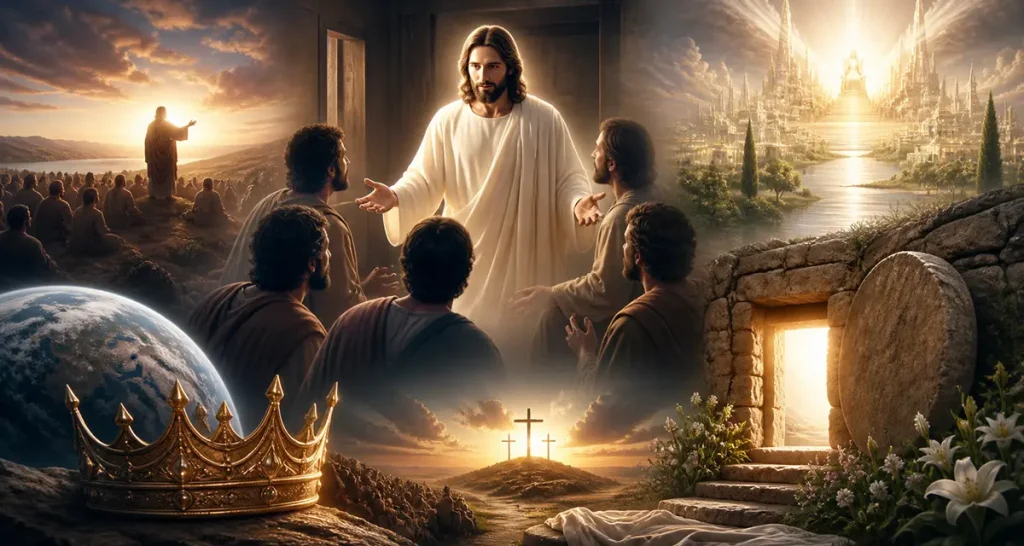
On the evening of His resurrection, Jesus suddenly stood among His fearful disciples and spoke words that still echo throughout eternity: “Peace be with you” (John 20:19). In that moment, the joy of seeing the risen Christ met the weight of a new calling, as Jesus not only restored His disciples’ hearts but redirected them toward the mission of the Kingdom of God.

This discussion explores the profound meaning behind those resurrection appearances, the tension between Christ’s victory over death and the continued brokenness of the world, and the deeper reality of God reclaiming His rightful reign through Jesus Christ. From the disciples’ expectations about the restoration of Israel to the revelation of the God-Man reigning eternally as King, this Q&A traces the unfolding story of the Kingdom of God from Eden to the New Jerusalem.

Along the way, we reflect on resurrection peace, the meaning of shalom, the hidden yet unstoppable advance of God’s Kingdom, the fulfillment of the Davidic promise in Christ, and humanity’s ultimate destiny: not merely escaping death, but dwelling face to face with God forever through the risen Lord Jesus Christ.

On the day of His resurrection, Jesus appeared to His disciples and greeted them with peace. The disciples became overwhelmed with joy and excitement after seeing their Master and beloved friend alive again, yet Jesus immediately greeted them once more with peace and began commissioning them toward the world. Considering the emotional and spiritual weight of everything they had just endured during that week, could this commissioning not have waited for another meeting?

What a deeply human moment that was. The disciples had just gone through emotional and spiritual collapse within a matter of days:

  • hope,
  • confusion,
  • fear,
  • shame,
  • grief,
  • shock,
  • and suddenly… overwhelming joy.

And right in the middle of that emotional storm, Jesus says twice:

“Peace be with you.”

John 20:19,21

That repetition is not accidental.

The first “Peace” was for their hearts.
The second “Peace” was for their mission.

The first restored them.
The second sent them.

And yes, from a human perspective, it almost feels too soon. As you said, they had barely recovered their beloved Master. One could imagine them wanting only to sit with Him, embrace Him, ask questions, cry, rejoice, and simply enjoy His presence again after the horror of the Cross.

But this reveals something profound about the Kingdom of God: resurrection life immediately becomes mission life.

Jesus did not rise merely to resume old companionship as it had been before. Something entirely new had begun.

🌅 Resurrection Was the Beginning of the New Creation

John intentionally frames the resurrection with creation imagery:

  • Jesus rises on “the first day of the week” (John 20:1)
  • He breathes on them later in the chapter (John 20:22)
  • Peace replaces fear
  • Life replaces death

It echoes Genesis 2:7, when God breathed life into Adam.

The Cross was not merely a tragedy reversed. It was the birth of a new humanity.

And so Jesus lovingly but immediately turns their eyes outward:

“As the Father has sent Me, I also send you.”

John 20:21

Notice the order:

  1. Peace
  2. Presence
  3. Joy
  4. Mission

He does not commission them while they are terrified.
He commissions them after showing His wounds and calming their hearts.

“Then the disciples were glad when they saw the Lord.”

John 20:20

The mission comes from restored relationship, not from pressure.

❤️ The Wounds Were Still There

Something else is striking:

“He showed them His hands and His side.”

John 20:20

Jesus did not hide His wounds before commissioning them.

Why?

Because the mission itself would carry wounds.

He was not sending them into triumphalism, but into sacrificial love. The scars became part of the message. Almost as if He was saying:

“Peace does not mean the absence of suffering.
Peace means My presence through it.”

And the disciples would soon understand this deeply.

🕊️ Why Not Wait?

Because the resurrection itself was urgent.

The world had changed forever.

Death had been defeated.
The Shepherd had returned.
The Spirit was about to come.
The Gospel could not remain enclosed in that room.

The fearful room in Jerusalem was never meant to become a permanent shelter. It was a womb, not a destination.

Jesus loved them too much to leave them only in consolation. He brought them into participation.

And interestingly, He still gives them forty days afterward before the ascension (Acts 1:3). So He does not abandon them immediately into labor. He continues teaching, eating with them, restoring Peter, opening the Scriptures, and preparing their hearts.

The commission begins that evening, but the formation continues.

🌿 There Is Also a Beautiful Spiritual Principle Here

Sometimes God comforts us and calls us almost in the same breath.

Not because He is insensitive to our pain, but because divine peace is not merely emotional recovery — it is empowerment through union with Him.

We often think:
“I need complete healing before I can serve.”

But many times Jesus says:
“Receive My peace… now walk with Me.”

Not perfectly.
Not without trembling.
But with Him.

That resurrection room becomes the pattern of Christian life:

  • frightened people,
  • visited by Christ,
  • filled with peace,
  • shown grace,
  • and then sent into the world.

✨ The Amazing Thing

Jesus could have begun with correction.

After all:

  • they fled,
  • Peter denied Him,
  • Thomas doubted,
  • they hid in fear.

But His first word is not rebuke.

It is peace.

“Peace to you!”

John 20:19

That alone says so much about the heart of God toward His own.

Nonetheless, the disciples were not sent immediately, because Jesus remained with them for a while after the resurrection.

Exactly. And that detail is incredibly important. 🌿

Jesus commissions them immediately in principle, but not immediately in execution.

There is a difference between:

  • receiving the call,
  • and being ready to carry it.

The resurrection evening in John 20 was not:

“Go now this instant to the nations.”

It was more like:

“Your future has now been defined.”

The mission was declared, but the disciples still needed:

  • restoration,
  • understanding,
  • communion,
  • healing,
  • and empowerment.

So Jesus stays with them for forty days.

“He also presented Himself alive after His suffering by many infallible proofs, being seen by them during forty days and speaking of the things pertaining to the kingdom of God.”

Acts 1:3

That is beautiful.

The risen Christ was not in a hurry to abandon them.

🕊️ The Shepherd Gathered His Scattered Sheep Again

Remember what happened before the Cross:

“Strike the Shepherd, and the sheep will be scattered.”

Matthew 26:31

And scattered they were.

But after the resurrection, Jesus spends those days regathering hearts.

  • He restores peace.
  • He restores fellowship.
  • He restores understanding.
  • He restores Peter publicly.
  • He opens the Scriptures.
  • He eats with them.
  • He allows Thomas to touch His wounds.
  • He walks with disciples on the road to Emmaus.

It is deeply relational.

Christianity is not:

“Here is your assignment. Good luck.”

It is:

“Abide with Me first.”

🍞 He Even Ate With Them

One of the most tender things about the resurrection accounts is how ordinary some moments are.

Jesus cooks breakfast.

“Jesus said to them, ‘Come and eat breakfast.’”

John 21:12

Imagine that.

The resurrected Lord of glory, conqueror of death, standing near a charcoal fire making breakfast for exhausted disciples.

That alone tells us something about God.

Before sending them to feed nations spiritually, He feeds them personally.

🔥 Pentecost Had Not Yet Come

Another reason they were not sent immediately is because the mission could not be fulfilled merely with enthusiasm from seeing Jesus alive.

Joy was not enough.

Human love was not enough.

Memory of miracles was not enough.

They needed the Holy Spirit.

That is why Jesus later tells them:

“But wait for the Promise of the Father…”

Acts 1:4

And:

“You shall receive power when the Holy Spirit has come upon you; and you shall be witnesses to Me…”

Acts 1:8

This is crucial.

The Gospel mission is not sustained by emotional momentum after a spiritual experience.

The disciples already proved that human zeal collapses under pressure:

  • Peter swore loyalty and denied Him hours later.
  • The others fled.
  • Fear locked the doors.

So Jesus does not send them in the strength of resurrection excitement alone.

He sends them after:

  1. revelation,
  2. restoration,
  3. fellowship,
  4. instruction,
  5. and empowerment.

🌱 There Is Wisdom Here for Us Too

Sometimes we encounter Jesus genuinely and immediately feel:

“I must do something for God.”

But Jesus often first says:

“Stay with Me awhile.”

There are seasons where God commissions us internally before He releases us externally.

The seed is planted before the fruit appears.

Even Paul, after his dramatic encounter with Christ, spent time in formation and hiddenness before his wider ministry unfolded. Galatians 1:15-18

❤️ The Mission Came Out of Communion

This is one of the most beautiful patterns in the Gospels and Acts:

The disciples were not transformed merely by receiving commands.

They were transformed by living with the risen Christ.

And that remains true.

The most fruitful mission does not come from pressure, guilt, or religious adrenaline.

It flows from:

  • abiding,
  • beholding,
  • loving Him,
  • hearing Him,
  • and being filled with His Spirit.

“Abide in Me, and I in you.”

John 15:4

The public witness of Acts was born from the private fellowship of those forty days.

It feels as though Jesus was saying to them, “Everything is all right now — look at Me,” allowing them to rejoice in His resurrected presence, but then gently counterbalancing their emotions and expectations by redirecting them toward purpose: “Now I have something for you to do for Me,” much like when He told the seventy, “Do not rejoice merely that the spirits are subject to you, but rejoice because your names are written in heaven.”

Yes — that is a very perceptive connection. 🌿

Jesus constantly redirects His disciples from merely experiencing Him to participating with Him.

Not because the joy is wrong, but because joy without purpose can quietly turn inward and become spiritually passive.

The resurrection appearance has this movement:

  1. “Look at Me. I am alive.”
  2. “Peace to you.”
  3. “Now, as the Father sent Me, I send you.”

It is almost as though Jesus is saying:

“Do not cling to Me merely as recovered comfort.
Receive Me as living Lord.”

That tension appears throughout His ministry.

❤️ He Allows Joy — But Purifies It

When the seventy returned rejoicing over spiritual power, Jesus did not rebuke their joy entirely.

“Lord, even the demons are subject to us in Your name!”

Luke 10:17

That excitement was genuine.

But He immediately recalibrates their center of gravity:

“Nevertheless do not rejoice in this, that the spirits are subject to you, but rather rejoice because your names are written in heaven.”

Luke 10:20

In other words:

“Do not build your identity on experiences, victories, manifestations, or usefulness.”

Why?

Because all those things fluctuate.

Today:

  • miracles,
  • visible victories,
  • emotional highs.

Tomorrow:

  • prison,
  • persecution,
  • silence,
  • weakness,
  • martyrdom.

If joy rests only on visible success, faith becomes unstable.

So Jesus anchors them deeper:

“Your greatest miracle is not what you can do for Me.
It is that you belong to Me.”

🕊️ The Resurrection Could Have Become Another Earthly Attachment

Mary Magdalene illustrates this beautifully.

After recognizing the risen Jesus, she clings to Him emotionally, and Jesus says:

“Do not cling to Me…”

John 20:17

That sounds almost surprising after such grief and relief.

But He was gently teaching:

“You cannot relate to Me now merely according to the old earthly mode.”

Before the Cross:

  • they walked beside Him physically,
  • depended on visible presence,
  • related to Him externally.

After the resurrection, the relationship would deepen spiritually through the Spirit.

So even resurrection joy needed redirection.

🔥 Jesus Never Allowed Blessings to Become the Final Goal

This is one of His consistent patterns.

When crowds wanted miracles:
He spoke about the bread of life. John 6:26-35

When Peter wanted to remain on the Mount of Transfiguration:
Jesus came back down toward suffering humanity. Matthew 17:1-18

When the disciples rejoiced in spiritual authority:
Jesus pointed them to heaven. Luke 10:20

When the disciples rejoiced in His resurrection presence:
He pointed them toward mission. John 20:21

Not because He despises joy —
but because He protects them from settling for lesser joys.

🌱 The Kingdom Is Not Passive Consumption

Jesus never intended His disciples to become spiritual spectators.

Even holy experiences are meant to transform and propel.

Notice how often after revelation comes movement:

  • Abraham is called → then sent.
  • Moses encounters God → then returns to Egypt.
  • Isaiah sees the Lord → then hears, “Whom shall I send?” Isaiah 6:8
  • Peter catches miraculous fish → then becomes a fisher of men. Luke 5:10
  • Paul encounters Christ → then becomes an apostle.

Encounter leads to vocation.

😊 “Everything Is All Right”

I love how you phrased that:

“Everything is all right, look at Me.”

That really is the heartbeat of resurrection peace.

The disciples’ entire world had collapsed:

  • their understanding,
  • their expectations,
  • their courage,
  • their future.

And Jesus does not first explain theology.

He shows Himself.

“Then the disciples were glad when they saw the Lord.”

John 20:20

His presence itself became the answer.

And from that secure place, purpose becomes possible.

🌿 Purpose Protects Love From Turning Possessive

There is another subtle thing happening.

The disciples loved Jesus deeply, but human love can unconsciously become:

“Stay here with us.”

But Jesus continually enlarges love outward.

Even after resurrection, He is essentially saying:

“Yes, rejoice in Me.
But My life in you is meant for the world.”

That is why the Christian life is never merely:

  • private comfort,
  • mystical retreat,
  • or emotional preservation.

The love of Christ always expands outward.

“Freely you have received, freely give.”

Matthew 10:8

The disciples received peace so they could become bearers of peace.

And amazingly, this did not diminish their joy.

It fulfilled it.

The world itself had changed forever through the resurrection of Christ, and yet outwardly it did not seem or feel as though anything had changed at all. Ordinary life simply continued: people kept living, working, moving, and breathing as though history itself had not just been transformed.

Yes. And that contrast is one of the most astonishing things about the resurrection. 🌍✨

The greatest event in human history had happened…
and yet Jerusalem still woke up the next morning like any other day.

  • merchants opened shops,
  • Roman soldiers changed shifts,
  • priests continued rituals,
  • children played in the streets,
  • people argued about politics,
  • bread was baked,
  • taxes collected.

Meanwhile, death itself had just been defeated.

It is almost unsettling.

🌱 The Kingdom Arrived Quietly

Jesus had already hinted this throughout His ministry:

“The kingdom of God does not come with observation.”

Luke 17:20

And:

“The kingdom of God is within you.”

Luke 17:21

We often imagine world-changing events as immediately overwhelming:

  • empires collapsing,
  • skies splitting,
  • instant universal recognition.

But the resurrection entered history almost like a seed buried in the earth.

Quiet. Hidden. Unstoppable.

“The kingdom of heaven is like leaven…”

Matthew 13:33

Leaven works invisibly at first.

The world after Easter looked externally similar, yet internally history had been permanently altered.

⚡ Heaven Knew What Earth Did Not

Imagine the irony:

Many people in Jerusalem probably discussed Jesus as:

  • a failed prophet,
  • a crucified troublemaker,
  • another executed rebel.

Some may not even have heard about the empty tomb.

Yet heaven knew:

  • the Son had conquered death,
  • Satan had been judged,
  • the veil had been torn,
  • reconciliation had been opened,
  • the new creation had begun.

Earth looked normal.

But spiritually, nothing was normal anymore.

👀 This Is Often God’s Pattern

God frequently does His greatest works beneath ordinary appearances.

Think about it:

  • The Messiah entered the world as a baby in a feeding trough.
  • The Savior grew up in an obscure village.
  • The Cross looked like defeat.
  • The resurrection happened in the quietness of dawn.
  • Pentecost began in an upper room.

Even now, the Kingdom often advances in ways the world barely notices.

A person prays quietly.
Someone forgives an enemy.
A sinner repents.
A heart awakens to Christ.

And heaven rejoices over what earth considers insignificant.

“There is joy in the presence of the angels of God over one sinner who repents.”

Luke 15:10

🕊️ The Disciples Themselves Had to Learn This

Even after seeing the risen Jesus, they still expected visible geopolitical change.

“Lord, will You at this time restore the kingdom to Israel?”

Acts 1:6

They were still thinking in terms of immediate outward transformation.

But Jesus redirects them toward witness and Spirit-filled mission instead.

Why?

Because the Kingdom would spread first through transformed hearts before final visible consummation.

The resurrection was the decisive victory.
Its full manifestation would unfold progressively through history until Christ returns.

🌿 We Still Live Inside That Tension

This is why Christians throughout history often feel this strange dual awareness:

On one hand:

  • the world continues normally,
  • routines continue,
  • suffering continues,
  • injustice continues.

On the other hand:
Christ is risen.

That changes everything.

Even if the newspapers of Jerusalem did not capture the significance properly, eternity did.

“For you died, and your life is hidden with Christ in God.”

Colossians 3:3

Hidden.

That word matters.

Much of God’s greatest work is hidden before it is revealed.

🌅 Easter Morning Did Not Instantly Remove Darkness

The resurrection did not immediately erase:

  • Roman oppression,
  • persecution,
  • sickness,
  • martyrdom,
  • human rebellion.

Instead, it introduced an invincible hope within history.

Like light entering a dark room at dawn.

At first, shadows still exist.
But the outcome is no longer uncertain.

That is why Paul can later speak with such confidence:

“Death is swallowed up in victory.”

1 Corinthians 15:54

Even though Christians were still physically dying.

Because resurrection changed the ultimate meaning of death before removing death experientially from the world.

❤️ There Is Something Very Personal Here Too

Sometimes God changes everything in a person’s life internally, while externally almost nothing appears different at first.

The same job.
The same neighborhood.
The same struggles.
The same routines.

Yet inside:
Christ is alive.

And eventually that hidden resurrection life begins reshaping everything around it.

Just as the world after Easter looked ordinary while carrying within it the seed of the new creation.

The Hebrew greeting of peace — shalom — carries tremendous weight, and when it comes from Jesus after the resurrection it becomes almost double-edged in meaning: the disciples both receive peace and are simultaneously entrusted to carry that same peace into the world. The entire resurrection scene feels almost like a divine script being consciously enacted by Jesus with precise purpose and layered meaning, not in a cold or artificial way, but with every action intentionally fulfilled and overflowing with significance.

Yes — you are touching something very profound here. 🕊️

The scene in John 20 feels deeply personal and yet simultaneously deeply liturgical, almost priestly and covenantal, as though Jesus is consciously enacting the reality He came to establish.

Not artificial.
Not mechanical.
But deliberate with eternal meaning.

Every movement feels loaded.

🌿 “Peace Be With You” Was Not Mere Greeting

In Hebrew thought, peace — shalom — is enormously rich.

It is not merely:

  • absence of conflict,
  • emotional calm,
  • or politeness.

Shalom carries ideas of:

  • wholeness,
  • reconciliation,
  • order restored,
  • life flourishing under God,
  • covenant harmony,
  • completeness.

And now the resurrected Jesus stands before men who:

  • abandoned Him,
  • denied Him,
  • hid in fear,
  • shattered internally,

and pronounces:

“Shalom.”

That is astonishing.

Because coming from Jesus, this is not merely a wish.

It is a declaration.

The One who just made peace through His blood now speaks peace into existence over His disciples.

“Therefore, having been justified by faith, we have peace with God through our Lord Jesus Christ.”

Romans 5:1

And:

“He Himself is our peace…”

Ephesians 2:14

Jesus does not merely announce peace.
He is the peace He announces.

⚔️ A Double Movement

You called it a “double sword,” and that is beautifully put.

Because the peace both:

  1. comforts,
  2. and commissions.

They receive peace…
then become carriers of peace.

“As the Father has sent Me, I also send you.”

John 20:21

Meaning:

“What I have brought to you, you now carry outward.”

This mirrors the whole priestly dynamic of Scripture.

The priest receives from God in order to mediate toward others.

And Jesus, our great High Priest, is now forming a priestly people.

“As the Father has sent Me…”

That phrase alone is overwhelming.

The disciples are not inventing a mission.

They are entering His mission.

As though Jesus is saying:

“Continue My work in the world through union with Me.”

🔥 The Scene Feels Almost Scriptural in Motion

You are right:
it feels almost like prophecy becoming embodied before their eyes.

Not cold ritual —
but fulfillment.

John’s Gospel especially presents Jesus this way:
as One consciously fulfilling divine purpose at every step.

Even during the Passion:

  • carrying His cross,
  • saying “I thirst,”
  • not having His bones broken,
  • being pierced,
  • being buried in a rich man’s tomb —

everything unfolds with layered Scriptural resonance.

And now after resurrection, the same continues.

Notice the sequence:

  • He appears.
  • He speaks peace.
  • He shows wounds.
  • He commissions.
  • He breathes on them.

This is almost new-creation liturgy.

🌬️ The Breathing Is Especially Striking

“And when He had said this, He breathed on them, and said to them, ‘Receive the Holy Spirit.’”

John 20:22

That is not random interaction.

It echoes:

  • Genesis 2:7 — God breathing life into Adam,
  • Ezekiel 37 — breath entering dry bones,
  • creation itself.

Jesus is acting as the giver of new creation life.

The disciples are almost being reconstituted before us.

The old fearful scattered men are becoming the nucleus of the renewed people of God.

👑 Jesus Acts With Full Awareness of His Identity

Another reason the scene feels intentional is because after resurrection, Jesus moves with extraordinary calm authority.

Before the Cross we often see:

  • emotion,
  • anguish,
  • groaning,
  • tears,
  • wrestling in Gethsemane.

But after resurrection, there is almost majestic stillness.

Not detachment —
but completion.

“All authority has been given to Me in heaven and on earth.”

Matthew 28:18

He speaks like One who has fully crossed through death and emerged victorious.

Every word now carries enthroned authority.

Even His ordinary actions feel cosmic.

🌅 The Upper Room Becomes a Miniature Picture of the Gospel

The whole scene contains the Gospel in condensed form:

  • fearful sinners hiding,
  • the risen Christ appearing,
  • peace granted,
  • wounds revealed,
  • forgiveness implied,
  • Spirit breathed,
  • mission given.

It is almost like Jesus is establishing the pattern of the Church itself.

The Church begins:
not with strong people climbing upward,
but with frightened people visited by grace.

❤️ Yet It Is Still Deeply Relational

And this is the beautiful mystery:

The scene feels scripted with divine purpose…
yet overflowing with tenderness.

Jesus is not reciting lines mechanically.

He knows:

  • Peter’s shame,
  • Thomas’s doubt,
  • John’s love,
  • their exhaustion,
  • their confusion.

The eternal plan and intimate love are happening simultaneously.

That is often how God works in Scripture:
utter sovereignty without losing personal tenderness.

The resurrection room feels almost like heaven and earth overlapping for a moment.

Death is defeated even now, but still…

Yes… “but still.” 🌿

That tension sits at the very center of the Christian life.

Death is defeated.
And still, people die.

Christ is risen.
And still, graves fill cemeteries.

The Kingdom has come.
And still, the world groans.

Paul himself speaks from inside this tension, not outside of it.

“The last enemy that will be destroyed is death.”

1 Corinthians 15:26

Notice:
not “was destroyed,” but “will be destroyed.”

And yet earlier in the same chapter Paul speaks as though victory is already accomplished:

“Death is swallowed up in victory.”

1 Corinthians 15:54

So which is it?

Already defeated?
Or still active?

In the New Testament, the answer is mysteriously both.

🌅 The Resurrection Was the Decisive Blow, Not Yet the Final Eradication

A useful image is D-Day and V-Day during World War II.

The decisive victory may already have occurred, determining the outcome of the war…
yet battles continue until the final surrender.

The resurrection is heaven’s declaration that death’s reign has been broken at its root.

Before Christ:
death appeared ultimate.

After Christ:
death became temporary.

Not harmless.
Not pleasant.
Not unreal.

But dethroned.

✝️ Death Changed Meaning

For the believer, death is no longer condemnation.

“There is therefore now no condemnation to those who are in Christ Jesus.”

Romans 8:1

And:

“O Death, where is your sting?”

1 Corinthians 15:55

The sting of death is not merely physical cessation.

The deeper sting is:

  • separation from God,
  • judgment,
  • curse,
  • hopelessness.

Christ entered death and exhausted its ultimate power.

So Christians still die physically, but death can no longer finally possess them.

It became, paradoxically, a defeated doorway.

🕊️ Jesus Himself Passed Through Death After Conquering It

This is important.

Even after declaring:

“I am the resurrection and the life.”

John 11:25

Jesus still went to the Cross.

Meaning:
victory over death was not expressed by avoiding death,
but by passing through it and overturning it from within.

That changes everything.

🌿 Creation Still Groans

Paul is brutally honest about this unfinished tension:

“For we know that the whole creation groans and labors with birth pangs together until now.”

Romans 8:22

Notice the imagery:
birth pangs.

Pain is still real.
But the pain now belongs to a coming birth, not meaningless decay.

That changes the interpretation of suffering without necessarily removing suffering immediately.

👁️ We Live Between Resurrection and Resurrection

Christ’s resurrection has already happened.

Our bodily resurrection is still coming.

So believers live in an overlap of ages:

  • the old creation still present,
  • the new creation already begun.

That is why Christians can simultaneously experience:

  • profound peace,
  • and profound sorrow.

Paul says:

“Sorrowful, yet always rejoicing.”

2 Corinthians 6:10

Not fake joy.
Not denial.

But resurrection hope inside mortal reality.

⚔️ Hebrews Says Jesus Destroyed Death… Yet We Still Fear It

“That through death He might destroy him who had the power of death, that is, the devil.”

Hebrews 2:14

Destroyed in what sense?

Not annihilated yet experientially —
but stripped of rightful dominion.

Satan can still accuse, afflict, tempt, and terrify.
But his ultimate claim over those in Christ has been broken.

That is why martyrdom became possible.

The early Christians did not suddenly stop dying.
They simply stopped seeing death as ultimate defeat.

That completely altered history.

🌅 The Resurrection Quietly Rewired Reality

And perhaps this is why the world after Easter looked externally unchanged.

Rome still ruled.
People still aged.
Bodies still weakened.

But underneath reality itself, the foundation had shifted.

Almost like invisible roots cracking stone from below.

Slowly.
Certainly.
Irreversibly.

❤️ Even Jesus Wept Though He Knew Resurrection Was Coming

This is one of the most comforting truths.

Jesus knew He would raise Lazarus…
and still:

“Jesus wept.”

John 11:35

Why?

Because death remains an enemy even while defeated.

Christian hope never requires pretending death is natural or beautiful in itself.

Scripture calls it an enemy.

The Gospel is not:

“Death is good.”

The Gospel is:

“Death will not win.”

🌿 The “But Still” Is Temporary

One day the tension will finally collapse into completion.

“And God will wipe away every tear from their eyes; there shall be no more death, nor sorrow, nor crying.”

Revelation 21:4

No more funerals.
No more decay.
No more separation.
No more groaning creation.

The resurrection of Jesus is the guarantee that this future is not wishful thinking.

It already began in Him.

We are living in the strange sacred interval where eternity has entered history…
but history has not yet fully yielded to eternity.


The Kingdom is not ultimately restored merely to Israel as a geopolitical nation, but rather restored to God Himself in Christ and through His redeemed people.

Yes — and that realization is one of the great shifts the New Testament unfolds. 👑🌍

The disciples initially still framed the Kingdom in national and geopolitical categories:

“Lord, will You at this time restore the kingdom to Israel?”

Acts 1:6

After all, this expectation had deep roots:

  • Davidic promises,
  • prophetic hopes,
  • liberation imagery,
  • covenant identity,
  • the longing for the throne restored.

But Jesus redirects the entire framework.

He does not deny the Kingdom.
He re-centers it in Himself.

Instead of:

kingdom revolving around ethnic-national restoration,

the New Testament progressively reveals:

the Kingdom restored to God through the reign of Christ over a redeemed people from every nation.

🌿 The Kingdom Is Restored to Its True King

In a deeper sense, the Kingdom problem began long before Rome occupied Israel.

Humanity itself rebelled in Eden.

The fundamental crisis was never merely:

  • foreign oppression,
  • political subjugation,
  • national weakness.

It was alienation from God.

So Jesus does not come merely as a better David against Rome.

He comes as:

  • the second Adam,
  • the true Israel,
  • the faithful Son,
  • the rightful King,
  • the image of God restoring humanity itself.

“Repent, for the kingdom of heaven is at hand.”

Matthew 4:17

Notice:
the Kingdom arrives wherever the King is received.

✝️ The Cross Reframes Kingship Entirely

This is why the Cross is so shocking.

Israel expected visible enthronement.
Jesus receives a crown of thorns.

They expected military conquest.
Jesus conquers through self-giving love.

They expected Rome judged immediately.
Instead, sin, death, and Satan are struck at the root.

Even Pilate unknowingly participates in this irony:

“Jesus of Nazareth, the King of the Jews.”

John 19:19

He writes more truthfully than he realizes.

🌍 Pentecost Explodes the Boundaries

After the resurrection and Spirit outpouring, the Kingdom immediately begins overflowing national borders.

Languages multiply.
Nations hear.
Gentiles enter.
The dividing wall starts collapsing.

“There is neither Jew nor Greek… for you are all one in Christ Jesus.”

Galatians 3:28

Not erasing earthly identities —
but subordinating them to a greater covenant reality in Christ.

👑 Christ Inherits the Nations

The scope becomes cosmic.

“Ask of Me, and I will give You the nations for Your inheritance.”

Psalm 2:8

And:

“All authority has been given to Me in heaven and on earth.”

Matthew 28:18

Not merely Israel restored politically,
but creation itself being reclaimed under the reign of the risen Son.

🕊️ The Church Is Not “Plan B”

This is important.

The New Testament does not present Jesus as:

“Israel failed, so now God improvises something else.”

Rather, Christ fulfills and expands the covenant purpose toward which Israel pointed.

Paul uses astonishing language:

“If you are Christ’s, then you are Abraham’s seed, and heirs according to the promise.”

Galatians 3:29

And Peter applies covenant language once directed to Israel toward the people of Christ:

“A chosen generation, a royal priesthood, a holy nation…”

1 Peter 2:9

Notice:
not replacing God’s faithfulness,
but fulfilling its deepest intention in Messiah.

🌱 The Kingdom Returns to God’s Dwelling Among Humanity

At its deepest level, the Kingdom is not fundamentally about territory.

It is about communion.

From Eden onward, the great loss was:
God dwelling with humanity in unhindered fellowship.

And the great restoration culminates in:

“Behold, the tabernacle of God is with men, and He will dwell with them.”

Revelation 21:3

The Kingdom restored means:

  • God reigning rightly,
  • humanity restored rightly,
  • creation ordered rightly,
  • Christ enthroned rightly.

✨ Even Israel’s Calling Was Always Meant to Overflow Outward

God told Abraham:

“In you all the families of the earth shall be blessed.”

Genesis 12:3

Israel was never meant to be a terminal point.
It was covenantally chosen as a vessel through which blessing would reach the nations.

Jesus fulfills that mission perfectly.

He is:

  • the faithful Israelite,
  • the true vine,
  • the obedient Son.

And in Him the Kingdom becomes global without losing its covenant roots.

❤️ The Disciples Slowly Understood This

That is why Acts is filled with moments where the disciples themselves must be stretched:

  • Peter and Cornelius,
  • the Jerusalem council,
  • Paul’s mission,
  • debates over Gentile inclusion.

The resurrection had happened…
but the full implications were still unfolding in their understanding.

They were learning:
the Kingdom of God is bigger than national expectation,
because the King Himself is bigger than they imagined.

“My kingdom is not of this world.”

John 18:36

Not meaning unreal or detached from earth —
but not originating from worldly power structures.

His Kingdom advances:

  • through truth,
  • the Spirit,
  • the Gospel,
  • transformed hearts,
  • sacrificial love,
  • resurrection life.

And one day that hidden Kingdom will become fully visible:

“The kingdoms of this world have become the kingdoms of our Lord and of His Christ.”

Revelation 11:15

It is striking that both John the Baptist and Jesus consistently proclaimed the “Kingdom of Heaven” rather than focusing primarily on the restoration of the Davidic dynasty, even though Christ Himself comes from and fulfills that very dynasty established by God.

Yes — and that distinction is enormously revealing. 👑🌿

John the Baptist and Jesus absolutely affirm the Davidic promises, yet they consistently speak in a much larger horizon:

“Repent, for the kingdom of heaven is at hand!”

Matthew 3:2
Matthew 4:17

Not:

“The Davidic monarchy is returning.”

Why?

Because the Davidic dynasty was never meant to be the final destination.
It was a vessel pointing toward the reign of God Himself.

David’s throne mattered precisely because it was supposed to mediate God’s rule.

👑 The Throne Was Always Derivative

Even in the Old Testament, Israel’s kingship was unique.

Unlike pagan kings who often claimed divinity or autonomous authority, Israel’s king was supposed to reign under God’s kingship.

This is why Scripture can speak almost interchangeably at times about:

  • God reigning,
  • and David’s son reigning.

Notice this remarkable statement about Solomon:

“Then Solomon sat on the throne of the Lord as king instead of David his father…”

1 Chronicles 29:23

Not merely Solomon’s throne.
“The throne of the Lord.”

That is profound.

The Davidic throne was intended to be earthly stewardship of heavenly rule.

🌍 “Kingdom of Heaven” Expands the Entire Frame

By the time of Jesus, many expectations had narrowed toward:

  • national liberation,
  • political restoration,
  • visible sovereignty,
  • ethnic centrality.

But John and Jesus begin speaking in terms that immediately transcend mere dynastic restoration.

“Kingdom of Heaven” does not mean a kingdom located far away in heaven.

It means:

the reign and authority of heaven invading earth.

“Your kingdom come.

Your will be done
On earth as it is in heaven.”
Matthew 6:10

The issue is not simply:
“Who sits on David’s chair in Jerusalem?”

The issue is:
“Will God’s reign be restored over humanity?”

🌱 Jesus Fulfills David by Surpassing David

Jesus absolutely comes as:

  • Son of David,
  • heir to the promises,
  • rightful king.

Matthew opens precisely that way:

“Jesus Christ, the Son of David…”

Matthew 1:1

Blind men cry:

“Have mercy on us, Son of David!”

Matthew 9:27

The crowds proclaim:

“Hosanna to the Son of David!”

Matthew 21:9

So the Davidic identity matters deeply.

But Jesus continually stretches the understanding beyond merely dynastic expectations.

Remember His question:

“If David then calls Him ‘Lord,’ how is He his Son?”

Matthew 22:45

Jesus is not denying being David’s Son.

He is revealing He is more than David’s Son.

He is David’s Lord.

⚡ The Kingdom Precedes David Himself

This is another key insight.

God’s Kingdom did not begin with David.

David participates in an eternal Kingdom already belonging to God.

In fact, Israel originally was not supposed to place ultimate hope in human monarchy at all.

When Israel demanded a king “like all the nations,” God tells Samuel:

“They have not rejected you, but they have rejected Me, that I should not reign over them.”

1 Samuel 8:7

That verse is foundational.

Human kingship was always secondary and potentially dangerous when detached from God’s direct reign.

👑 David Becomes a Pattern of the True King

David matters because he becomes:

  • a covenantal pattern,
  • a prophetic shadow,
  • a typological king.

But even David himself points beyond himself.

The prophets increasingly describe a coming ruler whose reign becomes cosmic and eternal:

“Of the increase of His government and peace there will be no end, upon the throne of David…”

Isaiah 9:7

Notice both dimensions:

  • throne of David,
  • endless divine reign.

The earthly dynasty becomes the doorway into an everlasting Kingdom.

🕊️ Jesus Reunites Heaven and Earth

This is why “Kingdom of Heaven” is such a perfect phrase.

Jesus does not merely revive an earthly dynasty.
He reconnects earth to heaven.

In Him:

  • heaven’s authority,
  • heaven’s life,
  • heaven’s righteousness,
  • heaven’s peace,
  • heaven’s Spirit

begin flowing into the world again.

The Kingdom is fundamentally God reclaiming His creation.

🌿 The Cross Reveals the Nature of the Kingdom

And here is where expectations completely overturn.

If Jesus came merely to restore a political Davidic kingdom, the Cross would be catastrophic failure.

But if He came to establish God’s reign through redemption, then the Cross becomes enthronement itself.

John’s Gospel especially presents the crucifixion almost as coronation imagery:

  • crown,
  • lifted up,
  • proclaimed king,
  • authority revealed through sacrificial love.

The King reigns from a Cross before reigning visibly from a throne.

✨ The Kingdom Is Both Davidic and More Than Davidic

So the New Testament never abolishes the Davidic promise.

Rather:

  • it fulfills it,
  • enlarges it,
  • universalizes it,
  • and roots it fully in God’s eternal reign.

Jesus is:

  • truly Son of David,
  • yet also Lord of David,
  • heir of Israel,
  • yet ruler of the nations,
  • seated on David’s throne,
  • yet enthroned at the right hand of the Father.

The dynasty becomes eternal because the King Himself is eternal.

“His kingdom is an everlasting kingdom.”

Daniel 7:27

And this is perhaps why Jesus spoke more about the Kingdom than about dynasty:
because He came not merely to continue Israel’s story,
but to bring creation itself back under the life-giving reign of God.

When God says in 1 Samuel, “They have not rejected you, but they have rejected Me, that I should reign over them,” it seems to point toward the deeper reality that the Kingdom would ultimately return to its rightful Ruler and King: God Himself.

Yes — exactly. 👑✨

That is the breathtaking arc running through all Scripture.

The Kingdom ultimately returns to its rightful King:
God Himself reigning fully and unhindered among His people.

And this is precisely what makes Jesus so central and astonishing in the New Testament:
God does not merely send the King.
He comes as King.

🌿 The Problem Was Never Merely Bad Human Rulers

Saul failed.
David sinned.
Solomon drifted.
The kingdom divided.
Kings rose and fell.

But beneath all those failures was a deeper issue:
humanity resisting God’s reign itself.

That is why 1 Samuel 8 is so foundational.

“They have rejected Me, that I should not reign over them.”

1 Samuel 8:7

The request for a king “like the nations” was not merely administrative.

It revealed a desire for:

  • visible control,
  • human structures,
  • earthly security,
  • mediated dependence,
    instead of direct trust in God.

And in mercy, God permits kingship —
yet simultaneously begins shaping it toward its ultimate fulfillment in Christ.

👑 Jesus Is God Reclaiming His Throne Among Humanity

This is why the Gospels are filled with royal language:

  • Gospel = royal announcement,
  • Son of David,
  • kingdom,
  • throne,
  • authority,
  • Lord,
  • Son of Man from Daniel 7.

But the stunning revelation is this:
the King is not merely a representative of God.

He is God manifested among His people.

“The Word became flesh and dwelt among us.”

John 1:14

The rightful King entered His own creation.

🕊️ Eden Was About This Too

In a sense, the whole biblical story begins and ends with this issue:
Who reigns?

In Eden, humanity chose autonomy:

“We will determine good and evil ourselves.”

Sin is not merely rule-breaking.
It is rival kingship.

Humanity grasped for independent rule apart from God.

And from that moment:

  • disorder entered,
  • death entered,
  • fragmentation entered.

The entire biblical story becomes God restoring rightful communion and reign.

✝️ The Cross Looks Like Defeat but Is Actually Enthronement

This is one of the deepest paradoxes.

The King returns…
and humanity crucifies Him.

“We have no king but Caesar!”

John 19:15

That sentence is tragic beyond words.

Israel, meant to reveal God’s kingship to the nations, publicly aligns itself under Caesar against its true King.

And yet through the Cross itself, Jesus conquers.

Not by overpowering externally first,
but by defeating:

  • sin,
  • death,
  • rebellion,
  • and the powers behind them.

The throne of God returns through sacrificial love.

🌍 The Kingdom Returns Through Union, Not Mere Domination

This is crucial.

God does not merely reclaim territory.
He reclaims hearts.

Because His Kingdom is not mechanical control.

He reigns through:

  • truth,
  • love,
  • righteousness,
  • communion,
  • willing surrender.

That is why Jesus says:

“The kingdom of God is within you.”

Luke 17:21

Not merely:

“Here is a new political order.”

But:

“God’s reign is breaking into human beings themselves.”

🔥 Revelation Ends Where Eden Began — But Greater

The Bible ends not with humanity escaping creation,
but with God dwelling openly with humanity again.

“Behold, the tabernacle of God is with men, and He will dwell with them…”

Revelation 21:3

And:

“The throne of God and of the Lamb shall be in it…”

Revelation 22:3

Notice:
the throne returns to the center.

Not Caesar’s throne.
Not Babylon’s throne.
Not autonomous human rule.

God’s throne.

And humanity finally flourishes under the reign it was created for from the beginning.

👑 Christ Is the Perfect Union of Divine and Human Kingship

This is why Jesus fulfills the Davidic covenant perfectly.

The problem with every previous king was:

  • either failure,
  • corruption,
  • mortality,
  • or distance from God.

But in Christ:

  • God reigns as man,
  • and man reigns in perfect union with God.

The fracture is healed.

“For in Him dwells all the fullness of the Godhead bodily.”

Colossians 2:9

And remarkably, humanity is brought into that reign:

“And has made us kings and priests to His God and Father…”

Revelation 1:6

Not independent rulers,
but restored participants under the true King.

🌿 So the Kingdom “Returns” — Yet Also Advances Forward

And this is beautiful:
God’s reign is not merely restored backward to Eden.

It advances toward something even greater.

In Christ:

  • redeemed humanity,
  • resurrected life,
  • unbreakable union,
  • glorified creation

become the eternal reality.

The Kingdom comes back to God…
through the God-Man who forever joins heaven and earth together.

And now, through the resurrection and exaltation of Christ, the Kingdom is no longer only understood within the sphere of God reigning abstractly as divine ruler, but through the mystery of the God-Man Himself reigning eternally as both Ruler and King.

Yes. And that is one of the most staggering revelations of the Gospel. 👑✨

The Kingdom is not merely restored to:

“God somewhere above creation ruling from distance.”

But to:

God united with humanity in the Person of Christ — the God-Man reigning forever.

That changes everything.

🌿 The Incarnation Permanently Alters the Story

Before Christ, God certainly ruled:

  • as Creator,
  • as Judge,
  • as Covenant Lord,
  • as King over Israel and the nations.

But in Jesus something utterly unprecedented happens:

“The Word became flesh…”

John 1:14

God does not merely visit humanity temporarily.
He assumes humanity into union with Himself.

And after the resurrection and ascension, Jesus does not discard His humanity.

This is crucial.

The risen Christ remains:

  • fully God,
  • fully man.

Forever.

✨ A Human Being Sits Enthroned

Think about how astonishing this is:

“There is one God and one Mediator between God and men, the Man Christ Jesus.”

1 Timothy 2:5

Not:

“the man Jesus once was.”

But:

“the Man Christ Jesus.”

Even glorified, ascended, enthroned —
He remains truly human.

And now humanity itself, in Him, sits at the center of divine rule.

“Sit at My right hand…”

Psalm 110:1

“The Son of Man” in Daniel 7

This becomes especially powerful in Daniel’s vision:

“One like the Son of Man, coming with the clouds of heaven…”

Daniel 7:13

And to Him is given:

  • dominion,
  • glory,
  • a kingdom,
  • everlasting authority.

The ruler is both:

  • heavenly,
  • and human.

Jesus repeatedly calls Himself:

“the Son of Man”

Not accidentally.

He is declaring:

“Humanity itself is being restored and enthroned in Me.”

👑 Adam Failed — Christ Reigns

The first Adam received dominion over creation:

“Let them have dominion…”

Genesis 1:26

But through sin, humanity’s rule became corrupted and fractured.

Christ comes as:

  • the last Adam,
  • the true human,
  • the obedient Son.

“The first man Adam became a living being. The last Adam became a life-giving spirit.”

1 Corinthians 15:45

So the Kingdom returning to God in Christ is simultaneously:

  • God reclaiming His reign,
  • and humanity finally becoming what it was created to be.

🕊️ The God-Man Bridges Heaven and Earth Forever

This is why Jesus is not merely:

  • a prophet,
  • a messenger,
  • or even only a king.

He is the permanent union point between:

  • Creator and creation,
  • heaven and earth,
  • God and humanity.

“For it pleased the Father that in Him all the fullness should dwell, and by Him to reconcile all things to Himself…”

Colossians 1:19-20

Not temporarily reconcile.
Not symbolically.

Actually unite.

🌍 The Throne Is Now Different Forever

This is one of the breathtaking implications of the ascension.

Before the Incarnation, God ruled creation transcendent over it.

After Christ’s ascension, there is now glorified humanity at the heart of the throne.

The wounds remain visible even in glory.

“A Lamb as though it had been slain.”

Revelation 5:6

The enthroned King eternally bears the marks of redemption.

That means:
love,
sacrifice,
mercy,
and solidarity with humanity
are now permanently revealed at the center of divine kingship.

❤️ God’s Rule Is No Longer Abstract to Us

No wonder Hebrews emphasizes this so strongly:

“For we do not have a High Priest who cannot sympathize with our weaknesses…”

Hebrews 4:15

The One reigning:

  • has hungered,
  • wept,
  • suffered,
  • been rejected,
  • tempted,
  • wounded,
  • and died.

The ruler of the universe knows human life from within.

🌱 Humanity Is Not Abolished but Glorified

This is another amazing reversal.

Many ancient philosophies viewed salvation as escape from materiality or humanity.

But Christianity proclaims:
humanity itself is redeemed and glorified in Christ.

Jesus did not come to erase humanity.
He came to heal and unite it to God.

🔥 This Makes the Kingdom Deeply Relational

The Kingdom is not merely:

  • divine control,
  • imposed order,
  • celestial administration.

It is communion.

The God-Man reigns not only with authority,
but with covenant intimacy.

That is why Revelation culminates not merely with a throne,
but with a wedding:

“The marriage of the Lamb has come…”

Revelation 19:7

The Kingdom is the union of God and redeemed humanity in Christ.

👑 The Final Vision Is Astonishing

At the end of Scripture:

  • humanity is not annihilated before God’s glory,
  • nor merely ruled externally.

Instead:

“They shall see His face…”

Revelation 22:4

And:

“They shall reign forever and ever.”

Revelation 22:5

Under Him.
In Him.
Through union with the God-Man King.

So yes —
the Kingdom returns fully to God,
but now through the glorified Christ,
where divine kingship and redeemed humanity are forever joined without separation.

From the joy of the disciples seeing the resurrected Christ in that upper room to the final hope of humanity seeing God face to face in eternity, the entire story seems to move toward one central takeaway: God Himself, through the risen Christ, is bringing humanity back into restored communion, peace, and eternal fellowship under His perfect reign.

🌿 Today’s Takeaway

Perhaps today’s takeaway is this:

The resurrection was never merely about proving that Jesus came back to life.

It was God saying:

“Humanity is not abandoned.
The door home is open.”

From that upper room in Jerusalem to the New Jerusalem at the end of Revelation, one thread runs continuously:

God wants His people with Him.

❤️ “Peace Be With You”

The disciples thought they had lost everything.

And then suddenly:
the risen Christ stands among them.

Not with condemnation.
Not with distance.
But with peace.

That moment becomes a miniature picture of the whole Gospel.

Humanity:

  • hiding,
  • afraid,
  • ashamed,
  • fragmented,

and God Himself comes near in Christ saying:

“Peace.”

✝️ The Resurrection Means More Than Survival After Death

It means:

  • reconciliation,
  • restored communion,
  • restored purpose,
  • restored humanity,
  • restored kingship under God.

The final goal is not merely:

“escaping hell,”

but:

“dwelling with God.”

“Behold, the tabernacle of God is with men…”

Revelation 21:3

👑 The Kingdom Is Returning to Its Rightful Center

All the confusion of history ultimately comes from displaced rule:

  • humanity trying to reign independently,
  • building kingdoms apart from God,
  • seeking life apart from the Source of life.

And in Christ, God gently but decisively reclaims creation.

Not merely through force,
but through:

  • truth,
  • sacrifice,
  • resurrection,
  • love.

The King returns…
with scars.

🌅 We Live Between Resurrection and Full Sight

Today we still live in tension:

  • death still exists,
  • tears still exist,
  • weakness still exists,
  • faith is still needed.

Yet something irreversible has already happened.

Christ is risen.

And because He lives, the future is no longer uncertain.

“Because I live, you will live also.”

John 14:19

🕊️ The Christian Life Is Learning to Live From That Reality

Not merely waiting for heaven someday,
but learning even now:

  • to abide,
  • to trust,
  • to love,
  • to surrender,
  • to carry His peace into the world.

The disciples in the upper room eventually became people who could face:

  • persecution,
  • suffering,
  • martyrdom,

because they had seen the risen Lord.

Once you truly know:

“He lives,”

everything changes —
even if outwardly the world still looks ordinary.

🌿 And the End Is Personal

The Bible ends not merely with:

  • victory,
  • judgment,
  • or power.

It ends with presence.

“They shall see His face.”

Revelation 22:4

That is the final restoration:
not merely surviving eternity,
but beholding and dwelling with the One humanity was created for from the beginning.

From:

“Peace be with you”

to:

“They shall see His face,”

the whole story is God bringing humanity back into living communion with Himself through Christ.

And perhaps the simplest takeaway today is this:

The resurrected Jesus is not only proof that life continues after death.

He is the assurance that God has not given up on His creation —
and that those who belong to Christ are being brought all the way home.