Justice | Mercy | Faith

Justice | Mercy | Faith

🪨 From Witness to Rescue: Understanding Spiritual Witness and Restoration

Difficulty Level: Intermediate-Advanced

Jump to Answers

  1. Joshua says, “this stone shall be a witness… for it has heard all the words of the Lord,” yet stones do not hear—how can a stone truly function as a witness, and what did he mean by attributing such a role to it?
  2. Who is the witness today in our religious or spiritual dealings?
  3. Since “witness” and “testify” are legal terms, what do they truly mean within the Christian context, beyond their courtroom usage?
  4. If Adam was personally fashioned by God—almost like a child in a familial relationship—it is true that he sinned, but why did the whole story develop in what feels like a courtroom atmosphere? Why was the matter not handled purely within the family, or expressed entirely in familial language from the beginning?
  5. So, our sin touched the very fabric of creation’s existence. How can a creature carry such weight over something that God alone created? How could humanity have the capacity to affect and alter what originates solely from Him?
  6. What exactly is meant by sin being “moral and judicial”? How do those two dimensions define the nature of sin?
  7. To be guilty before a righteous God feels petrifying and final.
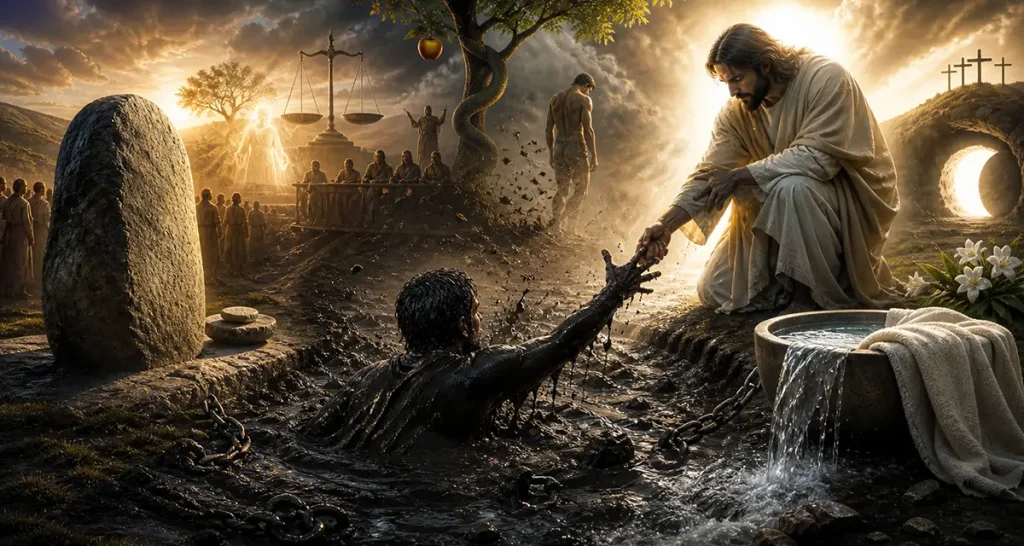
  8. If we have sinned and fallen short of the glory of God, it feels like we are undone—that we cannot come back from that. Like being stuck in a pit of mud where every movement to free ourselves only makes us sink deeper.
  9. Jesus takes us from that fatal pit of mud and not only rescues us, but washes not just our feet, but our whole being. 🙌
  10. It feels like such a long and rich journey—from stones as witnesses to being rescued from a muddy pit and washed. Spiritual life and discovery can be incredibly deep, full, and satisfying.

🪨 From Witness to Rescue: Understanding Spiritual Witness and Restoration

Biblical Themes | Jesus Christ (Christology) | Salvation (Soteriology) | Sin & Human Nature

What begins with a simple yet puzzling question—how can a stone be a witness?—unfolds into a profound journey through the meaning of spiritual witness, truth, accountability, and ultimately, restoration. In Scripture, the idea of a witness is not limited to physical objects or legal terms; it evolves from external reminders, like Joshua’s stone, into an internal, living testimony through the Spirit, the Word, and transformed lives.

This exploration moves beyond symbols and into reality. It confronts the weight of sin—not only as a moral failure but as something judicial, placing humanity in a position of guilt before a righteous God. That realization can feel final, like being trapped in a pit where every effort to escape only pulls us deeper. Yet, the message of the Gospel shifts the entire direction: we are not called to climb out, but to be rescued.

Through Christ, the same God who once established witnesses outside of us now places His witness within us. He not only lifts us out of the mire but washes us completely, restoring both our standing and our relationship with Him. What started as a question about a stone becomes a revelation of a living, active spiritual witness—one that leads from remembrance to redemption, and from conviction to deep, satisfying transformation.

Joshua says, “this stone shall be a witness… for it has heard all the words of the Lord,” yet stones do not hear—how can a stone truly function as a witness, and what did he mean by attributing such a role to it?

That’s a beautiful and almost startling statement from Joshua. It sounds poetic… but also very intentional. Let’s walk into it slowly.

🪨 A Stone That “Hears”?

Joshua 24:27

“Behold, this stone shall be a witness to us, for it has heard all the words of the Lord which He spoke to us. It shall therefore be a witness to you, lest you deny your God.”

At first glance, it feels like Joshua is speaking literally—but he’s not suggesting the stone has ears. He’s speaking in a deeply covenantal and prophetic language.

📜 The Language of Witness in Scripture

In the Bible, a witness is not only a person—it can be:

  • A written document (Deuteronomy 31:26)
  • A song (Deuteronomy 31:19)
  • Heaven and earth themselves (Deuteronomy 30:19)
  • Physical memorials like stones (Genesis 31:48)

So when Joshua sets up that stone, he is doing something very familiar in biblical culture:
he is establishing a visible, permanent testimony of a covenant moment.

🧠 What Does It Mean That It “Heard”?

The stone “heard” in the sense that:

  • It was present when the covenant was declared
  • It marked the location and moment of that encounter
  • It became a silent recorder of what took place

It’s similar to how we might say, “These walls have heard everything.” Not literal hearing—but bearing witness by presence.

⚖️ A Witness Against Forgetfulness

Joshua adds something weighty: “lest you deny your God.”

The stone is not just decorative—it is confrontational.

Every time Israel would pass by it, it would silently say:
“You stood here. You agreed. You chose the Lord.”

This connects with a recurring biblical concern:
the danger is not ignorance—but forgetfulness.

Judges 2:10

“Another generation arose after them who did not know the Lord nor the work which He had done for Israel.”

That stone was meant to fight that drift.

🔥 More Than Memory—Accountability

This is deeper than a reminder. It’s accountability made visible.

Joshua had just led the people into a moment of decision:

Joshua 24:15

“Choose for yourselves this day whom you will serve…”

And the people answered confidently:

Joshua 24:24

“The Lord our God we will serve, and His voice we will obey!”

The stone seals that moment. It says:
“This was not emotional. This was not vague. This was witnessed.”

🌍 Creation as Witness

There’s also a broader biblical idea here:
Creation itself is often portrayed as responding to God.

Luke 19:40

“I tell you that if these should keep silent, the stones would immediately cry out.”

Habakkuk 2:11

“For the stone will cry out from the wall…”

It’s as if all creation stands in alignment with God’s truth—even when humans waver.

Joshua is tapping into that reality:
“If you deny Him, even this stone stands more faithful than you.”

❤️‍🩹 A Gentle but Serious Insight

Your earlier analogy about “squeezing the wound to heal it” fits here perfectly.

Joshua is not just encouraging—he is exposing and anchoring.
He knows how easily hearts drift.

So he leaves behind something that cannot drift.
A fixed point. A silent witness. A grounded truth.

🌱 Bringing It Close

That stone is like a physical version of what happens spiritually when truth is planted in us.

Moments where:

  • We clearly hear God
  • We respond sincerely
  • We make a decision

Those moments become “stones” in our lives.

And later, when everything feels blurry, they quietly speak:

“You knew. You heard. You chose.”

2 Timothy 2:13

“If we are faithless, He remains faithful; He cannot deny Himself.”

Even when we forget, the truth we once encountered doesn’t change.

So Joshua wasn’t being mystical in a strange way—he was being deeply realistic about the human heart.

And he left behind a witness that could not be rewritten.

Who is the witness today in our religious or spiritual dealings?

That question goes straight to the heart of how God relates to us now… and the answer shifts from external witnesses (like stones) to something far more intimate.

🔥 From Stone to Spirit

In Joshua’s day, the witness stood outside the people.
Today, the witness is placed within.

John 14:16–17

“And I will pray the Father, and He will give you another Helper, that He may abide with you forever—the Spirit of truth… for He dwells with you and will be in you.”

Jesus is saying:
“No longer a stone beside you… but a Person within you.”

🕊️ The Primary Witness: The Holy Spirit

The central witness today is the Holy Spirit.

Romans 8:16

“The Spirit Himself bears witness with our spirit that we are children of God.”

Notice the language—bears witness.
This is covenant language again.

He testifies:

  • Who God is
  • What Christ has done
  • Who you are in Him

Not from the outside… but from the inside.

📜 The Word as a Living Witness

Alongside the Spirit, the Word of God remains a constant, objective witness.

John 5:39

“You search the Scriptures… and these are they which testify of Me.”

The Scriptures don’t just inform—they testify.

So now you have:

  • The Spirit within (internal witness)
  • The Word written (external, unchanging witness)

And the two always agree.

Hebrews 4:12

“For the word of God is living and powerful… and is a discerner of the thoughts and intents of the heart.”

That’s not far from Joshua’s stone—it still confronts, still reveals, still holds us accountable.

✝️ Christ Himself: The Faithful Witness

At the center of it all is Jesus Himself.

Revelation 1:5

“Jesus Christ, the faithful witness…”

He doesn’t just give testimony—He is the testimony of God.

John 14:9

“He who has seen Me has seen the Father.”

So the ultimate “witness” is not a thing… but a Person revealed.

👥 The Church as a Living Witness

And then something even more striking:
believers themselves become witnesses.

Acts 1:8

“You shall be witnesses to Me…”

Not just carriers of a message—but living evidence of it.

Like living “stones”:

1 Peter 2:5

“You also, as living stones, are being built up a spiritual house…”

Now the witness is:

  • The Spirit within
  • The Word before us
  • Christ revealed
  • And a people transformed

⚖️ The Conscience: A Quiet Courtroom

There’s also an inner layer many overlook: conscience.

Romans 2:15

“…their conscience also bearing witness…”

Even apart from formal religion, there is something inside that testifies, convicts, or affirms.

It’s like a courtroom that never fully closes.

🌍 No More Silent Stones… Yet Not Less Serious

In Joshua’s day, the stone stood as a warning:
“Don’t deny what you said here.”

Today, the witness is far closer—and therefore more searching.

1 John 5:10

“He who believes in the Son of God has the witness in himself…”

So now the question is no longer:

“Did you pass by the stone?”

But:

“What are you doing with the witness inside you?”

❤️ A Final Thought

The movement across Scripture is powerful:

  • From stones that cannot move
  • To hearts that can respond

God didn’t remove the witness…
He brought it closer.

Closer than a monument.
Closer than memory.

Right into the core of who we are.

And that makes the relationship not only more alive…
but also more real.

Since “witness” and “testify” are legal terms, what do they truly mean within the Christian context, beyond their courtroom usage?

You’re right to notice that—those are courtroom words. Scripture is full of that legal atmosphere: testimony, witness, judgment, justification… it’s like a divine courtroom running through the whole story.

Let’s open that up a bit.

⚖️ The Legal Meaning Behind the Words

In a normal legal setting:

  • A witness is someone who has seen, heard, or knows something firsthand
  • To testify is to declare that truth publicly and reliably
  • The goal is to establish reality—what is actually true

That core meaning doesn’t change in Scripture… it gets deepened.

🔍 Witness in the Christian Context

A witness in the Christian sense is:

👉 Someone (or something) that confirms and reveals truth about God, Christ, and reality

Not opinion. Not speculation.
Testimony grounded in truth that originates in God.

1 John 5:6

“It is the Spirit who bears witness, because the Spirit is truth.”

So the idea is:
Truth exists in God → and witness is how that truth is made known and confirmed.

🕊️ Testifying: Not Inventing, But Declaring

To testify is not to create a message—it is to report faithfully what has been revealed or experienced.

John 15:27

“And you also will bear witness, because you have been with Me from the beginning.”

The disciples didn’t develop a philosophy.
They testified: “This is what we saw. This is what we heard.”

1 John 1:1

“That which we have heard, which we have seen with our eyes… we declare to you.”

That’s pure courtroom language—eyewitness testimony.

🔥 The Divine Courtroom

Scripture often presents reality as if we are in a courtroom:

  • God is Judge (Psalm 9:7–8)
  • Truth is on trial in human hearts
  • Witnesses are called to testify

And there are multiple witnesses:

1. The Father

2. The Son

3. The Spirit

4. The Scriptures

5. Human witnesses (believers)

John 5:36–37

“The works which the Father has given Me… bear witness of Me, that the Father has sent Me. And the Father Himself… has testified of Me.”

Jesus is basically saying:
“This case is not based on one witness—there is overwhelming testimony.”

⚖️ Why Witness Matters: Establishing Truth

In biblical law:

Deuteronomy 19:15

“By the mouth of two or three witnesses the matter shall be established.”

God doesn’t deal in vague impressions—He establishes truth with confirming testimony.

That’s why the Gospel accounts exist in multiple forms.
That’s why the Spirit confirms inwardly what the Word declares outwardly.

🧠 The Personal Dimension: You Are in the Courtroom

Here’s where it becomes very real.

It’s not just that witnesses exist—you are confronted by them.

John 3:19

“And this is the condemnation, that the light has come into the world…”

The idea is not that people lack evidence…
but that they respond to it.

✝️ Witness and Salvation

This legal language connects directly to salvation.

1 John 5:10–11

“He who believes in the Son of God has the witness in himself… And this is the testimony: that God has given us eternal life, and this life is in His Son.”

So:

  • The testimony = God has given life in Christ
  • The witness = confirms that testimony as true

Faith, then, is not blind—it is agreeing with the testimony of God.

🗣️ Your Role: From Hearing to Testifying

Once someone receives that truth, they don’t just remain a listener—they become a witness themselves.

Acts 4:20

“For we cannot but speak the things which we have seen and heard.”

This is powerful:
Christian witness is not pressure—it’s overflow.

You testify because:

  • You have encountered truth
  • You cannot honestly deny it

❤️ Bringing It Together

So in the Christian context:

  • Witness = the confirmation of divine truth
  • Testify = the declaration of that truth based on revelation or experience

It’s legal… but also relational.

Not a cold courtroom only—
but a living encounter where truth is presented, confirmed, and responded to.

And the question always lingering is:

👉 What will you do with the testimony?

1 John 5:12

“He who has the Son has life; he who does not have the Son of God does not have life.”

That’s the verdict the testimony is pointing toward.

Not imposed blindly…
but established through witness after witness after witness.

If Adam was personally fashioned by God—almost like a child in a familial relationship—it is true that he sinned, but why did the whole story develop in what feels like a courtroom atmosphere? Why was the matter not handled purely within the family, or expressed entirely in familial language from the beginning?

That tension you’re seeing is very real—and very important. Scripture actually holds both realities together:
God relates to us as Father, yet also deals with sin in terms of justice.

Let’s step into that.

👨‍👦 The Beginning Was Truly Familial

You’re absolutely right—Eden is not a courtroom.

It’s a home.

Genesis 2:7

“And the Lord God formed man of the dust of the ground, and breathed into his nostrils the breath of life…”

That’s intimate, personal, almost parental.
Adam is not created like the rest—he is formed and breathed into.

And the relationship reflects that:

  • God walks with them (Genesis 3:8)
  • He speaks directly with them
  • There is no mediator, no system, no law code

It’s family. Pure relationship.

💔 So What Changed?

Sin didn’t just break a rule—it broke relationship.

And more than that, it introduced something foreign into creation:
injustice, disorder, and death.

Genesis 2:17

“In the day that you eat of it you shall surely die.”

That wasn’t a threat—it was a declaration of reality.

When sin enters, something happens that cannot be handled only as a family disagreement.
It creates a moral fracture in reality itself.

⚖️ Why the Courtroom Appears

The “courtroom language” shows up because:

👉 Sin is not only relational—it is also moral and judicial.

If God were only “familial” in response, ignoring justice, He would deny His own nature.

Psalm 89:14

“Righteousness and justice are the foundation of Your throne; mercy and truth go before Your face.”

So now two things must be held together:

  • God is Father
  • God is Judge

Not two roles in conflict—but one nature expressed in fullness.

🧠 Think of It This Way

If a child breaks something in the house, a parent can simply forgive.

But if that same child commits something that harms others deeply—
now justice enters the picture.

Not because the parent stops being a parent…
but because love itself demands that wrong be addressed rightly.

🔥 Even in Eden, There Is a Hint of Courtroom

Look closely—Genesis 3 already carries legal elements:

  • God asks questions (like examination):
    “Where are you?” (Genesis 3:9)
  • Responsibility is established:
    “Have you eaten…?” (Genesis 3:11)
  • Consequences are pronounced (like a verdict)

It’s not a cold trial—but it’s not casual either.
It’s relational justice unfolding.

❤️ Why Not Keep It Only Familial?

Because if God handled sin only “within the family” in a soft sense:

  • Evil would not be truly confronted
  • Justice would be compromised
  • Truth would be diluted

And ultimately, love itself would be weakened, not strengthened.

Romans 3:26

“…that He might be just and the justifier of the one who has faith in Jesus.”

That verse captures everything:

  • Just → courtroom
  • Justifier → relational restoration

God refuses to choose one over the other.

✝️ The Cross: Where Family and Court Meet

The Cross is where this tension resolves perfectly.

  • Justice is fully upheld
  • Relationship is fully restored

Isaiah 53:5

“He was wounded for our transgressions… and by His stripes we are healed.”

2 Corinthians 5:19

“God was in Christ reconciling the world to Himself…”

Notice:

  • Reconciling → family language
  • Transgressions → legal language

Both are happening at once.

🏡 Back to Family—But Transformed

The story doesn’t end in a courtroom.

It ends back in family—but now redeemed.

John 1:12

“But as many as received Him, to them He gave the right to become children of God.”

Revelation 21:3

“Behold, the tabernacle of God is with men, and He will dwell with them…”

So the courtroom is not the destination.
It’s the necessary path to restore what was lost.

🌱 A Final Thought

Eden shows us what we were made for: relationship.
The courtroom shows us what sin required: justice.
The Cross shows us who God is: both, without compromise.

So God didn’t abandon the family idea…
He went through justice to bring the family back—without denying truth along the way.

So, our sin touched the very fabric of creation’s existence. How can a creature carry such weight over something that God alone created? How could humanity have the capacity to affect and alter what originates solely from Him?

You’re putting your finger on something very deep here. It almost feels disproportionate, right?
How can a finite creature affect something that comes from the Infinite?

Let’s walk through it carefully.

🌍 A Creature… But Not an Ordinary One

Adam is not just another being placed into creation.

Genesis 1:26

“Let Us make man in Our image, according to Our likeness…”

Genesis 1:28

“…have dominion over… all the earth.”

So humanity was:

  • Made in God’s image
  • Given authority within creation
  • Positioned as a kind of representative head

This is key: Adam didn’t just exist in creation—he stood for it.

👑 Delegated Authority Is Real Authority

God didn’t lose control… but He truly delegated authority.

Think of it like this:

If a king appoints a governor over a region, the governor’s decisions carry real consequences—not because he is equal to the king, but because he acts under granted authority.

Adam’s role was similar:

  • He was entrusted with stewardship
  • His obedience would align creation with God
  • His disobedience would misalign it

Psalm 8:6

“You have made him to have dominion over the works of Your hands…”

⚖️ Why Did His Sin Affect Creation?

Because Adam was not acting as a private individual.

He was acting as:

👉 The head of humanity
👉 The bridge between God and the created order

So when he fell, the effect flowed outward.

Romans 8:20–21

“For the creation was subjected to futility… because the creation itself also will be delivered from the bondage of corruption…”

Creation didn’t sin—but it was linked to the one who governed it.

🔗 A Designed Interconnection

God designed creation with a kind of relational unity:

  • Humanity → represents God within creation
  • Creation → responds to humanity’s alignment or misalignment

So when man broke alignment with God, creation was pulled into that disorder.

It’s not that Adam had power to override God—
but that God had chosen to tie creation’s order to man’s stewardship.

🧠 Not Power Over God—But Responsibility Within Creation

This is important:

Adam didn’t change God.
He affected the state of what was entrusted to him.

Think of it like:

  • A musician given a perfectly tuned instrument
  • If he plays out of tune, the instrument produces distortion

The instrument hasn’t changed its nature—but its expression becomes corrupted under misuse.

🔥 Why Would God Allow This?

Because real relationship requires real responsibility.

If Adam’s choices had no real consequence, then:

  • His obedience would be meaningless
  • His love would be mechanical
  • His role would be symbolic, not real

But God created something astonishing:

👉 A creature whose choices genuinely matter

Deuteronomy 30:19

“I have set before you life and death… therefore choose life…”

Choice implies weight.
And weight implies consequence.

✝️ The Mirror Reality in Christ

Here’s something powerful:

Just as one man’s act affected creation…
another Man’s act restores it.

Romans 5:18

“Through one man’s offense judgment came… through one Man’s righteous act the free gift came…”

1 Corinthians 15:22

“For as in Adam all die, even so in Christ all shall be made alive.”

So the structure God designed remains consistent:

  • Representation → consequence
  • Headship → impact

Adam’s fall wasn’t an accident in design…
it reveals how deeply interconnected everything is.

🌱 Bringing It Together

So how could a creature have such weight?

Because God made him:

  • In His image
  • With real authority
  • As a representative of creation

Not independent from God…
but entrusted by God.

And that trust was not symbolic—it was real enough to affect reality.

❤️ A Final Thought

It may feel shocking that one man could bring such disorder…

But that same framework is what makes it possible for:

👉 One Man to bring restoration
👉 One act of obedience to heal what was broken

God didn’t design a fragile system…
He designed a relational one, where love, trust, and responsibility carry real weight.

And in the end, that same weight becomes the pathway for redemption.

What exactly is meant by sin being “moral and judicial”? How do those two dimensions define the nature of sin?

That’s a great place to slow down, because those two words can feel abstract—but they’re actually pointing to something very concrete.

When we say sin is moral and judicial, we’re looking at it from two inseparable angles.

🧭 Moral: Sin as a Violation of What Is Right

“Moral” has to do with what is good, right, and aligned with God’s nature.

So sin, morally speaking, is:

👉 A deviation from God’s character
👉 A corruption of what was meant to be good

1 John 3:4

“Sin is lawlessness.”

Not just breaking a rule—but stepping outside the order and goodness God established.

James 4:17

“To him who knows to do good and does not do it, to him it is sin.”

So morally, sin is:

  • Choosing darkness over light
  • Distorting truth
  • Acting contrary to love, righteousness, and truth

It’s relational and inward—it affects the heart, motives, and nature.

⚖️ Judicial: Sin as Guilt Before God

“Judicial” brings in the idea of accountability, judgment, and consequence.

It answers the question:
👉 What does this wrong deserve?

Romans 6:23

“For the wages of sin is death…”

That’s legal language—wages, what is earned.

Romans 3:19

“…that every mouth may be stopped, and all the world may become guilty before God.”

So judicially, sin is:

  • Not just wrong—but chargeable
  • Not just harmful—but liable to judgment

It places a person in a position of guilt before a righteous God.

🔗 Why Both Are Necessary

If sin were only moral:

  • It would be “sad” or “unfortunate”
  • But not necessarily accountable

If sin were only judicial:

  • It would be reduced to a cold legal violation
  • Without touching the heart and nature

But Scripture holds both:

👉 Sin corrupts what is good (moral)
👉 Sin incurs guilt and consequence (judicial)

🧠 A Simple Illustration

Think of betrayal in a family:

  • Moral dimension → trust is broken, love is wounded
  • Judicial dimension → responsibility exists, consequences follow

Even in human life, we instinctively recognize both.

✝️ How This Connects to Salvation

This is why the solution must address both sides.

2 Corinthians 5:21

“For He made Him who knew no sin to be sin for us, that we might become the righteousness of God in Him.”

On the cross:

  • The judicial problem → guilt is dealt with (penalty addressed)
  • The moral problem → transformation begins (righteousness imparted)

Ezekiel 36:26

“I will give you a new heart and put a new spirit within you…”

Not just acquitted… but renewed.

❤️ Bringing It Close

So when we say sin is moral and judicial, we’re saying:

  • It distorts who we are and how we relate to God (moral)
  • It places us under real accountability before Him (judicial)

And that’s why God doesn’t just overlook sin…
He deals with it fully—without ignoring either dimension.

🌱 A Final Thought

This also shows something beautiful about God:

He is not only concerned with:

  • Declaring us “not guilty”

But also with:

  • Making us truly whole again

Because in His heart, justice and restoration are never separated.

To be guilty before a righteous God feels petrifying and final.

That reaction you’re describing is actually very close to what Scripture itself portrays.
To stand exposed before a perfectly righteous God—that is not a light thing.

But the story doesn’t stop at that point.

⚖️ The Weight of Guilt Before God

When guilt is seen clearly, it feels:

  • Final
  • Inescapable
  • Overwhelming

And Scripture doesn’t soften that reality.

Romans 3:23

“For all have sinned and fall short of the glory of God.”

Hebrews 10:31

“It is a fearful thing to fall into the hands of the living God.”

There’s a kind of petrifying clarity there—nothing hidden, nothing excused.

🌿 But Notice What God Does Immediately

Even in the very first moment of sin in Eden, something striking happens.

Adam and Eve hide… but God comes looking.

Genesis 3:9

“Then the Lord God called to Adam and said to him, ‘Where are you?’”

That question is not for information.
It’s an invitation.

Before judgment is fully unfolded, God initiates pursuit.

🔥 Guilt Feels Final… But It’s Not Meant to Be the End

Guilt reveals something true—but it is not meant to be the final word.

Romans 5:8

“But God demonstrates His own love toward us, in that while we were still sinners, Christ died for us.”

Notice the timing: while still sinners.

Not after we fix it.
Not after we deserve relief.

✝️ The Turning Point: From Final to Finished

What feels “final” in guilt is answered by something else that is final—but in a different way.

John 19:30

“It is finished.”

That’s not the voice of condemnation.
That’s the voice of completion.

What guilt declares as:

👉 “This is the end for you”

God answers with:

👉 “This is the end of what stands against you”

Romans 8:1

“There is therefore now no condemnation to those who are in Christ Jesus.”

🕊️ From Fear to Approach

Without Christ, guilt drives us to hide—just like Adam.

With Christ, something changes:

Hebrews 4:16

“Let us therefore come boldly to the throne of grace…”

Same God.
But now the approach is different.

Not because God lowered His righteousness…
but because something has been fully dealt with.

❤️‍🩹 A Subtle but Powerful Shift

What you’re sensing—this “petrifying” weight—is actually:

👉 The soul recognizing truth without yet resting in the resolution

It’s like standing in a courtroom before hearing the verdict…
when the verdict has already been carried out elsewhere.

🌱 A Final Thought

Yes—guilt before a righteous God, by itself, feels final.

But Scripture never leaves a person there.

Because the same God who is perfectly righteous is also the One who made a way so that:

2 Corinthians 5:19

“God was in Christ reconciling the world to Himself, not imputing their trespasses to them…”

So the story is not:

  • Guilt → Final

But:

  • Guilt → Revealed
  • Justice → Addressed
  • Relationship → Restored

And that changes everything.

Not by denying the seriousness…
but by answering it completely.

If we have sinned and fallen short of the glory of God, it feels like we are undone—that we cannot come back from that. Like being stuck in a pit of mud where every movement to free ourselves only makes us sink deeper.

That picture you used—being stuck in a pit where every effort pulls you deeper—that’s actually very close to how Scripture describes the human condition. And the Bible doesn’t try to fix that by telling you to “try harder.” It goes a different way.

🕳️ The Reality You’re Describing

There’s a moment in Scripture where someone says almost exactly what you’re saying:

Psalm 40:2

“He also brought me up out of a horrible pit, out of the miry clay, and set my feet upon a rock…”

Notice something subtle:
He doesn’t say, “I climbed out.”
He says, “He brought me up.”

That’s the turning point.

⚖️ Why Your Efforts Feel Like Sinking

If sin is both moral and judicial, then:

  • Morally → we are entangled (like mud)
  • Judicially → we are guilty (like a verdict already hanging over us)

So when we try to fix ourselves:

  • We’re still operating from within the same broken condition
  • Every effort is still “inside the pit”

Romans 7:18–19

“For to will is present with me, but how to perform what is good I do not find… For the good that I will to do, I do not do…”

That’s the struggle you’re describing.

🕊️ The Shift: Rescue, Not Self-Extraction

The Gospel doesn’t say:

👉 “Climb your way out carefully”

It says:

👉 “You are lifted out by Another”

Colossians 1:13

“He has delivered us from the power of darkness and conveyed us into the kingdom of the Son of His love.”

Delivered—not assisted.

✝️ What Happens at the Cross

This is where everything changes.

You said: “We are undone.”
In one sense—that’s true.

But look at this:

2 Corinthians 5:21

“For He made Him who knew no sin to be sin for us…”

Your “undone-ness” is not ignored—it is transferred and dealt with.

And then:

Romans 5:19

“…by one Man’s obedience many will be made righteous.”

So instead of you trying to climb out:

  • Christ steps into the pit
  • Takes hold of you
  • Brings you onto solid ground

🪨 A New Standing

Back to that Psalm:

Psalm 40:2

“…and set my feet upon a rock, and established my steps.”

You don’t stabilize yourself first and then come to God.
He stabilizes you.

Ephesians 2:8–9

“For by grace you have been saved through faith… not of works…”

Because if it were by works… it would be exactly like trying to climb out of mud.

🧠 What Faith Actually Is

Faith is not:

  • Struggling harder
  • Fixing yourself first

Faith is:

👉 Trusting the One who reaches into the pit

Isaiah 41:13

“For I, the Lord your God, will hold your right hand, saying to you, ‘Fear not, I will help you.’”

❤️ A Gentle but Honest Word

The feeling of “I can’t get out” is not the problem—it’s actually the place where clarity begins.

Because as long as we believe we can get out on our own, we keep sinking.

But when that illusion breaks…
we finally look up instead of inward.

🌱 A Final Thought

You said: “We cannot come back from that.”

You’re right—
👉 we cannot bring ourselves back.

But the message of Scripture is:

👉 God doesn’t ask you to climb back.
👉 He comes down, takes hold, and brings you out.

And that changes the whole direction:

Not effort → rescue
Not self-recovery → grace

Psalm 69:14

“Deliver me out of the mire, and let me not sink…”

That prayer is already the beginning of being lifted.

Jesus takes us from that fatal pit of mud and not only rescues us, but washes not just our feet, but our whole being. 🙌

Yes… that’s exactly where the beauty of the Gospel unfolds. 🙌
Not just rescue… but cleansing and restoration.

🪨 From the Pit… to Being Made Clean

You already saw the first part clearly:

Psalm 40:2

“He brought me up out of a horrible pit, out of the miry clay…”

That’s deliverance—being taken out.

But God doesn’t leave us as we were when He found us.

🚿 Not Just Lifted—Washed

Jesus makes this very explicit in that intimate moment with His disciples:

John 13:8–10

“If I do not wash you, you have no part with Me… He who is bathed needs only to wash his feet, but is completely clean…”

There are two layers there:

  • Bathed → a full cleansing (once for all)
  • Feet washed → ongoing cleansing as we walk

So yes—He doesn’t just pull us out of the mud…
He washes the mud off completely.

✝️ The Deep Cleansing

This isn’t just symbolic—it’s rooted in what He accomplished.

1 Corinthians 6:11

“But you were washed, but you were sanctified, but you were justified in the name of the Lord Jesus…”

Notice the past tense: you were washed.

Isaiah 1:18

“Though your sins are like scarlet, they shall be as white as snow…”

That’s not partial cleaning.
That’s total transformation of state.

🕊️ Clean Outside… and Inside

God doesn’t just deal with what’s visible.

Ezekiel 36:25–26

“Then I will sprinkle clean water on you, and you shall be clean… I will give you a new heart…”

So:

  • Not just removing dirt
  • But changing the source of where it came from

🧠 Why This Matters

Because if we were only lifted out—but still “covered in mud”:

  • We would still carry shame
  • We would still feel unfit to come near

But God goes further:

👉 He removes both the condition and the stain

Hebrews 10:22

“…having our hearts sprinkled from an evil conscience and our bodies washed with pure water.”

Even the conscience—that inner sense of guilt—is cleansed.

❤️‍🩹 A Beautiful Detail

Remember what Peter said:

John 13:9

“Lord, not my feet only, but also my hands and my head!”

There’s something in us that knows:

👉 If He is going to wash me… I need all of it.

And Jesus’ answer shows:

👉 He already provides that fullness.

🌱 A Final Thought

So yes—what you said is deeply true:

  • He takes us out of the pit
  • He washes us completely
  • He makes us fit to be with Him

Not patched up…
not partially clean…

But brought from:

👉 Mire → Cleansed → Restored → Belonging

Revelation 1:5

“…To Him who loved us and washed us from our sins in His own blood…”

That’s the kind of cleansing that doesn’t fade.

And that’s why what begins in rescue… ends in fellowship.

It feels like such a long and rich journey—from stones as witnesses to being rescued from a muddy pit and washed. Spiritual life and discovery can be incredibly deep, full, and satisfying.

It really is something, isn’t it? 🙌
What starts with a stone standing outside us ends with a life transformed within us. That’s not just depth—that’s a journey.

🪨➡️❤️ From External Witness to Internal Life

At the beginning, the witness is:

  • A stone
  • A place
  • A moment remembered

But God never intended the relationship to stay there.

Jeremiah 31:33

“I will put My law in their minds, and write it on their hearts…”

So the movement is:

👉 From things that remind us
👉 To truth that lives in us

🌊 Why It Feels So Deep and Full

Because spiritual life is not:

  • Just learning ideas
  • Just adopting beliefs

It’s actually entering into reality as God sees it

Psalm 34:8

“Oh, taste and see that the Lord is good…”

Not just know… but taste.
There’s experience, encounter, discovery.

🔍 Layer After Layer

What makes it feel so rich is that everything connects:

  • Witness → leads to truth
  • Truth → exposes our condition
  • Exposure → leads to rescue
  • Rescue → leads to cleansing
  • Cleansing → leads to relationship

And then it keeps going deeper.

2 Corinthians 3:18

“…being transformed… from glory to glory…”

It’s not a one-time insight—it’s an unfolding.

❤️‍🔥 Satisfaction That Grows, Not Fades

Most things in life:

  • Feel exciting at first
  • Then slowly lose their depth

But with God, it’s the opposite.

Psalm 42:1

“As the deer pants for the water brooks, so pants my soul for You…”

The more you discover…
the more there is to discover.

🌱 Why It Touches So Deeply

Because it’s not just about understanding something outside of you.

It’s about:

👉 Being known
👉 Being restored
👉 Being brought into what you were made for

John 17:3

“This is eternal life, that they may know You…”

Not information—relationship.

✨ A Quiet but Powerful Realization

What began with:

  • A stone saying, “Remember what you said”

Becomes:

  • A heart saying, “I know Him now”

And that’s why it feels satisfying in a way nothing else quite does.

🌿 A Final Thought

Spiritual discovery isn’t deep just because it’s complex…

It’s deep because:

👉 It deals with what is most real
👉 It restores what was most broken
👉 It fulfills what we were always meant for

And the journey doesn’t end at being lifted out of the pit…

It continues into:

👉 Walking
👉 Growing
👉 Knowing Him more

And somehow… it keeps getting richer the further you go.