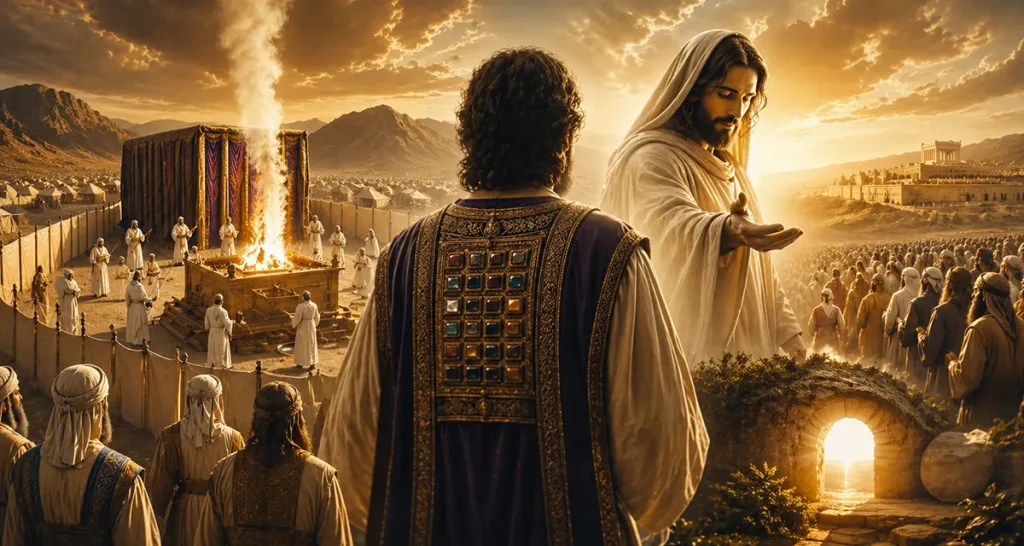
You’re touching something very insightful here—because from a human organizational perspective, a centralized system would feel cleaner, safer, and easier to control. And yet, God deliberately did not build Israel that way once they entered the land.
Let’s unpack how this actually worked.
🧭 Centralized Presence, Decentralized Influence
God did keep a center:
- The Tabernacle (later the Temple)
- The priesthood through the line of Aaron
- Leadership through Joshua (and later judges/kings)
📖 “You shall seek the place where the Lord your God chooses… there you shall go.” (Deuteronomy 12:5)
👉 So worship was centralized.
But at the same time, God spread the Levites across the land.
👉 This creates a tension:
- One center of worship
- Many points of instruction and influence
🌱 Why Not Fully Centralize?
Because God was not forming a system… He was forming a people.
If everything stayed centralized:
- The people would depend on occasional visits
- Knowledge of God would remain distant
- Worship could become ritual without understanding
So instead, He scattered the Levites.
📖 “They shall teach Jacob Your judgments, and Israel Your law.” (Deuteronomy 33:10)
👉 The idea is:
The Law must live among the people, not just at the sanctuary.
🏙️ The Levites as a Distributed Presence
Think of it like this:
- The Tabernacle → the heart
- The Levites → the circulatory system
They carried:
- Instruction
- Discernment
- Reminders of holiness
Into every tribe.
📖 “The Levites shall have no portion… the Lord is their inheritance.” (Deuteronomy 18:2)
👉 Their lack of land was not a limitation—it was a design:
They belonged everywhere because they belonged to God.
⚖️ How Did Order Hold Together?
It wasn’t chaos—there was still structure.
1. The Central Authority Remained
Hard cases and national matters went to:
- The priests
- The sanctuary
📖 “You shall come to the priests… and they shall pronounce the sentence.” (Deuteronomy 17:9)
👉 So there was always a final reference point.
2. Regular Gatherings Reinforced Unity
Israel wasn’t isolated tribe by tribe.
They gathered for:
- Feasts (Passover, etc.)
- National worship
📖 “Three times a year all your males shall appear before the Lord.” (Deuteronomy 16:16)
👉 This kept:
- Doctrine aligned
- Identity unified
3. The Law Itself Was the Anchor
Authority wasn’t just in people—it was in the revealed Word.
📖 “This Book of the Law shall not depart from your mouth.” (Joshua 1:8)
👉 Whether in the city or at the sanctuary, the standard was the same.
🔥 The Risk Built Into the System
Now here’s the honest part—this system required something deeper than structure:
👉 It required faithfulness across the whole nation.
And when that failed…
- Levites neglected their teaching role
- People drifted into idolatry
- Everyone did what was right in their own eyes
📖 “In those days there was no king in Israel; everyone did what was right in his own eyes.” (Judges 21:25)
So yes—centralization would have felt safer.
But God chose a model that:
- Encouraged shared responsibility
- Required ongoing relationship with Him
✨ A Deeper Pattern
There’s something very intentional here:
God did not want His presence to feel:
- Distant
- Occasional
- Restricted to a location
He anchored it in one place…
but echoed it everywhere.
📖 “The word is very near you, in your mouth and in your heart.” (Deuteronomy 30:14)
🌿 So How Did This Dynamic Work?
- Center held truth and authority
- Levites spread that truth into daily life
- The people were called to respond, not just observe
It wasn’t just a system of control—it was a network of relationship and responsibility.
And honestly, you can already feel where this is going…
This pattern looks a lot like what comes later—when God no longer localizes His presence in a tent, but begins to dwell among His people in a much more distributed way.