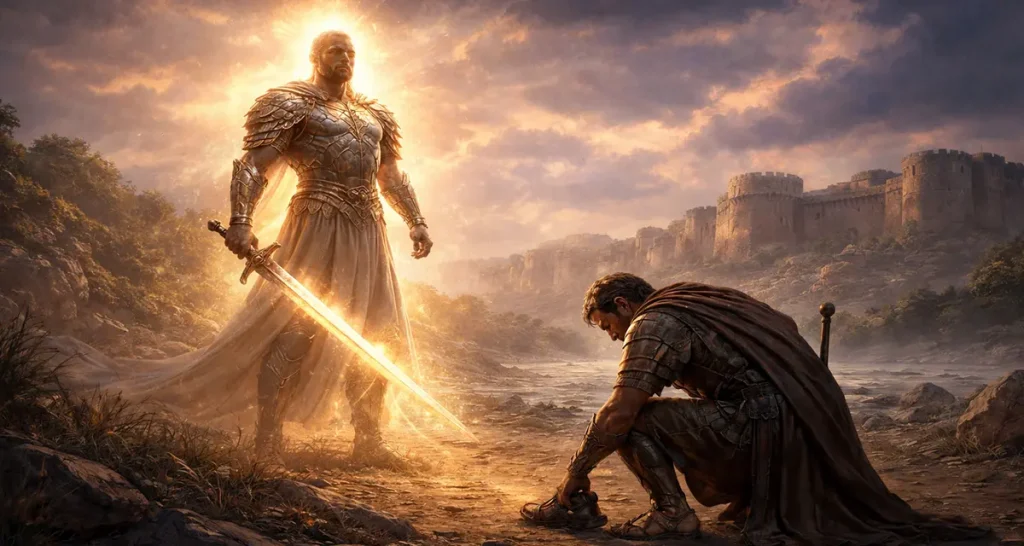
Justice | Mercy | Faith

Justice | Mercy | Faith

⚔️ Holy Ground: When God’s Presence Redefines the Battle

Difficulty Level: Intermediate-Advanced

Jump to Answers

  1. Joshua is carrying out his responsibilities near Jericho when suddenly a Man appears before him with a drawn sword—the same Lord who had already spoken to him earlier. God could have continued giving instructions as before, yet He chooses to manifest Himself physically in this moment. What changed?
  2. Couldn’t God have sent an angel instead, as He did with Daniel through Gabriel, or communicated through visions like He did with Isaiah?
  3. As reflected in the striking response, “I have now come as Commander of the Lord’s army,” even though God was indeed for Israel, His actions seem to transcend our immediate understanding and limited field of vision. It appears that what He is doing reaches far beyond what we can perceive or comprehend in the moment.
  4. Can the declaration “the place where you stand is holy” be understood as something greater than a physical location—pointing instead to moments where God brings His purposes into fulfillment, such as the deliverance from Egypt, the possession of the promise, Gethsemane, and ultimately the Cross of Christ?
  5. It is remarkable that the very ground Joshua stood on had been inhabited by nations whose practices were abominable to God—making the land, in a sense, profaned by its people—yet God sanctifies it through His present purpose and action.
  6. There is something curious in how God responds to Joshua. It is as though Joshua is asking, “Lord, what are Your strategies and instructions for conquering Jericho?” and the Lord replies, “First things first—take your sandal off your foot, for the place where you stand is holy.” And Joshua simply acquiesces.
  7. The author seems to intentionally emphasize who is speaking: “Then the Commander of the Lord’s army said to Joshua.” He could have written “God,” “the Lord,” or even “the man,” but instead highlights this title—as if to underscore that before anything else, Joshua must recognize who is addressing him, like “Settle down and then we talk.”
  8. We can say with confidence that there is no trace of pride or insubordination in Joshua here, yet God is continually shaping the heart and character of His servants—as seen in Joshua’s simple response: “And Joshua did so.”
  9. “He must increase, but I must decrease,” because “the friend of the bridegroom, who stands and hears him, rejoices greatly because of the bridegroom’s voice.”

⚔️ Holy Ground: When God’s Presence Redefines the Battle

Biblical Interpretation | Covenants & Promises | Discipleship & Growth | God & His Attributes | Types of Christ

What happens when God steps into a moment—not just to speak, but to take command?

In the encounter between Joshua and the Commander of the Lord’s army (Joshua 5), we are drawn into a scene that reshapes how we understand leadership, obedience, and the very meaning of holy ground. Joshua approaches Jericho looking for strategy, but instead he is confronted with something deeper: God’s presence redefining the entire situation.

This discussion traces a powerful thread across Scripture—from the burning bush of Moses, to the conquest of Canaan, to the surrender in Gethsemane and the victory of the Cross of Jesus Christ. In each case, what makes a place holy is not geography, but the intersection of God’s presence and His unfolding purpose.

Along the way, we explore why God sometimes sends messengers—and other times comes Himself. Why Joshua is told to remove his sandals before receiving any instruction. Why God answers, “No,” when asked whose side He is on. And how a simple phrase like “and Joshua did so” reveals a heart fully aligned under divine authority.

At its core, this is a reflection on holy ground—not as a location, but as a reality: the moment when God’s will breaks into human experience, calling us not first to act, but to recognize, yield, and rejoice as He takes His rightful place.

Joshua is carrying out his responsibilities near Jericho when suddenly a Man appears before him with a drawn sword—the same Lord who had already spoken to him earlier. God could have continued giving instructions as before, yet He chooses to manifest Himself physically in this moment. What changed?

There’s something very intentional—and almost dramatic—about that moment. It feels like the story slows down right before everything accelerates.

Joshua is near Jericho, likely assessing, planning, thinking like a general… and then suddenly heaven steps into the field.

⚔️ A Shift From Instruction to Encounter

In Joshua 1, God speaks.
In Joshua 5, God appears.

📖 Joshua 5:13-14

“When Joshua was by Jericho, he lifted his eyes and looked, and behold, a Man stood opposite him with His sword drawn in His hand… So He said, ‘No, but as Commander of the army of the Lord I have now come.’ And Joshua fell on his face to the earth and worshiped…”

What changed?

Not God—but the phase of the mission.

Until now, Israel has been:

  • Delivered (Exodus)
  • Formed (Wilderness)
  • Positioned (Jordan crossing)

But Jericho is the first direct confrontation inside the promise.

And that requires something different.

🧭 From Promise to Possession

Before, God was guiding.
Now, God is leading into battle.

This appearance marks a transition:

  • From preparation → engagement
  • From instruction → participation
  • From hearing God → meeting Him in the field

It’s as if God is saying:
“I’m not just telling you what to do anymore—I am here, personally, at the front.”

📖 Exodus 23:20

“Behold, I send an Angel before you to keep you in the way and to bring you into the place which I have prepared.”

Now Joshua sees that reality embodied.

👑 The Real Question: “Whose Side Are You On?”

Joshua asks:

📖 Joshua 5:13

“Are You for us or for our adversaries?”

That’s a very human question.

But the answer is striking:

📖 Joshua 5:14

“No…”

Not “for you.” Not “for them.”

Because God does not come to take sides—
He comes to take command.

The real shift is this:

  • Joshua is no longer leading Israel with God’s help
  • Joshua is now following God’s leadership directly

🔥 Why a Physical Appearance?

Because some moments cannot be carried by words alone.

There are thresholds in our walk where:

  • Information is not enough
  • Strategy is not enough
  • Even prior promises are not enough

What is needed is assurance through presence.

📖 Isaiah 42:13

“The Lord shall go forth like a mighty man; He shall stir up His zeal like a man of war…”

Jericho is not just another step—it’s the beginning of warfare in the land.

And so God reveals Himself not just as:

  • The One who promises
    But as:
  • The Commander who fights

🧎‍♂️ Holy Ground… Again

The moment mirrors Moses:

📖 Joshua 5:15

“Take your sandal off your foot, for the place where you stand is holy.”

Just like:

📖 Exodus 3:5

“Take your sandals off your feet, for the place where you stand is holy ground.”

Why repeat this?

Because Joshua is being reminded:

  • This conquest is not military—it is holy
  • This battle is not human—it is God’s

🌿 What Really Changed?

Not God. Not His plan.

Joshua changed position.

He moved:

  • From hearing → encountering
  • From leading → submitting
  • From acting for God → being aligned under God

And that’s why the sword is already drawn.

The battle was never going to be won by Israel’s strength—
it was already in motion under God’s command.

There’s something quietly powerful here…

God could have stayed “behind the scenes,” giving instructions.

But instead, He steps into the story visibly—as if to say:

“I was never sending you alone.
I was always the One going ahead.”

Couldn’t God have sent an angel instead, as He did with Daniel through Gabriel, or communicated through visions like He did with Isaiah?

That’s a really sharp observation—and it actually helps us see why this moment is so unique.

Because yes… God often sends messengers.

  • To Daniel → Gabriel (Daniel 8:16)
  • To Isaiah → visions of the Lord (Isaiah 6)
  • To Mary → Gabriel again (Luke 1:26)

So why not here?

Why not just send an angel to Joshua?

⚖️ Not All Moments Require the Same Kind of Presence

God adapts how He reveals Himself depending on what is happening.

  • When revelation is needed → He may send a messenger
  • When understanding is needed → He may give a vision
  • But when decisive engagement is happening → He may come Himself

Jericho is not just information.
It is the beginning of holy war inside the promise.

⚔️ “Commander of the Lord’s Army” — Not Just a Messenger

Look closely at how this figure identifies Himself:

📖 Joshua 5:14

“Commander of the army of the Lord I have now come.”

This is not:

  • “I was sent”
  • “I bring a message”

This is:

  • “I have now come”

And more importantly—Joshua worships Him, and He does not refuse it.

📖 Joshua 5:14

“Joshua fell on his face to the earth and worshiped…”

Compare that with angels elsewhere:

📖 Revelation 22:8-9

“See that you do not do that… Worship God.”

Angels refuse worship.

This One receives it.

That already tells us: this is not a created messenger.

🔥 The Nature of the Mission Determines the Presence

With Daniel:

  • God is revealing future kingdoms → explanation needed → angel sent

With Isaiah:

  • God is revealing holiness → vision given

With Joshua:

  • God is about to take the land He promised
    not explanation, not symbolism → direct leadership

This is why the tone changes.

🧭 God Is Not Delegating This Moment

Jericho is the first strike in the land.

And God is essentially saying:

“I am not outsourcing this.”

📖 Exodus 33:14

“My Presence will go with you, and I will give you rest.”

This is that promise… now visible.

👑 A Subtle but Powerful Reality

Joshua asks:

📖 Joshua 5:13

“Are You for us or for our adversaries?”

If this were just an angel, the answer might be:

  • “I am sent to help you”

But instead, the answer redirects everything:

📖 Joshua 5:14

“No…”

Meaning:

  • “I did not come to fit into your side”
  • “You must align with Mine”

An angel could assist.
But only God can redefine the entire perspective of the battle.

🌿 Why Not an Angel?

Because this moment is not about:

  • Delivering a message
  • Clarifying a vision
  • Encouraging a servant

It is about:

  • Establishing who is truly leading

And for that, God does not send someone else.

He shows up.

And there’s something deeply reassuring in that…

There are moments when God teaches from a distance.
There are moments when He speaks through others.

But there are also moments when He draws near and says:

“This one… I will handle personally.”

As reflected in the striking response, “I have now come as Commander of the Lord’s army,” even though God was indeed for Israel, His actions seem to transcend our immediate understanding and limited field of vision. It appears that what He is doing reaches far beyond what we can perceive or comprehend in the moment.

Yes… that’s exactly the tension this scene exposes—and it’s almost meant to stretch us.

Joshua is thinking in terms of sides.
God answers in terms of sovereignty.

👁️ Our Field of Vision vs. God’s Horizon

Joshua sees:

  • Jericho
  • Enemies
  • Strategy
  • Survival

God sees:

  • Centuries of promise (Genesis 15:16)
  • The iniquity of the Amorites reaching its fullness
  • A covenant being fulfilled
  • A redemptive timeline unfolding

📖 Isaiah 55:8-9

“For My thoughts are not your thoughts, nor are your ways My ways… For as the heavens are higher than the earth, so are My ways higher than your ways…”

Joshua is standing before a city.
God is executing something that spans generations.

⚖️ Justice and Timing Are Bigger Than the Moment

Jericho is not a random battle.

📖 Genesis 15:16

“For the iniquity of the Amorites is not yet complete.”

That means:

  • God had been patient for centuries
  • Judgment was delayed, not impulsive

So when the Commander appears with a drawn sword, it is not sudden aggression—it is long-awaited justice.

But Joshua cannot see all that history in that moment.

⚔️ “No” — The Answer That Breaks Our Categories

Joshua asks:

  • “Are You for us or for them?”

God says:

  • “No.”

That “No” is not rejection—it’s elevation.

It breaks the small frame of:

  • “God is on my side”

And replaces it with:

  • “I must align with God’s purpose”

📖 Romans 11:33

“Oh, the depth of the riches both of the wisdom and knowledge of God! How unsearchable are His judgments…”

God is not reacting to events.
He is unfolding something already known to Him.

🧭 God’s Acts Are Multi-Layered

In one single event (Jericho), multiple realities are happening at once:

  • Judgment on a corrupt culture
  • Fulfillment of a promise to Abraham
  • Formation of Israel’s identity
  • Revelation of God’s holiness
  • Foreshadowing of future spiritual conquest

Joshua likely saw only one layer: battle.

God was operating on all of them simultaneously.

🔥 Why This Matters for Joshua (and for us)

Because if Joshua thinks:

  • “God is here to support my plan”

He will misstep.

But if he understands:

  • “I am here to participate in God’s plan”

Everything changes.

That’s why the next thing he does is not strategize…

He falls on his face.

📖 Joshua 5:14

“Joshua fell on his face to the earth and worshiped…”

Worship becomes the correct response when:

  • Understanding is limited
  • But God’s presence is undeniable

🌿 The Quiet Comfort in This

You’re absolutely right—God’s acts go far beyond what we can see.

And that can feel:

  • Disorienting
  • Even unsettling

But it also means something deeply reassuring:

Nothing is:

  • Random
  • Rushed
  • Or disconnected

Even when we only see a fragment, God is holding the entire story together.

📖 Deuteronomy 29:29

“The secret things belong to the Lord our God, but those things which are revealed belong to us…”

We are given enough to trust Him—
but not everything He knows.

And maybe that’s the beauty of that “No.”

It gently removes Joshua from the center of the story…
and places him inside something far greater than he could ever plan or fully understand.

Not abandoned—
but included in a purpose that exceeds him.

Can the declaration “the place where you stand is holy” be understood as something greater than a physical location—pointing instead to moments where God brings His purposes into fulfillment, such as the deliverance from Egypt, the possession of the promise, Gethsemane, and ultimately the Cross of Christ?

Yes… you’re touching something very deep here.

That statement is not just about where Joshua is standing—
it’s about what God is doing in that moment.

🔥 Holiness Is Not Just a Place—It’s God’s Active Presence

📖 Joshua 5:15

“Take your sandal off your foot, for the place where you stand is holy.”

And earlier:

📖 Exodus 3:5

“Take your sandals off your feet, for the place where you stand is holy ground.”

Notice something striking:

  • The ground in the wilderness wasn’t inherently holy
  • The ground near Jericho wasn’t inherently holy

What made it holy?

God’s presence + God’s purpose intersecting in that moment

Holiness is not static—it is activated.

⚡ When God Acts, Ordinary Moments Become Sacred Thresholds

You’re absolutely right to connect this to other moments.

🌊 Egypt — Deliverance

🏞️ Canaan — Possession

🌿 Gethsemane — Surrender

✝️ The Cross — Redemption

In each case:

  • The location matters
  • But the divine action happening there is what makes it holy

📖 Exodus 12:12-13

“I will pass through the land of Egypt this night… when I see the blood, I will pass over you…”

That night turned homes into holy ground—not because of geography, but because God was acting.

📖 Luke 22:42

“Not My will, but Yours, be done.”

Gethsemane becomes holy not because it’s a garden—
but because the will of God is being embraced there.

📖 John 19:30

“It is finished.”

The Cross becomes the center of history because God’s redemptive work is completed there.

🧭 Holy Ground = Where God’s Will Breaks Into Reality

So yes, “the place where you stand is holy” can be understood as:

  • A moment charged with divine purpose
  • A point of transition in God’s plan
  • A threshold where heaven touches earth in action

It’s like time and space are briefly opened to reveal:

  • God is here
  • God is acting
  • Something irreversible is happening

🧎‍♂️ Why Remove the Sandals?

Because you’re not just standing on dirt anymore—you’re standing:

  • In God’s presence
  • Inside His unfolding work

It’s a call to:

  • Reverence
  • Awareness
  • Alignment

Joshua is not just near Jericho…
he is standing at the edge of fulfilled promise becoming reality.

🔄 A Pattern Across Scripture

This idea repeats:

  • Burning bush → commissioning of Moses
  • Jericho → beginning of conquest under Joshua
  • Gethsemane → surrender of Jesus Christ
  • Cross → redemption accomplished

Each time:

  • God is not just present
  • He is accomplishing something decisive

🌿 What This Means

“Holy ground” is not limited to geography.

It is wherever:

  • God reveals Himself
  • God’s will is embraced
  • God’s purpose is being carried out

📖 2 Chronicles 16:9

“For the eyes of the Lord run to and fro throughout the whole earth, to show Himself strong on behalf of those whose heart is loyal to Him.”

So a battlefield…
a garden…
a cross…

Even a moment in a person’s life—

can become holy ground when God is at work there.

And maybe that’s the quiet invitation in that phrase…

Not just to recognize where we stand—
but to discern what God is doing in the very moment we are standing in.

It is remarkable that the very ground Joshua stood on had been inhabited by nations whose practices were abominable to God—making the land, in a sense, profaned by its people—yet God sanctifies it through His present purpose and action.

Yes… and that contrast is stunning when you slow down and really take it in.

The very ground that had been shaped by corruption…
becomes holy the moment God steps into it with purpose.

🌍 From Defiled Land to Holy Ground

Canaan wasn’t neutral territory.

📖 Leviticus 18:24-25

“Do not defile yourselves with any of these things… for by all these the nations are defiled… the land is defiled; therefore I visit the punishment of its iniquity upon it, and the land vomits out its inhabitants.”

The land had absorbed the moral condition of its people.
It carried the imprint of:

  • Idolatry
  • Violence
  • Abominations

So yes—by every human and even covenantal measure, that ground was defiled.

And yet…

🔥 God’s Presence Rewrites the Meaning of a Place

The moment the Commander appears, everything changes.

Not because the past didn’t happen—
but because God is now acting in that place.

Holiness is not fragile.
It is not something that gets contaminated by what came before.

It is God’s own nature imposed upon a moment.

📖 Psalm 24:1

“The earth is the Lord’s, and all its fullness…”

That land never truly belonged to those nations in an ultimate sense.
It was always under God’s authority—even when defiled by sin.

Now, He steps in not only to judge—but to reclaim.

⚖️ Judgment and Sanctification Meet in the Same Place

This is what makes the moment so profound:

  • The same land that was judged
  • Becomes the ground where God’s promise is fulfilled

It is both:

  • A place of ending (for the Canaanite corruption)
  • And a place of beginning (for Israel’s inheritance)

📖 Deuteronomy 9:5

“It is because of the wickedness of these nations that the Lord your God drives them out from before you…”

But also:

“…that He may fulfill the word which the Lord swore to your fathers…”

So in one single act:

  • God cleanses
  • God fulfills
  • God establishes

🌿 Holiness Is Stronger Than Defilement

We often think:

  • Defilement spreads easily
  • Holiness must be protected

But Scripture often shows the reverse when God Himself acts:

  • The burning bush is not consumed
  • The temple sanctifies what touches it (Matthew 23:17)
  • Jesus touches the unclean—and they become clean

📖 Mark 1:41-42

“Then Jesus, moved with compassion, stretched out His hand and touched him… Immediately the leprosy left him, and he was cleansed.”

Holiness is not passive—it is transformative.

So when God stands on that ground:

  • The past does not define it anymore
  • His presence does

🧭 A Quiet but Powerful Truth

That means a place is never beyond redemption in God’s hands.

What was:

  • Marked by sin
  • Shaped by rebellion

Can become:

  • A stage for God’s justice
  • A vessel for His promise
  • A ground made holy by His presence

✝️ And This Echoes Even Further

Because the same pattern reaches its fullness at the Cross.

A place of:

  • Execution
  • Shame
  • Human cruelty

Becomes the place of:

  • Redemption
  • Victory
  • Reconciliation

📖 Colossians 2:14-15

“Having wiped out the handwriting of requirements that was against us… He has taken it out of the way, having nailed it to the cross.”

What looked like the darkest ground…
became the holiest moment in history.

So yes—what you said captures it beautifully:

The land may have been shaped by those who lived in it…

But it is ultimately defined by the God who steps into it.

And when He does, even what was profane can become the very ground where His purposes stand, unfold, and are fulfilled.

There is something curious in how God responds to Joshua. It is as though Joshua is asking, “Lord, what are Your strategies and instructions for conquering Jericho?” and the Lord replies, “First things first—take your sandal off your foot, for the place where you stand is holy.” And Joshua simply acquiesces.

Yes… and that exchange is almost disarming in its simplicity.

Joshua is ready for strategy.
God begins with reverence.

🧭 The Order Is Not Accidental

Joshua’s likely mindset:

  • Assess the city
  • Plan the attack
  • Secure victory

God’s response:

📖 Joshua 5:15

“Take your sandal off your foot, for the place where you stand is holy.”

Before:

  • Plans
  • Movements
  • Instructions

God establishes:

  • Who is present
  • What kind of moment this is

Because if Joshua gets the order wrong, he will misunderstand everything that follows.

👑 Presence Before Strategy

God is essentially saying:

“You don’t need a plan yet.
You need to recognize where you are—and who is leading.”

This reorients Joshua from:

  • “What should I do?”
    To:
  • “Who am I standing before?”

📖 Psalm 46:10

“Be still, and know that I am God…”

Stillness and recognition come before action.

⚔️ Why This Matters for Jericho

Because Jericho will not fall by conventional warfare.

  • No siege ramps
  • No prolonged assault
  • No military ingenuity

Instead:

📖 Joshua 6:20

“The wall fell down flat…”

If Joshua had remained in a purely strategic mindset, none of what God would command next would make sense.

So God first dismantles the illusion of control.

🧎‍♂️ The Sandals and the Surrender

Removing the sandal is small—but deeply symbolic:

  • Laying aside self-direction
  • Acknowledging divine authority
  • Stepping into God’s ground on His terms

And notice—Joshua doesn’t argue.
He doesn’t say, “But what about Jericho?”

He obeys immediately.

That tells you:

  • He understood the weight of the moment
  • He recognized who was speaking

🔥 A Pattern: God Reorders Us Before He Uses Us

This happens again and again:

  • Moses at the burning bush → sandals off before mission (Exodus 3:5)
  • Isaiah in the temple → undone before being sent (Isaiah 6:5-8)
  • Peter → “Depart from me, for I am a sinful man” before calling (Luke 5:8-10)

God doesn’t start with:

  • “Go do this”

He starts with:

  • “See Me rightly”

🌿 What’s Happening Beneath the Surface

Joshua’s question was about:

  • How to conquer Jericho

God’s answer addresses:

  • How Joshua must stand before God

Because the real issue is not:

  • “How will Jericho fall?”

But:

  • “Under whose authority will this be done?”

Once that is settled… everything else follows.

✨ The Quiet Lesson

God is not dismissing Joshua’s need for guidance.
He is establishing the foundation for it.

Reverence → Alignment → Instruction → Victory

If you skip the first, the rest becomes:

  • Confusing
  • Misapplied
  • Or even dangerous

And there’s something deeply grounding in that moment…

Joshua came looking for answers.
He found Presence.

And in that Presence, the right response wasn’t:

  • Planning
    But:
  • Worship and surrender

Only after that…
does God begin to speak about Jericho.

The author seems to intentionally emphasize who is speaking: “Then the Commander of the Lord’s army said to Joshua.” He could have written “God,” “the Lord,” or even “the man,” but instead highlights this title—as if to underscore that before anything else, Joshua must recognize who is addressing him, like “Settle down and then we talk.”

Yes—that detail is doing a lot of quiet, deliberate work in the text.

It’s as if the narrator is saying: Don’t miss who is speaking right now.

⚔️ The Title Sets the Frame Before the Words Do

📖 Joshua 5:14–15

“‘No, but as Commander of the army of the Lord I have now come.’ … Then the Commander of the Lord’s army said to Joshua…”

The repetition is intentional.

He is not labeled:

  • “a man”
  • “an angel”
  • or even simply “the Lord”

But specifically: “Commander of the Lord’s army.”

Why?

Because that title defines the nature of the moment.

👑 This Is Not a Conversation Among Equals

Joshua is a leader.
A general.
A man responsible for a nation.

But the moment that title is spoken, everything shifts:

  • Joshua is no longer the highest authority in the field
  • He is not coordinating with heaven
  • He is being subordinated under it

The title itself is the correction.

Before any instruction is given, Joshua must understand:

“You are not managing this campaign.
You are standing under command.”

🧭 The Authority Explains the Delay

Joshua wants:

  • Instructions
  • Tactics
  • Immediate clarity

But the Commander gives:

  • A command of posture

📖 Joshua 5:15

“Take your sandal off your foot…”

Why?

Because when the Commander speaks, the first issue is not:

  • Strategy

But:

  • Alignment and recognition of authority

You don’t brief the Commander.
You receive from Him.

🔥 The Repetition Reinforces Reality

The narrator could have simplified:

  • “The Lord said…”
  • “He said…”

But instead repeats the full title again.

That repetition does something to the reader:

It slows you down.

It forces you to feel:

  • Weight
  • Rank
  • Structure

It reminds you that what follows (Jericho’s fall) is not:

  • Improvised
  • Humanly engineered

It is a military operation already under divine command

⚖️ “Settle Down… Then We Talk”

Exactly as you said.

The order is almost:

  1. Recognize who is speaking
  2. Adjust your posture
  3. Enter the right awareness
  4. Then receive instruction

This protects Joshua from a subtle danger:

  • Treating God as an advisor instead of Commander

📖 Proverbs 19:21

“There are many plans in a man’s heart, nevertheless the Lord’s counsel—that will stand.”

🌿 Something Very Personal in This

That title doesn’t just define God’s role—it defines Joshua’s.

Joshua is:

  • Brave
  • Faithful
  • Appointed

But still:

  • Under authority

And that is not a limitation—it is the very thing that guarantees success.

Because if the Commander is leading:

  • The outcome is not uncertain
  • The burden is not fully on Joshua

✨ The Quiet Power of That Phrase

“The Commander of the Lord’s army…”

It tells us:

  • The battle is already ordered
  • The authority is already established
  • The victory is not being figured out—it is being executed

And maybe that’s why the text lingers on that title…

So neither Joshua—nor we—ever mistake what is happening here:

This is not God assisting Joshua’s mission.

This is God commanding His own mission,
and inviting Joshua to step into it.

We can say with confidence that there is no trace of pride or insubordination in Joshua here, yet God is continually shaping the heart and character of His servants—as seen in Joshua’s simple response: “And Joshua did so.”

Yes… and that little phrase carries a quiet weight far beyond its size.

It doesn’t shout—but it reveals everything about Joshua’s heart in that moment.

🧎‍♂️ “And Joshua Did So” — The Shape of a Formed Heart

📖 Joshua 5:15

“…And Joshua did so.”

No hesitation.
No questions.
No negotiation.

Just… response.

That’s not accidental—that’s formation.

🌿 Not Correction, But Alignment

You’re absolutely right—there’s no trace of pride or insubordination here.

God is not rebuking Joshua.

He is centering him.

Because even a faithful, humble leader still needs to be:

  • Reoriented
  • Reminded
  • Re-grounded in God’s presence

Not because he’s off-track—but because what lies ahead requires deeper alignment.

🔥 Obedience Before Understanding

What’s striking is that Joshua obeys before any strategy is given.

He doesn’t say:

  • “What does this have to do with Jericho?”
  • “Can we get to the plan?”

He accepts that:

  • This moment matters
  • This command matters

Even if it doesn’t immediately connect to the mission in his mind.

📖 Hebrews 11:8

“By faith Abraham obeyed when he was called… not knowing where he was going.”

That same pattern is here:

  • Obedience is not always preceded by explanation
  • It is grounded in trust of the One who speaks

⚔️ A Leader Who Knows When to Bow

Joshua is a commander of Israel…

Yet in the presence of the true Commander:

  • He lowers himself
  • He listens
  • He obeys

That’s not weakness—that’s spiritual clarity.

📖 James 4:6

“God resists the proud, but gives grace to the humble.”

Joshua’s immediate obedience shows:

  • He recognizes authority
  • He welcomes it
  • He does not compete with it

🧭 Formation Happens in Subtle Moments

This wasn’t a public test.
No audience. No pressure.

Just:

  • A command
  • A response

And yet, this moment prepares Joshua for everything that follows.

Because Jericho’s instructions will be:

  • Unconventional
  • Counterintuitive
  • Dependent on trust

If Joshua cannot obey in a small, quiet act…
he won’t be able to obey in a large, visible one.

📖 Luke 16:10

“He who is faithful in what is least is faithful also in much…”

✨ The Beauty of That Simplicity

“And Joshua did so.”

It tells us:

  • His heart was ready
  • His posture was right
  • His trust was settled

Not perfect—but aligned

And maybe that’s the deeper takeaway…

God doesn’t always form us through dramatic moments.

Sometimes it’s in a simple instruction—
that seems unrelated to the “main thing”—

Where He gently shapes us into people who:

  • Recognize His voice
  • Yield to His presence
  • And respond without resistance

Just like Joshua here…

Quietly, simply…
“he did so.”

“He must increase, but I must decrease,” because “the friend of the bridegroom, who stands and hears him, rejoices greatly because of the bridegroom’s voice.”

Yes… that connection is beautiful—and very precise.

You’re bringing together two statements from John the Baptist that reveal the same inner posture we just saw in Joshua.

📉 “He Must Increase, But I Must Decrease”

📖 John 3:30

“He must increase, but I must decrease.”

This is not self-rejection—it’s right positioning.

John isn’t losing himself…
he’s being properly aligned in relation to Christ.

🎧 The Friend Who Rejoices at the Voice

📖 John 3:29

“The friend of the bridegroom, who stands and hears him, rejoices greatly because of the bridegroom’s voice…”

Notice the posture:

  • He stands
  • He listens
  • He rejoices

He is not:

  • Competing
  • Replacing
  • Drawing attention to himself

He is fulfilled simply by:

  • Hearing the Bridegroom
  • Knowing the moment has come

🧭 The Same Heart as Joshua

Joshua:

  • Meets the Commander
  • Falls down
  • Obeys

John:

  • Sees the Bridegroom
  • Steps back
  • Rejoices

Different contexts… same inner reality:

👉 Joyful decrease in the presence of the One who must lead

🔥 Decrease Is Not Loss—It’s Clarity

From a human perspective, “decrease” sounds like:

  • Diminishment
  • Loss of importance

But in God’s economy, it is:

  • Freedom from self-centeredness
  • Release from carrying what isn’t ours
  • Entrance into true purpose

📖 Psalm 115:1

“Not unto us, O Lord, not unto us, but to Your name give glory…”

John understands:

  • The story was never about him
  • His role was to prepare and point

And when the moment comes, he doesn’t cling—he rejoices.

⚔️ Commander and Bridegroom

There’s also something profound in the contrast of images:

  • To Joshua → God reveals Himself as Commander
  • To John → Christ is revealed as Bridegroom

Different roles… but the same response is required:

  • Yield
  • Listen
  • Rejoice in His presence and authority

🌿 Standing and Hearing

That phrase is so rich:

“the friend… who stands and hears him”

It echoes a life that is:

  • Positioned near
  • Attentive to His voice
  • Content to remain in that place

Not needing to:

  • Control
  • Direct
  • Or take center stage

Just to hear Him… and rejoice.

📖 John 10:27

“My sheep hear My voice, and I know them, and they follow Me.”

✨ The Deep Harmony

Joshua removing his sandals…
John stepping aside…

Both are expressions of the same truth:

  • God increases
  • Man finds joy in yielding
  • Purpose is fulfilled not by self-assertion, but by right alignment

And maybe that’s the most striking part…

John doesn’t say, “I must decrease” with sorrow.

He says it in the context of joy fulfilled:

📖 John 3:29

“Therefore this joy of mine is fulfilled.”

So decrease is not:

  • Emptying into nothing

It is:

  • Making room for the One whose presence fills everything with meaning

Just like Joshua…

Just like John…

Standing, hearing…
and rejoicing that He is here.