Justice | Mercy | Faith

Justice | Mercy | Faith

🧱 Rahab’s Salvation in Jericho: When God’s Promise and Mercy Collide

Difficulty Level: Intermediate-Advanced

Jump to Answers

  1. The conquest of Canaan was guaranteed by God’s promise—nothing could prevent it. The encounter with Rahab confirmed what the spies reported to Joshua: “Truly the Lord has delivered all the land into our hands, for indeed all the inhabitants of the country are fainthearted because of us.” Yet, from a human perspective, Rahab could have acted differently—playing a double agent, setting a trap, and creating serious trouble for Israel. And still, the counsel and purposes of God cannot be thwarted; in that very place, both unexpected salvation and destruction unfold side by side.
  2. So Jericho’s walls collapsed, yet Rahab’s house—which was located on one of those very walls—did not fall with them!?! 🤯
  3. I believe this is the central point of the story of Jericho—not merely the collapse of the walls or the unusual means by which it happened, but the specific salvation of Rahab. She was, by all accounts, appointed to perish along with the rest of the inhabitants, yet God’s mercy reached her and her family. While this was the first conquest on that side of the Jordan—and there were likely many others not recorded—this one stands apart. It is as if God intentionally pauses the narrative to highlight the story of this woman, who would ultimately become the grandmother in the lineage of the Savior.
  4. The rescuing of Rahab does not appear to be an afterthought on Joshua’s part, but rather an immediate and deliberate response—sending the very same men to bring her out.
  5. And her miraculous salvation seems to serve not only as deliverance but also as a sign to strengthen her faith in God, revealing more of His character, and even shaping how she would be received among Israel—since God Himself spared her life.
  6. From a strategic standpoint, this introduces a real tension: Joshua was commanded to destroy everything, and that was clear. Yet now he also carries responsibility for the life of one woman and her family within a fortified city. So many things could go wrong. And beyond that, there was a binding, life-or-death oath—“Our lives for yours…”
  7. “By faith the harlot Rahab did not perish with those who did not believe…”—that statement is remarkable. If only the others had believed as she did!
  8. This whole account brings to mind scenes from military operations in films—where, during a full-scale assault on the enemy, there is simultaneously a high-risk extraction of a key individual whose survival is crucial to the mission.

🧱 Rahab’s Salvation in Jericho: When God’s Promise and Mercy Collide

Biblical Themes | Covenants & Promises | Faith & Doubt | God & His Attributes | Prophecy & Fulfillment | Salvation (Soteriology) | Types of Christ

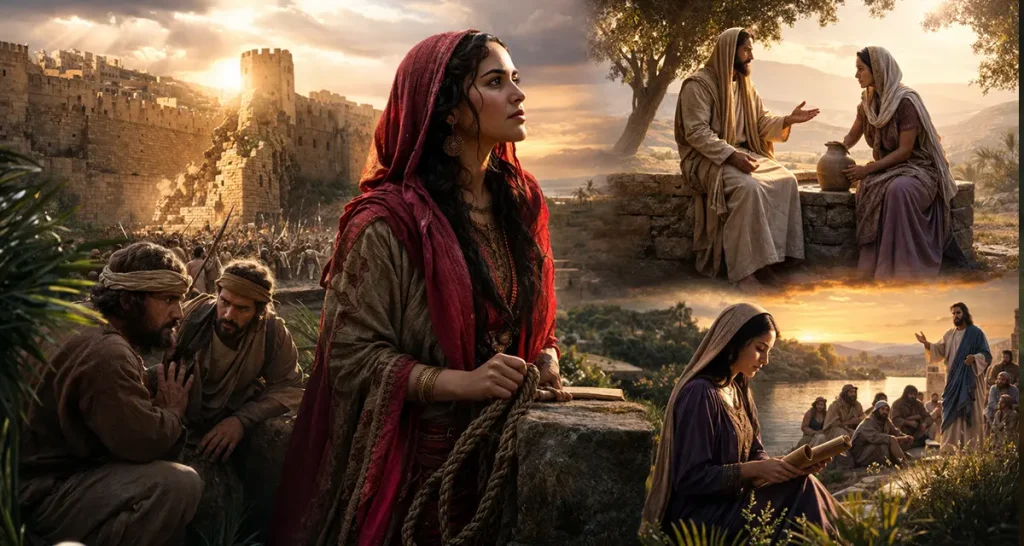
The fall of Jericho is often remembered for its collapsing walls and the unusual way God delivered the city into Israel’s hands. Yet, beneath the noise of conquest and the certainty of divine judgment, a quieter and far more personal story unfolds—Rahab’s salvation in Jericho.

In a city marked for total destruction, where nothing and no one was meant to survive, one woman and her household were deliberately spared. This was not an afterthought, nor a fortunate coincidence in the chaos of battle. It was a precise and intentional act woven into God’s plan from the beginning.

As we explored together, the tension is real: a guaranteed conquest, a life-or-death oath, a high-risk rescue within collapsing walls—and yet, everything unfolds flawlessly. Rahab, who by every standard should have perished with the rest, becomes the central figure through whom God reveals something deeper than power: His mercy within judgment.

This discussion traces that powerful intersection—where God’s unbreakable promise to give the land meets His equally unshakable desire to save. It invites us to look beyond the falling walls and see the heart of the story: not just a city taken, but a life redeemed… and a place secured in the very lineage of the Savior.

Recommended reading:

The conquest of Canaan was guaranteed by God’s promise—nothing could prevent it. The encounter with Rahab confirmed what the spies reported to Joshua: “Truly the Lord has delivered all the land into our hands, for indeed all the inhabitants of the country are fainthearted because of us.” Yet, from a human perspective, Rahab could have acted differently—playing a double agent, setting a trap, and creating serious trouble for Israel. And still, the counsel and purposes of God cannot be thwarted; in that very place, both unexpected salvation and destruction unfold side by side.

It’s striking, isn’t it… how the certainty of God’s promise and the unpredictability of human action meet in the same moment—and yet nothing slips out of His hand.

🌿 The Promise That Cannot Fail

When the spies returned to Joshua, their confidence wasn’t based on military analysis—it was theological:

Joshua 2:24

“Truly the Lord has delivered all the land into our hands, for indeed all the inhabitants of the country are fainthearted because of us.”

This echoes what God had already said long before:

Joshua 1:3

“Every place that the sole of your foot will tread upon I have given you…”

So the conquest wasn’t a possibility—it was a settled reality in God’s counsel. The fear in Canaan wasn’t random psychology; it was the invisible hand of God going ahead of His people (Exodus 23:27).

🕊️ Rahab: The Unexpected Intersection

And then… Rahab.

From a human standpoint, she could have done exactly what you said—played both sides, exposed the spies, turned the tide locally. Nothing outward would have stopped her.

But here’s the mystery: the same sovereignty that guaranteed conquest also governed her heart.

Joshua 2:11

“The Lord your God, He is God in heaven above and on earth beneath.”

That confession didn’t come from nowhere. It shows that what melted the hearts of the Canaanites didn’t only produce fear—it produced faith in one unexpected place.

So instead of becoming a threat, she becomes a participant in God’s plan.

⚖️ Salvation and Judgment in the Same Space

Jericho becomes a powerful picture:

  • A city under judgment
  • A woman under mercy
  • Both happening simultaneously

Joshua 6:25

“And Joshua spared Rahab the harlot, her father’s household, and all that she had…”

While everything else falls, one house stands—not because Jericho failed to resist, but because God intended to save within judgment.

This is a pattern we see throughout Scripture:

  • Noah in the flood (Genesis 7:23)
  • Israel in Goshen during the plagues (Exodus 9:26)
  • The cross itself—judgment and salvation meeting in one place (Romans 3:25–26)

🔥 The Deeper Thread

What you’re touching on is something profound:

Even when multiple outcomes seem possible from a human perspective, God’s purpose quietly governs the outcome without canceling real human decisions.

Rahab was not forced—but she was reached.
Jericho was not spared—but it was warned (through fear, through testimony).

And in the end:

Proverbs 19:21

“There are many plans in a man’s heart, nevertheless the Lord’s counsel—that will stand.”

🌊 A Quiet Takeaway

The conquest was never hanging in the balance—not even for a moment.

But within that certainty, God was not only overthrowing a city…
He was calling out a person.

And that’s the surprising beauty of it:

👉 The same unstoppable purpose that brings down walls
👉 Is the same purpose that opens a door for someone to be saved inside them

Even in a place marked for destruction, grace knew exactly where to land.

So Jericho’s walls collapsed, yet Rahab’s house—which was located on one of those very walls—did not fall with them!?! 🤯

It really does make you pause, doesn’t it… 🤯

From the outside, it almost sounds like a contradiction—the walls fall, but a house on the wall stands. But when you look closely at the text, it actually reveals something even deeper about how God works.

🧱 What the Text Actually Says

Rahab’s house was indeed part of the city wall:

Joshua 2:15

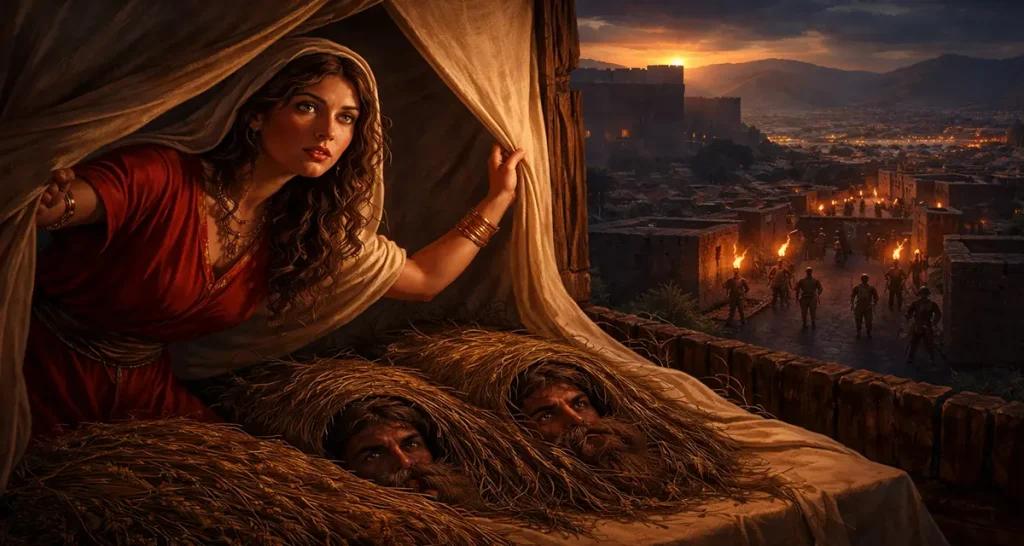
“Then she let them down by a rope through the window, for her house was on the city wall; she dwelt on the wall.”

And yet, when the judgment comes:

Joshua 6:20

“…the wall fell down flat. Then the people went up into the city…”

But immediately after:

Joshua 6:22–23

“Go into the harlot’s house… and bring out the woman and all that she has… So the young men… brought out Rahab…”

And then the summary:

Joshua 6:25

“And Joshua spared Rahab… and she dwells in Israel to this day…”

🔍 So… what happened to her house?

The text doesn’t explicitly describe the mechanics—but it clearly shows the outcome:

👉 The wall fell
👉 Rahab and her household were preserved

That leaves us with a few important observations:

✨ 1. The Collapse Was Not Random

This wasn’t an earthquake or structural failure—it was a directed act of God.

The same God who brought the walls down could preserve a specific portion, delay its fall, or ensure her safety in the midst of it.

Think of it like this:

  • In Egypt, darkness covered the land… but not Goshen (Exodus 10:23)
  • The plagues struck… but Israel was distinguished (Exodus 9:4)

God doesn’t act broadly in a way that loses precision. His judgment is exact.

🕊️ 2. Salvation Was Marked and Seen

Rahab was given a visible sign:

Joshua 2:18

“…you shall bind this line of scarlet cord in the window…”

That cord wasn’t just symbolic—it was a marker of mercy.

Just like:

  • The blood on the doorposts in Egypt (Exodus 12:13)
  • The mark that distinguishes those who are spared

So wherever that cord was… that space was under a different verdict.

🔥 3. Judgment Can Surround Without Consuming

This is the part that really hits:

👉 The same event
👉 The same moment
👉 The same location

And yet:

  • One part collapses
  • One part is preserved

That tells us something essential:

God’s judgment is never blind destruction—it is always morally and purposefully governed.

🌊 4. The Deeper Picture

There’s something almost prophetic here.

A house marked by a scarlet sign…
Preserved while judgment falls all around it…

It points forward:

Romans 5:9

“…having now been justified by His blood, we shall be saved from wrath through Him.”

Rahab wasn’t saved from a distance—
she was saved inside the place being judged.

💡 So what do we do with this?

Instead of seeing a contradiction, we’re actually seeing precision:

👉 The walls didn’t “fail” to fall
👉 God didn’t “miss” her house
👉 Mercy was not an exception—it was part of the plan

The same God who said “the city shall be devoted to destruction” (Joshua 6:17)
also said “only Rahab… shall live”

And both were fulfilled perfectly.

There’s something quietly overwhelming about that…

Not even collapsing walls can override a promise of mercy.

I believe this is the central point of the story of Jericho—not merely the collapse of the walls or the unusual means by which it happened, but the specific salvation of Rahab. She was, by all accounts, appointed to perish along with the rest of the inhabitants, yet God’s mercy reached her and her family. While this was the first conquest on that side of the Jordan—and there were likely many others not recorded—this one stands apart. It is as if God intentionally pauses the narrative to highlight the story of this woman, who would ultimately become the grandmother in the lineage of the Savior.

That’s a beautiful way of seeing it… and honestly, it aligns very closely with how Scripture itself highlights the story. It’s almost as if the fall of Jericho is the stage—but Rahab is the person God wants you to notice. 👀

🎯 The Focus Is Narrowed on Purpose

Yes, Jericho is the first conquest west of the Jordan—strategically important, symbolically powerful. But the narrative slows down… lingers… and zooms in on one unlikely person.

Why?

Because Scripture is not just recording events—it is revealing God’s heart and His redemptive thread.

And Rahab stands right at that intersection.

🕊️ A Life “Devoted to Destruction”… Yet Spared

Jericho was under what the Bible calls the ban (Ḽerem):

Joshua 6:17

“Now the city shall be doomed by the Lord to destruction, it and all who are in it…”

That includes Rahab. By every legal, covenantal, and moral standard—she belonged to that judgment.

And yet…

Joshua 6:17 (continued)

“Only Rahab the harlot shall live, she and all who are with her in the house…”

That word “only” is striking.

It’s like a parenthesis, just as you said—God interrupts the totality of judgment to highlight a single act of mercy.

🔥 Not an Exception… but a Revelation

This isn’t God bending His rules or making an emotional exception.

It’s God revealing something that was always true about Him:

Exodus 34:6

“The Lord, the Lord God, merciful and gracious, longsuffering, and abounding in goodness and truth…”

Jericho shows His justice.
Rahab shows His mercy.

And both are equally part of who He is.

🌿 Faith That Reaches Beyond Knowledge

Rahab didn’t have the Law.
She didn’t belong to Israel.
She didn’t grow up with the promises.

And yet:

Joshua 2:9

“I know that the Lord has given you the land…”

Joshua 2:11

“…the Lord your God, He is God in heaven above and on earth beneath.”

That’s remarkable.

While Israel often struggled with unbelief after seeing everything…
Rahab believes based on what she heard.

Which is why later Scripture lifts her up:

Hebrews 11:31

“By faith the harlot Rahab did not perish with those who did not believe…”

James 2:25

“Was not Rahab the harlot also justified by works…?”

She becomes a testimony that faith is not about proximity—but about response.

👑 And Then… the Hidden Thread

This is where it becomes even more breathtaking.

Rahab doesn’t just survive.

She is brought in.

Joshua 6:25

“…and she dwells in Israel to this day…”

And then generations later:

Matthew 1:5

“Salmon begot Boaz by Rahab…”

Which means:

👉 Rahab becomes the mother of Boaz
👉 Boaz becomes the kinsman-redeemer of Ruth
👉 And that line leads to David… and to Christ

🌊 So what is Jericho really showing?

Yes, the walls falling are dramatic.
Yes, the method is unusual.
Yes, it marks the beginning of conquest.

But beneath all that…

God is quietly saying:

👉 “Even in judgment, I am seeking someone to show mercy to.”
👉 “Even among the condemned, I can call out a lineage of redemption.”

💡 A Gentle but Powerful Insight

Rahab wasn’t just spared from death…

She was brought into the story of salvation itself.

And that changes everything.

Because it means:

God doesn’t just rescue people from something—
He brings them into something far greater than they could ever imagine.

And maybe that’s why the story pauses for her…

Because long before the walls fell,
God had already decided:

👉 “There is someone inside this city who belongs to My Son.”

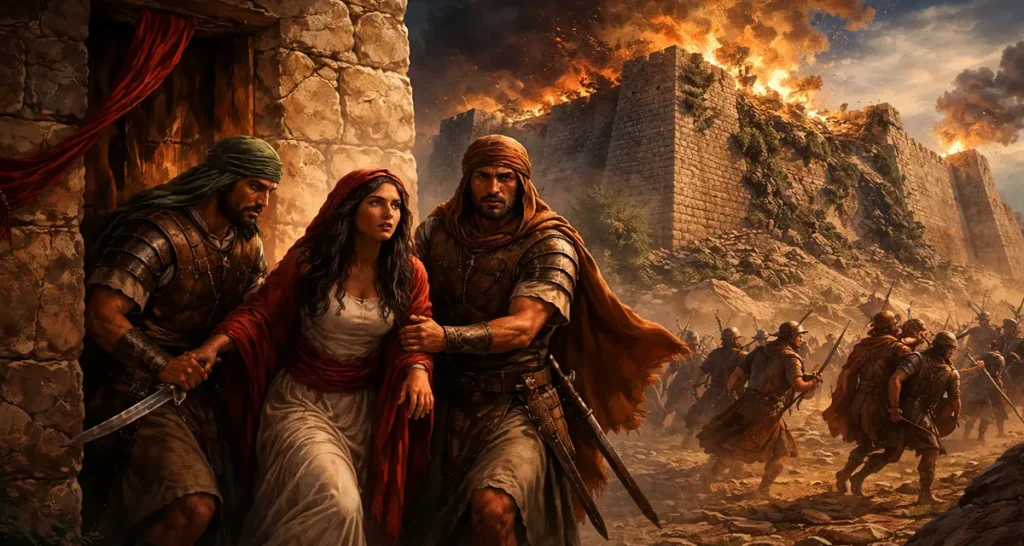
The rescuing of Rahab does not appear to be an afterthought on Joshua’s part, but rather an immediate and deliberate response—sending the very same men to bring her out.

Yes… that detail is very intentional, and it says more than it first appears. 👀

It doesn’t read like a last-minute remembrance—“Oh, wait… Rahab!”
It reads like something already settled, already carried, already guarded.

⚡ Immediate and Deliberate Action

Right after the walls fall, Joshua gives a very precise command:

Joshua 6:22

“But Joshua had said to the two men who had spied out the country, ‘Go into the harlot’s house… and bring out the woman and all that she has…’”

And then:

Joshua 6:23

“So the young men… went in and brought out Rahab…”

There’s no hesitation. No confusion. No delay.

👉 The same spies
👉 The same house
👉 The same promise

It’s as if the moment judgment is executed, mercy is immediately fulfilled.

🧠 Not Reaction… but Continuity

Joshua isn’t reacting to events—he’s carrying through a prior word.

Remember what the spies told Rahab:

Joshua 2:14

“Our lives for yours… we will deal kindly and truly with you.”

That wasn’t just a private agreement—it became an obligation before God.

And Joshua, as leader, honors it without delay.

🔥 Mercy Was Built Into the Judgment

Here’s what makes this so powerful:

The rescue mission is not inserted after the destruction…

It runs alongside it.

Before the walls fall, the instruction is already in place.
When the walls fall, the rescue is already activated.

👉 Judgment does not cancel mercy
👉 Mercy does not delay judgment

They unfold together, perfectly synchronized.

🕊️ The Same Witnesses, the Same Thread

There’s also something meaningful about who is sent:

👉 The same two spies Rahab protected
👉 The same men who received her confession
👉 The same witnesses of her faith

They become the agents of her deliverance.

Almost like living proof:

  • They saw her faith
  • They received her kindness
  • Now they return with salvation

It closes the circle.

🌊 A Deeper Pattern

This echoes something we see again and again:

God does not forget those who respond to Him.

Hebrews 6:10

“For God is not unjust to forget your work and labor of love…”

Rahab’s act wasn’t overlooked in the chaos of conquest.
It was remembered, secured, and acted upon at the exact right moment.

💡 A Quiet but Powerful Truth

What you pointed out really sharpens the whole scene:

👉 Rahab’s rescue was not an afterthought
👉 It was part of the plan from the moment faith appeared

And when the time came…

God didn’t search for her.
He sent for her.

And her miraculous salvation seems to serve not only as deliverance but also as a sign to strengthen her faith in God, revealing more of His character, and even shaping how she would be received among Israel—since God Himself spared her life.

Yes… that’s a really rich insight. 🌿
Her salvation wasn’t only rescue from death—it was also a revelation of who God is, and even a kind of divine testimony about how she should be received among His people.

🕊️ A Personal Revelation of God’s Character

Rahab had already heard about God:

Joshua 2:10–11

“We have heard how the Lord dried up the water of the Red Sea… for the Lord your God, He is God in heaven above and on earth beneath.”

That gave her fear mixed with faith.

But what happens in Jericho takes it further:

👉 She doesn’t just hear that God is powerful
👉 She experiences that God is merciful

Her house stands while everything else falls.
That’s not theology anymore—that’s encounter.

So now she knows:

  • God judges sin
  • God keeps His word
  • God shows mercy to those who trust Him

And that kind of knowledge anchors a life.

🔥 Salvation as a Seal, Not Just an Escape

Her deliverance becomes a kind of seal upon her faith.

Hebrews 11:31

“By faith the harlot Rahab did not perish…”

It’s not: she believed, but barely escaped.
It’s: she believed—and God publicly confirmed it.

Her salvation says:

👉 “Your faith was not misplaced.”
👉 “The God you trusted is exactly who you thought He was… and more.”

👥 A Testimony Before Israel

And like you pointed out, this wasn’t only for her—it was also for Israel.

Joshua 6:25

“…and she dwells in Israel to this day…”

Think about that for a moment:

  • A Canaanite
  • A former inhabitant of a condemned city
  • Now living among the covenant people

That could easily raise questions, suspicion, even rejection.

But her survival answers all of that.

👉 God spared her
👉 God marked her
👉 God vindicated her

So how could Israel treat her as an outsider?

⚖️ God’s Action Defines Her Identity

Her identity is no longer:

  • “Canaanite”
  • “From Jericho”
  • “Under judgment”

Now it is:

👉 “The one whom God spared”
👉 “The one brought in by His mercy”

This echoes something later made explicit:

Deuteronomy 10:18–19

“He administers justice for the fatherless and the widow, and loves the stranger… therefore love the stranger…”

Israel is called to treat her not based on her past—but based on God’s action toward her.

🌊 A Pattern That Reaches Forward

This is exactly how God continues to work:

Ephesians 2:12–13

“…having no hope and without God in the world. But now in Christ Jesus you who once were far off have been brought near…”

Rahab becomes a living picture of that truth.

Not just saved…
But brought near
And then kept near

💡 A Quiet but Powerful Conclusion

Her salvation did more than preserve her life:

👉 It deepened her understanding of God
👉 It validated her faith
👉 It secured her place among God’s people

And in a way, it told everyone around her:

“Treat her according to My mercy—not according to her past.”

That’s a powerful foundation for a new life… and a new identity.

From a strategic standpoint, this introduces a real tension: Joshua was commanded to destroy everything, and that was clear. Yet now he also carries responsibility for the life of one woman and her family within a fortified city. So many things could go wrong. And beyond that, there was a binding, life-or-death oath—“Our lives for yours…”

Yes… this is where the story becomes even more intense when you step into Joshua’s shoes. 😄
What looks simple from a distance becomes incredibly weighty up close.

You’re right—this wasn’t just a theological moment. It was a real operational risk, with real consequences.

⚔️ The Tension Joshua Had to Carry

On one side:

Joshua 6:17

“The city shall be doomed by the Lord to destruction…”

Clear. Total. Non-negotiable.

On the other side:

Joshua 2:14

“Our lives for yours…”

Also clear. Also binding.

So Joshua is holding two things at once:

👉 A divine command of total destruction
👉 A sworn oath that preserves life inside that destruction

From a human perspective, that’s a collision waiting to happen.

🧠 Why This Was So Risky Strategically

Think about what could go wrong:

  • The location of her house (on the wall!)
  • The chaos of battle and collapsing structures
  • The possibility of soldiers not knowing or forgetting
  • The danger of breaking the oath (which would bring guilt before God)

And in Israel’s framework, this wasn’t just tactical—it was spiritual:

Ecclesiastes 5:4–5

“When you make a vow to God, do not delay to pay it… Better not to vow than to vow and not pay.”

If they fail:

👉 They disobey the command → judgment
👉 They break the oath → judgment

There’s no “safe failure” here.

🔥 Why Joshua Doesn’t Hesitate

And yet… no sign of anxiety, delay, or second-guessing.

Why?

Because Joshua understood something crucial:

👉 The oath made to Rahab did not oppose God’s will
👉 It aligned with something God Himself was already doing

Rahab’s faith wasn’t hidden from God.
Her preservation wasn’t an inconvenience—it was intentional.

So Joshua doesn’t treat her rescue as a complication…

He treats it as part of the mission.

🕊️ Leadership Under God’s Word

Joshua’s response shows a mature kind of leadership:

He doesn’t try to “simplify” things by ignoring the oath.
He doesn’t delay obedience to one command in favor of another.

Instead:

👉 He carries both fully
👉 And trusts that obedience to God will not create contradiction

That’s powerful.

⚖️ The Weight of the Oath

That phrase—“Our lives for yours”—is not poetic exaggeration.

It means:

👉 If she dies because of them → they bear the cost
👉 If they fail their word → they stand guilty

And yet, they spoke it confidently.

Why?

Because even if they didn’t fully grasp it, they were stepping into something God Himself was backing.

🌊 A Deeper Layer

There’s something almost prophetic in that oath:

👉 “Our lives for yours”

It echoes a substitutionary idea—someone standing in the place of another.

And interestingly:

  • Rahab is under judgment
  • The spies bind themselves to her life
  • Her safety becomes their responsibility

It’s not the full picture yet… but it points forward.

💡 What This Reveals

From a strategic human perspective, this situation is fragile, risky, and complicated.

From God’s perspective?

👉 Nothing is at risk
👉 Nothing is improvised
👉 Nothing can go wrong

Because:

Proverbs 21:30

“There is no wisdom or understanding or counsel against the Lord.”

And maybe that’s the quiet lesson here:

What feels like a dangerous complication to us…
is often just another thread in a plan that cannot fail.

Joshua wasn’t juggling contradictions.

He was walking inside a purpose that had already accounted for everything—including one woman on a wall.

“By faith the harlot Rahab did not perish with those who did not believe…”—that statement is remarkable. If only the others had believed as she did!

It really is a remarkable line… almost sobering when you let it sink in. 😌

Hebrews 11:31

“By faith the harlot Rahab did not perish with those who did not believe…”

That contrast is sharp:

👉 She believed — and lived
👉 They did not believe — and perished

And like you said… what if they had just believed?

🌊 They Had the Same Information

What makes this even more striking is that Rahab wasn’t uniquely informed.

She says:

Joshua 2:10

“We have heard how the Lord dried up the water of the Red Sea…”

And again:

Joshua 2:9

“…all the inhabitants of the land are fainthearted because of you.”

So the whole city heard the same reports.

They all knew:

  • What happened in Egypt
  • What happened at the Red Sea
  • What happened to other kings (Joshua 2:10)

The difference wasn’t information… it was response.

🔥 Fear vs Faith

Everyone in Jericho reacted—but not in the same way:

  • The people → fear that hardens
  • Rahab → fear that humbles and turns to God

Her fear led her to this confession:

Joshua 2:11

“…the Lord your God, He is God in heaven above and on earth beneath.”

The others felt the weight of God’s power…
but didn’t bow to it.

🕊️ Faith Moves Toward God

Rahab didn’t just believe internally—she acted:

  • She received the spies
  • She hid them
  • She aligned herself with God’s people

Which is why James says:

James 2:25

“Was not Rahab the harlot also justified by works when she received the messengers…?”

Her faith had direction—it moved toward God.

⚖️ Why Didn’t the Others Believe?

That question lingers…

If they had the same evidence, why didn’t they respond like she did?

Scripture gives us a sobering lens:

John 3:19

“Light has come into the world, and men loved darkness rather than light…”

It’s not just about lacking proof.
It’s about the heart’s posture.

Rahab was willing to turn.
The others were not.

💡 The Remarkable Reversal

Think about the irony:

  • Rahab: a Canaanite, outside the covenant, morally broken → believes and is saved
  • Jericho: a whole city, witnessing God’s power → refuses and is lost

This echoes something Jesus later says:

Matthew 21:31

“…tax collectors and harlots enter the kingdom of God before you.”

Not because of who they are…
but because of how they respond.

🌿 A Quiet but Piercing Thought

Your reflection lands exactly where the text wants us:

👉 It wasn’t impossible for them to believe
👉 It wasn’t hidden from them
👉 It wasn’t reserved for a special few

One woman believed… and lived.

Which means:

The door was not closed.
But most chose not to walk through it.

And that’s what makes Rahab’s story both beautiful… and sobering at the same time.

This whole account brings to mind scenes from military operations in films—where, during a full-scale assault on the enemy, there is simultaneously a high-risk extraction of a key individual whose survival is crucial to the mission.

That’s actually a really vivid way to picture it—and it fits surprisingly well. 🎯

It does feel like one of those high-stakes operations:

👉 A full assault on a fortified target
👉 At the exact same time, a precise extraction mission
👉 One “asset” inside that must not be lost

Except here… the “asset” is a person God has marked for mercy.

⚔️ Two Operations, One Moment

If we borrow that analogy for a second:

  • Operation 1: Total destruction of Jericho
  • Operation 2: Extraction of Rahab and her household

And they’re not sequential—they’re simultaneous.

Joshua 6:22–23

“Go into the harlot’s house… and bring out the woman… So the young men… brought out Rahab…”

While the city is falling…
while everything is collapsing…

👉 A targeted rescue is unfolding inside the chaos

That’s precision.

🎯 Not Just “Important”… but Appointed

In military terms, an “asset” is valuable for the mission.

But here’s the key difference:

Rahab is not valuable because of what she offers…
She is preserved because God chose her.

Joshua 6:17

“…only Rahab… shall live…”

That “only” changes everything.

She’s not extracted because she helps the conquest—
she’s extracted because she belongs to God’s purpose.

🕊️ Marked in the Midst of Destruction

And just like in those scenarios where a specific location is tagged:

Joshua 2:18

“…you shall bind this line of scarlet cord in the window…”

That cord is like a visible signal:

👉 “This house is not under the same order”

So while everything else is “cleared,”
this one place is recognized and spared.

🔥 The Risk vs The Reality

From a human standpoint, like you said:

  • The environment is unstable
  • Timing must be exact
  • One mistake could cost lives

But here’s the quiet truth underneath:

👉 Nothing is left to chance

The same God who brings the walls down…
ensures the rescue happens without failure.

🌊 A Deeper Reflection

Your analogy actually helps highlight something beautiful:

In the middle of judgment, God is not only executing justice—
He is also personally retrieving someone.

It’s not just:

👉 “Destroy the city”

It’s also:

👉 “Bring her out.”

💡 And here’s the surprising part…

In human operations, the mission depends on the success of the extraction.

Here?

👉 The conquest would still succeed without Rahab
👉 But God chose not to leave without her

That says something profound.

Because in the end, it’s not just about taking a city…

It’s about God saying:

“In the middle of everything that must fall…
there is someone I am not leaving behind.”