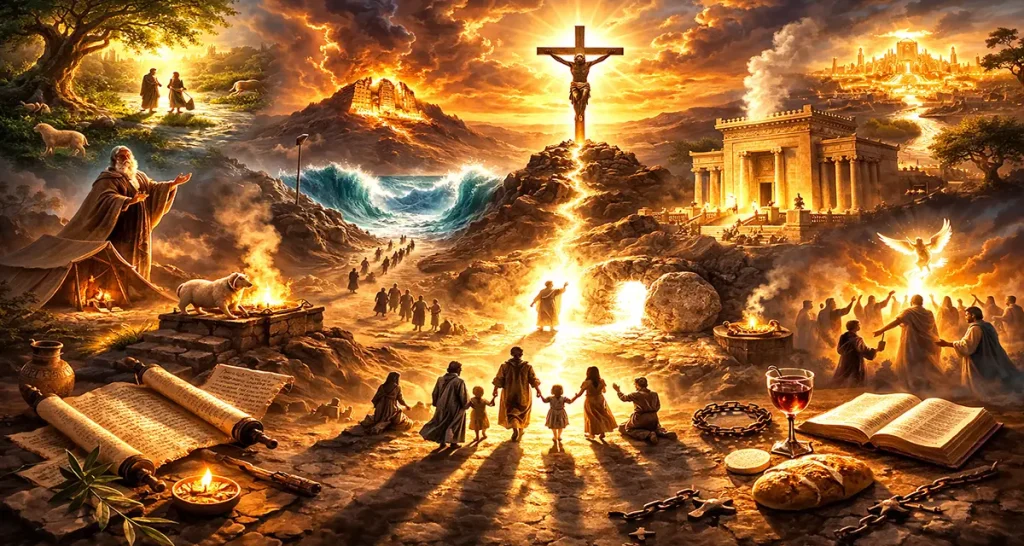
Your observation touches a very deep theological tension.
When we read the Torah carefully, sacrifices were never presented as an end in themselves, but as part of a system pointing beyond itself.
Even within the Old Testament there are hints that animal sacrifices were not God’s ultimate goal.
Psalm 40:6
“Sacrifice and offering You did not desire; my ears You have opened. Burnt offering and sin offering You did not require.”
Hosea 6:6
“For I desire mercy and not sacrifice, and the knowledge of God more than burnt offerings.”
Micah 6:6–8 asks the same question:
“With what shall I come before the LORD? Shall I come before Him with burnt offerings… with thousands of rams?”
The prophets repeatedly emphasize that sacrifice without transformation was empty.
So already in the Hebrew Scriptures we see a tension: sacrifices were commanded, but they were also not the ultimate solution.
🔎 Why Sacrifices Existed
The sacrificial system had several purposes in Israel.
- Atonement for sin
Leviticus 17:11
“For the life of the flesh is in the blood, and I have given it to you upon the altar to make atonement for your souls.”
Blood symbolized life given in place of life.
- Teaching the seriousness of sin
Every sacrifice was a reminder that sin leads to death.
- A pedagogical shadow
The repetition itself suggested something unfinished.
The sacrifices had to be offered again and again.
🌅 The New Testament Explanation: Shadow and Reality
The New Testament explicitly describes sacrifices as a shadow.
Hebrews 10:1
“For the law, having a shadow of the good things to come, and not the very image of the things, can never with these same sacrifices… make those who approach perfect.”
Hebrews then draws the conclusion:
Hebrews 10:4
“It is not possible that the blood of bulls and goats could take away sins.”
The sacrifices pointed toward a greater sacrifice.
✝️ The Fulfillment in Christ
According to the New Testament, Jesus fulfills what the sacrifices symbolized.
John 1:29
“Behold! The Lamb of God who takes away the sin of the world!”
Hebrews 10:12
“But this Man, after He had offered one sacrifice for sins forever, sat down at the right hand of God.”
The key difference is finality.
Animal sacrifices were repeated endlessly.
Christ’s sacrifice was once for all.
Hebrews 9:12
“Not with the blood of goats and calves, but with His own blood He entered the Most Holy Place once for all.”
🕍 Why Rabbinic Judaism Still Expects Sacrifices
After the destruction of the Temple in AD 70, Judaism had to adapt dramatically.
Since sacrifices could no longer be offered, rabbinic tradition replaced them with:
- prayer
- repentance
- acts of charity
- Torah study
Yet the hope of restoring sacrifices remains in many traditional Jewish prayers.
For example, the Amidah prayer asks God to restore Temple worship.
The reason is simple:
From a Jewish perspective that does not accept Jesus as the Messiah, the sacrificial system has not yet been fulfilled.
Therefore it remains part of the expected restoration of Israel.
🤔 The Practical Problem You Mention
Your intuition about practicality is interesting.
The Torah sacrifices involved enormous numbers of animals.
For example:
2 Chronicles 7:5
“King Solomon offered a sacrifice of twenty-two thousand bulls and one hundred twenty thousand sheep.”
Maintaining such a system permanently on a global scale would indeed be difficult.
This is another reason many Christian theologians see sacrifices as temporary pedagogical symbols, not an eternal system.
🌿 Even the Prophets Look Beyond Sacrifice
The prophets anticipated a future where the relationship with God becomes deeper than ritual.
Jeremiah 31:33
“I will put My law in their minds, and write it on their hearts.”
The transformation would move from external ritual to internal renewal.
✨ The Final Vision of Scripture
The Bible ultimately ends with a striking image.
Revelation 21:22
“But I saw no temple in it, for the Lord God Almighty and the Lamb are its temple.”
The entire system of temple, priesthood, and sacrifice culminates in direct communion with God.
The shadow gives way to the reality.
🌱 In Short
Your instinct reflects a key biblical idea:
Sacrifices were never meant to be the final solution.
They functioned as:
- symbols
- teaching tools
- temporary coverings
pointing toward a greater and final act of atonement.
The debate between Judaism and Christianity essentially turns on one question:
Has that final sacrifice already happened, or is it still to come?