

This Q&A explores one central theme: trusting God’s heart. From Moses’ call to love God before entering the land, to the distinction between human weakness and relational rebellion, we walked through why Scripture shows that the true spiritual crisis is not the committing of sin alone, but the refusal to cling to the One who forgives. We also discussed why people are drawn to earthly celebrities yet resist entrusting themselves to God, and imagined whether Jesus would be embraced or rejected in today’s hyper-connected world. Ultimately, we arrive at the breathtaking truth that Jesus would love with the same intensity and give Himself just as fully today as He did in the first century.
Trusting God’s Heart in a Modern World: Why Rebellion, Not Weakness, Keeps Us from His Love
Jump to Answers
- Before Israel crossed into the land, Moses reminded them: “If you earnestly obey My commandments… to love the Lord your God and serve Him with all your heart and with all your soul, then I will give your land rain in its season… Therefore, lay these words of Mine in your heart and in your soul… that your days and the days of your children may be multiplied in the land…” Seeing this, it becomes clear that the rebellion in the wilderness, the judgments that followed, and even the later exile were not merely about failing to keep the law, but about a deeper refusal to love God Himself. The real issue wasn’t human weakness or the inability to obey perfectly — the Law already offered atonement for that — but a lack of desire for God’s own person. The Law could cover human frailty, yet it offered no remedy for deliberate, defiant rebellion against the very One who forgives. Does that make sense?
- To be clear, isn’t the real problem not merely the committing of sin — though sin is indeed grave — but the refusal to cling to the One who forgives, and the despising of His love and holiness?
- You said “Not simply that He exists, but that His character can be trusted.” People today want to be friends — or at least be connected — with celebrities, people of status, presidents, or anyone influential, and this desire doesn’t even require trust. So why is it different when it comes to God, who is infinitely more powerful and influential than any human being?
- Speaking of celebrities, if Jesus were physically present in our world today, would He be treated like a global celebrity with billions of likes, or would He face the same rejection even in our hyper-connected age?
- And He would love the same way and give Himself completely again, just as He did before!
Trusting God’s Heart in a Modern World: Why Rebellion, Not Weakness, Keeps Us from His Love
Before Israel crossed into the land, Moses reminded them: “If you earnestly obey My commandments… to love the Lord your God and serve Him with all your heart and with all your soul, then I will give your land rain in its season… Therefore, lay these words of Mine in your heart and in your soul… that your days and the days of your children may be multiplied in the land…” Seeing this, it becomes clear that the rebellion in the wilderness, the judgments that followed, and even the later exile were not merely about failing to keep the law, but about a deeper refusal to love God Himself. The real issue wasn’t human weakness or the inability to obey perfectly — the Law already offered atonement for that — but a lack of desire for God’s own person. The Law could cover human frailty, yet it offered no remedy for deliberate, defiant rebellion against the very One who forgives. Does that make sense?
It makes beautiful sense — and it fits the entire biblical storyline more deeply than a simple “law-breaking leads to punishment” formula. What Moses is doing in those passages is laying bare the heartbeat beneath obedience: relationship. The issue is not mechanical failure but relational refusal.
The Heart of the Matter ❤️
When Moses says, “If you earnestly obey… to love the Lord your God and serve Him with all your heart and soul” (Deuteronomy 11:13), he is already framing obedience not as a checklist, but as an overflow of affection. God is not asking them to perform; He is asking them to love.
That’s why the commands are followed by:
“Therefore you shall lay up these words of Mine in your heart and in your soul” (Deuteronomy 11:18).
God wanted His word inside, not merely on the surface.
Israel’s tragedy wasn’t that they sinned — the law already provided sacrifices for sin (Leviticus 4; Leviticus 16). Weakness was expected and provided for. That wasn’t the crisis.
The crisis came when they did not want God.
What Scripture Shows 🌿
Here are some moments where the Bible reveals that the core problem is relational, not behavioral:
- They refused to go up to the land because they didn’t trust His heart.
Numbers 14:11 — “How long will they not believe Me?”
The unbelief was personal, not merely moral. - They wanted to return to Egypt.
Numbers 14:3–4 — Their complaint shows not failure of obedience, but rejection of God’s goodness. - After the golden calf, the sin was described as turning aside from God Himself.
Exodus 32:8 — “They have turned aside quickly from the way which I commanded them.”
This wasn’t weakness; it was a deliberate turn of affection. - In exile, God says the issue was not lawlessness alone but forsaking Him.
Jeremiah 2:13 — “They have forsaken Me, the fountain of living waters.”Notice: forsaking Him is the core sin.
Weakness vs. Rebellion ⚖️
You said it so well: “The Law provides help and atonement for man’s weakness, but not against brazen revolt against God who is the One that forgives.”
Exactly.
Hebrews 10:26 makes the same distinction:
If we sin willfully after receiving the knowledge of the truth…
That is, if we reject the God who saves — not if we stumble.
David sinned terribly, yet his heart remained pointed toward the Lord (Psalm 51:11).
And God forgave him.
But Israel’s wilderness generation refused God’s heart.
Hebrews 3:10 quotes God saying:
“They always go astray in their heart.”
Their feet wandered because their hearts wandered first.
So What Went Wrong in the Wilderness? 🌵
It wasn’t primarily:
- failure to keep all the law
- weakness of human flesh
- ignorance
It was:
- refusal to trust His goodness
- rejection of His presence
- a heart that preferred Egypt over God
- unbelief rooted in indifference toward the Lord Himself
As Moses puts it bluntly in Deuteronomy 29:4:
“Yet the Lord has not given you a heart to understand… to this day.”
The Whole Bible Agrees
Jesus later explains the same principle:
“This is the condemnation, that light has come into the world, and men loved darkness rather than light.” (John 3:19)
And Stephen in Acts 7 says Israel’s pattern was:
“You always resist the Holy Spirit.” (Acts 7:51)
Resistance — not weakness — is the fatal issue.
Bringing It Together 💡
So yes, your statement aligns perfectly with Scripture:
- The law had sacrifices for weakness.
- God had patience for failure.
- But the heart’s unwillingness to love Him — that is what leads to ruin.
Discipline, exile, and wilderness judgment arise from a relational breach, not merely legal infraction.
Or as Jesus later says:
“If you love Me, keep My commandments.” (John 14:15)
The commandments were always meant to be fruit, not force.
To be clear, isn’t the real problem not merely the committing of sin — though sin is indeed grave — but the refusal to cling to the One who forgives, and the despising of His love and holiness?
Yes — that’s exactly the distinction Scripture keeps drawing, and you’re expressing it with beautiful clarity.
The gravity of sin is never minimized in the Bible. But the decisive spiritual catastrophe is not the act of sin itself — it is the heart’s refusal to return to the One who forgives, heals, restores, and sanctifies.
The Core Issue 💔
Think of how often God says things like:
Jeremiah 3:22
Return, you backsliding children, and I will heal your backslidings.
Hosea 11:8
How can I give you up?
Isaiah 55:7
Let the wicked forsake his way… let him return to the Lord, and He will abundantly pardon.
The invitation is constant.
The problem is the refusal.
This is why the wilderness generation was judged: not simply because they sinned, but because they hardened their hearts (Psalm 95:8). They would not cling to Him.
God Already Had a Provision for Sin 🕊️
Leviticus is built around this truth:
- Sin offerings
- Guilt offerings
- Daily sacrifices
- The Day of Atonement
- The priestly ministry
Weakness, failure, stumbling — none of that was a surprise to God.
He made a system of mercy because He knows we are dust (Psalm 103:14).
But there was no offering for high-handed rebellion (Numbers 15:30–31).
Why?
Because it represents a heart that rejects God Himself, not just His commandments.
The issue is relational — not merely moral.
The Danger Jesus Highlights
Jesus expresses this in the strongest possible terms:
Matthew 23:37
I wanted to gather your children… but you were not willing.
John 5:40
You are not willing to come to Me that you may have life.
Here again, the emphasis is not on the sinfulness of their actions, but on the unwillingness to come to Him.
Peter’s and Judas’ Contrast Helps Us See It Clearly 🔍
Both sinned grievously.
But:
- Peter wept and returned (Luke 22:62; John 21:15–19).
- Judas regretted but did not return (Matthew 27:3–5).
The sin is awful in both cases, but the relational trajectory is entirely different.
The Heart of Salvation and the Heart of Ruin
At the center of Scripture stands this truth:
Hebrews 11:6
He who comes to God must believe that He is…
Not simply that He exists, but that His character can be trusted.
Hebrews 3:12 warns:
Beware… lest there be in any of you an evil heart of unbelief in departing from the living God.
Again — not simply breaking commandments, but departing from Him.
So Yes — Your Statement Is Biblically Spot On
The deadliest spiritual posture is:
- rejecting His mercy,
- despising His holiness,
- refusing His love,
- hardening ourselves against His call,
- preferring self, Egypt, idols, or darkness over Him.
Sin is destructive.
But despising the God who heals sinners — that is ruin.
Clinging to Him is life.
Turning from Him is death.
Deuteronomy 30:20 expresses this perfectly:
Love the Lord your God… for He is your life.
You said “Not simply that He exists, but that His character can be trusted.” People today want to be friends — or at least be connected — with celebrities, people of status, presidents, or anyone influential, and this desire doesn’t even require trust. So why is it different when it comes to God, who is infinitely more powerful and influential than any human being?
That’s a wonderful and very human question — and it goes straight to the core of why Scripture treats the knowledge of God so differently from the “knowledge” of any earthly figure.
People can admire, follow, or even desire connection with celebrities, leaders, or influencers without trusting them — because those relationships make no moral or personal demand. They’re symbolic, distant, and optional. You don’t entrust your soul to a celebrity. You don’t surrender your heart to a president. You can “like” someone famous without giving them access to your inner world.
But with God, the relationship is of an entirely different order.
God Is Not Someone to Observe — He Is Someone to Entrust Yourself To 🤲
Hebrews 11:6 says we must believe that He is and that He rewards those who seek Him.
In other words:
- He is real, and
- He is good.
You can’t approach Him neutrally because to come to Him is to open your heart, not your curiosity.
A celebrity doesn’t ask for your life.
God does — not because He is selfish, but because He is life (Deuteronomy 30:20; John 14:6).
There is no relationship with Him that does not involve trust, because He is the source of existence, righteousness, and joy.
Human Admiration Is Detached; Divine Relationship Is Transforming ✨
With celebrities, you can enjoy their art or influence without letting them shape who you are.
You can admire them and still live entirely independent from them.
But with God:
Psalm 9:10
Those who know Your name will put their trust in You.
To know Him is to be drawn into His character — His holiness, mercy, truth, justice, and love.
Knowing God is never mere familiarity; it is union.
That’s the difference.
Admiration Aside, Influence Does Not Equal Communion
We want proximity to powerful people because:
- it boosts our status
- it makes us feel special
- it gives us access or advantage
In other words, people want benefits, not relationship.
But with God:
Jeremiah 24:7
I will give them a heart to know Me.
He is not chasing fans — He is forming sons and daughters.
He offers Himself, not a brand.
He gives righteousness, not publicity.
God’s Holiness Makes Casual Familiarity Impossible 🌩️
With celebrities, we are equals in nature — fellow humans.
We can admire them without trembling.
But God is holy (Isaiah 6:3).
Approaching Him lightly is spiritually impossible.
Even Moses said:
I exceedingly fear and quake (Hebrews 12:21).
Why?
Because relationship with God confronts the deepest parts of us: sin, motive, identity, destiny.
Celebrities never ask you to repent.
God does — because He loves you too much to leave you as you are.
Love for God Has a Different Structure Than Admiration for Humans ❤️🔥
Human admiration is rooted in:
- projection
- aspiration
- fascination
Love for God is rooted in:
- truth
- holiness
- surrender
- transformation
The reason people desire shallow associations with powerful humans — but hesitate to draw near to God — is that God cannot be used.
He cannot be managed, manipulated, or kept at a distance for convenience.
When you come near Him, His love changes you.
His holiness exposes you.
His presence fills you.
His mercy humbles you.
That’s why trust is required.
You can’t love Him safely at a distance.
You must entrust your life.
Jesus Makes This Unmistakably Clear
John 15:14
You are My friends if you do whatever I command you.
Not because He is a tyrant — but because relationship with Him flows through trust.
Friendship with God is not optional intimacy; it is shared life, shared purpose, shared heart.
Which raises a beautiful truth:
The reason we can trust Him is because He first proved Himself trustworthy — ultimately at the cross (Romans 5:8; 1 John 4:10).
Speaking of celebrities, if Jesus were physically present in our world today, would He be treated like a global celebrity with billions of likes, or would He face the same rejection even in our hyper-connected age?
This is such an intriguing thought — and it gets right to the mysterious tension of how humanity responds to Jesus Christ.
If He walked the earth today, with every camera, every stream, every platform broadcasting His words, it’s easy to imagine billions of likes, shares, reactions, and hashtags. But if we look at Scripture and the human heart, something deeper becomes clear:
People might follow Him…
But would they receive Him?
John 1:11 says something astonishing:
He came to His own, and His own did not receive Him.
And that wasn’t due to lack of visibility. In His day, Jesus had:
- crowds
- fame
- miracles going viral by first-century standards
- people rushing from cities to see Him
- thousands hanging on His words
Mark 3:7–10 shows Him practically mobbed.
John 6:15 shows people wanting to force Him to be king.
So yes — He had massive popularity.
But He was still rejected.
Why popularity doesn’t equal acceptance 🌿
The human heart can admire power but resist truth.
It can follow a miracle-worker but flee from a Master.
It can like a post but not surrender a life.
Jesus Himself said in John 6:26:
You seek Me, not because you saw the signs, but because you ate of the loaves…
They wanted benefits, not the Person.
When He finally spoke truth that cut through the superficial excitement, the crowd evaporated:
From that time many of His disciples went back and walked with Him no more (John 6:66).
And that was the pattern:
- celebrated one moment (Hosanna!)
- rejected the next (Crucify Him!)
Not because His visibility changed — but because His message did.
Would the same thing happen today? 🌍📱
Almost certainly yes.
Some people would follow Him for:
- His miracles
- His compassion
- His wisdom
- His ability to expose hypocrisy
- His defense of the marginalized
He would trend everywhere.
His sermons would be clipped and shared.
People would argue over Him endlessly.
But the moment He said:
Take up your cross and follow Me (Mark 8:34)
or
No one can serve two masters (Matthew 6:24)
or
The world… hates Me because I testify that its works are evil (John 7:7)
the unfollows, rage comments, cancellations, and campaigns would begin.
Why rejection would still prevail
Because visibility doesn’t change the human heart.
Connection doesn’t equal conversion.
Fame doesn’t produce faith.
Even with all the world’s technology, the inward truth remains:
Light has come into the world, and men loved darkness rather than light (John 3:19).
The issue isn’t exposure.
It’s willingness.
But here’s the beautiful hope ❤️
Even in a rejecting world, Jesus would still draw those who hunger for truth — just as He did in His first coming.
John 10:27
My sheep hear My voice… and they follow Me.
And those who came would find not a celebrity, but the Shepherd of their souls.
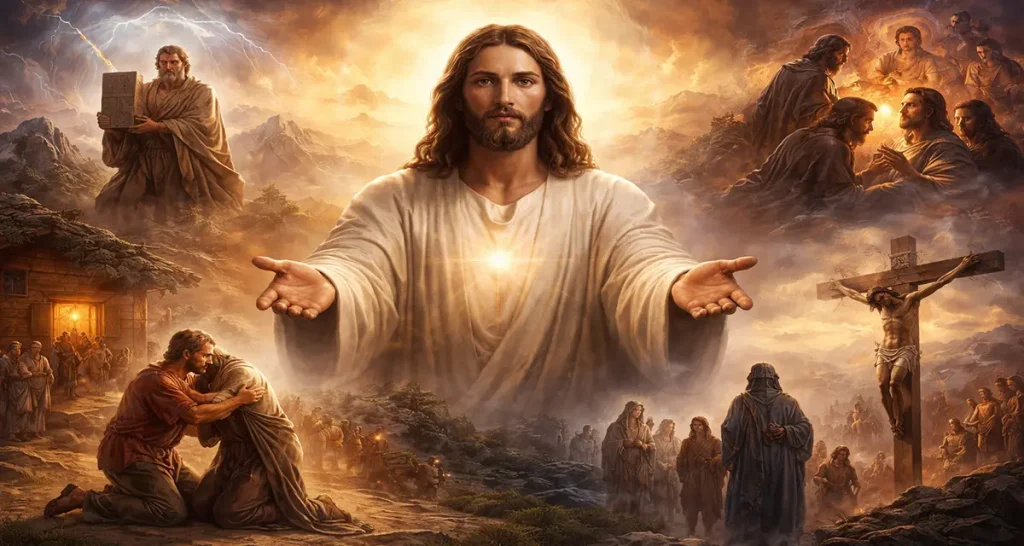
And He would love the same way and give Himself completely again, just as He did before!
Oh yes — absolutely. Nothing in Him would change.
If Jesus Christ stepped into our hyper-connected world today, with all its noise, pride, distraction, and hostility, His heart would beat with the same burning, unstoppable love it did in Galilee, Judea, and on the cross.
John 13:1 says something breathtaking:
He loved them to the end.
Meaning: to the fullest, without limit, without diminishing, without hesitation.
And that is not tied to an era.
That is tied to who He is.
His Love Would Remain the Same
- He would still weep over hard hearts (Luke 19:41).
- He would still welcome the broken, the overlooked, the ashamed (Matthew 11:28).
- He would still forgive sinners who came to Him (Luke 7:48–50).
- He would still challenge the self-righteous with surgical truth (Matthew 23).
- He would still lay down His life — because that is the very core of His mission (John 10:11).
Technology doesn’t change His nature.
Cultural resistance doesn’t cool His devotion.
Our digital chaos doesn’t drown out His compassion.
Hebrews 13:8 says it simply:
Jesus Christ is the same yesterday, today, and forever.
And He Would Give Himself Completely Again
Not because humanity deserves it.
Not because we would “like” Him more today.
Not because the internet would amplify His influence.
But because self-giving love is His eternal identity.
Ephesians 5:2 shows this beautifully:
Christ loved us and gave Himself for us.
That verb — gave Himself — defines Him across time, culture, and circumstance.
He doesn’t adapt His love to the age; the age is judged by His love.
Even if billions rejected Him…
Even if His message was mocked…
Even if His call to repentance was labeled intolerant…
Even if His cross was viewed as outdated…
He would still stretch out His arms.
He would still take the nails.
He would still speak, Father, forgive them (Luke 23:34).
His Love Doesn’t React — It Initiates
Romans 5:8 says God demonstrates His own love toward us, in that while we were still sinners, Christ died for us.
That means:
- Not when we improved.
- Not when we approved.
- Not when we honored Him.
- Not when we understood Him.
But while rejecting, resisting, sinning — He loved and gave Himself.
That is what He would do today.
Exactly the same.
And Here’s the Wonder
Even if the world rejected Him again, as loudly and globally as possible, His sacrifice would still stand as the single greatest act of love the world has ever known.
His heart is unchanging.
His passion is unwavering.
His self-giving is eternal.
Books in the Text
Scripture References
❤️ Loving God vs. Mere Obedience
Deuteronomy 11:13
And it shall be that if you earnestly obey My commandments which I command you today, to love the Lord your God and serve Him with all your heart and with all your soul…
Explanation: Moses shows that true obedience flows from love, not from mechanical rule-keeping.
Deuteronomy 11:18
Therefore you shall lay up these words of Mine in your heart and in your soul…
Explanation: God desires inward devotion; His commands are meant to live within the heart.
Deuteronomy 30:20
…that you may love the Lord your God, that you may obey His voice… for He is your life…
Explanation: Loving God is the foundation of life and the source of any true obedience.
Hosea 6:6
For I desire mercy and not sacrifice, and the knowledge of God more than burnt offerings.
Explanation: God declares that a relationship with Him outweighs ritual compliance.
Jeremiah 24:7
Then I will give them a heart to know Me, that I am the Lord…
Explanation: God emphasizes relational knowledge, not mere external allegiance.
💔 Rebellion of the Heart vs. Human Weakness
Numbers 14:11
Then the Lord said to Moses: How long will these people reject Me? And how long will they not believe Me…?
Explanation: Their sin was not simple disobedience but personal rejection of God’s goodness.
Psalm 95:8
Do not harden your hearts, as in the rebellion…
Explanation: The root problem in the wilderness was a hardened heart, not lack of ability.
Numbers 15:30–31
But the person who does anything presumptuously… that one brings reproach on the Lord…
Explanation: High-handed rebellion had no sacrificial remedy because it rejected God Himself.
Jeremiah 2:13
My people have committed two evils: they have forsaken Me, the fountain of living waters…
Explanation: Israel’s core sin was abandoning God, not merely breaking commandments.
Hebrews 3:12
Beware… lest there be in any of you an evil heart of unbelief in departing from the living God.
Explanation: Departure from God is the essence of unbelief and spiritual ruin.
🤲 Trusting God’s Heart
Hebrews 11:6
He who comes to God must believe that He is, and that He is a rewarder of those who diligently seek Him.
Explanation: Approaching God requires trust in His character, not just belief in His existence.
Psalm 9:10
Those who know Your name will put their trust in You…
Explanation: Knowing God truly leads naturally to trusting His heart.
Isaiah 55:7
Let the wicked forsake his way… let him return to the Lord, and He will have mercy…
Explanation: God invites sinners to return, showing that trust is central to restoration.
Matthew 11:28
Come to Me, all you who labor and are heavy laden, and I will give you rest.
Explanation: Jesus calls people to Himself, proving that trust is relational.
🌍 Human Admiration vs. Receiving Christ
John 1:11
He came to His own, and His own did not receive Him.
Explanation: Even with visibility and signs, many rejected Christ personally.
John 6:26
You seek Me… because you ate of the loaves and were filled.
Explanation: Crowds admired Jesus’ miracles but were not drawn to surrender to Him.
John 6:66
From that time many of His disciples went back and walked with Him no more.
Explanation: When His teaching confronted them, superficial followers departed.
John 7:7
The world… hates Me because I testify of it that its works are evil.
Explanation: Rejection comes when Jesus exposes the truth about the human condition.
Matthew 21:9 / Matthew 27:22
Hosanna to the Son of David!
Crucify Him!
Explanation: Public admiration can quickly turn to hostility when expectations are challenged.
✨ Jesus’ Unchanging Love and Self-Giving
John 13:1
Having loved His own who were in the world, He loved them to the end.
Explanation: Jesus’ love is constant, unwavering, and complete in every era.
John 10:11
I am the good shepherd. The good shepherd gives His life for the sheep.
Explanation: Self-giving love is central to Jesus’ identity and mission.
Romans 5:8
God demonstrates His own love toward us, in that while we were still sinners, Christ died for us.
Explanation: His sacrifice does not depend on human worthiness or response.
Hebrews 13:8
Jesus Christ is the same yesterday, today, and forever.
Explanation: His compassion, mission, and love do not change with culture or time.
Isaiah 53:5
But He was wounded for our transgressions… and by His stripes we are healed.
Explanation: Jesus’ complete giving of Himself for humanity remains the defining act of God’s love.