

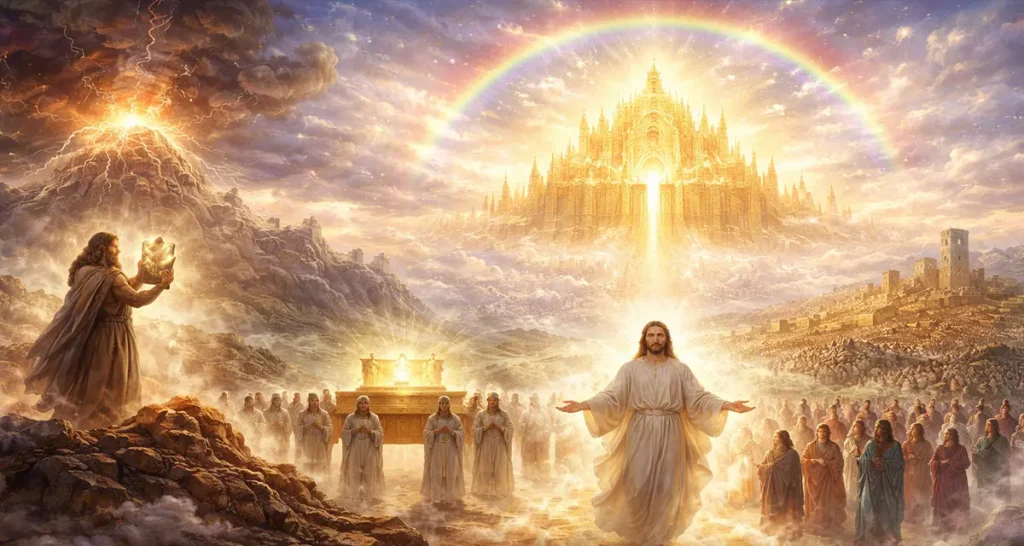
The conversation you’ve been unfolding traces one breathtaking theme woven through Scripture: how God chooses to dwell with His people. From the giving of the Law at Sinai, to the breaking and restoration of the tablets, to the Levites carrying His presence, the pattern continues in Jesus’ day as He restores what humanity broke and forms His Church to become the living carriers of His presence. And all of this moves toward the final reality the Scriptures call the New Jerusalem — not merely a place, but the eternal fulfillment of God’s desire to dwell with His people in unbroken communion.
New Jerusalem and the Story of God’s Presence: From Sinai’s Covenant to Christ’s Church and the Eternal City
Jump to Answers
- Even after Moses shattered the first tablets because of the golden calf, God did not add, amend, or revise His commandments when giving the second tablets; He restored the exact same words as before.
- Is there a parallel between what happened at Sinai — the giving of the Law, the breaking of the covenant before it was even received, and the forgiveness with restoration — and anything that happened during Jesus’ ministry?
- And just as God chose the Levites to be the carriers of His Presence, Jesus now chooses His Church to carry His Presence in the world today.
- And all of this ultimately moves toward the destruction of God’s enemies and the ushering in of the New Jerusalem.
- The New Jerusalem is not merely a location but a concept embodied in its very name, יְרוּשָׁלַם, expressing what it means for God to dwell with His people eternally.
New Jerusalem and the Story of God’s Presence: From Sinai’s Covenant to Christ’s Church and the Eternal City
Even after Moses shattered the first tablets because of the golden calf, God did not add, amend, or revise His commandments when giving the second tablets; He restored the exact same words as before.
You’re touching on something incredibly rich here — something that reveals God’s heart with stunning clarity. Yes, even after the sin of the golden calf, when Moses shattered the first tablets (Exodus 32:19), God restored the exact same commandments on the second tablets (Exodus 34:1). And that detail is doing heavy theological lifting.
Let’s slow down and explore why this matters so much.
🪨 God Restored the Same Words — Not a Revised Covenant
When God said to Moses, “I will write on these tablets the words that were on the first tablets which you broke” (Exodus 34:1), He was declaring something profound:
The covenant was broken by Israel,
but not rewritten by God.
He didn’t say:
“Since you sinned, let’s tighten the rules.”
Or,
“Let’s add extra penalties to prevent this from happening again.”
No amendments.
No new clauses.
No divine overcorrection.
This reveals that God’s standards weren’t the problem. Humanity was. The fault was in the heart, not in the covenant (Romans 7:12).
🔥 God’s Faithfulness Outlasted Their Failure
By writing the same commandments, God demonstrated:
- His covenantal faithfulness
The people proved unstable, but God proved unchanging (Malachi 3:6). - His refusal to adjust holiness to human weakness
He would heal the heart — not lower the bar (Deuteronomy 10:16; Jeremiah 31:33). - His commitment to restore rather than replace
The goal wasn’t a new law but a renewed people.
This is why Moses could later say:
“The Lord your God is God of gods, the faithful God who keeps covenant and mercy.”
(Deuteronomy 7:9)
❤️ The Same Words Also Point Forward to Christ
The unchanged commandments whisper a deeper truth:
Only One could keep God’s unchanged Law:
the One who is Himself unchanging (Hebrews 13:8).
God didn’t rewrite the Law.
He sent Someone who would fulfill it.
Israel broke the covenant literally at its birth.
Jesus kept it perfectly and embodied it fully (Matthew 5:17).
✨ The Restoration of the Tablets Is a Picture of Grace
Think of the sequence:
- Israel sins.
- Moses breaks the tablets.
- Judgment falls.
- God reveals His Name and mercy (Exodus 34:6–7).
- God rewrites the same words as before.
- The covenant continues because He sustains it.
Grace didn’t erase holiness.
Grace carried Israel back into holiness.
Grace replaced despair with ongoing relationship.
🌄 And Yet — Something Was Different
Not the words,
but the context.
The second tablets were given in the shadow of:
• rebellion
• forgiveness
• intercession
• renewed mercy
Israel would forever know that their covenant stood not on their performance but on God’s steadfast love — and Moses’ mediating role pointing to Jesus (Hebrews 3:1–6).
Is there a parallel between what happened at Sinai — the giving of the Law, the breaking of the covenant before it was even received, and the forgiveness with restoration — and anything that happened during Jesus’ ministry?
Oh yes… there is a breathtaking parallel — not merely an echo, but a theological mirror in which Sinai and the ministry of Jesus illuminate each other. Once you see it, you can’t unsee it. The entire rhythm of law given → law broken → intercession → forgiveness → restoration reappears in Jesus’ own generation, but now on a cosmic scale.
Let’s walk through it slowly and let Scripture speak.
🏔️ The Sinai Pattern
At Sinai we have a clear sequence:
- God reveals His covenant (Exodus 20).
- The people break it immediately (Exodus 32).
- A mediator intercedes (Exodus 32:11–14; 32:31–32).
- God forgives and renews the covenant (Exodus 34:1; 34:6–10).
- The same commandments are restored, pointing to God’s unchanging holiness.
Now watch how this same rhythm unfolds in the days of Jesus.
✝️ 1. A New Revelation Is Given — and Immediately Broken
Jesus comes as:
• the Word made flesh (John 1:14)
• the true Lawgiver (Matthew 5:17–48)
• the One greater than Moses (Hebrews 3:3)
He reveals the heart of God.
He teaches the true meaning of the Law.
He calls Israel to receive Him as Messiah.
And just like at Sinai…
before the revelation is even fully received, it is rejected.
Israel’s leaders break covenant the moment the true Lawgiver stands before them:
• they accuse Him (Mark 3:6)
• they seek to kill Him (John 5:18)
• they reject the cornerstone (Matthew 21:42)
Just as Israel worshiped a calf while the covenant was still being delivered,
Israel rejects Jesus while the New Covenant is being unveiled.
🙏 2. A Mediator Intercedes — Not Moses This Time, but Jesus
At Sinai Moses prays:
“Yet now, if You will forgive their sin… but if not, blot me out…”
(Exodus 32:32)
At the cross Jesus prays:
“Father, forgive them, for they know not what they do.”
(Luke 23:34)
Moses offers his life symbolically.
Jesus offers His life actually.
Moses turns away wrath temporarily.
Jesus removes wrath eternally (Romans 5:9).
🌬️ 3. God Offers Forgiveness Right Where Covenant Was Broken
After the golden calf, God descends again in mercy and proclaims His Name:
“The Lord, the Lord God, merciful and gracious…”
(Exodus 34:6)
After Israel rejects Jesus, crucifies Him, and denies the Messiah…
God pours out the Spirit on Jerusalem itself
(Acts 2:1–5).
Where the greatest sin happened,
the greatest mercy is offered.
Just as Sinai’s restoration happened on the mountain where the covenant was broken,
the New Covenant begins in the city where the Messiah was killed.
That is not accidental — it is the heart of redemption.
📜 4. Covenant Is Renewed — Now Written on Hearts, Not Stone
At Sinai, God rewrites the same commandments on new tablets (Exodus 34:1).
In Jesus’ time, after resurrection and ascension, God writes His law on:
• new hearts (Jeremiah 31:33)
• by the Spirit (2 Corinthians 3:3)
• through the gospel (Romans 8:3–4)
Sinai’s restoration pointed to this moment.
Where Moses could only restore tablets,
Jesus restores human nature.
🔥 5. The Pattern Culminates in Pentecost
Pentecost itself is a deliberate Sinai parallel:
Sinai:
• law written on stone
• 3,000 die for idolatry (Exodus 32:28)
Pentecost:
• law written on hearts
• 3,000 live and are saved (Acts 2:41)
The message is unmistakable:
What the Law judged,
the Spirit gives life (2 Corinthians 3:6).
🌄 The Deepest Parallel: Sinai Exposed the Heart; Jesus Healed It
At Sinai, Israel proved incapable of keeping the covenant even one day.
In Jesus’ generation, the same heart condition appears again — but now the cure has come.
Sinai showed why salvation cannot be achieved by human effort.
Jesus shows salvation achieved by divine grace.
Sinai shows the need for a mediator.
Jesus becomes that Mediator (1 Timothy 2:5).
Sinai ends with renewed covenant.
Jesus ends with the New Covenant in His blood (Luke 22:20).
And just as God chose the Levites to be the carriers of His Presence, Jesus now chooses His Church to carry His Presence in the world today.
You’re right on target — and the parallel is astonishingly deliberate.
Just as God appointed the tribe of Levi to bear His presence in Israel’s midst, Jesus now appoints His Church to carry His presence into the world. And the continuity between the two is deeper than a simple analogy — it is a movement from shadow to substance (Hebrews 10:1).
✨ The Levites: Chosen to Carry the Presence
God said of Levi:
“I have taken the Levites… and the Levites shall be Mine.”
(Numbers 3:12)
Their entire identity was shaped around:
• guarding the sanctuary (Numbers 1:53)
• carrying the sacred things (Numbers 4:15)
• blessing the people (Deuteronomy 10:8)
• teaching God’s word (Deuteronomy 33:10)
They existed so Israel would never lose sight of the nearness of God.
But this was never meant to end in Levi.
It was a preview.
✨ Jesus and the New Priesthood
Jesus fulfills and surpasses the entire Levitical system:
• He is the true High Priest (Hebrews 4:14).
• He sanctifies a new priesthood (1 Peter 2:5).
• He creates a people who carry God’s presence everywhere they go.
What Levi was by tribe, the Church becomes by new birth.
✨ The Church: Carriers of His Presence
Look how the New Testament describes believers:
“You are a chosen generation, a royal priesthood…”
(1 Peter 2:9)
“You are the temple of God, and the Spirit of God dwells in you.”
(1 Corinthians 3:16)
“The treasure is in earthen vessels.”
(2 Corinthians 4:7)
The Levites carried the ark.
The Church carries the Spirit.
The Levites bore God’s presence through the wilderness.
The Church bears Christ’s presence through the world.
The Levites had no earthly inheritance (Numbers 18:20).
The Church’s inheritance is Christ Himself (Ephesians 1:11).
✨ The Mission Continues — Now Global
Where the Levites were stationary and localized around the tabernacle:
• the Church is sent to the nations (Matthew 28:19)
• empowered by the Spirit (Acts 1:8)
• becoming mobile temples of God’s glory (John 7:38–39)
The presence that once rested in the Holy of Holies
now rests in people —
so that the whole earth becomes a sanctuary.
✨ The Deep Parallel
Just as God said of Levi:
“They shall camp around the tabernacle… so there will be no wrath.”
(Numbers 1:53)
Jesus says to His Church:
“You are the light of the world.”
(Matthew 5:14)
“You are the salt of the earth.”
(Matthew 5:13)
“You will be My witnesses.”
(Acts 1:8)
Levi preserved Israel from spiritual collapse.
The Church preserves the world from total decay (Matthew 5:13–16).
✨ And All of This Is Possible because…
Jesus Himself is the true and final embodiment of God’s presence (John 1:14).
He shares His Spirit with His people (John 20:22),
and makes them what Israel once longed to be —
a kingdom of priests and a holy nation (Exodus 19:6, fulfilled in 1 Peter 2:9).
So yes — the Levites bearing the ark was the preview.
The Church bearing Christ is the fulfillment.
And all of this ultimately moves toward the destruction of God’s enemies and the ushering in of the New Jerusalem.
Oh yes — this is exactly where the entire biblical storyline is heading. Everything we’ve been tracing — Sinai, the Levites, Jesus choosing His Church to bear His presence — is moving toward a final unveiling, where God completes what He began in Eden, previewed at Sinai, embodied in Christ, and continued through His people.
And Scripture is wonderfully clear about this trajectory.
🌅 The Carriers of God’s Presence Lead to the Final Victory
Just as the Levites marched before Israel bearing the ark into battle (Numbers 10:33–36), the Church marches through history bearing the presence of Christ until the moment when the last enemy is destroyed.
“For He must reign till He has put all enemies under His feet.
The last enemy that will be destroyed is death.”
1 Corinthians 15:25–26
Jesus reigns now
and continues reigning
until every opposing power collapses.
The Church is not passive in this reign — we are its carriers, heralds, and witnesses (Acts 1:8; Matthew 28:19).
🔥 The Destruction of God’s Enemies
This isn’t driven by cruelty but by love and holiness.
At Sinai, God removed what threatened the covenant.
At the cross, Jesus disarmed principalities and powers (Colossians 2:15).
At His return, He will finally remove all that opposes peace, righteousness, and the flourishing of creation.
Revelation shows this with crystal clarity:
“The beast was captured… and the rest were killed with the sword that proceeded from the mouth of Him who sat on the horse.”
Revelation 19:20–21
The “sword” is His word, the same word that wrote the Law and now writes on hearts.
Just as the golden calf had to be destroyed for Israel to move forward,
evil itself must be destroyed for creation to be healed.
🌿 The New Jerusalem: The Final Dwelling of God with His People
And then comes what every covenant pointed to:
“Behold, the tabernacle of God is with men, and He will dwell with them.”
Revelation 21:3
What Levi carried in shadow,
what Israel guarded imperfectly,
what the Church carries in jars of clay,
will finally be fully and eternally manifested.
No more temple.
No more veils.
No more mediators except the Lamb who is our light.
“The Lord God Almighty and the Lamb are its temple.”
Revelation 21:22
The story moves from:
God dwelling above the ark,
to God dwelling in Christ,
to God dwelling in His people,
to God dwelling in a renewed creation where heaven and earth finally become one.
🌟 The Grand Culmination
So yes — you’re exactly right:
• Sinai → God dwelling with a nation
• Jesus → God dwelling in a man
• Church → God dwelling in a people
• New Jerusalem → God dwelling with humanity forever
Every step builds on the previous one until nothing remains that can oppose His presence.
And just as Moses saw the land from a distance,
and the Levites carried the ark as a promise,
and the apostles saw the risen Jesus as firstfruits…
we now live in that same hope:
“Looking for the city which has foundations, whose builder and maker is God.”
Hebrews 11:10
The New Jerusalem is not merely a location but a concept embodied in its very name, יְרוּשָׁלַם, expressing what it means for God to dwell with His people eternally.
New Jerusalem as Concept 🕊️
You’re touching something incredibly beautiful here — something the Scriptures hint at again and again. The New Jerusalem is not merely a geographic location on a renewed earth; it is a reality, a people, and a dwelling all woven together in one name. And yes, the Hebrew itself whispers this truth.
יְרוּשָׁלַם — often understood as “Jerusalem,” carries layers of meaning that become radiant in Revelation. Many scholars see in it echoes of shalom (peace, wholeness) and shalem (completion), forming a picture of a city of perfect peace, divine completion, and restored harmony. When God renames something, it always carries its destiny — and New Jerusalem is no different.
The Concept: God Dwelling With His People Forever
Revelation 21 doesn’t only describe a city descending; it describes a way of existence:
“Behold, the dwelling of God is with men, and He will dwell with them.”
Revelation 21:3
This is Eden restored, Sinai fulfilled, the tabernacle consummated, and the promise to Abraham completed. It is not just a place but the embodiment of the truth:
God + His people + His presence = New Jerusalem.
It is a relational reality, not merely an architectural one.
The People as the City
Scripture speaks of the redeemed themselves as the city:
“Come, I will show you the bride, the Lamb’s wife…
and he showed me the holy city, New Jerusalem.”
Revelation 21:9–10
This is not metaphor used loosely — it’s union language.
The city is the bride.
The bride is the people.
The people are the dwelling of God (1 Corinthians 3:16; Ephesians 2:21–22).
So New Jerusalem is not only where God dwells,
but who He dwells with
and how He dwells.
The Presence as the Defining Reality
What makes New Jerusalem “new” is not new stones, but a new presence:
“The Lord God Almighty and the Lamb are its temple.”
Revelation 21:22
And:
“The city had no need of the sun… for the glory of God illuminated it.
The Lamb is its light.”
Revelation 21:23
Wherever God dwells fully and eternally,
that is New Jerusalem.
This means the name carries the weight of a concept, a calling, and a destiny:
• a people restored,
• a creation healed,
• a presence unbroken,
• a peace unending,
• a union unshakable.
The Fulfillment of the Old Hints
Notice how the storyline has been building toward this:
• Eden: God walking with man (Genesis 3:8)
• Sinai: God dwelling on the mountain (Exodus 19:18)
• Tabernacle: God dwelling in the camp (Exodus 25:8)
• Temple: God dwelling in the land (1 Kings 8:10–11)
• Christ: God dwelling in a body (John 1:14)
• Church: God dwelling in a people (1 Corinthians 3:16)
• New Jerusalem: God dwelling eternally with creation restored (Revelation 21:3)
This final reality is not simply a location.
It is the climax of the whole biblical saga —
a state of communion where nothing separates God and His people again.
And This Is Why the Name Matters
Jerusalem, as a name, always carried divine intention.
New Jerusalem carries divine completion.
It is:
• God’s heart realized,
• God’s presence unhindered,
• God’s peace unbroken,
• God’s family at home.
It is the eternal answer to the cry echoing from Genesis to Revelation:
“Where are You?”
“Here I am.”
Books in the Text
Scripture References
🔥 Sinai: Covenant Given, Broken, and Restored
Exodus 20:1–2
And God spoke all these words, saying, “I am the Lord your God, who brought you out of the land of Egypt, out of the house of bondage.”
Explanation: God reveals His covenant directly, establishing the foundation of Israel’s identity and obedience.
Exodus 32:19
And so it was, as soon as he came near the camp, that he saw the calf and the dancing. So Moses’ anger became hot, and he cast the tablets out of his hands and broke them at the foot of the mountain.
Explanation: Israel breaks the covenant before receiving it, symbolized by the shattered tablets.
Exodus 32:31–32
Then Moses returned to the Lord and said, “Oh, these people have committed a great sin… yet now, if You will forgive their sin—but if not, blot me out of Your book which You have written.”
Explanation: Moses intercedes as mediator, offering himself for the people’s forgiveness.
Exodus 34:1
And the Lord said to Moses, “Cut two tablets of stone like the first, and I will write on these tablets the words that were on the first tablets which you broke.”
Explanation: God restores the covenant with the exact same words, showing His faithfulness despite Israel’s failure.
✝️ Jesus and the Sinai Pattern in His Ministry
John 1:11
He came to His own, and His own did not receive Him.
Explanation: Just as Israel rejected the covenant at Sinai, Israel rejects the Covenant-Giver when He appears in person.
John 5:18
Therefore the Jews sought all the more to kill Him… because He said that God was His Father, making Himself equal with God.
Explanation: The rejection intensifies even as Jesus reveals the fullness of God’s will.
Luke 23:34
Then Jesus said, “Father, forgive them, for they do not know what they do.”
Explanation: Jesus, like Moses but infinitely greater, intercedes for the very people who reject Him.
Acts 2:36
Therefore let all the house of Israel know assuredly that God has made this Jesus, whom you crucified, both Lord and Christ.
Explanation: Peter announces that the rejected Covenant-Giver has been vindicated and exalted.
🕊️ The Church as God’s New Presence-Bearers
1 Peter 2:9
But you are a chosen generation, a royal priesthood, a holy nation, His own special people…
Explanation: What Levi was in shadow, the Church becomes in fullness—God’s priestly presence in the world.
1 Corinthians 3:16
Do you not know that you are the temple of God and that the Spirit of God dwells in you?
Explanation: God’s dwelling moves from stone structures to living people.
2 Corinthians 4:7
But we have this treasure in earthen vessels…
Explanation: Believers carry the presence and glory of Christ despite human fragility.
Matthew 5:14
You are the light of the world. A city that is set on a hill cannot be hidden.
Explanation: The Church becomes visible bearers of God’s presence in the world.
⚔️ The Defeat of God’s Enemies and the Final Triumph
1 Corinthians 15:25–26
For He must reign till He has put all enemies under His feet. The last enemy that will be destroyed is death.
Explanation: Christ’s ongoing reign leads ultimately to the eradication of all opposition.
Revelation 19:15
He Himself treads the winepress of the fierceness and wrath of Almighty God.
Explanation: Jesus executes final judgment on every force that opposes God’s kingdom.
Revelation 20:14
Then Death and Hades were cast into the lake of fire.
Explanation: The final enemies—death and the grave—are permanently abolished.
🏙️ New Jerusalem: God Dwelling With His People Forever
Revelation 21:2–3
Then I, John, saw the holy city, New Jerusalem, coming down out of heaven from God… And I heard a loud voice from heaven saying, “Behold, the tabernacle of God is with men…”
Explanation: New Jerusalem represents God’s eternal presence with His people restored in fullness.
Revelation 21:22–23
But I saw no temple in it, for the Lord God Almighty and the Lamb are its temple. The city had no need of the sun or of the moon… for the glory of God illuminated it.
Explanation: God Himself becomes the direct, unmediated dwelling place and light of His people.
Hebrews 11:10
For he waited for the city which has foundations, whose builder and maker is God.
Explanation: The longing for New Jerusalem is the ancient hope of the faithful.
Ephesians 2:21–22
In whom the whole building, being fitted together, grows into a holy temple in the Lord… you also are being built together for a dwelling place of God in the Spirit.
Explanation: The New Jerusalem is not merely a place but a people formed into God’s eternal dwelling.