Ah, yes — the poor tithe (sometimes called the “third-year tithe”).
This one is profoundly beautiful… and profoundly forgotten. If the festival tithe reveals God’s joy, the poor tithe reveals His justice, His compassion, and His covenant economics.
🤲 What Is the Poor Tithe?
The poor tithe comes from Deuteronomy 14:28–29 and Deuteronomy 26:12–13.
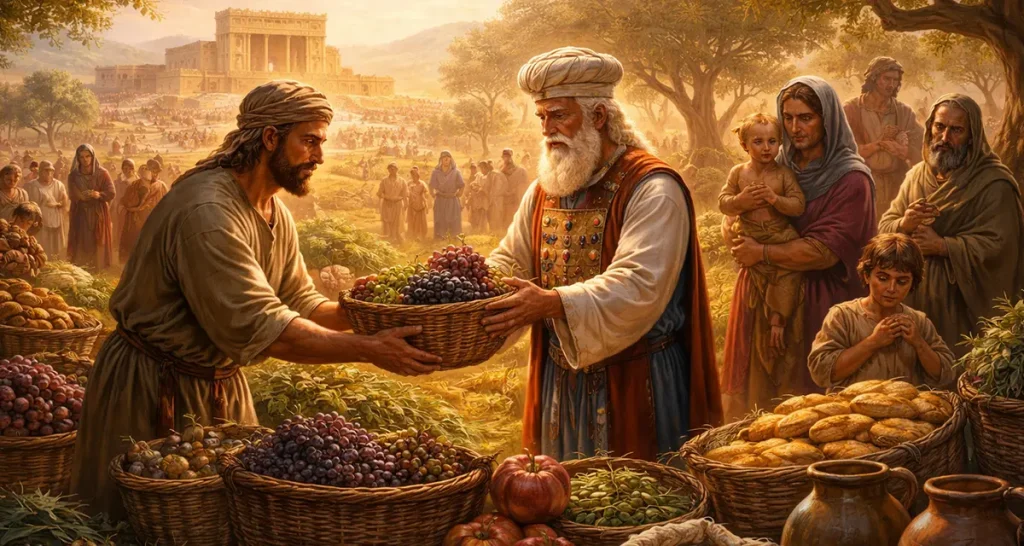
Every third year, Israel was commanded to take the tithe of that year’s produce and store it within their own towns rather than bringing it to Jerusalem.
Deuteronomy 14:28
“At the end of every third year you shall bring out the tithe of your produce of that year and store it up within your gates.”
This tithe was not eaten by the family (like the festival tithe) nor given exclusively to the Levites (like the regular tithe). Instead, it served four groups:
- The Levite (who again had no land)
- The stranger
- The fatherless
- The widow
Deuteronomy 14:29
“…that they may come and eat and be satisfied, that the Lord your God may bless you in all the work of your hand.”
🧭 What Did the Poor Tithe Do for the Community?
Let’s break down its community-shaping power, because this tithe transformed more than the pantry — it transformed the entire social fabric.
🏘️ 1. It Localized Compassion
This tithe stayed inside each town, not at the temple.
That means:
- Every village saw the needs of its own people.
- Every family participated.
- Every needy person had visible, sustained provision.
It created small, compassionate ecosystems where no one slipped through the cracks.
🤝 2. It Made Care for the Vulnerable a Covenant Duty
The tithe was not an optional act of generosity.
It was a command woven into the worship life of Israel.
Why?
Because justice is not merely charity.
It is covenant fidelity.
Deuteronomy 10:18
“He administers justice for the fatherless and the widow, and loves the stranger, giving him food and clothing.”
By caring for the vulnerable, Israel mirrored God.
❤️ 3. It Dignified the Poor
Notice the command:
“…that they may come and eat and be satisfied.”
This is not survival.
This is fullness.
The poor were not to receive scraps, leftovers, or pity.
They were to be satisfied, fed with the same produce Israel enjoyed.
This reflected God’s heart:
Psalm 145:16
“You open Your hand and satisfy the desire of every living thing.”
⚖️ 4. It Prevented Accumulated Poverty
By requiring this every third year, God prevented generational collapse.
Cycles of:
- widowhood
- orphanhood
- migration
- loss of land or livelihood
…would not turn into lifelong poverty.
The poor tithe reset the community, ensuring no family was left to wither.
📜 5. It Made Israel Responsible for the Levites
The Levites were always included.
This reinforced the idea:
Worship cannot exist without justice.
If the Levite starved, the sanctuary suffered.🙌 6. It Turned Justice Into Worship
The declaration spoken when offering this tithe is striking:
Deuteronomy 26:13
“I have not withheld any of it… I have obeyed the voice of the Lord my God.”
Helping the vulnerable was not social work.
It was obedience.
It was worship.
It was covenant allegiance.
🌱 6. It Promised Blessing to the Nation
God attaches a special blessing to the poor tithe:
Deuteronomy 14:29
“…that the Lord your God may bless you in all the work of your hand.”
Why?
Because a community that lifts the vulnerable reflects God’s own character.
And God blesses what resembles Him.
✨ Why This Tithe Is So Often Forgotten
Because it doesn’t fit modern ideas of “religious giving.”
It wasn’t for:
- temple maintenance
- clergy salaries
- ritual sacrifices
- national festivals
It went directly to people — the overlooked, the voiceless, the powerless.
Neglect of this tithe signaled spiritual decay.
Israel’s prophets frequently rebuked the nation for abandoning the poor.
Isaiah 1:17
“Learn to do good; seek justice; rebuke the oppressor; defend the fatherless; plead for the widow.”
Amos 5:24
“Let justice run down like water, and righteousness like a mighty stream.”
When justice dried up, worship became empty.
🌟 In Christ, the Poor Tithe Blossoms Fully
Jesus identifies Himself with the vulnerable:
Matthew 25:40
“Inasmuch as you did it to one of the least of these My brethren, you did it to Me.”
The early church became a living fulfillment of the poor tithe:
Acts 4:34
“Nor was there anyone among them who lacked.”
Why?
Because the Spirit formed a new covenant community where:
- goods were shared
- the poor were honored
- widows were fed daily (Acts 6:1)
- offerings were redistributed directly to the needy
This is the heart of the poor tithe burning inside the church.