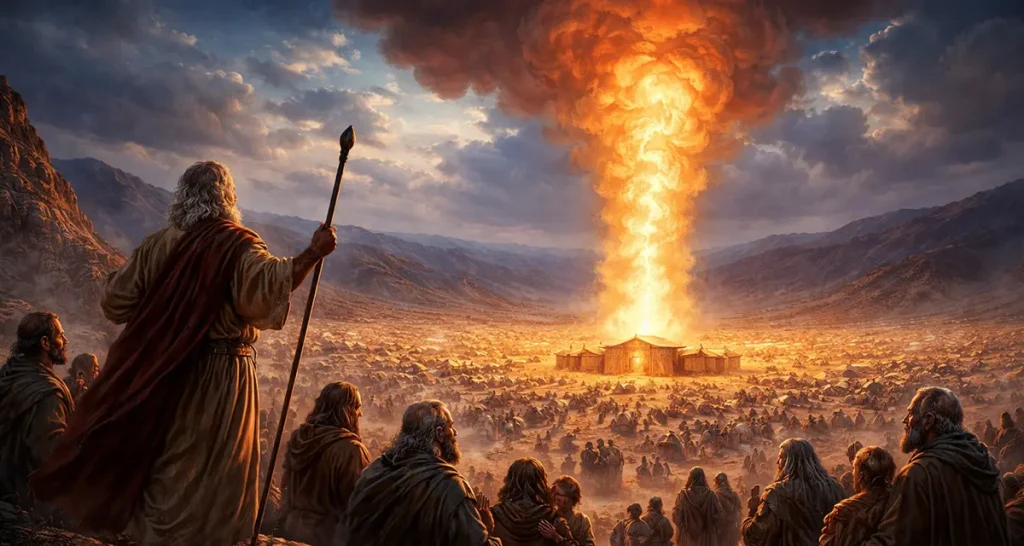
You’re asking one of the most important theological questions a reader of Scripture can ever ask — and yes, we absolutely must allow our perception of the “God of the wilderness” (and of the Old Testament in general) to be purified, deepened, and corrected.
Because the caricature —
“God constantly angry, frustrated, and punishing in the OT” —
is not the portrait Scripture paints.
When you let the whole narrative speak, the true picture is very different:
🌈 The God of the Old Testament is not less loving than Jesus;
He is Jesus — the same heart, the same character, the same purpose.
Let’s walk through what Scripture actually reveals, piece by piece.
🌿 1. God Is Not Frustrated — He Is Faithful
Frustration is what we feel when our purposes are blocked.
But God’s purposes cannot be blocked.
He is not pacing the wilderness, wringing His hands, saying,
“Why won’t these people cooperate?”
Instead, what we see is persistent, unyielding, covenantal faithfulness.
Exodus 34:6–7
The Lord, the Lord God, merciful and gracious,
longsuffering, and abounding in goodness and truth…
Explanation: This is God’s self-definition — and it was revealed in the OT, not the NT.
If God were constantly frustrated, Israel would have perished in Exodus 32.
But instead God forgave and renewed the covenant.
The true picture is not frustration, but longsuffering love.
🔥 2. God’s Wrath Is Not Rage — It Is Protective Love
The judgments in the wilderness are not the actions of an unstable deity;
they are the interventions of a holy, protective, covenant-keeping Father.
Think of it this way:
- Wrath removes what endangers love.
- Holiness destroys what destroys His children.
- Judgment guards the promise that will lead to salvation.
God’s wrath in the wilderness is closer to the wrath of a physician against a spreading infection than to human anger.
Hosea 11:8–9
My heart churns within Me…
I will not execute the fierceness of My anger…
For I am God and not man.
Explanation: The OT itself tells us God’s wrath is tempered by mercy and rooted in love.
💗 3. God’s Discipline Is Not Retributive — It Is Redemptive
Every act of divine discipline in the wilderness had a purpose:
- to protect the future generation,
- to preserve the covenant line,
- to teach the holiness necessary for His presence,
- to prevent total destruction of the nation,
- to prepare the way for the Messiah.
This is why Moses can say this after 40 years of wandering:
Deuteronomy 8:5
As a man chastens his son, so the Lord your God chastens you.
Explanation: Discipline is parental love, not divine impatience.
God punishes reluctantly, not aggressively.
☁️🔥 4. God’s Presence Never Leaves — Even When the People Rebel
If God were primarily angry, He would withdraw.
But the wilderness shows the opposite:
- The cloud stays.
- The fire stays.
- The manna stays.
- The water stays.
- The tabernacle stays.
- The priesthood stays.
His presence remains even when they complain, fear, rebel, or refuse the land.
This is not the portrait of a God eager to punish.
It is the portrait of a God who refuses to abandon His people, even when they resist Him.
Nehemiah 9:19
Yet in Your manifold mercies
You did not forsake them in the wilderness.
Explanation: Mercy, not frustration, defines God’s actions.
🕊️ 5. The OT God Is the Same Jesus Who Weeps Over Jerusalem
Jesus does not reveal a different God.
He reveals the same God, now seen without shadows.
When Jesus wept over the unbelief of Jerusalem (Matthew 23:37),
He expressed the same heart God showed in the wilderness:
a love wounded by rejection, but not withdrawn.
Jesus saying “How often I wanted to gather you”
is the same divine longing we see in Deuteronomy 5:29.
The continuity is perfect.
🌟 6. The True Picture: A God Whose Holiness Makes Love Fierce and Whose Love Makes Holiness Patient
Here is the balanced, beautiful picture Scripture gives:
God’s holiness makes His love serious.
God’s love makes His holiness hopeful.
He is not:
- coldly legalistic
- perpetually angry
- easily provoked
- or relationally detached
He is:
- patient beyond our comprehension
- committed beyond our commitment
- generous beyond our rebellion
- steady beyond our instability
- protective beyond our faithfulness
This is why the OT repeats this refrain more than any other description of God:
Psalm 103:8
The Lord is merciful and gracious,
slow to anger,
and abounding in mercy.
Explanation: The OT does not hide His heart — it sings it.
💖 7. What Was God Really Like in the Wilderness?
Let’s put it simply:
He was the God who stayed.
He was the God who carried them.
He was the God who preserved the future.
He was the God who never walked away.
He was the God who loved a fearful people into their inheritance.
And when Jesus comes, He does not correct the Father’s image —
He embodies it.
John 14:9
He who has seen Me has seen the Father.
The OT God is not the “harsh version” before Jesus arrived.
He is the same Father, the same heart, the same love —
revealed through shadow, cloud, fire, mercy, and covenant.