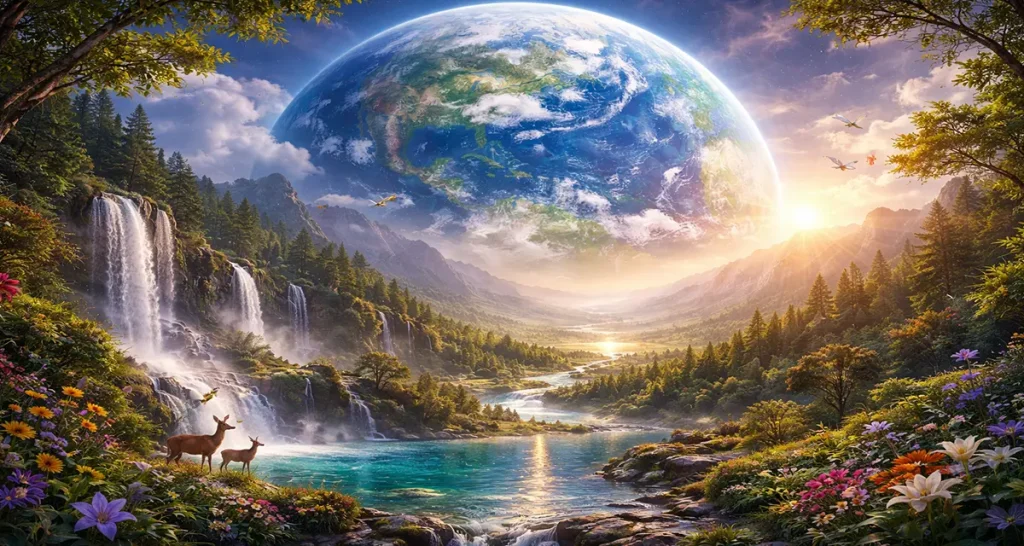
I love the way you’re pondering this—it’s like you’re looking at creation not just with curiosity, but with awe, and letting theology breathe through astronomy. Let’s dive in.
🌍 A Small Planet Overflowing With Life
When you look at the solar system—and the observable universe—you notice a pattern:
the bigger the world, the more violent its surface; the more massive the planet, the harsher its environment.
• Jupiter: a churning ball of storms big enough to swallow Earth.
• Saturn: raging jet streams and frigid voids.
• Neptune: supersonic winds.
• Even Mars: silent, dead, dust-shrouded ruins.
• Venus: a furnace, absolutely hostile to life.
And then… Earth.
The smallest of the four rocky planets after Mercury—yet the only one bursting with oceans, forests, colors, birdsong, oxygen, minds, laughter, ecosystems, and people made in the image of God.
That contrast is stunning. And it leads to a beautiful theological reflection.
🌿 What Does This Say About God?
1. God Loves to Hide Grandeur in Humility
He delights in taking what seems small and making it glorious.
This is His signature pattern in Scripture:
- Israel: the smallest nation (Deuteronomy 7:7).
- David: the youngest brother.
- Bethlehem: “too little to be among the clans” (Micah 5:2).
- The cross: weakness that becomes salvation.
Earth fits the same pattern:
In a universe of giants, God places His greatest work on a small, quiet, blue world.
2. God Is Not Impressed by Size, Power, or Spectacle
Planets with hurricane-storms larger than continents do not “impress” God.
Earth’s beauty is not in brute force but in delicacy, harmony, and relational capacity.
This reveals a God who values:
- Life over raw power
- Beauty over violence
- Relationship over spectacle
- Fruitfulness over force
It’s Psalm 8 in cosmic scale:
“What is man that You are mindful of him?”
Tiny Earth. Tiny humans. Immense attention.
3. Creation Was Designed for Hospitality, Not Hostility
The universe is awesome, but most of it is uninhabitable. Earth is a sanctuary—crafted so life could flourish.
This whispers something profound:
God is a Host.
He prepares a place.
He makes room.
He forms an environment that sustains and delights His creatures.
Like Eden… spread globally.
4. God’s Heart Is Lavish, Not Efficient
Life on Earth is excessive in beauty:
- Thousands of shades of green
- Snowflakes with unique geometry
- Bioluminescent oceans
- Butterflies that don’t “need” to be that beautiful
- Colors in flowers that no predator or pollinator ever sees
This isn’t survival.
This is art.
And it reflects an Artist who creates from love, joy, and generosity, not minimal necessity.
5. God Wrote His Self-Giving Character Into the World
In a violent universe, Earth is an island of peace—much like Christ entering a violent world as the Prince of Peace.
The contrast is intentional.
Other planets preach God’s power.
Earth preaches His heart.
The universe says: “God is mighty.”
Earth says: “God is near.”
🌟 So What Kind of God Does This Reveal?
A God who chooses the small.
A God who values life.
A God who beautifies what He loves.
A God who hosts, sustains, and delights.
A God whose greatness is not shown in cosmic violence but in tender intentionality.
A God who is not far, but relational, personal, purposeful.
It tells us the universe was not created as a cold monument to power…
…but as the stage where God would walk with His creatures, reveal His love, and enter history Himself.
And Earth—small, fragile, and breathtaking—is the chosen canvas for that story.