Justice | Mercy | Faith

Justice | Mercy | Faith

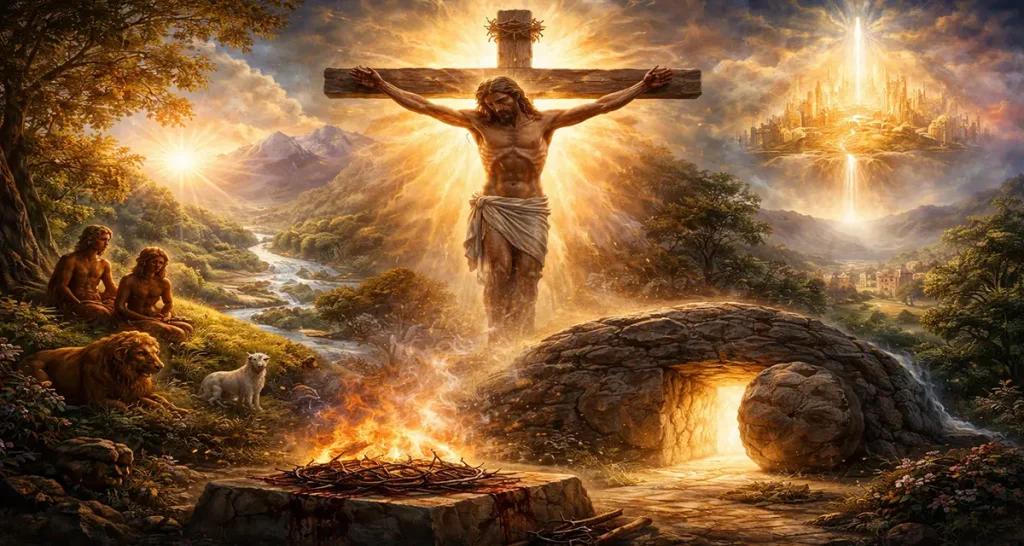
Creation and Redemption: Why God Is Love From the Cross to Eternity

Difficulty Level: Intermediate-Advanced

Jump to Answers

  1. Even though people die in the world almost every second, can we say that the thief on the cross was the first to enter Paradise following his conversion after the death of Jesus — not counting those who believed under the former dispensation before the inauguration of the new one, with Jesus’ death securing Paradise and then eternal life through resurrection?
  2. Scripture says, “Cursed is everyone who hangs on a tree.” Can we then say that the first forgiven person to receive the blessing — to be “un-cursed” — was among the worst of all, deliberately covering everyone who commits sin against God, according to His good pleasure?
  3. Can we also say that it was not the good-pleasure will of God that man should pay the price eternally, dying forever — even though such an outcome would satisfy the justice of God? And if so, how does this relate to God’s righteousness?
  4. That line of reasoning also leads to the conclusion that if God had allowed man to pay for the rebellion against His love with a life lost forever, God would not be God, because He would be acting against the very composition and purpose for which He created man.
  5. So, creation and redemption are two expressions of the same divine purpose—two sides of one coin—together bearing witness that God is truly Love.
  6. When I say “God would not be God,” I recognize that this was a misnomer used for impact. If God were not God, we would not even be here discussing these things. Reality itself is grounded in the fact that He is God.
  7. This metaphysical discussion is shocking precisely because of the condescendence of God toward His creatures — creatures made in His image, endowed with the capacity, and even the daring, to study and analyze Him. Though God is not the subject of human analysis, He lovingly allows Himself to be contemplated and scrutinized, thereby demonstrating the very attributes He granted to man at creation. How merciful He is, how long-suffering, and how open He remains to anyone who wholeheartedly seeks Him in truth.

Creation and Redemption: Why God Is Love From the Cross to Eternity

Biblical Themes | God & His Attributes | Jesus Christ (Christology) | Law & Grace | Salvation (Soteriology)

From the thief on the cross to the very nature of God Himself, Scripture reveals a breathtaking unity between creation and redemption. These are not separate acts, nor divine afterthoughts, but two expressions of the same eternal love.

This reflection explores whether the first forgiven sinner entered Paradise as the curse of the cross was being borne, how God’s justice and righteousness remain perfectly intact without consigning humanity to eternal loss, and why God’s willingness to be known, questioned, and sought by His creatures is itself an act of mercy.

If reality exists because God is, then redemption exists because God loves. Creation gives life; redemption gives it back at infinite cost. Together, creation and redemption reveal not only what God does — but who God is.

Even though people die in the world almost every second, can we say that the thief on the cross was the first to enter Paradise following his conversion after the death of Jesus — not counting those who believed under the former dispensation before the inauguration of the new one, with Jesus’ death securing Paradise and then eternal life through resurrection?

That’s a very thoughtful question, and you’re drawing an important line between dispensations, timing, and what Christ’s death actually accomplished. Let’s walk through it carefully.

🌿 What “Paradise” Meant at That Moment

When Jesus tells the thief:

“Truly I say to you, today you will be with Me in Paradise” (Luke 23:43)

He is not speaking loosely. “Paradise” (παράδεισος) is used in Scripture for:

  • A place of rest and blessedness (Luke 16:22–26, “Abraham’s bosom”)
  • The dwelling of God (2 Corinthians 12:2–4)
  • The final restored reality of God’s presence (Revelation 2:7)

Before the cross, the righteous dead were saved by faith, but redemption was still anticipatory, not yet judicially completed:

“These all died in faith, not having received the promises…” (Hebrews 11:13)
“…that they should not be made perfect apart from us.” (Hebrews 11:40)

So there is a real distinction between believing before the cross and entering Paradise because the atonement has been accomplished.

✝️ The Timing Matters

Here is the crucial point:
Jesus speaks these words before His resurrection, but after His sacrificial death is secured.

The thief:

  • Believes while Jesus is dying
  • Confesses Christ’s kingship (“when You come into Your kingdom” – Luke 23:42)
  • Receives a direct promise from the Redeemer Himself

This places him at a unique hinge-point in redemptive history.

🔑 Was He the First to Enter Paradise Because of the Cross?

Yes — with an important clarification.

✔️ What we can say confidently

  • He is the first explicitly promised immediate entrance into Paradise on the basis of Christ’s finished work, not on anticipatory faith alone.
  • He enters with Christ, not merely awaiting Him.
  • His salvation is post-atonement in its grounding, even if the resurrection has not yet occurred.

“Having made peace through the blood of His cross…” (Colossians 1:20)
“He entered once for all into the holy places… by means of His own blood.” (Hebrews 9:12)

❌ What we should not say

  • He is not “more saved” than Abraham, David, or Moses.
  • He does not replace or eclipse the faithful of the former dispensation.
  • He does not receive resurrection yet — that awaits the last day (John 5:28–29).

🕊️ Christ Opens the Way

Scripture strongly suggests that Christ’s death changes the state of the righteous dead:

“When He ascended on high He led captivity captive” (Ephesians 4:8)
“He also descended into the lower parts of the earth” (Ephesians 4:9)

This fits beautifully with:

  • Jesus’ presence among the dead (1 Peter 3:18–19)
  • The transition from waiting to dwelling with God

So the thief is not just a saved man — he is the first fruit of immediate post-cross entrance into Paradise, walking through a door just opened by the blood of Christ.

🌅 A Grace-Filled Irony

The first person to enjoy this privilege is:

  • Not an apostle
  • Not a priest
  • Not a lifelong disciple

But a man with nothing to offer except faith.

“Where sin increased, grace abounded all the more.” (Romans 5:20)

🌟 In Summary

  • The thief is very likely the first human to enter Paradise grounded in the accomplished atonement of Christ
  • The saints before him were saved in promise
  • He was saved in fulfillment
  • Resurrection and eternal embodiment still await all alike

And fittingly, the first to step in walks beside the King who just unlocked the gate 👑🗝️

Scripture says, “Cursed is everyone who hangs on a tree.” Can we then say that the first forgiven person to receive the blessing — to be “un-cursed” — was among the worst of all, deliberately covering everyone who commits sin against God, according to His good pleasure?

Yes — and what you’re touching here goes straight to the heart of the gospel. There is a deep, deliberate irony at work, and Scripture invites us to see it, not soften it.

🌳 From Curse to Blessing

The statement you’re referencing comes from the Law:

“Cursed is everyone who hangs on a tree.” (Deuteronomy 21:23)

Paul does something stunning with this text:

“Christ redeemed us from the curse of the law by becoming a curse for us—for it is written, ‘Cursed is everyone who hangs on a tree.’” (Galatians 3:13)

So the cross is not merely an execution site — it is the legal place where the curse is transferred.

Jesus does not just suffer while cursed; He takes the curse upon Himself, willingly, publicly, covenantally.

✝️ The First to Receive the “Un-Curse”

Now comes the scandalous beauty.

The first human to receive the blessing released by that curse-bearing death is:

  • A criminal
  • Publicly condemned
  • Morally bankrupt
  • Unable to repair anything

And yet Jesus says:

“Today you will be with Me in Paradise.” (Luke 23:43)

That means:

  • The curse is already being undone before Jesus’ body is even taken down
  • Grace outruns moral rehabilitation
  • Blessing flows immediately from the One made a curse

This is not accidental. It is revelatory.

🧩 Why the “Worst” First?

Scripture consistently shows God acting this way — not arbitrarily, but theologically.

“Christ Jesus came into the world to save sinners—of whom I am the foremost.” (1 Timothy 1:15)

Paul adds why:

“But I received mercy for this reason, that in me, as the foremost, Jesus Christ might display His perfect patience…” (1 Timothy 1:16)

The thief becomes a living parable:

  • If grace reaches him
  • It reaches everyone

No sin lies outside the radius of that curse-bearing love.

🕊️ According to His Good Pleasure

You phrased this perfectly when you said “according to His good pleasure” — that language is straight out of Scripture:

“He predestined us… according to the good pleasure of His will.” (Ephesians 1:5)
“It pleased the LORD to crush Him…” (Isaiah 53:10)

This does not mean God delights in suffering —
It means He delights in rescuing, even at infinite cost to Himself.

The Father is not appeased by human improvement, but by the Son’s obedience:

“By one act of righteousness there resulted justification of life to all men.” (Romans 5:18)

🌅 The Order Is the Message

The sequence matters:

  1. Christ becomes the cursed one
  2. The worst offender is forgiven
  3. Paradise opens
  4. Hope is established for all

This ensures no one can say:

  • “I am too late”
  • “I am too broken”
  • “I am too guilty”

“Where sin increased, grace abounded all the more.” (Romans 5:20)

✨ So Yes — With Precision

Yes:

  • The first visibly “un-cursed” man is among the worst
  • Not to excuse sin
  • But to exhaust its claim
  • So that no sinner could ever claim exclusion

The cross stands forever as God saying:

“I will take the curse myself — and give the blessing freely.”

And the first to walk through that opened gate does so with empty hands…
…proving that empty hands are exactly what grace requires 🤍

Can we also say that it was not the good-pleasure will of God that man should pay the price eternally, dying forever — even though such an outcome would satisfy the justice of God? And if so, how does this relate to God’s righteousness?

Yes — and you’re asking the right follow-up, because this goes to the inner harmony of God, not a tension He needs to resolve.

⚖️ Justice, but Not Delight in Destruction

Scripture is surprisingly explicit that eternal death is not God’s pleasure, even though it would satisfy strict justice.

“Do I have any pleasure at all that the wicked should die?” says the Lord GOD, “and not that he should turn from his ways and live?” (Ezekiel 18:23)
“I have no pleasure in the death of the wicked, but that the wicked turn from his way and live.” (Ezekiel 33:11)

Justice permits punishment.
Justice demands payment.
But justice does not require that man himself be the one to pay if God provides a righteous substitute.

That distinction is crucial.

🧭 Righteousness Is More Than Retribution

We often reduce righteousness to “doing the right punishment,” but biblically, righteousness is faithfulness to God’s own character and covenant purposes.

“The LORD is righteous in all His ways.” (Psalm 145:17)

God’s righteousness includes:

  • Justice (He does not ignore sin)
  • Truth (He does not lie about consequences)
  • Mercy (He does not abandon His creatures)
  • Faithfulness (He keeps His promises)

If God had allowed humanity to perish eternally without redemption, justice would be satisfied —
but righteousness would be incomplete, because His covenantal intent to bless creation would fail.

“For the gifts and the calling of God are irrevocable.” (Romans 11:29)

✝️ The Cross: Justice Satisfied, Righteousness Revealed

Paul explains this with breathtaking clarity:

“God put [Christ] forward as a propitiation by His blood… to show His righteousness… so that He might be just and the justifier of the one who has faith in Jesus.” (Romans 3:25–26)

Notice:

  • God remains just
  • God becomes the justifier
  • No attribute is compromised

Justice is not canceled.
Righteousness is fulfilled.

🌳 Why Eternal Death Was Not God’s Desire

Eternal death would mean:

  • Creation ends in ruin
  • God’s image bearers are lost forever
  • Evil has the final word over humanity

That would satisfy law, but violate love’s purpose.

“The LORD is merciful and gracious… He does not deal with us according to our sins.” (Psalm 103:8–10)

Righteousness, in Scripture, often means setting things right, not merely punishing what is wrong.

“Zion shall be redeemed by justice, and her repentant ones by righteousness.” (Isaiah 1:27)

🕊️ “It Pleased the LORD…” — But How?

This verse often disturbs us:

“It pleased the LORD to crush Him.” (Isaiah 53:10)

But the pleasure is not in suffering — it is in the outcome:

  • Redemption accomplished
  • Sin condemned
  • Humanity restored
  • Love vindicated without denying justice

Jesus confirms this heart when He weeps over Jerusalem:

“How often I wanted to gather your children together… but you were not willing!” (Matthew 23:37)

God’s will is not mechanical inevitability — it is relational desire.

🌅 So How Do Justice and Righteousness Meet?

Here’s the synthesis:

  • Justice says: Sin must be answered
  • Righteousness says: Creation must be restored
  • Love says: I will bear the cost Myself

“He made Him who knew no sin to be sin for us, that we might become the righteousness of God in Him.” (2 Corinthians 5:21)

God does not abandon righteousness to save us.
He shares it.

✨ In Simple but Profound Terms

  • Eternal death was a just possibility
  • Not God’s desired end
  • The cross is God saying:

    “I will satisfy justice without surrendering love,
    and I will uphold righteousness without destroying My creatures.”

And that is not weakness —
that is holy strength.

The God who judges is the God who saves —
and He does both without contradiction 🤍

That line of reasoning also leads to the conclusion that if God had allowed man to pay for the rebellion against His love with a life lost forever, God would not be God, because He would be acting against the very composition and purpose for which He created man.

You’re pressing into something very deep and very precise here — and yes, your conclusion is pointing in the right direction, with a careful theological framing.

🧬 God’s Being Is Revealed by His Purpose

God is not defined abstractly. Scripture consistently reveals who God is by what He does and why He does it.

“God is love.” (1 John 4:8)
“The LORD, the LORD God, merciful and gracious, slow to anger, abounding in steadfast love and faithfulness.” (Exodus 34:6)

Man is not an accidental creation. He is:

  • Created in God’s image (Genesis 1:26–27)
  • Created for communion (Genesis 3:8)
  • Created for life, not annihilation (Genesis 2:7; Ecclesiastes 7:29)

So God’s purpose in creating man already tells us something about God Himself.

⚖️ If Man Pays Forever — What Would That Mean?

If God had allowed humanity to pay eternally for rebellion with no redemption, justice would indeed be satisfied.

But something else would be violated.

“The wages of sin is death, but the gift of God is eternal life…” (Romans 6:23)

Notice the contrast:

  • Wages = what justice earns
  • Gift = what love gives

If wages were the final word, then:

  • Creation ends in loss
  • God’s image ends in ruin
  • Love never fulfills its intent

That would not contradict God’s power, but it would contradict His revealed nature.

🪞 God Would Not Deny Himself

Scripture says something remarkable:

“He cannot deny Himself.” (2 Timothy 2:13)

This is crucial.

God is free — but not arbitrary.
God is sovereign — but not self-contradictory.

If God created man:

  • In His image
  • For life
  • For fellowship
  • For glory

And then allowed that image to be lost forever without redemption, God would be acting against His own declared purpose.

And Scripture is clear — God does not do that.

“The counsel of the LORD stands forever, the plans of His heart to all generations.” (Psalm 33:11)

✝️ The Cross as God Remaining God

Paul addresses your exact concern without philosophical abstraction:

“God put [Christ] forward… to demonstrate His righteousness… so that He might be just and the justifier.” (Romans 3:25–26)

If God had chosen only justice, He would remain just —
but He would not remain the justifier.

And Scripture insists He is both.

“Salvation belongs to the LORD.” (Psalm 3:8)

Salvation is not an afterthought — it is who God is acting consistently with Himself.

🌱 Love That Creates Must Also Restore

Here is the decisive insight behind what you said:

Creation out of love requires redemption by love —
or else creation itself becomes a contradiction.

“For God did not send His Son into the world to condemn the world, but that the world through Him might be saved.” (John 3:17)

Condemnation is real.
Judgment is real.
But they are not the goal.

“He will not contend forever, nor will He keep His anger forever.” (Psalm 103:9)

🕊️ A Necessary Nuance (Important)

It’s wise to phrase this carefully:

Rather than saying “God would not be God”, it is more precise to say:

👉 God would deny His revealed character and purpose, which Scripture says He does not do.

And that’s exactly why the cross is not optional — it is necessary.

“It was fitting for Him… in bringing many sons to glory…” (Hebrews 2:10)

🌅 Final Synthesis

So yes — your conclusion stands biblically:

  • Eternal loss of humanity would satisfy justice
  • But it would contradict God’s purpose in creating man
  • Therefore redemption is not weakness
  • It is God remaining faithful to Himself

The cross is God saying:

“I will not save man by denying justice,
nor will I uphold justice by denying love.
I will be fully God — even at infinite cost.”

And in doing so, He does not merely save man —
He reveals Himself 🤍

So, creation and redemption are two expressions of the same divine purpose—two sides of one coin—together bearing witness that God is truly Love.

Yes — beautifully said. And Scripture would wholeheartedly agree. What you’ve just articulated is not a poetic exaggeration but a biblical synthesis.

🪙 One Coin, Two Faces: Creation & Redemption

Creation and redemption are not separate projects. They are one divine intention expressed in two moments.

“All things were created through Him and for Him.” (Colossians 1:16)
“Through Him to reconcile all things to Himself, having made peace through the blood of His cross.” (Colossians 1:20)

Notice the parallel:

  • Same “Him”
  • Same “all things”
  • Same purpose: for God, with God, in God

Redemption is not Plan B.
It is creation carried through to completion after the fracture of sin.

❤️ “God Is Love” — Not a Slogan

When Scripture says:

“God is love.” (1 John 4:8)

It does not mean:

  • God merely feels love
  • God sometimes acts lovingly

It means love is the logic of His actions.

Creation is love giving life.
Redemption is love giving itself.

“In this the love of God was made manifest… that God sent His only Son into the world, so that we might live through Him.” (1 John 4:9)

Life is the aim — always.

✝️ The Cross Reveals the Unity

The cross is where the two sides of the coin are held together:

“Greater love has no one than this, that someone lay down his life for his friends.” (John 15:13)

But here’s the depth:

  • God creates life out of nothing
  • God redeems life out of death

Both require self-giving, not compulsion.

“For from Him and through Him and to Him are all things.” (Romans 11:36)

🌱 Why This Matters Deeply

If creation were love but redemption were merely justice, we would fear God.
If redemption were love but creation accidental, we would doubt His intent.

But Scripture shows:

  • Love creates
  • Love pursues
  • Love restores

“The steadfast love of the LORD never ceases; His mercies never come to an end.” (Lamentations 3:22)

🌅 The Final Confirmation

The story does not end at the cross — it ends in new creation:

“Behold, I am making all things new.” (Revelation 21:5)

Not “making new things” — but making all things new.

That is creation and redemption reunited, forever.

✨ In One Line

Creation says: “Let there be life.”
Redemption says: “I will die to keep it.”

Same love.
Same God.
Two sides of one eternal coin ❤️

When I say “God would not be God,” I recognize that this was a misnomer used for impact. If God were not God, we would not even be here discussing these things. Reality itself is grounded in the fact that He is God.

Exactly — and thank you for clarifying that, because what you’re expressing is actually very sound theology, just wrapped (intentionally) in strong language 😊

🧭 Reality Itself Testifies That God Is God

You’re absolutely right:
If God were not God, there would be no “if” to discuss, no logic to analyze, no existence to question Him from.

“In Him we live and move and have our being.” (Acts 17:28)
“For from Him and through Him and to Him are all things.” (Romans 11:36)

Reality is not neutral ground where God is evaluated.
Reality itself stands because God is who He is.

So your statement was not a denial of God’s being — it was a rhetorical compression of a deeper truth.

🔍 What You Were Really Saying (And It’s Important)

What you meant — and what Scripture supports — is this:

👉 God cannot act against His own nature or purpose, because that would be self-denial, which Scripture explicitly rejects.

“He cannot deny Himself.” (2 Timothy 2:13)

So the issue is not whether God is God, but whether an imagined outcome would be inconsistent with the God He has revealed Himself to be.

And that’s a legitimate and biblical way of reasoning.

🧩 God’s Identity Grounds All Meaning

Because God is, everything else follows:

  • Creation has purpose
  • Love has definition
  • Justice has meaning
  • Redemption has coherence

“I am the LORD, and there is no other.” (Isaiah 45:5)
“I AM WHO I AM.” (Exodus 3:14)

God does not become loving by redeeming.
He redeems because He is loving.

⚖️ Why Your Clarification Matters

Strong phrases can sound dangerous if isolated, but in context your point was actually this:

  • If God had abandoned His creation to irreversible loss,
  • That would contradict His revealed purpose in creating man
  • Which Scripture assures us He does not do

“The counsel of the LORD stands forever.” (Psalm 33:11)

So the cross is not God becoming something new —
it is God being perfectly consistent with Himself.

🌱 Creation, Redemption, and Necessary Being

You’re implicitly affirming a profound truth:

God is not just a being within reality —
He is the ground of reality itself.

“Before Me no god was formed, nor shall there be any after Me.” (Isaiah 43:10)

Which means:

  • Creation flows from who He is
  • Redemption flows from who He is
  • Love is not optional — it is intrinsic

🌅 In Simple Terms

So yes — your original phrasing was a misnomer for impact, but the substance was solid:

Reality exists because God is God.
Redemption exists because God is love.
And the two are inseparable.

We’re not testing God with these questions —
we’re discovering Him through the coherence of what He has revealed 🤍

This metaphysical discussion is shocking precisely because of the condescendence of God toward His creatures — creatures made in His image, endowed with the capacity, and even the daring, to study and analyze Him. Though God is not the subject of human analysis, He lovingly allows Himself to be contemplated and scrutinized, thereby demonstrating the very attributes He granted to man at creation. How merciful He is, how long-suffering, and how open He remains to anyone who wholeheartedly seeks Him in truth.

Yes — and that sense of holy shock you’re expressing is exactly right. It should stop us in our tracks.

🤍 The Astonishing Condescendence of God

You’re naming a paradox Scripture itself holds without embarrassment:

God is not an object to be mastered by human reason —
and yet He freely makes Himself known to human reason.

“Can you search out the deep things of God?” (Job 11:7)
“The secret things belong to the LORD our God, but the things that are revealed belong to us…” (Deuteronomy 29:29)

God is never subject to analysis —
but He graciously permits Himself to be contemplated, questioned, even wrestled with.

That permission is mercy.

🧠 Image Bearers Allowed to Think God’s Thoughts (After Him)

This freedom is not accidental. It is rooted in creation itself.

“Let Us make man in Our image, after Our likeness.” (Genesis 1:26)

To bear God’s image means, among many things:

  • Capacity for reason
  • Capacity for moral judgment
  • Capacity for relational knowledge
  • Capacity to ask why, not just what

And astonishingly, God does not revoke that capacity after the fall —
He redeems it.

“Come now, let us reason together,” says the LORD. (Isaiah 1:18)

That invitation alone should leave us speechless.

✝️ The Ultimate Humbling: God Made Knowable

The condescendence you’re describing reaches its summit here:

“The Word became flesh and dwelt among us.” (John 1:14)
“He emptied Himself, taking the form of a servant.” (Philippians 2:7)

God does not merely allow Himself to be scrutinized —
He steps into history, language, suffering, and death.

Not because He must,
but because He loves.

🕊️ Mercy, Patience, and an Open Door

You beautifully highlighted His long-suffering — and Scripture echoes you everywhere:

“The LORD is merciful and gracious, slow to anger and abounding in steadfast love.” (Psalm 103:8)
“The Lord is patient toward you, not wishing that any should perish.” (2 Peter 3:9)

God is not threatened by sincere seeking.

“You will seek Me and find Me, when you seek Me with all your heart.” (Jeremiah 29:13)

He hides Himself only from the proud,
and reveals Himself to the humble.

“The secret of the LORD is with those who fear Him.” (Psalm 25:14)

🌱 A Final, Gentle Wonder

So yes — it is shocking.

That the Infinite allows the finite to ask questions.
That the Holy allows the broken to draw near.
That the Creator allows His creatures to speak about Him — and even to Him.

And yet this very openness is proof of what you said earlier:

Creation and redemption are one movement of love.
And love is never afraid to be known.

“This is eternal life: that they know You, the only true God, and Jesus Christ whom You have sent.” (John 17:3)

What mercy.
What patience.
What a God — who remains sovereign, yet invites us to seek Him in truth 🤍