Justice | Mercy | Faith

Justice | Mercy | Faith

Footwashing, Fellowship, and the Cleansing of the Holy: Why Jesus Refused to Wash Peter’s Head and Hands

Difficulty Level: Intermediate-Advanced

Footwashing, Fellowship, and the Cleansing of the Holy: Why Jesus Refused to Wash Peter’s Head and Hands

Biblical Interpretation | Biblical Themes | Christian Living & Ethics | Jesus Christ (Christology) | Priesthood & Sacrifices | Types of Christ

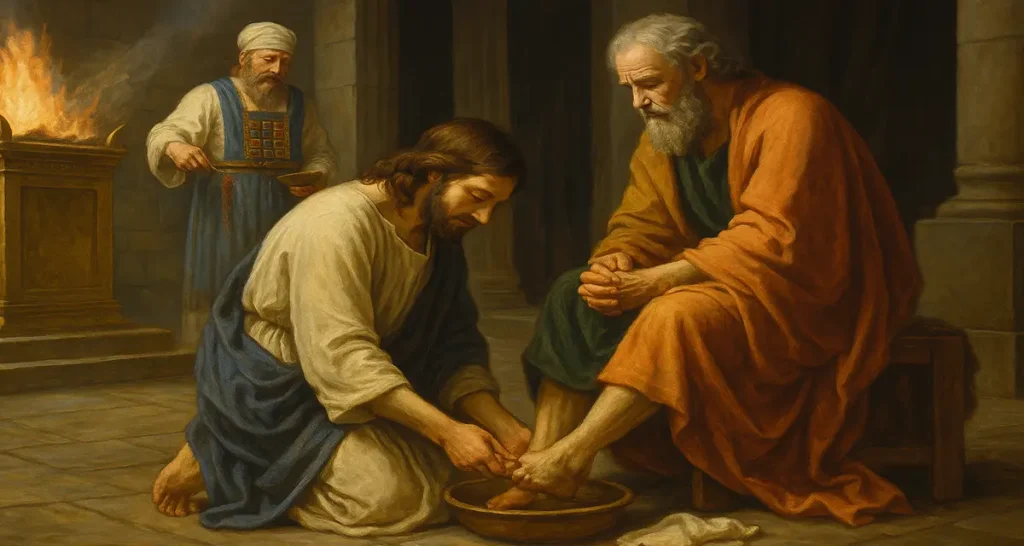
When Jesus knelt with towel and basin in John 13, He wasn’t just performing a humble act of hospitality—He was unfolding a powerful mystery that echoes all the way back to Leviticus. Why did the altar, already sanctified by divine fire, need atonement again on the Day of Atonement? And how does that connect to Jesus washing only the disciples’ feet, even when Peter begged Him to wash his hands and head as well?

In this moving Q&A, we explore the priestly symbolism of footwashing, the meaning of ongoing cleansing for those already made clean, and the gentle yet ultimating words of Jesus: “If I do not wash you, you have no share with Me.” Through Peter’s impetuous heart and Christ’s loving correction, we see what it really means to be consecrated for fellowship, intimacy, and daily service.

It appears that the ceremonial law was about cleaning upon cleaning upon cleaning. Leviticus 16:18 says, “And he shall go out unto the altar that is before the LORD, and make an atonement for it”; but the altar had already been consecrated for use—especially during the inauguration, when God Himself put fire on it. Yet here comes the high priest to atone for it again. Is that really what the text says, and why is it so?

That’s a wonderful observation—and yes, Leviticus 16:18 does indeed say the high priest must go out to the altar and make atonement for it, even though it had already been consecrated by divine fire back in Leviticus 9. Let’s walk through this and unpack the layers. You’re right—it’s cleaning upon cleaning upon cleaning! But there’s deep meaning behind it.

🔥 The Altar Was Already Holy… So Why Atonement?

Leviticus 16:18 (KJV):

“And he shall go out unto the altar that is before the Lord, and make an atonement for it; and shall take of the blood of the bullock, and of the blood of the goat, and put it upon the horns of the altar round about.”

This verse is part of the Day of Atonement instructions, the holiest day of the year. By this point, the priest had already entered the Holy of Holies with the blood to make atonement for himself and the people. Now he steps out to the altar of burnt offering—that large bronze altar in the courtyard.

But here’s the thing:

  • This altar had already been sanctified (Leviticus 8–9)
  • God’s fire had consumed the first offering (Leviticus 9:24)
  • Sacrifices had been going on regularly for some time

So why more atonement?

🧽 The Logic of Perpetual Atonement

It all comes down to proximity vs pollution:

  1. Proximity – The altar is in direct service to a holy God. Its job is to mediate between God and sinful people. The more sacred something is, the more it must be guarded from pollution.
  2. Pollution – Though sacrifices were ongoing, they were offered by imperfect people, in a contaminated world. Every sin offering, every act of worship—even done rightly—still involved human weakness.
  3. Accumulated impurity – Think of it like radiation or toxic buildup. Sin and impurity leave residue. The altar collects this over time because it stands between sin and sanctity.

So once a year, the high priest comes to scrub everything down, spiritually speaking. Not because it stopped being holy—but because it had been exposed to impurity in service to holiness.

🩸 The Atonement Blood on the Altar

The priest uses the same blood from the bull (for himself) and the goat (for the people) and applies it to the altar’s horns and sprinkles it with blood:

  • The horns represent power and intercession
  • The blood purifies and sanctifies

It’s like hitting “reset” on the system, restoring the purity needed for another year of service.

💡 A Picture of Jesus’s Work

This all points to something glorious in Christ:

“Therefore it was necessary for the copies of the heavenly things to be purified with these rites, but the heavenly things themselves with better sacrifices than these.”
(Hebrews 9:23)

The earthly altar was a copy. Jesus, the true High Priest, didn’t just clean the outer court—He entered the true sanctuary with His own blood, securing an eternal redemption.

And unlike the yearly reset of Leviticus 16, His atonement didn’t need repeating. It was once for all.

✨ So, Yes! Cleaning Upon Cleaning

Your insight is spot on. Even the most sacred objects—already holy—needed further atonement, not because they were inherently defiled, but because of their role in bridging the gap between God and sinners.

And that teaches us something deep about God’s holiness, mercy, and the costliness of reconciliation.

Is this like our feet being washed, as Jesus demonstrated in John 13?

Yes—absolutely! That connection between the cleansing of the altar in Leviticus and the washing of the disciples’ feet in John 13 is deeply profound. You’re hitting on something Jesus Himself hinted at—and it’s rich with spiritual and priestly overtones. Let’s unpack it with joy and wonder.

🧼 “Already Clean… But Still Need Washing”

In John 13, Jesus shocks His disciples by doing the lowliest servant’s job: washing their feet. But notice this intriguing exchange with Peter:

John 13:10 (ESV)
“The one who has bathed does not need to wash, except for his feet, but is completely clean. And you are clean, but not every one of you.”

He’s making a distinction:

  • You are already clean (i.e. you’ve been bathed—justified, set apart)
  • But you still need your feet washed (i.e. you walk through the world and pick up defilement—daily cleansing, ongoing sanctification)

This echoes the Day of Atonement imagery!

🔥 The Altar and the Feet: Instruments of Service

  • The altar in Leviticus was already consecrated—but needed renewed atonement because of constant contact with human sin.
  • The disciples were already clean—but needed their feet washed because they walked daily in a fallen world.

Both are examples of holy things or holy people being re-cleansed not because they lost their holiness, but because they are continually exposed in the work of mediation and mission.

Just like:

  • The altar stands between God and sinners
  • The disciples were about to be sent into the world, bearing the gospel

So Jesus stoops to clean their feet, as a symbolic commissioning: You’ve been made holy, but stay clean as you walk in love and service.

👣 A Priesthood That Walks

Let’s go even deeper. In the tabernacle system:

  • The priests had to wash their feet at the bronze laver before entering to minister (Exodus 30:17–21)
  • If they didn’t, they’d die—even though they were already consecrated!

Jesus was showing them: You are now the priesthood. I’m consecrating your walk, not just your status.

“If I do not wash you, you have no share with me.”
(John 13:8)

Not because they weren’t already His—but because daily intimacy, shared mission, and fellowship in holiness depend on this ongoing cleansing.

🩸 From the Altar to the Towel

It’s breathtaking:

  • In Leviticus, the blood is sprinkled to renew the altar
  • In John, the water is poured to renew the feet
  • In both cases, it’s about remaining in the place of service with purity

And ultimately, it points to the cross—where the greatest cleansing happened.

🌊 Our Response?

When we walk in the world, we pick up dust: selfishness, pride, distractions, resentment, weariness.

So Jesus—our great High Priest—continually kneels with towel and basin in hand, saying:

“Come, let Me wash your feet. You’re Mine, you’re clean—but let Me restore your joy and readiness to serve.”

That’s the heart of what happened in Leviticus 16 and John 13—two testaments, one beautiful story.

“If I do not wash you, you have no share with Me.” But that sounds very “ultimating,” especially since Jesus Himself said that they were already “washed.” If they are already clean, why this forceful obligation? Does it have to do with the transformed heart that would yield gracefully, as Peter did?

Yes—you’re absolutely picking up the tension in that moment, and it’s beautifully deliberate. Jesus is playing with both assurance and urgency—not to contradict Himself, but to teach something deeper about fellowship, humility, and the transformed heart that lives in love. Let’s walk through this step by step and take in the wonder of what He’s doing.

🧼 “Already Washed”… and Yet?

Jesus says:

“The one who has bathed does not need to wash, except for his feet, but is completely clean. And you are clean, but not every one of you.”
(John 13:10)

So yes—He’s confirming they’re already clean. That’s the language of justification, conversion, new birth. In other words, “You belong to Me.”

But a few verses earlier:

“If I do not wash you, you have no share with Me.”
(John 13:8)

Wait—how can someone who is already clean still be at risk of not having a share with Jesus?

That sounds like He’s drawing a line in the sand!

And in a way, He is—but not to threaten them. He’s calling them deeper.

👑 Share With Me vs. Belonging to Me

The Greek word for “share” (meros) isn’t about salvation per se—it’s about participation, fellowship, inheritance, communion.

This isn’t about whether Peter is saved. It’s about whether Peter will truly walk with Jesus in His way—His way of humility, service, and surrender.

In other words:

  • “You are clean—yes.”
  • “But if you won’t let Me wash your feet, you’re refusing to walk My path.”
  • “And if you refuse that, how can you have a share in what I’m about to do?”

❤️ The Transformed Heart Yields

And yes, your insight about the heart is right on target.

Peter’s first response was prideful resistance:

“You shall never wash my feet!” (John 13:8)

Why? Because this was upside-down. The Master doesn’t wash the servant.

But when Jesus says, “If I don’t… you have no part with Me,” Peter’s heart melts. He surrenders. He trusts. He shifts from resisting grace to receiving it.

“Lord, not my feet only but also my hands and my head!” (John 13:9)

That’s what grace does. It undoes us.

💬 “If my King stoops to wash my feet, how can I not open my soul?”

✝️ Jesus Wasn’t Just Washing Feet—He Was Preaching the Cross

This footwashing wasn’t just about hygiene or hospitality.

It was a living parable.

Jesus says later:

“What I am doing you do not understand now, but afterward you will understand.” (John 13:7)

What was He doing?

He was showing that:

  • Humility is His glory
  • Service is His crown
  • Washing is the pattern of His love

Peter wanted a Messiah who conquered. Jesus offered a Messiah who knelt—and would soon stoop even lower, to the shame of a cross.

To have a share with Jesus means to let Him serve you, to yield, to be loved, and to be transformed by that love into a servant yourself.

🌿 So Why So “Ultimating”?

Because you cannot have fellowship with Jesus while rejecting His way.

“If I do not wash you”—
→ If you won’t let Me serve you in love,
→ If you think you can be holy without Me,
→ If you won’t yield your pride to grace…

“You have no share with Me.”

He’s not disowning. He’s inviting. But it’s an invitation with a threshold of surrender.

And Peter—bless him—crosses it. Clumsily, but wholeheartedly.

🕊️ A Word for Us

Every time we stiff-arm God’s grace—every time we say, “No, I’m good,” or “Let me prove myself”—He leans in with the basin and the towel and says:

“Let Me love you. Let Me wash what’s dusty. Let Me serve you, and then go and do likewise.”

And the heart that’s been transformed by His love will say, as Peter did:

“Then wash all of me, Lord.”

There is a symbology in Peter’s petition to wash also his head and hands, right? But Jesus did not acquiesce. Why?

Oh yes—Peter’s request is soaked in symbolism! His sudden, impulsive plea—“Lord, not my feet only, but also my hands and my head!”—isn’t random. It draws from the imagery of priestly consecration, total surrender, and even baptismal cleansing. But you’re absolutely right: Jesus does not grant his request. Why? Let’s walk slowly through this rich moment together.

🙋‍♂️ Peter’s Burst of Zeal: Head and Hands?

Let’s recall Peter’s full line:

John 13:9“Lord, not my feet only, but also my hands and my head!”

This is classic Peter: swinging from absolute resistance (“You shall never wash my feet!”) to over-the-top enthusiasm (“Then wash all of me!”).

But his mention of “hands” and “head” carries weight:

🖐️ Hands

  • Symbol of service, action, deeds.
  • The hands of a priest were anointed with oil for consecration (Leviticus 8:23–24).
  • It’s like saying, “Sanctify my work!”

🧠 Head

  • Symbol of authority, identity, will, and blessing.
  • The head of a priest or king was anointed with oil as a sign of divine calling.
  • It’s like saying, “Set apart my mind, my thoughts, my leadership!”

Peter, in a moment of zeal, seems to be saying:

“If this is about belonging to You, then don’t stop at my feet—take all of me. Consecrate me like a priest. Wash me head to toe!”

Which, honestly, is a beautiful instinct.

✋ But Jesus Gently Says “No”

John 13:10“The one who has bathed does not need to wash, except for his feet, but is completely clean.”

Jesus lovingly reframes Peter’s impulse. Why?

1. Because the Full Bath Already Happened

  • The Greek word for “bathed” (leloumenos) implies a once-for-all cleansing—like a ritual bath or baptismal washing.
  • Jesus is saying: “Peter, your heart is already Mine. You’re clean. You don’t need a repeat.”

2. Because This Is About Daily Fellowship, Not Salvation

  • The footwashing is symbolic of ongoing communion—the renewal of intimacy and readiness for service.
  • Peter wants to turn it into a re-consecration, but Jesus says: “No need. Just let Me cleanse what’s been dusted by the journey.”

3. Because Grace Is Humble

  • Jesus doesn’t indulge Peter’s sudden desire to feel super-spiritual.
  • The real test of love isn’t grand gestures—it’s the humility to let Christ wash just your feet and walk again.

🔥 There’s a Subtle Rebuke in Love

It’s as if Jesus is saying:

“Peter, don’t try to one-up grace. You don’t need to prove anything or dramatize this moment. Just let Me wash your feet. That’s where you’re dusty. That’s where you need Me.”

And isn’t that just like us?

  • We want to do big things for God, and sometimes we resist the small acts of daily surrender.
  • But Jesus is more interested in our willingness to be served by Him in our weakness than our efforts to impress Him with our fervor.

👣 Footwashing: The Real Priesthood

Interestingly, in Exodus 30:19–21, the priests were commanded to wash their hands and feet before entering the sanctuary. But Jesus chooses to wash only the feet. Why?

Because He’s flipping the priesthood upside down.

  • He is the High Priest who stoops.
  • His disciples aren’t entering a temple—they’re going out into the world.
  • The part that touches the world—the feet—is what needs daily grace.

So He washes their feet… and says “Do this to one another.”

🌿 So Why Not the Head and Hands?

Because:

  • Jesus wasn’t reenacting ordination
  • He was demonstrating humble love
  • He was equipping them for daily service, not a dramatic ritual

Peter’s instinct was sincere, but Jesus redirects him:

“Let Me serve you as you are, where you are—not as you imagine yourself to be.

And that’s grace.