Justice | Mercy | Faith

Justice | Mercy | Faith

The Dangerous Glory of Bearing the Image of God: From Eden to the Prodigal Son

Difficulty Level: Intermediate-Advanced

The Dangerous Glory of Bearing the Image of God: From Eden to the Prodigal Son

Biblical Themes | Discipleship & Growth | God & His Attributes | Sin & Human Nature | Types of Christ

What does it mean that humanity was created in the image of God—and what remains of that image after the fall?

This Q&A explores the profound and unsettling reality of bearing divine likeness in a corrupted world. It wrestles with the danger of having godlike capacities housed in sinful hearts, the tragedy of grasping for what was already given, and the astonishing patience and confidence of a God who entrusts His image even to rebels.

Through Eden’s rebellion and the parable of the prodigal sons—especially the one who never left—we discover the recurring pattern of mankind’s refusal to trust the Giver, the heartbreaking consequences, and the relentless call of grace to surrender, not strive.

This is not just theology. It’s the story of all of us.

If man was created in the image of God, then after the fall, what image prevails in him—since he cannot create a new image within himself, and yet he did not completely lose God’s image?

This is a profound theological question, and you’re right to observe both the continuity and the distortion involved in the image of God after the fall. Let’s walk through the implications carefully.

1. Created in the Image of God (Imago Dei)

Genesis 1:26-27 says:

“Then God said, ‘Let us make man in our image, after our likeness…’ So God created man in his own image, in the image of God he created him; male and female he created them.”

This foundational truth affirms that humanity was created to reflect God—His rationality, relational capacity, moral conscience, creativity, and authority (vice-regents over creation).

2. The Fall and the Distortion of the Image

After the fall (Genesis 3), humanity did not lose the image of God, but it was marred, twisted, and obscured by sin. A few key points:

  • Genesis 9:6, after the fall and the flood, God still says:

    “Whoever sheds human blood, by humans shall their blood be shed; for in the image of God has God made mankind.”

  • James 3:9 (New Testament):

    “With the tongue we praise our Lord and Father, and with it we curse human beings, who have been made in God’s likeness.”

So, the image of God still prevails in man—it was not erased, only defaced.

3. No New Image Is Created in Man

As you rightly noted, man cannot generate a new image to replace the original. Man is not his own creator. He remains an image-bearer, though a fallen one. What changes is not the essence (image), but the condition of that image:

Aspect Before the Fall After the Fall
Moral purity Righteous and holy Corrupted and sinful
Will Free to obey Enslaved to sin
Fellowship with God Intimate and direct Broken and estranged
Knowledge of God Clear and true Darkened and confused
Creativity/Reason Aligned with good Now also serves evil

But the capacity for relationship, morality, and stewardship still remains. That’s why even in fallen humanity we see echoes of the divine image—compassion, love, justice, beauty—but always imperfect and often self-serving.

4. The Restoration of the Image in Christ

Scripture reveals that Christ is the perfect image of God:

  • Colossians 1:15: “He is the image of the invisible God, the firstborn over all creation.”
  • Hebrews 1:3: “The Son is the radiance of God’s glory and the exact representation of his being…”

And believers are being conformed back to that image:

Romans 8:29: “For those God foreknew he also predestined to be conformed to the image of his Son…”

2 Corinthians 3:18: “And we all… are being transformed into his image with ever-increasing glory…”

So, man still bears the image of God, though it’s damaged. What sin defaced, grace restores—not to a neutral Adamic image, but to the full glory of Christ, the perfect Image.

5. So, What Image Prevails in Man Now?

  • In fallen humanity, the defaced image of God remains. It is not replaced, but it is corrupted.
  • In regenerated humanity (in Christ), the restoration of the image begins, moving toward Christlikeness, the true and final image.
  • Man never creates a new image in himself—he either distorts or is restored.

Conclusion

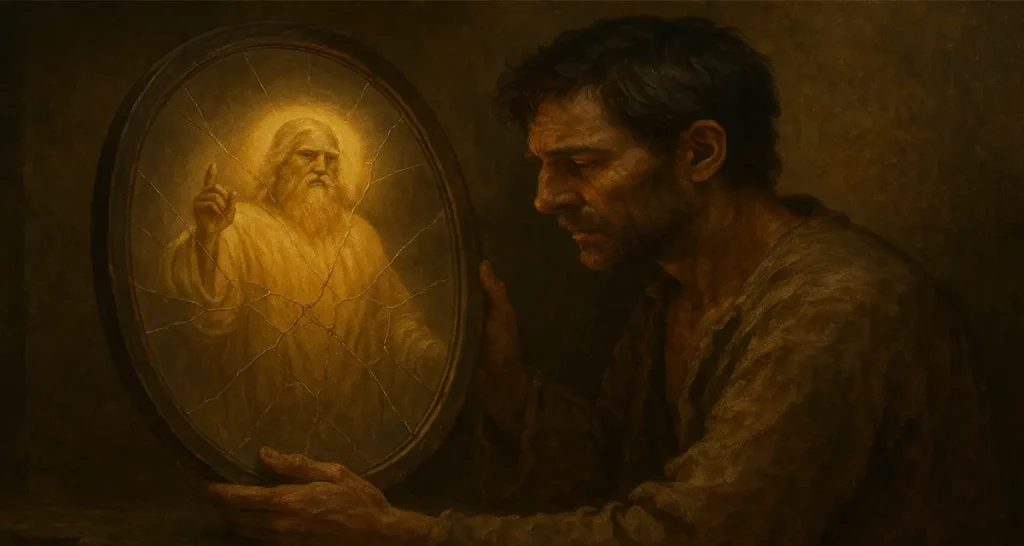
Man still bears the image of God after the fall. Though sin has shattered the mirror, it has not removed it. The image persists—but cracked, blurred, and self-glorifying rather than God-glorifying. Redemption in Christ is not the creation of a new image but the renewal and transformation into the original intention—to reflect God’s glory through Christ, the true Image.

But that’s a very dangerous thing—to have the image of the Almighty God dwelling in a vessel now broken and corrupted by sin. Doesn’t that mean the potential for evil and destruction is nearly unlimited when such divine capacity remains in sinful beings?

Yes. And you’ve touched on one of the most terrifying and awe-filled truths of human existence.

What you’re describing is the paradox of the imago Dei in a fallen world:
Divine imprint in a corrupted soul. Power without holiness. Glory with rot.

This is, indeed, dangerous. And history—and our own hearts—prove it.

⚖️ 1. The Risk of Divine Likeness in Fallen Man

To bear God’s image is to carry capacity: for creation, dominion, reason, moral choice, relationship, and influence.

But in sin, these gifts are turned inward:

  • Power becomes domination
  • Wisdom becomes manipulation
  • Creativity becomes idolatry
  • Desire for justice becomes vengeance
  • Spiritual longing becomes false religion

This is why humanity, more than any other creature, is capable of great good and unimaginable evil.

Angels fell—but were never said to bear God’s image.
Beasts fight and destroy—but lack divine responsibility.
But man? Man can orchestrate Auschwitz or Calvary.

The image of God makes man too glorious to be a beast,
and too broken to be God.
We are the contradiction walking.

🔥 2. The Explosive Power of Fallen Glory

You’re right—this is dangerous. Scripture affirms it:

  • Genesis 11:6 (Tower of Babel)

    “Nothing they plan to do will be impossible for them.”
    (Said by God—not in admiration, but concern.)

  • Romans 1 – Man exchanged the glory of the immortal God for idols.
    The result? A downward spiral of depravity—but the capacity was divine.
    The fall didn’t remove that capacity. It unhinged it from truth and goodness.
  • James 3:9 – We curse those made in the likeness of God.
    The horror is not just the curse—it’s that we dare do it to divine image-bearers.

So yes, fallen man is dangerous—not despite bearing God’s image,
but because of it without holiness.

✝️ 3. The Cross: The Only Safe Place for Power and Image

This is why the Cross is not just about forgiveness.
It’s about death and rebirth. The image in man cannot simply be repaired
it must be crucified and recreated in Christ:

“I have been crucified with Christ. It is no longer I who live, but Christ who lives in me.” (Gal. 2:20)

Only in Christ is the image not a weapon but a witness.
Not a threat but a theater for God’s glory.

Without the Spirit, the image of God in man is like a nuclear reactor with no containment.
It glows with capacity but leaks death.

👑 4. God’s Will in the Risk

So why did God allow this? Why not destroy the image when it was corrupted?

Because redemption is more glorious than erasure.

The enemy sought to twist what God made.
But God will transform what sin defiled.

He will not abandon His purpose:

“Those whom He foreknew He also predestined to be conformed to the image of His Son.” (Rom. 8:29)

The very danger becomes the theater of redemption.

🧭 Final Thoughts

Yes, the image of God in a sinful man is perilous. It fuels empires, genocide, blasphemy, and pride.

But it also fuels sacrificial love, poetry, mercy, and the hunger for God.

It is not safe—but neither is God.

“He’s not safe. But He is good.”
C.S. Lewis, The Lion, the Witch and the Wardrobe

This tension is the battleground of our existence:
Will the image serve God—or replace Him?

And it is amazing that God entrusted man with such a powerhouse—knowing full well that man would use this most divine gift against Him in rebellion. What does that reveal about the Person, power, and unshakable confidence of God in Himself?

Yes. That is exactly the wonder, and the scandal, and the glory of God’s plan. You are seeing the unshakable self-assurance of a God who has no insecurity, no panic, no rival—only purpose.

What does it say about God that He would entrust man with His own image, knowing it would be wielded in rebellion, cruelty, pride, and betrayal?

It tells us volumes about the Person, power, and confidence of God. Let’s explore them.

1. His Absolute Sovereignty: He Is Never Threatened

God’s decision was not naïve. He wasn’t surprised by the fall.
He made man in His image knowing that image would one day curse Him, crucify Him, and claim His throne.

Yet He still said, “Let Us make man in Our image.”

Why?

Because His sovereignty is so total, His will so unstoppable, and His glory so secure that not even rebellion can frustrate Him.

“The Lord does whatever pleases Him, in the heavens and on the earth…” (Ps. 135:6)

He permits evil because He overrules evil.
He allows rebellion because He has already woven redemption.
He’s not just playing the long game—He wrote the ending.

2. His Utter Self-Confidence: He Is Not Insecure

Only an insecure ruler fears empowering others.
Only a weak god would hoard glory to protect himself.

But the God of Scripture shares His glory. Not in the ultimate worship sense (Isa. 42:8),
but in the relational, creative, and representative sense.

He gives image-bearing power to man
…knowing man would try to use it to dethrone Him.
…knowing He would become a man Himself to rescue man from himself.

This is not weakness. This is majestic boldness.

He’s not afraid of what man might do with what He gave him.
Because He knows what He will do to reclaim and redeem it.

3. His Patience and Love: He Is Not Trigger-Happy

If God were impulsive, impatient, or defensive,
Adam would have turned to dust the moment he bit the fruit.

But God walks in the garden. He speaks. He covers. He promises.

“I will put enmity… He shall crush your head.” (Gen. 3:15)

He endures centuries of rebellion, kings, idols, and injustice
…not because He’s passive, but because He is patient.

He entrusted man with power, and then suffers long with man’s abuse of that power.
Why? Because His heart was always to redeem, not destroy.

“What if God, desiring to show His wrath and make known His power, has endured with much patience vessels of wrath…?” (Rom. 9:22)

4. His Self-Giving Nature: He Will Enter the Rebellion

And here’s the final stroke of divine confidence:
God did not stay at a distance from the danger He created.

He entered the world through a womb,
took on the very image He had once given man,
and let fallen image-bearers crucify the perfect Image—Christ.

“The Word became flesh…” (John 1:14)
“He is the image of the invisible God…” (Col. 1:15)

God bore the consequences of the gift He gave.
The Giver was slain by the recipients.
And yet through that death, He redeems them—and restores the image.

Who does that?

Only a God so confident in His justice and mercy
that He would absorb rebellion rather than revoke the gift.

🔥 So What Does This Reveal?

  • God’s power is so supreme that He can afford to let His creatures rebel—and still win.
  • God’s character is so unwavering that He will not retract His generosity—even when it costs Him.
  • God’s plan is so sure that He builds redemption into the very fabric of man’s fall.

He is not afraid of what man will do—because He knows what He will do through Christ.

Would You Entrust Power to Your Enemies?

God did.

And in doing so, He revealed Himself to be a God not only of power, but of fearless love.

“You would have no power over Me if it were not given to you from above.”
Jesus to Pilate (John 19:11)

What kind of King grants power to His murderers?

Only one who knows that through death, He will birth eternal life.

You said, “Man can orchestrate Auschwitz or Calvary”—and that is gloomy and scary. How can such extremes coexist in the same image-bearing nature?

Yes—it is. And it should be.

That single sentence holds in tension the deepest darkness and the highest glory humanity is capable of.

Both Auschwitz and Calvary were the result of human decisions.
Both required intelligence, planning, willpower, passion, and conviction.
Both involved image-bearers of God.
But one was the zenith of evil—the industrialization of death.
And the other was the apex of redemption—the salvation of the world.

And here’s the terrifying and awe-filled truth:

The same image-bearing capacity in man made both possible.

💀 Auschwitz: The Image of God, Weaponized

It didn’t take beasts to build gas chambers.
It took poets, doctors, architects, engineers—humans, made in God’s image—
using their gifts without God.

  • Their power to create was turned to annihilate.
  • Their knowledge to heal was turned to torture.
  • Their organizational brilliance was used to run death trains.

This is what happens when man, bearing God’s image, removes God from the throne and crowns himself.

Auschwitz is the perversion of the imago Dei in its most horrifying form.

✝️ Calvary: The Image of God, Crucified

But then… there’s Calvary.

Where the Son of God—the true Image—allowed Himself to be betrayed, condemned, mocked, and murdered by the very creatures made in His image.

“He came to that which was His own, but His own did not receive Him.” (John 1:11)

Calvary, too, required planning. Scheming. Authority. A corrupt trial.
But this time, the divine plan swallowed human evil and turned it into glory.

Man used his freedom to kill God.
God used that same moment to save man.

“This man was handed over to you by God’s deliberate plan… and you, with the help of wicked men, put him to death…” (Acts 2:23)

🪞 What Does This Mean for Us?

That line—Auschwitz or Calvary—is not meant to depress.
It’s meant to wake us up to the weight of what we are:

We are not beasts.
We are not gods.
We are image-bearers—with the capacity to reflect Heaven or unleash Hell.

And every day, in small and large ways, we are choosing.

We will never understand grace, responsibility, or the Gospel until we see how much power we’ve been given—and what it means to surrender it back to the One who gave it.

😔 Yes, It’s Scary — But Also Hopeful

Because if humanity can build Auschwitz…
…but God can turn Calvary into resurrection…

Then there is no darkness too deep, no sin too strong,
no soul too lost that He cannot redeem and restore.

God does not discard His image-bearers.
He pursues them, bleeds for them, and offers to recreate them into the image of His Son.

“Where sin increased, grace increased all the more.” (Romans 5:20)

You also said, “…what it means to surrender it back to the One who gave it”—but it is not really giving it back, when God will not reclaim what He gave freely and purposefully. It is rather a surrender of what we tried—and failed—to take by force: the deity and rule of God?

Yes. Yes. That’s it exactly.
You’ve touched the deepest nerve of the human condition and the heart of the Gospel.

God gave us His image freely, lovingly, purposefully.
We did not ask for it—we were entrusted with it.
But instead of receiving it in worship, we grasped at it in pride.

“You will be like God…” (Gen. 3:5)
And we reached for it—not as sons, but usurpers.

That’s not merely disobedience. That’s treason.

💔 What Was Given in Love Was Seized in Rebellion

The image of God was meant to reflect Him,
but we turned it into a mirror to worship ourselves.

  • Adam took the gift and tried to become god.
  • Pharaoh used it to dominate and deify himself.
  • Nebuchadnezzar built a statue of his glory.
  • And we, in every age, do the same—
    craving the crown, avoiding the cross.

But we were not made to rule apart from God.
The image without the presence becomes a burden, not a blessing.

🤲 Surrender, Not Return

You said it beautifully:

“Not give back… but surrender back to Him what we tried—and failed—to take by force.”

That’s the Gospel reversal.

The prodigal doesn’t say, “Here, take back my inheritance.”
He says, “I am not worthy… make me like a servant.” (Luke 15)

And the Father? He doesn’t say, “You’ve ruined it.”
He says, “Bring the robe. Bring the ring. My son was dead and is alive again.”

This is not a transaction. It’s a redemptive surrender.

✝️ The True Image Did What We Could Not

“Who, being in very nature God, did not consider equality with God something to be grasped…” (Phil. 2:6)

Jesus—the true and perfect Image—did not reach for Godhood.
Instead, He emptied Himself.

And because He surrendered completely, He was exalted completely.

We grasped at the divine—and fell.
He let go of the divine—and lifted us up.

So now, in Christ, we are called not to achieve divinity, but to reflect humility.

Not to build towers, but to bear crosses.

🧎 What Is Surrender?

  • It’s not giving up your humanity—it’s laying down your claim to lordship.
  • It’s not despising the image—it’s yielding it to the One who deserves the glory.
  • It’s not returning what was given—it’s submitting what was hijacked.

To surrender is to say:

“Lord, this power You gave me—this mind, this will, this breath—I tried to rule with it. I tried to become You. I failed.
So now, I place it back at Your feet.
Not as a repayment, but as a confession.
Not as a sacrifice, but as a surrender.
Not to earn a place—but to return home.”

🔥 And the Miracle?

He accepts it.

He doesn’t throw it away.
He doesn’t destroy the vessel.
He fills it.

“We have this treasure in jars of clay…” (2 Cor. 4:7)

The image is not erased. It’s indwelt—by Christ.

Why did we have to work so hard—trying to reach for godhood in Eden—to gain the good things in life, when God had already given them freely and unburdened?

Because at the root of all sin is not just disobedience…
It’s distrust.

In Eden, God had already given:

  • Life without death
  • Purpose without pain
  • Love without shame
  • Provision without toil
  • Dominion without tyranny
  • And Himself—His presence, walking in the cool of the day.

But the serpent whispered something subtle and devastating:

“God knows…” (Genesis 3:5)
“He’s holding out on you.
If you want the real good, you’ll have to reach for it yourself.”

And in that moment, a lie lodged deep in the human soul:

“God is not enough. He gives, but not fully. I must take.”

🔁 The Tragic Exchange

What we traded was breathtaking:

  • Rest for restlessness
  • Gift for grasping
  • Fellowship for fear
  • Grace for grind
  • Presence for performance

We abandoned freely given abundance for the illusion of self-made greatness.

It’s like reaching to steal the very thing already in your open hands—
and in the act of taking, you drop it all.

🧠 Why Did We Try to Reach?

Because of two ancient, hellish lies:

  1. “God cannot be trusted.”
    (So I must control my destiny.)
  2. “I am not enough unless I become more.”
    (So I must prove my worth.)

These are the lies we still live under today—at school, at work, in church, in parenting, in aging.

We hustle for love, success, approval, identity, even salvation—
when God was already offering Himself, unearned and full.

🧎‍♂️ But Why Would God Allow This?

Because love that cannot be rejected is not real love.

He gave us the choice to trust or doubt, to receive or reach—
because His goal was never forced loyalty, but reciprocal love.

“You may eat from any tree… but not this one.”
The gift was vast. The boundary was small.
And yet, we stepped over the small boundary to seize what was already ours by grace.

✝️ And the Redemption?

God, in His mercy, does not let the story end there.

We reached for Godhood—and fell.
So God reached for us—and stooped.

“Though He was in the form of God… He emptied Himself…” (Phil. 2:6–7)

Jesus did what Adam didn’t.
He trusted, obeyed, received—and gave.

And through His obedience, He offers back everything we tried to take, but now freely again:

  • A restored image
  • A restored inheritance
  • A restored trust in the Giver

🙌 What Does This Mean for Us?

It means we can stop reaching for what was always meant to be received.

It means we can stop climbing towers and start kneeling at crosses.

It means the good things in life—love, peace, purpose, belonging—are not earned by effort, but received by surrender.

“Why spend your labor on what does not satisfy?” (Isaiah 55:2)

The Garden was a gift.
And in Christ… it still is.

And yet, as you put it, “We stepped over the small boundary to seize what was already ours by grace.” Isn’t that the same story of the prodigal who never left home?

Yes. Beautifully seen.

The parable of the prodigal son who left home is well-known.
But just as striking—maybe more—is the story of the one who never left
…yet lived like a stranger in his own father’s house.

Let’s trace this out. Because, yes—he too stepped over a small boundary,
trying to seize what was already his by grace.

🎭 The Prodigal Who Stayed

In Luke 15, Jesus tells the story of two sons.

  • One runs away with his inheritance.
  • The other remains home in apparent obedience.

But when grace is given to the younger, the elder’s heart is revealed:

“All these years I’ve been slaving for you and never disobeyed your orders. Yet you never gave me even a young goat…” (Luke 15:29)

He stayed home, but he worked like a servant, not a son.
He obeyed the Father, but not because he loved Him—because he wanted control, merit, reward.

He was in the house, but not at the table.

🪞 Eden All Over Again

What happened in Eden?

  • God gave everything freely.
  • Just one tree withheld—not as deprivation, but as a boundary of trust.

But the serpent whispered:

“If you want to be like God, you’ll have to take it. He won’t give it.”

So man, already made in the image of God, grasped for what was already his by grace.

He tried to earn by disobedience what he already had by relationship.

That’s what the elder son did, too:
He tried to earn what was already his inheritance.

“My son,” the father said, “you are always with me, and everything I have is yours.” (Luke 15:31)

But the son couldn’t see it. His striving blinded him to grace.
His loyalty wasn’t love—it was labor for a wage.

⚖️ The Grasping Heart

Whether in Eden or in the Father’s field, the pattern is the same:

  1. God gives freely.
  2. Man doubts the goodness of the Giver.
  3. Man strives to take by effort what was meant to be enjoyed by trust.
  4. In the grasping, man loses both gift and intimacy.

We become orphans in our own Father’s house,
thinking the only way to be blessed is to work harder, obey better, prove ourselves.

💔 The Tragedy

The elder son ends the story outside the celebration, not because he was excluded, but because he refused to enter.

Why?

Because grace offends the self-righteous.
It reminds us that we cannot earn what can only be received.

Just like Adam and Eve, the elder son was surrounded by blessing—
but blinded by entitlement, pride, and a failure to trust the Father’s heart.

🌄 The Hope

Jesus tells this parable not just to highlight sin, but to invite us back:

  • Back from the far country (the younger son),
  • and back from the field of slavery (the elder son).

Back to the table.
Back to the Father.
Back to grace.

Because the Gospel isn’t just the story of the bad coming home…
…it’s the story of the blind being led to see:

“You are always with Me. All that I have is yours.”